A Social Capital Perspective on the Mentoring of
Undergraduate Life Science Researchers: An Empirical
Study of Undergraduate–Postgraduate–Faculty Triads
Melissa L. Aikens,
†* Sona Sadselia,
‡Keiana Watkins,
‡Mara Evans,
§Lillian T. Eby,
∥and Erin L. Dolan
¶†
Department of Biological Sciences, University of New Hampshire, Durham, NH 03824;
‡Department of
Biochemistry & Molecular Biology and
‖Department of Psychology, University of Georgia, Athens, GA 30602;
§
Department of Biology, University of North Carolina at Chapel Hill, Chapel Hill, NC 27599;
¶Texas Institute for
Discovery Education in Science, College of Natural Sciences, University of Texas at Austin, Austin, TX 78712
Submitted October 5, 2015; Revised March 14, 2016; Accepted March 14, 2016 Monitoring Editor: Nancy Pelaez
Undergraduate researchers at research universities are often mentored by graduate students or
postdoctoral researchers (referred to collectively as “postgraduates”) and faculty, creating a
mento-ring triad structure. Triads differ based on whether the undergraduate, postgraduate, and faculty
member interact with one another about the undergraduate’s research. Using a social capital theory
framework, we hypothesized that different triad structures provide undergraduates with varying
resources (e.g., information, advice, psychosocial support) from the postgraduates and/or faculty,
which would affect the undergraduates’ research outcomes. To test this, we collected data from a
national sample of undergraduate life science researchers about their mentoring triad structure and
a range of outcomes associated with research experiences, such as perceived gains in their
abili-ties to think and work like scientists, science identity, and intentions to enroll in a PhD program.
Undergraduates mentored by postgraduates alone reported positive outcomes, indicating that
post-graduates can be effective mentors. However, underpost-graduates who interacted directly with faculty
realized greater outcomes, suggesting that faculty interaction is important for undergraduates to
realize the full benefits of research. The “closed triad,” in which undergraduates, postgraduates, and
faculty all interact directly, appeared to be uniquely beneficial; these undergraduates reported the
highest gains in thinking and working like a scientist.
Article
gineering, and mathematics (STEM) education community. Undergraduates who participate in research realize a vari-ety of cognitive, behavioral, and affective outcomes, includ-ing the development of research and communication skills (Kardash, 2000; Zydney et al., 2002; Bauer and Bennett, 2003; Lopatto, 2004; Russell et al., 2007), increased ability to think and work like a scientist (Seymour et al., 2004; Hunter et al., 2007), the development of a scientific identity (Hunter et al., 2007; Adedokun et al., 2012; Robnett et al., 2015), increased scientific self-efficacy (Chemers et al., 2011; Robnett et al., 2015), and sustained or increased interest in graduate educa-tion in science (Zydney et al., 2002; Bauer and Bennett, 2003; Lopatto, 2004; Russell et al., 2007; Schultz et al., 2011; Eagan et al., 2013). The importance of undergraduate research ex-periences in the persistence and success of STEM students forms the basis for national calls to increase undergraduate research opportunities (e.g., American Association for the
INTRODUCTION
Undergraduate research experiences, during which students conduct research projects in faculty members’ laborato-ries, are highly valued within the science, technology,
en-*Address correspondence to: Melissa L. Aikens (melissa.aikens@unh .edu).
© 2016 M. L. Aikens et al. CBE—Life Sciences Education © 2016 The American Society for Cell Biology. This article is distributed by The American Society for Cell Biology under license from the author(s). It is available to the public under an Attribution–Noncommer-cial–Share Alike 3.0 Unported Creative Commons License (http:// creativecommons.org/licenses/by-nc-sa/3.0).
DOI:10.1187/cbe.15-10-0208
Advancement of Science [AAAS], 2011; National Research Council, 2003).
Mentoring is an integral element of the undergraduate research experience, and faculty mentorship has been pro-posed as an important factor for students to maximize the benefits of participating in research (e.g., Zydney et al., 2002; Taraban and Logue, 2012). However, the number of faculty available to mentor undergraduates limits the number of un-dergraduates who can participate in internship-style research experiences (Wei and Woodin, 2011). Graduate students and postdoctoral researchers, whom we refer to collectively as “postgraduates” to be consistent with prior research (Dolan and Johnson, 2010), often serve as mentors to undergradu-ate researchers in order to involve more undergraduundergradu-ates in research, especially at large research universities. Yet there has been little research on the effect of being mentored by a postgraduate. Initial research in this area suggests that post-graduates provide important forms of technical, psychoso-cial, and informational support to undergraduate research-ers (Dolan and Johnson, 2010; Thiry and Laursen, 2011) but also can influence undergraduates negatively by increasing pressure to work long hours, enhancing the sense of hierar-chy in lab groups, and varying in their abilities to mentor (Dolan and Johnson, 2010).
Postgraduates who mentor undergraduates at large uni-versities are themselves mentored by faculty members (Whiteside et al., 2007; Thiry and Laursen, 2011). This cre-ates a social structure that we refer to as a “mentoring triad” to distinguish it from dyadic mentoring, in which an un-dergraduate researcher is mentored directly by a faculty member. Social capital theory is useful for examining how mentoring triads function and how being in different triads may affect the outcomes undergraduates realize from partic-ipating in research. Social capital theory posits that beneficial resources are embedded in a person’s social network, and the value derived from a person’s social network is called “social capital” (Lin, 2001). A person’s social ties are con-sidered assets, because they may provide access to helpful resources, such as information about a job opening or influ-ence through a letter of recommendation (Lin, 2001). Thus, the more ties an individual has and the more beneficial those ties are with respect to offering information, advice, and in-fluence, the more social capital the undergraduate is able to accumulate.
Relationships with faculty are an important source of so-cial capital for undergraduates. Faculty serve as institutional agents, helping students find resources and make important connections within their institutions and disciplines (Crisp and Cruz, 2009; Stanton-Salazar, 2011; Eagan et al., 2013). Faculty also provide psychosocial support, such as encour-agement and sharing personal stories of struggle, which is thought to be important for encouraging students to persist in the face of difficulty (Crisp and Cruz, 2009). Undergrad-uates’ social capital in the form of ties to faculty is known to improve their academic and professional outcomes. For ex-ample, undergraduates’ interactions with faculty have been shown to predict their retention and persistence in higher ed-ucation (Pascarella and Terenzini, 2005) and their intentions to pursue graduate study (Eagan et al., 2013). For STEM un-dergraduate researchers, interactions with faculty have been linked to the socialization of students into science (Hunter et al., 2007; Thiry and Laursen, 2011) and the development of
a scientific identity (Carlone and Johnson, 2007), which is an important predictor of students’ intentions to pursue science research–related careers (Chemers et al., 2011; Estrada et al., 2011). Many of these studies have specifically focused on the benefits of research experiences for historically underserved students in science. Because there has been no quantitative study of the influence of mentoring triads on the outcomes of undergraduate researchers, we focus here on characteriz-ing the experiences of undergraduate life science researchers in general rather than with respect to undergraduates’ gen-der, race, ethnicity, or first-generation status.
Qualitative research indicates that social capital available to undergraduates through ties to postgraduates differs from social capital through ties to a faculty member (Dolan and Johnson, 2010). For example, undergraduates consider fac-ulty mentors to be helpful for answering “big picture” ques-tions (Dolan and Johnson, 2010; Thiry and Laursen, 2011), suggesting that faculty serve as agents for undergraduates to develop a broader conceptual understanding of their re-search. Undergraduates report that postgraduates are agents for information about the technical aspects of their research projects (Dolan and Johnson, 2010; Thiry and Laursen, 2011). We posit that, because of differences in social capital avail-able from postgraduates and faculty, undergraduates who differ in their connections to postgraduates and faculty members will realize different outcomes from participating in research. Undergraduates mentored by faculty alone may come to understand and value science research but receive insufficient day-to-day guidance on technical aspects of the work that limits their ability to produce results. This could reduce undergraduates’ motivation to continue in research and reduce their scholarly productivity (e.g., authorship on conference presentations or journal publications) and their competitiveness for graduate school. Undergraduates men-tored by postgraduates alone may develop technical skills but not a broader understanding of the purpose and value of the research, which may limit their interest in pursuing a research-related career (Estrada et al., 2011).
realize greater outcomes. For instance, regular communica-tion about the undergraduate’s research progress and pro-fessional development may help the undergraduate make both technical and conceptual progress in his or her research, which could lead to greater identification with the scientific community and enhanced scholarly productivity. Thus, both direct and indirect connections among members of a mentor-ing triad have the potential to influence the undergraduate’s outcomes. Understanding how mentoring triads contribute to the outcomes of undergraduate researchers is critical as we consider how to build capacity to effectively involve more undergraduates in research.
Mentoring triads have not been the focus of empirical studies to date. The prevalence of particular triads and the effects of triad structure on undergraduate outcomes are un-known. In addition, little is known about the effectiveness of postgraduate mentors compared with faculty mentors. In this study, we begin to address this knowledge gap by 1) characterizing the prevalence of different mentoring tri-ads at research universities, and 2) identifying the empirical associations, if any, between undergraduates’ membership in particular mentoring triads and the outcomes they realize from participating in research.
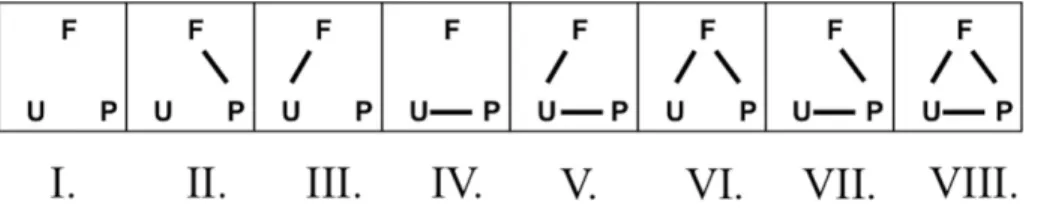
We first established which mentoring triads (Figure 1) are common at research universities, where undergraduates are likely to be mentored by postgraduates. We then docu-mented the outcomes of undergraduates in different triads, specifically, undergraduates’ reports of outcomes that are associated with participating in research: 1) ability to think and work like a scientist, 2) scientific self-efficacy, 3) scien-tific identity, 4) satisfaction with their research experience, 5) career and education preparation, 6) scholarly productivity, and 7) intentions to enroll in a STEM PhD program. Finally, we compared the outcomes of undergraduates in different triads to test hypotheses based on expected differences in the social capital available to undergraduates depending on their triad membership (Table 1). In the following sections, we describe each hypothesis and explain which triads we compared to test the corresponding hypothesis.
Mentorship by a Faculty Member
versus a Postgraduate
Undergraduate researchers with only one mentor may real-ize distinct outcomes depending on whether the mentor is a faculty member or postgraduate. For example, an under-graduate may report higher scientific identity following rec-ognition from a faculty mentor than a postgraduate mentor because he or she perceives the faculty member as more of a science expert or as better representing the scientific com-munity. In this case, the scientific identity of undergraduates in the faculty-only triads (triads III/VI) would be greater than those of undergraduates in the postgraduate-only triad
(triad IV). In contrast, an undergraduate’s ability to think and work like a scientist may be greater if mentored by a postgraduate than a faculty member, since postgraduates are more likely to spend more time mentoring undergraduates on day-to-day research activities. Here, the undergraduates in the postgraduate-only triad (triad IV) would report high-er gains in thinking and working like a scientist than those reported by undergraduates in faculty-only triads (triads III/VI). Although resources from faculty may be brokered through postgraduates, the quality of resources are thought
Figure 1. Possible mentoring triads among an undergraduate researcher (U), a faculty member (F), and a post-graduate (P).
triads not only benefit from direct interaction with faculty and postgraduate mentors but also from direct interaction between the postgraduate and faculty mentors. Discussions between the postgraduate and faculty mentors may yield better insight into what the undergraduate needs and how to help the undergraduate obtain it. If closed mentoring triads foster the development of trust among members and rein-force group norms, undergraduates could realize more posi-tive outcomes, such as greater scientific self-efficacy, scientific identity, and scholarly productivity. If so, the outcomes of un-dergraduates in the closed triad (triad VIII) should exceed the outcomes of undergraduates in all other triads.
Hypothesis 3. Undergraduates mentored by both a post-graduate and faculty member who themselves interact about the undergraduate’s research (“closed triad”) realize greater outcomes than undergraduates in all other triads (Table 1, panel 3).
Here, we present data that were collected as part of a larger study aimed at understanding mentoring of under-graduate life science researchers by postunder-graduates and fac-ulty. We focus on results that address the goals of this study: characterizing the prevalence of mentoring triads at research universities and identifying any relationships between un-dergraduates’ triad types and their outcomes.
METHODS
Participants
Participants were U.S. undergraduates who had completed at least one semester or summer of research in the life sciences in the past 2 yr and who reported previously or currently work-ing with a postgraduate and a faculty member in a research experience. We recruited undergraduates directly to mini-mize bias resulting from faculty choosing to respond about their best undergraduate researchers. We distributed study invitations with a link to the online survey to undergraduate researcher listservs maintained by universities or National Science Foundation–funded Research Experience for Under-graduates (REU) programs. We also recruited at the annual meeting of the Society for the Advancement of Chicanos and Native Americans in Science (SACNAS) and the Association of Biomedical Researchers Conference for Minority Students (ABRCMS). Recruiting was targeted to undergraduates at in-stitutions classified as having very high research activity and high research activity and at doctoral degree–granting insti-tutions to maximize the likelihood of identifying students mentored by postgraduates and faculty rather than by fac-ulty alone. All participants were offered a $20 cash incentive for participating. This study was approved by institutional review boards at the University of Georgia (MOD00000565) and the University of Texas at Austin (2014-06-0094).
A total of 842 undergraduates participated, represent-ing more than 50 institutions in more than 25 states; demo-graphic information for all student respondents are presented in Appendix A in the Supplemental Material. Approximately 2% of the participants were recruited through REU programs and responded about their REU experience; the vast majority of participants responded about research experiences offered through programs at their home institutions. Approximately 86% of the institutions in the data set are public institutions, to deteriorate as they are passed from one person to the next
(Baker, 1984; Baker and Iyer, 1992). Thus, if undergraduates in the postgraduate-only triad (triad IV) report less positive outcomes compared with undergraduates in faculty-only tri-ads (tritri-ads III/IV), outcomes of undergraduates in the triad missing the undergraduate–faculty tie (triad VII) would also be less positive.
Hypothesis 1. Direct mentorship by the faculty member versus the postgraduate leads to distinct outcomes (Table 1, panel 1).
Mentorship by Two Mentors versus One Mentor
Mentorship by both a postgraduate and a faculty mem-ber, compared with mentorship by solely a postgraduate or a faculty member, gives rise to two competing hypoth-eses. On the one hand, undergraduates with two ties may realize greater outcomes than undergraduates with one tie simply because they have access to more resources (Table 1, panel 2A). If so, the outcomes of undergraduates with ties to both a postgraduate and a faculty mentor (triad V) should exceed the outcomes of undergraduates with only a facul-ty mentor (triads III/VI) and undergraduates with only a postgraduate mentor (triad IV). In contrast, undergraduates mentored by both a postgraduate and a faculty member who do not communicate with each other about the undergrad-uate’s project may receive conflicting information or advice and thus realize lesser outcomes (Table 1, panel 2B). If so, the outcomes of undergraduates in faculty-only triads (triads III/VI) and the postgraduate-only triad (triad IV) would ex-ceed those of undergraduates with both a postgraduate and faculty mentor (triad V).
Hypothesis 2A. Undergraduates with two mentors realize greater outcomes than undergraduates with only one men-tor (Table 1, panel 2).
Hypothesis 2B. Undergraduates with two mentors realize lesser outcomes than undergraduates with only one mentor (Table 1, panel 2).
Mentorship by a Faculty Member and a Postgraduate
Who Communicate about the Undergraduate’s
Project (Closed Triad)
for students included in these analyses is outlined in Table 2. We collected few responses from students who identified as American Indian, Native American, African American, Native Hawaiian, Pacific Islander, Hispanic, or Latino/a. These stu-dent populations have been historically underserved by insti-tutions of higher education (Ladson-Billings, 2006). We com-bined these students into one category termed “underserved” 14% are Hispanic-serving institutions, and 3% are historically
black colleges or universities. The Carnegie classifications of the institutions at which responding students conducted their research are provided by triad type in Table 2. As explained below (see Mentoring Triad Type, Control Variables, and Data Analysis sections), some student responses are not included in the analyses presented here. Demographic information
Table 2. Characteristics of the undergraduate participants (n = 748) used in the analyses: overall and by triad typea
that items from the Thinking and Working Like a Scientist scale were highly correlated with items that measured gains in higher-order skills on the URSSA Skills scale. Therefore, we added one item from the Skills scale, “defending an argument when asked questions,” because we felt this was an essential higher-level skill for scientists. We conducted confirmatory factor analysis to ensure that the scale was functioning as a measure of Thinking and Working Like a Scientist with the additional item (see Appendix A in the Supplemental Materi-al for additionMateri-al details). Cronbach’s α for the nine-item scale was 0.90 (n = 785), indicating high internal consistency.
Scientific Self-Efficacy. We measured students’ scientific self-efficacy using the six-item Scientific Self-Efficacy Scale (Estrada et al., 2011), which asked students to rate their level of confidence (from 1 = not confident to 5 = very confident) to do scientific tasks, such as their ability to “generate a research question to answer” or “figure out what data/observations to collect and how to collect them.” This scale showed high internal consistency (n = 822; α = 0.90).
Scientific Identity. We measured student’s scientific identi-ty using the five-item Scientific Identiidenti-ty Scale (Estrada et al., 2011), which asked students to indicate their level of agree-ment (from 1 = strongly disagree to 5 = strongly agree) to items such as “I have a strong sense of belonging to the com-munity of scientists” and “I have come to think of myself as a ‘scientist.’” This scale showed high internal consistency (n = 811; α = 0.86).
Research Satisfaction. We measured undergraduates’ sat-isfaction with their research experience using a modified measure of an academic satisfaction scale (Volkwein and Carbone, 1994), which asked students to indicate their lev-el of agreement (from 1 = strongly disagree to 5 = strongly agree) with these three items: “I am satisfied with my re-search experience in general,” “I am satisfied with the extent of my intellectual development during my research experi-ence,” and “My research experience has had a positive in-fluence on my intellectual growth.” This scale showed high internal consistency (n = 835; α = 0.91).
Career and Education Preparation. We used six items to measure undergraduates’ perceptions of how well their re-search experience prepared them for a career or future ed-ucational pursuits. Undergraduates indicated their level of agreement (from 1 = strongly disagree to 5 = strongly agree) with five items from the URSSA (Hunter et al., 2009): “My research experience has prepared me for a job,” “Doing re-search has confirmed my interest in my field of study,” “Do-ing research has clarified for me which field of study I want to pursue,” “My research experience has prepared me for advanced coursework or thesis work,” and “My research experience has prepared me for graduate school”; and an additional item: “My undergraduate research experience has prepared me to succeed in an academic career.” We con-ducted confirmatory factor analysis to ensure that the scale was functioning as a measure of career and education prepa-ration with the additional item (see Appendix A in the Sup-plemental Material for additional details). These six items showed high internal consistency (n = 708; α = 0.89).
Scholarly Productivity. We asked students to report how many times (from 0 to 5+ times) they completed each of the in order to have a sufficiently large sample to conduct the
analyses presented here, but we recognize that there may be distinct and important differences among these populations. We categorized students as first-generation to go to college if they indicated that both their mother’s and father’s (or guardian’s, if applicable) educational level was “high school/ GED,” “some high school,” or “trade/technical school.”
Measures
We collected data via a survey administered through the online, secure, survey service Qualtrics. We queried each undergraduate about his/her mentoring triad and seven possible outcomes he or she could have realized from par-ticipating in research. Specific measures are described below, and the items for each outcome measure are included in Appendix A in the Supplemental Material.
Mentoring Triad Type. We presented the diagram (Figure 1) of all eight triad types to students and asked them to indi-cate which triad best represented their relationships with the postgraduate and faculty members with whom they worked. Based on preliminary analyses, we used only six of the eight mentoring triad types in the final analyses. We did not include the triads in which the undergraduate had no ties to the faculty and postgraduate mentors (Figure 1, triads I and II) due to low sample size (n = 1 and n = 10, respectively). Additionally, we combined the two triads in which the undergraduate is only connected to a faculty men-tor (Figure 1, triads III and VI, which we refer to as triads III/VI), because we thought it unlikely that postgraduates were passing social resources to the undergraduates through the faculty mentors in a way that would influence under-graduate outcomes. To ensure this was a valid assumption, we checked for significant differences between these two tri-ads for all outcomes but found no differences. Finally, we dropped students who chose “Other” or “Prefer not to re-spond” when asked to identify their mentoring triad (n = 11). To determine whether undergraduates accurately assessed the presence of a postgraduate–faculty connection of which they were not directly a part, we surveyed undergraduate participants’ postgraduate mentors about the mentoring tri-ads in which they work with an undergraduate and faculty member (n = 511). Of the postgraduates who reported a post-graduate–faculty tie, ∼90% of their undergraduate protégés also reported a postgraduate–faculty tie (unpublished data). Thus, the high congruence suggests undergraduates are gen-erally able to accurately perceive the presence of postgrad-uate–faculty ties, even though they are not a direct part of these dyadic relationships.
2010; O’Brien et al., 2015), and levels of STEM self-confidence (Litzler et al., 2014). Additionally, race/ethnicity and first-gen-eration college status interact to influence the saliency of a student’s identity as a first-generation college student (Orbe, 2004). There has been little work done specifically exploring the effect of intersectionality on undergraduate researcher outcomes, but we considered it important to account for any variance in outcomes associated with intersectionality. Thus, for each regression, we tested whether to include a race/ ethnicity × gender interaction term and a race/ethnicity ×
first-generation interaction term in the model using Wald tests and likelihood ratio tests (see Appendix A in the Sup-plemental Material for details). A significant race/ethnicity ×
first-generation interaction effect was found for the Thinking and Working Like a Scientist and the Career and Education Preparation scales, so this interaction term was included as a control variable in these two analyses.
Data Analysis
We included only students who were not missing data from any of the independent variables or from any item on the scale of the dependent variable in the analyses. We checked for multicollinearity among the independent variables in each final model by calculating the generalized variance-in-flation factor (Fox and Monette, 1992) for each variable, but we found no problems with multicollinearity. A correlation matrix that includes both the independent and dependent variables is presented in Appendix B in the Supplemental Material. All analyses were conducted in R, version 3.1.2 (R Core Team, 2014).
We analyzed the seven undergraduate outcomes with separate regressions followed by contrast analyses to test the three hypotheses about triad membership. In regression, a reference group must be established for each categorical predictor variable. The regression output provides statistical information comparing each group of the categorical predic-tor with the designated reference group. We used the closed triad (triad VIII) as the reference group for our triad pre-dictor variable in all regressions. Thus, all other triad types were compared with the closed triad, testing hypothesis 3 simply by running the regressions. To test hypotheses 1 and 2, we conducted four contrasts (hypothesis 1: triads III/VI vs. IV and III/VI versus VII; hypothesis 2: triads V vs. III/ VI and V vs. IV; see Table 1) for each regression model by comparing the relevant triad regression coefficients (mult-comp package; Hothorn et al., 2008). When doing multiple contrasts, the probability of a type I error (a false positive) in-creases with the number of contrasts conducted. Therefore, it is important to control the overall α level across all contrasts (i.e., the family-wise error rate) at 0.05, rather than use an α
of 0.05 for each individual contrast. We controlled the fami-ly-wise error rate for the four contrasts at an overall α level of 0.05 by using a single-step p-value adjustment (Hothorn et al., 2008). Contrast estimates are the difference in regres-sion coefficients between the two triads being compared and are equivalent to the regression coefficients that would be obtained if one of the triads used in the contrast was desig-nated the reference group in the regression.
We used multiple linear regression to predict the effects of mentoring triad membership on the five outcomes that were continuous variables: thinking and working like a scientist, following professional activities: “presented a poster or talk
as part of a local program or event,” “presented a poster at a regional, national, or international conference,” “presented a talk at a regional, national, or international conference,” “participated in writing a manuscript for publication in a peer-reviewed journal,” and “published an article in a peer-reviewed journal.” We used these data to create a schol-arly productivity score for each student. Because the items represented activities considered by the scientific communi-ty to range from less influential (presenting a talk or poster at a local event) to more influential (publishing a manuscript), the score represents the level of influence associated with a student’s scholarly products: 0 = no scholarly productivity; 1 = presented at a local event; 2 = presented at a regional, national, or international conference; or 3 = coauthoring a manuscript. A student’s score did not take into account the number of times he or she was involved in creating any par-ticular scholarly product.
Intentions to Enroll in a STEM PhD Program. We used an item from the URSSA (Hunter et al., 2009; Weston and Laurs-en, 2015) to measure the impact of the research experience on undergraduates’ intentions to enroll in a STEM PhD pro-gram. Students were asked to compare their current inten-tions with their inteninten-tions before the research experience by indicating how much more likely (from 1 = not more likely to 5 = extremely more likely) they were to “enroll in a PhD program in science, mathematics, or engineering.”
Control Variables
We anticipated that students’ characteristics beyond their mentoring triad would affect the outcomes they realized from participating in research. Thus, we included gender, race/ ethnicity, first-generation status, college grade point average (GPA; mean-centered), number of prior research experiences, duration of the research experience, and whether the student was in an honors program as control variables in the regres-sion analyses described in the Data Analysis section. Because few students chose “Other” for gender or race/ethnicity, we omitted these students from the analyses due to concerns of low statistical power (n = 7). We combined students who had two prior research experiences with students who had three or more prior research experiences, because very few students fit the latter category. We included prior research experience and duration of the research experience in the regressions to control for differences in outcomes that may arise if the outcome accrues over the number or length of the research experience. Institutional characteristics have been found to influence undergraduate researcher outcomes (e.g., Eagan et al., 2013), but we found more variation among individuals at an institution than across institutions (maximum intraclass correlation coefficient among continuous outcomes: 0.022). In addition, several institutions were represented by only one student in the sample. Thus, we chose not to use multilevel models in which the institution where the undergraduate did research was included as a random variable.
In general, students reported high gains in being able to think and work like a scientist, scientific identity, research satisfaction, and career preparation (Table 3). They reported moderately high levels of scientific self-efficacy. These values are similar to the values observed for other national samples of undergraduate researchers using the same or very similar measures (T. Weston, personal communication concerning unpublished data from URSSA; Estrada et al., 2011). Consis-tent with our overarching hypothesis for this study, under-graduates’ outcomes varied by their triad type; triad type was a significant predictor in all models. The effect sizes of triad type ranged from small (f2= 0.041 for scientific
self-ef-ficacy) to medium-small (f2= 0.087 for thinking and working
like a scientist) for the linear models (Appendix B in the Sup-plemental Material), which is not surprising, given the many facets of a research experience that are likely to influence undergraduate researchers’ outcomes. Appendix B provides the regression tables, which include regression coefficients for triad and all control variables.
Hypothesis 1. Direct mentorship by the faculty member
versus the postgraduate leads to distinct outcomes
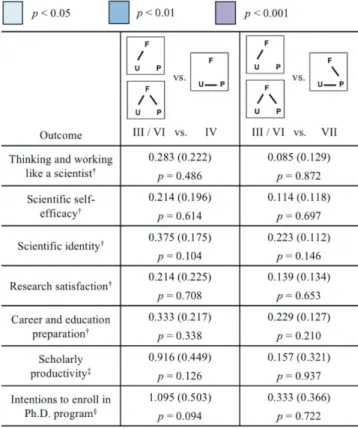
The undergraduates in this study who were mentored solely by a faculty member versus solely by a postgraduate real-ized the same positive outcomes (Table 4). However, small sample sizes of undergraduates in less common triads (tri-ads III/VI and IV) increase the probability of a type II error (false negative). A post hoc power analysis, using G*Power (Faul et al., 2007) indicated that, to achieve an 80% chance of correctly rejecting the null hypothesis with an α = 0.05, the effect size would have to be medium (Cohen’s d = 0.5) or greater for the triads III/VI versus VII contrasts and medi-um-large or greater for the triads III/VI versus triad IV con-trasts. This is a conservative estimate, since each contrast for an outcome used an adjusted α < 0.05 for significance tests to preserve the overall family-wise error rate at 0.05. Small effect sizes can be important in education research and are common in complex social science models. Therefore, rather than solely relying on significance tests that cannot detect small effects, we examined the contrast estimates holistically and found that undergraduates in faculty-only triads (triads scientific self-efficacy, scientific identity, research
satisfac-tion, and career and education preparation. We took the mean of the responses to the items on each scale as a measure of the outcome (range = 1–5). We checked the assumptions for each linear regression, and in most cases, the error terms were heteroskedastic. Although heteroskedasticity does not result in biased parameter estimates, it does result in biased SEs, upon which tests of significance are based (Long and Ervin, 2000). Therefore, we used heteroskedastic-consistent SEs, calculated using the HC3 estimator (MacKinnon and White, 1985), to test for the significance of variables in the regression. Mentoring triad effect sizes were calculated for each outcome using Cohen’s f2. R2 from regression models
with (full) and without (nested) triad in the model were used to calculate Cohen’s f2: (R2
full − R2nested)/(1 − R2full) (Cohen,
1988; Selya et al., 2012). Cohen (1988) suggests that effect sizes of 0.02 are small, 0.15 are medium, and 0.35 are large.
We used ordinal logistic regression (MASS and ordinal packages; Venables and Ripley, 2002; Christensen, 2015) to examine the effect of triad membership on scholarly produc-tivity, because the scholarly productivity score is an ordered categorical variable. Ordinal logistic regression assumes pro-portional odds. That is, the relative odds of a response of a dependent variable level at least one level higher is the same for all levels of the dependent variable. This assumption re-sults in fewer parameter estimates than a multinomial model, in which categorical outcomes are not ordered and separate relative odds must be calculated for each dependent variable level compared with a reference level. We used Akaike’s infor-mation criterion (AIC) values to determine whether the more complex multinomial model was a better fit to the data than the simpler ordinal logistic model (Fox and Weisberg, 2011). The ordinal logistic model had a lower AIC value than the multinomial model (1922.04 vs. 1938.07, respectively), indi-cating the ordinal logistic regression model was appropriate.
We used binary logistic regression to examine the effect of an undergraduate’s triad on his or her intentions to en-roll in a PhD program in science, mathematics, or engineer-ing. The original survey item had five response options. However, for some of the triads with low sample sizes, there were few responses for some of the response options. There-fore, we combined response options to create two outcome groups: not more likely and a little/somewhat/much/ex-tremely more likely. Because the item was meant to deter-mine whether the research experience had influenced their decisions to enroll in a PhD program, combining all of the positive responses creates a “more likely” category that we can easily compare with a “not more likely” category.
RESULTS
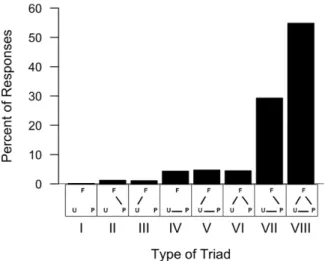
Undergraduate researchers most frequently reported being part of the closed triad (triad VIII; Figure 2). Almost twice as many students reported being in a closed triad compared with the second most common triad (triad VII), in which the undergraduate is tied to the postgraduate and the postgrad-uate is tied to the faculty member, but there is no tie between the undergraduate and faculty member. The remaining tri-ads contained fewer than 40 students each (<5% of students in each triad), indicating students did not frequently experi-ence these mentoring triads at research universities.
Table 3. Means (± SD) for each continuous outcome and medians for each categorical outcome, overall and by triad type
Continuous outcome Overall mean (± SD) Triads III/VI mean (± SD) Triad IV mean (± SD) Triad V mean (± SD) Triad VII mean (± SD) Triad VIII mean (± SD) Thinking and working like a
scientist (n = 708) 4.089 (0.729) 3.997 (0.707) 3.720 (0.902) 3.713 (0.793) 3.889 (0.773) 4.284 (0.612) Scientific self-efficacy (n = 742) 3.831 (0.764) 3.765 (0.694) 3.599 (0.913) 3.556 (0.758) 3.661 (0.785) 3.979 (0.712) Scientific identity (n = 731) 4.066 (0.728) 4.071 (0.684) 3.731 (0.763) 3.988 (0.700) 3.868 (0.753) 4.212 (0.682) Research satisfaction (n = 752) 4.286 (0.827) 4.235 (0.783) 4.021 (1.074) 4.111 (0.922) 4.086 (0.896) 4.467 (0.679) Career and education
preparation (n = 636) 4.096 (0.793) 4.106 (0.685) 3.769 (0.981) 3.994 (0.761) 3.865 (0.826) 4.282 (0.707)
Categorical outcome Overall median Triads III/VI median Triad IV median Triad V median Triad VII median Triad VIII median Scholarly productivity (n = 758) Presented as
part of a local program (1)
Presented at a regional, national, or international conference (2)
Presented as part of a local program (1)
Presented as part of a local program (1)
Presented as part of a local program (1)
Presented at a regional, national, or international conference (2) Enroll in a PhD program in
STEM (n = 748) Somewhat more likely (3) A little more likely (2) Not more likely (1) Somewhat more likely (3) A little more likely (2) Somewhat more likely (3)
Table 4. Contrast tests to determine whether direct mentorship by a faculty member versus a postgraduate leads to distinct outcomesa
aContrast estimates (± SE) based on differences in the regression co-efficients for the named triads are shown. All control variables were included in the estimates. Positive numbers indicate that under-graduates in the left triads reported more positive outcomes than undergraduates in the right triad. Negative numbers indicate that undergraduates in the left triads reported less positive outcomes than those in the right triad. †, continuous variable; ‡, ordinal vari-able; §, dichotomous variable.
III/VI) generally reported more positive outcomes than un-dergraduates in postgraduate-only triads (triads IV and VII). Additional studies with larger sample sizes are necessary to determine whether this trend is noteworthy.
Hypothesis 2A. Undergraduates with two mentors
realize greater outcomes than undergraduates with
only one mentor
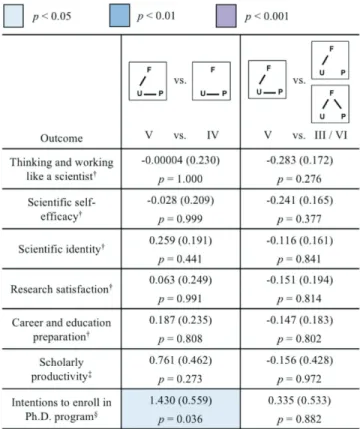
For the most part, undergraduates mentored by both a post-graduate and a faculty member (triad V) reported statistical-ly similar outcomes to undergraduates mentored solestatistical-ly by a postgraduate (triad IV) or solely by a faculty member (triads III/VI; Table 5). However, undergraduates in the triad with both postgraduate and faculty mentors (triad V) were approx-imately four times more likely than undergraduates with just a postgraduate mentor (triad IV) to report increased inten-tions to enroll in a PhD program after completing the research experience. Having two mentors may be additive in terms of an undergraduate’s intentions to enroll in a PhD program. Al-ternatively, the undergraduates’ direct connection to faculty mentors may be driving this result. Specifically, undergradu-ates with a faculty mentor (triads III/VI) were approximately three times more likely than undergraduates with a postgrad-uate mentor (triad IV) to report increased intentions to enroll in a PhD program after completing the research experience (Table 4). Although this difference is not statistically signif-icant (p = 0.094), it suggests that faculty may influence stu-dents’ intentions to enroll in a PhD program, especially given the small sample sizes for the triads in this contrast.
Hypothesis 2B. Undergraduates with two mentors
realize lesser outcomes than undergraduates with
only one mentor
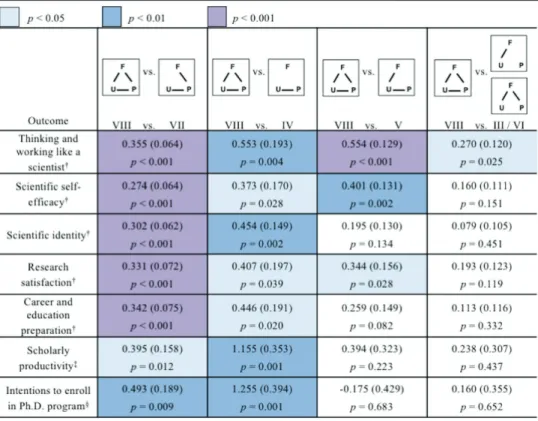
In particular, all undergraduates’ outcomes were signifi-cantly greater in closed triads (triad VIII) compared with triads in which the undergraduate was mentored solely by a postgraduate (triad IV). The outcomes of undergraduates in closed triads were also greater than the outcomes of under-graduates in triads with indirect ties to the faculty mentor through the postgraduate (triad VII). The positive outcomes of undergraduates in closed triads could not be explained simply as having access to two mentors, because three of the seven outcomes were greater for undergraduates in the closed triad (triad VIII) than for undergraduates tied to both a postgraduate mentor and a faculty mentor who were not tied to each other (triad V). For the most part, undergrad-uates who were directly tied to a faculty member (triads III/VI) realized similar outcomes to undergraduates in the closed triad (triad VIII). These results suggest that much of the value undergraduates reap from being in the closed triad may be through direct interaction with the faculty mentor. Alternatively, closed triads may be an indicator of faculty members’ involvement or investment in the research group or the esprit de corps of the lab, which results in a high-er-quality experience for the undergraduate researcher. The only exception was for the outcome of thinking and work-ing like a scientist; undergraduates in closed triads reported greater gains in this area than undergraduates in any other triad.
Limitations
We used several methodological approaches to ensure the validity of our results. First, when possible, we made use of valid and reliable measures of the outcomes undergraduates realize from participating in research. We chose to focus on outcomes that were well established in the literature on un-dergraduate research experiences to allow for comparison of our work with published research. We identified partic-ipants by using diverse recruiting strategies and included data from a nationally representative sample of undergradu-ate life science researchers at research universities. We used several statistical tests to determine the appropriateness of the assumptions we made in conducting the regression analyses. We recognize, however, that our study design and methods are inherently limited in ways that may affect the interpretation of our results.
We surveyed undergraduates once after the comple-tion of at least one semester of undergraduate research. This cross-sectional approach does not account for what students brought into the research experience but rather assumes outcomes were the result of the research experi-ence the undergraduates were reporting. For some mea-sures, this is likely valid, as we explicitly asked students to reference their research experience when responding to items (see Appendix A in the Supplemental Material). However, the scientific self-efficacy and scientific identity measures were more general and were not explicitly tied to a student’s research experience. To account for this, we included the number of research experiences and duration of research experiences as control variables in all analyses. Yet we cannot say with certainty that membership in a triad preceded the outcomes within the research experience itself. For example, students with high self-efficacy or identity may seek out opportunities to interact with faculty direct-ing their research, thus generatdirect-ing a closed triad situation. differences were not significant, the small sample sizes for all
triad types in these contrasts resulted in a low probability of detecting a true significant result unless the effect sizes were medium-large or greater. Postgraduates and faculty who do not communicate with each other about undergraduates’ research may give conflicting advice, resulting in a less pos-itive research experience. Alternatively, the lack of commu-nication between postgraduate and faculty mentors may be a sign of a less positive work environment in general, which would limit the quality of the undergraduates’ research ex-periences and their outcomes. Additional data are needed from undergraduates who experience this triad to determine whether this trend holds with a larger sample.
Hypothesis 3. Undergraduates mentored by both a
postgraduate and a faculty member who themselves
interact about the undergraduates’ research (“closed
triad”) realize greater outcomes than undergraduates
in all other triads
Undergraduate researchers in the closed triad often had greater outcomes than students in the other triads (Table 6).
Table 5. Contrast tests to determine whether undergraduates realize different outcomes when they have more than one mentora
enrollment. Self-report is widely accepted for documenting psychosocial outcomes such as scientific self-efficacy and scientific identity.
We included specific language in the study invitation aimed at encouraging participation by students with poor research experiences, but our data set contains few under-graduates who reported having a negative experience. Only 49 students indicated their satisfaction with their research experience was less than neutral (score < 3). Thus, the prev-alence of triads as well as the outcomes of undergraduates in different triads reported here may be biased by underrep-resentation of students with negative research experiences. It is possible that undergraduates with negative experiences opted out of our study because they had to call to mind the postgraduates and faculty with whom they worked. Under-graduates with negative experiences may also have been less motivated to respond due to concerns about potential retalia-tion by the postgraduate or faculty mentor. This adds a layer of sensitivity that might not be an issue in more general stud-ies of undergraduate research experiences. It is important to note that undergraduates in our study reported average out-comes that were very similar to average outout-comes reported by other national samples of undergraduate researchers (e.g., T. Weston, personal communication concerning unpublished data from URSSA; Estrada et al., 2011). This indicates that Future research should employ longitudinal studies that
survey students before and after their research experiences and make use of structural equation modeling to determine directionality.
We made use of measures that rely on undergraduates’ self-reporting on their research outcomes. Concerns have been raised by us and others about the validity of self-re-ported learning gains, since correlations vary widely be-tween self-reported measures of learning and more direct measures such as tests or expert judgments (Falchikov and Boud, 1989; Corwin Auchincloss et al., 2014). Only one out-come reported here is a self-report of learning: thinking and working like a scientist (Hunter et al., 2009; Weston and Laursen, 2015). This measure is used to document out-comes of students in all NSF-funded BIO REU sites. By us-ing this measure, our results can be compared with results from national samples of undergraduate researchers in the life sciences. Similar concerns could be raised about relying on students’ intentions to enroll in a PhD program rather than tracking students to document actual enrollment. Ea-gan and colleagues (2013) also relied on students’ graduate school aspirations in their national study of the impact of undergraduate research programs, arguing that intentions to enroll in graduate school were the best predictors of ac-tual enrollment and an essential first step for subsequent
Table 6. Contrast tests to determine whether undergraduates in a closed triad realize greater out-comes than undergraduates in all other triadsa
identify significant effects of small or medium magnitude. Future research should examine this trend with larger sam-ple sizes.
The beneficial nature of the closed triad is consistent with Coleman’s (1988, 1990) argument that closed networks are the source of social capital. Dense social networks, which are characterized by the prevalence of closed triads, result in mutual trust and obligation among all members (Coleman, 1988). With respect to the undergraduate–postgraduate–fac-ulty relationship, a closed triad may allow for the develop-ment of greater rapport between the undergraduate and his or her mentors, which leads to the provision of greater pro-fessional opportunities and the realization of more positive outcomes. For example, a faculty member and postgraduate who trust an undergraduate researcher more may be will-ing to give him or her more complex and rewardwill-ing research tasks or allow him or her to make independent decisions, leading to greater learning, more research progress, and new professional opportunities (e.g., Seymour et al., 2004). Additionally, in a closed network, everyone is more likely to be “on the same page,” because everyone is communicat-ing and workcommunicat-ing toward a collective goal (Coleman, 1988). Faculty and postgraduate mentors who do not communi-cate with one another about their undergraduate protégés’ research are more likely to provide conflicting advice or in-formation. An undergraduate may then become unsure of who should or should not be a source of advice or informa-tion. Based on our findings, we recommend the formation of closed triads in which postgraduates play a prominent role in the mentoring of undergraduate researchers but faculty also interact directly with undergraduates. We also recom-mend that postgraduates and faculty set regular meetings to discuss undergraduate researchers’ projects and prog-ress and for faculty to provide guidance to postgraduates on how to mentor. Further research is needed to discern the frequency and nature of undergraduate–faculty interactions and delineate the specific functions of postgraduate–faculty interactions (e.g., information sharing, mentoring) necessary for undergraduates to maximally benefit from their research experiences.
If we look holistically at the triads compared in Table 6, there is evidence that faculty offer unique resources that help undergraduates benefit maximally from research ex-periences. Undergraduates in the closed triad (VIII) and the faculty-only triads (III/VI) achieved the most positive outcomes, while undergraduates with a direct tie only to a postgraduate (triads IV and VII) achieved the least-positive outcomes. We likely did not find differences between facul-ty-only (III/VI) and postgraduate-only (IV and VII) triads because the power of this analysis was limited by the small sample sizes of faculty-only triads (n = 40–45). However, consistently positive contrast estimates (Table 4) suggest that undergraduates who work directly with faculty may expe-rience greater outcomes than those who work only with a postgraduate. For example, scientific identity was greater in students with a faculty mentor than a postgraduate mentor (triad IV: contrast estimate = 0.375, p = 0.104; triad VII: con-trast estimate = 0.223, p = 0.146). Development of a scientific identity is particularly important for the persistence of stu-dents in STEM. Stustu-dents who report greater scientific iden-tity are more committed to pursuing a science career after college (Chemers et al., 2011; Estrada et al., 2011). Even small any bias due to undergraduates with negative experiences
opting out of the study is not unique to our sample.
Finally, our study examined mentoring triads primarily at research universities. Our inferences about undergraduate– faculty interactions and their effects are not likely to apply to undergraduates who participated in research in labs with-out a postgraduate, either at research universities or at other types of institutions. Further research is needed to compare the effects of different mentoring structures across institu-tion types.
DISCUSSION
Postgraduates, who are themselves mentored by faculty members, commonly serve as mentors to undergraduate life science researchers at research universities (Whiteside et al., 2007; Thiry and Laursen, 2011). This is the first quantitative study to examine how this triadic mentoring relationship contributes to the outcomes undergraduates realize from participating in research, even though this relationship is commonplace at research universities. Although undergrad-uates in this study reported being in all eight possible men-toring triad structures (Figure 2), only two were commonly reported: the closed triad, in which all three members are tied (triad VIII), and the triad with undergraduate–postgrad-uate and postgradundergraduate–postgrad-uate–faculty ties, but no undergradundergraduate–postgrad-uate– faculty tie (triad VII).
REFERENCES
Adedokun OA, Zhang D, Carleton Parker L, Bessenbacher A, Childress A, Daniels Burgess W (2012). Understanding how un-dergraduate research experiences influence student aspirations for research careers and graduate education. J Coll Sci Teach 42, 82–90. American Association for the Advancement of Science (2011). Vision and Change in Undergraduate Biology Education. A Call to Action, Washington, DC.
Baker WE (1984). The social structure of a national securities market. Am J Sociol 89, 775–811.
Baker WE, Iyer AV (1992). Information networks and market behav-ior. J Math Sociol 16, 305–332.
Bauer KW, Bennett JS (2003). Alumni perceptions used to assess un-dergraduate research experience. J High Educ 74, 210–230.
Burt RS (2000). The network structure of social capital. Res Organ Behav 22, 345–423.
Burt RS (2001). Structural holes versus network closure as social cap-ital. In: Social Capital: Theory and Research, ed. N Lin, KS Cook, and RS Burt, New Brunswick, NJ: Transaction.
Carlone HB, Johnson A (2007). Understanding the science experienc-es of succexperienc-essful women of color: science identity as an analytic lens. J Res Sci Teach 44, 1187–1218.
Mentoring triad membership accounted for a small pro-portion of the variance associated with each outcome, likely due to the many factors that influence the outcomes an un-dergraduate realizes from participating in research. Factors outside the research experience per se are also likely to be influential. For example, Eagan and colleagues (2013) found that initial aspirations for an advanced degree, race/ethnic-ity, and mother’s education level affected a STEM student’s intentions to pursue a graduate or professional degree above and beyond the effect of a research experience. In our anal-yses, student demographics significantly predicted some of the outcomes. Yet, even including all control variables, the total variance explained in undergraduates’ outcomes was relatively small (range of R2 for regressions: 0.090–0.140;
see Appendix B in the Supplemental Material). Finer char-acterization of research experiences in general and research mentoring in particular is likely to be necessary to more fully explain undergraduate researchers’ outcomes. For ex-ample, Thiry and Laursen (2011) found that undergraduate researchers benefited from particular types of mentoring help, such as professional socialization, intellectual support, and personal support. Future research should move beyond linking the presence of a mentor to undergraduate research-ers’ outcomes and elucidate aspects of the mentoring rela-tionship that are important for undergraduates’ intellectual, personal, and professional growth.
differences in scientific identity can discriminate between students who stay in science and students who leave sci-ence after college (Estrada et al., 2011). Recognition from established members of the scientific community has been shown to influence a student’s scientific identity (Carlone and Johnson, 2007; Hurtado et al., 2011). Because faculty are more established members of the scientific community than postgraduates, faculty recognition may be an important form of capital for students to develop their own identities as scientists. Studies that include more faculty-only triads are necessary to test this hypothesis.
Given the positive outcomes of undergraduates in closed triads and the trend in positive outcomes reported by under-graduates who interact directly with faculty, future research is needed to understand the factors that influence whether an undergraduate reports a tie with his or her faculty men-tor. It is standard practice in social network analyses to mea-sure the strength of a tie based on the frequency of interac-tion or the “closeness” of the relainterac-tionship (Granovetter, 1973; Marsden and Campbell, 1984). The size of the research group and norms within the particular life science disciplines are likely to influence this relationship and affect what an un-dergraduate researcher might consider a meaningful tie with a faculty member. Perhaps one intensive week of side-by-side fieldwork is sufficient for an ecology undergraduate to perceive a tie with a faculty member, while weekly one-on-one interactions are necessary for a biochemistry undergrad-uate to report a faculty tie. An undergradundergrad-uate conducting research in a large group may report a faculty tie based on only a handful of interactions over the semester, while an undergraduate in a small research group may not perceive a tie unless he or she interacts with a faculty member every week. Alternatively, it may be necessary for an undergradu-ate to feel some level of comfort or deep level similarity to a faculty member to form a productive tie (Eby et al., 2013). Fu-ture research should explore how interaction frequency and relationship quality, as well as other contextual factors such as discipline and research group size, influence undergrad-uates’ perceptions of their ties to faculty mentors and their realization of particular outcomes.
Even though our results indicate that direct undergradu-ate–faculty interaction is important, undergraduates in this study reported positive outcomes regardless of triad type. This suggests that postgraduates are able to provide the so-cial resources (e.g., information, advice, psychososo-cial sup-port) that undergraduates need to reap many of the benefits of research experiences. Even undergraduates with a single postgraduate mentor reported generally positive outcomes. For example, the average undergraduate researcher in triad VII (i.e., undergraduate–postgraduate and postgraduate–fac-ulty ties, but no undergraduate–facpostgraduate–fac-ulty tie, with all control variables taken into account) reported high gains in thinking and working like a scientist (mean = 3.889 on scale of 1–5) and a high scientific identity score (mean = 3.868 on scale of 1–5). These results provide the first empirical support from the un-dergraduate perspective for involving postgraduates as men-tors in order to broaden the availability of undergraduate research opportunities (AAAS, 2011; President’s Council of Advisors on Science and Technology, 2012). The positive out-comes of undergraduates mentored by postgraduates should assuage concerns about postgraduates’ capabilities to mentor undergraduate researchers (Dolan and Johnson, 2010).
ACKNOWLEDGMENTS
Chemers MM, Zurbriggen EL, Syed M, Goza BK, Bearman S (2011). The role of efficacy and identity in science career commitment among underrepresented minority students. J Soc Issues 67, 469–491. Christensen RHB (2015). ordinal—Regression Models for Ordinal Data, R Package Version 2015.1–21. https://cran.r-project.org/ package=ordinal (accessed 24 February 2015).
Cohen J (1988). Statistical Power Analysis for the Behavioral Scienc-es, 2nd ed., Hillsdale, NJ: Erlbaum.
Coleman JS (1988). Social capital in the creation of human capital. Am J Sociol 94, S95–S120.
Coleman JS (1990). Foundations of Social Theory, Cambridge, MA: Belknap.
Corwin Auchincloss L, Laursen SL, Branchaw JL, Eagan K, Graham M, Hanauer DI, Lawrie G, McLinn CM, Pelaez N, Rowland S, et al. (2014). Assessment of course-based undergraduate research experi-ences: a meeting report. CBE Life Sci Educ 13, 29–40.
Crisp G, Cruz I (2009). Mentoring college students: a critical review of the literature between 1990 and 2007. Res High Educ 50, 525–545. Dolan E, Johnson D (2010). The undergraduate-postgraduate-facul-ty triad: unique functions and tensions associated with undergrad-uate research experiences at research universities. CBE Life Sci Educ 9, 543–553.
Eagan MK, Jr., Hurtado S, Chang MJ, Garcia GA, Herrera FA, Garibay JC (2013). Making a difference in science education: the impact of undergraduate research programs. Am Educ Res J 50, 683–713. Eby LT, Allen TD, Hoffman BJ, Baranik LE, Sauer JB, Baldwin S, Morrison MA, Kinkade KM, Maher CP, Curtis S, et al. (2013). An interdisciplinary meta-analysis of the potential antecedents, cor-relates, and consequences of protégé perceptions of mentoring. Psychol Bull 139, 441–476.
Erdem F, Ozen J, Atsan N (2003). The relationship between trust and team performance. Work Stud 52, 337–340.
Estrada M, Woodcock A, Hernandez PR, Schultz PW (2011). Toward a model of social influence that explains minority student integra-tion into the scientific community. J Educ Psychol 103, 206–222. Falchikov N, Boud D (1989). Student self-assessment in higher edu-cation: a meta-analysis. Rev Educ Res 59, 395–430.
Faul F, Erdfelder E, Lang A-G, Buchner A (2007). G*Power 3: a flexi-ble statistical power analysis program for the social, behavioral, and biomedical sciences. Behav Res Methods 39, 175–191.
Fox J, Monette G (1992). Generalized collinearity diagnostics. J Am Stat Assoc 87, 178–183.
Fox J, Weisberg S (2011). An R Companion to Applied Regression, 2nd ed., Thousand Oaks, CA: Sage.
Granovetter M (1985). Economic action and social structure: the problem of embeddedness. Am J Sociol 91, 481–510.
Granovetter MS (1973). The strength of weak ties. Am J Sociol 78, 1360–1380.
Hothorn T, Bretz F, Westfall P (2008). Simultaneous inference in gen-eral parametric models. Biometrical J 50, 346–363.
Hunter A-B, Laursen SL, Seymour E (2007). Becoming a scientist: the role of undergraduate research in students’ cognitive, personal, and professional development. Sci Educ 91, 36–74.
Hunter A-B, Weston TJ, Laursen SL, Thiry H (2009). URSSA: eval-uating student gains from undergraduate research in the sciences. Counc Undergrad Res Q 29, 15–19.
Hurtado S, Eagan MK, Tran MC, Newman CB, Chang MJ, Velasco P (2011). “We do science here”: underrepresented students’ interactions with faculty in different college contexts. J Soc Issues 67, 553–579. Jones GR, George JM (1998). The experience and evolution of trust: implications for cooperation and teamwork. Acad Manage Rev 23, 531–546.
Kardash CM (2000). Evaluation of an undergraduate research expe-rience: perceptions of undergraduate interns and their faculty men-tors. J Educ Psychol 92, 191–201.
Ladson-Billings G (2006). From the achievement gap to the educa-tion debt: understanding achievement in U.S. schools. Educ Res 35, 3–12.
Lin N (2001). Social Capital: A Theory of Social Structure and Action, New York: Cambridge University Press.
Litzler E, Samuelson CC, Lorah JA (2014). Breaking it down: engineering student STEM confidence at the intersection of race/ ethnicity and gender. Res High Educ 55, 810–832.
Long JS, Ervin LH (2000). Using heteroscedasticity consistent standard errors in the linear regression model. Am Stat 54, 217–224. Lopatto D (2004). Survey of undergraduate research experiences (SURE): first findings. Cell Biol Educ 3, 270–277.
Lusher D, Kremer P, Robins G (2014). Cooperative and competitive structures of trust relations in teams. Small Group Res 45, 3–36. MacKinnon JG, White H (1985). Some heteroskedasticity-consistent covariance matrix estimators with improved finite sample proper-ties. J Econometrics 29, 305–325.
Marsden PV, Campbell KE (1984). Measuring tie strength. Soc Forces 63, 482–501.
National Research Council (2003). BIO2010: Transforming Under-graduate Education for Future Research Biologists, Washington, DC: National Academies Press.
O’Brien LT, Blodorn A, Adams G, Garcia DM, Hammer E (2015). Ethnic variation in gender-STEM stereotypes and STEM participa-tion: an intersectional approach. Cultur Divers Ethnic Minor Psy-chol 21, 169–180.
Orbe MP (2004). Negotiating multiple identities within multiple frames: an analysis of first-generation college students. Commun Educ 53, 131–149.
Pascarella ET, Terenzini PT (2005). How College Affects Students, vol. 2, San Francisco, CA: Jossey-Bass.
President’s Council of Advisors on Science and Technology (2012). Engage to Excel: Producing One Million Additional College Graduates with Degrees in Science, Technology, Engineering, and Mathematics, Washington, DC: U.S. Government Office of Science and Technology.
R Core Team (2014). R: A Language and Environment for Statisti-cal Computing, Vienna: R Foundation for StatistiStatisti-cal Computing. www.R-project.org (accessed 10 November 2014).
Riegle-Crumb C (2006). The path through math: course sequences and academic performance at the intersection of race-ethnicity and gender. Am J Educ 113, 101–122.
Riegle-Crumb C, King B (2010). Questioning a white male advan-tage in STEM: examining disparities in college major by gender and race/ethnicity. Educ Res 39, 656–664.
Robnett RD, Chemers MM, Zurbriggen EL (2015). Longitudinal as-sociations among undergraduates’ research experience, self-efficacy, and identity. J Res Sci Teach 52, 847–867.
Russell SH, Hancock MP, McCullough J (2007). Benefits of under-graduate research experiences. Science 316, 548–549.
Schultz PW, Hernandez PR, Woodcock A, Estrada M, Chance RC, Aguilar A, Serpe RT (2011). Patching the pipeline: reducing edu-cational disparities in the sciences through minority training pro-grams. Educ Eval Policy Anal 33, 95–114.
Selya AS, Rose JS, Dierker LC, Hedeker D, Mermelstein RJ (2012). A practical guide to calculating Cohen’s f2, a measure of local effect size, from PROC MIXED. Front Psychol 3, ar111.
Simmel G (1902). The number of members as determining the socio-logical form of the group. I. Am J Sociol 8, 1–46.
Stanton-Salazar RD (2011). A social capital framework for the study of institutional agents and their role in the empowerment of low-sta-tus students and youth. Youth Soc 43, 1066–1109.
Sundstrom E, de Meuse KP, Futrell D (1990). Work teams: applica-tions and effectiveness. Am Psychol 45, 120–133.
Taraban R, Logue E (2012). Academic factors that affect undergradu-ate research experiences. J Educ Psychol 104, 499–514.
Thiry H, Laursen SL (2011). The role of student-advisor interactions in apprenticing undergraduate researchers into a scientific commu-nity of practice. J Sci Educ Technol 20, 771–784.
Venables WN, Ripley BD (2002). Modern Applied Statistics with S, 4th ed., New York: Springer.
Volkwein JF, Carbone DA (1994). The impact of departmental re-search and teaching climates on undergraduate growth and satisfac-tion. J High Educ 65, 147–167.
Wei CA, Woodin T (2011). Undergraduate research experiences in biology: alternatives to the apprenticeship model. CBE Life Sci Educ 10, 123–131.
Weston TJ, Laursen SL (2015). The undergraduate research student self-assessment (URSSA): validation for use in program evaluation. CBE Life Sci Educ 14, ar33.
Whiteside U, Pantelone DW, Hunter-Reel D, Eland J, Kleiber B, Larimer M (2007). Initial suggestions for supervising and mentoring undergraduate research assistants at large research universities. Int J Teach Learn High Educ 19, 325–330.