Step By Action
10.2. REC U RSIO N IN SQL 437
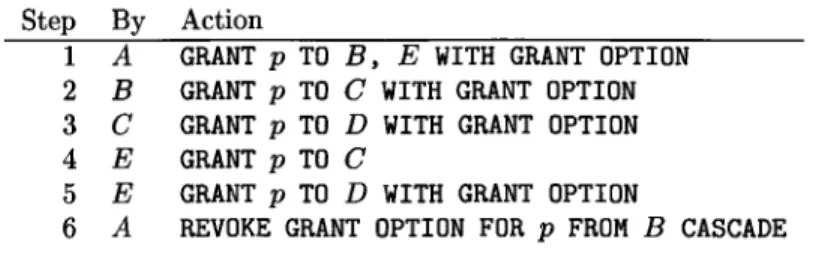
1 A GRANT p TO B , E WITH GRANT OPTION 2 B GRANT p TO C WITH GRANT OPTION 3 C GRANT p TO D WITH GRANT OPTION 4 E GRANT p TO C
5 E GRANT p TO D WITH GRANT OPTION
6 A REVOKE GRANT OPTION FOR p FROM B CASCADE Figure 10.7: Sequence of actions for Exercise 10.1.3
E x ercise 1 0 .1 .4 : Show the final grant diagram after the following steps, as suming A is the owner of the relation to which privilege p refers.
Step By Action
1 A GRANT p TO B WITH GRANT OPTION 2 B GRANT p TO B WITH GRANT OPTION 3 A REVOKE p FROM B CASCADE
10.2
R ecursion in SQL
The SQL-99 standard includes provision for recursive definitions of queries. Although this feature is not part of the “core” SQL-99 standard th at every DBMS is expected to implement, at least one major system — IBM’s DB2 — does implement the SQL-99 proposal, which we describe in this section.
10.2.1
Defining Recursive R elations in SQL
The WITH statement in SQL allows us to define temporary relations, recursive or not. To define a recursive relation, the relation can be used within the WITH statement itself. A simple form of the WITH statement is:
WITH R AS <definition of R> <query involving R>
That is, one defines a temporary relation named R , and then uses R in some query. The tem porary relation is not available outside the query th a t is part of the WITH statement.
More generally, one can define several relations after the WITH, separating their definitions by commas. Any of these definitions may be recursive. Sev eral defined relations may be mutually recursive; th at is, each may be defined in terms of some of the other relations, optionally including itself. However, any relation th at is involved in a recursion must be preceded by the keyword RECURSIVE. Thus, a more general form of WITH statem ent is shown in Fig. 10.8. E x a m p le 1 0 .8 : Many examples of the use of recursion can be found in a study of paths in a graph. Figure 10.9 shows a graph representing some flights of two
WITH
[RECURSIVE] R i AS <definition of R i> , [RECURSIVE] R 2 AS <definition of R 2> , [RECURSIVE] R n AS <definition of R n> < query involving R i, R 2, . . . ,R n >
Figure 10.8: Form of a WITH statem ent defining several tem porary relations hypothetical airlines — Untried Airlines (UA), and Arcane Airlines (AA) — among the cities San Francisco, Denver, Dallas, Chicago, and New York. The d ata of the graph can be represented by a relation
F l i g h t s ( a i r l i n e , frm , t o , d e p a r t s , a r r i v e s ) and the particular tuples in this table are shown in Fig. 10.9.
A A 1 9 0 0 -2 2 0 0
Figure 10.9: A map of some airline flights airline from to departs arrives
UA SF DEN 930 1230
AA SF DAL 900 1430
UA DEN CHI 1500 1800
UA DEN DAL 1400 1700
AA DAL CHI 1530 1730
AA DAL NY 1500 1930
AA CHI NY 1900 2200
UA CHI NY 1830 2130
Figure 10.10: Tuples in the relation F lig h ts
The simplest recursive question we can ask is “For what pairs of cities (x, y) is it possible to get from city x to city y by taking one or more flights?” Before
10.2. RECURSIO N IN SQL 439 writing this query in recursive SQL, it is useful to express the recursion in the Datalog notation of Section 5.3. Since many concepts involving recursion are easier to express in Datalog than in SQL, you may wish to review the terminology of th at section before proceeding. The following two Datalog rules describe a relation R eaches(x,y) th at contains exactly these pairs of cities.
1. R eaches(x.y) «— F l i g h t s ( a , x , y , d , r )
2. R eaches(x,y) •<— R each es(x ,z) AND R each es(z,y )
The first rule says th a t Reaches contains those pairs of cities for which there is a direct flight from the first to the second; the airline a, departure time d, and arrival time r are arbitrary in this rule. The second rule says th at if you can reach from city x to city z and you can reach from z to city y, then you can reach from x to y.
Evaluating a recursive relation requires th at we apply the Datalog rules repeatedly, starting by assuming there are no tuples in Reaches. We begin by using Rule (1) to get the following pairs in Reaches: (SF, DEN), (SF, DAL), (DEN, CHI), (DEN, DAL), (DAL, CHI), (DAL, NY), and (CHI, NY). These are the seven pairs represented by arcs in Fig. 10.9.
In the next round, we apply the recursive Rule (2) to put together pairs of arcs such th at the head of one is the tail of the next. T hat gives us the additional pairs (SF, CHI), (DEN, NY), and (SF, NY). The third round combines all one- and two-arc pairs together to form paths of length up to four arcs. In this particular diagram, we get no new pairs. The relation Reaches thus consists of the ten pairs (a;, y) such th a t y is reachable from x in the diagram of Fig. 10.9. Because of the way we drew the diagram, these pairs happen to be exactly those (x , y) such th at y is to the right of x in Fig 10.9.
From the two Datalog rules for Reaches in Example 10.8, we can develop a SQL query th at produces the relation Reaches. This SQL query places the Datalog rules for Reaches in a WITH statement, and follows it by a query. In our example, the desired result was the entire Reaches relation, but we could also ask some query about Reaches, for instance the set of cities reachable from Denver.
1) WITH RECURSIVE R eaches(frm , to ) AS 2) (SELECT frm , t o FROM F lig h ts )
3) UNION
4) (SELECT R I.frm , R 2.to
5) FROM Reaches R I, Reaches R2 6) WHERE R I .to = R2.frm) 7) SELECT * FROM Reaches;
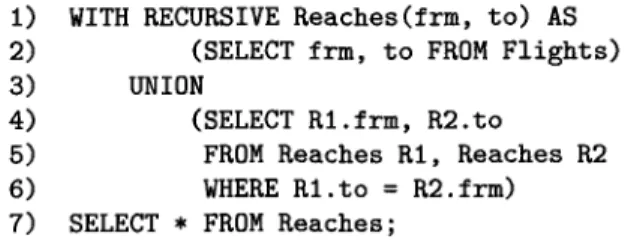
Figure 10.11: Recursive SQL query for pairs of reachable cities Figure 10.11 shows how to express Reaches as a SQL query. Line (1) intro duces the definition of Reaches, while the actual definition of this relation is in
M utual Recursion
There is a graph-theoretic way to check whether two relations or predi cates are mutually recursive. Construct a dependency graph whose nodes correspond to the relations (or predicates if we are using Datalog rules). Draw an arc from relation A to relation B if the definition of B depends directly on the definition of A. T hat is, if Datalog is being used, then A appears in the body of a rule with B at the head. In SQL, A would appear in a FROM clause, somewhere in the definition of B , possibly in a subquery. If there is a cycle involving nodes R and S, then R and 5 are mutually recursive. The most common case will be a loop from R to R, indicating th at R depends recursively upon itself.
lines (2) through (6).
That definition is a union of two queries, corresponding to the two Datalog rules by which Reaches was defined. Line (2) is the first term of the union and corresponds to the first, or basis rule. It says th a t for every tuple in the F lig h ts relation, the second and third components (the f rm and to components) are a tuple in Reaches.
Lines (4) through (6) correspond to Rule (2), the recursive rule, in the definition of Reaches. The two Reaches subgoals in Rule (2) are represented in the FROM clause by two aliases RI and R2 for Reaches. The first component of RI corresponds to x in Rule (2), and the second component of R2 corresponds to y. Variable z is represented by both the second component of RI and the first component of R2; note th at these components are equated in line (6).
Finally, line (7) describes the relation produced by the entire query. It is a copy of the Reaches relation. As an alternative, we could replace line (7) by a more complex query. For instance,
7) SELECT t o FROM Reaches WHERE frm = ’DEN’ ; would produce all those cities reachable from Denver. □
10.2.2
Problem atic Expressions in Recursive SQL
The SQL standard for recursion does not allow an arbitrary collection of mutu ally recursive relations to be written in a WITH clause. There is a small m atter th at the standard requires only th at linear recursion be supported. A linear recursion, in Datalog terms, is one in which no rule has more than one subgoal th at is mutually recursive with the head. Notice th a t Rule (2) in Example 10.8 has two subgoals with predicate Reaches th a t are mutually recursive with the head (a predicate is always mutually recursive with itself; see the box on Mutual
10.2. RECURSIO N IN SQL 441 Recursion). Thus, technically, a DBMS might refuse to execute Fig. 10.11 and yet conform to the standard.1
But there is a more im portant restriction on SQL recursions, one th at, if violated leads to recursions th at cannot be executed by the query processor in any meaningful way. To be a legal SQL recursion, the definition of a recursive relation R may involve only the use of a mutually recursive relation S (including R itself) if th a t use is “monotone” in S. A use of S is monotone if adding an arbitrary tuple to S might add one or more tuples to R, or it might leave R unchanged, but it can never cause any tuple to be deleted from R. The following example suggests what can happen if the monotonicity requirement is not respected.
E x a m p le 1 0 .9 : Suppose relation R is a unary (one-attribute) relation, and its only tuple is (0). R is used as an EDB relation in the following Datalog rules:
1. P(x) <- R(x) AND NOT Q(x) 2. Q(x) «- R(x) AND NOT P(x)
Informally, the two rules tell us th a t an element x in R is either in P or in Q but not both. Notice th a t P and Q are mutually recursive.
If we start out, assuming th a t both P and Q are empty, and apply the rules once, we find th a t P — {(0)} and Q = {(0)}; th a t is, (0) is in both IDB relations. On the next round, we apply the rules to the new values for P and Q again, and we find th at now both are empty. This cycle repeats as long as we like, but we never converge to a solution.
In fact, there are two “solutions” to the Datalog rules: a) P = {(0)} Q = 0
b) p = 0 Q = {(0)}
However, there is no reason to assume one over the other, and the simple iteration we suggested as a way to compute recursive relations never converges to either. Thus, we cannot answer a simple question such as “Is P (0) true?”
The problem is not restricted to Datalog. The two Datalog rules of this example can be expressed in recursive SQL. Figure 10.12 shows one way of doing so. This SQL does not adhere to the standard, and no DBMS should execute it. □
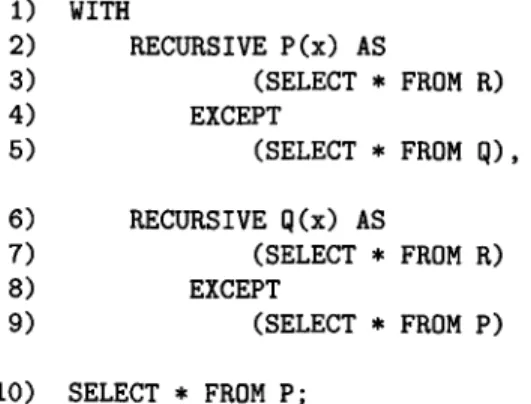
The problem in Example 10.9 is th a t the definitions of P and Q in Fig. 10.12 are not monotone. Look at the definition of P in lines (2) through (5) for instance. P depends on Q, with which it is mutually recursive, but adding a tuple to Q can delete a tuple from P. Notice th a t if R — {(0)} and Q is empty, then P = {(0)}. But if we add (0) to Q, then we delete (0) from P. Thus, the definition of P is not monotone in Q, and the SQL code of Fig. 10.12 does not meet the standard.
1N o te , how ever, t h a t we c a n re p la c e e ith e r o n e o f th e u se s o f R e ach es in lin e (5) o f F ig . 10.11 b y F l i g h t s , a n d th u s m a k e th e re c u rsio n lin e a r. N o n lin e a r re c u rsio n s c a n fre q u e n tly — a lth o u g h n o t alw ay s — b e m a d e lin e a r in th is fash io n .
1) WITH
2) RECURSIVE P (x) AS
3) (SELECT *
4) EXCEPT
5) (SELECT *
6) RECURSIVE Q(x) AS
7) (SELECT *
8) EXCEPT
9) (SELECT *
10) SELECT * FROM P;
Figure 10.12: Query with nonmonotonic behavior, illegal in SQL E x a m p le 1 0 .1 0: Aggregation can also lead to nonmonotonicity. Suppose we have unary (one-attribute) relations P and Q defined by the following two conditions:
1. P is the union of Q and an EDB relation R.
2. Q has one tuple th a t is the sum of the members of P.
We can express these conditions by a WITH statem ent, although this statem ent violates the monotonicity requirement of SQL. The query shown in Fig. 10.13 asks for the value of P.
1) WITH
2) RECURSIVE P(x) AS
3) (SELECT * FROM R)
4) UNION
5) (SELECT * FROM Q),
6) RECURSIVE Q(x) AS
7) SELECT SUM(x) FROM P
8) SELECT * FROM P;
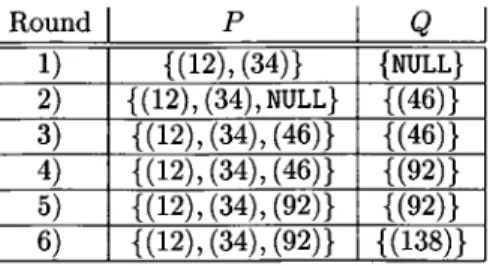
Figure 10.13: Nonmonotone query involving aggregation, illegal in SQL Suppose th a t R consists of the tuples (12) and (34), and initially P and Q are both empty. Figure 10.14 summarizes the values computed in the first six rounds. Note th a t both relations are computed, in one round, from the values of the relations at the previous round. Thus, P is computed in the first round
10.2. RECURSIO N IN SQL 443
Round P Q
1) {(12), (34)} {NULL}
2) {(12), (34),NULL} {(46)} 3) {(12), (34), (46)} {(46)} 4) {(12), (34), (46)} {(92)} 5) {(12), (34), (92)} {(92)} 6) {(12), (34), (92)} {(138)}
Figure 10.14: Iterative calculation for a nonmonotone aggregation to be the same as R, and Q is {NULL}, since the old, empty value of P is used in line (7).
At the second round, the union of lines (3) through (5) is the set R U {NULL} = {(12), (34), NULL}
so th at set becomes the new value of P. The old value of P was {(12), (34)}, so on the second round Q = {(46)}. That is, 46 is the sum of 12 and 34.
At the third round, we get P = {(12), (34), (46)} at lines (2) through (5). Using the old value of P , {(12), (34), NULL}, Q is defined by lines (6) and (7) to be {(46)} again. Remember th at NULL is ignored in a sum.
At the fourth round, P has the same value, {(12), (34), (46)}, but Q gets the value {(92)}, since 12+34+46=92. Notice th a t Q has lost the tuple (46), although it gained the tuple (92). T hat is, adding the tuple (46) to P has caused a tuple (by coincidence the same tuple) to be deleted from Q. That behavior is the nonmonotonicity th at SQL prohibits in recursive definitions, confirming th at the query of Fig. 10.13 is illegal. In general, at the 2*th round, P will consist of the tuples (12), (34), and (46* — 46), while Q consists only of the tuple (46*). □
10.2.3
Exercises for Section 10.2
E x ercise 10.2.1: The relation
Flights(airline, frm, to, departs, arrives)
from Example 10.8 has arrival- and departure-time information th at we did not consider. Suppose we are interested not only in whether it is possible to reach one city from another, but whether the journey has reasonable connections. That is, when using more than one flight, each flight must arrive at least an hour before the next flight departs. You may assume th at no journey takes place over more than one day, so it is not necessary to worry about arrival close to midnight followed by a departure early in the morning.
b) Write the recursion in SQL.
! E x e rc ise 1 0 .2 .2 : In Example 10.8 we used frm as an attribute name. Why did we not use the more obvious name from?
E x e rc ise 1 0 .2 .3 : Suppose we have a relation
SequelOf(movie, sequel)
th a t gives the immediate sequels of a movie, of which there can be more than one. We want to define a recursive relation FollowOn whose pairs (x, y) are movies such th a t y was either a sequel of x, a sequel of a sequel, or so on.
a) Write the definition of FollowOn as recursive Datalog rules. b) Write the definition of FollowOn as a SQL recursion.
c) Write a recursive SQL query th a t returns the set of pairs (x, y) such th at movie y is a follow-on to movie x, but is not a sequel of x.
d) Write a recursive SQL query th a t returns the set of pairs (a;, y) meaning th at y is a follow-on of x, but is neither a sequel nor a sequel of a sequel. ! e) Write a recursive SQL query th a t returns the set of movies x th a t have
at least two follow-ons. Note th a t both could be sequels, rather than one being a sequel and the other a sequel of a sequel.
! f) Write a recursive SQL query th a t returns the set of pairs (x, y) such th at movie y is a follow-on of x but y has at most one follow-on.
E x e rc ise 1 0 .2 .4 : Suppose we have a relation
Rel(class, rclass, mult)
th at describes how one ODL class is related to other classes. Specifically, this relation has tuple (c, d, m ) if there is a relation from class c to class d. This relation is multivalued if m = ’m u l ti ’ and it is single-valued if m = ’ s i n g l e ’ . It is possible to view Rel as defining a graph whose nodes are classes and in which there is an arc from c to d labeled m if and only if (c, d, m ) is a tuple of Rel. Write a recursive SQL query th a t produces the set of pairs (c, d) such that:
a) There is a path from class c to class d in the graph described above. b) There is a path from c to d along which every arc is labeled s in g le . ! c) There is a path from c to d along which at least one arc is labeled m u lti.
d) There is a path from c to d but no path along which all arcs are labeled s in g le .