A STUDY TO ASSESS THE EFFECTIVENESS OF STRUCTURED
TEACHING PROGRAMME ON KNOWLEDGE REGARDING
DENGUE FEVER AND IT’S PREVENTION AMONG STUDENTS IN
SELECTED HIGHER SENIOR SECONDARY SCHOOL STUDENTS AT
UDAIPUR CITY, RAJASTHAN
Brincy Babu*1, Jisa Jaiji Varghese2 and Ravikant Sharma3 1
Assistant Professor, Obstetrics and Gynecological Nursing Department, Geetanjali College
Of Nursing, Udaipur, Geetanjali University, Udaipur, Rajasthan, India. 2
Lecturer, Medical Surgical Nursing Department, P.D. Hinduja College of Nursing,
Maharashtra, Maharashtra University Of Health and Sciences, Maharashtra, India.
3
Lecturer, Medical Surgical Nursing Department, Saraswati College of Nursing, Udaipur,
Rajasthan University of Health Sciences, Jaipur, Rajasthan, India.
ABSTRACT
Dengue has emerged as a global threat, while scientist still know little
about, how the virus infects cells and causes the disease. Most people
with dengue recover without any ongoing problems. The mortality is
1-5% without treatment and less than 1% with adequate treatment,
however sever disease carries a mortality of 26%. dengueis endemic in
more than 110 countries. It infects 50 to 100 million people worldwide
a year, leading to half a million hospitalization, and approximately
12,500 to 25,000 deaths. It has a disease burden up to 16000 disability
- adjusted life years per million populations. The world health
organization estimates that around 2.5 billion people are at a risk for
dengue infection every year. Thus the researcher felt that there is a
need to assess as an “Effectiveness of Structured Teaching Programme On Knowledge Regarding Dengue Fever And It‟s Prevention among Students in Selected
Higher Senior Secondary School Students at Udaipur City Rajasthan.” Finding & conclusion
of the study are when the sample was taken for the study the samples had less knowledge
about dengue fever and it‟s prevention. The structured teaching programme regarding dengue
Volume 8, Issue 12, 1203-1212. Research Article ISSN 2277– 7105
Article Received on 10 Sept. 2019,
Revised on 01 Oct. 2019, Accepted on 20 Oct. 2019
DOI: 10.20959/wjpr201912-16113
*Corresponding Author
Brincy Babu
Assistant Professor,
Obstetrics and Gynecological
Nursing Department,
Geetanjali College Of
Nursing, Udaipur, Geetanjali
University, Udaipur,
fever and it‟s prevention was found to be effective in increasing the knowledge of higher
senior secondary school students. The sample had significant gain in knowledge after
structured teaching programme.
KEYWORDS: Knowledge, Effectiveness, Structured Teaching Programme, Dengue Fever, Prevention & Higher Senior Secondary School Students.
INTRODUCTION
Dengue is one of the most common mosquitoes borne disease in India. It causes a high fever
and a rash. Unlike most mosquitoes, dengue causing mosquitoes bites during the day. The
cause of dengue fever is Aedes Aegypti. Dengue is an acute fever caused by a virus. It occurs
in two form; Dengue fever and Dengue Hemorrhagic Fever. Dengue fever is marked by the
onset of sudden high fever, severe headache and pain behind the eyes, muscles and joints.
Prevention of Dengue involves all efforts of control is directed against mosquitoes. It is
important to take control measures to eliminate the mosquitoes and their breeding place.
Dengue mosquitoes bite during the daytime. Protect yourself from the bite by wearing full
sleeve clothes, use of repellent, mosquito coils, nets, protection of people sick with dengue.
OBJECTIVES
To assess the level of knowledge regarding dengue and its prevention among the higher senior secondary school students.
To evaluate the effectiveness of Structured Teaching Programme regarding dengue and
its prevention among the higher senior secondary school students.
To find out association between the level of knowledge with selected demographic variables regarding dengue and it‟s prevention among the higher senior secondary school
students.
MATERIAL AND METHOD
Research Design: One Group Pretest Post Test Design.
Setting of The Study: Vidhya Niketan Higher Senior Secondary School, Udaipur, Rajasthan, India.
Description of Tool
Tools are divided into two parts
b) The structured questionnaire to assess the level of knowledge.
Population of The Study: Higher Senior Secondary students who are study in Vidhya Niketan Higher Senior Secondary School, Udaipur, Rajasthan, India.
Sample Size: The Sample Size Selected For Study is 80 Higher Senior Secondary students. Sampling Technique: in the present study use convenient sampling technique.
RESULT AND DISCUSSION
Organization and presentation of data -
The findings were organized and presented under following sections:-
Section – 1: Socio-demographic characteristics and clinical profile of Higher Senior Secondary School Students.
Table 1: Frequency & percentage distribution of selected socio-demographic variables. N = 80
S. No. Variable Frequency Percentage
1. Age
a) 16 year 3 3.75 %
b) 17 year 15 18.75 %
c) 18 year 33 41.25 %
d) 19 year 29 36.25 %
2. Area of residence
a) Rural 29 36.25%
b) Urban 51 63.75%
3. Family income
a) Less than 10,000 23 28.75 %
b) 10,001-20,000 19 23.75 %
c) 20,001-30,000 22 27.5 %
d) 30,001 above 16 20 %
4. Stream of Studies
a) Arts 18 22.5 %
b) Commerce 31 38.75%
c) Science 31 38.75 %
5. Source of information
a) No information 21 26.25 %
b) Mass media 19 23.75 %
c) Family members 16 20 %
d) Health personal 14 17.5 %
e) Peer group 10 12.5 %
6. Education qualification of mother
b) Primary education 14 17.5 %
c) Secondary education 22 27.5 %
d) Senior secondary education 14 17.5 %
e) Graduation or above 18 22.5 %
7. Occupation of father
a) Farmer 12 15 %
b) Government employee 24 30 %
c) Businessman 28 35 %
d) Private employee 16 20 %
8. Food habits
a) Vegetarian 28 35 %
b) Non-vegetarian 52 65 %
Section – 2: Assessment of level of knowledge scores of respondents regarding use of dengue fever and its prevention
Part-I: Area wise pre-test knowledge score of respondents on use of health education on dengue fever and its prevention among urban area.
Part-II: Area wise post-test knowledge score of respondents on use of health education on dengue fever and its prevention among urban area.
Part- III: Distribution of respondents by the level of knowledge regarding use of dengue fever and its prevention dengue fever and it‟s prevention.
Part-I
Table: 2 Area wise pre-test knowledge score of Respondents regarding Prevention of dengue fever.
N=80
Area Maximum
Score Mean
Mean Percentage
Standard Deviation
Definition of dengue fever 02 0.46 23.09% 0.68
Incidence 01 0.21 21.27 % 0.46
Causes 06 0.90 18.07 % 0.95
Incubation period 01 0.20 19.60 % 0.44
Risk factors 01 0.12 12.01 % 0.35
Sign and symptoms 02 0.32 16.07 % 0.57
Diagnosis 01 0.20 20.19 % 0.45
Management 06 1.14 18.98 % 1.07
Prevention 11 2.36 21.45 % 1.54
[image:4.595.129.468.70.245.2] [image:4.595.114.483.519.693.2]Total 30 9.63 32.10% 3.10
Table 2: Area wise analysis shows that in pre-test the maximum mean percentage obtained by the respondents 0f definition of dengue regarding, 23.09% with SD of 0.68 in the aspect of
of 0.95 in the aspect of incubation period of dengue, 19.60% with SD of 0.44 in the aspect of
risk factor of dengue, 12.01% with SD of 0.35 in the aspect of sign & symptoms of dengue,
16.07% with 0.57 in the aspect of diagnosis of dengue fever,20.19% with SD 0.45 in the
aspect of management of dengue,18.98% with SD 1.07 in the aspect of prevention of
dengue, 21.45% with SD 1.54.
[image:5.595.112.491.292.466.2]Part-II
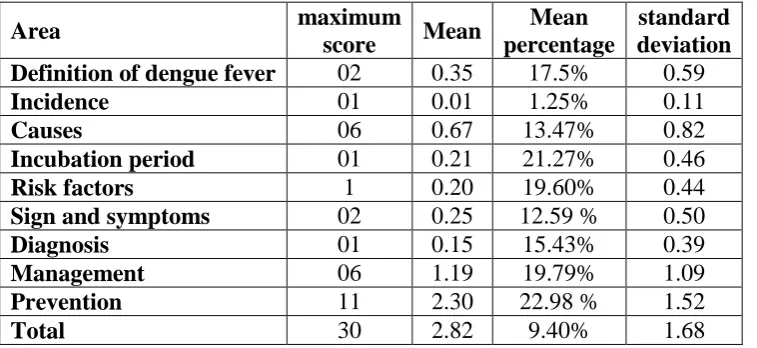
Table 3: Area wise post-test knowledge score of respondents on use of on dengue fever and it’s prevention among higher senior secondary school students Udaipur city, Rajasthan.
N=80
Area maximum
score Mean
Mean percentage
standard deviation Definition of dengue fever 02 0.35 17.5% 0.59
Incidence 01 0.01 1.25% 0.11
Causes 06 0.67 13.47% 0.82
Incubation period 01 0.21 21.27% 0.46
Risk factors 1 0.20 19.60% 0.44
Sign and symptoms 02 0.25 12.59 % 0.50
Diagnosis 01 0.15 15.43% 0.39
Management 06 1.19 19.79% 1.09
Prevention 11 2.30 22.98 % 1.52
Total 30 2.82 9.40% 1.68
Table 3: Area wise analysis shows that in post-test the maximum mean percentage obtained by the respondents 0f definition of dengue regarding, 17.5%% with SD of 0.59 in the aspect
of incidence regarding, 1.25% with SD 0.11 in the aspect of causes of dengue, 13.47% with
SD of 0.82 in the aspect of incubation period of dengue, 21.27% with SD of 0.46 in the
aspect of risk factor of dengue, 19.60% with SD of 0.44 in the aspect of sign & symptoms of
dengue, 4.23% with 0.50 in the aspect of diagnosis of dengue fever, 15.28% with SD 0.39 in
the aspect of management of dengue,19.79% with SD 1.09 in the aspect of prevention of
PART- III
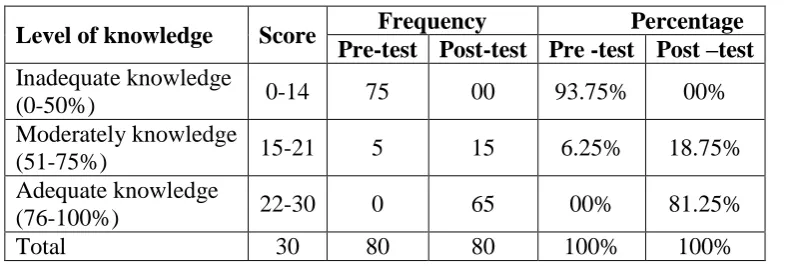
Table 4: Distribution of respondents by the level of knowledge regarding use of dengue fever and its prevention dengue fever and it’s prevention.
N=80
Level of knowledge Score Frequency Percentage
Pre-test Post-test Pre -test Post –test Inadequate knowledge
(0-50%) 0-14 75 00 93.75% 00%
Moderately knowledge
(51-75%) 15-21 5 15 6.25% 18.75%
Adequate knowledge
(76-100%) 22-30 0 65 00% 81.25%
Total 30 80 80 100% 100%
Table 4: Depicts the pre-test and post-test knowledge regarding Dengue fever and it‟s prevention. The result shows that in pre-test none of the respondents had adequate
knowledge, 0.00% had moderately knowledge and 6.25% had inadequate knowledge and in
pre-test 93.75%, post-test had adequate knowledge81.25 % had moderately knowledge
18.75% of the respondent had inadequate knowledge 0.00% regarding use of dengue fever
and its prevention and it‟s prevention and it‟s prevention among higher senior secondary
school, Udaipur Rajasthan.
Section – III: Effectiveness of structured teaching programme on knowledge regarding Dengue fever and it’s prevention.
Table 5: Effectiveness of structured teaching programme on knowledge regarding Dengue fever and it’s prevention.
N=80 Knowledge Mean Mean
% SD Enhancement
Enhancement Percentage
(%)
Df Z
Value Inference Pre-test 9.63 32.10 3.10
6.81 22.7% 79 35.03 S*
Post test 2.82 9.40 1.68
S* = Significant NS = Not Significant
Table 5: The result showed that the mean post-test knowledge score is 2.82 (9.40%) is greater than the mean pre-test knowledge score 9.63 (32.10%). The above table also depicts
that the enhancement in the knowledge of respondents is 6.81 (22.7%) supporting the
post-test knowledge score are higher than the prepost-test knowledge score. The data further represent
[image:6.595.105.505.152.285.2] [image:6.595.62.537.563.654.2]significance. This indicates that there was difference in pre-test and post-test knowledge
score of respondents and Structured Teaching Programme is effective in improving the
knowledge score of higher senior secondary school students on dengue fever and it‟s
prevention.
H1: There is a significant difference between the pre and post-test knowledge score of on use
of higher senior secondary school students in structured teaching programme on dengue fever
and it‟s prevention. Hypothesis was tested at 0.05 levels. The calculated „Z‟ value 35.04 is
significantly higher than the table value 1.96 at 0.05 level of significance. This indicates that
there is significant difference between pre-test and post-test knowledge score, hence the
hypothesis is proved and accepted.
SECTION – IV: Finding related to association between pre-test knowledge score with selected demographic variables of it dengue fever and it prevention.
This section deals with analysis and interpretation of the data collected to find out the
association between pre-test knowledge score with selected demographic variables like; Age,
Area of residence, family income, streams of studies, source of information, education
qualification of mother, occupation of father, food habits.
A parametric chi square test is used to describe the association between pre-test knowledge
score with selected demographic variables.
Table 6: Association between pre-test knowledge score of respondent with selected demographic variables.
N=80
Variables Below
median
Above
median Total
Chi
square Df
P value (0.05)
Inference
1. Age in years
16Year 2 1 3
2.05 3 7.81 N.S
17 Year 5 10 15
18 Year 12 21 33
19 Year 8 21 29
Total 27 53 80
2. Area of residence
Rural 6 23 29
3.47 1 3.84 N.S
Urban 21 30 51
Total 27 53 80
3. Family income per month
10001-20000 8 11 19
20,001-30,000 7 15 22
30,001above 4 12 16
Total 27 53 80
4. Streams of studies.
Arts 5 13 18
1.52 2 5.99 N.S
Commerce 9 22 31
Science 13 18 31
Total 27 53 80
5. Source of information
No information 9 12 21
558.02 2 5.99 S.
Mass media 6 13 19
Family members 6 10 16
Health personal 4 10 14
Peer Group 2 8 10
Total 27 53 80
6. Education qualification of mother No formal
education 3 9 12
5.31 4 9.49 N.S
Primary education 6 8 14
Secondary
education 7 15 22
Senior Secondary
education 8 6 14
Graduation or
above 4 14 18
Total 28 52 80
7. Occupation of father
Farmer 8 16 24
1.18 2 5.99 N.S
Government
employee 7 12 19
Businessman 8 13 22
Private employee 4 12 16
Total 27 53 80
8. Food habit
Vegetarian 10 18 28
0.07 1 3.84 N.S
Non-vegetarian(Mixed) 17 35 52
Total 27 53 80
S = Significant NS = Non-Significant
H2: There is a significant association between pre-test knowledge score with selected socio
demographic variables.
The chi-square test was carried out to determine the association between the pre-test
income, streams of studies, source of information, education qualification of mother,
occupation of father, food habit.
Out of which age in years 2=2.05, Area of residence 2=3.47, Family income 2=1.19,
Streams of studies 2=1.14,Source of information 2=558.02,Education Qualification of
mother 2==5.31, Occupation of father 2==1. 19, Food habit 2==0.07.
The researcher found the significant associated with pre-test knowledge score at 0.05 levels
with the socio-demographic variables such as Source of information 2=558.02. Hence
research hypothesis H2 is accepted. The data also revealed that researcher does not found
significant with age in year, area of residence, family income, streams of studies, source of
information, education qualification of mother, occupation of father, food habit.
CONCLUSION
The following conclusion was made from the following finding of the study. When the
sample was taken for study the sample has less knowledge about dengue fever & it‟s
prevention. The structured teaching programme on knowledge regarding dengue fever & it‟s
prevention was found to be effective in increasing the knowledge of higher senior secondary
students. The sample had significant gain in knowledge after the structured teaching
programme. The structured teaching programme on knowledge of dengue fever & it‟s
prevention was found to be effective in enhancing to become aware of the significant dengue
fever & it‟s prevention & the role of higher senior secondary students towards dengue fever & it‟s prevention.
ACKNOWLEDGEMENT
Our sincere thanks to administrator of Vidhya Niketan Higher Senior Secondary School,
Udaipur city, Rajasthan for valuable data for our research work. Our specially thanks the
participants of this study, without whose cooperation it would have been impossible to
complete study.
REFERENCES
1. Dengue and severe dengue (Fact sheet). World Health Organization, Geneva,
Switzerland, 2016 [cited 18 August 2016].
2. Global Strategy for dengue prevention and control, 2012–2020. World Health
3. World Health Organization. Dengue, guidelines for diagnosis, treatment, prevention and
control. Geneva: World Health Organization; 2009. [Online] Available from:
http://www.who.int/ tdr/publications/ documents/dengue-diagnosis.pdf [Accessed on 18
August 2016].