ISOLATION AND IDENTIFICATION OF BACILLUS THURINGIENSIS
BY BIOCHEMICAL METHOD
Dr. Prasanna Purohit*
Department of Botany, Sarojini Naidu Govt. Girls P.G. Autonomous College, Shivaji Nagar
Bhopal (M.P.)-492021 India.
ABSTRACT
Bacillus thuringiensis is a gram positive rod shaped, aerobic spore
forming soil bacterium, which produces crystalline insecticidal
proteins within the cytoplasm at the time of sporulation. These
insecticidal crystal proteins are highly toxic to various insects belong
to Lepidopteron Coleopterus and Dipteran families. Isolation and
characterization to obtain efficient Lepidopteran specific Bacillus
thuringiensis as bio-control agent from different soil samples. Out of
50 soil samples collected, only 20 samples were used for the isolation.
Sodium acetate selection method was used and the results were
positive for presence of Bacillus thuringiensis bacteria. More than one
method or biochemical test is used for isolate Bacillus thuringiensis
strains from different soil samples. The isolates which are positive for
crystal protein production were invariable endospore formers but the morphology of the
crystal protein inside. These isolated Bacillus thuringiensis can be used in future for the
transformation techniques as a biopesticide and may be on the control of Teak defoliator.
1. INTRODUCTION
The population is increasing in a alarming rate and needs to produce larger amount of food
grain to feed the increasing population. Therefore it needs to develop technologies like high
yielding corps varieties, intensive cultivation practice with enhanced crop protect modern
strategies has to be developing to meet food demand. The approaches like the development of
crop varieties with increased host plant resistance based on biotechnology methods
development of biological control of enhancing microorganisms of living forms. The
employment of synthetic chemicals for pest control lead to the several environmental
Volume 8, Issue 13, 1373-1386. Research Article ISSN 2277– 7105
Article Received on 20 Oct. 2019,
Revised on 10 Nov. 2019, Accepted on 30 Nov. 2019,
DOI: 10.20959/wjpr201913-16410
*Corresponding Author
Dr. Prasanna Purohit
Department of Botany,
Sarojini Naidu Govt. Girls
P.G. Autonomous
College, Shivaji Nagar
Bhopal (M.P.)-492021
problems including development of resistance of insects to insecticides, resurgence of minor
pests, pesticide resident food, fodder and feed and destruction of beneficial insects. A modern
alternative method to overcome chemical and in biological control and development of insect
resistant varieties. Among the biological agent Bacillus thuringiensis plays important role in
recent advance techniques of transgenic.
Bacillus thuringiensis is a gram positive rod shaped aerobic spot forming soil bacterium,
which produces crystalline insecticidal proteins within the cytoplasm at the time of
sporulation. These insecticidal crystal proteins are highly toxic to various insects belong to
Lepidoptera Coleopterus and Dipteran families. Bacillus thuringiensis (B) was first isolated
from Lepidopteron larvae (Ishiwala 1901 and Berlines, 1915 and is naturally present in both
live and dead insects (Damgard et al. 1997), Bt produce insecticidal crystal proteins (ICP)
ranging in between 27-140K.
02. MATERIAL AND METHODS
2.1 Collection and preparation of soil sample: Soil sample collected from the teak
plantation and forest area.
2.1.1. Isolation of Bacillus thuringiensis without acetate selection
The bacterium Bt was isolated from the soils. 01gram soil was suspended in 10ml sterile
distilled water and logarithmic dilutions were made up to 10 - 10 level.10-3 and 10 tubes were pasteurized at 60°c for 30min After pasteurization 5 ml Nutrient Broth was added to the to
These tubes were incubated at 30°C for 24 hours. After incubation 1 ml solution was added in
the petriplate and adds Nutrient Agar 20ml in petriplate rotate clockwise and anticlockwise
direction pour plate. After solidifying the media the plates were incubated at 30°C for 24
hours.
2.1.2. Isolation of Bacillus thuringiensis through acetate selection
01 gram soil was suspended in to 10 ml sterile distilled water serial dilutions made up to 10-6 level. 10ml suspension was added in to 10 ml Luria-Bertani (LB) broth containing 0.25M
sodium acetate, allowed to grow on a shaker at 100 rpm at 4-6hours. Then the culture was
pasteurized at 60°C for 30 minutes. 1ml pasteurized culture was added in the sterile petriplate
and Nutrient Agar 20 ml was added and rotated in clockwise and anticlockwise directions.
2.1.3. Colony characters of the isolates
The isolates were dilution streaked on NA plates, incubated for 72 hours at 30 + 0.1°C. The
shape, size, color margin and opacity were recorded from isolated colonies.
2.1.4. Gram's stain procedure
To study the Gram's stain is G+ve and G -ve characters of the isolates. The diluted
suspensions of the bacteria were screened on clean glass slides, air dried, heat fixed by
passing over a flame for 2-3 times. The slides were flooded with crystal violet solution for
01minute, washed with water and flooded with Gram's iodine for 1minute. The slides were
washed with water and decolorized with 95% ethyl alcohol drop by drop. The slides were
washed with water and counter stain safranin stain for about 30 seconds and washed with
water. The slides were air dried and examined under a microscope using 100 x objectives.
2.1.5. Microscopy Study
2.1.5.1. Spores and crystal stain
For staining spores and crystal 5days old bacterial cultures are used for spore and crystal
staining a small amount of bacterial suspensions was screened on oil free clean slides. The
slide was a dried and heat fixed over a flame.
2.1.6. Biochemical tests
2.1.6.1. Catalase test
The culture plate flooded with H2O2 solution and observed the effervescence of oxygen form
the plate. Reagent: 1% H2O2.
2.1.6.2. Indole production test
The test was performed by inoculating the bacterial cultures in to tuber containing tryptone
broth incubated at 30 +0.1°C for 72 hours. After incubation Kovae's reagent was added and
mixed to check for indole production which was indicated by a pink ring at the interface of
two solutions. Absence of pink ring indicated negative result.
2.1.6.3. Starch Hydrolysis test
Starch agar was prepared and isolated colony was inoculated in to the petriplate and
incubated at 30°C for 48 hrs. After incubation plates were flooded with iodine solution for
five minutes excess solution was decanted and starch hydrolysis was noted from a clear zone
Medium: NA + 1% starch.
Iodine solution: iodine 1 g, KI 2 g and water 300 ml. Initially KI was dissolved in H20 and
then I was added.
2.1.6.4. Chitin hydrolysis test
Chitin at 1% level was added to NA medium, organisms were spotted and incubated at 30°C
for 72 hours. A clean zone formation was observed after the incubation.
2.1.6.5. Methyl red test
The culture were inoculated into the tubes containing Methyl red and Voges proskauer
(MRVP) broth and incubated at 30°C for 72 hours. After incubation alcoholic methyl red
indicator was added. Positive reaction was indicated by change in colour of medium to red.
2.1.6.6. Voges Proskauer test
The bacteria were inoculated into tubes containing MRVP broth and incubated at 30°C for 72
hours. After incubation mixed solution a- napthol and potassium hydroxide was added 2.5 to
5 ml of the culture. Development of crimson red color of the medium indicated the positive
result.
Reagent: 3 ml of 5% a-napthol in absolute ethanol mixed with 1 m 40% KOH.
2.1.6.7 Casein hydrolysis test
The bacteria on NA plates containing 1% casein, spot inoculated and incubated at 30°C for
24 hours. The plates were flooded with acidic HgCl2 (15%), excess solution was decanted off
and clear zone formation was observed.
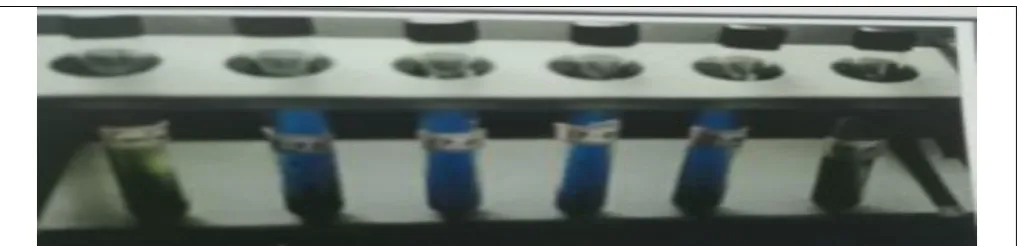
2.1.6.8. Citrate utilization test
This test was performed by H inoculating the bacterial cultures in Simmon's citrate agar
slants and incubated at 30°C for 24 hours. Growth on the slant accompanied by changes oin
colour of the slants to blue indicated positive result. No growth and yellowish green color
slant indicated negative result.
03. RESULTS AND DISCUSSION
3.1. Isolation of Bacillus thuringiensis in seletion media with and without acetate
In the isolation method with and without acetate selection acetate selection media only 11
given in Table 1. The isolates obtained from dilutions of 10-3 10-4 were found to be positive
for Bacillus thuringiens showed cream colour and fried egg like appearance. The colony
characters are presented in the Table-2 (Plate-1). Only 11 samples out of 20 samples reflected
the colony characters same that of Bacillus thuringiens. Martin and Travers (1989) isolated
BT in 785 out of 1115 sample from U.S. and 29 other countries. The soils used for isolation
comprised both and forest soils, these isolated were obtained irrespective of the above
suggesting they are ubiquitous. Some of the soils were negative under both methods when
employed for isolation. The reasons of their absence of these soils needs detail studies to
know the cause for this absence. The study carried out different workers earlier had reported
in the Philippines only 72 out of 54 soil samples harbored Bt (Padua et al., 1982). Aizwa
(1986b) reported that, out of 6910 soil isolates from Japan, morphologically referable to the
Bacillus cereus/Bt group, most of them were acrystalliferous of which 24.6% reacted with
known Bt flagella antisera.
3.2. Morphological characters of isolate
Morphological characters of the colonies and the bacteria were studies the standard
microbiological methods (Pelezar et al., 1957; Collee and Miles, 1989; Lacey, 1997).
3.2.1. Gram's staining
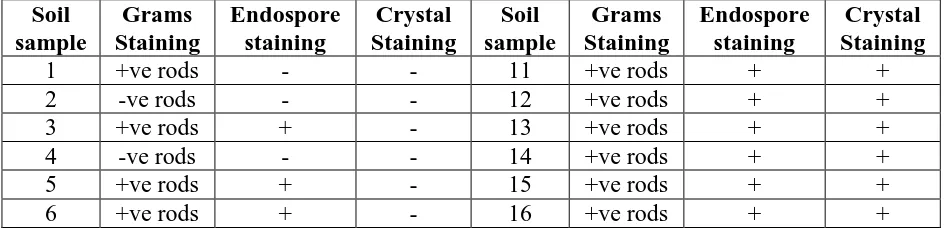
All the 20 isolates were examined for the gram reaction by gram staining method. The results
of the experiment are presented in Table-3. The results for the staining had given only 16
isolates positive for gram reaction and showing the rod shapes. Other were gram negative
rods and cocci. Bt are gram positive rods so, the gives may be only 16 isolates are positive for
the Bt.
3.2.2. Endospore staining
Out of 20 isolates 16 isolates shows endospore formation. Other isolates do not form
endospore. The results were presented in the Table 3. The presence of endospore suggesting
that they are mostly Bacillus spp.
3.2.3. Crystal staining
The isolates were observed for the paranormal crystals adjacent to the endospore. This crystal
staining confirms the Bt isolates. The results of the crystal staining are presented in Table 3.
Only 12 isolates shows the crystal proteins. Then the it was observed for the presence of
confirms out of 12 isolates 6 isolates showed bipolar. Bacillus thuringiensis is gram positive
bacterium occurring naturally in the soil around the world (Krattiger, 1997).
Bacillus thuringiensis isolate from different ecological niches viz. grain dust, soil, rice straw,
compost and mammalian faces, reported by Travers et al. (1987) and Theunis et al. (1998).
Lee et al. reported similar isolation process. kaur et al. (2006) observed morphological and
biochemical characterization and studied all the isolates to be gram positive, rod shaped,
spore farming and showed colony morphology.
3.3. Biochemical test
Biochemical characters of the Bt isolate were done following the standard methods for the
identification of the isolates (Pelczar et al., 1957, Collee and Milez, 1989, Lacey, 1997) and
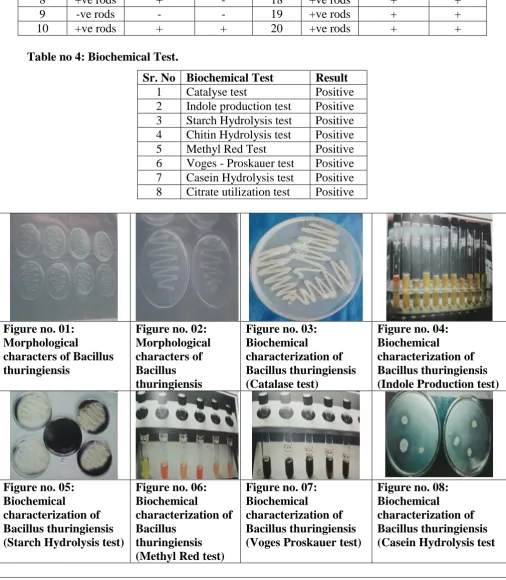
the results were presented below. 7 different type biochemical test (Catalyze test, indole
production test, Starch Hydrolysis test, Chitin Hydrolysis test, Methyl Red Test, Voges -
Proskauer test Casein Hydrolysis test and Citrate utilization test) are performed. (Table
no.04). Stair (1981) and Aramideh et al. (2010) studied on the nitrate reduction, starch and
casein hydrolysis. According to stair catalase production positive on strains of Bacillus
thuringiensis and negative for acid and gas production.
Biochemical test carried out the identification of the Bacillus thuringiensis in culture test
enzyme Catalysis break down of hydrogen peroxide in to water and oxygen Bacillus
thuringiensis shows the effervescence of oxygen from the plate (Refer result Figure no. 03).
In indole production test Bacillus thuringiensis do not convert tryptophan to idole and cannot
form pink color ring (Refer result Figure no. 04). In citrate utilization test Bacillus
thuringiensis grown in a medium containing citrate as sole source of carbon, the appearance
of growth increase the pH to 6.8 which was indicated by color changes from green to blue
(Refer result Figure no. 09). In starch hydrolysis test Bacillus thuringiensis to hydrolyze
starch in to simple substances like dextrin glucose and maltose by amylase enzyme was
detected. After flooded iodine solution clean zone was obtained (Refer result Figure no. 05).
In casein hydrolysis test Bacillus thuringiensis hydrolysis casein and form clean zone was
observed (Refer result Figure no.08). Chitin hydrolysis test Bacillus thuringiensis cannot
hydrolyze chitin and cannot form clean zone. The MRVP test in methyl red test Bacillus
thuringiensis shows red in color They convert pH more than 4.2 (Refer result Figure no. 06).
VP test Bt shows negative result. They do not form crimson red color (Refer result Figure no.
Therefore isolation technique employed is not exclusively efficient to isolate Bt. The isolates
which are positive for crystal protein production were invariable endospore formers but the
morphology of the crystal protein inside. The cells are different in all the isolates, Out of
these 20 samples only 12 samples showed the crystal protein present in the cell. Two kinds of
morphologically different crystal were observed among 12 isolates. It was found that all
crystal formers are invariably endospore formers.
Table No 1: Isolation of local Bacillus thuringiensis isolates from without acetate
selection and with acetate selection method.
Isolation no
Without acetate selection
With acetate selection method Isolation no Without acetate selection With acetate selection method
1 A A 11 P P
2 A A 12 A A
3 A A 13 P P
4 A A 14 P P
5 A A 15 P P
6 A A 16 P P
7 P P 17 P P
8 A A 18 P P
9 A A 19 P P
10 P P 20 P P
[image:7.595.37.566.251.421.2]A-Absent, P-Present
Table No 2: Study the colony characters local Bacillus thuringiencis Isolates.
Soil sample Shape of the colony Colour of the colony ISoil sample Shape of the colony Colour of the colony
1 Round Creamish,Yellowish 11 Fried egg Creamish
2 Round Creamish,Yellowish 12 OVAL Creamish
3 Round Creamish 13 Fried egg Creamish
4 Round Light Yellowish 14 Fried egg Creamish
5 Round Light Yellowish 15 Fried egg Creamish
6 Round Creamish 16 Fried egg Creamish
7 Fried egg Creamish 17 Fried egg Creamish
8 Round Creamish 18 Fried egg Creamish
9 Round Light Yellowish 19 Fried egg Creamish
10 Fried egg Creamish 20 Fried egg Creamish
Table No 3: Study the colony characters local Bacillus thuringiencis Isolates.
Soil sample Grams Staining Endospore staining Crystal Staining Soil sample Grams Staining Endospore staining Crystal Staining
1 +ve rods - - 11 +ve rods + +
2 -ve rods - - 12 +ve rods + +
3 +ve rods + - 13 +ve rods + +
4 -ve rods - - 14 +ve rods + +
5 +ve rods + - 15 +ve rods + +
[image:7.595.12.585.463.613.2] [image:7.595.62.537.644.760.2]7 +ve rods + + 17 +ve rods + +
8 +ve rods + - 18 +ve rods + +
9 -ve rods - - 19 +ve rods + +
10 +ve rods + + 20 +ve rods + +
Table no 4: Biochemical Test.
Sr. No Biochemical Test Result
1 Catalyse test Positive
2 Indole production test Positive
3 Starch Hydrolysis test Positive
4 Chitin Hydrolysis test Positive
5 Methyl Red Test Positive
6 Voges - Proskauer test Positive
7 Casein Hydrolysis test Positive
[image:8.595.62.534.74.133.2] [image:8.595.45.552.94.675.2]8 Citrate utilization test Positive
Figure no. 01: Morphological
characters of Bacillus thuringiensis
Figure no. 02: Morphological characters of Bacillus thuringiensis
Figure no. 03: Biochemical
characterization of Bacillus thuringiensis (Catalase test)
Figure no. 04: Biochemical
characterization of Bacillus thuringiensis (Indole Production test)
Figure no. 05: Biochemical
characterization of Bacillus thuringiensis (Starch Hydrolysis test)
Figure no. 06: Biochemical
characterization of Bacillus
thuringiensis (Methyl Red test)
Figure no. 07: Biochemical
characterization of Bacillus thuringiensis (Voges Proskauer test)
Figure no. 08: Biochemical
Figure no. 09: Biochemical characterization of Bacillus thuringiensis (Citrate utilization test)
04. CONCLUSION
A total of 20 numbers of isolates were obtained from both the methods were studied
microscopically to record the presence of endospore and crystal protein by following standard
staining techniques. Observations were recorded employing phase contrast microscopes were
able to distinguish different type of crystals. All the isolates studied microscopically 16
isolates were endospore and crystal forming isolates test of the isolates were either forming
only endospore or they non spore formers.
05. REFERENCES
1. Adang, M.J., Brody, M.S., Cardinau, G., Eagan, Roush, R.T., Shewmaker, C.J., Jones
A.O., Okces, Mc Bridge, K.C., The reconstitution and expression of Bt CryllIB in
protoplasts and protoplasts. Plant Mol. Microbiology, 1993; 21: 1131-1145.
2. Agaisse, H. and Lereclus, D., How does Bt produce so much insecticidal protein. J.
Bacteriol., 1995; 177: 6027-2032.
3. Amer, G. A., Aggarwal, R., Singh, D.V. and Srivastava, K. D., Interaction of Bt with
Pythium ultimum and Fusarium oxysporum f. sp. Lycopersici; possible role in biological
control. Curr. Sci., 1997; 73: 3-10.
4. Ananda Kumar, P., Sharma, R. P. and Malik, U.S., The insecticidal proteins of Bt.
Advances in Applied Microbiology, 1996; 42: 1-43.
5. Aronson, A., Incorporation of protease K in to larval insect membrane vesicles does not
result in the disruption of integrity or function of the pore forming Bt d-end toxin.
Applied Environmental Microbiology, 2000; 66(10): 4568-4570.
6. Aronson, A., Beck A. Beckman, W. and Dunn, P., Bt and related insect pathogens.
Microbiology Rev., 1986; 50: 1-25.
7. Arun Kumar, K. P., 2002, Characterization of Bt isolates and Development of protocol
for regeneration of field bean (Lablab purpureus) and Transformation of field bean with
8. Bakker, P. Staykov, N., Dukiandjiev, S., Stiekema, W., Bosch, D. and de Maagd,
Identification of Bt d-endotoxin cry 1C Domain III amino acid residues involved in insect
specificity. Appl. Environ. Micobiol., 1999; 65(10): 4369-4374.
9. Ballester, V., Granero, F., Tabashnik, B. E., Mavatur, T. and Ferre, J., Integrative model
for binding of Bt toxins in susceptible and resistant larvae of the diamond back moth
(Plutella xylostella). Appl. Environ. Microbiol., 1999; 65(4): 1413-1419.
10.Barjae, H. and Bonnefoi, A., Essai de classification biochemique et serologique de 24
souches de Bacillus du type Bt. Entamophaga, 1962; 7: 5-31.
11.Baum, J. A., Cola, D M, Gilbert, M. P., Jany, C. S. and Gawrontenike, C., Novel cloning
vectors for Bt. Appl. Environ. Microbiol., 1990; 56: 3420-3428.
12.Becker, and Margalt, 1993, Use of Bt israelensis against mosquitoes and blackflies, p
145-170. In Entwistle, D. F., Cory, J.S., Bailey, MJ. and Higger, S., 1993, Bt An
Environmental Biopesticide, Theory and Practice, John Wiley and Sons.
13.Bege, CC, and Jamamoto, T., History of Bt Berlines: Research and Development, Con.
Entomol, 1992; 124: 587-616.
14.Bel, Y., Canero, F. and Alberola, T.M., Distribution, frequency and diversity of Bt in
olive tree environments in Spain, Syst, and Appl. Microbiol., 1997; 20: 652-658.
15.Ben Dov, E., Boussiba. s. and Zarifsky, A., Mosquito larida activity of E. coli
combinations of genes from Bt s elensis J. Bacteriology, 1995; 177: 2551-2857.
16.Benges, H. D. 4.D., Mimro, report of the second internatiosium on the standardization of
e ste solutions. Tests and principles, Washeringen Netherlands, 1966; 2.
17.Bernhand, K., Jarrett, P., Meadows, M., Butt, J., Ellis, DJ, Roberts, G.M., Pauli, S.,
Rodgers, P. and Barges, HD., National isolates of Bt worldwide distribution,
characterization and activity against insect pest. I insect Pathology, 1997; 70(1): 55-66.
18.Bidochka, M.J., Selinger, L.B. and Khachatourians, 6., A Bt isolate found on grapes
imported from California (USA). J. Food Protect, 1987; 50: 857-858.
19.Bizzand, B.L., Schnepf, H.E. and Kronstad, Expansion of the Cry 1B protein genes of Bt.
Mol. Gen. Genetin, 1991; 231: 59-64.
20.Bonnefoi, A., Bargerjon, A. and Grison, P. Titrage biologique dispreparations de spores
de Bt Berlines. CR Acad. Science, 1958; 247: 1418-1420.
21.Bravo, A., Savabia, S., Lopez, L., Ontiveros, H. Abarca, C.Ortiz, M, Lina, L., Villalobos,
F.J., Pena, O., Nunez Valdez, M., Soberon, M. and Ountero, R, Characterization of cry
22.Chilcoh, C.N. and CN. and Wigley, P.J., Isolation and toxicity of om soil and insect
habitats in New Zealand. J. Invert. Pathol., 1993; 61: 244-247.
23.Chu, CC., Th.CC. 1978, The N6 medium and its applications to another culture of cereal
crops. In: Proc. Symp. Plant tissue culture science press, Beijing, 1978; 43-50.
24.Conger. B.V., Cloning agricultural plants via in vitro techniques, CRC press, Boca Raton,
F.L., Driver, J.A., Kuniyuki, A.H., 1984, In vitro propagation of Pavadox walnut root
stocks. Hort. Science, 1981; 19: 507.
25.Crickmone, N., Zeigler, D.R., Feitelson, J., Sehnspf, E., Van Rie, J., Kerclus, D., Baum,
J. and Dean, D.H., Revision of the nomenclatune of the Bt pesticidal crystal proteins.
Microbial Mol. Biol. Rev., 1998; 62(3): 807-813.
26.Damagaard, P.H., Abdel, H.A., Eilenborg, J. and Smits, P.H., National occurrence of Bt
on grass foliage. World Journal of Microbiology and Biotechnology, 1998; 14: 239-242.
27.Danagand, P.H., Hansen, B. M., Pedersen, S.C. and Eilenberg, V., Natural occurrence of
Bt on cabbage foliage and in insects associated with cabbage crops. J. Appl. Microbiol.,
1997; 82(2): 253-258.
28.Farkas, J. Sebesta, K., Horska, K., Samek, Z. Dolejs, L. and Sorm. F., The structure of
endotoxin of BT var. gelechiae Coll. Czech. Chem. Commu., 1969; 34: 1118-1120.
29.Feitelson, J. S., Payne, J. and Kim, L., Bl. Insects and beyond. Biotech, 1992; 10:
271-275.
30.Feng.X.X. and Xing, X.Y., A preliminary study on a poly crystal stain of Bt Kunchong -
Zhoslu, 1982; 19(3): 18-19.
31.Galowalia, M. M. S., Gibson - nhe, Wolf, S., The comparative potencies of the crystalline
endotoxin of eight varieties of Bt to larvae of piers brassicae, J. invert.., 1973; 21(3):
301-308.
32.Gamborg, 1986, Protoplasts and plant regeneration in re. In: Demain, A.L., Solomon,
M.A. (eds.) Manual of stries microbiology and biotechnology. American Society for
Microbiology, Washington, D. C.
33.Gamborg, O.L., Shyluk, The culture of plant cells using ammonium salts as the sole
nitrogen source. Plant Physiol, 1970; 45: 598-600.
34.Gamborg, O.L., Shyluk, J.P., Nutrition, media and characteristics of plant cell and tissue
cultures in. Thorpe T.A. (ed) Plant tissue cultures methods and applications in agriculture,
Academic Press, New York, 1981; 21-24.
35.Huang, Y.X and Huang, R.R., Investigations of Bt resources in guangixi. Chinese Journal
36.Ibarra, J.E. and Federici, B. A., Comparison of the toxicity, parasporal body protein
composition and plasmid complements of time isolates of BT sub sp. Israelesis J. Econ.
Entomol., 1987; 80(6): 1131-1146.
37.Iizuka, T. and Yamamoto, T., 1984, Serological properties of mosquitocidal protein of Bt
and the morphology of the mosquitocidal protein prasporal crystal.
38.Kalman, S., Kichu, K.L., Cooper, N., Reynoso, MS Yamamoto, T., Enhanced production
of insecticidal proteins in Bt strains carrying an additional protein genes in their
chromosomes. Appl. Environ. Microbiol,. 1995; 61: 3063-3068.
39.Kronstad, W.S. and Whitefly, H.R., Three classes of homologous Bt crystal protein
genes. Gene., 1986; 43: 2940.
40.Kuzmanova, I., Isolation of local strains of Bt and study of their biological properties.
Gradinarska-1 - Lozarska -Nauka, 1975; 12(6): 79-89.
41.Li. R. and Chen, T., The toxicity and morphology of the crystal from several strain of Bt.
Acta-microbiological Sinica, 1981; 21(3): 311-317.
42.Li, R., Jarret, P. and Benges, H.D., Importance of spores, crystals and d-endotoxins in the
pathogen city of different varieties of Bt in Galleria mellonelle and Pieris brassicaei. J.
Invert Pathol., 1987; 50(3): 277-284.
43.Lin-liangbin, Guan-angbin, Guan-Chanyum. Lin, L.B. and Guan, S.Y., inces of studies on
Bt toxic protein gene. J. Human Agril. Univ. 1997; 23(4): 389-396.
44.Martin. AW. and Trakers, R.S., Worldwide abundance and distribution of Bt isolates.
Appl. Environ. Micro. 1989; 55: 2437-2442.
45.Meadows. M.P., Ellis, D.J., Butt, J., Jarret, P. and Burges, H.D., Distribution, frequency
and diversity of Bt in an animal feed mill. Appl. Environ. Micro., 1992; 58: 1344-1350.
46.Milne, R. Murphy. D. and Fast, P.g., Bt delta endotoxin, an improved technique fo the
separation of crystals from spores. J. Invert. Pathol., 1977; 29(2): 230-231.
47.Moar, M.V., Osbrink. W. L. A. and Truble, J. T., Potentiation of Bt var Kurstaki with
thuringiensis on beet wymyworm (Lepidoptera: Noctuidae). J. Econ. Entomology, 1986;
79(6): 1443-1446.
48.Morris, O.N. SON. Conkerbe. V. and Kahagaratham, P., on characterization and culture
of Bt from soil and Isolation characteriza dust from grains storage binds and their facity
for amestra configurata (Lepidoptera Noctivada The Canadian Entomologist, 1998; 130:
49.Nagamatsu, Y.atsu, Y., Tsutsui, R., lehimaru, T., Nagamat, ON Koga, K. and Hoyashik,
Submít structure and to component of delta endotoxin from Be J. Inwert Pothol, 1976;
32(1): 103-109.
50.Nigade. A.V., Wani, P.V., Pawar, V.M. and Indi, DV, Isolation and characterization of
Bt. J. Soil Photo Boot, 1996; 16(2): 113-119.
51.Ohba, M. and Aizawa, K., Insect toxicity of Bio isolates from soils of Japan. J. Invert.
Pathol., 1986; 47(1): 1220.
52.Ohba, M., Aizawa, K. and Sudo, S.L., 1984, Distribution of in sericulture forms of
Pukuoka perfective, Japan Proceedings of the association for plant protection of Kyushu
1984: 30: 152-155.
53.Ordus-Peralter, S., Diza, T., Restrpo, N. and Rais, W. Isolation and characterization of
four new strains of from central Nigeria highly toxic to mosquito larvae. J.Invert. Pathol,
1992; 60: 107-108.
54.Padidam, M. The insecticidal crystal protein cry C from Bt is highly toxic for Helothis
armigero. I. Invert Pathol, 1992; 59: 109-111.
55.Padua, L.E., Gabriel, B.P., Aizawa and Ohba, M., Bt isolated from the Philippine -
Entomological, 1981; 5(2): 199-208.
56.Ren, G., Feng, X. and Feng, W., The shape and antigenic characteristics of the parasporal
crystal of Bt. Acta. Microbiologiciasinicu, 1983; 23(1): 57-62.
57.Sharpe, E.S. and Barker, F.L., Ultrastructure of he unusual crystal of the HD-1 isolate of
Bt var. Kurstaki, J. Invert. Pathol, 1979; 34(3): 320-322.
58.Sharpe, E.S. Hermer, A.L. and Toolan, S.C., Separation spores and parasporal crystals of
Bt by isolation. J. Invert. Pathol., 1979; 34(30): 315-316.
59.Smirnoff, W.A., A staining method for differentiating spores, crystals and cell of Bt. J.
Insect Pathol, 1962; 4: 384-386.
60.Smith, R.A., Use of crystal serology to differentiate among varieties of Bt. J. Invert.
Pathol., 1987; 50(1): 1-8.
61.Slepanov, V.M., Chestukhina, G.G., Zalunian, A., Kostina, Li, Mikhailova, A.Z. Voelter,
W., Winseh, E., Ovehinnikov, Ivanov, V., 1982, Structural features of Bt crystal protein.
Chemistry of peptides and proteins. Proceedings of the third USSR-FRG symposium,
Makhachkala, October 26, 1980; 1: 423-427.
62.Tabashink, B.E, Evolution of resistance to Bt. Annual Rev. Entomol., 1994; 38: 47-79.
63.Tai, G C., A simple staining method for differentiating crystals of Bt. Acta-Entomologica
64.Travers, R.S., Martin, P.A.W. and Reicneldorfer, C.F., Sective process for efficient
isolation of soil Bacillus sp. Appl. Environ. Micro., 1987; 53: 1263-1266.
65.Wu, F.Y. and Tany, K.F., Isolation and identification of an insect pathogenic strain
C.W.-1 Weishengwuxue-longbao, C.W.-198C.W.-1; 8(3): C.W.-10C.W.-1-C.W.-102.
66.Yamamoto, T. and Mc Laughlin, R.E., Isolation of a protein from the parasporal crystal
of Bt var. Kurstaki toxic to the mosquito larvae Aedes Taeniorhychus biochemical and