FORMULATION AND EVALUATION OF TELMISARTAN FLOATING
DRUG DELIVERY SYSTEM
Bidkar S. J., Shelke M. M.*, Dama G. Y. and Bidkar J. S.
SGMSPM, Sharadhchandra Pawar College of Pharmacy, Dumberwadi, Otur, Pune.
ABSTRACT
The present research work was an attempt to formulate and evaluate
tablet containing Telmisartan in the form of tablet to prolong the
release of orally administer. Telmisartan in the floating tablets by using
different Grade of hydroxypropylmethylcellulose (HMPC). Citric acid,
sodium bicarbonate as gas generating agent. Different viscosity grade
polymer of HPMC k4 M, HPMCK100M were used a floating polymer.
It was observed that different viscosity not only influence the drug
release from hydrophilic matrix but they also affect the floating
properties of tablets. Telmisartan is an anti-hypertensive drug under the
class of angiotensin II receptor blocker. The bioavailability of
Telmisartan is range between 42%-58%. Preformulation studies for drug excipient
compatibility is done by FTIR spectroscopy it was observed that there was no compatibility
problem with they are used in study. The tablets were characterized for the pre and post
compression parameters such as friability, hardness, thickness, drug content, weight
variation, in-vitro buoyancy studies and in-vitro drug release studies and the results were
within the limits. The in vitro drug release studies were carried out in an USP type II
apparatus in 0.1N HCL.
KEYWORD: Telmisartan HPMC K4M, HPMC K100M, gastric residence time, Floating tablets.
1. INTRODUCTION
’Floating systems or dynamically controlled systems are low-density systems that have
sufficiently buoyancy to float over the gastric contents and remain buoyant in the stomach
without affecting the gastric emptying rate for a prolonged period of time. This results in an
Volume 8, Issue 8, 1019-1031. Research Article ISSN 2277– 7105
Article Received on 18 May 2019,
Revised on 08 June 2019, Accepted on 28 June 2019,
DOI: 10.20959/wjpr20198-15375
*Corresponding Author
Shelke M. M.
SGMSPM, Sharadhchandra
Pawar College of Pharmacy,
increased gastric retention time and a better control of the fluctuations in plasma drug
concentration.’’
Floating drug delivery system (FDDS) have a bulk density less than gastric fluid and so
remain buoyant in the stomach without affecting the gastric emptying rate for a prolonged
period of time. While the system is floating on the gastric contents, the drug is released
slowly at the desired rate from the system. After release of drug the residual system is
emptied form the stomach. This results in an increased GRT and a better control of the
fluctuation in plasma drug concentration. FDDS is one approaches for improving the
bioavailability of drug via floating the tablets instantly depend upon is interacting with gastric
fluid.
Telmisartan is an anti-hypertensive drug under the class of selective angiotensin II receptor
blocker. It is a class II drug according to biopharmaceutical classification system (BCS); with
poor solubility and high permeability. TEL shows the low dissolution rate in GIT media and
poor bioavability it has dose dependent bioavailability .which is ranging between 42% and
58% according to its own doses of 40mg to 160mg respectively. In anthor word TEL has high
absorption rate with peak plasma concentration of 44.7µg/L. It is practically insoluble in
water (7µg/mL).
2 METHODOLGY 2.1 Material
Telmisartan, HPMCK4M, HPMCK100M, Microcrystalline cellulose, Sodium bicarbonate,
Polyvinylpyrrolidone, Magnesium Stearate, and Talc were used to formulate floating tablets.
All the reagents were used of analytical grades.
2.2 Preparation of TEL Floating Tablet
Floating matrix tablets containing Telmisartan were prepared by wet granulation technique
using varying concentrations of different grades of polymers with sodium bicarbonate.
Polymers and Telmisartan were mixed homogeneously using glass mortar and pestle.
Isopropyl alcohol was used as granulating agent. Granules were prepared by passing the wet
coherent mass through a # 8 sieve. The granules were dried in hot air oven at a temperature of
600c. Dried granules were sieved through # 22 sieves and lubricated with magnesium stearate
and talc just 4-5 min before compression. Lubricated granules were compressed into tablets
Table No. 1: Composition of Telmisartan Floating Tablets.
Ingredients(mg.) F1 F2 F3 F4 F5 F6 F7 F8 F9
Telmisartan 40 40 40 40 40 40 40 40 40
HPMC K4M 20 20 20 25 25 25 30 30 30
HPMCK100M 60 75 90 60 75 90 60 75 90
Sod. Bicarbonate 20 20 20 20 20 20 20 20 20
Citric Acid 10 10 10 10 10 10 10 10 10
PVP K30M 20 20 20 20 20 20 20 20 20
Mg stearate 10 10 10 10 10 10 10 10 10
Talc 5 5 5 5 5 5 5 5 5
MCC 185 200 215 190 205 215 190 210 225
Total 350 350 350 350 350 350 350 350 350
3. RESULTS AND DISCUSSION 3.1 Preformulation Study
3.1.1 Characterization Study: In the present study, an attempt was made to formulate floating tablets of Telmisartan by using HPMC K4M, HPMCK100 M as polymer. the
characterization done by the UV, FTIR Spectroscopy.
3.1.2 Description: white to off-white crystalline powder.
3.1.3 Determination of melting point
The melting point of Telmisartan was found to be in the range of 260°C to 269°C. the
reported melting point for telmisartan is of 265°C to 272°C. Hence, experimental value are in
good agreement with official value.
3.1.4. Solubility: Practically insoluble in Water and 0.1N HCL, Telmisartan is freely soluble in Ethanol and dichloromethane. Springly soluble in methanol.
3.1.5. Preparation of Standard Curve of Telmisartan
Accurately weighed 50 mg of drug was dissolved in ethanol and then made up to a volume of
50ml with 0.1 N HCL it gives 1000µg/ml ppm concentration stock solution. From the stock
solution different concentration (10, 20, 30, 40, 50, and 60 μg/ml) were prepared. TEL at the
Table No 2: Calibration curve of Telmisartan.
Sr. No. Concentration (μg/ml)
Absorbance in 0.1N HCl
1 10 0.044
2 20 0.087
3 30 0.133
4 40 0.170
5 50 0.218
6 60 0.266
3.2Pre-compression Evaluation
Fig no 1: Standard calibration curve of Telmisartan.
1. Angle of Repose (θ)
The angle of repose of powder blend was determined by the funnel method. A clean and dry
funnel was taken and attached to burette stand. A white paper site was placed 5cm below the
tip of the funnel in a dry plat form. Gently this sample was pore in to the funnel. Using a
pencil circle was drawn around the tip of powder. The height of the hip also measured.
Angle of Repose (θ) = tan –1 h/r
Where,h= height of the powder cone and r= radius of the powder cone.
2. Bulk density (Db.)
Both loose bulk density (LBD) and tapped bulk density (TBD) was determined.
a) Loose Bulk Density (LBD)
An accurately weighed quantity of 10 gm. of powder was transferred to 10ml measuring
cylinder and the volume occupied by the powder in terms of ml was recorded. LBD and TDB
LBD =Weight of powder in gram
Untapped volume of the packed in ml
b) Tapped bulk density (TBD)
Loosely packed powder in the cylinder was tapped 100 times on plan hard surface and
volume occupied in ml.
TBD = Weight of powder in gram
Tapped Volume of the packing in ml
2. Compressibility index
The compressibility index is measure of the capacity of a powder to be compressed. The
Compressibility Index of the powder blend was determined by Carr’s compressibility index.
It is a simple test to evaluate the LBD and TBD of a powder and the rate at which it packed
down. The formula for Carr’s Index is as below:
Carr’s index = TBD- LBD × 100 TBD
4. Hausner’s ratio (HR)
This was calculated as the ratio of tapped density to bulk density of the sample
HR = Tapped Density
[image:5.595.108.488.503.637.2]Bulk Density
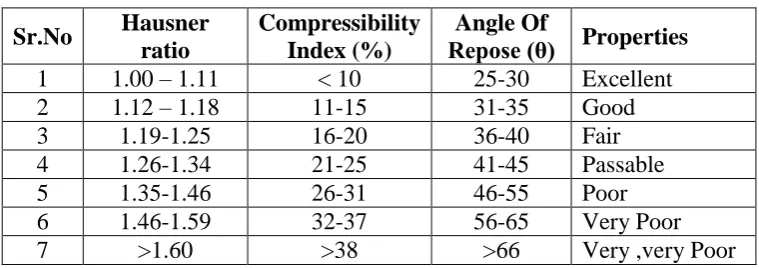
Table No 3: Scale of Flow ability.
Sr.No Hausner ratio
Compressibility Index (%)
Angle Of
Repose (θ) Properties 1 1.00 – 1.11 < 10 25-30 Excellent
2 1.12 – 1.18 11-15 31-35 Good
3 1.19-1.25 16-20 36-40 Fair
4 1.26-1.34 21-25 41-45 Passable
5 1.35-1.46 26-31 46-55 Poor
6 1.46-1.59 32-37 56-65 Very Poor
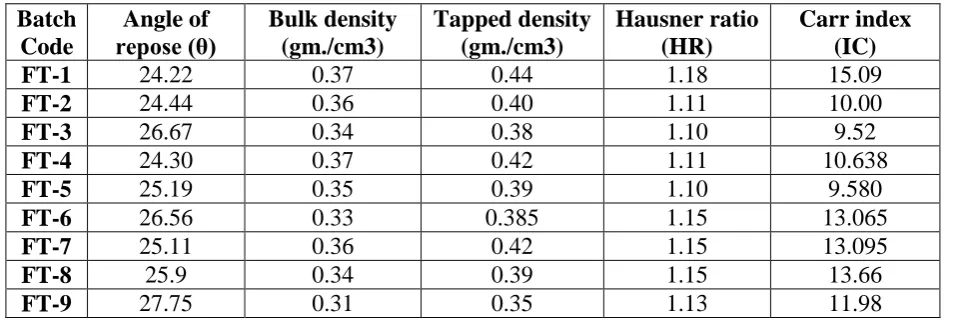
Table No 4: Micrometric properties of powder blend. Batch
Code
Angle of repose (θ)
Bulk density (gm./cm3)
Tapped density (gm./cm3)
Hausner ratio (HR)
Carr index (IC)
FT-1 24.22 0.37 0.44 1.18 15.09
FT-2 24.44 0.36 0.40 1.11 10.00
FT-3 26.67 0.34 0.38 1.10 9.52
FT-4 24.30 0.37 0.42 1.11 10.638
FT-5 25.19 0.35 0.39 1.10 9.580
FT-6 26.56 0.33 0.385 1.15 13.065
FT-7 25.11 0.36 0.42 1.15 13.095
FT-8 25.9 0.34 0.39 1.15 13.66
FT-9 27.75 0.31 0.35 1.13 11.98
3.4 Post-compression evaluation of Telmisartan floating tablets 1. Weight variation test
To study weight variation 10 tablets of the formulation were weighed using an electronic
balance and the test was performed according to the official method. 10 tablets were selected
randomly from each batch and weighed individually to check for weight variation.
Percentage Deviation (PD) = Wavg-Winitial
wavg
Where, WAvg = average weight and
WInitial =initial weight
Acceptance Criteria for tablet weight variation (USP29-NF34) Table No 5: Weight variation tolerance for uncoated tablets.
Average weight of Tablet (mg) % difference allowed
130 or less than ±10
130-324 ±7.5
More than 324 ±5
2. Drug content
Five tablets were weighed individually and powdered. The powder equivalent to average
weight of tablets was weighed and drug was dissolved in 0.1N HCL. The drug content was
determined measuring the absorbance at 272 nm after suitable dilution using a Jasco V-630
UV- Visible double beam spectrophotometer.
3. Hardness
Hardness indicates the ability of a tablet to withstand mechanical shocks while handling. The
hardness of the tablets was determined using Monsanto hardness tester. It is expressed in
4. Thickness
The thickness of the tablets was determined by using Vernier calipers. Five tablets were used,
and average value was calculated.
5. Friability Test
The friability of tablets was determined using Roche Friabilator. It is expressed in percentage
(%). Five tablets were initially weighed and transferred into friabilator. The friabilator was
operated at 25rpm for 4 minutes or run up to 100 revolutions. The tablets were weighed
again. The % friability was then calculated by-
Percentage Friability = W-W0 × 100
W
Where,
W0= initially weight
W= weight after friability
Percentages Friability of tablets less than 1% are considered acceptable.
6. Tablet density
Tablet density is an important parameter for floating tablets. The tablet will float when its
density is less than that of 0.1N HCL (1.004).
The density was determined using following formula
d = m/v
Where, v = volume of tablet (cc)
r = radius of tablet (cm)
h = crown thickness of tablet (cm)
m = mass of tablet.
Table No 6: Evaluation of physical parameters of Telmisartan floating tablets.
Batch Code
Weight variation
Average wt. in (mg) ±SD
Hardness (kg/cm2)
±SD
Thickness (mm)
±SD
Friability (%)
Drug Content Uniformity
(%)±SD
Tablet Density
FT-5 348.8±0.56 4.66±0.25 5.30±0.10 0.99 98.66±0.57 0.84 FT-6 348.4±0.54 4.42±0.45 5.06±0.15 0.90 94.66±0.57 0.88 FT-7 345.6±0.84 4.36±0.41 5.13±0.15 0.82 97.00±0.57 0.86 FT-8 348.3±0.87 3.64±0.20 5.13±0.11 0.79 96.66±0.57 0.87 FT-9 348.7±0.33 4.12±0.31 4.93±0.15 0.89 94.66±2.08 0.90
7. In vitro buoyancy studies
The in vitro buoyancy was determined by floating lag time method described by Dave B.S.
The tablets were placed in 100 ml beaker containing 0.1 N HCl. The time required for the
tablets to rise to the surface and float was determined as floating lag time. The time between
introduction of dosage form and its buoyancy in 0.1 N HCl and the time during which the
dosage form remain buoyant were measured. The time taken for dosage form to emerge on
surface of medium called Floating Lag Time (FLT) or Buoyancy Lag Time (BLT) and total
duration of time by which dosage form remain buoyant is called Total Floating Time (TFT).
8. Swelling index of Telmisartan floating tablets
The swelling index of tablets was determined by using 0.1 N HCl (pH 1.2) at room
temperature. The swollen weight of the tablets was determined at predefined time intervals.
The swelling index was calculated by the following equation:
Swelling Index(SI) = × 100
Wo
Where,
Wt. = Weight of tablet at time t.
W0 = Initial weight of tablet
Table No 7: Floating Profile of Telmisartan tablets.
Formulation code Floating lag time (sec)
Total Floating
time (hours) Swelling Index (%)
F1 48 6 85.25
F2 37 6 89.22
F3 50 4 83.42
F4 20 8 87.21
F5 16 10 98.62
F6 45 10 96.32
F7 56 10 89.42
F8 80 12 92.43
9. In Vitro drug release studies of Telmisartan floating tablets
The release rate of from floating tablets was determined using The United States
Pharmacopoeia (USP) XXIV dissolution testing apparatus II (paddle method). The
dissolution test was performed using 900 ml of 0.1 N HCl, at 37 ± 0.5°C and 50 rpm. A
sample (5ml) of the solution was withdrawn from the dissolution apparatus hourly for 12h,
and the samples were replaced with fresh dissolution medium. The samples diluted to a
suitable concentration with 0.1N HCl. Absorbance of these solutions was measured at 272nm
using a Jasco UV-Vis double beam spectrophotometer. Cumulative percentage of drug
release was calculated using the equation obtained from a standard curve.
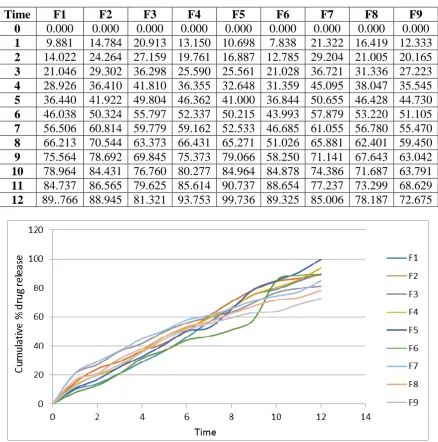
Table No 8: In-Vitro Drug Release Data of Telmisartan batch F1-F9.
Time F1 F2 F3 F4 F5 F6 F7 F8 F9
[image:9.595.79.518.286.729.2]0 0.000 0.000 0.000 0.000 0.000 0.000 0.000 0.000 0.000 1 9.881 14.784 20.913 13.150 10.698 7.838 21.322 16.419 12.333 2 14.022 24.264 27.159 19.761 16.887 12.785 29.204 21.005 20.165 3 21.046 29.302 36.298 25.590 25.561 21.028 36.721 31.336 27.223 4 28.926 36.410 41.810 36.355 32.648 31.359 45.095 38.047 35.545 5 36.440 41.922 49.804 46.362 41.000 36.844 50.655 46.428 44.730 6 46.038 50.324 55.797 52.337 50.215 43.993 57.879 53.220 51.105 7 56.506 60.814 59.779 59.162 52.533 46.685 61.055 56.780 55.470 8 66.213 70.544 63.373 66.431 65.271 51.026 65.881 62.401 59.450 9 75.564 78.692 69.845 75.373 79.066 58.250 71.141 67.643 63.042 10 78.964 84.431 76.760 80.277 84.964 84.878 74.386 71.687 63.791 11 84.737 86.565 79.625 85.614 90.737 88.654 77.237 73.299 68.629 12 89..766 88.945 81.321 93.753 99.736 89.325 85.006 78.187 72.675
CONCLUSION
From the present study, the following conclusions were observed:
Gastric Floating Drug Delivery (GFDD) systems of Telmisartan with shorter lag time can
be prepared by wet granulation method using HPMC K4M, HPMC K100 and NaHCO3,
Citric acid as gas generating agent
All the prepared tablet formulations were found to be good without capping and chipping. The in vitro dissolution profiles of all the prepared GFDDS formulations of Telmisartan
were found to extend the drug release over a period of 10 to 12 hours and the drug release
rate decreased with increase in polymer concentration.
IR spectroscopic studies indicate no drug-excipients interaction in the prepared
formulations. Comparing the all formulations, GFDDS formulation of F5 was considered
as an ideal formulation which exhibited 99.73% of drug release in 12 hours, and floating
lag time of 16 second with a total floating time of 12 hours.
REFERENCES
1. Bhavjit Kaur, Shivani Sharma, Geetika Sharma, Rupinder Saini, Sukhdev, Meenu
Nagpal, Mandeep Sharma A review of floating drug delivery system Asian journal Of
Biomedical and Pharmaceutical Sciences, 2013; 3(24): 1-6.
2. A.Arunachalam, M.Karthikeya, Kishore Konam, Pottabathula Hari Prasad, S.Sethuraman,
S.Manidipa Floating drug delivery systems: A Review An Int. J. Res. Pharm. Sci, 2011;
2(1): 76-83 ISSN:0975-7538.
3. Daghan MH, Khan FN, gastro retentive drug delivery systems: A Patent perspective. Int.
J. Health Res., 2009; 2: 23-44.
4. Mathur P. Saroha K, Sayan N, Verma S, Kumar V, Floating drug delivery systems an
innovative acceptable approach in gastro retentive drug delivery, Arch Apll Sci Res.,
2010; 2: 257-70.
5. Shah SH, Patel Jk, Patel N.V., Stomach specific Floating Drug Delivery System a review
An Int. J. Pharm Tech Res., 2009; 1: 63-33.
6. Bharkatiya Meenakshi, Kitawat Santosh, Ojha Annapurna A Review: Floating Drug
Delivery System an Journal of Drug Delivery & Therapeutics, 2014; 4(2): 130-134.
ISSN; 2250-1177.
7. Abhishek Suryawanshi, S.P, Hiremath A Review: Floating Drug Delivery Systems an
8. Neha Narang An updated review on: floating Drug Delivery system an international
journal applied Pharmaceutics, 2011; 3(1): ISSN:-0975-7058.
9. Meenakshi Kandwal, Dr.G.Gnanarajan, Dr.Preeti Kothiyal Floating Drug Delivery
System: A novel approach the pharma innovation –journal, 2014; 3: 3.
10.Drishti Rani Ghosh, Rishikesh, Md.Anwarul Haque, Mst Rikta Banu, Mohammad
Mahbubur, Hossain Maih, Md. Mofizur Rahman. A Review Floating Drug Delivery
System Journal of Drug Discovery and Therapeutics, 2013; 1(8): 52-59.
11.Vishal Bhardwaj, Nirmala S.L., Harikumar floating drug delivery system: a review. an
International Research Journal pharmacophore, 3013; 4(1): 26-38 ISSN 2229-5402.
12.Mohit R.Gaikwad, S.Z.Chemate, Mubashshera S. Shaikh formulation and IN-Vitro
Evaluation of Floating Tablets of Telmisartan. World Journal of Pharmaceutical
Research, 5(7): 1281-1295.
13.Bhavjit Kaur, Shivani Sharma, Geetika Sharma, Rupinder Saini, Sukhdev Saini, Sukhdev
Singh, Meenu Nagpal, Mandeep Sharma A review of floating drug delivery system Asian
journal Of Biomedical and Pharmaceutical Sciences, 2013; 3(24): 1-6.
14.Amrinder Singh, K.K Jha, Anuj Mittal, and Amit Kumar A Review on: Telmisartan
Journal of Scientific & Innovative Research, 2(1): ISSN: 2230-4818.
15.Kumar Ganesh, Dhyani Archana, Kothiyal Preeti Natural Polymer In Floating Drug
Delivery System: A Review an International Journal of Pharmaceutical and Life Sciences,
2013; 2(4): ISSN 2305-0330.
16.Albhar ketan, Wagh Vaibhav, Chavan Bhagwat. Effect on HPMCK4M, HMPCK15,
Sodium alginate, Carbopol 934in the formulation of carbonyl iron capsule Scholar
Research Library Der Pharmacia Letter, 2012; 4(1): 367-394 ISSN 0974-248X.
17.Shalini Sharma, Mukesh Prashar, and Ram Kumar Sahu Floating Drug Delivery System:
Incredible Revolution A pharmacology online, 2011; 3: 1039-1054.
18.D.Saritha, D. Sathish, Y.Madhusudan Rao Formulation and Evaluation of Gastro
retentive Floating Tablets of Domperidone Maleate an Journal of Applied Pharmaceutical
Science, 2012; 02(03): 68-73.
19.Shreeraj H.Shah, Jayvadan K.Patel, Nirav V.Patel an Formulation and evaluation of
effervescent Floating tablet of Levofloxacin against H.pylori infection an Pelagia
Research Library Der Pharmacia Sinica, 2010; 1(3): 232-244 ISSN:0976-8688.
20.Yash Paul, Manoj Kumar, Bhupinder Singh Formulation and in vitroevaluation of
Gastroretntive drug delivery system of Cefixime Trihydrate an International Journal of
21.Ratnaparkhi Mukesh P, Pawar Sham A, Somvanshi Fattesingh U., Chudhari Shilpa P.
Formulation and Development of Floating Drug Delivery of Itopride HCL. an Journal of
Drug Delivery & Therapeutics, 2013; 3(4): 222-228.
22.Deepu S, Dr.Molly Mathew, Shamna MS Formulation and Evaluation of Swelling
Restricted Matrix Tablet Containing Metformin HCL an IOSR journal of Pharmacy, 4(4):
43-52 ISSN: 2319-4219.
23.Shashanka Venmam, Bahurao Bhukya Formulation and Evaluation of Gastrortentive drug
delivery system of Amlodipine Besylate Floating tablets a Journal of Drug Delivery
Research, 3(1): and ISSN2319-1074.
24.A.Niharika, D.K.Sarangi, D.Ghose, S.K.Mekap, R, Rana an Formulation and Evalution of
Metoprolol Succinate and Hydrochlorothiazide Bilayer tablets by Wet Granulation
method an Research Journal of Life sciences, Bioinformatics, Pharmaceutical and
Chemical Sciences, 2018 ISSN 2454-6348.
25.U.Sambamoorthy, D.Yashwant kumar, G.Venkata Ramana, K, Suresh, J.Sunil an
Formulation and Evaluation of Floating Matrix Tablets of Telmisartan an IJCTPR, 2014;
2(6): 494-505. ISSN:2321-3760.
26.Mohit R.Gaikwad, S.Z. Chemate, Mubashshera S. Shaikh a Formulation and Evaluation
of Floating tablets Telmisartan a World journal of pharmaceutical research, 5(7):
1281-1295.
27.Sameer Singh, Kalpana Prajapati, A K Pathak, A Mishra on Formulation and Evalution of
Floating Tablet of Captopril.an International Journal Of Pharm Tech Research, 3(1):
333-341. ISSN:0947-4304.
28.Syed Iftequar, Maria Saifee, Lahoti Swaroop, Zahid Zaheer, Sabina Meraj, Furqan Khan,
Sarfraz Khan, Qazi Yasar, Shaikh Abdulla on Formulation and evaluation of Floating
drug delivery system of ramipril an Journal of Innovations in Pharmaceuticals and
Biological Sciences, 2016; 3(1): 85-95.
29.B.Prabakaran, K.Elango, K. Ramesh Kumar Jaison Formulation Development and
Evaluation of Gastro retentive Bilayer Floating Tablets of Simvastatin and Telmisartan an
International Journal of Pharma Research & Review, Jan 2016; 5(1): 9-18.
30.Rajesh Asijia, Sangeeta Asijia, Shailendra Bhatt, Deepak Sharma, Avinash Shah,
Priyanka Sharma an Formulation and evaluation of Floating tablet of Valsartan an Journal
of Chemical and Pharmaceutical Research, 2015; 7(2): 708-715 ISSN:0975-7384.
31.Nidhi Jain, Rahul Gupta an Approach of Developing Floating Tablet of Lisinopril an
32.Jhansee Mishra, Alok Kumar Dash Formulation and Floating Activity of
Antihypertensive Floating Tablet Losartan an World Journal of Pharmacy And
Pharmaceutical Sciences, 2(3): 1246-1258 ISSN2278-4357.
33.D.V Charan, C.P. Meher, B.Pochaiah Design and Evaluation of Atenolol Floating Drug
Delivery System an International Journal of current Pharmaceutical Review and
Research, 4(1): 10-26 ISSN: 0976-822X.
34.Lachman, L., Lieberman, H.A, Kanig, J.L, the Theory and Practice of Industrial
Pharmacy, 3rd Ed, 1992; 171-194, and 293-372.
35.A.P.Pawar. the Theory & Practice of Pharmaceutics I carrer publication, 154-155.
36.Atmaram Pawar, R.S.Gaud the Modern Dispensing Pharmacy carrier publication 3rd
edition, 320-321.
37.United State Pharmacopeia 22-Nf 27. 2004. Page no.2769, 2877, 2889.
38.Indian Pharmacopeia Vol II, 1996. Page no.734, A-80-83.
39.M. Aulton, Pharmaceutics, the science of dosage form design, 2nd ed., 2002; 410-411.
40.Subramanyam CVS. Text Book of Physical Pharmaceutics. 2nd ed. Delhi; Vallabh
Prakashan, 2003.
41.Derle, Boddhu the Essential of Physical Pharmacy 2nd ed.; 187-213.