Bansal. World Journal of Pharmaceutical Research
EFFECT OF BIOCHAR AMENDMENT AND AGEING ON SORPTION
AND DISSIPATION OF TETRACYCLINE’S IN SOILS
*Dr. O. P. Bansal
Chemistry Department, D.S. College, Aligarh-202001 (U.P.).
ABSTRACT
This study pertains to investigate the effects of biochar an
environmental friendly soil amendment used to enhance the soil
fertility on the sorption dissipation and mobility of three tetracycline
antibiotics, viz., chlortetracycline (CTC), oxytetracyline (OTC) and
tetracycline (TC) on six agricultural field soil samples collected from
different parts of India. The results of the study revealed that with the
increase in TCs concentration the sorption of TCs increased in both the
bulk soils and biochar amended soils denoting that process of TCs
sorption is influenced by the soil properties mainly organic carbon and
CEC. The sorption of TCs was significantly increased in presence of biochar which might be
attributed to availability of sorption sites on biochar and the presence of micro pores in
biochar. However, the sorption retards in aged biochar amended soils which might be due to
covering of micro pores by organic and inorganic substances and oxidation of functional
groups on the biochar surface. The adsorptive capacity of soils was in order soil No. 3 > 5 > 2
> 4 > 1 > 6. The adsorption capacity was significantly positively correlated with the amount
of biochar amended. The interaction between TCs and biochar might occur via multiple
bonding mechanisms including ionic bond between negative charged organic matter and
positively charged TCs and/or hydrogen bonds in between TCs and organic matter. The
sorption data of un- amended and biochar amended soils were best fitted in Freundlich
adsorption equation and the adsorption isotherms were of ‘L’ type. The TCs dissipation in all
the substrates followed the first order rate equation and DT50 ranged in between 34.3 to 58.7
d. Soils amended with biochar enhanced the stability of TCs and reduced their mobility. The
concentration of TCs below 10 cm after 91 days of application in biochar amended soils was
70% lesser than un-amended soil. The dissipation in soil environment was slow, indicating
that these compounds may persist in soils.
Volume 7, Issue 7, 896-912. Research Article ISSN 2277– 7105
Article Received on 02 Feb. 2018,
Revised on 22 Feb. 2018, Accepted on 14 March 2018
DOI: 10.20959/wjpr20187-11553
*Corresponding Author
Dr. O. P. Bansal
Chemistry Department, D.S.
College, Aligarh-202001
KEYWORDS: Antibiotics, compost, DT50,organic carbon, soils.
INTRODUCTION
Antibiotics particularly tetracyclines are among the most common medications used for
human and veterinary treatments. Veterinary antibiotics are used in large amounts for
therapeutic and prophylactic purposes as well as growth promoters.[1,2] The tetracycline’s
{Tetracycline (TC), Oxytetracyline (OTC) and chlortetracycline (CTC)} are broad spectrum
antibiotics widely used in animal production. As tetracycline’s and other antibiotics
administered in humans and animals undergo minimal or no metabolism and are excreted in
urine and manure in an either unaltered or as metabolites, a large number of antibiotics have
been detected in soil, animal manure, sediment, ground and sewage water samples. These
antibiotics are released in the terrestrial environment via the application of animal manure
and bio solids containing excreted antibiotics to agricultural land as fertilizer.[3,4] Antibiotics
can also be introduced to the agricultural land through irrigation with sewage waste water.[5,6]
The fate of pharmaceuticals in the environment is not different from that of other organic
chemicals such as pesticides.[7] Knowledge of persistence pollutants and their sorption
behavior is crucial for the evaluation of the leaching. The sorption of tetracycline is
influenced by soil pH, organic matter and metal ions.[8]
As biochar has environmental benefits it is a acceptable soil amendment. Biochar amendment
can alter soil properties such as sorption, degradation and leaching of different chemicals.
Biochar is a carbon rich bio product that is produced from feedstock through the process of
pyrolysis which is stable carbonaceous substance with high porosity, big surface area.
Addition of biochar in soils boost soil fertility and improve soil quality by changing the pH,
increasing water holding capacity, enhancing the cation Exchange Capacity (CEC), nutrient
availability and microbial population.[9-11] The high specific surface area and CEC of biochar
as compared to soil reduces leaching of nutrients.[12,13]
The main objective of the present study was to investigate the effects of biochar and aged
biochar amended six soils differing significantly in organic matter (OM) and other physical
and chemical properties on the sorption, dissipation and leaching of tetracycline. The results
of this study will be helpful for understanding the impact of biochar amendment on sorption,
MATERIALS AND METHODS
Six types of surface soils (0-25 cm depth), which had never been applied with tetracycline
were collected from different parts of India. These soils were air dried, crushed and grounded
to pass through <70 mesh sieve, then stored at 40C before use. The physicochemical
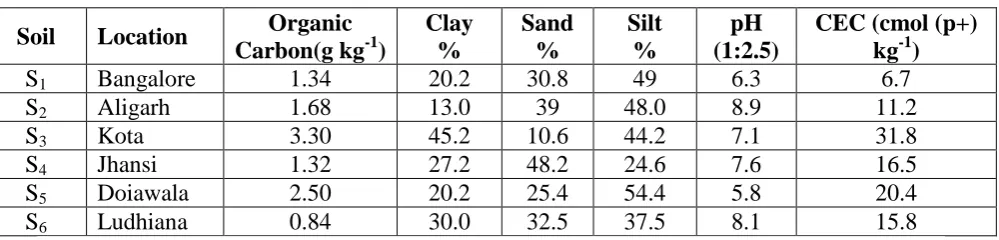
properties of these soils are given in Table 1.
Preparation and ageing of soil - Biochar Mixtures
The biochar used was prepared from paddy straw by the methods as described by Reddy.[14]
The characteristics of the biochar are given in Table 2. Soil mixtures were prepared by
mixing soil with sieved biochar (< 2mm) at a rate of 1, 2 and 5% biochar per unit soil dry
weight. Biochar ageing was performed by amending soils with 2% of biochar. These
mixtures were incubated in darkness at room temperature for 4 months. The moisture content
was adjusted to 60% of water holding capacity and monitored and adjusted weekly by
addition of deionized water.
Sorption isotherms
Sorption experiments were conducted by placing 5 g of air dried soils and soil-biochar
mixtures in large number of glass stoppered tubes and adding various amounts of tetracycline
solution in methanol (0-15 ml of 20 µg ml-1) and making upto 25 ml with distilled water. The
suspensions were shaken for 30 h at 25±2oC (Preliminary studies indicated that equilibrium
was attained < 27 h). When equilibrium was attained the suspensions were centrifuged at
13,000 rpm for 15 min. The amount of tetracyclines in supernatants was estimated.
Analysis of tetracyclines
The concentration of TC, OTC and CTC in soil extracts were analyzed by HPLC using an
Agillent 1100 system with an octadecilsilan column (50mmx4mmx3um, AQ-YMC), TC,
OTC and CTC were analyzed simultaneously.[15] A gradient elution was carried out over 20
min with 0.1% formic acid in acetonitrile (Solvent A) and 0.1% formic acid in water (Solvent
B). The initial percent of Solvent A was 5%, which was then increased to 30% from 0 to 7
min and remained at 30% from 7 to 8.5 min. The percentage of Solvent A was returned to 5%
from 8.5 to 10 min and remained at 5% from 10 to 12 min. The flow rate was maintained
0.70 mL min-1 throughout the analysis and simultaneous detection of TC, OTC and CTC was
performed at 360 nm. Retention times of OTC, CTC and TC were 6.4, 17.3 and 9.6 min.
Degradation and movement studies
For persistence and degradation studies 1 kg of soil and soil-biochar mixtures were incubated
with 0, 5, 10, 20 and 50 µg g-1 soils of tetracycline in methanol in several polypropylene pots
separately at 60% of water retention capacity. Moisture was regularly maintained based on
the difference in between two consecutive days. Samples were incubated at room
temperature. The residues were monitored at the time interval of 0 (4 h), 7, 14, 21, 28, 35, 42,
49, 56, 63, 70, 77, 84 and 91 days after incubation followed by residue analysis.
Mobility studies
The mobility studies were conducted in 60 x 12 cm PVC pipes. The lower end of pipes was
sealed with polythene and cotton cloth. The pipes were filled with 10 kg of each soil and
soil-biochar mixtures. 200 mg of tetracycline in methanol (20 µg g-1 soils) were applied separately
in all the pipes at 60% of water retention capacity. Soil samples were collected using a steel
soil sampler at the depth of 0-15 and 15-30 cm after 0, 7, 14, 21, 28, 35, 42, 49 days of
application and at the depth of 0-15, 15-30, 30-45, 45-60 cm after 56, 63, 70, 77 and 91 days
of application followed by residue analysis.
All the chemicals used were of analytical grade and all the experiments were done in three
replicates with suitable blanks.
RESULTS AND DISCUSSION
The adsorption isotherms, Freundlich and Langmuir were used to fit the sorption of TCs in
the sorbents. The results showed that Freundlich relationship (R2>0.91) can be best used to
describe TCs adsorption results on soils and biochar amended soils. The linear form of this
equation is log C = log K + 1/n log Ce. Where C is the amount (mg kg-1) of TCs adsorbed, Ce
is the equilibrium concentration in solution (mg L-1), K (mg-1/nL1/nkg-1) is the Freundlich
adsorption coefficient and 1/n is a describer of isotherm curvature. The values of 1/n were
less than unity indicating a L’ type of isotherm. The values of K and 1/n (Table 3) followed
the order CTC > OTC > TC. The values of K and 1/n were higher in biochar amended soils
than un amended soils and followed the order 5% biochar> 2% biochar > 2% aged biochar >
1% biochar > un-amended soil. The data of Table 3 also denote that sorption of TCs on
different soils were in the order soil 3> 5> 2> 4> 1> 6. The enhancement in TCs sorption in
biochar amended soils may be availability of sorption sites on biochar and the presence of
micro pores in biochar.[16,17] Data of Fig 1 and Table 3 also denote that sorption capacity of
lower than 2% fresh biochar amended soils. The decrease in sorption of studied antibiotics in
aged biochar amended soils might be due to covering of micropores by organic and inorganic
substances and oxidation of functional groups on the biochar surface.[18]
The sorption isotherms (Fig. 1) showed that the quantity of TCs adsorbed on all matrices
increased with increasing TC concentration in equilibrium solution. The slope of the isotherm
steadily decreases with the rise in solute concentration as vacant sites become less accessible
with the progressive covering of the surface. The curvilinear isotherm suggests that the
number of available sites for the adsorption become a limiting factor. The sorption isotherms
were convex or ‘L’ type[19]
(Fig.1). These kinds of isotherm arise because of minimum
competition of solvent for sites on the adsorbing surface. The adsorption was in the order
CTC > OTC >TC. The adsorption of all the three antibiotics followed the order soil 3 > 5 > 2
> 4 > 1 > 6 supporting the hypothesis that clay content, CEC and organic matter plays an
important role in sorption of antibiotics. The sorption isotherms for biochar amended soils
(Fig. 1) were non-linear and similar to those un-amended soils. When biochar is added in
soils the sorption of TCs was increased significantly as addition of biochar in soils increases
the organic carbon content and CEC of soils by increasing available sorption sites on biochar
and the presence of micro pores in biochar. The more the biochar was added more the
sorption of TCs was observed and sorption followed the order 5% biochar> 2% biochar > 2%
aged biochar > 1% biochar > un-amended soil. This increase could be related to the sorption
of organic matter to the soil by increasing the sorption sites available for adsorption as
organic matter enhanced carboxyl and phenolic groups that may interact with polar groups of
TCs. The interaction between TCs and organic matter occur via multiple bonding
mechanisms including ionic bond between negative charged organic matter and positively
charged TCs and/or hydrogen bonds in between TCs and organic matter.[20] The decrease in
sorption of studied TCs in aged biochar amended soils might be due to covering of
micropores by organic and inorganic substances and oxidation of functional groups on the
biochar surface.[18]
Preliminary studies denoted that the dissipation of TCs on studied samples followed the first
order reaction, as all the regression lines generated have a coefficient of determination (R2)
more than 0.92.
The Equation (1) describes the dissipation kinetics and equation (2) is used to calculate
Ct = Co x e-(kt) ….. (1) DT50 = 0.693/k ….. (2)
Where Co and Ct are the concentration of analytes at time 0 and time t (days) and k is the
first order rate constant determined as the slope value from test substance dissipation curves.
The time taken for dissipation of 50% (DT50) of the CTC in all the treatments were 36.1 to
58.7 d (Table 4) which were longer than OTC (35-55 d), which were longer than TC
(34.3-53.3 d), denoting that CTC was more stable in the soils and soil biochart mixture followed by
OTC and TC. An examination of data of Table 4 showed that the rate of degradation
followed the soil order S6>S1>S4> S2 > S5 > S3 indicating thereby a role of soil organic
matter, CEC and clay content.[21,22] The rate of degradation was inverse the order of sorption.
The DT50 increased with increase in amount of biochar. The dissipation in different compost
amended soils was in the order 5% biochar < 2% biochar < 2% aged biochar < 1% aged
biochar < un-amended which might be significantly correlated with soil organic carbon and
CEC which in turn enhance the sorption of TCs.[23] The difference in dissipation times of
different antibiotics on same substrates may be due to their characteristics and the nature of
substrate.
Mobility Studies
Results of mobility studies denote that the TCs in all the studied biochar un-amended soils
did not leach below 30 cm. The concentration of studied tetracyclines below 15 cm after 91
days of application in un-amended soils was 20-38% of the initial amount of TCs applied.
With the amendment of biochar into the soil, leaching of antibiotics in soil columns retards
which may be due to enhanced sorption. The concentration of TCs below 10 cm after 91 days
of application in biochar amended soils was 10-23% of the initial amount of tetracycline’s
applied. The leaching of the studied antibiotics in the aged biochar amended soils was more
than fresh biochar amended soils. These results confirm the results that ageing of biochar in
soil environment decreases the sorption capacity of biochar. Similar results are also reported
by other researchers on pesticide sorption.[24,25] Data of Fig 2 also showed that the leaching of
tetracycline’s was in the order soil S6 > S1 > S4 > S2 > S5 > S3 (Fig. 2). The amount of TCs
leaching below 15 cm depth showed a strong inverse relationship to sorption and soil organic
Table 1: Selected Physical and Chemical properties of the soils used.
Soil Location Organic Carbon(g kg-1)
Clay %
Sand %
Silt %
pH (1:2.5)
CEC (cmol (p+) kg-1)
S1 Bangalore 1.34 20.2 30.8 49 6.3 6.7
S2 Aligarh 1.68 13.0 39 48.0 8.9 11.2
S3 Kota 3.30 45.2 10.6 44.2 7.1 31.8
S4 Jhansi 1.32 27.2 48.2 24.6 7.6 16.5
S5 Doiawala 2.50 20.2 25.4 54.4 5.8 20.4
Bansal. World Journal of Pharmaceutical Research
Table 2:Selected Physical and Chemical properties of the biochar used in this study.
pH (1:2.5)
Specific surface area
(m2/g)
Bulk density (g/mL) Ash content (% w/w) Total Pore volume (mL/g) Micro Pore volume (mL/g) CEC (cmol (p+)
kg-1)
Total Organic Carbon (%) Total Nitrogen (%) Total Phosphorous (%) Exchangeable Acidity (m mol/kg)
9.14 11.84. 0.484 21.24 0.044 0.006 9.1 51.2 0.88 0.22 21
Table 3: Freundlich parameters for tetracycline antibiotics (CTC, OTC and TC) adsorption in unamended and biochar- amended soils.
Properties
Soils
S1 S2 S3 S4 S5 S6
CTC
K 1/n R2 Kf 1/n R2 Kf 1/n R2 Kf 1/n R2 Kf 1/n R2 Kf 1/n R2
Fresh soil 9.61 0.915 0.932 11.86 0.882 0.924 13.82 0.858 0.920 10.79 0.898 0.912 12.64 0.866 0.922 8.48 0.922 0.918
Soil+1% Biochar 13.49 0.878 0.912 15.94 0.866 0.908 17.26 0.838 0.914 14.12 0.872 0.908 16.16 0.844 0.916 11.34 0..886 0.936
Soil+2% Biochar 16.24 0.866 0.918 18.27 0.854 0.924 20.85 0.826 0.946 17.84 0.860 0.926 19.22 0.832 0.932 14.54 0.874 0.924
Soil+5% Biochar 20.85 0.842 0.916 22.32 0.828 0.936 25.12 0.810 0.932 21.48 0.834 0.934 23.66 0.820 0.914 18.42 0.848 0.932
Soil+2% Aged Biochar 14.25 0.872 0.926 16.78 0.864 0.922 18.45 0.832 0.924 15.48 0.866 0.916 17.58 0.838 0.918 13.48 0.876 0.926
OTC
Fresh soil 9.12 0.910 0.924 10.36 0.874 0.934 12.16 0.852 0.916 9.79 0.892 0.920 11.88 0.860 0.948 8.08 0.914 0.916
Soil+1% Biochar 11.68 0.872 0.912 13.94 0.860 0.922 15.78 0.832 0.922 12.64 0.864 0.918 14.72 0.840 0.920 10.18 0..880 0.926
Soil+2% Biochar 13.84 0.860 0.940 15.88 0.848 0.918 18.18 0.826 0.934 14.72 0.852 0.912 16.84 0.822 0.912 12.66 0.866 0.942
Soil+5% Biochar 17.14 0.832 0.926 19.68 0.816 0.944 22.44 0.810 0.922 18.52 0.826 0.924 21.08 0.814 0.920 15.88 0.840 0.924
Soil+2% Aged Biochar 12.94 0.866 0.916 14.16 0.856 0.916 16.88 0.826 0.934 13.66 0.860 0.928 15.38 0.830 0.922 12.14 0.870 0.932
TC
Fresh soil 8.84 0.902 0.942 9.64 0.870 0.922 11.44 0.848 0.934 9.22 0.884 0.932 10.88 0.852 0.932 7.68 0.908 0.934
Soil+1% Biochar 10.42 0.866 0.926 11.84 0.852 0.936 14.84 0.824 0.928 11.08 0.860 0.924 13.14 0.834 0.920 9.82 0..872 0.920
Soil+2% Biochar 12.12 0.852 0.928 14.16 0.844 0.924 16.12 0.820 0.926 12.96 0.844 0.934 14.54 0.818 0.922 10.66 0.860 0.926
Soil+5% Biochar 15.18 0.824 0.920 17.44 0.812 0.932 20.76 0.804 0.918 16.48 0.820 0.918 19.14 0.810 0.924 13.64 0.834 0.916
Table 4: Average degradation rate constants, half-lives for tetracycline antibiotics (CTC, OTC and TC) in unamended and biochar-
amended soils.
Soil
Soils
Fresh soil Soil+1% Biochar Soil+2% Biochar Soil+5% Biochar Soil+2% Aged Biochar
CTC
k (d-1)x101 DT50 R2 k (d-1)x101 DT50 R2 k (d-1)x101 DT50 R2 k (d-1)x101 DT50 R2 k (d-1)x101 DT50 R2
S1 0.180±0.05 38.5±1.0 0.952 0.166±0.05 41.7±1.4 0.954 0.156±0.03 44.4±1.6 0.944 0.146±0.04 47.6±1.3 0.938 0.158±0.05 43.9±1.3 0.938
S2 0.166±0.03 41.7±1.2 0.938 0.156±0.03 44.4±1.1 0.958 0.148±0.03 46.8±1.3 0.938 0.134±0.04 51.7±1.5 0.952 0.154±0.04 45±1.0 0.948
S3 0.146±0.02 47.4±1.4 0.958 0.134±0.03 51.7±1.5 0.944 0.126±0.03 55±1.6 0.948 0.118±0.03 58.7±1.5 0.946 0.130±0.03 53.3±1.5 0.952
S4 0.172±0.05 40.3±1.0 0.962 0.158±0.05 43.9±1.3 0.932 0.150±0.03 46.2±1.3 0.952 0.142±0.05 48.8±1.3 0.952 0.154±0.04 45±1.3 0.946
S5 0.160±0.04 43.3±0.9 0.944 0.150±0.04 46.2±1.2 0.942 0.140±0.04 49.5±1.5 0.928 0.132±0.04 52.5±1.4 0.944 0.144±0.03 48.1±1.4 0.928
S6 0.192±0.04 36.1±1.2 0.954 0.182±0.04 38.1±0.9 0.938 0.170±0.04 40.8±1.3 0.936 0.162±0.04 42.8±1.5 0.936 0.174±0.04 39.8±1.2 0.942
OTC
S1 0.184±0.04 37.7±1.2 0.936 0.172±0.04 40.3±1.0 0.934 0.162±0.03 42.8±1.3 0.944 0.152±0.04 45.6±1.2 0.936 0.166±0.04 41.7±1.4 0.936
S2 0.170±0.05 40.8±1.1 0.946 0.162±0.04 42.8±1.2 0.952 0.156±0.03 44.4±1.5 0.948 0.142±0.04 48.8±1.4 0.944 0.160±0.04 43.3±1.3 0.952
S3 0.152±0.05 45.6±1.3 0.954 0.142±0.03 48.8±1.3 0.948 0.132±0.03 52.5±1.6 0.934 0.126±0.03 55±1.6 0.948 0.134±0.03 51.7±1.3 0.948
S4 0.176±0.05 39.4±1.3 0.932 0.166±0.05 41.7±1.2 0.936 0.158±0.03 43.9±1.1 0.946 0.148±0.05 46.8±1.3 0.938 0.160±0.05 43.3±1.4 0.944
S5 0.164±0.03 42.2±1.1 0.942 0.154±0.04 45±1.3 0.940 0.146±0.04 47.5±1.2 0.952 0.138±0.04 50.2±1.4 0.942 0.150±0.04 46.2±1.5 0.948
S6 0.198±0.04 35±0.9 0.926 0.188±0.05 36.9±1.3 0.950 0.178±0.04 38.9±1.2 0.960 0.166±0.04 41.2±1.4 0.936 0.182±0.04 38.1±1.2 0.936
TC
S1 0.188±0.04 36.9±1.0 0.946 0.174±0.04 39.8±1.2 0.936 0.166±0.03 41.7±1.3 0.948 0.158±0.03 43.9±1.4 0.954 0.170±0.04 40.8±1.3 0.944
S2 0.176±0.05 39.4±1.1 0.958 0.166±0.04 41.7±1.4 0.948 0.160±0.03 43.3±1.1 0.942 0.150±0.04 46.2±1.2 0.936 0.162±0.04 42.8±1.4 0.956
S3 0.154±0.04 45±1.2 0.954 0.146±0.03 47.5±1.3 0.948 0.138±0.03 50.2±1.4 0.948 0.130±0.03 53.3±1.3 0.946 0.140±0.03 49.5±1.3 0.952
S4 0.180±0.05 38.5±1.2 0.942 0.170±0.04 40.8±1.1 0.942 0.160±0.03 43.3±1.5 0.936 0.154±0.05 45±1.4 0.938 0.166±0.05 41.7±1.2 0.944
S5 0.166±0.04 41.7±1.2 0.936 0.160±0.04 43.3±1.3 0.954 0.152±0.04 45.6±1.3 0.952 0.146±0.04 47.5±1.5 0.952 0.154±0.04 45±1.3 0.936
[image:9.842.0.842.117.250.2]Fig. 1: Adsorption isotherms of Tetracycline’s (CTC, OTC and TC) adsorption on six
soils in 5% biochar amended, , 2% biochar amended, 1% biochar amended,
(X) 2% aged biochar amended and (*) fresh soils.
[image:12.595.86.513.318.651.2]Fig. 2: Distribution of Tetracycline’s (CTC, OTC and TC) at different depths in
Biochar amended and unamended soils.
CONCLUSIONS
The batch sorption studies of this work demonstrate that the sorption behaviour of TCs in
soils is caused by interactions of soils and antibiotics which are related to soil and antibiotics
properties. The results of this study also showed that soil amended with biochar enhance the
sorption of TCs, reduce their dissipation, mobility and decrease the environmental risk.
in the soil environment was slow denoting that these compounds persist in soils for a longer
period.
REFERENCES
1. Shi H, Yang Y, Liu M, Yan C, Yue H, Zhou J. Occurrence and distribution of antibiotics
in the surface sediments of the Yangtze Estuary and nearby coastal areas. Mar Pollut.
Bull, 2014; 83(1): 317-23. doi: 10.1016/j.marpolbul.2014.04.034.
2. Sim WJ, Lee JW, Lee ES, Shin SK. Hwang SR, Oh JE, Occurrence and distribution of
pharmaceuticals in wastewater from households, livestock farms, hospitals and
pharmaceutical manufactures. Chemosphere, 2011; 82: 179-186.
3. Diaz-Cruz MS, de Alda MJL, Barcelo D, Determination of antimicrobials in sludge
from infiltration basins at two artificial recharge plants by pressurized liquid extraction–
liquid Chromatography-tandem mass spectrometry. Journal of Chromatography, 2006;
A1130: 72- 82
4. Kemper N, Veterinary antibiotics in the aquatic and terrestrial environment- a review.
Ecological Indica, 2008; 8: 1-13.
5. Liu X, Zhang H, Li L, Fu C, Tu C, Huang Y, et al. Levels, distributions and sources of
veterinary antibiotics in the sediments of the Bohai Sea in China and surrounding
estuaries. Mar Polluut. Bull, 2016; 109(1): 597-602.
6. Herklotz PA, Gyrung P, Heuvel B V, Kinney CA, Uptake of Human pharmaceuticals by
plants grown under hydroponic conditions. Chemosphere, 2010; 78: 1416-1421.
7. Wehrhan A, Kasteel R, Simunek J, Groeneweg J, Vereecken H. Transport of sulfadiazine
in soil columns - experiments and modelling approaches. J Contam Hydrol, 2007;
89(1-2): 107-35. doi: 10.1016/j.jconhyd.2006.08.002.
8. Bezza FA, Nkhalambayausi-Chirwa EM. Desorption kinetics of polycyclic aromatic
hydrocarbons (PAHs) from contaminated soil and the effect of biosurfactant
supplementation on the rapidly desorbing fractions. Biotechnol Biotechnol Equip, 2015;
29(4): 680-88. doi: 10.1080/13102818.2015.1028444
9. Hardy H, Cornelis JT, Leifeld J, Lambert R, Dufey JE, Evaluation of the long term effect
of biochar on properties of temperate agricultural soil at pre-industrial charcoal kiln sites
in Wallonia, Belgium, European J. Soil Sci., 2017; 68: 80-89.
10.Wang ZY, Chen L, Sun FL, Luo XX, Wang HF, Liu GC, Xu ZH, Jiang ZX, Pan B,
Zheng H, Effects of adding biochar on the properties and nitrogen bioavailability in acidic
11.Uzoma KC, Inoue M, Andry H, Zahoor A, Nishihara E. Influence of biochar application
on sandy soil hydraulic properties and nutrient retention. J. Food Agric. Environ., 2011;
9: 1137–1143.
12.Ventura M, Sorrenti G, Panzacchi P, George E, Tonon G. Biochar reduces short-term
nitrate leaching from a horizon in an apple orchard. J. Environ. Qual., 2013; 42: 76–82.
13.Parvage MM, Ulen B, Eriksson J, Strock J, Kirchmann H. Phosphorus availability in
soils amended with wheat residue Char. Biol. Fert., 2013; 49: 245–250.
14.Reddy SBN. Biocharculture, Biochar for Environment and Development, Pub. Metameta,
Netherlands, 2014.
15.Blackwell PA, Lutzhoft HCH, Ma HP, Sorensen, BH, Boxall ABA, Kay P, Ultrasonic
extraction of veterinary antibiotics from soils and pig slurry with SPE clean up and Lc-uv
and fluorescence detection. Talanta, 2004; 64: 1058-1064.
16.Khorram MS, Lin D, Zhang Q, Zheng Y, Fang H, Yu Y. Effects of aging process on
adsorption-desorption and bioavailability of fomesafen in an agricultural soil amended
with rice hull biochar, Journal of Environmental Science, 2017; 56: 180-191.
17.Ahmad M. Rajapaksha AU, Lim JE, Zhang M, Bolan N, Mohan D, et al., Biochar as a
sorbent for contaminant management in soil and water; a review, Chemosphere, 2014; 99:
19-33.
18.Joseph SD, Camps-Arbestain M, Lin Y, Munroe P, Chia CH, Hook J, et al., An
investigation into the reactions of biochar in soil. Aust. J. Soil Res., 2010; 48: 501-515.
19.Giles CH, MacEwan TH, Nakhwa SN, Smith D. Studies in adsorption, part XI. A system
of classification of solution adsorption isotherms and its use in diagnosis-adsorption
mechanism and measurement of specific area of solid. Journal of Chemical Society, 1960;
3973-3993.
20.Pateiro-Moure M, Pérez-Novo C, Arias-Estévez M, RialOtero R, Simal-Gándara J. Effect
of organic matter and iron oxides on quaternary herbicide sorption-desorption in
vineyard-devoted soils. J. Colloid Interface Sci., 2009; 333: 431-8, doi:
10.1016/j.jcis.2009.02.019.
21.Yang JF, Ying GG, Zhou LJ, Liu S, Zhao JL. Dissipation of oxytetracycline in soils under
different redox conditions. Environ. Pollut., 2009; 157: 2704-2709.
22.Yang JF, Ying GG, Yang LH, Zhao JL, Liu F, Yu ZQ, Peng P. Degradation behaviour of
sulfadiazine in soils under different conditions. Journal of Environmental Science and
23.Li J, Zhang H. Adsorption-desorption of oxytetracycline on marine sediments: Kinetics
and influencing factors. Chemosphere, 2016; 164: 156-63. doi: 10.1016/j.
chemosphere.2016.08.100.
24.Delwiche KB, Lehmann J, Walter MT. Atrazine leaching from biochar ended soils,
Chemosphere, 2014; 95: 346-352.
25.Martin SM, Kookana RS, Van Zwieten L, Krulla E. Marked changes in herbicide sorption
–desorption upon ageing of biochars in soil, J. Hazard. Mater., 2012; 231-232: 70-78.