QUANTITATIVE ESTIMATION AND VALIDATION OF
URSODEOXYCHOLIC ACID TABLETS BY RP-HPLC
A.Santosh Kumar Sreevatsav1*, A.K.Hareesh babu, P.Vamsi reddy, K.Radhika, Shravani Boguda, N.Mamatha..
Department of Pharmaceutical Analysis, MLR Institute of Pharmacy, Hyderabad, A.P, India.
ABSTRACT
The study involves validate analytical method for Assay of Ursodeoxycholic Acid in Udihep Tablets by HPLC as per Method of Analysis. Establish documentary evidence that the method meets the acceptance criteria, as the method given for assay is a non-pharmacoepial method and developed in-house. Here the different parameters like suitable, selective, specific, precise, linear, accurate and robust are performed for the development of analytical method of assay of Ursodeoxycholic Acid in Udihep Tablets by HPLC and obtained standard deviation and Relative standard deviation of each parameter and it found that analytical method is validated and can be used for routine analysis and for stability study.
KEY WORDS: Ursodeoxycholic Acid, HPLC, standard deviation.
INTRODUCTION
Ursodeoxycholic acid is an epimer of chenodeoxycholic acid. It is a mammalian bile acid found first in the bear1 and is apparently either a precursor or a product of chenodeoxycholate. Practically insoluble in water, freely soluble in ethanol, slightly soluble in aceton2 Ursodeoxycholic acid is found in large quantities in bear bile. Ursodeoxycholic acid (3 alpha7 beta-dihydroxy-5 beta-cholanoic acid, UDCA) is a therapeutically applicable bile acid widely used for the dissolution of cholesterol-rich gallstones and in the treatment of chronic liver diseases associated with cholestasis3. It is the only FDA approved drug to treat primary biliary cirrhosis4. Udihep Tablets are white coloured, uncoated and round shaped tablets5. In absence of biochemical response to 13-15mg/kg/day Ursodeoxycholic
Volume 3, Issue 5, 1046-1066. Research Article ISSN 2277 – 7105
Article Received on 24 May 2014,
Revised on 19 June 2014, Accepted on 14 July 2014
*Correspondence for
Author
acid, its use is associated with an incidence of 20% hepatocellular carcinoma in patients with primary biliary cirrhosis in 15 years6.
Structure
Ursodeoxycholic Acid
Chemical name
4R)-4-[(1S,2S,5R,7S,9S,10R,11S,14R,15R)-5,9-dihydroxy-2,15-
dimethyltetracyclo[8.7.0.0^{2,7}.0^{11,15}]heptadecan-14-yl]pentanoic acid
Molecular formula: C24H40O4
Molecular Weight: 392.57
Limit
The limits for Assay of Ursodeoxycholic acid in Udihep Tablets are not less than 98.0% and not more than 102.0% of the labeled amount. This analytical method validation report is intended to summarize the validation results obtained during the validation of HPLC method for the assay of Ursodeoxycholic acid in Udihep Tablets. The report summarizes results of validation activity performed on Ursodeoxycholic acid in Udihep Tablets.
Overview Objective
Purpose
To establish documentary evidence that the method meets the acceptance criteria, as the method given for assay is a non-pharmacoepial method and developed in-house.
Revalidation
Analytical method needs to be revalidated, if there is any change in 1. Synthesis of Active Substance
2. Composition of Drug Product 3. Analytical Procedure
INSTRUMENTS / EQUIPMENTS USED
1. H.P.L.C- Waters - Alliance 510 with UV- 484 Data Ace software (Instrument I.D: AL-011)
2. HPLC - Agilent 1100 Series with Chromeleon software (Instrument I.D: AL-013) 3. HPLC Analytical column C18 (100mm x 6mm x 5µ)
4. Analytical weighing balance - Mettler Toledo B204S 5. Millipore membrane 0.45µm
6. Laboratory accessories
CHEMICALS USED
1. Ursodeoxycholic Acid, working standard 2. Udihep Tablets
3. Placebo or Excipient mixture (about 100g) 4. Acetic Acid - AR
5. Acetonitrile - AR 6. Methanol – AR 7. Water – HPLC grade
ANALYTICAL METHODS
The quantitative determination is carried out by HPLC system equipped with UV/VIS detector. Chromatographic conditions
Column
Mobile phase
Mix methanol-acetonitrile-water (60: 22: 18), adjusted at pH 4.20 0.2 with acetic acid. Filter through 0.2 µ Nylon membrane filter paper and degas prior to use.
Wavelength: 205 nm
Flow rate: 1.0 ml / minute
Injection volume: 20 μl
Run time: 10 minutes
Blank solution: Use Mobile phase as blank
Diluent
Use Mobile phase as diluents
Preparation of Ursodeoxycholic Acid Solutio
Weigh accurately about 25 mg of Ursodeoxycholic acid working standard and transfer to a 25 ml volumetric flask. Add 10 ml of diluent and sonicate to dissolve. Dilute to volume with diluent and mix. Transfer 1.0 ml of solution into a 10 ml of volumetric flask and dilute to volume with the diluent and mix. (Dilution scheme: 25mg 25.0 ml 1 ml /10.0 ml)
Preparation of Test Solution
Weigh and transfer 66mg of sample powder into a 25 ml volumetric flask. Add about 10 ml of diluent and shake for 20 minutes by mechanical means or manually and further sonicate for 30 minutes. Dilute up to mark with diluent. Centrifuge this solution at 8000 rpm for 10 minutes. Decant the supernatant solution into another test tube and transfer 1.0 ml of supernatant solution into another 10 ml volumetric flask and make up the volume with diluent. Further transfer 1.0ml of solution into another 10 ml volumetric flask and make up the volume with diluent. Filter the solution through 0.2µm nylon membrane filter. (Dilution scheme: 66mg 25 ml 1 ml 10.0 ml)
System Suitability Solution
Procedure
Separately inject equal volumes of blank, five replicate injections of system suitability solution (Ursodeoxycholic acid standard working solution). Then inject two injections of test solution and record the chromatograms. Disregard any peak due to blank in the test solution. Calculate % RSD of five replicate injections of system suitability solution (Ursodeoxycholic acid standard working solution). Check tailing factor and theoretical plates of the peak in the chromatogram obtained with 5th injection of system suitability solution (Ursodeoxycholic acid standard working solution).
The limits are as below,
1. Theoretical plates should be not less than 3000. 2. Tailing factor should be less than 2.0.
3. % RSD should be not more than 2.0%.
Injection scheme:
Sr. No. Solutions to be injected No. of injections
01 Diluent Blank solution 1
02 System suitability solution
(Ursodeoxycholic acid standard working solution) 5
03 Test Solution 2
Calculations
AT WS 1 25 10 AW 100-(LOD) % Assay = ---X---X---X---X---X---X--- X P
AS 25 10 WT 1 L.C 100
AT- Average Peak area of Ursodeoxycholic acid in test solution
AS- Mean peak area of Ursodeoxycholic acid in system suitability solution WS -Weight of Ursodeoxycholic acid working standard taken in mg
WT -Weight of Tablet powder taken in mg
P - Assay of Ursodeoxycholic acid working standard in % on as is basis L.C -Label Claim
LOD-Loss on drying
1. Specificity / Selectivity
Selectivity was performed by injecting the diluent blank solution, excipient blend, system suitability solution, test solution.
Acceptance criteria
The Ursodeoxycholic Acid peak should be well resolved from any other peak and from each other. The diluent blank solution, excipient blend solution should not show any peak at the retention time of the Ursodeoxycholic Acid.
RESULTS
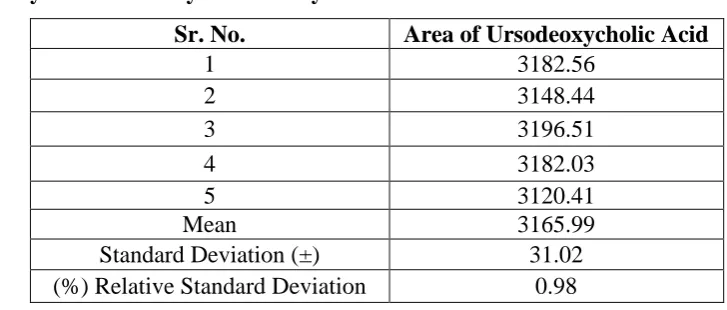
[image:6.595.109.473.332.487.2]The system suitability criteria were found to meet the pre-established acceptance criteria as per the analytical method
Table 2: System suitability - Selectivity
Sr. No. Area of Ursodeoxycholic Acid
1 3182.56
2 3148.44
3 3196.51
4 3182.03
5 3120.41
Mean 3165.99
Standard Deviation (±) 31.02 (%) Relative Standard Deviation 0.98
Remarks: The method is selective.
2. Linearity
Linearity and Range for standard
For the linearity study five standard solutions of Ursodeoxycholic Acid were prepared from the range starting from 50% to 150% of the theoretical concentration of assay preparation. The system suitability solution and the linearity solutions were injected as per the protocol. The linearity graph of concentration against peak response was plotted and the correlation coefficient was determined.
Acceptance criteria
RESULTS
The system suitability criteria were found to meet the pre-established acceptance criteria as per the analytical method.
Table 3: System suitability – Linearity of standard
Sr. No. Area of Ursodeoxycholic Acid
1 3160.42
2 3161.26
3 3127.55
4 3180.85
5 3106.33
Mean 3147.28
Standard Deviation (±) 29.84 (%) Relative Standard Deviation 0.95
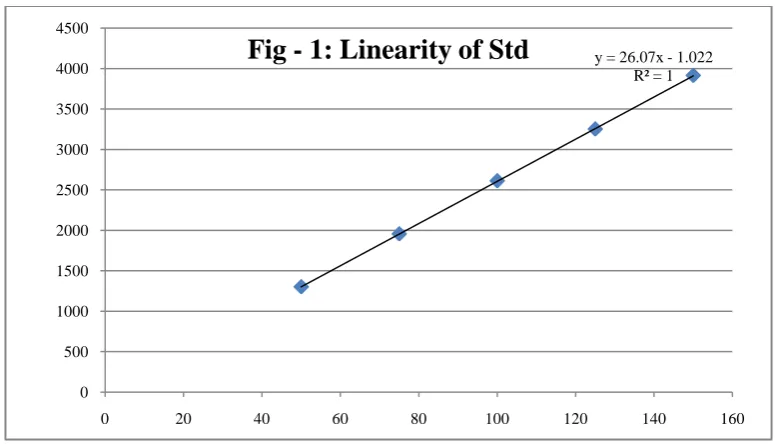
[image:7.595.87.484.159.322.2]The average peak area of Ursodeoxycholic Acid peak at each concentration level was determined and the linearity graph was plotted against the sample concentration in percentage. The results of linearity study are as given in table 4.
Table 4: Results of Linearity of standard
The linearity plot of peak area of Ursodeoxycholic Acid Vs. standard concentration in percentage is presented in figure-1.
Linearity Level
Sample Concentration
( in% )
Sample
Concentration (ppm)
Peak Area Correlation Coefficient
Level – 1 50 50 1301.91
0.999
Level – 2 75 75 1955.72
Level – 3 100 100 2611.54
Level – 4 125 125 3251.30
Figure 1: Linearity graph of Ursodeoxycholic acid standard
Remark
1. A linearity graph of the average area at each level against the concentration (%) is plotted and is found to be a straight line graph.
2. The correlation coefficient is found to be more than 0.999.
3. Hence it is concluded that, the method is found to be linear in the range of 50% to 150% of the working concentration.
4. The range for the analytical method is 50 ppm to 150 ppm.
Linearity and Range for standard in presence of placebo: Procedure
For the linearity study five standard solutions of Ursodeoxycholic Acid were prepared from the range starting from 50% to 150% of the theoretical concentration of assay preparation. The system suitability solution and the linearity solutions were injected as per the protocol. The linearity graph of concentration against peak response was plotted and the correlation coefficient was determined.
Acceptance criteria
Correlation coefficient should be greater than or equal to 0.999.
RESULTS
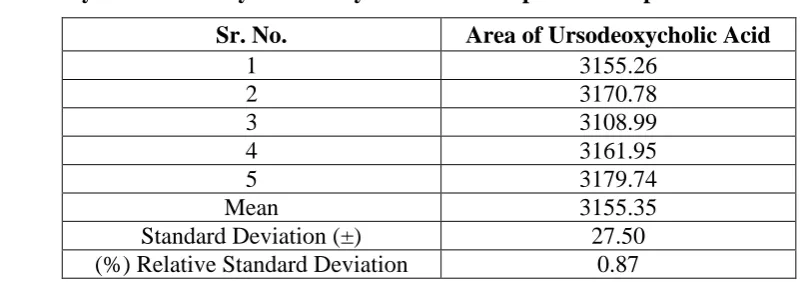
The system suitability criteria were found to meet the pre-established acceptance criteria as per the analytical method. (Refer to Table 5 for system suitability results).
y = 26.07x - 1.022 R² = 1
0 500 1000 1500 2000 2500 3000 3500 4000 4500
[image:8.595.103.491.69.291.2]0 20 40 60 80 100 120 140 160
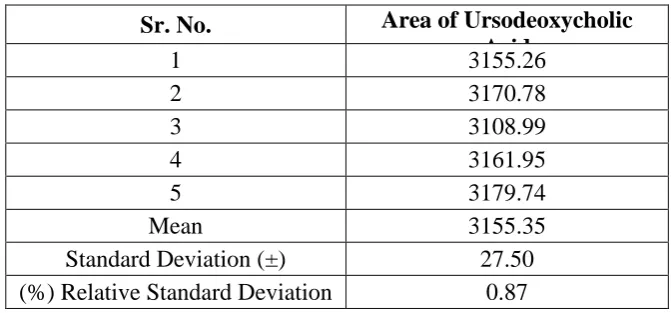
Table 5: System suitability - Linearity of standard in presence of placebo
Sr. No. Area of Ursodeoxycholic Acid
1 3155.26
2 3170.78
3 3108.99
4 3161.95
5 3179.74
Mean 3155.35
Standard Deviation (±) 27.50 (%) Relative Standard Deviation 0.87
The average peak area of Ursodeoxycholic Acid peak at each concentration level was determined and the linearity graph was plotted against the sample concentration in percentage. The results of linearity study are as given in Table - 6.
Table 6: Results of linearity of standard in presence of placebo
Figure - 2. The linearity plot of peak area of Ursodeoxycholic Acid Vs. standard concentration in presence of placebo in percentage is presented in
y = 26.05x - 0.172 R² = 1
0 500 1000 1500 2000 2500 3000 3500 4000 4500
[image:9.595.56.531.329.699.2]0 20 40 60 80 100 120 140 160
Fig - 2: Linearity of Std in placebo
Linearity Level
standard Concentration
(in %)
standard Concentration
(in ppm)
Placebo added to the standard
solution
Peak Area Correlation Coefficient
Level – 1 50 50 66mg 1299.51
1.0
Level – 2 75 75 66mg 1952.71
Level – 3 100 100 66mg 2615.30
Level – 4 125 125 66mg 3249.81
4. Precision System Precision Procedure
The system precision was performed by injecting 10 replicate injections of system suitability solution and the chromatograms are reviewed for the system suitability criteria.
Acceptance criteria
% RSD of peak areas of ten replicate injections of system suitability solution should not be more than 2.0% and system suitability criteria should pass as per analytical method.
Results
The system suitability criteria were found to meet the pre-established acceptance criteria as per the analytical method.
Table 6: System precision
Sr. No. Area of Ursodeoxycholic Acid
1 3163.69
2 3158.54
3 3121.69
4 3114.95
5 3111.50
6 3121.42
7 3174.35
8 3101.47
9 3159.33
10 3181.05
Mean 3140.80
Standard Deviation (±) 29.33 (%) Relative Standard Deviation 0.93
Remark
From the above data it is concluded that the system precision is established.
Method Precision Procedure
Six test solutions of Ursodeoxycholic Acid in Udihep and were prepared as per the analytical method. The % RSD of % assay of six test solutions was calculated
Acceptance criteria:
Results
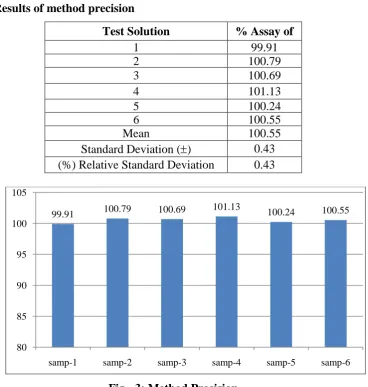
[image:11.595.96.485.171.311.2]The system suitability criterion was found to meet the pre-established acceptance criteria as per the analytical method. The results of assay obtained from six test solutions preparations are presented in Table - 9.
Table 8: System suitability - Method precision
Sr. No. Area of Ursodeoxycholic Acid
1 3182.57
2 3148.45
3 3196.52
4 3158.28
5 3158.76
Mean 3168.91
[image:11.595.124.493.324.711.2]Standard Deviation (±) 19.90 (%) Relative Standard Deviation 0.63
Table 9: Results of method precision
Fig - 3: Method Precision
99.91 100.79 100.69 101.13 100.24 100.55
80 85 90 95 100 105
samp-1 samp-2 samp-3 samp-4 samp-5 samp-6
Test Solution % Assay of
1 99.91
2 100.79
3 100.69
4 101.13
5 100.24
6 100.55
Mean 100.55
Remark
The % RSD of the six assay results is found less than 2.0% and meets the pre-established acceptance criteria. Hence, it is concluded that the method is precise.
Intermediate Precision Procedure
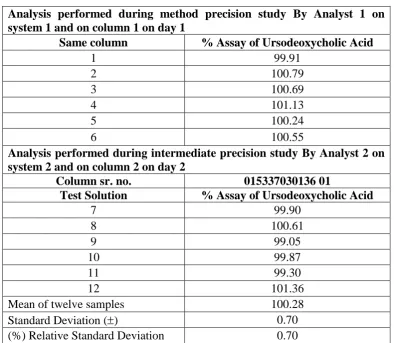
Six test solutions of Udihep Tablets and were prepared as per the analytical method on different day. These test solutions were analyzed by a different analyst using different HPLC column of same make but having different serial number and different HPLC system. The % RSD of % assay results of twelve test solutions (six samples from method precision and six samples from intermediate precision) was calculated.
Acceptance criteria
% RSD of the results of twelve test solutions (six of method precision and six of intermediate precision) should not be more than 2.0%.
Results
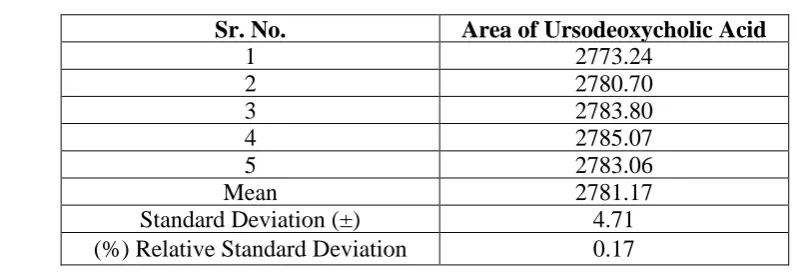
[image:12.595.85.484.495.633.2]The system suitability criteria were found to meet the pre-established acceptance criteria as per the analytical method. (Refer to Table -10 for system suitability results). The results of assay obtained from six test solutions are presented in Table - 11. % RSD of assay results from method precision and intermediate precision (12 results) are presented in Table - 12.
Table 10: System suitability – Intermediate precision
Sr. No. Area of Ursodeoxycholic Acid
1 2773.24
2 2780.70
3 2783.80
4 2785.07
5 2783.06
Mean 2781.17
Standard Deviation (±) 4.71
(%) Relative Standard Deviation 0.17
Table11: Results of Intermediate precision
Test Solution % Assay of Ursodeoxycholic Acid
1 99.90
2 100.61
3 99.05
4 99.87
5 99.30
Mean 100.01 Standard Deviation
()
0.85 (%) Relative
Standard Deviation
[image:13.595.110.483.70.357.2]0.85
Fig - 4:Intermediate Precision
Table 12: Results of twelve test solutions of Ursodeoxycholic acid in Udihep (Six of method precision and six of intermediate precision)
Analysis performed during method precision study By Analyst 1 on system 1 and on column 1 on day 1
Same column % Assay of Ursodeoxycholic Acid
1 99.91
2 100.79
3 100.69
4 101.13
5 100.24
6 100.55
Analysis performed during intermediate precision study By Analyst 2 on system 2 and on column 2 on day 2
Column sr. no. 015337030136 01
Test Solution % Assay of Ursodeoxycholic Acid
7 99.90
8 100.61
9 99.05
10 99.87
11 99.30
12 101.36
Mean of twelve samples 100.28
Standard Deviation () 0.70
(%) Relative Standard Deviation 0.70
99.9 100.61
99.05 99.87 99.3
101.36
80 85 90 95 100 105
[image:13.595.101.496.422.765.2]Remark
The analysis was carried out on six test solutions of the same lot of the drug product by two different analysts using two different equipments within the same laboratory using two different columns of the same make but having different serial numbers on two different days. The % RSD of the twelve assay results (six of method precision and six from intermediate precision) is found to be less than 2.0%.
4. Accuracy (% Recovery) Procedure
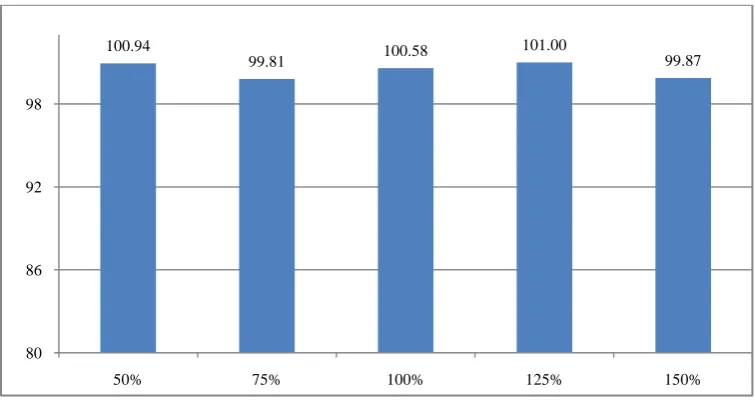
Accuracy study was performed by analyzing Ursodeoxycholic Acid test solutions which were prepared by mixing Ursodeoxycholic Acid API with excipient blend.
These test solutions were prepared by adding a quantity of Ursodeoxycholic Acid API to excipient blend to produce three different concentration solutions equivalent to 50%, 75%, 100%, 125% and 150% of test concentration.
Acceptance criteria
Mean recovery at each concentration level should be between 97.0% and 102.0%
Results
[image:14.595.129.465.539.695.2]The system suitability criteria were found to meet the pre-established acceptance criteria as per the analytical method. (Refer to Table – 13 for system suitability result). The results of accuracy study obtained are presented in Table-14.
Table 13: System suitability-Accuracy (% Recovery)
Sr. No. Area of Ursodeoxycholic
Acid
1 3155.26
2 3170.78
3 3108.99
4 3161.95
5 3179.74
Mean 3155.35
Table 14: Accuracy (%Recovery)
Level of addition
Amount of
Ursodeoxycholic Acid added in mg
Amount of
Ursodeoxycholic Acid found in mg
Recovery (%)
First Level (Rec-50 %) 10.20 10.30 100.94
Second Level (Rec-75
%) 15.50 15.47 99.81
Third Level (Rec-100
%) 20.60 20.72 100.58
Fourth Level (Rec-125
%) 26.90 27.17 101.00
Fifth Level (Rec-150
%) 31.00 30.96 99.87
Mean 100.44
Standard Deviation (±) 0.57
(%) Relative Standard Deviation 0.57
Remarks
The percentage recovery for Ursodeoxycholic Acid at each level lies between 97.0% and 102.0%. % RSD at each recovery level is less than 2.0%.
The analytical method meets the pre-established acceptance criteria for recovery study as per protocol. Hence, it is concluded that the method is accurate.
Fig - 5:Accuracy/Recovery Acceptance criteria
System suitability criteria should pass as per analytical method and the % RSD between results obtained with changed condition and average result of method precision, should not be more than 2.0%.
100.94
99.81 100.58
101.00
99.87
80 86 92 98
[image:15.595.109.487.462.662.2]5. Robustness Experiment
Prepare two test solutions of the same lot (as used in 7.0.a and 7.0.b) of Ursodeoxycholic Acid in Udihep Tablets as per analytical method. Inject this solution along with diluent blank solution and system suitability solution along different chromatographic conditions as shown below
1. Change in column lot (same make, different serial no.) 2. Change in flow rate ( 0.2 ml/minute)
3. Change in wavelength (± 2 nm) 4. Change in pH of mobile phase (± 0.2)
Change in Column Lot
[Normal Experimental Condition: C18, 100mm x 6mm x 5µ]
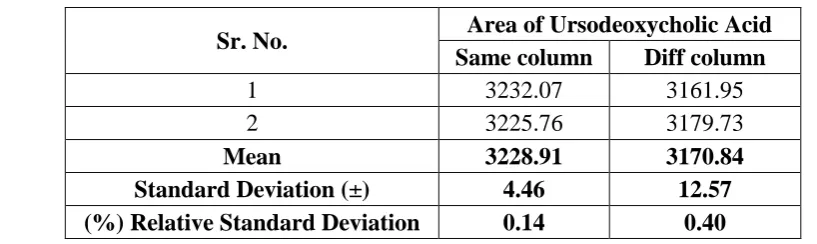
[image:16.595.81.490.408.530.2]The system suitability criteria were found to meet the pre-established acceptance criteria as per the analytical method. (Refer to Table - 15 for system suitability results).
Table 15: System suitability – Robustness with change in column lot
Sr. No. Area of Ursodeoxycholic Acid
Same column Diff column
1 3232.07 3161.95
2 3225.76 3179.73
Mean 3228.91 3170.84
Standard Deviation (±) 4.46 12.57
(%) Relative Standard Deviation 0.14 0.40
[image:16.595.87.508.583.704.2]
The assay results obtained with different flow rate conditions are as given in Table - 16.
Table 16: Results for change in column lot
Flow rate Same column Diff column
Sample % Assay
Test solution 99.91 100.91
Average assay result from method precision 100.55 100.55
Mean 100.23 100.73
Standard Deviation () 0.45 0.25
Change in Flow Rate ( 0.2 mL/minute): (Normal Experimental Condition: 1.4ml/minute) The system suitability criteria were found to meet the pre-established acceptance criteria as per the analytical method. (Refer to Table - 17 for system suitability results).
Table 17: System suitability – Robustness with change in flow rate
Sr. No. Area of Ursodeoxycholic Acid
0.8mL/minute 1.2 mL/minute
1 3069.88 2638.01
2 3023.48 2666.13
Mean 3046.68 2652.07
Standard Deviation (±) 32.81 19.88 (%) Relative Standard Deviation 1.08 0.75
Change in Wavelength (± 2 nm): (Normal Experimental Condition
[image:17.595.85.499.396.531.2]303nm) The system suitability criteria were found to meet the pre-established acceptance criteria as per the analytical method. (Refer to Table - 19 for system suitability results).
Table 19: System suitability- Robustness with change in wavelength
Sr. No.
Area of Ursodeoxycholic Acid mestlate
203nm 207nm
1 3133.47 3188.39
2 3157.84 3157.09
Mean 3145.66 3172.74
Standard Deviation () 17.23 22.13 (%) Relative Standard Deviation 0.55 0.70
The assay results obtained with different wavelength conditions are as given in Table - 20.
Table 20: Results for change in wavelength
Wavelength 203nm 207nm
Sample % Assay
Test solution 101.03 100.31
Average assay result from method precision 100.55 100.55
Mean 100.79 100.43
Standard Deviation () 0.34 0.17
(%) Relative Standard Deviation 0.34 0.17
[image:17.595.100.497.582.695.2]Table 21: System suitability – Robustness with change in pH of mobile phase
Sr. No. Area of Ursodeoxycholic Acid
pH 4.0 pH 4.4
1 3161.99 3106.33
2 3155.72 3155.26
Mean 3158.85 3130.80
Standard Deviation () 4.44 34.60 (%) Relative Standard Deviation 0.14 1.11
The assay results obtained with change in pH of mobile phase are as given in Table – 22
Table 22: Results for change in pH of mobile phase
pH pH 4.0 pH 4.4
Sample % Assay
Test solution 100.21 101.13
Average assay result from method precision 100.55 100.55
Mean 100.38 100.84
Standard Deviation () 0.24 0.41
(%) Relative Standard Deviation 0.24 0.41
Remarks
The analysis of the same lot of UDIHEP was carried out at different conditions of column lot, flow rate, wavelength, and pH of mobile phase. The system suitability was found to meet the pre-established criteria at all the conditions and the % RSD between results obtained with changed condition and average result of method precision is not more than 2.0%.The analytical method meets the pre-established acceptance criteria for robustness study as per protocol. Thus, the method is robust.
6. Stability of Analytical Solution Procedure
System suitability solution and test solution of UDIHEP were prepared on 0th,12th, 24th, 36th and 48th hour of experiment and stored these solutions at room temperature for every time interval up to 48 hrs and analyzed these solutions on 48 hrs with freshly prepared test solution. The system suitability solution was prepared freshly at the time of analysis. The assay of UDIHEP in the sample was calculated.
Acceptance criteria
[image:18.595.102.494.257.371.2]Results The system suitability criteria were found to meet the pre-established acceptance criteria as
per the analytical method (Refer to Table - 23 for system suitability results)
[image:19.595.59.523.422.574.2]Table 23: System suitability of standard and sample
Table 24: Results for solution stability
Remark
The system suitability was found to meet the pre-established criteria and the % RSD between assay results obtained for freshly prepared test solution and the stored test solutions is less than 2.0%. There is no significant change in assay level observed up to 48Hrs for test solution at room temperature. Thus, it can be concluded that the solution is stable up to 48Hrs at room temperature.
Time Std Area Avg std area Spl area Avg Spl area
0th hr 3163.689 3161.11 3121.691 3118.32
3158.539 3114.951
12th hr 3111.5 3116.46 3174.348 3137.91
3121.42 3101.471
24 hr 3159.333 3170.19 3188.555 3184.15
3181.051 3179.739
36 hr 3116.408 3139.04 3136.274 3159.44
3161.681 3182.602
48 hr 3192.699 3189.01 3158.763 3158.52
3185.325 3158.277
Mean 3155.16 3155.16 3151.67 3151.67
Standard Deviation () 29.21 28.13 31.12 24.82 (%) Relative Standard Deviation 0.93 0.89 0.99 0.79
% Assay results calculated against the freshly prepared system suitability standard
Sample % Assay of Ursodeoxycholic Acid
0th hr 100.07
12th hr 102.14
24 hr 101.89
36 hr 102.10
48 hr 100.47
Mean 101.33
Standard Deviation () 0.99
LIST OF ABBREVIATIONS
Sr. No. Abbreviations used Details
1 R&D Research and Development
2 QA Quality Assurance
3 API Active Pharmaceutical Ingredient 4 HPLC High performance liquid chromatography
5 mg milligram
6 gm gram
7 mL or ml mililitre
8 B. No. Batch Number
9 No. or no. Number
10 N Normal
11 NaOH Sodium hydroxide
12 ppm Parts per million
13 RSD Relative standard deviation 14 rpm Rotations per minute
15 nm nanometer
16 °C Degree centigrade
17 µl microlitre
18 % Percentage
19 & and
20 Sr. No. Serial Number
21 µm micrometer
22 R.T. Room Temperature
CONCLUSION
The above summary and the validation data summarized in this document shows that the analytical method of assay of Ursodeoxycholic Acid in Udihep Tablets by HPLC is found to be suitable, selective, specific, precise, linear, accurate and robust. The analytical solution is found to be stable up to 48 Hrs at room temperature. Hence, it is concluded that the analytical method is validated and can be used for routine analysis and for stability study.
REFERENCES
1. Hagey LR, Crombie DL, Espinosa E, Carey MC, Igmi H, Hofman AF. Ursodeoxycholic Acid in the Urside: biliary bile acids of bear, pandas, and related carnivores
2. British Pharmacopeia 2012.
3. HPLC determination of Ursodeoxycholic acid after solid phase extraction of blood serumand detection – oriented dervatization by Nobilis M, Pour M, Kunes J, Kopecký J. 4. Jackson H, Solaymani-Dodaran M, Card TR, Aithal GP, Logan R, West J (October
5. Determination of Ursodeoxycholic acid in bulk and tablets by RP-HPLC by Peepliwal, Ashok; Talekar, Yogesh P.; Raina, Sunny; Bonde, Chandrakant G.