FORMULAION AND EVALUATION OF ORALLY DISINTEGRATING
TABLETS OF RIZATRIPTAN BENZOATE REVIEW
Sandeep Aher* Dr. Salunkhe K. S Dr. Chaudhari S. R
Amrutvahini college of pharmacy. sangamner, Newasa ,Maharashtra ,India ,414105
ABSTRAC
Formulation research is oriented towards safety , efficacy &and quick onset of action of existing drug molecule through novel concepts of drug delivery . Orally disintegrating tablet of Rizatriptan benzoate were prepared by direct compression method to provide faster relief from pain to migraine sufferers . Due to problem of swallowing ability with age , The paediatric and geriatric patient complian of difficulty to take conventional solid dosage forms . The ODT’s are solid dosage
forms that dissolves and disintegrates rapidly in the oral cavity. This results in solution or suspension without the need of water. Mian objective of this work to formulate and evaluate Rizatriptan Benzoate ODT’s using different concentration of super disintegrating agents like croscarmellose ,
Sodium starch glycolate (SSG) , Crospovidone . Tablets were prepared by direct compression method and evaluate for hardness, thickness, friability, disintegration time, and percentage drug release . the results indicated that formulation prepared with Crospovidone was found to be optimised which provides maximum drug release (100%) and minimum disintegrating time.
KEY WORDS: Orally disintegrating tablets, Superdisintegrant , Rizatriptan Benzoate , Direct compression , Croscarmellose , Sodium starch glycolate , Crospovidone .
INTRODUCTION
Most of the oral pharmaceutical dosage forms like conventional tablets and capsules are formulated to be swallowed or chewed . As a result children , bedridden patients and elderly patients have difficulty in swallowing these dosage forms . To overcome this drawback novel drug delivery system like orally disintegrating tablets have been developed which disintegrate, dissolve , disperse in saliva within few seconds without water. USFDA defines
Volume 3, Issue 6, 919-928. Research Article ISSN 2277 – 7105
Article Received on 14 June 2014,
Revised on 09 July 2014, Accepted on 04 August 2014
*Correspondence for
Author
Sandeep Aher
Amrutvahini college of
pharmacy. sangamner ,
Newasa, Maharashtra ,India ,
414105
ODT as “ A solid dosage form containing medical substances or active ingredients which
disintegrates rapidly within a matter of seconds when placed upon a tongue . The new generation anti-migraine drug, Rizatriptan Benzoate is a potent and selective 5-hydroxy tryptamine 1B/1D receptor agonist and is considered more effective than the traditional triptans for the treatment of acute migraine attack . Chemically it is 3-[2-(dimethylamino ) ethyl]-5-(1H-1,2,4-triazol-1-ylmethyl) indole onobenzoate . A 10mg dose of Rizatriptan benzoate is equipotent to a 100mg of Sumatriptan , the traditional antimigriane drug . The bioavailability of Rizatriptan benzoate is about 45% which is superior to a poor 14-17% of Sumatriptan .
On the basis of these consideration , in the presents study it was proposed to formulate an oral delivery device , in the form of rapidly disintegrating tablet by using direct compression technology , with the aim of rapid disintegrating and a complete drug release in short period of time . In this study , effort has been made to prepare different formulations based on 22 full factorial design for each set of super disintegrants at their two levels viz., higher and lower concentration . The main effect and the interactions of disintegrants on dispersion time and drug release were studied .
MATERIALS AND METHODS Materials
Rizatriptan Benzoate was obtained as gift sample from Dr. Reddy’s laboratory, Hyderabad .
Croscarmellose , Crospovidone and Sodium Starch Glycolate (SSG) where gift sample obtained from madras Pharmaceuticals , Chennai. All chemicals used were of analytical grade.
Table : Formulation development trial ( mg/tablet )
Ingredients F1 F2 F3 F4 F5 F6
Rizatriptan Benzoate 10 10 10 10 10 10
Lactose 50.47 - - - - -
Avicel PH102 - 70 90 50.47 50.47 50.47
Mannitol 90 70 50.47 90 90 90
Crospovidone 10 10 10 - - 10
Crosscarmellose - - - 10 - -
Sodium starch glycolate 10
Glycine 23 23.47 23 23 23 23
Sodium Chloride 5 5 5 5 5 5
Aspartame 4 4 4 4 4 4
Magnesium stearate 2 2 2 2 2 2 Total weight(mg) 200 200 200 200 200 200
Preparation of orally disintegrating tablet
Rizatriptan benzoate was weighed accurately and sifted through #40 mesh. Micro crystalline cellulose and Mannitol were weighed accurately sifted through #40 separately and added individually to the above and mixture for 5 minutes. Sodium chloride, Glycine, Aspartame and Mint were weighed accurately and pass through #60 mesh separately and added to the above mixture one after the other and for each addition the mixture was blended thoroughly for 5 minutes. The Super disintegrant Crospovidone was weighed and shifted through #40 mesh and added to the above mixture and blended for 5 minutes. Magnesium sterate was weighed accurately and sifted to #40 mesh and added to above blend. The final blend was mix thoroughly for 2-3 minutes in a the poly bag tablet were compressed using 7 mm round flat shape punches.
Evaluation of blends
Prior to the compression of both granules in the tablets, the granules were evaluated for for properties like angle of repose, Bulk density, tapped density, Carr’s index and Hausner’s
ratio.
Evaluation of tablet Thickness
Thickness was determine for twenty pre-weighed tablet for each bach using a digital vernier scale and the average thickness was determined in mm. The tablet thickness should be controlled within a 5% variation of standard.
Hardness
Hardness or crushing strength is the force required to break a tablet in diametric compression. Hardness of the tthe tablet is determined by Monsanto hardness tester which consist of a barrel with a compressible spring. The pointer moving along the guaze in the barrel at which the tablet fracture indicates the hardness of the tablet. Six tablet from each batch were taken randomly and there hardness was determined.
Friability
USP TYPE Roche friabilator, then reweighed after removal of fines and the percentage weight loss was calculate according to the following formula. The tablet were found to pass the friability test, if the percentage weight loss found to be less than 1%.
(Initial weight – Final weight)
% Friability = --- × 100 Initial weight
Wetting time
The wetting time of the tablets can be measured using a simple procedure. Five circular tissue papers of 10 cm diameter are placed in a petridish with a 10 cm diameter. Ten millimeters of water- containing Eosin, a water soluble dye, is added to petridish. A tablet is carefully placed on the surface of the tissue paper. The time required for water to reach upper surface of the tablet is noted as a wetting time.
Water absorption ratio (%)
A piece of tissue paper folded twice was placed in a small petridish (Internal Diameter = 6.5 cm) containing 6 ml of water. A tablet was placed on the paper and the time required for complete wetting was then measured. The water absorption ratio (R) was determined using the following equation.
Wa -Wb
R = ---x100 Wb
Where, Wb is the weight of the tablet before water absorption and Wa is the weight of the tablet after water absorption.
In vitro disintegration test
The test was carried out on 6 tablets using Tablet disintegration tester. Distilled water at 37ºC ± 2ºC was used as a disintegration media and the time in seconds taken for complete disintegration of the tablet with no palable mass remaining in the apparatus was measured.
In vitro dispersion time
Tablet was added to 10 ml of phosphate buffe r solution (pH 6.8) at 37 ± 0.5°C. Time required for complete dispersion of a tablet was measured.
In-vitro dissolution study
using United State Pharmacopoeia (USP) XXIV dissolution testing apparatus II (paddle method). The dissolution test was performed using 900 ml of 0.1N HCl pH 1.2 as a dissolution medium, at 37±0.5ºC and 50 rpm. A sample (5ml) of the solution was withdrawn from the dissolution apparatus at 1, 2, 3, 4, 5, 10, 20 and 30 min. The samples were filtered through a 0.45 membrane filter. Absorbance of these solutions was measured at 280 nm using a Shimadzu UV-1700 UV/VIS spectrophotometer. Cumulative percentage of drug release was calculated using an equation obtained from a standard curve.
[image:5.595.35.571.268.419.2]RESULTS AND DISCUSSION
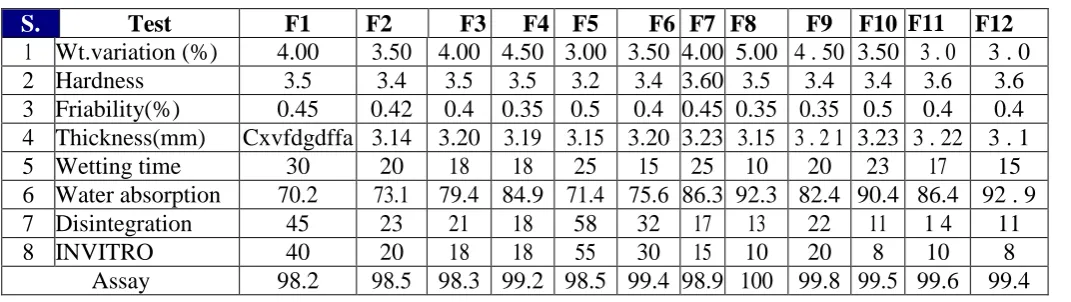
Table 3: Evaluation of directly compressible orally disintegrating tablets
S. Test F1 F2F2 F3F3 F4F4 F5 F6F6 F7 F8F8 F9 F10 F1111 F12 12 1 Wt.variation (%) 4.00 3.50 4.00 4.50 3.00 3.50 4.00 5.00 4 . 50 3.50 3 . 0 3 . 0 2 Hardness 3.5 3.4 3.5 3.5 3.2 3.4 3.60 3.5 3.4 3.4 3.6 3.6 3 Friability(%) 0.45 0.42 0.4 0.35 0.5 0.4 0.45 0.35 0.35 0.5 0.4 0.4 4 Thickness(mm) Cxvfdgdffa 3.14 3.20 3.19 3.15 3.20 3.23 3.15 3 . 2 1 3.23 3 . 22 3 . 1 5 Wetting time 30 20 18 18 25 15 25 10 20 23 17 15 6 Water absorption 70.2 73.1 79.4 84.9 71.4 75.6 86.3 92.3 82.4 90.4 86.4 92 . 9 7 Disintegration 45 23 21 18 58 32 17 13 22 11 1 4 11
8 INVITRO 40 20 18 18 55 30 15 10 20 8 10 8
Assay 98.2 98.5 98.3 99.2 98.5 99.4 98.9 100 99.8 99.5 99.6 99.4
dispersion time was 8 to 20 seconds for formulations containing combination of sodium starch glycolate and croscarmellose sodium. Amount of drug released after INVITRO dispersion of tablet was determined.
High level of crospovidone increase in concentration of sodium starch glycolate had no effect on dispersion time on ODT. Nevertheless at low level of crospovidone increase in concentration of sodium starch glycolate had a negative effect, decreases the dispersion time. When a combination of crospovidone and croscarmellose sodium was tried we identified that they had an interaction between them as evident from figure 3. ODT containing 3% croscarmellose sodium and 4% crospovidone showed the lowest dispersion time (10s). croscarmellose sodium, when tried in combination with sodium starch glycolate showed a negative effect on INVITRO dispersion time at lower levels of sodium starch glycolate and only a slight effect at higher levels of sodium starch glycolate.Formulation (F12) containing (3%) croscarmellose sodium and (8%) sodium starch glycolate showed the lowest INVITRO dispersion time of 8s. Among all the twelve formulations, confirming it to be the optimum combination of super disintegrants. The same formulation showed short wetting time and larger water absorption ratio.
[image:7.595.121.470.70.259.2]
Figure 2: Combination of Sodium starch glycolate & Crospovidone at high & low level
Figure 3: Combination of Croscarmellose sodium & Crospovidone at high & low evels
0 20 40 60 80 100 120
0 2 4 6 8 10 12
% D R U G
R E A L E S E
TIME (MIN)
DISSOLUTION PROFILE
F1
F2
F3
F4
F5
F6
F7
F8
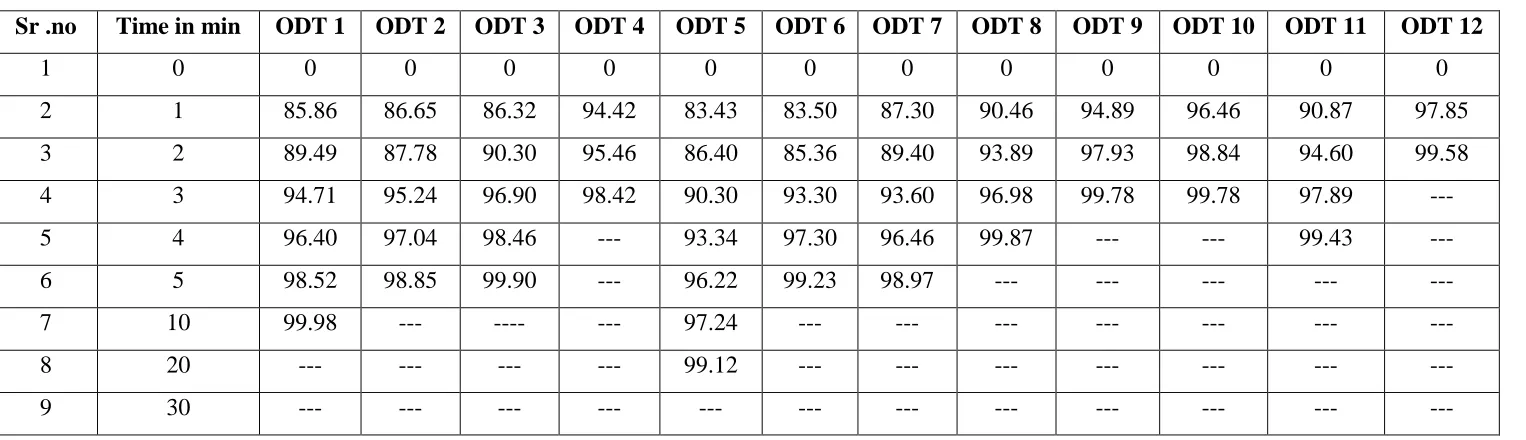
Table 4: Cumulative drug release of all formulations
Sr .no Time in min ODT 1 ODT 2 ODT 3 ODT 4 ODT 5 ODT 6 ODT 7 ODT 8 ODT 9 ODT 10 ODT 11 ODT 12
1 0 0 0 0 0 0 0 0 0 0 0 0 0
2 1 85.86 86.65 86.32 94.42 83.43 83.50 87.30 90.46 94.89 96.46 90.87 97.85 3 2 89.49 87.78 90.30 95.46 86.40 85.36 89.40 93.89 97.93 98.84 94.60 99.58 4 3 94.71 95.24 96.90 98.42 90.30 93.30 93.60 96.98 99.78 99.78 97.89 ---
5 4 96.40 97.04 98.46 --- 93.34 97.30 96.46 99.87 --- --- 99.43 ---
6 5 98.52 98.85 99.90 --- 96.22 99.23 98.97 --- --- --- --- ---
7 10 99.98 --- ---- --- 97.24 --- --- --- --- --- --- ---
8 20 --- --- --- --- 99.12 --- --- --- --- --- --- ---
Figure 4 : Cumulative drug releases of all formulations
CONCLUSION
The goal of the present investigation was to identify the optimum combination of superdisintegrants for the development of orally disintegrating tablets of Rizatriptan benzoate. Three superdisintegrants viz., crospovidone, croscarmellose sodium and sodium starch glycolate were tried. 22 full factorial design was used for a set of two superdisintegrants and totally twelve formulations were made by direct compression method and evaluated for their hardness, friability and the key parameters like INVITRO dispersion time, wetting time and water absortion ratio. Factorial design had facilitated the study and helped in understanding the interaction between superdisintegrants when used in combinations. 3%croscarmellose sodium and 8% sodium starch glyocolate (F12) was identified as the optimum combination of super disintegrants based on INVITRO dispersion time, wetting time and water absorption ratio.
ACKNOWLEDGEMENT
The authors are thankful to Dean, SRM College of Pharmacy, Chennai for providing the necessary facilities and help. The authors are grateful to Matrix laboratories Ltd, hyd. and Orchid laboratories, Chennai, for providing the gift samples.
REFERENCE
1. Rangasamy Manivannan. Oral disintegrating tablets: A future Compaction Publication. International Journal of Pharmaceutical Research and Development 2009; 1: 1-10.
3. Kaushik D, Dureja H, Saini TR. Mouth dissolving tablets: A review. Indian Drugs. 2004; 41: 503-508.
4. Ansel HC, Popovich NG, Allen LV. Pharmaceutical dosage forms and drug delivery system. B.I. Waverly Pvt. Ltd, New Delhi. 1995; 6:99-154.
5. Goodman, Gilman's. The Pharmacological Basis of Therapeutics. 11th ed. New York: McGraw Hill, 2006, pp 305-9.
6. Sanford B, Eds in pharmaceutical statistics, Practical and clinical applications, 2nd Edn, Marcel Dekker. NY, 1990, pp 303-337.
7. Wade A, and waul , P.J, Eds, in hand book of pharmaceutical excipients, ed 2, American pharmaceutical association, Washington, pharmaceutical press, London, 1994.
8. Banker G.S, Anderson N. R. In: Lachman L, Lieberman H.A. and Kanig J.L. The Theory and Practice of Industrial Pharmacy. 3rd ed, Mumbai, Varghese Publishing House, 1987, pp 293-399.