INVITRO ANTIOXIDANT ACTIVITY AND ANTI -INFLAMMATORY
ACTIVITY OF ETHANOLIC LEAF EXTRACT OF COCCULUS
HIRSUTUS
Dr. S.Umamaheswari*, K.S. Sridevi Sangeetha
Department of pharmacology, Sri ramachandra university, Porur, Chennai, India.
ABSTRACT
Aim isto study the invitro antioxidant and anti-inflammatory action
of the ethanolic extract of leaves of Cocculus hirsutus. Preliminary
Phytochemical anlalysis showed the presence of flavones, flavonoids,
triterpenoids, anthocyanins, coumarins, proteins, reducing sugars,
alkaloids, tannins, glycosides and quinines. The invitro antioxidant
study was done by DPPH, Nitric oxide radical generation and reducing
power assay. The anti-inflammatory study was done by HRBC
(Human Red Blood Cell) assay. Ethanolic extract of the leaf of the
plant showed significant antioxidant activity and the anti inflammatory
activity. The maximum percentage of inhibition by DPPH method was
found to be 56.73 % at the concentration of 800 µg/ml and the maximum percentage of
inhibition by Nitric oxide method was found be 58.6 %. The invitro anti inflammatoy activity
was found to 79.77 % at the concentration of 25 µg and it increases with increase in
concentration at the concentration of 800 µg it was found to be 94.74%. The antioxidant and
the antinflammatory activity is may due to the presence of flavonoids. From the above it was
concluded that the ethanolic leaf extrac of cocculus hirustus having in vitro antioxidant and
anti-inflammatory activity. Further investigation has to be done in experimental animals to
find out the mechanism of action.
KEY WORDS: Cocculus hirsutus, antioxidant, HRBC, inflammation.
INTRODUCTION
Among the innumerable gifts of nature belong the fascinating varieties of natural products
which in some guise have been inseparable parts of mankind’s history since they fulfill many
of our basic requirements. Plants are an important source of natural products, thus form the
Volume 3, Issue 5, 1279-1289. Research Article ISSN 2277 – 7105
Article Received on 24 May 2014,
Revised on 19 June 2014, Accepted on 14 July 2014
*Correspondence for
Author
Dr. S.Umamaheswari
Department of pharmacology,
Sri ramachandra university,
very beginning of this existence, man has familiarized himself with plants and used them in a
variety of ways. Therefore some plants came to be widely used as food, while others showed
beneficial effects against various human sufferings such as injuries and diseases continues at
an accelerating pace and the number of new plant-derived drugs increases likewise. Globally
there are wide spread diseases like diabetes, hypertension, atherosclerosis, urolithiasis, ulcers
etc, which are mainly caused by increase in free radicals. Plants constitute one of the major
scavenging free radicals. Hence the efficacy of scavenging property of plants will help to
curb the disease. A wide range of antioxidants both natural and synthetic has been proposed
for uses in treatment of human diseases. Cocculus hirsutus is a climbing scandent shrub with
softly villous young parts found in India, Sudan, China and Baluchistan provinces of
Pakistan. [1]
Taxonomic classification of COCCULUS HIRSUTUS (Linn) Diels [2]
Kingdom: Plantae
Division: Magnoliophyta
Class: Magnoliopsida
Order: Ranunculates
Family: Menispermaceae
Genus: Cocculus
Species: hirustus
Vernacular names[3]
Eng: Broom creeper, ink berry
Hin: Patalagarudi, Jaljamini
Kan: Sogadibali, Quesaribali
Mar: Patalagaruda kkoti
San: Patalagaredah, chilihindah
Tam: Kattukkoti
Tel: Dusaratiga
Morphology
Cocculus hirsutus Diels (locally known as Jamti-ki-bel) belongs to family Menispermaceae.
It is a climbing shrub. The leaves of this plant are sometimes sublanceolate, retuse or obtuse,
and mucronate; sometimes three-lobed, base subcordate or truncate, with young villosus on
themselves, keeled, seldom branched with a peculiar, acrid odour and a disagreeable and
bitter taste.[4]
The species of Cocculus is used as ingredients in various formulations in Ayurveda system
of medicine as ―Guduchi Satwam‖ It heads the list of valuable bitter tonics in Ayurvedic
pharmacopoeia and is the bitterest amongst them. It is recommended for various ailments like
rheumatism, urinary disease, diabetes, dyspepsia, splenic affections, chronic gonorrhoea,
diarrhea, dysentery and vermifuge. Traditionally the root and leaves of Cocculus hirustus
have more medicinal value. The juice of the leaves coagulates in water and it is used as
cooling agent in eye problem and soothing agent in eczema, Impetigo and dyspepsia.
Decoction of root used in rheumatism.[5]
Recently many studies investigated on the Antidiabetic,[6],[ 7] anti- inflammatory,[8] analgesic,
diueretic,[9], [10] antimicrobial,[12],[13] immunostimulant,[14]spermatogenic[15],anticancer[16]
activities. From the literature review it is concluded that the ethanolic extract of leaves of
Cocculus hirustus (Linn) Diels is not investigated for invitro antioxidant and anti
inflammatory effect.
MATERIALS AND METHODS Plant collection
The plant cocculus hirsutus was collected from Tirunelveli and authenticated by Botany
Professor Dr. V.Chelladurai.
Preparation Of Extract: The Leaves were separated, shade dried and powdered in a grinder. The powder was extract with ethanol using soxhlet apparatus. The residue was
macerated overnight with water and filtered. The filterate was dried on tray drier at 600 C and
was used for study purpose.
Phyto Chemical Screening[17]
The ethanolic extract of leaves of Cocculus hirustus was studied for various phyto chemical
analysis.
Test for Steroids
1 mg of test extract was dissolved in few drops of chloroform. 3ml of acetic anhydride was
added followed by a drop of conc.sulphuric acid. Bluish-green colour showed presence of
Test for Flavones
To the extract in alcohol, a few magnesium turnings and a few drops of conc. HC1 was
added. Boiled for 5 minutes. Red coloration showed presence of flavones.
Test for Phenolic Compounds
To the extract few drops of alcoholic ferric chloride solution was added. Bluish-green colour
indicates presence of phenolic compounds.
Test for Triterpenoids
Extract was warmed with tin and thionyl chloride. Pink colour indicates presence of
triterpenoids.
Test for Flavones
To the extract, 10% Sodium hydroxides was added. Yellow to orange colour showed
presence of Flavanones.
Test for Anthocyanins:
To the extract 10 % Sodium hydroxide was added. Blue colour showed presence of
anthocyanins.
Test for Reducing Sugars
Extract was mixed with Fehiling’s solution I & II. Red coloration indicated the presence of
reducing sugars.
Test for Anthraquinone Glycosides:
Extract was macerated with ether and filtered, to the filtrate caustic soda was added. Pink,
violet or red colour in aqueous layer indicates the presence of anthraquinones. If present as a
glycoside then the test should be modified by hydrolysing with hydrochloric acid as first step.
Test for Alkaloids
Few drops of acetic acid was added to little of extract, then followed by Draggendroff’s
regent and shaken well. Orange red precipitate indicates the presence of alkaloids.
Test for Quinones
To the little amount of extract sodium hydroxide was added, red or blue green colour
Test for Tannins
To the extract, little amount of lead acetate solution was added. White precipitate indicates
presence of tannins.
Test for Saponins
A little of the extract was shaken with water. Copious lather formation confirmed presence of
saponins.
Test for Amino acids
To the extract added Ninhydrin reagent and warmed it. Violet or Pink colour indicates the
presence of amino acids.
Invitro Antioxidant Assay
DPPH radical scavenging activity [18]
1 ml each concentration (25-800 g/ml) of test sample solution was added 1.9 ml DPPH in
ethanol solution. After vortexing, the mixture (due to quenching of DPPH free radicals) was
measured at 517 nm and the percentage inhibition was calculated. The IC50 values were
determined as the concentration of the test mixture that gave 50% reduction in the absorbance
from a control blank. The experiment was repeated in triplicates and the results were
expressed in mean. The results were computed for analysis.
Effect of Cocculus hirsutus on inhibition of nitric oxide radical generation [19]
Aqueous sodium nitro prusside at physiological pH spontaneously generates nitric oxide
(NO), which interacts with oxygen to produce nitrate, which can be estimated by use of
Greiss reagent. Sodium nitro prusside (5 mM) in phosphate buffered saline was mixed with 3
ml of different concentrations (50-1000 μg/ml) of the extracts dissolved in methanol and
incubated at 25oC for 150 min. The samples from the above were allowed to react with Greiss
reagent (1% sulphanlimide, 2% H3PO4 and 0.1% napthylethylenedrocholoride). The
absorbance of the chromophore formed during the diazotization of nitric with sulphanilamide
and subsequent coupling with napthylethylenediaminehydrochloride was read at 546 nm. The
experimental were replaced in triplicates. The percentage scavenging of nitric oxide radical
activity was calculated by the formula below and results were computed.
% Nitic oxide scavenged = (OD of control – OD of test)
OD of control
Reducing Power Assay [20]
The reducing power of ethanolic extract of leaves of Cocculus hirsutus was determined by using various concentrations of the extracts in 1 ml of deionised water mixed respectively
with phosphate buffer (2.5ml, 0.2M, pH 6.6) and 1% potassium ferricyanide (2.5ml). The
mixture was incubated at 50oC for 20 minutes. Aliquots of TCA (2.5ml, 10%) were added to
the mixture. Which was then centrifuged at 1036 g for 10 minutes. The upper layer of
reaction mixture was mixed with distilled water (2.5ml) and freshly prepared ferric chloride
solution (0.5ml, 0.1%). The absorbance was measured at 640nm. Increased absorbance of the
reaction mixture indicated reducing power. Reducing power is given in terms of ascorbic acid
equivalent (AsEmg-1). The experiment was carried in triplicate.
In Vitro Anti – Inflammatory Activity – HRBC Membrane Stabilization Method [21]
Stabilization of Human Red Blood Cell Membrane method is based on the principle of
hypotonicity induced membrane lysis. The lysosomal enzymes released during inflammatory
condition produce a variety of disorders. The extracellular activity of these enzymes in said to
be related to acute or chronic inflammation. The anti inflammatory agents acts by either
inhibiting the lysosomal enzymes or by stabilizing the lysosomal membranes. Since the
human blood cell membrane are similar to lysosomal membrane components, the prevention
of hypotonicity induced HRBC membrane lysis is taken as a measure of anti – inflammatory
activity of drug. Diclofenac 100g/ml concentration was used as standard drug.
The assay mixture contains 1 ml of phosphate buffer (PH 7.4), 2 ml hyposaline, (0.36%), 0.5
ml HRBC suspension ( 10% v/v) and 0.5 ml of the ethanolic extract of the plant in various
concentrations ( 25, 50, 100, 200, 400 and 800) and standard drug Diclofenac and control
(distilled water instead of hypo saline to produce 100% hemolysis) were incubated at 37oC
for 30 minutes, and centrifuged. The hemoglobin content in the supernatant solution was
estimated using spectrophotometer at 560nm. The percentage hemolysis produced in the
presence of distilled water was taken as 100%. The percentage of HRBC membrane
stabilization or protein was calculated using the formula:
% protein = 100 - optical density of drug treated sample
RESULT
1. Preliminary phytochemical screening
Phytochemical screening reveals that ethanolic extract showed the presence of flavones,
flavonoids, triterpenoids, anthocyanins, coumarins, proteins, reducing sugars, alkaloids,
tannins, glycosides and quinines. (Table – I)
Table-I Preliminary Phytochemical Screening Of cocculus hirsutus +: Present, - : Absent
Phytochemicals Ethanolic Leaf Extract
STEROIDS -
TRITERPENES +
FLAVANOIDS +
FLAVONES +
ANTHOCYANINS +
COUMARINS +
PROTEINS +
REDUCING SUGARS +
ALKALOIDS +
TANNINS +
PHENOLICS -
GLYCOSIDES +
QUINONES +
SAPONINS +
ANTHRAQUINONES +
2. In Vitro Antioxidant Activity
DPPH Free Radical Scavenging Activity
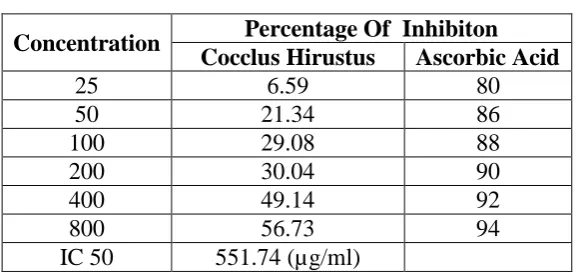
The scavenging activity of the ethanolic extract of leaves of Cocculus hirsutus and ascorbic
acid on DPPH radical was studied. This method is based on the reduction of alcoholic DPPH
solution in the presence of antioxidant(AH).
DPPH +AH DPPH-H + A
The remaining DPPH measures indirectly the antioxidant capacity of the extract. The
reducing capacity of the plant extract was found to increasing with dose dependent manner
when compared with ascorbic acid. The plant extract showed significant scavenging effect
and it increase with increase in concentraion but the activity was less when compared to
standard ascorbic acid. IC 50 value of ethanolic leaf extract was found to be 551.74 µg/ml,
Table -II – In vitro antioxidant - DPPH ASSAY
Nitric Oxide Scavenging Activity of Cocculus hirsutus
Nitric oxide is a free radical produced in mammalion cells, involved in the regulation of
various physiological process; however excess production of nitric oxide is associated with
several diseases. In the present study the nitrate produced by the incubation of solution of
sodium nitropursside in a standard phosphate buffer at 25oC was reduced by ethanolic extract.
This may be due to the antioxidant activity. It was observed that nitrate free radical were
scavenged by the extract in a concentration dependent manner ( Table –III). The maximum
percentage inhibition in nitricoxide method was found to be 58.6% at the concentration of
800 µg/ml the antioxidant activity was due to the presence of tannis, flavonoids, and
glycosides.
Table III – Invitro antioxidant- Nitric oxide radical generation method
S.No Concentration
Percentage Of Inhibiton Cocclus irustus Ascorbic Acid
1. 25 11.89 25.13
2. 50 22.64 34.17
3. 100 28.73 44.93
4. 200 36.65 55.46
5. 400 43.06 66.72
6. 800 58.6 75.25
IC 50 582.53 (µg/ml)
Invitro anti -inflammatory activity[22][23]
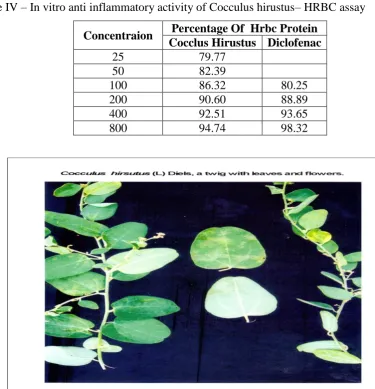
Ethanolic extract of leaves of Cocculus hirsutus were subjected to in – vitro anti
inflammatory activity in various doses, they showed dose dependent anti-inflammatory
activity. At 100 µg/ml concentration HRBC membrane stabilization was found to 86.32 %
and reaches maximum at the concentration of 800 µg/ml by 94.74%. The effect may be due
to presence of flavonoids and terpenoids.
Concentration Percentage Of Inhibiton Cocclus Hirustus Ascorbic Acid
25 6.59 80
50 21.34 86
100 29.08 88
200 30.04 90
400 49.14 92
800 56.73 94
Table IV – In vitro anti inflammatory activity of Cocculus hirustus– HRBC assay
Concentraion Percentage Of Hrbc Protein Cocclus Hirustus Diclofenac
25 79.77
50 82.39
100 86.32 80.25
200 90.60 88.89
400 92.51 93.65
800 94.74 98.32
DISCUSSION
The ethanolic leaf extract of the plant Cocculus hirustus showed significant antioxidant and
antiinflammatory effect, this was mainly due to the presence of flavonoid and tri terpenoids.
Proper isolation of the active principles can help in the findings of new lead compound that
having anti-inflammatory action. Further investigations are needed to prove antinflammatory
action with experimental animals
CONCLUSION
From the research it was concluded that the ethanolic leaf extract of the Cocculus hirustus
leaves having invitro antioxidant and anti-inflammatory activity.
ACKNOWLEDGEMENT
The author gratefully acknowledge Sri Ramachandra University, Chennai for their support in
REFERENCES
1. Kirtikar KR, Basu BD. Indian Medicinal Plants.reprinted ed. Vol. 1. L.M.Basu,
Allahabad; 1981: 80-82, 86-90.
2. The Wealth of India — A Dictionary of Indian, Raw Materials, Vol. 2, Publications and
Information Directorate, CSIR, New Delhi; 1950:35-36.
3. Deepika Arya, Mukesh Meena, Neha Grover and Vidya Patni. In vitro anti-inflammatory
and anti-arthritic activity in methanolic extract of cocculus hirsutus (l.) Diels. In vivo and
in vitro. International journal of pharmaceutical sciences and reasearch, 2014; vol. 5(5):
1957-1962.
4. Chatterjee Tk, ''Herbal Options", 1996,1st edition,published by M/s Eastern Traders,
Calcutta :157-178
5. Chadha YR, The Wealth of India- A dictionary of Indian Raw Materials and industrial
products. CSIR, New Delhi; 1950: 258.
6. Badole S, Patel N, Bodhankar S, Jain B, .antihyperglycemic activity of aqueous extract of
leaves of Cocculus, hirsutus (L.) Ind. J Pharmacol,2006; 38(1):49-53
7. Satyanarayana K, Mangathayaru V. Studies on hypoglycaemic and cardiotonic effects of
roots of Cocculus hirsutus. J Pharmaceutical Sci, 1994; 3: 30-35.
8. Badole, Sachin L. Patel, NM, Acute and chronic diuretic effect of ethanolic extract of
leaves of Cocculus hirsutus (L.) Diels in normal rats, Journal of Pharmacy and
Pharmacology, 2009; 61(3):387-393.
9. Ganapaty S, Dash GK, Diuretic, laxative, toxicitystudies of Cocculus hirsutus,
Fitoterapia, 2002;73 (1):28-31.
10.Sangameswaran, B, Jayakar, B, Antidiabetic and spermatogenic activity of Cocculus
hirsutus, Afri. J. Biotech., 2007; 6(10):1212-1216.
11. Jeyachandran R, Mahesh A, Cindrella L, Antibacterial activity of Cocculus hirsutus,
J.Plant Sci., 2008; 3(3): 194-198
12.Mangathayaru K,Venkateswarlu V,Antimicrobial activity of Cocculus hirsutus(Linn)
Ind.37.Rastogi B, Tiwari U, Aditi Dubey, et al.Pharma. Sci., 2005: 67(5): 619-621.
13.Rastogi B, Tiwari U, Aditi Dubey. Immunostimulant activity of cocculus hirsutus on
immunosuppressed rat, Pharma cology online,2008;3: 38-57.
14.Sangameswaran, B, Jayakar, B, Antidiabetic and spermatogenic activity of Cocculus
15.Tevari MN, Ramavat KG, Bhardwaj L, Anti tumour activity of Cocculus hirsutus,
Bionature, 1992, 12, 33-41.
16. Rakkimuthu R, Kavitha krishna R, quantitative phytochemical analysis and their
antioxidant activity of cocculuc hirsutus (L) Diel fruit. International Journal of
phytomedicine. 2012, 4 , 447-455.
17.Oyaizu, (1986) M. Studies on product of browning reaction prepared from glycosamine
J.P. Nnutr, 44, 307 – 315.
18.Green LC, Wagnes DA, Glogowski s, Skipper PL, wishonk is and Tannebarn S.R, 1982,
Analaysis of nitrate & 156 (N) nitrate in biology fluids, analytical biochemistry, 126.
19.B. R. Panda*,1, S. R. Mohanta1, A. K. Manna1, S. Si2 , In vitro antioxidant activity on
the aerial parts of Cocculus hirsutus Diels Journal of Advanced Pharmaceutical Research.
2011, 2(1), 18-2
20.Gulcin I, Oktay M, Kirecci E and Kufreviolu I 2003, Screening of antioxidant and
antimicrobial activities of Anise (pimpella anisum L.) seed extracts, Food,Chem., 83 (
371-382)
22. R.Lavanya, S.Umamaheswari, G,Harish. J Bharath Raj, S.Kamali, Invitro antioxidant,
…...anti-inflammatory and anti-arthritic activities in the leaves of coldenia procumbens
Linn,Research Journal of Pharmaceutical, biological and chemical sciences 2010, 1(4),
753
23.V.Afsar, Y Mohan Reddy, K V Saritha, Invitro antioxidant and anti-inflammatory
activity of Methanolic Leaf extract of Boswellia serrata, 2012, 1(4) 15- 23.