Modern mass spectrometric techniques applied to
occupational hygiene analysis.
FORD, Michael James.
Available from Sheffield Hallam University Research Archive (SHURA) at:
http://shura.shu.ac.uk/19654/
This document is the author deposited version. You are advised to consult the
publisher's version if you wish to cite from it.
Published version
FORD, Michael James. (2002). Modern mass spectrometric techniques applied to
occupational hygiene analysis. Doctoral, Sheffield Hallam University (United
Kingdom)..
Copyright and re-use policy
o n c r r ic u u rw xnjvt vi wv tr ia l i i
LEARNING CENTRE
CITY CAMPIUS, HOWARD STREET
S H vH JL D S 11W 8
1 0 1 7 1 5 6 5 4 9
I l l ’ l l I B I H U B I B I B I B I I I f l B i l l
ProQuest Number: 10694535
All rights reserved
INFORMATION TO ALL USERS
The qu ality of this repro d u ctio n is d e p e n d e n t upon the q u ality of the copy subm itted.
In the unlikely e v e n t that the a u th o r did not send a c o m p le te m anuscript and there are missing pages, these will be note d . Also, if m aterial had to be rem oved,
a n o te will in d ica te the deletion.
uest
ProQuest 10694535
Published by ProQuest LLC(2017). C op yrig ht of the Dissertation is held by the Author.
All rights reserved.
This work is protected against unauthorized copying under Title 17, United States C o d e M icroform Edition © ProQuest LLC.
ProQuest LLC.
789 East Eisenhower Parkway P.O. Box 1346
Modern Mass Spectrometric Techniques Applied to
Occupational Hygiene Analysis
By
Michael James Ford
A thesis submitted in partial fulfillment o f the requirements o f Sheffield
Hallam University for the degree o f Doctor o f Philosophy
November 2002
Collaborating Organisation:
Abstract
The identification of chemical hazards is o f significant importance in occupational hygiene. The concentration at which a chemical substance may be regarded as a hazard may be very low and as a result o f this the demands on analytical techniques to determine the presence of a chemical substance can be great. Mass spectrometry is an analytical technique with a broad range o f applications, described as the universal detector; the technique offers high sensitivity and high selectivity. Although an established technique in many areas only limited applications have been reported in the field o f occupational hygiene analysis.
The aim o f this work was to apply modem mass spectrometric techniques to analyse samples arising from occupational hygiene monitoring. Liquid Chromatography/Mass Spectrometry (LC/MS) was used with Electrospray Ionisation (ESI) and Atmospheric Pressure Chemical Ionisation (APCI). Nanospray ionisation was used for the direct infusion analysis o f isocyanate samples. Matrix assisted Laser Desorption/Ionisation (MALDI) has been demonstrated as an ionisation technique suitable for application to occupational hygiene sample analysis. Tandem mass spectrometry (MS/MS) was used where necessary to identify unknown species.
Benzalkonium Chloride (BAC) has biocidal properties and for this reason the substance is used in many products such as in-can preservatives and ophthalmic cleaning systems. The phenyl substituent o f BAC facilitates detection by spectrophotometric methods. Other quaternary ammonium compounds, that have no chromaphore, are used in preparations also containing BAC. The detection o f these compounds can be a problem. In this work an LC/ESI/MS method is presented for the analysis o f mixtures o f BAC and other non-chromaphoric quaternary ammonium compounds. Excellent limits o f detection were achieved e.g., 3 ng.mf1 for the C12
homologue o f BAC. MS/MS and cone voltage dissociation techniques were used to identify an unknown quaternary ammonium compound.
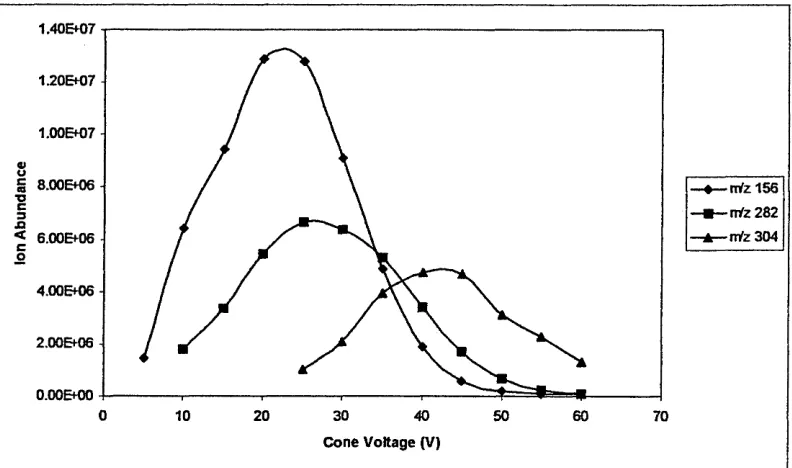
lodopropynylbutylcarbamate, a wood treatment agent with fungicidal properties, was analysed using LC/MS with APCI and ESI techniques. The effect o f the cone voltage on the ionisation efficiency was studied, as were the effects o f the wood treatment formulation matrix. Limits of detection o f 3.19 pg.m l_1 using APCI and 8.95 gg.m l_1 using ESI were calculated.
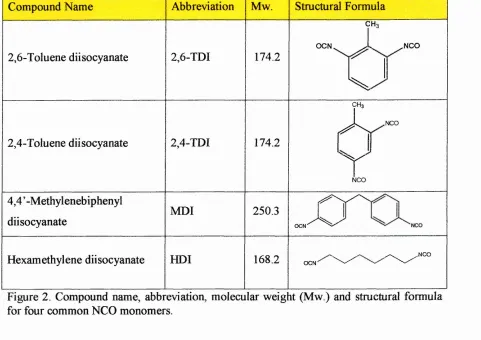
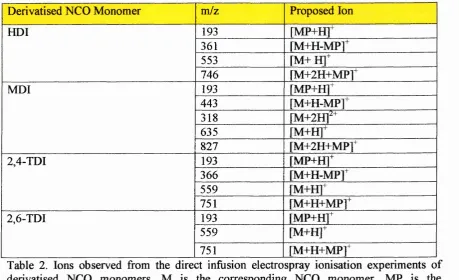
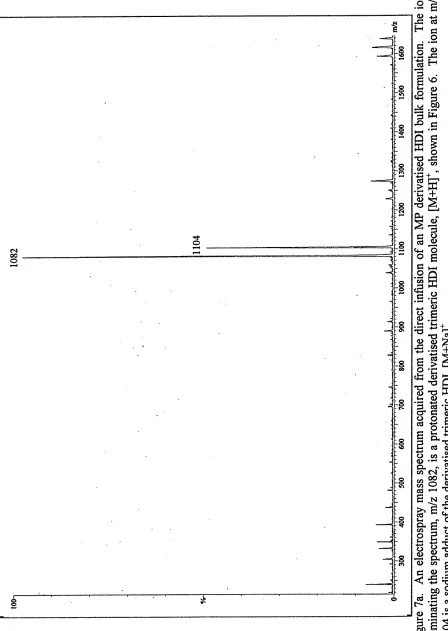
Isocyanates are the number one cause of occupational asthma in the U.K. l-(2- methoxyphenyl)piperazine derivatised isocyanate monomers and prepolymers were studied using LC/ESI/MS, nanospray and MALDI mass spectrometric techniques. Tandem mass spectrometry was used to facilitate structural elucidation o f several derivatised prepolymeric isocyanate species.
CONTENTS
1.0 Introduction 1
1.1 Occupational Hygiene 2
1.1.1 Exposure 3
1.1.2 Legislation 9
1.1.3 Case Study 16
1.2 Conclusion 22
1.3 References 24
2.0 An Introduction to High Performance Liquid Chromatography and Mass
Spectrometry 31
2.1 Liquid Chromatography 32
2.1.1 High Performance Liquid Chromatography 3 2
2.1.2 Modes o f Liquid Chromatography 3 3
2.1.3 Partition Chromatography 33
2.1.4 Chromatographic Theory 35
2.2 Detectors for HPLC 41
2.2.1 UV/Visible Photometric Detectors fo r HPLC 41
2.2.2 Liquid Chromatography/Mass Spectrometry (LC/MS) 43
2.2.2.1 Atmospheric Pressure Ionisation (API) 45
2 2 .2 2 Electrospray Ionisation (ESI) 45
2.2.2.3 Atmospheric Pressure Chemical Ionisation (APCI) 49
2.2.2.4 Matrix Assisted Laser/Desorption Ionisation (MALDI) 51
2 2 3 Mass Analysers . 53 .
2.2.3.2 Time-of-Flight Mass Analysers 55
2.2.4 Molecular Dissociation Techniques 58
2.2.4.1 Tandem Mass Spectrometry 58
2.2.4.2 Cone Voltage Dissociation 58
2.2.5 Detectors 60
2.3 Conclusion 61
2.4 Bibliography 62
2.5 References 63
3.0 The Application of Liquid Chromatography Coupled with Electrospray
Ionisation Mass Spectrometry and Tandem Mass Spectrometry to the Analysis of
Alkylbenzyl and Dialkyldimethyl Quaternary Ammonium Biocides in
Occupational Hygiene and Environmental Media. 66
3.1 Introduction 67
3.2 Experimental 69
3.2.1 Chemicals and Reagents 69
3.2.2 Instrumentation 70
3.2.3 Analytical Procedure 71
3.3 Results 72
3.3.1 Applications o f LC/ESI/MS 72
3.3.2 Evaluation ofLinear Response ofLC/M S Method 73
3.3.3 Applications o f LC/MS Method to Occupational Hygiene, Concentrates
and Forensic Samples 7 6
3.3.4 Structural Elucidation o f Quaternary Ammonium Compounds 7 8
3.3.5 Application o f Dissociation Methods to Real Samples 79
3.4 Conclusion 80
4.0 The Analysis of Iodopropynylbutylcarbamate (IPBC) by LC/ESI/MS and
LC/APCI/MS. 83
4.1 Introduction 84
4.2 Experimental 85
4.2.1 Chemicals and Reagents 85
4.2.2 Instrumentation 85
4.2.3 Analytical Procedure 86
4.3 Results 89
4.3.1 Optimisation o f Spray Ionisation Parameters 89
4.3.2 Evaluation o f Linear Response o f LC/ESI/MS and LC/APCI/MS Methods
90
4.3.3 Determination o f LOD fo r LC/MS methods 91
4.3.4 Application o f LC/ESI/MS and LC/APCI/MS Methods to the Analysis o f
IPBC Containing Professional use Products 93
4.3.5 Analysis o f Matrix Effects 93
4.3.6 Comparison o f ESI and APCI Ionisation Methods fo r the LC/MS Analysis
o f IPBC in Professional use Products 94
4.4 Conclusion 95
4.5 References 97
5.0 The Qualitative Determination of Isocyanate Derivatives by LC/MS,
Nanospray/MS/MS and MALDI/MS/MS 98
5.1 Introduction 99
5.2 Experimental 110
5.2.3 Chemicals 112
5.2.4 Derivatisation o f Isocyanates 112
5.2.5 Working Solutions 113
5.2.6 MALDI Matrix Preparation 113
5.3 Results and Discussion 114
5.3.1 Initial Direct Infusion Experiments 114
5.3.2 Application o f LC/MS to the Analysis o f Derivatised Isocyanates 116
5.3.3 MS/MS Direct Infusion Triple Quadrupole 122
5.3.4 MS/MS Nanospray Q/ToF Ultima 125
53.5 Application ofMALDI/MS to the Analysis o f Derivatised Isocyanates
129
5.3.6 Application ofMALDI/MS/MS to the Analysis o f Derivatised Isocyanates
133
5.3.7 Potential Structures Identified 150
5.4 Conclusions 153
5.5 Reference 154
6.0 Analysis o f the Surfactant Composition of a Commercial Sheep Dip
Formulation 158
6.1 Introduction 159
6.2 Experimental 162
6.2.1 Chemicals and Reagents 162
6.2.2 Instrumentation 162
6.2.3 Analytical Procedure 163
6.3 Results and Discussion 164
63.2 Application o f ESI/MS to the analysis o f surfactants 170
6.3.3 Application o f LC /E SI/M S to the surfactant analysis 170
6.4 Conclusion 175
6.5 Reference 176
7.0 Conclusion 178
Appendix 1 Conferences Attended and Presentations 182
1.1 Occupational Hygiene
This thesis describes the role of selected modem analytical techniques in the analysis
o f samples that result from occupational hygiene monitoring. The techniques used
involve liquid chromatography coupled with UV/Vis absorbance and mass
spectrometric detectors. The aforementioned techniques offer advantages which may
be utilised in many fields including the analysis o f occupational hygiene samples;
however, the much praised mass spectrometric [1] detector has not been fully exploited
in this field. The work presented is the result o f three years work during which period
the potential role o f mass spectrometry for occupational hygiene analyses was
investigated.
Occupational hygiene is concerned with the prevention and control of hazards arising
from work activities [2], The goals o f occupational hygiene include the protection and
promotion o f workers’ health and the protection of the environment [3]. Work is
generally considered to be essential for life, development and personal fulfilment.
Unfortunately, indispensable activities such as food production, extraction of raw
materials, manufacturing o f goods, energy production and services involve processes,
operations and materials which can, to a greater or lesser extent, create hazards to the
health of workers and those in nearby communities, as well as to the environment [4].
The exposure of individuals to hazards is minimised through adequate hazard control
interventions, which not only protect workers’ health but also seek to limit the damage
to the environment which is often associated with industrialisation. It is in an
employer’s interest to provide a safe working environment for employees as the
employer’s public image [5]. The need for occupational hygiene in the protection of
workers’ health cannot be overemphasised. The potential for harm associated with
work involving chemical substances is great. In many cases the chemical hazard may
not be apparent until harm is done. Often a feeling o f discomfort can be an
individual’s first indication of a problem.
1.1.1 Exposure
Exposure to a toxicant poses a risk to the health o f individuals who may or may not be
aware o f a health-affecting incident [6]. The toxic effects of an agent may be broadly
defined as chronic or acute [7-9]. Acute effects are associated with incidents of
abnormal contact with a high concentration o f a hazardous substance. Such incidents
can be the result o f accidents (e.g. spillages or leakages), or a change from the normal
working routine (e.g. maintenance) [7]. Chronic toxicity is the result o f repeated
exposure to a hazardous substance at a concentration sufficient to have a compounded
detrimental affect to health. Chronic toxic effects can result from poor working
practice (e.g. poor house keeping) or the failure to recognise a hazard in the workplace
[7]. Conditions associated with exposure to toxic material include irritation,
mutagenesis, teratogenesis, carcinogenesis, organ damage and reproductive constraints.
The main work-place exposure routes for chemical and biological agents are dermal
and respiratory. Oral ingestion must also be considered as a less common but equally
threatening mode o f exposure [10]. Gases, vapours, aerosols, volatile solvents, liquids,
dusts and fibres are common to many industrialised processes as raw materials or by
substances in all o f these states and the substances can either be absorbed or cause
local toxic effects. The degree o f entry into the circulatory system is determined by
many factors, including the toxic chemical’s concentration, exposure duration, the
solubility and reactivity o f the substance in the blood and body tissues, and the
excretion/secretion rate of the chemical from the body [11]. The inhalation of toxic
substances into the air passages of the lungs and on into the circulatory system is a
rapid and a direct means of entry into the bloodstream. The high rate of absorption is a
result of the large surface area of the pulmonary alveoli, richly provided with
capillaries [12].
Acute inhalation o f solvents in large quantities can cause asphyxiation,
unconsciousness or death [13]. Inhalation o f large quantities o f very irritant
substances, such as methyl isocyanate, may cause immediate bronchoconstriction and
pulmonary oedema leading to death [14]. Each of these pulmonary effects is usually
the result of short term high level accidental exposure and these effects are less
common than chronic industrial diseases. Over the long term, exposure to air-borne
hazards can result in cancer or debilitating respiratory disease [15]. Sensitisation may
also be a problem following inhalation exposure where it may lead to a systemic effect
such as asthma [16]. Sensitisation is essentially an irreversible allergic reaction. A
sensitised individual will exhibit symptoms of exposure at concentrations o f a toxicant
well below those o f a non-sensitised individual. Sensitisation may affect not only the
health o f an employee but also their employment prospects [17].
Statistics published annually by the Health and Safety Executive, HSE, quote the
Work-Related Illness Survey conducted in 1995, SW I95, [19], in which all cases were
assessed, puts the number o f persons suffering from asthma symptoms, which they
believed to be work related, at 151,000. SWI 95 provides an interesting point of
reference for all areas o f occupational illness as it was a survey o f the entire working
population, and the focus o f attention was not just new cases o f illness. The average
incidence of new cases o f occupational asthma over three years (1998-2000) was 911,
or around 3 cases per 100,000 [18] workers per year. Isocyanates are the most
common agents responsible for occupational asthma [18]. The occupation with the
highest incidence rate o f occupational asthma reported to chest physicians was spray
painters (72 cases per 100,000 workers per annum), where the estimated rate was over
30 times the national average [18]. The dangers associated with spray painting are
well documented [20]. Occupational asthma has been defined by Bernstein as:
“A disease characterized by airflow limitation and/or airway hyper-responsiveness due
to causes and conditions contributable to a particular occupational environment and not
to stimuli encountered outside the workplace.” [21].
Occupational asthma occurs when workplace exposures to particular
substance/substances result in biological changes in a person’s airways, known as a
hypersensitive state, so that subsequent exposure to the same substance triggers an
asthma attack [22]. The mechanism by which sensitization occurs varies from one
substance to another; however, the fundamentals of the mechanism are now understood
[23]. The range of industries which use substances with the potential to cause asthma
is quite broad, and not all employees in these industries will necessarily be exposed. It
risk. Monitoring of occupational asthma precursors in the workplace offers a means o f
reducing the number o f cases by allowing measures to be taken to remove the source of
the toxicant It may be necessary for example to reassess die working practice and/or
the design o f a particular manufacturing process.
Meredith et a l [24] have estimated that the true incidence o f occupational asthma
diagnosed by consultant physicians may be as high as 1500-2000 or 6-8 cases per
100,000 workers, per year. The incidence o f occupational asthma and its related
precursors is a constant area o f concern for employers and enforcement agencies alike.
As a result o f this, research in the area persists [25]. The need for sensitive and
specific analytical methods for determining possible airborne toxicants and affiliates of
respiratory dysfunction is extremely important.
Examples o f airborne industrial toxicants are toluene diisocyanale [26-29], carbon
monoxide [30, 31] and some fibrous materials such as asbestos [32]. Toluene
diisocyanate is a commonly cited sensitising agent widely used in industry as a starting
material in the manufacture o f polyurethanes [26-29]. Carbon monoxide (CO) is a gas
phase toxicant. Its toxicity is a consequence o f tissue hypoxia created by the
displacement o f oxygen from haemoglobin and the subsequent impairment o f oxygen
release to the tissue [30], Early symptoms o f CO exposure include tightness across the
forehead and a slight headache. The later symptoms o f CO exposure involve severe
headaches, vomiting, collapse o f the lungs and ultimately death; which is essentially
asphyxiation [30, 31]. Toxic substances that deposit in the lung can cause the
mining dust are examples o f such substances. For a review o f asbestos toxicity see
review [32].
The skin is composed o f epidermis, dermis, and hypodermis layers. The relatively
waterproof epidermis, or outer skin layer, prevents the diffusion o f fluids and is tough
enough to withstand abrasive contact. The dermis, which is thicker than the epidermis,
provides tear resistance and flexibility to the skin. The even thicker hypodermis layer
contains the blood vessels and nerves. The sweat glands penetrate both the dermis and
epidermis [33]. Toxic substances have difficulty entering the body through the skin
because of the epidermis layer [34]. Chemical diffusion through the epidermis layer
depends upon the nature of the chemical substance as well as the skin thickness and its
condition at the point o f contact. Skin that has been damaged by physical abuse or
chemical reaction is more vulnerable to toxic effects of a substance than undamaged
skin as diffusion across the epidermis may occur more readily.
Skin contact with a hazardous substance is a common problem in many industrial
processes [13]. The most prevalent occupational disease is dermatitis and this accounts
for more working days lost in the U.K. than all other industrial diseases together [18].
Dermatitis is an inflammatory condition which can be caused by irritants or allergens
[35]. The number o f potential irritants is large and includes many different types o f
chemical substances such as acids, alkalis, metals, solvents and solid organic and
inorganic chemicals [36]. There are a large number of possible interactions between
potential irritants and the skin. Solvents will degrease skin, whereas acids and alkalis
will denature skin proteins [37]. Skin sensitizers act via an immunological mechanism
with proteins such as keratin, to produce an antigen. This “foreign”, antigenic protein
then initiates the production of antibodies. Re-exposure to the substance will then
initiate an allergic reaction [38].
The best example of prevalence o f work-related skin disease comes from the SWI 95
[19]. This provides an estimate o f the prevalence of self-reported work-related skin
disease o f 66,000 workers. In terms of the current situation with regard to work-
related skin disorders, figures provided by Occupational Physicians Reporting Activity
(OPRA) and EPIDERM, a group responsible for the surveillance for occupational skin
disease by dermatologists, report an estimated 4540 workers each year in the period
1998-2000 with work-related skin disorders. Approximately 78% of the reported cases
were diagnosed as contact dermatitis [18]. EPIDERM and OPRA provide information
on the incidence o f work-related skin disease and contact dermatitis through voluntary
surveillance schemes
The occupations estimated to be at highest risk in 1998-2000 according to
dermatologists reporting to EPIDERM are hairdressers and barbers, grinding machine
setters and operators, electroplaters, galvanizers and colour coaters, rubber process
operatives and printers [18]. During 1998-2000, the most common agents associated
with occupational skin disease cited both by dermatologists and occupational
physicians are rubber chemicals and materials, followed by wet work, soaps and
cleaners, respectively [18],
To reduce the risk and number of incidents of exposure, the HSE publishes guidelines
by the HSE and are aimed at a technical audience. They report scientific and technical
information that has been collected by the HSE in respect o f work on a specific
substance or the results of work on a particular subject. Most of these documents will
report the exposure assessment which contributes to the setting o f an occupational
exposure limit (OEL) for a specific substance. Two types of exposure limits are used:
the maximum exposure limit (MEL) and the occupational exposure standard (OES)
[39]. A description of the criteria used to determine which type of limit is applicable is
given in HSE publications EH40, Occupational and Exposure Limits [36] and EH64,
Summary Criteria for Occupational Exposure Limits [40].
1.1.2 Legislation
From its origins in the early nineteenth century the development o f Health and Safety
Legislation has been a constant process. The 1961 Factories Act [41] sought to
consolidate previous legislation with the production o f a single code of conduct that
could be applied to the diverse factory industries developing at that time. The diverse
nature of work activities had previously produced rules and regulations which were
tailored to specific subsets o f industry e.g. the Mines and Quarries Act 1954 [42] and
the Agricultural (Poisonous Substances) Act 1952 [43] to protect miners and
agricultural workers, respectively. The first all-encompassing act was published in
1974 i.e. The Health and Safety at Work Act (HASWA) [44].
HASWA [44] describes the role o f both employer and employee in the acquisition and
maintenance o f a working environment which is both practical and conducive to a safe
o f a safe working environment. Employees are bound to obey the company health and
safety policy and the company is bound to have a health and safety policy. Thus a safe
working environment is created for all involved in the work activity. Examples of
compliance include the responsibility of the employee to wear or use any personal
protective equipment provided by the employer, and the responsibility o f the employer
to provide such equipment as is necessary. HASWA not only concerns itself with the
physical safety o f persons involved in a work task but also the premises on which that
task is to be executed and also any waste products, emissions, from that task. Any
substances that may be emitted as a result o f a task must be rendered harmless and
ineffective to avoid pollution of the external environment. Also, emission-related
adjectives such as “noxious or offensive” are not confined to the description on a label,
but include what is perceived by a user or third person to be noxious. An important
statement in HASWA with regards the role of the employer to the employee is:
“It shall be the duty of every employer to ensure, so far is reasonably practicable, the
health, safety and welfare at work of all his employees” [44].
This statement essentially describes the responsibility of the employer to the employee
and emphasises the liability o f the management o f a company if the company is subject
to a health and safety incident.
There are numerous Acts o f parliament governing the safety o f employees in the
workplace. The Acts themselves contain every detail o f how the content and context
o f an act will be enacted. Instructions to industry on how to implement the
types; General in Scope, e.g. Reporting of Industrial Diseases and Dangerous
Occurrences Regulations 1995 (RIDDOR) [45]; Health and Safety (First Aid)
Regulations 1981 [46]; Limited in Scope, e.g. Control of Lead at Work Regulations
1980 [47]; Functional, e.g. Electricity at Work Regulations 1989 [48], Food Hygiene
Regulations 1970 [49]; and Industry Related, e.g. Construction (Design and
Management) 1994 (CONDAM) [50], Pottery (Health and Welfare) Special
Regulations 1980 [51]. Practical guidance explaining how industry can conform to the
detail o f the respective regulations is provided in the form of Approved Codes o f
Practice (ACOPs), e.g. [52].
In the case of operations involving chemical substances health and safety regulations
are reinforced by the Control o f Substances Hazardous to Health Regulations
(COSHH) [52]. Substances that may cause harm to health are subject to COSHH. The
basic principle underlying the COSHH regulations is that the risks associated with the
use of any substance hazardous to health must be assessed before it is used and the
appropriate measures taken to control the risk. A hazardous substance is defined by
the COSHH regulations as one which falls into any o f five categories:
/
1. Any substance which is classified as toxic, very toxic, irritant, harmful,
corrosive, flammable, explosive or radioactive under the Chemicals (Hazard
Information and Packaging) Regulations 1996 (CHIP) [53].
2. Any substance which has a Maximum Exposure Limit (MEL) or Occupational
Exposure Standard (OES).
3. Any micro-organism that creates a hazard to the health of any person.
5. Any other substance not mentioned above that creates a comparable risk o f ill-
health effects to any person.
The COSHH Regulations cover any hazardous substance that is included in the five
categories above, and includes any natural or artificial substance that is solid, liquid,
dust, gas or vapour. An employer is required by the COSHH regulations to prevent, or
if this is not reasonably practicable, adequately control, employees’ exposure to
hazardous substances. The occupational exposure limits set by the HSE are expressed
as concentrations o f a hazardous substance in the air, averaged over a specified period
o f time referred to as a time weighted average (TWA). Two time periods are used: 8
hour (based on average shift length), and 15 minute short term exposure limits (STEL)
which are set up to help prevent effects, such as eye irritation, which may occur after
just a few minutes exposure. OES are legally binding as they are approved by the
Health and Safety Commission. A MEL is set for substance which may cause the most
serious health effects, such as cancer and occupational asthma. To comply with
COSHH, exposure should be reduced as far below the MEL as is reasonably
practicable and should not exceed the MEL when averaged over the specified reference
period. For substances given a short term MEL (15 minute reference period), the level
o f exposure should never be exceeded. The OEL values relate to effects resulting from
inhalation. However, certain substances may rapidly penetrate intact skin, become
absorbed into the body and exert, or contribute to, adverse health effects. When the
effect o f a substance on the skin is a significant hazard e.g., for strongly irritating
An OES is set at a level at which (based on current scientific knowledge) there is no
indication o f risk to the health o f workers who are exposed to a particular substance on
a regular basis. If exposure to a substance that has an OES is reduced at least to that
level, then adequate control has been achieved. For some toxic substances, biological
monitoring may also be appropriate as a means o f assessing whether exposure is being
taken into the body by breathing or through the skin [54]. Measurements o f substances
(or their by-products) in blood, urine or expired air are commonly used. Biological
Monitoring Guidance Values (BMGV) are set to help employers, safety representatives
and employees to interpret biological monitoring results but they have no legal status.
MEL, OES and BMGV are set on the recommendations of the Health and Safety
Commission (HSC) Advisory Committee on Toxic Substances (ACTS) and its
Working group on the Assessment o f Toxic Chemicals (WATCH). COSHH is
omnipresent in industry with no employer, no matter how small the workforce, or
whatever the industry, being exempt.
An example of substances with a MEL is the polychlorinated biphenyls (PCB); the
maximum exposure limit for which is 0.1 mg. m‘3 for an 8 hour (TWA) period. PCB
are given the skin notation (Sk) reflecting their irritant status [36]. PCB are a group o f
highly lipophilic hepatotoxic compounds with the same general formula, Ci2Hio-nCln.
PCB have been proven to be extremely toxic to aquatic organisms [55]. They have
very high chemical, thermal and biological stability; low vapour pressure; and high
dielectric constants. These properties have led to the use of PCB as cooling liquids in
electrical equipment, particularly transformers and capacitors. Occupational exposure
is most likely to occur during the removal, decontamination and disposal o f PCB-
companies or trained in-house staff. Regular exposure is therefore restricted to a small
population. However, a minority of transformer and capacitor replacements is carried
out by general electrical contractors. Occupational exposure to commercial PCB
preparations can result in cutaneous effects such as chloracne and eczema.
Carbofuran and malathion, (Figure la and lb), are examples o f substances with OES:
0.1 mg.m'3 and 10 mg.m'3 for long term, 8hr, exposure, respectively. Carbofuran is a
broad spectrum systemic carbamate insecticide, nematicide, and acaricide commonly
used throughout the world [56,36]. Malathion is an organophosphorus pesticide that is
widely used for both domestic and commercial agricultural purposes. It is considered
to be one o f the safest organophosphate insecticides [57, 36]
/ \ —
Malathion Carbofuran
Figure 1. The structural formula o f a common carbamate pesticide, carbofuran, and a common organophosphorus pesticide, malathion.
Pesticides are an instance o f a class of compounds where separate legislation is used in
conjunction with COSHH to enforce exposure limits. Pesticide legislation in the U.K.
is in the form of The Food and Environment Protection Act 1985 (FEPA) [58] and
advertising, sale, supply, storage and use o f pesticides. European legislation also
heavily regulates the use of pesticides. The European Council (EC) Directive
91/414/EEC [60], the Plant Protection Directive, was introduced to harmonise national
arrangements for the authorisation o f plant protection products within the European
Union. Under the provisions o f the directive, individual member states are responsible
for authorisation within their own territory of products containing active substances
that appear in a list agreed at Community level. Only officially approved pesticides
may be marketed in the United Kingdom. The official list o f approved products,
including all the above categories except those for experimental purposes, is the
Ministry o f Agriculture Food and Fisheries/Health and Safety Executive publication,
Pesticides 2001; Your Guide to Approved Pesticides [61]. Pesticides are subject to
exposure limits other than OES and MEL. Maximum Residue Levels (MRL) are
levels set to prevent exposure to the number of pesticides which leave a residue even
when used correctly [62]. MRL provide a check that products have been used as
directed; they are not safety limits. However, they do take account o f consumer safety
because they are set at levels that ensure that normal dietary intake o f residues presents
no risk to health. Wide safety margins are built in and eating food containing residues
above the MRL does not automatically imply a risk to health. Nevertheless, it is an
offence to put into circulation any produce where the MRL is exceeded. Details of
those MRL that have been set have been published in the Pesticides (Maximum
Residue Levels in Crops, Foods and Feeding Stuffs) (England and Wales) Regulations
2002 [62], An example o f a pesticide MRL is 0.1 mg residue/kg food on fruits,
vegetables, pulses, oilseeds, potatoes, tea and hops for atrazine. Atrazine is a triazine
herbicide with residual and foliar activity (Figure 2). It has restricted permitted use
Atrazine
Figure 2. The structural formula o f a common triazine herbicide, atrazine.
The European Commission passes down many laws in the form o f European
Community (EC) Directives that also act to provide a safe working environment.
These Directives have no power over employers in the United Kingdom but are
instructions to the governments of member states to implement a particular aspect of
EC law [64]. In the United Kingdom, the power comes from the fact that the
Government issues Regulations under an appropriate Act of Parliament. The European
Directive 89/391/EEC [65] lays down the minimum requirements covering the
prevention o f occupational risks. The directive is backed by a number o f ‘daughter’
directives which are specific to types o f equipment and the requirements covering
them An example daughter directive is EC Directive 89/656/EEC covering the use o f
personal protective equipment, (PPE), in the workplace [66].
1.1.3 Case Study
Recent European legislation has isolated “Biocides” as a class o f compounds which
need to be regulated by member states. The Biocidal Products Directive (BPD)
establish a single European market in biocides and to provide a high level o f protection
for people and the environment [69]. Biocidal products are defined as:
“Active substances and preparations containing one or more active substances, put up
in the form in which they are supplied to the user, intended to destroy, deter, render
harmless, prevent the action of, or otherwise exert a controlling effect on any harmful
organism by chemical and biological means” [67].
Biocides are essentially non-agricultural pesticides. This class of compounds was left
unregulated by the Plant Protection Directive and so the biocide directive is necessary
to cover this grey area Biocidal products include such preparations as rodenticides,
insecticides, avicides and moluscicides. The BPD is modelled on the Plant Protection
Directive, despite the fact that biocidal product uses are quite different from crop
protection applications [69].
Active substances in biocides have a desired effect, typically a chemical activity, e.g.,
disinfection of drinking water by killing bacteria and viruses in the water. Such
desired effects are very important for general public health and without them
significant public health problems may occur [70]. Chemical biocides also fulfil a key
role in the preservation of products as diverse as cutting fluids, foods and beverages,
cosmetics and pharmaceutical formulations and afford protection against spoilage in a
wide range o f industrial and environmental applications [71]. Biocides may exert both
bacteriostatic and bactericidal effects, although the mechanism of action responsible
for each may differ. Bacteriostatic events are generally considered to arise from some
whereas bactericidal action results in irreparable and irreversible damage to a vital
cellular structure or function [71].
One particular area where the negative effects o f biocidal products are well
documented is anti-foulant coatings. Biocides have been used for many years to
prevent organisms such as bacteria, larve, macroalgae, barnacles and other
invertebrates [72] from becoming encrusted on fresh and seawater marine structures,
such as oil rigs supports, buoys, fish cages and ships hulls [73]. Chemicals including
organo-mercury compounds, lead and arsenic, were historically used as anti-foulants.
However, such compounds pose severe environmental and human health risks and
were withdrawn voluntarily by the paint industry during the early 1960s [74]. A
suitable replacement for these compounds was a group o f organotin congeners and
particularly tributyltin (TBT) [75]. The contamination generated by the direct
introduction o f biocides, mainly organotins, and more specifically o f TBT into the
aquatic environment from the leaching o f anti-fouling paints, is well established [75,
76]. The introduction o f organotin compounds into seawater has resulted in higher
accumulation levels o f organotin compounds in marine products [77]. The uptake
mechanism is via food chain and/or direct absorption because o f the high lipophilicities
o f the organotin congeners [78]. Despite various degradation pathways and the
evidence of decreasing concentrations in the water column in some places around the
world, TBT contamination is still considered to be one o f the most important
ecotoxicological problems o f the last two decades [77].
The adverse effect of organotins on non-target aquatic organisms [78-82] combined
based anti-foulant paints in many countries. At the end o f the 1980s, TBT and other
organotin-based anti-foulants were banned by the European Union in small vessels
(<25m) [83]. This ban was extended in 2002 to cover any organotin-based free
association paint and any anti-foulant for use on, or as:
• All craft irrespective of their length intended for use in marine, coastal
estuarine and inland waterways and lakes.
• Cages, floats, nets and any other appliances or equipment used for fish or
shellfish farming.
• Any totally or partly submerged appliance or equipment.
• Constituents of preparations intended for use in the treatment o f industrial
waters [84].
Thus the use o f organotin based anti-foulants has been effectively banned in the
European Community.
In the absence o f the anti-fouling potency o f TBT, a copper compound such as cuprous
oxide (CU2O), copper thiocyanate (CuSCN) or metallic copper is utilised as the
principal biocide. Copper exhibits anti-fouling activity against organisms such as
barnacles, tube worms and the majority o f algal fouling species. However, several
algal species (e.g. Entermorpha spp., Ectocarpus spp., Achnanthes spp.) show marked
physiological tolerance to copper [85]. In order to achieve protection against these
tolerant species, various booster biocides have been used in conjunction with copper to
Examples of organic booster biocides include chlorothalonil, Irgarol 1051, zinc
pyrithione, Kathon 5287, TCMTB and TCMS pyridine (Figure 3). There is little
known about the eco-toxicity, or environmental fate of these compounds and it is
argued that the dissipation o f the booster biocide from the surface to the surrounding
waters, with subsequent exposure of non-target algae, could have similar consequences
to those experienced with organotins. In the absence o f organotin-based anti-fouling
products concern has increased about the concentrations of copper in the aquatic
environment.
Irgarol 1051 is added to anti-foulant products because o f its high effectiveness as a
growth inhibitor o f marine and freshwater algae through interactions with their
photosynthetic system [86]. There have been several studies involving the monitoring
o f Irgarol 1051 in coastal waters with positive results reported from the analyses of
samples taken from the Mediterranean [87], English [88] and Scandinavian [89]
coastal regions. These studies have found elevated levels of Irgarol 1051
contamination in areas o f high recreational and commercial boating activity.
As a result of concerns regarding the levels o f booster biocides in marine samples
methods have been developed for the analysis o f a broad spectrum o f biocidal products
in aqueous samples. Thomas reports methods for the analysis o f Kathon 5287 and
TCMTB, in aqueous samples [90] and Voulvoulis et a l have reported methods for the
determination of chlorothalonil, Irgarol 1051, zinc pyrithione, Kathon 5287, TCTMB
Chemical Name Structure Common Name
CN 2,4,5,6-tetracholoro-
1,3,dicyanobenzene Chlorothalonil
ci
Cl
HN Cyclopropyl-N’-( 1,1-
dimethylethyl)-6-
(methylthio)-1,3,5-triazine- 2,4-diamine
Irgarol 1051
Zinc pyridine-2-thiol-l-oxide Zinc Pyrithione
Zn
S
2-n-octyl-4-isothiazolin-3-one
Kathon 5287
2-thiocyanomethyl-benzothiazole TCMTB
.CN S
2,3,5,6-tetrachloro-4-
sulfiironyl pyridine c h3
Cl
Cl
[image:31.614.85.543.20.645.2]The case o f anti-foulant paints highlighted above is just one example of an area
affected by the Biocidal Products Directive. With many other areas of industry relying
on processes which are liable to bacterial infection with associated negative effects, it
is important that methods are in place for the accurate determination o f biocides in the
working environment.
1.2 Conclusion
Exposure to chemical substances in the occupational environment and its adverse
consequences is an issue of great importance. The exposure of an individual to a
substance having a detrimental affect on their health is unpleasant and unnecessary.
The close monitoring of the working environment and the encouragement o f employers
and employees to operate within a safe environment is one method o f reducing cases o f
chemical exposure incidents. Using legal tools such as HASWA and COSHH it is
possible to enforce safe working practice in the United Kingdom.
An understanding o f the toxicity o f chemical substance allows the HSE to establish
occupational exposure limits (OEL). OEL are a method o f controlling the exposure of
individuals to a chemical substance. OEL are legally binding, and so can be viewed as
another legal tool to improve safety in the workplace. In the case o f pesticides
exposure limits other than OEL are used. MRL are used to limit exposure to residual
pesticides which may remain on a plant product after use.
Organotins have been used as an example to demonstrate the effectiveness o f suitable
organotin anti-fouling products and their negative environmental effects has been well
documented. The use o f organotins has been extremely restricted in Europe. The
common replacement for organotins is copper based anti-fouling products; the effects
o f these on the environment are now being studied.
The role o f analytical chemistry in occupational hygiene monitoring is significant. The
capability to detect a chemical substance in the working environment can prevent and
where necessary identify a chemical hazard. The continuing development o f analytical
methods for the analysis o f samples taken from occupational hygiene monitoring
1.3 References
[1] Liquid Chromatography-Mass Spectrometry 2nd Edition. W.M.A. Niessens.
(1998), Marcel Dekker.
[2] W. TofFel, L.R. Birkner. Applied Occupational and Environmental Hygiene, 17,
(2002), 477-485.
[3] Encyclopaedia o f Occupational Health and Safety 4th Edition. Ed. J.M. Stellman.
(1998), International Labour Office.
[4] The Changing Nature o f Occupational Health, Eds. R. McCraig, J.M. Harrington.
(1998), HSE Books.
[5] Occupational Health and Safety Law: Text & Materials 2nd Edition. B. Barret.
(2000), Cavendish.
[6] R. Herbert, P.J. Landrigan. American Journal o f Public Health, 90, (2000), 541-
545.
[7] Types o f exposure and response in Introduction to Toxicology 3rd Edition. J. A.
Trimbell. (2002), Taylor and Francis
[8] G.M. Rusch, R Garrett, P. Tobin, E. Falke, P-Y. Lo. Drug and Chemical
Toxicology, 25, (2002), 339-348.
[9] J.A. Strickland, G.L. Foureman. The Science o f the Total Environment, 288, (2002),
51-63.
[10] Industrial toxicology in Occupational and Environmental Safety Engineering and
Management, H. R. Kavianian, C. A Wentz. (1990), van Nostrand Reinhold.
[11] Factors affecting toxic responses in Principles of Biochemical Toxicology 3rd
[12] J.R. Bend, C.J. Serabjit- Singh, R.M. Philpot. Annual Reviews Pharmacology and
Toxicology, 25, (1985), 97-103.
[13] Industrial Toxicology in Introduction to Toxicology 2nd Edition J.A. Trimbrell,
(2001), Taylor and Francis.
[14] P. Cullinan, S. Acquilla. Journal o f Occupational and Environmental Medicine,
40, (1998), 11-12.
[15] J.E. Fish. Journal o f Occupational Medicine, 24, (1982), 379-386.
[16] J.E. Salvaggio. The Journal o f Allergy and Clinical Immunology, 79, (1987) 558-
568.
[17] Medical aspects o f occupational asthma MS25, (1998), HSE Books.
[18] Health and Safety Statistics 2000/2001, (2001), HSE Books.
[19] Self reported work related illness in 1995, Results from a household survey, J.R
Jones, J.T. Hodgson, T.A. Clegg, R.C. Elliot. (1998), HSE Books.
[20] RG . Feldman, M.H. Ratner, T. Ptak. Environmental Health Perspectives, 107,
(1999), 417-422.
[21] J.A Bemsteia Journal o f Toxicology, 111, (1996), 181-189.
[22]. Occupational Respiratory Allergy, J. A. Bernstein, D. I. Bernstein, I. L. Bernstein
in Toxicology of Chemical Respiratory Hypersensitivity, Eds. I. Kimber, R J.
Dearman, (1997). Taylor and Francis.
[23] J. Jarvis, R. Agius, L. Sawyer. Chemistry in Britain, 32, (1996), 51-53.
[24] S. Meredith, H. Nordman. Thorax, 51, (1996), 435-440.
[25] J-L. Malo, M Chan-Yeung. Journal o f Allergy and Clinical Immunology, 108,
(2001), 317-328.
[26] J.M. Peters, R.L.H. Murphy, L.D. Pagnotto, W.F. Van Ganse. Archives o f
[27] J.M. Peters, R.L.H. Murphy, B.G. Ferris. British Journal o f Industrial Medicine,
16, (1968), 642-647.
[28] J.M. Peters, R.L.H. Murphy, B.G. Ferris. British Journal o f Industrial Medicine,
26, (1969), 115-120.
[29] D.H. Wegman, J.M. Peters, L. Pagnotto, L.J. Fine. British Journal o f Industrial
Medicine, 34, (1977), 195-200.
[30] I. Mikov, D. Draskovic, M. Savic, M. Arsic, Z. Todorovski, M. Glavaski.
Archives o f Environmental Health, 55, (2000), 455-456.
[31] J. Wright. Emergency Medicine Journal, 19, (2002), 386-390.
[32] C.B. Manning, V. Vallyathan, B.T. Mossman. International Immuno-
pharmacology, 2, (2002), 191-200.
[33] Biology, 6th Edition. N.A. Campbell, J.B. Reece. (2002), Benjamin Cummings.
[34] Skin Toxicity, RD . Aldridge, in Fundamental Toxicology for Chemists. Eds. J.H.
DufiEus, H.G.J. Worth. (1996), The Royal Society of Chemistry.
[35] Handbook o f Contact Dermatitis, J.G. Marks Jr. (2002), Martin Dunitz Publishers.
[36] EH40/2002-Occupational Exposure Limits 2002. (2002), HSE Books.
[37] H.N. MacFarland. American Industrial Hygiene Association Journal, 47, (1986),
704-707.
[38] H.R. Smith, D.A. Basketter, J.P. McFadden. Clinical and Experimental
Dermatology, 27, (2002), 138-146.
[39] M. Topping. The Annals o f Occupational Hygiene, 68, (1998), 57-78.
[40] Occupational Exposure Limits: Criteria Document Summaries. (2001), HSE
books.
[41] Factories Act 1961, (1961), The Stationery Office Books.
[43] Agriculture (Poisonous Substances) Act 1952, (1952), Her Majesty’s Stationery
Office.
[44] The Health and Safety at Work etc. Act, 1974, (2000), Her Majesty’s Stationery
Office.
[45] The Reporting o f Injuries, Diseases and Dangerous Occurrences Regulations,
1995, (1995), Her Majesty’s Stationery Office.
[46] The Health and Safety (First-aid) Regulations 1981, (1981), The Stationery Office
Books.
[47] The Control o f Lead at Work Regulations 1980, (1980), The Stationery Office
Books.
[48] The Electricity at Work Regulations 1989, (1989), The Stationery Office Books.
[49] The Food Hygiene (General regulations) 1970, (1970), The Stationery Office
Books.
[50] The Construction (Design and Management Regulations) 1994. (1995), The
Stationery Office Books.
[51] Factories Act 1961: The Pottery (Health and Welfare) Special Regulations 1980,
(1980), The Stationery Office Books.
[52] General COSHH ACOP (Control of Substances Hazardous to Health) and
Carcinogens ACOP (Control o f Carcinogenic Substances) and Biological Agents
(Control o f Biological Agents). Control o f Substances Hazardous to Health
Regulations 1999. Approved Codes of Practice L5 (1999), HSE Books.
[53] Chemicals (Hazard Information and Packaging for Supply) Regulations, 1996,
The Stationery Office Books.
[54] Biological monitoring in the workplace: A guide to its practical application to
[55] G. Font, J. Manes, J.C. Molto, Y. Pico. Journal o f Chromatography A, 733,
(1996), 449-471.
[56] D.M. Trotter, R.A. Kent, P. Wong. Critical Reviews in Environmental Control,
21, (1991), 137-176.
[57] PSD, Pesticide Safety Directorate, Evaluation No. 135, UK MAFF, 1995.
[58] The Food and environment Protection Act (1985) FEPA.
[59] Control of Pesticides Regulations (1986) COPR.
[60] Council Directive 91/414/EEC o f 15 July 1991 concerning the placing of plant
protection products on the market, Official Journal o f the European Communities,
L230, (1991), 1-36.
[61] Ministry o f Agriculture Food and Fisheries/ Health and Safety Executive,
Pesticides 2001; Your Guide to Approved Pesticides, (2001) MAFF/HSE.
[62] The Pesticides (Maximum Residue Levels in Crops, Food and Feeding Stuffs)
(England and Wales) (Amendment) Regulations 2002, 23 July, 2002, The Stationery
Office Books.
[63] J. Ashby, H. Tinwell, J. Stevens, T. Pastoor, C.B. Breckenridge. Regulatory
Toxicology and Pharmacology, 35, (2002), 468-473.
[64] A Critical Introduction to European Law, I. Ward. (1996), Butterworths.
[65] Council Directive 89/391/EEC of 12 June 1989 on the introduction of measures to
encourage improvements in the safety and health of workers at work Official Journal
o f the European Communities, L183 (1989), 1-9.
[66] Council Directive 89/656/EEC o f 30 November 1989 on the minimum health and
safety requirements for the use by workers of personal protective equipment at the
[67] Council Directive 98/8/EC of the European Parliament and the Council o f 16
February 1998 concerning the placing of biocidal products on the market, Official
Journal o f the European Communities, L123, (1998), 1-63.
[68] D. Knight Chemistry and Industry, 20, (1999), 706-708.
[69] M.L.M. Classens. International Biodeterioration and Biodegradation 41, (1998),
303-307.
[70] K. Rasmussen, P. Chemin, P. Haastrup. Journal o f Hazardous Materials A67,
(1999), 237-251.
[71] S.P. Denyer. International and Biodeterioration and Biodegradation, 36, (1995),
227-245.
[72] A.B.A. Boxall, S.D. Comber, A.U. Conrad, J. Howcroft, N. Zaman. Marine
Pollution Bulletin, 40, (2000), 898-905.
[73] J. Chadwick. International Biodeterioration & Biodegradation 39, (1997), 87-89.
[74] S.M. Evans, A.C. Birechenough, M.S. Brancato. Marine Pollution Bulletin, 40,
(2000), 204-211.
[75] R J. Hugget, M.A. Unger, P.F. Seligman, A.O. Valkirs. Environmental Science
and Technology, 26, (1992), 232-237.
[76] C. Alzieu. Ocean and Coastal Management, 40, (1998), 23-36.
[77] C. Alzieu, J. Sanjuan, P. Michel, M. Borel, J.P. Dreno. Marine Pollution Bulletin,
20, (1989), 22-26.
[78] T. Suzuki, T. Matsuda, Y. Saito. Journal o f Agricultural and Food Chemistry, 40,
(1992), 1437-1444.
[79] S.C. Uren. Marine Pollution Bulletin, 14, (1983), 303-306.
[80] R.J. Maguire. Applied Organometallic Chemistry, 1, (1987), 475-498.
[82] M.J. Waldock; J.E. Thain, M. E. Waite. Applied Organometallic Chemistry, 1,
(1987), 287-301.
[83] Council Directive of 21 December 1989 amendment to Directive 76/769/EEC on
the approximation o f the laws, regulations and administrative provisions o f the
member states relating to restrictions on the marketing and use o f certain dangerous
substances and preparations. Official Journal o f the European Communities, L398,
(1989), 18-24.
[84] Commission Directive 2002/62/EC o f 9 July 2002 adaptation to Annex I of
76/769/EEC on the approximation of the laws, regulations and administrative
provisions of the Member States relating to restrictions on the marketing and use of
certain dangerous substances and preparations (organostannic compounds). Official
Journal o f the European Communities, L183 (2002) 17-23.
[85] N. Voulvoulis, M.D. Scrimshaw, J.N. Lester. Applied Organometallic Chemistry,
13, (1999), 135-143.
[86] J.S. Holt. Annual Reviews o f Plant Physiology and Plant Molecular Biology, 44,
(1993), 203-229.
[87] I. Tolosa, J.W. Readman, A. Blaevoet, S. Ghilini, J. Bartocci, M. Horvat. Marine
Pollution Bulletin, 37, (1996), 335-341.
[88] M.A. Gough, J. Fothergill, J. Hendrie. Marine Pollution Bulletin, 28, (1994), 613-
620.
[89] B. Dahl, H. Blanck. Marine Pollution Bulletin, 32, (1996), 342-350.
[90] K.V. Thomas. Journal o f Chromatography A, 825, (1998), 29-35.
[91] N. Voulvoulis, M.D. Scrimshaw, J.N. Lester. Chemosphere, 38, (1999), 3503-
2.0 An Introduction to High Performance Liquid Chromatography and Mass
2.1 Liquid Chromatography
Liquid chromatography (LC) is a separation technique where analyte molecules are
separated based on their interactions with two phases; a mobile liquid phase and a solid
stationary phase.
2.1.1 High Performance Liquid Chromatography
High Performance Liquid Chromatography (HPLC) is an established separation
technique with a wide range o f modes o f operation and varied applications. The
technique is essentially a method for the separation o f the components o f a mixture by
using the affinity o f the individual components for either a solid stationary phase or a
liquid mobile phase. The relative affinities o f the components o f a mixture for either
phase will result in different rates of migration through the stationary phase.
Compounds favouring the mobile phase will elute faster than those favouring the
stationary phase. In liquid chromatography the stationary phase is packed into a
column (commonly stainless steel) of varying dimensions depending upon the
application. On a preparative scale, chromatography can be used to isolate individual
fractions of mixtures and in this way can be considered similar to distillation processes
(Column dimensions in this case are typically o f the order 60 x 300 mm). On the
analytical scale, chromatography offers a method for the identification o f the
components of a mixture by resolving the individual species present prior to detection
by a suitable technique (Column dimensions here are typically <4.5 x <300 mm). The
dynamic relationship between the solute species and the mobile and stationary phases
2.1.2 Modes o f Liquid Chromatography
Chromatography can be controlled by the selection o f the mechanism o f interaction
between the analyte and the stationary phase. This is termed the mode of the
separation. The mode o f chromatography selected for an analysis describes the best
available conditions conducive to such interactions as are necessary to separate the
desired components o f a mixture. The elution o f an analyte through the
chromatographic system may be by either isocratic or gradient elution methods.
Isocratic chromatography involves constant conditions for the separation. In gradient
elution chromatography, solute elution is accomplished by varying the parameters of
the solvent flow. Gradient chromatography elution in liquid chromatography
commonly involves variation of the mobile phase composition from low elution
strength to high elution strength. Gradient chromatography may also involve the
variation of temperature or flow rate. The stationary phase in liquid chromatography is
a major contributing factor to the separation process. (Further examination of the
importance o f stationary phase media is given in Section 2.1.4 Chromatographic
Theory). The stationary phase in column chromatography may be referred to as the
column packing although this is generally used to imply consideration o f the interstitial
uniformity of the stationary phase in the column.
2.1.3 Partition Chromatography
The term partition chromatography refers to the retention mechanism employed in the
chromatographic separation process. There are two forms o f partition
the stationary phase is a polar, and the mobile phase a non-polar medium. The
opposite is true for reversed phase partition chromatography. The origin o f retention in
normal-phase chromatography is the interaction of polar functional groups o f analyte
molecules with polar functional groups on the surface of the stationary phase. This
interaction is mediated by the interaction o f the mobile phase with both solute and
stationary phase molecules. Hydrogen bonding and dipole-dipole interactions are
important considerations in normal phase chromatography. In reversed phase
chromatography the retention mechanism is dependent upon the hydrophobicity o f the
stationary phase and the solute molecule; however, dipole-dipole and hydrogen
bonding interactions are also contributing factors to the separation mechanism. A
strongly hydrophobic analyte will interact strongly with a hydrophobic stationary
phase. The stationary phase in partition chromatography is commonly an organic
moiety bound to a silica particle. Particulate silica acts as a centre for many o f the
organic moieties and provides a surface on which the retention mechanism may occur.
The nature o f the organic ligand is an important consideration in partition
chromatography. Normal phase stationary phase media include polar functional
groups such as aminopropyl and cyanopropyl. Reverse phase stationary phase media
include hydrophobic moieties such as
C
4,
Cg and Cig hydrocarbon chains. Interaction between the solute molecule and the stationary phase is further facilitated by acidicsilanol groups on the stationary phase media. Thus pH is an important consideration in
method development. The cross compatibility o f the relative stationary phases is
heavily weighted in favour o f reverse phase chromatography. There are many solvents
available for partition chromatography. The choice o f solvent is dependent on the type
o f partition chromatography. Common examples o f solvents used in partition
tetrahydrofuran (THF), acetonitrile, methanol and water. Reversed phase partition
chromatography is more widely used than normal phase because it is applicable to a
broader range of compounds.
2.1.4 Chromatographic Theory
The relationship between an analyte species and the chromatographic media is
fundamental in the retention and elution o f a chromatographic peak. The affinity o f the
analyte for the stationary or mobile phase determines the rate at which it is eluted from
the column. This dynamic relationship is expressed as the partition coefficient, K,
defined by Equation 1, that relates the concentration o f the analyte in the mobile phase
(Cm) to the concentration of the analyte in the stationary phase (Cs) thus defining the
separation for a single point in time.
K = ... Equation 1
Cm
In the chromatographic process, the solute molecules are introduced to the mobile
phase by a suitable injection device and are subsequently deposited at the head o f the
column by the mobile phase. As the band o f solute molecules moves along the
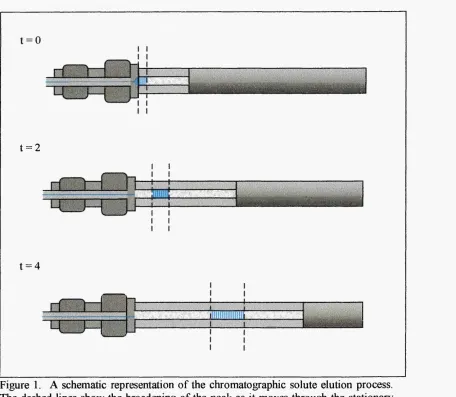
column, it gradually spreads out. Figure 1 illustrates this process. The solute
molecules are injected at time = 0, and elute after time = 4. Since the solute molecules
spread out as they travel through the column, some arrive at the end of the column
solute molecules as an “ideally” Gaussian peak; the greater the dispersion o f the solute
molecules, the broader the peak that the detector records.
The three processes that contribute to the dispersion of the solute molecules in the
mobile phase are flow profile effects including eddy diffusion (A), longitudinal
molecular diffusion (B), and resistance to mass transfers (C). The van Deemter
equation (Equation 2) is a summation o f the three effects and can be used to describe
the theoretical plate height (B) and its relationship with the mobile phase velocity and
the stationary phase.
7?
H = A + — + Cv ...Equation 2
v
Longitudinal molecular diffusion results from the tendency of solute molecules to
migrate from the concentrated centre of the band toward the more dilute regions on the
periphery. Flow profile broadening effects include the phenomenon arising from the
multitude o f pathways available to a solute molecule to find its way through the
column. The lengths of these pathways may differ significantly, and the residence time
in the column for molecules of the same species varies according to the lengths o f the
paths they take. Dispersion due to longitudinal molecular diffusion takes place both in
and opposed to the direction o f flow. Mass transfer refers to the flux o f analyte
molecules from one phase to another. The rate of mass transfer governs the dispersion
of analyte molecules during the chromatographic process. If the rate of mass transfer
is high then the eluting analyte molecules will maintain a uniform distribution in the
velocities of the eluting analyte molecules has the result o f broadening the
chromatographic band.
t = 2
_
i i
t = 4
■ ■ __
Figure 1. A schematic representation o f the chromatographic solute elution process. The dashed lines show the broadening of the peak as it moves through the stationary phase packed column.
An important point of reference in chromatography is the column conditions. HPLC
column conditions usually quoted are the column length, internal diameter (i.d.),
stationary phase and stationary phase particle size. Reduction of the i.d. or bore, o f the
column is a useful method of reducing the total volume of the chromatographic
[image:47.616.88.544.87.484.2]bore columns have an i.d. o f approximately 1 mm. Further reductions in column i.d.
have produced capillary HPLC columns (i.d.<100 pm). The inherent benefits of
reducing column i.d. are decreased solvent consumption and increased sensitivity.
Capillary columns operate at flow rates substantially lower than those of conventional
column chromatography (<10 pl.m in1), hence the decrease in solvent consumption.
The increase in sensitivity is because o f the reduced volume o f the column. The
reduction in volume decreases the diffusion of the chromatographic band for samples
that would in conventional chromatography be diffused, in the mobile phase, to such
an extent that they would not be detected. Reductions in column i.d. require careful
instrumental considerations. First, the liquid chromatograph must be capable of
delivering low flow rates reproducibly and precisely. Second the system must have
small internal volumes and be capable o f producing small injection volumes (<5 pi). If
these two conditions are not met, the advantages of using narrow bore columns are
lost.
The size of the particles used in column packing is an integral part o f the
chromatographic dispersion process. Reducing particle size results in less dispersion
o f the sample in the column during the separation proce


![Figure 3. A schematic representation of the MS/MS modes of operation of a triple quadrupole mass spectrometer (Adapted from [34]).](https://thumb-us.123doks.com/thumbv2/123dok_us/775219.583545/69.612.80.494.143.535/figure-schematic-representation-operation-triple-quadrupole-spectrometer-adapted.webp)