FORMULATION AND EVALUATION OF TABLETS CONTAINING
POORLY WATER SOLUBLE DRUG BY MADG METHOD.
Devendra Sharma1, M.D. Godbole2, Ameya Lanjewar*2 and Sushil Burle1
1
Department of Pharmaceutics HI-Tech College of Pharmacy, Chandrapur.
2
Department of Pharmaceutics Kamala Nehru College of Pharmacy Butibori, Nagpur.
ABSTRACT
Tablet is a unit solid dosage form containing active ingredient with or
without suitable excipient. These are most widely used dosage form.[1]
The main objective of the design and manufacture of the compressed
tablet is to deliver orally correct amount of drug in the proper form
over proper time and at desired location, so as to have suitable
chemical integrity protected at the point of its action. The physical
design, manufacturing process, and complete chemical makeup of the
tablet can have a profound effect on the efficiency of the drug being
administered.[2] Poorly water soluble drugs are associated with slow
drug absorption leading eventually to inadequate and variable
bioavailability[3] and nearly 40% of the new chemical entities currently being discovered are
poorly water-soluble drugs.[4] Based upon their permeability characteristics, the
biopharmaceutics classification system (BCS) classifies such drugs in two major classes, i.e.,
Class II and IV. The BCS class II drugs are poorly water-soluble entities with high
permeability. Most formulation strategies for such drugs are targeted at enhancing their fine
dispersion at absorption level.[5] Ibuprofen being poorly water-soluble drug known to
demonstrate dissolution or solubility limited absorption. The bioavailability of the drug is
low, yet its rate of absorption is quite inconsistent and delayed with time. Based upon its
aqueous solubility and various dissolution parameters, the drug bioavailability can
unambiguously be regarded as limited solely to dissolution.[6] The main focus on moisture
activated dry granulation method is better than other granulation method in case of poorly
soluble drug tablets.
KEYWORD:MADG, Tablets, Ibuprofen.
Volume 6, Issue 3, 1523-1537. Research Article ISSN 2277– 7105
*Corresponding Author
Ameya Lanjewar
Department of
Pharmaceutics Kamala
Nehru College of Pharmacy
Butibori, Nagpur. Article Received on 19 Jan. 2017,
Revised on 09 Feb. 2017, Accepted on 01 March 2017
INTRODUCTION
Tablet manufacturing process can be broadly classified as granulation and direct
compression. Granulation process may be defined as the size enlargement process in which
fine or coarse particles is converted into physically stronger and larger agglomerates having
good flow properties, better compression characteristics and uniformity and a process for
collecting particles together by creating bonds between them. It is the most widely used
technique in the pharmaceutical industry for the preparation of materials for tableting.
Granulation may be either wet granulation or dry granulation i.e., by using binder solution or,
by using dry binder. Pharmaceutical granules typically have a size range between 0.2 to 4.0
mm, depending on their subsequent use. Most of formulation in tablet manufacturing is by
wet granulation process.[7] Granulation is the process in which primary powder particles are
made to adhere to form larger, multi particle aggregates called granules.Granulation method
can be broadly classified into two types[4,5,6,7]
DRY GRANULATION WET GRANULATION MOISTURE ACTIVATED
DRY GRANULATION
Dispensing and Shifting Dispensing and Shifting Dispensing and Shifting
Dry mixing Dry mixing Dry mixing
Slugging Slugging Granulation Granulation
Half lubrication Lubrication Pre-drying Pre-drying
Compression Compression Shifting Shifting
Milling Drying Drying
Shifting Pre-mixing (unlubrication) Pre-mixing (unlubrication)
Final lubrication Lubrication Lubrication
compression Compression Compression
Moisture Activated Dry Granulation (MADG) was developed in response to the
difficulties experienced with wet granulation, in terms of endpoint, drying and milling. Wet
granulation process endpoint is very sensitive to granulation time and shear. The wet granules
need to be dried to a narrow range of moisture contents, which is difficult. The dried granules
need to be milled, but the milled granules often have either too many fines or too many
coarse particles (or both) — an undesirable bimodal distribution.
MADG is a very simple and innovative process where granules are created with water and a
granulating binder, as in wet granulation, but are not heat dried or milled. This process helps
MOISTURE ACTIVATED DRY GRANULATION (MADG) MADG is a very simple and
innovative process where granules are created with water and a granulating binder, as in wet
granulation, but are not heat dried or milled. This process helps to minimize endpoint
sensitivity.
It is applicable to many of the pharmaceutical industry's granulation needs for solid dosage
form development and can be described as a 'one-pot' granulation process.
MATERIAL AND METHOD
Ibuprofen BP was procured as a gift sample from ZIM Laboratories Ltd, Nagpur,
Maharashtra. Colloidal anhydrous silicon (Aerosil) was procured as a gift sample from ZIM
Laboratories Ltd, Nagpur, Maharashtra.Maize starch was procured from ZIM Laboratories
Ltd, Nagpur, Maharashtra. Lactose DC was procured from ZIM Laboratories Ltd, Nagpur.
PVP K30 (Povidone) was procured from ZIM Laboratories Ltd, Nagpur, Maharashtra.
Microcrystalline cellulose was procured from ZIM Laboratories Ltd, Nagpur, Maharashtra.
Talcum was procured from ZIM Laboratories Ltd, Nagpur, Maharashtra. All other chemicals
used were of analytical grade.
Formulation and development
MADG is a process in which moisture is used to activate granule formation, without the need
to apply heat to dry the granules. There are two main stages in MADG:
1. Agglomeration 2. Moisture distribution/ Absorption
During agglomeration, drug is mix with fillers and binder in the powder form, to obtain a
uniform mixture. This blend constitutes approximately 50-80% of formula weight. While
mixing, a small amount of water (0.5-5%) is sprayed as small droplets onto the powder blend,
which moistens the binder and makes it tacky. The binder facilitates the binding of the drug
and excipients as they move in a circular motion forced by the mixer blades. The process
does not results in larger lumps formation as the amount of water used in this process is very
small as compared to the other conventional wet granulation techniques. The particle size of
the agglomerates generally falls in the range of 150-500 μm.
In moisture distribution/absorption, moisture absorbents, such as microcrystalline cellulose or
silicon dioxide, are added while mixing continues. When they come into contact, the moisture
absorbents pick up moisture from the moist agglomerates, resulting in moisture redistribution
some of the moisture is removed from the wet agglomerates, some of these agglomerates
remain almost intact and some usually the larger particles may break up. This process results
in granulation with more uniform particle size distribution.[34]
Flow chart: Method for preparation of Ibuprofen tablet 400mg
Evaluation of Ibuprofen tablets
The Ibuprofen tablets were evaluated for following parameters;
1) Appearance 3)Weight variation
2) Friability 4)Disintegration time
5) Drug release study (in-vitro) 6) Dimensions 7) Hardness 8) Drug content
9) DSC 10) X-ray diffraction (XRD)
11) Scanning electron microscopy 12)Stability testing
Preformulation study
Flow characterization A. Bulk density
B. Tapped density
Bulk density = weight of sample in gram / volume occupied by the
C. Hausner’s ratio and Compressibility index
In recent years the compressibility index and the closely related Hausner’s ratio have become
the simple, fast and popular methods for predicting powder flow characteristics. Both the
compressibility index and the Hausner’s ratio were determined by using bulk density and the
tapped density of a powder.[54]
i. Hausner’s ratio
ii. Compressibility index
Bulk density – Tapped density
Carr’s index = × 100 (%) Tapped density
Table 6.8: Limits of Compressibility index and Hausner ratio
a. Angle of repose
Tan θ = h/r
Where,
h = Height of pile, r = Radius of the base of pile, θ = Angle of repose
[image:5.595.23.585.501.756.2]Table 6.9: Flow properties and corresponding angles of repose
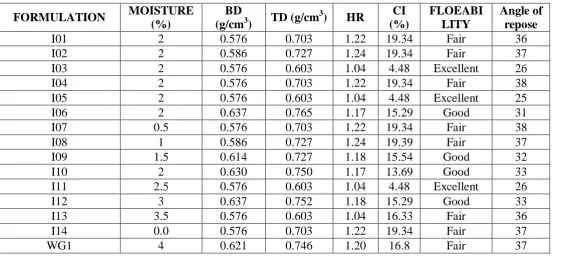
Table 6.10: Formulation flow characterization
FORMULATION MOISTURE
(%)
BD
(g/cm3) TD (g/cm
3
) HR CI
(%)
FLOEABI LITY
Angle of repose
I01 2 0.576 0.703 1.22 19.34 Fair 36
I02 2 0.586 0.727 1.24 19.34 Fair 37
I03 2 0.576 0.603 1.04 4.48 Excellent 26
I04 2 0.576 0.703 1.22 19.34 Fair 38
I05 2 0.576 0.603 1.04 4.48 Excellent 25
I06 2 0.637 0.765 1.17 15.29 Good 31
I07 0.5 0.576 0.703 1.22 19.34 Fair 38
I08 1 0.586 0.727 1.24 19.39 Fair 37
I09 1.5 0.614 0.727 1.18 15.54 Good 32
I10 2 0.630 0.750 1.17 13.69 Good 33
I11 2.5 0.576 0.603 1.04 4.48 Excellent 26
I12 3 0.637 0.752 1.18 15.29 Good 33
I13 3.5 0.576 0.603 1.04 16.33 Fair 36
I14 0.0 0.576 0.703 1.22 19.34 Fair 37
Particle size
Measurement of particle size involves the electromagnetic sieve shaking of the sample
through the series of successively arranged sieves (Sieve No. 20, 30, 40, 60, 80, 100 and
receiver) and weighing the portion of the sample retained on each sieve and calculation of
[image:6.595.11.596.483.740.2]same.
Table 6.11: Particle size analysis of formulation batches
Batch No sieve Number
20 40 60 80
I01 3.8 7.3 9.58 29.11
I02 4.3 8.6 12.56 31.88
I03 4.3 8.6 12.56 31.88
I04 5.3 10.76 15.12 32.43
I05 6.41 12.62 17.46 33.27
I06 6.40 12.56 16.46 28.56
I07 5.1 9.80 14.12 31.46
I08 4.2 8.5 12.56 30.90
I09 6.40 12.56 16.46 28.56
I10 3.8 7.3 9.58 29.11
I11 4.3 8.6 12.56 31.88
I12 4.3 8.6 12.56 31.88
I13 5.3 10.76 15.12 32.43
I14 6.41 12.62 17.46 33.27
WG1 3.1 5.8 12.58 28.64
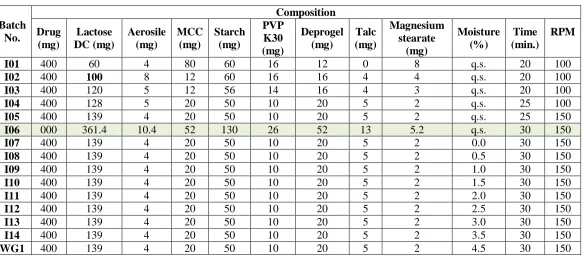
Table: Formulations of Ibuprofen tablet 400mg
Batch No. Composition Drug (mg) Lactose DC (mg) Aerosile (mg) MCC (mg) Starch (mg) PVP K30 (mg) Deprogel (mg) Talc (mg) Magnesium stearate (mg) Moisture (%) Time (min.) RPM
I01 400 60 4 80 60 16 12 0 8 q.s. 20 100
I02 400 100 8 12 60 16 16 4 4 q.s. 20 100
I03 400 120 5 12 56 14 16 4 3 q.s. 20 100
I04 400 128 5 20 50 10 20 5 2 q.s. 25 100
I05 400 139 4 20 50 10 20 5 2 q.s. 25 150
I06 000 361.4 10.4 52 130 26 52 13 5.2 q.s. 30 150
I07 400 139 4 20 50 10 20 5 2 0.0 30 150
I08 400 139 4 20 50 10 20 5 2 0.5 30 150
I09 400 139 4 20 50 10 20 5 2 1.0 30 150
I10 400 139 4 20 50 10 20 5 2 1.5 30 150
I11 400 139 4 20 50 10 20 5 2 2.0 30 150
I12 400 139 4 20 50 10 20 5 2 2.5 30 150
I13 400 139 4 20 50 10 20 5 2 3.0 30 150
I14 400 139 4 20 50 10 20 5 2 3.5 30 150
Formulation of tablets using most suitable approach of MADG
Ingredients mentioned in table 6.15 were used for the formulation of modified tablets of
Ibuprofen by MADG process. The ingredients were weighted, mixed in geometrical order
and compressed by 15.6 x 8 mm size punch to get a 100 tablets each weighing 650 mg using
14 station single rotary Rimak tablet compression machine.
Fig. 6.19: Tablet manufacturing flow chart
Prior to compression the prepared granules were evaluated for pre-compression parameters
(flow properties) viz. Angle of repose, Bulk density, Tapped density, Hausner’s ratio and
Compressibility index as per the procedure mentioned.
Appearance
Tablets were examined for texture, any surface flaws like cracks and chips.
Table: Characteristics of Batches
Sr. No. Batch No. Characteristic/observation
Appearance Color Taste Thickness Dimensions
1 I01 White color, Caplet shape,
smooth, free from cracks White Bitter 5.7 mm 26 mm
2 I02 White color, Caplet shape,
smooth, free from cracks white Bitter 5.7 mm 25 mm
3 I03 White color, Caplet shape,
smooth, free from cracks White Bitter 5.7 mm 27 mm
4 I04 White color, Caplet shape,
smooth, free from cracks White Bitter 5.8 mm 28 mm
5 I05 White color, Caplet shape,
smooth, free from cracks White Bitter 5.8 mm 26 mm
6 I06 White color, Caplet shape,
smooth, free from cracks white Bitter 5.8 mm 25 mm
7 I07 White color, Caplet shape,
Dimensions
Dimensions such as thickness of the tablets were measured using digital Vernier caliper.
Weight variation
20 tablets of each formulation batch were weighed individually using an electronic balance.
The average weight was calculated and individual tablet weight was then compared with
average value and the deviation was recorded.[51]
Friability
Where, F = friability Wo = initial weight of the ten tablets W = final weight of the ten tablets
Disintegration time (in vitro)
The disintegration time was determined by using USP tablet disintegration test apparatus
using 900 ml of deionised water without disk. For this, 6 tablets of each formulation were
used and the disintegration test was conducted at following test conditions.
Hardness
Drug content
Two tablets of each formulation were used. The tablets were weighed and crushed. A
quantity of powder equivalent to 650 mg of Ibuprofen was accurately weighed and
transferred to 100 ml volumetric flask to which small volume of Phosphate buffer pH 7.2 was
added to disperse the contents. Final volume was adjusted to 100 ml using Phosphate buffer
8 I08 White color, Caplet shape,
smooth, free from cracks White Bitter 5.8 mm 28 mm
9 I09 White color, Caplet shape,
smooth, free from cracks White Bitter 5.8 mm 26 mm
10 I10 White color, Caplet shape,
smooth, free from cracks white Bitter 5.8 mm 25 mm
11 I11 White color, Caplet shape,
smooth, free from cracks White Bitter 5.7 mm 27 mm
12 I12 White color, Caplet shape,
smooth, free from cracks White Bitter 5.7 mm 28 mm
13 I13 White color, Caplet shape,
smooth, free from cracks White Bitter 5.7 mm 25 mm
14 I14 White color, Caplet shape,
smooth, free from cracks White Bitter 5.7 mm 27 mm
15 WG1 White color, Caplet shape,
smooth, free from cracks White Bitter 5.9 mm 28 mm
7.2. The dispersion was stirred for 2 hr using magnetic stirrer and then allowed to settle.
Solution was filtered through Whatman filter paper (No.41). Appropriate dilution of filtrate
was made using Phosphate buffer pH 7.2 and the UV absorbance was recorded.[55]
Drug release study (in-vitro)
i) Drug release of Ibuprofen in phosphate buffer pH 7.2
Table 6.14: Drug release of Ibuprofen in phosphate buffer pH 7.2
Batch no.
WEIGHT
VERIATION HARDNESS
Disintegration time
Drug content
Drug
release FRIABILITY
I01 0.651±5 111 64 95.30 80.30 0.1
I02 0.652±5 112 72 96.45 85.60 0.2
I03 0.645±5 90 78 96.22 95.60 0.3
I04 0.653±5 86 65 98.00 96.30 0.1
I05 0.655±5 72 63 97.38 88.30 0.4
I06 0.650±5 69 68 90.23 89.30 0.3
I07 0.651±5 48 78 96.45 89.36 0.2
I08 0.640±5 50 70 88.68 90.36 0.4
I09 0.643±5 70 65 95.40 92.36 0.3
I10 0.646±5 96 60 89.30 96.30 0.2
I11 0.650±5 110 55 99.20 99.30 0.1
I12 0.651±5 90 50 98.30 96.78 0.2
I13 0.653±5 97 20 86.40 92.33 0.3
I14 0.651±5 30 78 87.46 91.40 0.5
WG1 0.652±5 67 180 85.30 78.60 0.2
Fig 6.13: X- ray diffraction spectrum of Ibuprofen
The analysis of XRD pattern reveals sharp intensity of the crystallinity peaks of the pure
drug, but when it was incorporated into the excipients the intensities of the peaks were
decreased due to decreased crystallinity of the drug. The formulation containing MCC and
Lactose DC showed maximum amorphisity. XRD analysis showed that there was little
reduction in the crystallinity of drug when formulate these polymers
Differential Scanning Calorimeter
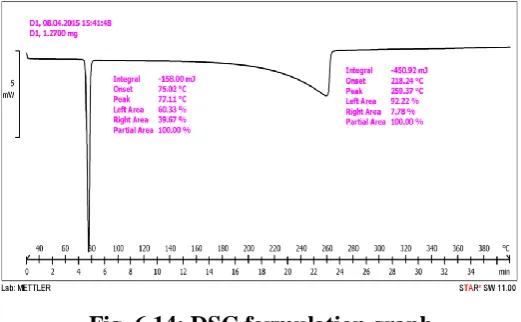
Fig. 6.14: DSC formulation graph
The thermo gram of pure Ibuprofen showed sharp endothermic with melting peak at 77.31ºC.
Thermo gram of In optimized formulation showed peak at 77.11ºC. Slight shift in of
endothermic peaks on left hand with decreased in its intensity indicates little amorphization
of drug shown in Figure.
This may attributed to presence of moisture which may cause drug in crystallization form and
[image:10.595.167.428.378.539.2]FTIR
Fig. : FTIR formulation graph
FTIR spectrum of Ibuprofen showed peaks at 945.94 due to O-H bending, 1258.72 due to
C-O stretching, 1378.69 due to CH2 and CH3,1417.65 due to Ar C-C stretching and 1700.98
due to C=O stretching. The optimize formulation showed more intense and prominent peaks.
SEM Analysis
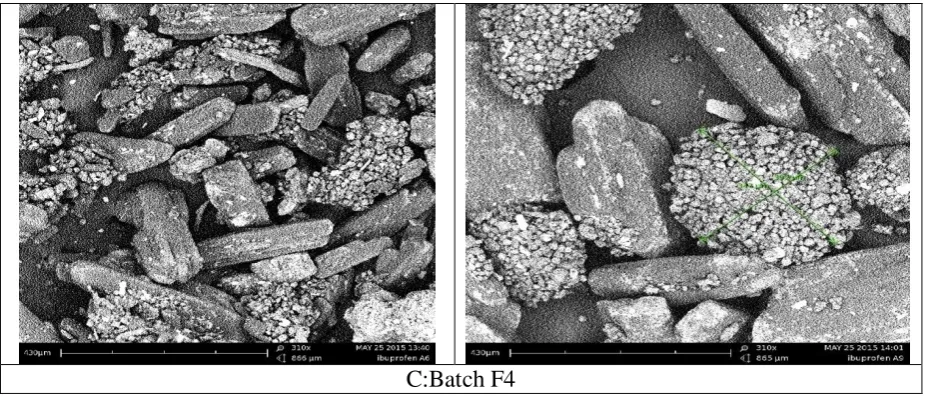
Scanning electron microscopy was performed to study the effect of mixing time on the
morphology of particles. Figure shows the scanning electron micrograph of initial blend of
Ibuprofen and binders. Result was determine as per procedure and SEM of drug, placebo and
formulation show following
C:Batch F4
Fig: SEM formulation and placebo graph
DISCUSSION
Rheumatoid arthritis, osteorthritis and other musculoskeletal major disorder in India.
[image:11.595.67.531.475.673.2]arthritis, osteorthritis and other musculoskeletal disorder. Ibuprofen primarily absorbed from
lower part of gastrointestinal tract. The main objective of the study was to develop, evaluate
and optimization of tablets containing poorly water soluble drug by moisture activated dry
granulation method, thereby reducing the production cost of tablet.
Appearance, melting points, loss on drying, λmax, IR study and DSC study of drug Ibuprofen
were carryout as per the specification of B.P. It was observed that the obtained sample of
Ibuprofen complies with the standard of quality mentioned in B.P. Standard calibration curve
of Ibuprofen (absorbance Vs concentration) was found to be linear and obeyed Beer
Lambert’s law in the range of 0-10µg/ml. SSG and povidone were evaluated for their
standard. It was observed that they complies with the standard of quality as per prescribe
official books.
Preliminary batches of Ibuprofen tablets were prepared by moisture activated dry granulation
method using sodium starch glycolate as Superdisintegrant and povidone as binder polymer
in various concentrations. From the results of preliminary batches, it was observed that
polymer concentration is important parameter in the formulation of tablets. As the SSG
concentration was increased from 12 mg to 20 mg, and concentration of povidone were
increased from 10 mg to 16 mg disintegration time, % drug release from tablets were
increased. The disintegration time was decreased with the decrease in the quantity of sodium
starch glycolate in tablets by moisture activated dry granulation process
CONCLUSION
Ibuprofen tablets were successfully developed using moisture activated dry granulation
method. Concentration of sodium starch glycolate 2.8% and concentration of povidone0.8%
was taken then resultant tablets were given drug release (85.60±0.36) in 15 minutes. The in-vitro results indicated that the tablets were potentially useful. The moisture activated dry granulation method was found to be simple, reproducible, easily controllable, economical,
and continues process. Additionally, the excipients used for the formulation of tablets were
cheap and easily available. Other drugs for the use in moisture activated dry granulation
method can be incorporated in the formulation of tablets. Therefore, these types of moisture
activated dry granulation method for tablets can be commercially processed easily and
ACKNOWLEDGEMENT
The authors are thankful to ZIM Laboratories Ltd, Nagpur, Maharashtra. India for providing
the free gift sample of drug Ibuprofen. Authors wish to thank the Principal of Kamla Nehru
College of Pharmacy, Nagpur for providing necessary facilities to carry out this work.
REFERENCES
1. Lachman L, Lieberman HA, Joseph LK. The Theory and Practice of Industrial Pharmacy,
1990; Third Edition, P. 317-324.
2. B.Venkateswara Reddy, K. Navaneetha, P. Sandeep. Improved tablet production by
modified granulation techniques, International Journal of research in pharmacy and life
sciences, ijrpls, 2014; 2(2): 224-235.
3. Puckhraj Chhaprel, Amit Talesara, Amit K Jain. solubility enhancement of poorly water
soluble drug using spray drying technique,‖ International Journal of Pharmaceutical
Studies and Research, IJPSR and R-Vol. III, Issue II, April-June, 2012 pg. 01-05.
4. Abu T.M. Serajuddin, Solid Dispersion of Poorly Water Soluble Drugs: Early Promises,
Subsequent Problems and Recent Breakthroughs, Journal of Pharmaceutical Sciences, an
American Chemical Society and American Pharmaceutical Association October, 1999;
88: 10.
5. Dr Abhijit V Gothoskar, Biopharmaceutical Classification Of Drugs Biopharmaceutical
Classification Of Drugs _ Pharmainfo.net.mht.
6. Dong Xun Li, Yu-Kyuong Oh, Soo-Jeong Lim, Jong Oh Kim, Ho Joon Yang, Jung Hoon
Sung, Chul Soon Yong, Novel gelatin microcapsule with bioavailability enhancement of
ibuprofen using spray-drying technique, International Journal of Pharmaceutics, May
2008; 355(1-2): 1 277-284.
7. Remington J. Remington: The Science and Practice of Pharmacy; twenty first edition,
Lippincott Williams & Wilkins, 2006; 895-899.
8. Michael D.Tousey, the granulation process: basic technologies for tablet making.
9. N.K.Jain and S.N.Sharma, a text book of professional pharmacy, fourth edition, pg
295-296.
10.larry l. augsburger, Stephen w. Hoag, pharmaceutical dosage forms: tablets 3rd addition,
volume 1, pg. 303.
11.Sahu Deepak, Ketawat Santosh, ―Formulation design manufacture criteria requirement
12.Larry l. augsburger, Stephen w. Hoag, pharmaceutical dosage forms: tablets 3rd addition,
volume 2, pg 173-174.
13.Himanshu.K.Solanki, Tarashankar Basuri, Jalaram H.Thakkar, ―Recent advances in
granulation technology, International Journal of Pharmaceutical Sciences Review and
Research, December 2010; 5(3): 008, 48.
14.www.powderpro.se/uploads/media/Brochure_Freeze_Granulation_2010.pdf.
15.www.technopolisonline.com.
16.www.excella-pharma-source.de.
17.United States Patent 4489504 - Steam granulation apparatus and method.
18.Heng WS, Wong TW., Melt processes for oral solid dosage forms, Pharm Tech. 2003; Pg.
1-6.
19.www.dow.com/dowexcipients/resources/application/app_granulation.htm
20.Paul J., Shesky R., Colin K., New foam binder technology from Dow improves
granulation process, Pharmaceutical Canada, June 2006; 19-22.
21.Sheskey P. et al., "Foam Technology: The Development of a Novel Technique for the
Delivery of Aqueous Binder Systems in High-Shear and Fluid- Bed Wet-Granulation
Applications," poster presented at AAPS Annual Meeting and Exposition, Salt Lake City,
UT, Oct. 2003; pg. 26-30.
22.Zhaib H, Lia S, Andrewsb G, Jonesb D, Bella S, Walkera G. Nucleation and growth in
fluidised hot melt granulation. Powder Technology. 2009; 189(2): 230-237.
23.Hong-Liang L, Hsiu-O H, Chi-Chia C, Ta-Shuong Y. Process and formulation
characterizations of the thermal adhesion granulation (TAG) process for improving
granular properties, International J Pharm. 2008; 357(1-2): 206-212.
24.P. Thejaswini, B. Suguna, N Sumalatha. Advance granulation techniques for
pharamceutical pharmulations, International journal of research in pharmaceutical and
nano sciences, 2013; 2(6): 723-732.
25.Essentials of medical pharmacology, 6th addition, JAYPEE, KD Tripathi.
26.Nidhi Prakash Sapkal, Vaishali A. Kilor, Minal Nandkumar Bonde. Application of a
convenient and cost and effective granulation technology for the formulation of tablets
using conventional excipients, Asian Journal of Pharmaceutics - July-September 2014,
October 01, 2014; 223.30: 225.254.
27.N. S. Ranpise and a. A. Borse. Review on novel granulation techniques, journal of
28.Susan F, Carrie S, Brian J, Shawn E, Ismat U. Optimization of binder level in
moistureactivated dry granulation using absorbent starch to distribute moisture available
from URL www.vectorcorporationcomnewspapersasp May14, 2011; 19.
29.Ismat U. Moisture-activated dry granulation. Pharm Tech Eur, 2011; 23(3): 1-3.
30.Ismat U, Jennifer W, Shih-YC, Gary JW, Nemichand BJ, San K. Moisture activate dry
granulation-Part I: A guide to excipient and equipment selection and formulation