inorganic papers
i8
Richard Welteret al. NaAuBr42H2O DOI: 101107/S1600536800021140 Acta Cryst.(2001). E57, i8±i9 Acta Crystallographica Section EStructure Reports Online
ISSN 1600-5368
Sodium tetrabromoaurate(III) dihydrate
Richard Welter,a* Hedi Omranib
and Rene Vangelistic
aLaboratoire de Chimie des meÂtaux de transition
(UMR 7513 CNRS), Universite Louis Pasteur, 4 rue Blaise Pascal, F-67070 Strasbourg CEDEX, France,bFaculte des Sciences, DeÂpartement de
Chimie, Monastir 5000, Tunisia, andc
Labor-MineÂral, UMR 7555, Universite Henri Poincare Nancy I, Faculte des Sciences, BP 239, 54506 Vandoeuvre les Nancy CEDEX, France
Correspondence e-mail: [email protected]
Key indicators Single-crystal X-ray study
T= 293 K
Mean(Au±Br) = 0.002 AÊ
Rfactor = 0.049
wRfactor = 0.097
Data-to-parameter ratio = 25.3
For details of how these key indicators were automatically derived from the article, see http://journals.iucr.org/e.
#2001 International Union of Crystallography Printed in Great Britain ± all rights reserved
The structure of the title compound, NaAuBr42H2O is
isomorphous with that of NaAuCl42H2O. The Na, Au and
Br atoms lie on the mirror plane. The AuBr4ÿ anions are
nearly square planar with AuÐBr bond lengths in the range 2.415 (2)±2.433 (2) AÊ.
Comment
Previous studies concerning the crystal structure determina-tion of the anhydrous MAuX4 compounds and the
corre-sponding dihydrateMAuX42H2O (Mis Na or K,Xis Cl or
Br) have shown that: (i) KAuBr4 (Omrani et al., 1999),
KAuBr42H2O (Omrani et al., 1986), KAuCl4 (Jones &
Bembenek, 1992) and NaAuCl4(Joneset al., 1988) crystallize
in the monoclinic system with the space groupP21/c(orP21/
n); (ii) NaAuCl42H2O (Bonamico & Dessy, 1965) and
KAuCl42H2O (Theobald & Omrani, 1980) crystallize in the
orthorhombic system with the space group PnmaandPbcn, respectively. All these compounds are characterized by the occurrence of square-planar AuX4ÿanions with typical AuÐ
X distances (approximately 2.29 AÊ for AuÐCl bond and 2.43 AÊ for AuÐBr bond). In this class of based gold coordi-nation compounds, only both NaAuBr4 and NaAuBr42H2O
compounds were not yet characterized. In the present work, we report on the crystal structure of the dihydrate.
The structure of the title compound, NaAuBr42H2O, (I), is
isomorphous with that of NaAuCl42H2O (Bonamico & Dessy,
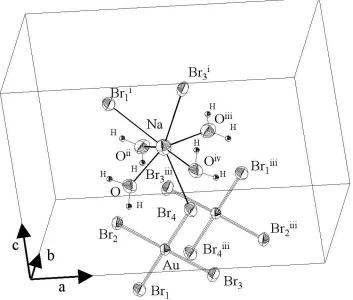
1965). The orthorhombic cell contains four Au atoms and the AuBr4ÿanions are nearly square planar (Fig. 1). The Au, Br
and Na atoms lie on the mirror plane. The structure can also be described as a pseudo-lamellar compound in which the NaAuBr4planes (aty=14and34) are piled up along thebaxis
and connected via NaÐOÐNa bonds. There is only one independent Na atom, which is coordinated by four O atoms at distances in the range 2.437 (12)±2.509 (13) AÊ and three Br atoms at distances in the range 3.150 (10)±3.300 (10) AÊ (Table 1).
Experimental
Crystals were prepared by dissolving powder of NaAuCl42H2O in
aqueous HBr (1M). The solution was slowly evaporated (two months) at 300 K. After complete crystallization, dark brick red crystals were obtained. A single-crystal was then sealed in Linde-mann glass capillary.
Crystal data
NaAuBr42H2O Mr= 575.63
Orthorhombic,Pnma a= 13.320 (6) AÊ
b= 7.253 (2) AÊ
c= 9.420 (3) AÊ
V= 910.1 (6) AÊ3 Z= 4
Dx= 4.201 Mg mÿ3
AgKradiation Cell parameters from 25
re¯ections
= 8.3±10.4
= 18.20 mmÿ1 T= 293 (2) K
Parallelepiped, dark red 0.160.090.06 mm
Data collection
Enraf±Nonius CAD-4 diffract-ometer
!±2scans
Absorption correction: scan (SORTAV; Blessing, 1987)
Tmin= 0.051,Tmax= 0.363
1368 measured re¯ections 1368 independent re¯ections
905 re¯ections withI> 2(I)
max= 22.9 h= 0!18
k= 0!10
l= 0!13
2 standard re¯ections frequency: 180 min intensity decay: 0.1%
Re®nement
Re®nement onF2 R[F2> 2(F2)] = 0.049 wR(F2) = 0.097 S= 1.09 1368 re¯ections 54 parameters
H-atom parameters constrained
w= 1/[2(F
o2) + (0.0178P)2
+ 12.7490P]
whereP= (Fo2+ 2Fc2)/3
(/)max< 0.001 max= 2.09 e AÊÿ3 min=ÿ1.57 e AÊÿ3
Extinction correction:SHELXL97 Extinction coef®cient: 0.0047 (3)
Table 1
Selected geometric parameters (AÊ,).
AuÐBr4 2.415 (2) AuÐBr3 2.427 (2) AuÐBr1 2.431 (2) AuÐBr2 2.433 (2) Br1ÐNai 3.163 (9)
Br3ÐNai 3.150 (10)
Br4ÐNa 3.300 (10) NaÐO 2.437 (12) NaÐOii 2.437 (12)
NaÐOiii 2.509 (13)
NaÐOiv 2.509 (13)
Br4ÐAuÐBr3 88.41 (8) Br4ÐAuÐBr1 180.00 (8) Br3ÐAuÐBr1 91.59 (8)
Br4ÐAuÐBr2 90.19 (8) Br3ÐAuÐBr2 178.60 (7) Br1ÐAuÐBr2 89.81 (8)
Symmetry codes: (i) x;y;zÿ1; (ii) x;1
2ÿy;z; (iii) 1ÿx;12y;1ÿz; (iv)
1ÿx;ÿy;1ÿz.
In the ®nal electron-density difference map, both minimum (ÿ1.57 e AÊÿ3at 0.3594,0.2500,0.5494) and maximum (2.09 e AÊÿ3at
0.4964,0.1831,0.2760) occur respectively at 0.96 AÊ away from Br4 and 1.72 AÊ from Na. They may be due to the irregular crystal shape and the approximate absorption correction. The H atoms were ®xed with OÐH distances of 0.95 AÊ.
Data collection: CAD-4 Software (Enraf±Nonius, 1989); cell re®nement:CAD-4Software; data reduction:CADAKandSORTAV
(Blessing, 1987); program(s) used to solve structure: SHELXS97
(Sheldrick, 1990); program(s) used to re®ne structure:SHELXL97 (Sheldrick, 1997); molecular graphics:ATOMS(Dowty, 1995); soft-ware used to prepare material for publication:SHELXL97.
We are grateful to Dr Slimane Dahaoui (Laboratoire de Cristallographie et Modelization des Materiaux Mineraux et Biologiques, Faculte des Sciences de NANCY I) for his help during the data collection.
References
Blessing, R. H. (1987).Crystallogr. Rev.1, 3±58.
Bonamico, M. & Dessy, G. (1965).Atti della Accademia Nazionale dei Lincei, Rend. Sc. Fis.Mater. e Nat.39, 504±509.
Dowty, E. (1995).ATOMS for Windows. Version 3.2. Shape Software, 521 Hidden Valley Road, Kingsport, TN 37663, USA.
Enraf±Nonius (1989).CAD-4Software. Version 5.0. Enraf±Nonius, Delft, The Netherlands.
Jones, P. G. & Bembenek, E. (1992).J. Crystallogr. Spectrosc. Res.22, 397±401. Jones, P. G., Hohbein, R. & Schwarzmann, E. (1988).Acta Cryst.C44, 1164±
1166.
Omrani, H., Theobald, F. & Vivier, H. (1986).Acta Cryst.C42, 1091±1092. Omrani, H., Welter, R. & Vangelisti, R. (1999).Acta Cryst.C55, 13±14. Sheldrick, G. M. (1990).Acta Cryst.A46, 467±473.
Sheldrick, G. M. (1997).SHELXL97. University of GoÈttingen, Germany. Theobald, F. & Omrani, H. (1980).Acta Cryst.B36, 2932±2935.
Figure 1
Part of the crystal structure. Displacement ellipsoids are shown at 50% probability levels. Symmetry codes: (i)x,y, zÿ1; (ii)x,1
2ÿy, z; (iii)
1ÿx,1
supporting information
sup-1
Acta Cryst. (2001). E57, i8–i9supporting information
Acta Cryst. (2001). E57, i8–i9 [doi:10.1107/S1600536800021140]
Sodium tetrabromoaurate(III) dihydrate
Richard Welter, Hedi Omrani and Rene Vangelisti
S1. Comment
Previous studies concerning the crystal structure determination of the anhydrous MAuX4 compounds and the
corresponding dihydrate MAuX4.2H2O (M is Na or K, X is Cl or Br) have shown that: (i) KAuBr4 (Omrani et al., 1999),
KAuBr4.2H2O (Omrani et al., 1986), KAuCl4 (Jones & Bembenek, 1992) and NaAuCl4 (Jones et al., 1988) crystallize in
the monoclinic system with the space group P21/c (or P21/n); (ii) NaAuCl4.2H2O (Bonamico & Dessy, 1965) and
KAuCl4.2H2O (Theobald & Omrani, 1980) crystallize in the orthorhombic system with the space group Pnma and Pbcn,
respectively. All these compounds are characterized by the occurrence of square-planar AuX4- anions with typical Au—X
distances (approximately 2.29 Å for Au—Cl bond and 2.43 Å for Au—Br bond). In this class of based gold coordination
compounds, only both NaAuBr4 and NaAuBr4.2H2O compounds were not yet characterized. In the present work, we
report on the crystal structure of the dihydrate.
The structure of the title compound, NaAuBr4.2H2O, (I), is isomorphous with that of NaAuCl4.2H2O (Bonamico &
Dessy, 1965). The orthorhombic cell contains four Au atoms and the AuBr4- anions are nearly square planar (Fig. 1). The
Au, Br and Na atoms lie on the mirror plane. The structure can also be described as a pseudo-lamellar compound in
which the NaAuBr4 planes (at y = 1/4 and 3/4) are piled up along the b axis and connected via Na—O—Na bonds. There
is only one independent Na atom, which is coordinated by four O atoms at distances in the range 2.437 (12)–2.509 (13) Å
and three Br atoms at distances in the range 3.150 (10)–3.300 (10) Å (Table 1).
S2. Experimental
Crystals were prepared by dissolving powder of NaAuCl4.2H2O in aqueous HBr (1 M). The solution was slowly
evaporated (two months) at 300 K. After complete crystallization, dark brick red crystals were obtained. A single-crystal
was then sealed in Lindemann glass capillary.
S3. Refinement
In the final electron-density difference map, both minimum (-1.57 e Å-3 at 0.3594, 1/4,0.5494) and maximum (2.09 e Å-3
at 0.4964,0.1831,0.2760) occur respectively at 0.96 Å away from Br4 and 1.72 Å from Na. They may be due to the
irregular crystal shape and the approximate absorption correction. The H atoms were fixed with O—H distances of 0.95
Figure 1
Part of the crystal structure. Displacement ellipsoids are shown at 50% probability levels. Symmetry codes: (i) x, y, z - 1;
(ii) x, 1/2 - y, z; (iii) 1 - x, 1/2 + y, 1 - z; (iv) 1 - x, -y, 1 - z.
Sodium tetrabromoaurate(III) dihydrate
Crystal data
NaAuBr4·2H2O
Mr = 575.63
Orthorhombic, Pnma
a = 13.320 (6) Å
b = 7.253 (2) Å
c = 9.420 (3) Å
V = 910.1 (6) Å3
Z = 4
F(000) = 1000
Dx = 4.201 Mg m−3
Ag Kα radiation, λ = 0.5608 Å Cell parameters from 25 reflections
θ = 8.3–10.4°
µ = 18.20 mm−1
T = 293 K
Parallelepiped, dark red 0.16 × 0.09 × 0.06 mm
Data collection
Enraf Nonius CAD-4 diffractometer
Radiation source: fine-focus sealed tube Graphite monochromator
ω–2θ scans
Absorption correction: ψ scan
1368 independent reflections 905 reflections with I > 2σ(I)
Rint = 0.000
θmax = 22.9°, θmin = 2.1°
h = 0→18
supporting information
sup-3
Acta Cryst. (2001). E57, i8–i9Refinement
Refinement on F2
Least-squares matrix: full
R[F2 > 2σ(F2)] = 0.049
wR(F2) = 0.097
S = 1.09 1368 reflections 54 parameters 3 restraints
Primary atom site location: structure-invariant direct methods
Secondary atom site location: difference Fourier map
Hydrogen site location: inferred from neighbouring sites
H-atom parameters constrained
w = 1/[σ2(F
o2) + (0.0178P)2 + 12.749P]
where P = (Fo2 + 2Fc2)/3
(Δ/σ)max < 0.001
Δρmax = 2.09 e Å−3
Δρmin = −1.57 e Å−3
Extinction correction: SHELXL97, Fc*=kFc[1+0.001xFc2λ3/sin(2θ)]-1/4
Extinction coefficient: 0.0047 (3)
Special details
Geometry. All e.s.d.'s (except the e.s.d. in the dihedral angle between two l.s. planes) are estimated using the full covariance matrix. The cell e.s.d.'s are taken into account individually in the estimation of e.s.d.'s in distances, angles and torsion angles; correlations between e.s.d.'s in cell parameters are only used when they are defined by crystal symmetry. An approximate (isotropic) treatment of cell e.s.d.'s is used for estimating e.s.d.'s involving l.s. planes.
Refinement. Refinement of F2 against ALL reflections. The weighted R-factor wR and goodness of fit S are based on F2,
conventional R-factors R are based on F, with F set to zero for negative F2. The threshold expression of F2 > σ(F2) is used
only for calculating R-factors(gt) etc. and is not relevant to the choice of reflections for refinement. R-factors based on F2
are statistically about twice as large as those based on F, and R- factors based on ALL data will be even larger.
Fractional atomic coordinates and isotropic or equivalent isotropic displacement parameters (Å2)
x y z Uiso*/Ueq
Au 0.43636 (5) 0.2500 0.01537 (7) 0.0258 (2)
Br1 0.32724 (15) 0.2500 −0.1914 (2) 0.0422 (5)
Br2 0.28961 (13) 0.2500 0.16910 (19) 0.0364 (5)
Br3 0.58537 (14) 0.2500 −0.1329 (2) 0.0411 (5)
Br4 0.54477 (15) 0.2500 0.2209 (2) 0.0462 (6)
Na 0.4885 (6) 0.2500 0.5620 (10) 0.051 (2)
O 0.3845 (7) 0.0025 (16) 0.4674 (10) 0.050 (3)
H1 0.321 0.00 0.513 0.08*
H2 0.373 −0.02 0.370 0.08*
Atomic displacement parameters (Å2)
U11 U22 U33 U12 U13 U23
Au 0.0209 (3) 0.0288 (3) 0.0276 (3) 0.000 0.0002 (3) 0.000
Br1 0.0319 (10) 0.0647 (15) 0.0298 (9) 0.000 −0.0044 (8) 0.000
Br2 0.0236 (8) 0.0534 (13) 0.0321 (9) 0.000 0.0017 (7) 0.000
Br3 0.0299 (10) 0.0523 (12) 0.0410 (11) 0.000 0.0107 (8) 0.000
Br4 0.0309 (11) 0.0710 (15) 0.0367 (11) 0.000 −0.0099 (8) 0.000
Na 0.046 (5) 0.053 (5) 0.054 (5) 0.000 −0.001 (4) 0.000
Geometric parameters (Å, º)
Au—Br4 2.415 (2) Na—Oiii 2.509 (13)
Au—Br3 2.427 (2) Na—Oiv 2.509 (13)
Au—Br1 2.431 (2) Na—Br3v 3.150 (10)
Au—Br2 2.433 (2) Na—Br1v 3.163 (9)
Br1—Nai 3.163 (9) Na—Naiv 3.823 (6)
Br3—Nai 3.150 (10) Na—Navi 3.823 (6)
Br4—Na 3.300 (10) O—Naiv 2.509 (13)
Na—O 2.437 (12) O—H1 0.95
Na—Oii 2.437 (12) O—H2 0.95
Br4—Au—Br3 88.41 (8) Oiii—Na—Br4 74.9 (3)
Br4—Au—Br1 180.00 (8) Oiv—Na—Br4 74.9 (3)
Br3—Au—Br1 91.59 (8) Br3v—Na—Br4 142.7 (3)
Br4—Au—Br2 90.19 (8) Br1v—Na—Br4 150.4 (3)
Br3—Au—Br2 178.60 (7) O—Na—Naiv 40.1 (3)
Br1—Au—Br2 89.81 (8) Oii—Na—Naiv 129.3 (5)
Au—Br1—Nai 100.51 (18) Oiii—Na—Naiv 127.2 (5)
Au—Br3—Nai 100.95 (17) Oiv—Na—Naiv 38.7 (3)
Au—Br4—Na 130.15 (17) Br3v—Na—Naiv 104.2 (3)
O—Na—Oii 94.9 (6) Br1v—Na—Naiv 106.2 (3)
O—Na—Oiii 151.7 (4) Br4—Na—Naiv 71.6 (3)
Oii—Na—Oiii 78.8 (4) O—Na—Navi 129.3 (5)
O—Na—Oiv 78.8 (4) Oii—Na—Navi 40.1 (3)
Oii—Na—Oiv 151.7 (4) Oiii—Na—Navi 38.7 (3)
Oiii—Na—Oiv 93.8 (5) Oiv—Na—Navi 127.2 (5)
O—Na—Br3v 124.5 (3) Br3v—Na—Navi 104.2 (3)
Oii—Na—Br3v 124.5 (3) Br1v—Na—Navi 106.2 (3)
Oiii—Na—Br3v 79.9 (3) Br4—Na—Navi 71.6 (3)
Oiv—Na—Br3v 79.9 (3) Naiv—Na—Navi 143.1 (5)
O—Na—Br1v 83.3 (3) Na—O—Naiv 101.2 (4)
Oii—Na—Br1v 83.3 (3) Na—O—H1 112
Oiii—Na—Br1v 122.6 (3) Naiv—O—H1 127
Oiv—Na—Br1v 122.6 (3) Na—O—H2 126
Br3v—Na—Br1v 67.0 (2) Naiv—O—H2 81
O—Na—Br4 76.9 (3) H1—O—H2 107
Oii—Na—Br4 76.9 (3)