www.wjpr.net Vol 3, Issue 9, 2014. 1121
“EFFECT OF MALNUTRITION ON THE COGNITIVE
DEVELOPMENT AMONG CHILDREN POPULATION”
Tanvi Twara1*, Sanskriti Upasna2, Mamta Tiwari3, Aruna Agrawal4,G.P Dubey5.
1
Junior Research fellow, Dept. of kriya Sharir, Faculty of Ayurveda Institute of medical Sciences, Banaras Hindu University, Varanasi UP, India
2
Junior Research fellow, Dept. of kriya Sharir, Faculty of Ayurveda Institute of medical Sciences, Banaras Hindu University, Varanasi UP, India
3
PHD Scholar, Dept. of kriya Sharir, Faculty of Ayurveda Institute of medical Sciences, Banaras Hindu University, Varanasi UP, India
4
Professor, Dept. of kriya Sharir, Faculty of Ayurveda, IMS, BHU, Varanasi UP, India
5
Distinguished Professor, Dept. of kriya Sharir, Faculty of Ayurveda, IMS, BHU, Varanasi UP, India
ABSTRACT
The present study was designed to investigate the effect of malnutrition on cognitive development. Out of total 900 children 441 undernourished children were selected for this study. These 441 undernourished children of 5 to 12 years of age groups of both the gender were selected from various school of Varanasi district. Various anthropometric indices have been measured to identify undernourished children. These children were classified in mild, moderate and severe malnourished category based on Gomez classification. Total protein, albumin and globulin were estimated in selected children as these are important indicator of severity of malnutrition. Long-term and short term memory and attention span were determined in undernourished children to assess the cognitive impairment. It was observed that under nutrition exert profound influence on cognitive development of
children. A significant poor memory and attention span was recorded in malnourished children suggested poor scholastic performance. At biochemical level low values of serum total protein and altered albumin globulin levels were estimated and the results indicated that protein energy malnutrition play a major role in the cognitive impairment of children.
KEYWORDS: Malnutrition, Protein Energy, Cognitive Function,
Volume 3, Issue 9, 1121-1129. Research Article ISSN 2277– 7105
Article Received on 05 September 2014,
Revised on 30 Sept 2014, Accepted on 24 Oct 2014
*Correspondence for
Author
Dr. Tanvi Twara
Junior Research fellow,
Dept. of kriya Sharir,
Faculty of Ayurveda
Institute of medical
Sciences, Banaras Hindu
University, Varanasi UP,
www.wjpr.net Vol 3, Issue 9, 2014. 1122 INTRODUCTION
Malnutrition is defined as “the lack of sufficient quantity or quality of nutrients to maintain the body system at some definable level of functioning”. Malnutrition is a board term commonly used as an alternative to under nutrition but technically it also refers to over nutrition. Children are malnourished if their diet doesn’t provide adequate calories and protein for growth and maintenance or they are unable to fully utilize the food they eat due to illness (under nutrition) and they are also malnourished if they consume too much calories(UNICEF).
A strong correlation has been established between malnutrition and cognitive impairment.
Several studies have indicated that malnourished children are more prone to develop cognitive impairment in early childhood. Recent report provided by UNICEF pointed out that in India about 46 percent of children below the age of three years have shown poor growth for their age, 47 per cent are underweight and at least 16 percent are wasted. It is estimated that Madhya Pradesh has highest number of malnutrition in India while lowest in Kerala .
www.wjpr.net Vol 3, Issue 9, 2014. 1123 Brain development is regulated by intake of various nutrients and growth factors during fetal and earlier postnatal life. Brain development occurs largely in between 24 and 42 week of gestation. Poor nutritional status during this period impairs the development and also rapidly obstructs several neurological processes, including synapse formation and myelination (Georgieff 2001, Dopping 1990, Rao 2000, Thompson 2001, Kretchmer 1996). Malnutrition not only harms the body but leaves an ill effect on the mind of those who survive with it. As a consequence lower IQ, poor scholastic performance and behavioral problem are associated with children (Mcgregor 1995, Lui et al 2005). Sharma et al (2009) also pointed out that PEM increase susceptibility to infection, low general immunity resulting in cognitive decline among school going children. Early malnutrition significantly alters the learning capability of the children in both male and female. These workers further pointed out that PEM is an important causative factor for poor cognitive function including poor attention span. Thus it is concluded that both genetic as well as environmental factor play vital role in the development of malnutrition mediated cognitive impairment.
In view of the above fact a field study was planned to investigate the effect of malnutrition on brain development with special reference to cognitive development particularly memory and attention span among children population.
MATERIAL AND METHOD
www.wjpr.net Vol 3, Issue 9, 2014. 1124 attention span was determined by using attention span apparatus. The total number of 441 school going children were finally studied and the various parameter mentioned earlier were measured and calculated by using ANOVA and 95% confidence interval of the limit of mean.
RESULT AND DISCUSSION
Out of total 441 undernourished children 250 were males and remaining 190 were females. When we measured the degree of undernourishment, 158 cases were grouped under the category of mild, 178 under moderate and remaining 105 under severe group. Moderate degree of malnutrition exhibited the higher percentage (40.36%) of prevalence of malnutrition as compared to mild and severe group of malnourished children.
Table 1. Classification of under nutrition in terms of mild, moderate and severe in
[image:4.595.101.495.328.399.2]children.
Table 2. Total protein content of blood serum as one of the indices of determination of
degree of malnutrition among children belonging to rural localities.
Classification Gender/
sample size
Sample size
Total protein(g/dl)
95% confidence interval of the limit of mean
Mild Male 94 5.40±0.94 5.21-5.59
Female 64 5.09±1.20 4.8-5.38
Moderate Male 104 5.20±1.20 4.97-5.43
Female 74 4.90±0.95 4.68-5.12
Severe Male 52 4.60±0.75 4.4-4.8
Female 53 4.30±1.02 4.03-4.57
Normal level of total protein = 6 -7.5 g/dl.
Comparison Mild Vs Moderate Mild Vs Severe
Male p>0.05* p<0.0001***
Female p>0.05* p<0.0001***
When total protein measured in malnourished children, categorized in mild, moderate and severe a significant difference was noticed in mean value of all three groups. When mild degree of malnutrition was compared with severe degree of malnutrition a significant difference was noticed in the average value of total protein. Female group showed low protein level as compaired to male group.
Classification Percent of reference
weight for age Total number Percentage (%)
Mild 75-89% 158 35.82
Moderate 60-74% 178 40.36
www.wjpr.net Vol 3, Issue 9, 2014. 1125 Table 3. Albumin and Globulin content of blood serum as an important determinate of
malnutrition.
Classification
Gender / sample
size
Albumin (gm)
95% confidence interval of the
limit of mean
Globulin (gm)
95% confidence interval of the limit of mean
Mild
Male
(n=94) 3.2±0.95 3.01 - 3.39 2.6±0.42 2.52 - 2.68 Female
(n=64) 2.4±0.66 2.24 - 2.56 2.8±0.32 2.72 - 2.88
Moderate
Male
(n=104) 2.4±0.68 2.25 - 2.55 3.0±0.64 2.85 - 3.15 Female
(n=74) 2.0±0.42 1.92 - 2.08 2.9±0.09 2.88 - 2.92
Severe
Male
(n=52) 2.4±0.36 2.3 - 2.5 2.4±0.63 2.23 - 2.57 Female
(n=53) 2.2±0.80 1.98 – 2.42 2.4±0.36 2.3 - 2.5
Normal level of Albumin =3.5 to 5.0g/dl and globulin = 2.5 to 3.5 g/dl
Albumin was found significantly low in severe cases of malnutrition than moderate and mild. Females showed low level of albumin in all the three group. 95% confidence interval of the limit of the mean showed distinct patterns in all groups. The globulin didn’t exhibit much difference in mild to moderate and mild to severe cases. 95% confidence interval of the limit of mean (table.3) also overlap with each group indicating insignificant variation in all the three groups.
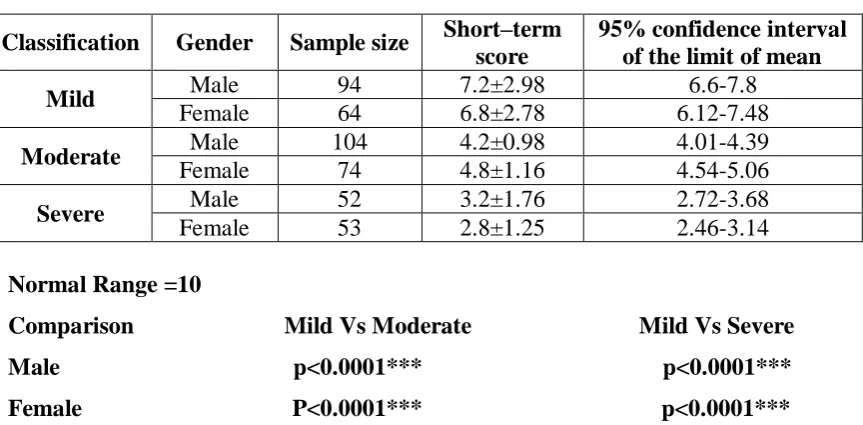
Table 4.Short term memory scores in mild, moderate and severe malnourished children.
Classification Gender Sample size Short–term
score
95% confidence interval of the limit of mean
Mild Male 94 7.2±2.98 6.6-7.8
Female 64 6.8±2.78 6.12-7.48
Moderate Male 104 4.2±0.98 4.01-4.39
Female 74 4.8±1.16 4.54-5.06
Severe Male 52 3.2±1.76 2.72-3.68
Female 53 2.8±1.25 2.46-3.14
Normal Range =10
Comparison Mild Vs Moderate Mild Vs Severe
Male p<0.0001*** p<0.0001***
Female P<0.0001*** p<0.0001***
[image:5.595.68.500.511.723.2]www.wjpr.net Vol 3, Issue 9, 2014. 1126 moderate and severe highly significant difference was noticed. A similar pattern was observed in female also.(Table 4)
Table 5.Long-term memory scores in mild, moderate and severe malnourished children.
Classification Gender Sample size Long-term
score
95% confidence interval of the limit of mean
Mild Male 94 4.6±1.05 4.39-4.81
Female 64 3.2±1.87 2.74-3.66
Moderate Male 104 4.1±1.75 3.76-4.44
Female 74 3.0±1.25 2.72-3.28
Severe Male 52 2.5±1.02 2.22-2.78
Female 53 2.6±0.85 2.37-2.83
Normal range = 10
Comparison Mild Vs Moderate Mild Vs Severe
Male p<0.05* p<0.0001***
Female p>0.05* p<0.01**
Long-term memory was also found very low in severe cases than mild and moderate. Females have shown low scores of long term memory as compared to male.
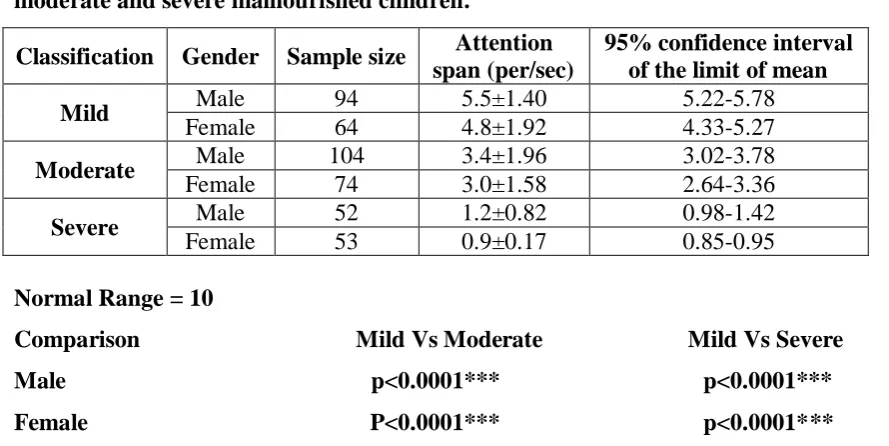
Table 6.Level of attention span in different degree of under nutrition like mild,
moderate and severe malnourished children.
Classification Gender Sample size Attention
span (per/sec)
95% confidence interval of the limit of mean
Mild Male 94 5.5±1.40 5.22-5.78
Female 64 4.8±1.92 4.33-5.27
Moderate Male 104 3.4±1.96 3.02-3.78
Female 74 3.0±1.58 2.64-3.36
Severe Male 52 1.2±0.82 0.98-1.42
Female 53 0.9±0.17 0.85-0.95
Normal Range = 10
Comparison Mild Vs Moderate Mild Vs Severe
Male p<0.0001*** p<0.0001***
Female P<0.0001*** p<0.0001***
www.wjpr.net Vol 3, Issue 9, 2014. 1127 Ample evidence has been accumulated in the recent past indicating the significance of nutrition in cognitive development including behavior. Several epidemiological studies have demonstrated that the protein energy malnutrition is an important health related issue in developing countries. Childhood mortality is significantly higher in tribal and rural locality due to poor hygiene and low body immunity in undernourished children. Poor intellectual development is an outcome of undernourishment. Though the problem of malnourishment is a global issue but it is more dominant in third world countries. Grantham-McGregor (1995) reviewed the effect of severe malnutrition on mental development. He enumerates several factors responsible for poor cognitive development in undernourished children. He further observed that a poor socio-culture background play an important role in mental development. Kar et al (2008) emphasized that once brain is affected by severe undernourishment for a considerable long phase, inspite of improving socio-economic condition no improvement can be obtained. Indian Council of Medical Research (ICMR) and National Institute of Nutrition (NIN) both organization have widely surveyed the various parameters for determination of nutritional status. These organizations have considered different ethnic group and noticed that dietary habit and absence of balanced diet is main cause of malnutrition. While in tribal locality poor calorie intake particularly severe deficiencies of protein and vitamins are the major cause of infection and high prevalence of mortality among tribal children.
As shown in result maximum cognitive impairment was noticed in severe cases of malnutrition. Poor attention span was noticed in severe cases in comparison to mild and moderate. It indicates that low protein intake significantly affect the cognitive development resulting in poor memory span. Such children exhibit poor scholastic performance and learning abilities particularly associated with severely malnourished children. Poor performance in mathematics and science is a consequence of under nutrition.
CONCLUSION
www.wjpr.net Vol 3, Issue 9, 2014. 1128 REFERENCES
1. Abhilasha Sharma, Aruna Agarwal, G.Victor Kajamanickam and G.P Dubey, 2009. Modulation of scholastic performance of protein energy malnourished (PEM) children by Seabuckthorn; Seabuckthorn, satish serial publishing house.272-273.
2. Cherkin A. Interaction of nutrition factor with memory processing. In: Essman WB ed Nutrients and brain function. Karger,Basel 72-94(1987).
3. Connolly KJ, K Valsvig JD. Infection, nutrition and cognitive performance in children. Parasilology;107 supp: 5187-200(1993).
4. Dobbing J. Vulnerable periods in the developing brain. In: Dobbing J, ed. Brain, behavior and iron in the infant diet. London, United Kingdom: Springer, 1990:1–25.
5. Grantham-Mcgregor, S. (1995). A Review of Studies of the Effect of Severe Malnutrition on Mental Development. The Journal of Nutrition. 125: 2233S-2238S.
6. Green, M., Rogers, P., Elliman, N., &Gatenby, S.(1992).Impairment of cognitive performance associated with dieting and high levels of dietary restraint. Physiology & Behavior, 55(3),447-452.doi:10.1016/0031-9384(94)90099-X.
7. Georgieff MK, Rao R (2001). The role of nutrition in cognitive development. In: Nelson CA, Luciana M, eds. Handbook in developmental cognitive neuroscience. Cambridge, MA: MIT Press, 2001:491–504.
8. Kar BR, Rao SL, Chandramouli BA(2008). Cognitive development in children with chronic protein energy malnutrition. Behavioral and Brain Functions, 2008;4:31 doi:10.1186/1744-9081-4-3`. Available from:http://www.behaviouraland brainfunctions.com/content/4/1/31.
9. Kemps, E.,Tiggemann,M.,& Marshall,K.(2005).Relationship between dieting to lose weight and the functioning of the central executive.Appetite,45(3),287-294.doi: 10.101/j.appet.2005. 07.002.
10.Kretchmer N, Beard JL, Carlson S.(1996). The role of nutrition in the development of normal cognition. Am J Clin Nutr;63(suppl):997S–1001S.
11.King, Lindsey M. (2012) "Nutrition and Cognitive Functioning: Multifaceted Analysis of Physiological and Psychological Components," Pure Insights: Vol. 1: Iss. 1, Article 6. 12.Lui J., Raine A.D., Venables, P.H.,& Mednick S.A.(2004). Malnutrition at Age 3 Years
and Externalizing Behavior Problems at Ages 8, 11, and 17 Years. American Journal of Psychiatry. 161:2005–2013.
www.wjpr.net Vol 3, Issue 9, 2014. 1129 14.Rao R, Georgieff MK(2000). Early nutrition and brain development. In: Nelson CA, ed.
The effects of early adversity on neurobehavioral development. Minnesota Symposium on Child Psychology. Vol 31. Hillsdale, NJ: Erlbaum Associates:1–30.
15.Richardson, S.A., H.G. Birch, E. Grabie, and K. Yoder(1972). The behavior of children in school who were severely malnourished in the first two years of life. Journal of health and social behavior, 13,276-274.
16.Sharma ,S., De Roose, E.D., Cao, X., Gittelsohn, J. and Corriveau, A. (2009) Dietary intake in a population undergoing a rapid transition in diet and lifestyle: the Inuvialuit in the Northwest Territories of Arctic Canada. Can.J. Public Health 100, 442-448.
17.Thompson RA, Nelson CA(2001). Developmental science and the media: early brain development.Am Psychol;56:5–15.CrossRef.
18.Uauy R, Mena P Peiranop.(2001). Mechanism for nutrient effect on brain development and cognitive Nestle Nutr workshop ser clin perform programme; (5): 41-70.
19.Vreugdenburg, L., Bryan, J., & Kemps, E. (2003). The effect of self-initiated weight-loss dieting on working memory: The role of preoccupying cognitions.Appetite, 41(3), 291-300.doi:10.1016/S0195-6663(03)00107-7.