FORMULATION AND EVALUATION OF BILAYERED TABLET OF
CAPTOPRIL AND GLIMIPERIDE
Fatima Sultana* and R. Balaji Reddy
Department of pharmaceutics, Deccan school of pharmacy, Darrusalam, Aghapura, Hyderabad.
ABSTRACT
Objective: Diabetes mellitus generally accompanied with major complications like Hypertension, Cardio myopathy, Stroke, Hyperlipidemia, Ischemic cerebrovascular disease, and Peripheral vascular disease. These conditions account for most morbidity and mortality among middle-aged and older people. The drug of choice for type2 diabetes mellitus is glimiperide and for Hypertension is captopril, to reduce the prevention of cardiac problems in diabetic patients. The objective of this research work was to overcome the above complication and to establish Bilayer tablet of Glimepiride (SR) with Captopril (IR) as a once daily formulation. Method: The formulations of tablets (F1-F6) were prepared by using release retarding agents like HPMC, guar gum and xanthum gum for sustained release (SR) layer and super disintegrants like Crosscarmellose sodium, Sodium starch glycolate (SSG) for immediate release (IR) layer. Both sustained and immediate release granules were evaluated for flow property. Bilayer tablets were evaluated for weight variation, hardness, thickness, swelling index and in-vitro drug release for 12 hours. Results: There was no Chemical interaction between drug and excipients which was indicated in the FT-IR. Disintegration and dissolution profiles decreases with addition of super disintegrating agents like Croscarmellose Sodium (CCS), Cross povidone (CP), Sodium Starch Glycolate (SSG) and polymers like xanthum gum, guar gum and HPMC. Conclusion: Among all the formulation F4 with CCS in 7.5% for immediate release and formulation F3 with guar gum in 10% for sustained release found to be best in drug release profile.
KEY WORDS: Diabetes mellitus, Hypertension, Captopril, Glimepiride,Cross carmellose sodium, Sodium starch glucolate.
Volume 4, Issue 9, 1249-1260. Research Article ISSN 2277– 7105
Article Received on 05 July 2015,
Revised on 26 July 2015, Accepted on 17 Aug 2015
*Correspondence for
Author
Fatima Sultana
Department of
1 INTRODUCTION[1-3]
Drug delivery systems (DDS) are a strategic tool for expanding markets/indications, extending product life cycles and generating opportunities. Oral administration is the most popular route for systemic effects due to its ease of ingestion, pain, avoidance, versatility and most importantly, patient compliance. Also solid oral delivery systems do not require sterile conditions and are therefore, less expensive to manufacture. Patient compliance, high-precision dosing, and manufacturing efficiency make tablets the solid dosage form of choice. Excipients and equipments choices will be significantly affected, should solid dosage form technologies change in response to the unprecedented shifts in the drug discovery such as genomics.Bi-Layered tablet consists of two or more layers of granulation compressed together. One layer shows sustained release and the other is immediate release.
OBJECTIVE: To optimize the concentration of Polymer for sustaining layer, Glimiperide. To select and optimize the concentration of disintegrant for immediate release layer, Captopril. To select the suitable filler to produce the bulkiness and desired weight. To compare the dissolution profile of the prepared formulations and optimize the best formulation.Preparation of bilayered tablets by direct compression technique. To evaluate all the post compression parameters of the prepared formulations. To perform the drug excipient compatibility studies as per ICH guideline.
MATERIALS AND METHODS
Formulation Of Captopril Immediate Release Layer: Direct compression: Accurately weighed amounts of drug, super disintegrants, binder and diluents were mixed geometrically in a mortar. This mixture was passed through No.40 sieve and thoroughly mixed in a polythene bag for 15 minutes. The powder blend was then lubricated with magnesium stearate for 2 minutes and compressed into tablets on a 16-station rotary tableting machine using 9 mm round, flat-faced punches.
Table No4.5 b 1 formulation of immediate release layer ( Captopril).
Ingredients (%) F1 F2 F3 F4 F5 F6
Captopril(mg) 25 25 25 25 25 25
CP 5 -- -- 7.5 -- --
CCS -- 5 -- -- 7.5 --
SSG -- -- 5 -- -- 7.5
Starch 5 5 5 5 5 5
stearate
Talc 2.5 2.5 2.5 2.5 2.5 2.5
MCC Q.S Q.S Q.S Q.S Q.S Q.S
Total weight(mg) 150 150 150 150 150 150
CP- crospovidone, CCS- Cross Carmellose Sodium, PVP- Poly vinyl pyrrolidine, MCC- Micro crystalline cellulose
FORMULATION OF SUSTAINED RELEASE GLIMIPERIDE TABLETS
[image:3.595.67.529.74.159.2]The sustained release tablets of Glimiperide were prepared by wet granulation method, using various concentrations of HPMC K4M, K15M, xanthum gum, guar gum. Microcrystalline cellulose, povidone were passed through #40 mesh and added to the above granular material and blended for 5 min and prepare damp mass and finally pass through #24 mesh and allow the granules at 40˚C, Magnesium stearate were passed through 60#and added to the above blended material. Compress the blend into tablets with punch size 9mm
Table no. 4.5 b 2: Formulation for Sustained Release layer (Glimiperide)
Ingredients(%) F1 F2 F3 F4 F5 F6
Glimiperide(mg) 4 4 4 4 4 4
Xanthum gum 10 15 -- -- -- --
Guar gum -- -- 10 15 -- --
HPMC K4M -- -- -- -- 10 15
PVP K30 2.5 2.5 2.5 2.5 2.5 2.5
Talc 2 2 2 2 2 2
Magnesium stearate 2 2 2 2 2 2
MCC Q.S Q.S Q.S Q.S Q.S Q.S
Total weight (mg) 200 200 200 200 200 200
MCC: Micro crystalline cellulose; EC: Ethyl cellulose; PVP: Poly vinyl pyrrolidine; HPMC: Hydroxy Propyl methyl cellulose.
FORMULATION OF OPTIMISED BILAYER TABLETS OF CAPTOPRIL & GLIMIPERIDE
TABLE -.Composition of Optimised Bilayer Tablets of Captopril & Glimiperide.
INGREDIENTS IR FORMULATION
BATCH (F4)
SR FORMULATION BATCH (F3)
OPTIMISED BILAYERED TABLETS
CAPTOPRIL (mg) 25 -- 25
GLIMIPERIDE (mg) -- 4 4
Crospovidone (%) 7.5 -- 7.5
Starch 5 -- 5
PVP K30 (%) 2.5 2.5
Microcrystalline Cellulose (%) Q.S. Q.S. Q.S.
Magnesium Stearate (%) 2.5 2 4.5
Talc (%) 2.5 2 4.5
Guar Gum (%) -- 10 10
Total Weight (mg) 150 200 350
PREFORMULATION STUDIES
Bulk Density Blend was weighed and transferred to a measuring cylinder. Then bulk volume was noted. Bulk density was calculated by using the following formula.
Bulk density = Weight of powder / Bulk volume
Tapped density Blend was weighed, transferred to measuring the cylinder and subjected to 500 tappings. Then volume was noted as tapped volume. Tapped density was measured by using the following formula
Tapped density = Weight of powder / Tapped volume
Carr’s Index Carr’s index was calculated by using the following formula.
Carr’s index = (Tapped density – Bulk density / Tapped density) X 100
Hausner’s ratio: Hausner’s ratio is an index of ease of powder flow; it calculated by following formula.
Hausner’s Ratio = Tapped density /Bulk density
Angle of repose Angle of Repose (θ) is the maximum angle between the surface of a pile of powder and horizontal
= tan1 (h/r) = tan1 (height of pile/0.5base)
POSTFORMULATION STUDIES
EVALUATION OF BILAYER TABLETS OF CAPTOPRIL & GLIMIPERIDE The prepared formulations were evaluated for the following parameters
HARDNESS TEST
Hardness indicates the ability of a tablet to withstand mechanical shocks while handling the hardness of the tablets was determined using Monsanto Hardness tester. It is expressed in kg/cm2.
FRIABILITY TEST
The friability of tablets was determined using Roche Friabilator. It is expressed in percentage (%). Ten tablets were initially weighed (W) and transferred in to the friabilator. The friabilator was operated at 25 rpm for 4 minutes or run up to 100 revolutions. The tablets were weighed again (W) final. The % friability was then calculated by
Where,
%F= Friability in percent %
friability of tablets <1% were considered acceptable.
WEIGHT VARIATION TEST
Ten tablets were selected randomly from each batch and weighed individually to check for weight variation. A little variation is allowed in the weight of tablet by U.S. Pharmacopoeia.
DRUG CONTENT UNIFORMITY
FOR SUSTAINED RELEASE GLIMIPERIDE TABLETS
Tablet containing drug is dissolved in 100 ml of 0.1N HCl taken in volumetric flask. The drug is allowed to dissolve in the solvent. The solution was filtered, 1 ml of filtrate was taken in 50 ml of volumetric flask and diluted up to mark with 0.1N HCl and analyzed spectrophotometrically at 228nm for sustained release layer of Glimipereide.
FOR IR LAYER CAPTOPRIL TABLETS
Ten tablets were weighed and powdered and 250mg equivalent weight of Captopril was accuarately weighed and transfered in 100ml volumetric flask. It was dissolved and made up the volume with 0.1N HCl pH- 1.2. Subsequently the solution was filtered and suitable dilution were made and analyzed at 212nm using UV-Visible spectroscopy.
DISINTEGRATION TEST
By using disintegration apparatus, tablets were tested for disintegration time at 37± 0.50C taking distilled water as medium.
SWELLING CHARACTERISTICS
The swelling properties of tablets were determined by placing the tablet in dissolution test apparatus in 900 ml of 0.1N HCl at 37 ± 0.5. The tablets were removed periodically from the dissolution medium. After draining the tablets were measured for weight gain. Swelling characteristics were expressed in terms of % water uptake (WU%).
IN VITRO DISSOLUTION STUDIES:
In-vitro release studies were carried out USP II paddle type dissolution test apparatus. 900 ml of 0.1 N HCl (PH 1.2) was filled in dissolution vessel and the temperature of the medium were set at 37° C ± 0.1°C.The speed was set at 50 rpm. 5 ml of sample was withdrawn at predetermined time intervals and analysed
Kinetic Analysis of Dissolution Data
The following plots were made using the in-vitro drug release data
Cumulative % drug release vs. time (Zero order kinetic model);
Log cumulative of % drug remaining vs. time (First order kinetic model);
Cumulative % drug release vs. square root of time (Higuchi model);
And cube root of initial concentration minus the cube root of percentage of drug
remaining in the matrix vs. time (Hixson-Crowell cube root law).
Mechanism of drug release: Korsmeyeret al (1983) derived a simple relationship which described drug release from a polymeric system Eq. (5). To find out the mechanism of drug release, first 60% drug release data was fitted in Korsmeyer–Peppas model.
Mt / M∞ = Ktn
RESULTS AND DISCUSSION
DRUG EXCIPIENT COMPATIBILITY STUDIES BY FTIR FTIR ANALYSIS OF CAPTOPRIL
stretching vibration in the lactone ring, 1037.12 cm-1, 971.08 cm-1, and 881.41 cm-1, refers to the -O-ether functional bands, and at 750cm-1 refers to the Alkyl- CH3 substitution bands.
Fig.No: 5.1a FTIR compatility studies graph of Captopril
FTIR ANALYSIS FOR GLIMIPERIDE
An FTIR spectrum of glimiperide was obtained in the range of 400-4000 cm-1 using KBr pellet technique and the peaks mentioned in standards were compared with those obtained. The studies of Fourier Transform – Infra Red spectra showed C-O of furan group peak at 1674cm-1, S=O of alkyl group peak at 1708.15cm-1 and 106.14 cm-1, 1036.65 cm-1 refers to the –O- ether functional bands, 617.06 cm-1 refers to the Alkyl –CH3 substitution bands.
Fig.No: 5.1c FTIR compatibility studies graph of Bilayered Tablet of Captopril & Glimiperide.
INFERENCE
There is no significant change in the shift of major peaks of drug in the above graphs, hence there were no drug and excipient interactions found in either IR, SR, OR Bilayer tablets.
5.1 PREFORMULATION STUDIES
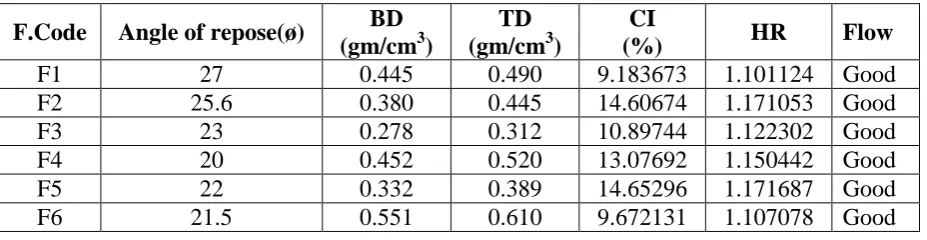
[image:8.595.151.450.72.263.2]A. PREFORMULATION STUDIES FOR IMMEDIATE RELEASE LAYER OF CAPTOPRIL
TABLE NO. 5.1.a: Precompression parameters of Immediate release layer of Captopril. F.Code Angle of repose(ø) BD
(gm/cm3)
TD (gm/cm3)
CI
(%) HR Flow
F1 27 0.445 0.490 9.183673 1.101124 Good
F2 25.6 0.380 0.445 14.60674 1.171053 Good
F3 23 0.278 0.312 10.89744 1.122302 Good
F4 20 0.452 0.520 13.07692 1.150442 Good
F5 22 0.332 0.389 14.65296 1.171687 Good
F6 21.5 0.551 0.610 9.672131 1.107078 Good
DISCUSSION
[image:8.595.68.532.484.604.2]B. PREFORMULATION STUDIES FOR SUSTAINED RELEASE LAYER OF GLIMIPERIDE
TABLE NO. 5.1.b: Precompression parameters for the sustained release layer of Glimiperide.
DISCUSSION: All the formulation blends of SR layer were subjected to preformulation studies and the flow was found to be fair to good. The optimised batch F3 has good flow properties.
EVALUATION OF POST COMPRESSION PARAMETERS
A. EVALUATION TESTS FOR VARIOUS FORMULATIONS OF IMMEDIATE RELEASE LAYER OF CAPTOPRIL
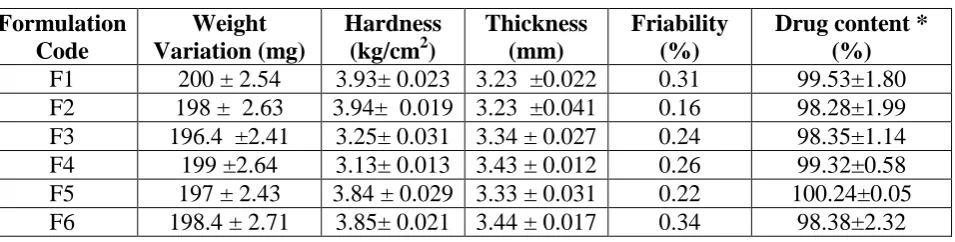
TABLE-5.3.a. Postcompression Evaluation tests of immediate release layer of captopril Formulation
Code
Weight Variation (mg)
Hardness (kg/cm2)
Thickness (mm)
Friability (%)
Drug content * (%)
F1 200 ± 2.54 3.93± 0.023 3.23 ±0.022 0.31 99.53±1.80
F2 198 ± 2.63 3.94± 0.019 3.23 ±0.041 0.16 98.28±1.99
F3 196.4 ±2.41 3.25± 0.031 3.34 ± 0.027 0.24 98.35±1.14
F4 199 ±2.64 3.13± 0.013 3.43 ± 0.012 0.26 99.32±0.58
F5 197 ± 2.43 3.84 ± 0.029 3.33 ± 0.031 0.22 100.24±0.05
F6 198.4 ± 2.71 3.85± 0.021 3.44 ± 0.017 0.34 98.38±2.32
DISCUSSION: All the formulations of IR layer tablets were evaluated for various physicochemical parameters and they were found to within limits. The optimised formula is F4.
F.code Angle of repose(ø) BD(gm/cm3) TD(gm/cm3) CI(%) HR Flow
F1 25 0.320 0.395 18.98 1.234375 Fair
F2 26 0.420 0.500 16.0 1.190476 Fair
F3 19 0.321 0.399 19.54 1.242991 Fair
F4 28 0.325 0.400 18.75 1.230769 Fair
F5 22 0.555 0.692 19.79 1.246847 Fair
[image:9.595.63.541.445.566.2]B. EVALUATION TESTS FOR VARIOUS FORMULATIONS OF SUSTAINED RELEASE LAYER OF GLIMIPERIDE.
TABLE-5.3d Post compression evaluation tests of sustained release layer of glimiperide. Formulation
Code
Weight Variation (mg)
Hardness (kg/cm2)
Thickness (mm)
Friability (%)
Drug content * (%)
F1 300± 1.34 6.93 ±0.020 3.53 ± 0.035 0.21 97.35±0.37
F2 298 ± 1.33 7.94± 0.015 3.63 ± 0.032 0.26 99.88±1.80
F3 296.4 ±1.31 6.25± 0.026 3.44 ± 0.025 0.24 97.12±1.37
F4 299± 1.64 6.83± 0.012 3.53 ± 0.017 0.36 100.12±0.98
F5 297 ±2.13 7.84± 0.024 3.43 ± 0.028 0.32 101.22±0.25
F6 298.4± 2.11 7.85± 0.029 3.54 ± 0.018 0.34 98.33±0.87
DISCUSSION
All the formulations of SR layer tablets were evaluated for various physicochemical parameters and they were found to within limits. The optimised formula is F3.
[image:10.595.142.452.351.539.2][image:10.595.144.454.576.745.2]
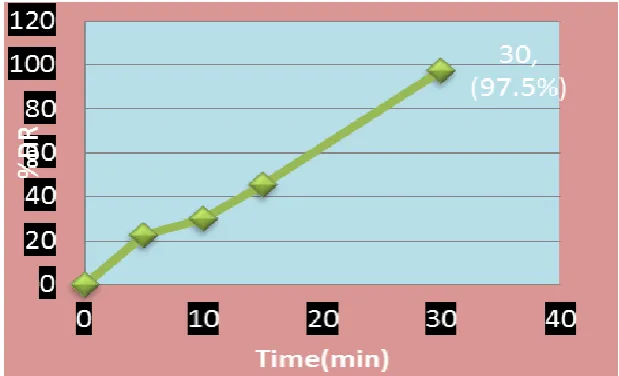
Fig. No:5.3 l 1 dissolution graph of bilayer tablet – captopril ir layer
CONCLUSIONS
The Bilayered tablets containing Captopril SR and Glimepiride IR were successfully
prepared by direct compression method respectively.Various formulations were prepared and evaluated with an aim of presenting Captopril as sustained release and Glimepiride as immediate release for improving the patient’s compliance.The physiochemical evaluation
results for the powdered blend of all trials pass the official limits in angle of repose, compressibility index.The prepared blend for IR layer tablets and SR layer tablets were also maintained the physiochemical properties of tablets such as thickness, hardness, weight variation, friability. The optimized formulation F4 in IR formulations contains the average thickness of 3.07mm, average hardness of 3.13 kg/cm2, average weight of 150mg, friability of 0.26%. The optimized formulation F5 in SR formulations contains the average thickness of 3.43mm, average hardness of 6.25 kg/cm2, friability of 0.24%.
The F9 formulation which releases the Glimiperide in sustained manner in 1st
hour it releases 12.32% but the remaining drug release was sustained up to 24 hours and Captopril immediate release F4 formulation showed 97.50% drug release with in 30 min.With the data of kinetic analysis, F3 formulation showed best linearity in Zero order plot indicating that the release of drug from matrix tablet follows Non Fickian diffusion.The dissolution study was carried out for optimized bilayer tablet and it correlates with the drug release of individual release layer formulations.
“Hence it may be summarized that the tablets prepared by direct compression method for
sustained release layer and immediate release layer might be a perfect and effective
formulation for the treatment of Diabetes and Hypertension”.
REFERENCES
1. Martindale, the Extra Pharmacopoeia, 31sted.The Pharmaceutical Press, London; 1996; 936–937.
2. Shiyani B et al. Formulation and evaluation of bilayer tablet of Metoclopramide hydrochloride and Ibuprofen. AAPS Pharm Sci Tech 2008; 9(3): 818-27. Pranjal Kumar Singh et al, Sanjoo Kumar et al Bilayer and Floating Bioadhesive Tablets: Innovative approach to Gastroretention, Journal of Drug Delivery & Therapeutics; 2011; 1(1): 32-35. 3. Kulkarni A et al, Development and evaluation of bilayer floating tablets of atenolol and
4. Panchel hiten ashok, Tiwari ajay kumar, A Novel approach of bilayer tablet technology-A review, IRJP, 2012; 3(5).
5. Nirmal J et al, Saisivam S et al, Peddanna C et al, Muralidharan S et al, Nagarajan M et al, Bilayer tablets of atorvastatin calcium and nicotinic acid: formulation and evaluation. Chem. Pharm.Bull. 2008; 56: 1455–1458,26-102-1PB.
6. Reynolds JEF, In; Martindale; The Extra Pharmacopoeia, 29th Edn., The Royal Pharmaceutical Society of Great Britain, London: 1993; 295.
7. Mcnaman JO, Hardman JG, Limbird LE, Molinoff PB and Ruddon RW. Eds., The Pharmacological Basis of Therapeutics: 9th Edn. Mc Graw-Hill.
8. Indian Pharmacopoeia. Vol. II, 4th ed. TheController of Publications, New Delhi, 1996; 736.
9. AM Raggi; R Mandrioli; A Ferranti; J. Pharm. Biomed. Analysis., 2003; 32: 1037-1044. 10. J Siepmann; H Kranz; R Bodmeier; NA Peppas; Pharm Res., 1999; 16: 1748-1756.