COMPARISON OF THE SENSITIVITY AND SPECIFICITY OF
DIFFERENT TESTS TO DETERMINE DIFFICULT INTUBATION
*1Javaher Foroosh Zadeh F and 2Safaii Sara
1
Associate Professor, Ahvaz Anesthesiology and Pain Research Center, Ahvaz Jundishapoor
University of Medical Sciences, Ahvaz, Iran.
2
Assistant of Anesthesia, Ahvaz Anesthesiology and Pain Research Center, Ahvaz
Jundishapoor University of Medical Sciences, Ahvaz, Iran.
ABSTRACT
Back ground: Difficult intubation is variably predicted by different tests. In this study we evaluated the sensitivity and specificity of four
airway examination tests including: Mallampati, Thyro-mental
distance, ULBT(Upper Lip Bite Test), and Inter incisicor gap for
predicting difficult tracheal intubation. Methods: Total of 448 patients
with a mean age of 53.5 years were enrolled. Preoperative airway
assessment of patients by Mallampati test, Thyro mental distance
measurement, ULBT and Inter incisor gap were done. All patients
were anesthetized and intubation grade was assessed by experienced
anesthesiologist according to Cormack-Lehan classification. Degree of
observed difficulty of intubation was compared to predicted values.
Statistical analysis was performed using SPSS version 16. Data were
analysis by using Fishers exact and McNemar's test, and a P value
<0.05 was considered statistically significant. Results and discussion: The incidence of difficult intubation by Cormack-Lehane in this study was 8.4%, Mallampati test had the
highest sensitivity (47.3%) and Thyro-mental distance was most specific(96%). The ULBT
(upper lip bite tests) had most positive and negative predictive value(37.9% &93.5%).Data
also showed that power of these tests in predicting easy intubation is more than their ability
in assessing the likelihood of difficult intubation.
KEYWORDS: Difficult intubation, Mallampati, Thyro-mental Distance, Inter incisor gap, Upper Lip Bite Test.
7105 – 2277 ISSN
Research Article
. 42
-, 36 Volume 4, Issue 9
Article Received on 19 June 2015,
Revised on 10 July 2015, Accepted on 05 Aug 2015
*Correspondence
For Author
Javaher Foroosh Zadeh F
Associate Professor,
Ahvaz Anesthesiology
and Pain Research Center,
Ahvaz Jundishapoor
University of Medical
INTRODUCTION
The fundamental responsibility of an anesthesiologist is to maintain adequate gas exchange
through a patent airway. Failure to maintain a patent airway for more than a few minutes
results in brain damage or death.[1] Anesthesia in a patient with a difficult airway can lead to
both direct airway trauma and morbidity from hypoxia and hypercarbia. Direct airway trauma
occurs because the management of the difficult airway often involves the application of more
physical force to the patient’s airway than is normally used. Much of the morbidity
specifically attributable to managing a difficult airway comes from an interruption of gas
exchange (hypoxia and hypercapnia), which may then cause brain damage and cardiovascular
activation or depression.[2]
Though endotracheal intubation is a routine procedure for all anesthesiologists, occasions
may arise when even an experienced anesthesiologist might have great difficulty in the
technique of intubation for successful control of the airway. As difficult intubation occurs
infrequently and is not easy to define, research has been directed at predicting difficult
laryngoscopy, i.e. when is not possible to visualize any portion of the vocal cords after
multiple attempts at conventional laryngoscopy. It is argued that if difficult laryngoscopy has
been predicted and intubation is essential, skilled assistance and specialist equipment should
be provided. Although the incidence of difficult or failed tracheal intubation is comparatively
low, unexpected difficulties and poorly managed situations may result in a life threatening
condition or even death.[3, 4]
The paucity of fool proof tests in predicting difficult intubation commonly results in
unanticipated difficult scenarios and their attendant repercussions. The reported incidence of
difficult intubation ranges from 0.5 to 18%.[3, 4, 5] It is obvious that preoperative identification of difficult intubation in patients would decrease the rate of anesthesia related
complications .Although many advances have been made and many methods have been
used to overcome the conundrum of an unanticipated difficult intubation, most tests are not
reliable.
All preoperative airway assessment tests are low sensitivity and specificity except ULBT.[6, 7]
In this study we evaluated sensitivity, specificity, positive predictive value, and negative
predictive value of 4 common tests : Mallampati, Thyromental distance, Inter incisor gap and
METHODS
Between sep 2008 and may 2011, 448 patients with American society of anesthesia class I or
II were selected. Patients who had an age above 18 years with BMI<30 and were scheduled
for elective surgery under general anesthesia requiring endotracheal intubation. After
approval of the ethics committee of the Ahvaz Jundishapoor University, an informed consent
was obtained from all patients. Excluding criteria included patients with: Airway
malformation, inability to cooperate, pregnancy, edentulous patients, those unable to open the
mouth and limitation in mobility of temporomandibular and atlanto axial joints.
Preoperatively the airway were evaluated by two anesthesiologist who were not involved in
intubation .The details of evaluation are given in table 1.
Table 1: Methods of assessment of airway.
class1: faucial pillars, soft palate and uvula visible.
Class2: soft palate and base of uvula seen
Class3: only soft palate visible Class4: soft palate not seen Mallampati scoring
Distance between tip of thyroid cartilage and tip of chin, with fully extended
Tyro mental distance
Distance between the incisors with mouth fully open(Cm) Inter incisors gap
Class1 lower incisor can bite the upper lip above the vermilion
Class 2 lower incisor can bite the upper lip below the vermilion
Class 3 lower incisor can not bite the upper lip ULBT
Mallampati class3 and 4, inter incisor gap≤4cm, thyromental distance≤ 6 and ULBT class3
were considered as markers of a potentially difficult intubation based on receiver operating
characteristic (ROC) analysis.
After induction of anesthesia direct laryngoscopy with Macintosh blade no.3 was performed
by an anesthesiologist who was blinded to preoperative assessment. Glottic exposure was
graded as per Cormack–Lehane classification.[8] (Table2) No external laryngeal pressure was
applied while laryngoscopy. Grade 1 and 2 were considered as easy and grade 3 and 4 as
difficult.
Table 2: Cormack – Lehane classification
Statistical analysis was performed using SpSS software version 16/0. Data were analysis by
using Fishers exact andMc-Nemar tests, and a P value <0.05 was considered statistically
significant and calculation of sensitivity ,specificity ,positive predictive value(PPV), negative
predictive value(NPV), and accuracy with their 95%confidence interval(95%CI).
RESULTS
Four hundred forty eight (448) patientswere included in our study(235women&213men)The
mean age was 53.5yr.Intubation was difficult in38 patients(8.4%).From four preoperative
tests Mallampati was most sensitive(47.3%) and thyromental distance was most specific for
detection of difficult intubation(96%). Most PPV (37.9%) and NPV (93.5%) were found for
ULBT. This study showed also that the power of these tests in predicting easy intubation is
more than their ability in assessing the likelihood of difficult intubation. The results in detail
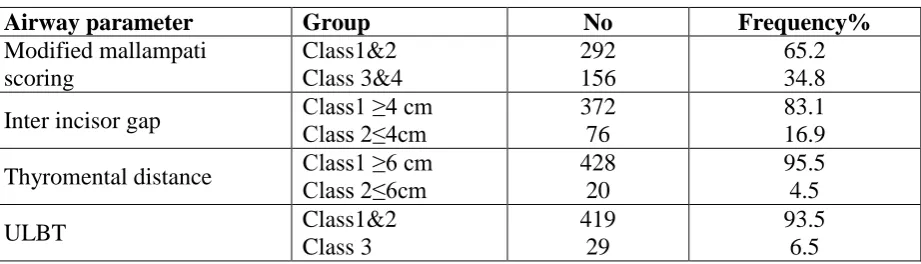
are in table 3&4.
Table 3: the frequency analysis of predictor parameters
Airway parameter Group No Frequency%
Modified mallampati scoring Class1&2 Class 3&4 292 156 65.2 34.8
Inter incisor gap Class1 ≥4 cm Class 2≤4cm 372
76
83.1 16.9
Thyromental distance Class1 ≥6 cm Class 2≤6cm 428
20
95.5 4.5
ULBT Class1&2
Class 3
419 29
[image:4.595.69.530.458.590.2]93.5 6.5
Table 4: comparative analysis of various scoring system.
Most sensitive test wasMMT, Most specific test was TMD, MostPPV&NPV were found for ULBT
Grade 1 :Most of glottis visible,
Grade2 :only the posterior extremity the glottis and the epiglottis seen Grade 3 :no part of the glottis visible, only the epiglottis seen,
Grade 4: not even the epiglottis seen.
NPV (%) PPV (%) Specificity (%) Sensitivity (%) Various scoring system 93.1 11.5 66.3 47.3 Modified mallampati scoring 93 15.7 84.3 31.5
Inter incisor gap
DISCUSSION
Difficulty in endotracheal intubation is a major cause of morbidity and mortality, especially
when it is not anticipated preoperatively. This unexpected difficulty in intubation is the result
of a lack of accurate predictive tests and inadequate preoperative assessment of the airway.
Since no anatomical factor can correctly forecast a difficult intubation with100% accuracy ,
we might expect predictive tests to be unreliable. Only few published articles regarding the
use of Hyomental distance or Tyromental distance or Modified Mallampaty as screening tests
to detect difficulty in intubation .This study was designed to evaluate the efficacy of
Modified mallampaty, Inter incisor gap ,Tyromental distance and Upper Lip bite test in
detection difficult intubation ,and to draw a possible correlation between the tests and
Cormack – Lehanegrades.
The prevalence of difficult intubation in our study was 8.4% that is comparatively with
previous studies(0.5-18%).[3,4]
Wilson et al suggested five risk factors in predicting difficult intubation, including weight
(p=0.05), head and neck movement(p=0.001), jaw movement(p=0.001), receding mandible
(p=0.001),and protruding upper incisor (p=0.001).[9]
ULBT when tested initially had the potential to evaluate both jaw movement and buck teeth
simultaneously, providing additional support for its use as an airway evaluation test.
Sensitivity, specificity, PPV and NPV of the ULBT (28.9%, 95.6%, 37.9%, 93.5%) in our
study were similar to those reported in Khan et al.
The ULBT has high specificity and NPV, making it superior in identifying easy intubation.
The high sensitivity and specificity of MMP and TM suggests these tests to be a valuable
adjuvant when combination with ULBT providing additional support for air way assessment.
Our study has similar results to Kashan hospital. In this study PPV&NPV of MMP was 12%
and 93% and for TM9.8%&92.7%.this group have concluded the low sensitivity and PPV of
TM and MMP, they are of limited value for detection of difficult intubation.[10]
In Khan et all study in 2006 specificity and accuracy of ULBT was significantly higher than
inter incisor and TMD similar to our study and was more accurate in airway assessment.[11]
In Jimson and et all study in 1995, they concluded that MMP &TMD had a little value for
they yield negative results.[12] In 2003 Khan et all concluded that the ULBT significantly higher specificity and accuracy than the MMT(p<0.001).[13] Our results similar to theose.
In 2009 Khan et all had similar results and they concluded that the specificity and accuracy
of the ULBT is significantly higher than other tests and is more accurate in airway
assessment.[6] Also In 2011 Khan and et all concluded an agreement between laryngoscopic
grading and HMD and MMP ,but was comparatively weaker.[7] The high accuracy of
ULBT specificity, NPV, PPV as revealed a good rationale for its application in the prediction
of difficulty or easiness in intubation that these were similar to our results too.
CONCLUSION
Despite the validity of MMP, TMD, ULBT and IIG in predicting easy intubation is much
greater than the value in prediction of difficult intubation, however the simplicity of
performing these tests and results of the four tests in evaluating patients before surgery by
combination of tests in predicting difficult intubation will likely safe. It seams that best
results are from applying combined test than a single one.
REFERENCES
1. Rose DK, Cohen MM.The airway: problem and predictors in 18500 patients. Can J
Anesthesia., 1994; 41: 372-83.
2. Benumof JL: Management of the difficult airway: With special emphasis on awake
tracheal intubation. Anesthesiology., 1991; 75: 1087-1110.
3. Wilson ME, Spiegelhalter D, Robertson JA, Lesser P.Predicting difficult intubation.Br J
Anesthesia., 1988; 61(2): 211-6.
4. 4)Arun Kr,Gupta,Mohamad Omid,Showkat Nengroo,Imtiyaz Naqash:Predictors of
difficult intubation.British J Of M., 2010; 3(1): 307-311.
5. Turkan S, Ates Y, Cuhruk H, Tekdemir I. should we reevaluate the variables for
predicting the difficult airway in anesthesiology? Anesth Analg., 2002; 94: 1340-4(Pub
Med).
6. Zahid Hussain Khan,MD,Mostafa Mohammadi,MD,Mohammad
R.Rasuouli,MD,Fahimeh Farrokhnia,MD,Razmeh Hussain Khan:The diagnostic value of
the upper lip bite test combined with sternomental distance, thyromental distance for
prediction of easy laryngoscopy and intubation. Anesth Analg., 2009; 109: 822-824.
7. Zahid Hussain Khan,MD,Anahid Maleki, Jalil Makarem,Mostafa
test with thyomental/thyrosternal distance and mandible length in predicting difficulty in
intubation. Indian JAnesthesia., 2011; 55(1): 43-46.
8. Cormack RS,Lehane J.Dificult intubation in obstetrics. Anesthesia., 1984; 39(11):
1105-11.
9. Wilson ME,Spiegelhalter D,Robertson JA,Lesser P.Predicting difficult intubation.Br J
Anesthesia., 1988; 61: 211-6.
10.Nurizad S,Mahdian M, Sayyedi H R,Mallampati and thyromental tests to predict difficult
intubation, J of KUMS., 2002; 6(3): 16-21.
11.Zahid Hussain Khan,MD,Mohammady M,MD,Eghtesadi P.Upper lip bite test with
thyromental, sternomental and interincisior distance in predicting difficult intubation: a
comparative study. Tehran university of medical J., 2006; 64(5): 102-110.
12.Jimson C. Tse, MD, PhD*, Eric B. Rimm, sat, and Ayyaz Hussain, FFARCS: Predicting
Difficult Endotracheal Intubation in Surgical Patients Scheduled for General Anesthesia:
A Prospective Blind Study. Anesth Analg., 1995; 81: 254-8.
13.Zahid Hussain Khan,MD, Arash Kashfi,MD,and Elham Ebrahimkhani, MD : A
Comparison of the Upper Lip Bite Test (a Simple New Technique) with Modified
Mallampati Classification in Predicting Difficulty in Endotracheal Intubation. Anesth