Fast Methods for Kernel-based Text Analysis
Taku Kudo and Yuji Matsumoto
Graduate School of Information Science, Nara Institute of Science and Technology {taku-ku,matsu}@is.aist-nara.ac.jp
Abstract
Kernel-based learning (e.g., Support Vec-tor Machines) has been successfully ap-plied to many hard problems in Natural Language Processing (NLP). In NLP, al-though feature combinations are crucial to improving performance, they are heuris-tically selected. Kernel methods change this situation. The merit of the kernel methods is that effective feature
combina-tion is implicitly expanded without loss
of generality and increasing the compu-tational costs. Kernel-based text analysis shows an excellent performance in terms in accuracy; however, these methods are usually too slow to apply to large-scale text analysis. In this paper, we extend a Basket Mining algorithm to convert a kernel-based classifier into a simple and fast linear classifier. Experimental results on English BaseNP Chunking, Japanese Word Segmentation and Japanese Depen-dency Parsing show that our new classi-fiers are about 30 to 300 times faster than the standard kernel-based classifiers.
1 Introduction
Kernel methods (e.g., Support Vector Machines (Vapnik, 1995)) attract a great deal of attention re-cently. In the field of Natural Language Process-ing, many successes have been reported. Examples include Part-of-Speech tagging (Nakagawa et al.,
2002) Text Chunking (Kudo and Matsumoto, 2001), Named Entity Recognition (Isozaki and Kazawa, 2002), and Japanese Dependency Parsing (Kudo and Matsumoto, 2000; Kudo and Matsumoto, 2002).
It is known in NLP that combination of features contributes to a significant improvement in accuracy. For instance, in the task of dependency parsing, it would be hard to confirm a correct dependency re-lation with only a single set of features from either a head or its modifier. Rather, dependency relations should be determined by at least information from both of two phrases. In previous research, feature combination has been selected manually, and the performance significantly depended on these selec-tions. This is not the case with kernel-based method-ology. For instance, if we use a polynomial ker-nel, all feature combinations are implicitly expanded without loss of generality and increasing the compu-tational costs. Although the mapped feature space is quite large, the maximal margin strategy (Vapnik, 1995) of SVMs gives us a good generalization per-formance compared to the previous manual feature selection. This is the main reason why kernel-based learning has delivered great results to the field of NLP.
analysis of large quantities of text is indispensable. This paper presents two novel methods that make the kernel-based text analyzers substantially faster. These methods are applicable not only to the NLP tasks but also to general machine learning tasks where training and test examples are represented in a binary vector.
More specifically, we focus on a Polynomial
Ker-nel of degreed, which can attain feature combina-tions that are crucial to improving the performance of tasks in NLP. Second, we introduce two fast clas-sification algorithms for this kernel. One is PKI (Polynomial Kernel Inverted), which is an exten-sion of Inverted Index in Information Retrieval. The other is PKE (Polynomial Kernel Expanded), where all feature combinations are explicitly expanded. By applying PKE, we can convert a kernel-based clas-sifier into a simple and fast liner clasclas-sifier. In order to build PKE, we extend the PrefixSpan (Pei et al., 2001), an efficient Basket Mining algorithm, to enu-merate effective feature combinations from a set of support examples.
Experiments on English BaseNP Chunking, Japanese Word Segmentation and Japanese Depen-dency Parsing show that PKI and PKE perform re-spectively 2 to 13 times and 30 to 300 times faster than standard kernel-based systems, without a dis-cernible change in accuracy.
2 Kernel Method and Support Vector Machines
Suppose we have a set of training data for a binary classification problem:
(x1, y1), . . . ,(xL, yL) xj ∈ <N, yj ∈ {+1,−1},
wherexjis a feature vector of thej-th training
sam-ple, and yj is the class label associated with this
training sample. The decision function of SVMs is defined by
y(x) = sgn³ X j∈SV
yjαjφ(xj)·φ(x) +b´, (1)
where: (A)φis a non-liner mapping function from
<N to<H (N ¿H). (B)α
j, b∈ <, αj ≥0.
The mapping functionφshould be designed such that all training examples are linearly separable in
<H space. SinceH is much larger than N, it
re-quires heavy computation to evaluate the dot prod-uctsφ(xi)·φ(x)in an explicit form. This problem
can be overcome by noticing that both construction of optimal parameter αi (we will omit the details
of this construction here) and the calculation of the decision function only require the evaluation of dot productsφ(xi)·φ(x). This is critical, since, in some
cases, the dot products can be evaluated by a simple
Kernel Function:K(x1,x2) =φ(x1)·φ(x2).
Sub-stituting kernel function into (1), we have the fol-lowing decision function.
y(x) = sgn³ X j∈SV
yjαjK(xj,x) +b´ (2)
One of the advantages of kernels is that they are not limited to vectorial objectx, but that they are appli-cable to any kind of object representation, just given the dot products.
3 Polynomial Kernel of degreed
For many tasks in NLP, the training and test ex-amples are represented in binary vectors; or sets, since examples in NLP are usually represented in so-called Feature Structures. Here, we focus on such cases1.
Suppose a feature set F = {1,2, . . . , N} and training examples Xj(j = 1,2, . . . , L), all of
which are subsets of F (i.e., Xj ⊆ F). In this
case, Xj can be regarded as a binary vector xj = (xj1, xj2, . . . , xjN) where xji = 1 if i ∈ Xj,
xji = 0 otherwise. The dot product of x1 andx2
is given byx1·x2=|X1∩X2|.
Definition 1 Polynomial Kernel of degreed
Given setsX andY, corresponding to binary fea-ture vectorsxandy, Polynomial Kernel of degreed
Kd(X, Y)is given by
Kd(x,y) =Kd(X, Y) = (1 +|X∩Y|)d, (3)
whered= 1,2,3, . . ..
In this paper, (3) will be referred to as an implicit
form of the Polynomial Kernel.
1In the Maximum Entropy model widely applied in NLP, we
usually suppose binary feature functionsfi(Xj)∈ {0,1}. This
formalization is exactly same as representing an exampleXjin
It is known in NLP that a combination of features, a subset of feature set F in general, contributes to overall accuracy. In previous research, feature com-bination has been selected manually. The use of a polynomial kernel allows such feature expansion without loss of generality or an increase in compu-tational costs, since the Polynomial Kernel of degree dimplicitly maps the original feature spaceF into Fd space. (i.e.,φ : F → Fd). This property is
critical and some reports say that, in NLP, the poly-nomial kernel outperforms the simple linear kernel (Kudo and Matsumoto, 2000; Isozaki and Kazawa, 2002).
Here, we will give an explicit form of the Polyno-mial Kernel to show the mapping functionφ(·).
Lemma 1 Explicit form of Polynomial Kernel. The Polynomial Kernel of degreedcan be rewritten as
Kd(X, Y) = d
X
r=0
cd(r)· |Pr(X∩Y)|, (4)
where
• Pr(X)is a set of all subsets ofXwith exactly
relements in it,
• cd(r) =Pdl=r¡dl¢³Prm=0(−1)r−m·ml¡r m
¢´
.
Proof See Appendix A.
cd(r)will be referred as a subset weight of the
Poly-nomial Kernel of degree d. This function gives a
prior weight to the subsets, where|s|=r.
Example 1 Quadratic and Cubic Kernel
Given sets X = {a, b, c, d}andY = {a, b, d, e}, the Quadratic KernelK2(X, Y)and the Cubic Ker-nelK3(X, Y)can be calculated in an implicit form as:
K2(X, Y) = (1 +|X∩Y|)2 = (1 + 3)2 = 16,
K3(X, Y) = (1 +|X∩Y|)3 = (1 + 3)3 = 64. Using Lemma 1, the subset weights of the Quadratic Kernel and the Cubic Kernel can be cal-culated as c2(0) = 1, c2(1) = 3, c2(2) = 2 and
c3(0) = 1, c3(1) = 7, c3(2) = 12, c3(3) = 6. In addition, subsets Pr(X∩Y) (r = 0,1,2,3)
are given as follows: P0(X ∩ Y) =
{φ}, P1(X∩Y) ={{a},{b},{d}}, P2(X∩Y) = {{a, b},{a, d},{b, d}}, P3(X∩Y) = {{a, b, d}}.
K2(X, Y) and K3(X, Y) can similarly be calcu-lated in an explicit form as:
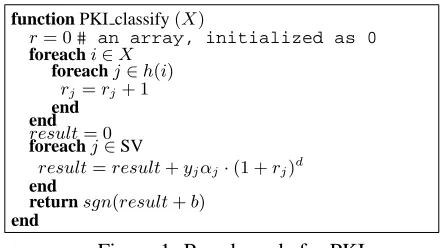
function PKI classify(X)
r= 0# an array, initialized as 0
foreachi∈X
foreachj∈h(i)
rj=rj+ 1
end end
result= 0
foreachj∈SV
result=result+yjαj·(1 +rj)d
end
returnsgn(result+b)
[image:3.595.311.532.70.194.2]end
Figure 1: Pseudo code for PKI
K2(X, Y) = 1·1 + 3·3 + 2·3 = 16,
K3(X, Y) = 1·1 + 7·3 + 12·3 + 6·1 = 64.
4 Fast Classifiers for Polynomial Kernel
In this section, we introduce two fast classification algorithms for the Polynomial Kernel of degreed.
Before describing them, we give the baseline clas-sifier (PKB):
y(X) = sgn³ X j∈SV
yjαj·(1 +|Xj∩X|)d+b
´
. (5)
The complexity of PKB is O(|X| · |SV|), since it takesO(|X|)to calculate(1 +|Xj∩X|)dand there
are a total of|SV|support examples.
4.1 PKI (Inverted Representation)
Given an item i ∈ F, if we know in advance the set of support examples which contain itemi ∈ F, we do not need to calculate|Xj∩X|for all support
examples. This is a naive extension of Inverted
In-dexing in Information Retrieval. Figure 1 shows the
pseudo code of the algorithm PKI. The functionh(i) is a pre-compiled table and returns a set of support examples which contain itemi.
The complexity of the PKI isO(|X| ·B+|SV|), whereB is an average of|h(i)|over all itemi∈F. The PKI can make the classification speed drasti-cally faster whenB is small, in other words, when feature space is relatively sparse (i.e.,B ¿ |SV|). The feature space is often sparse in many tasks in NLP, since lexical entries are used as features.
4.2 PKE (Expanded Representation)
4.2.1 Basic Idea of PKE
Using Lemma 1, we can represent the decision function (5) in an explicit form:
y(X) = sgn³ X
j∈SV
yjαj ¡Xd
r=0
cd(r)· |Pr(Xj∩X)| ¢
+b
´
. (6)
If we, in advance, calculate
w(s) = X j∈SV
yjαjcd(|s|)I(s∈P|s|(Xj))
(whereI(t)is an indicator function2) for all subsets s∈Sdr=0Pr(F), (6) can be written as the following simple linear form:
y(X) = sgn³ X s∈Γd(X)
w(s) +b´. (7)
whereΓd(X) =Sdr=0Pr(X).
The classification algorithm given by (7) will be referred to as PKE. The complexity of PKE is O(|Γd(X)|) = O(|X|d), independent on the
num-ber of support examples|SV|.
4.2.2 Mining Approach to PKE
To apply the PKE, we first calculate|Γd(F)|
de-gree of vectors
w= (w(s1), w(s2), . . . , w(s|Γd(F)|)).
This calculation is trivial only when we use a Quadratic Kernel, since we just project the origi-nal feature space F into F × F space, which is small enough to be calculated by a naive exhaustive method. However, if we, for instance, use a poly-nomial kernel of degree 3 or higher, this calculation becomes not trivial, since the size of feature space exponentially increases. Here we take the following strategy:
1. Instead of using the original vectorw, we use w0, an approximation ofw.
2. We apply the Subset Mining algorithm to cal-culatew0efficiently.
2I(t)
returns 1 iftis true,returns 0 otherwise.
Definition 2 w0: An approximation ofw
An approximation of w is given by w0 = (w0(s
1), w0(s2), . . . , w0(s|Γd(F)|)), where w
0(s) is
set to 0 ifw(s)is trivially close to 0. (i.e., σneg <
w(s)< σpos(σneg<0, σpos>0), whereσposand
σnegare predefined thresholds).
The algorithm PKE is an approximation of the PKB, and changes the final accuracy according to the selection of thresholdsσpos andσneg. The
cal-culation ofw0is formulated as the following mining problem:
Definition 3 Feature Combination Mining Given a set of support examples and subset weight
cd(r), extract all subsetssand their weightsw(s)if
w(s)holdsw(s)≥σposorw(s)≤σneg.
In this paper, we apply a Sub-Structure Mining algorithm to the feature combination mining prob-lem. Generally speaking, sub-structures mining al-gorithms efficiently extract frequent sub-structures (e.g., subsets, sequences, trees, or sub-graphs) from a large database (set of transactions). In this context, frequent means that there are no less than ξ transactions which contain a sub-structure. The parameterξ is usually referred to as the
Mini-mum Support. Since we must enumerate all subsets
ofF, we can apply subset mining algorithm, in some times called as Basket Mining algorithm, to our task. There are many subset mining algorithms pro-posed, however, we will focus on the PrefixSpan al-gorithm, which is an efficient algorithm for sequen-tial pattern mining, originally proposed by (Pei et al., 2001). The PrefixSpan was originally designed to extract frequent sub-sequence (not subset) pat-terns, however, it is a trivial difference since a set can be seen as a special case of sequences (i.e., by sorting items in a set by lexicographic order, the set becomes a sequence). The basic idea of the PrefixS-pan is to divide the database by frequent sub-patterns (prefix) and to grow the prefix-spanning pattern in a depth-first search fashion.
We now modify the PrefixSpan to suit to our fea-ture combination mining.
• size constraint
• Subset weightcd(r)
In the original PrefixSpan, the frequency of each subset does not change by its size. How-ever, in our mining task, it changes (i.e., the frequency of subsets is weighted bycd(|s|)).
Here, we process the mining algorithm by assuming that each transaction (support ex-ample Xj) has its frequency Cdyjαj, where
Cd = max(cd(1), cd(2), . . . , cd(d)). The weightw(s) is calculated by w(s) = ω(s)×
cd(|s|)/Cd, where ω(s) is a frequency of s,
given by the original PrefixSpan.
• Positive/Negative support examples
We first divide the support examples into posi-tive (yi > 0) and negative (yi < 0) examples,
and process mining independently. The result can be obtained by merging these two results.
• Minimum Supportsσpos, σneg
In the original PrefixSpan, minimum support is an integer. In our mining task, we can give a real number to minimum support, since each transaction (support exampleXj) has possibly
non-integer frequencyCdyjαj. Minimum
sup-portsσpos andσnegcontrol the rate of
approx-imation. For the sake of convenience, we just give one parameterσ, and calculate σpos and
σnegas follows
σpos = σ·³#of positive examples #of support examples
´
,
σneg = −σ·
³#of negative examples
#of support examples
´
.
After the process of mining, a set of tuplesΩ =
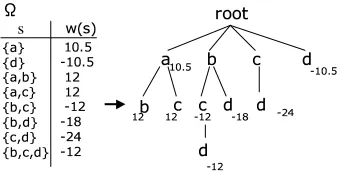
{hs, w(s)i}is obtained, wheresis a frequent subset andw(s)is its weight. We use a TRIE to efficiently store the setΩ. The example of such TRIE compres-sion is shown in Figure 2. Although there are many implementations for TRIE, we use a Double-Array (Aoe, 1989) in our task. The actual classification of PKE can be examined by traversing the TRIE for all subsetss∈Γd(X).
5 Experiments
To demonstrate performances of PKI and PKE, we examined three NLP tasks: English BaseNP Chunk-ing (EBC), Japanese Word Segmentation (JWS) and
!#"$"&%
'(#)*
'+,'-+
.
'-(#)*
.
+-/
.
'0
.
'-+
.
'-+
s
[image:5.595.342.512.74.160.2]1
Figure 2:Ωin TRIE representation
Japanese Dependency Parsing (JDP). A more de-tailed description of each task, training and test data, the system parameters, and feature sets are presented in the following subsections. Table 1 summarizes the detail information of support examples (e.g., size of SVs, size of feature set etc.).
Our preliminary experiments show that a Quadratic Kernel performs the best in EBC, and a Cubic Kernel performs the best in JWS and JDP. The experiments using a Cubic Kernel are suitable to evaluate the effectiveness of the basket mining approach applied in the PKE, since a Cubic Kernel projects the original feature spaceF intoF3 space, which is too large to be handled only using a naive exhaustive method.
All experiments were conducted under Linux us-ing XEON 2.4 Ghz dual processors and 3.5 Gbyte of main memory. All systems are implemented in C++.
5.1 English BaseNP Chunking (EBC)
Text Chunking is a fundamental task in NLP – divid-ing sentences into non-overlappdivid-ing phrases. BaseNP chunking deals with a part of this task and recog-nizes the chunks that form noun phrases. Here is an example sentence:
[He] reckons [the current account deficit] will narrow to [only $ 1.8 billion] .
A BaseNP chunk is represented as sequence of words between square brackets. BaseNP chunking task is usually formulated as a simple tagging task, where we represent chunks with three types of tags:
B: beginning of a chunk. I: non-initial word. O:
5.2 Japanese Word Segmentation (JWS)
Since there are no explicit spaces between words in Japanese sentences, we must first identify the word boundaries before analyzing deep structure of a sen-tence. Japanese word segmentation is formalized as a simple classification task.
Let s = c1c2· · ·cm be a sequence of Japanese
characters,t=t1t2· · ·tmbe a sequence of Japanese
character types 3 associated with each character, andyi ∈ {+1,−1}, (i = (1,2, . . . , m−1)) be a
boundary marker. If there is a boundary betweenci
andci+1, yi = 1, otherwiseyi = −1. The feature
set of examplexi is given by all characters as well
as character types in some constant window (e.g., 5):
{ci−2, ci−1,· · ·, ci+2, ci+3, ti−2, ti−1,· · ·, ti+2, ti+3}. Note that we distinguish the relative position of each character and character type. We use the Kyoto University Corpus (Kurohashi and Nagao, 1997), 7,958 sentences in the articles on January 1st to January 7th are used as training data, and 1,246 sentences in the articles on January 9th are used as the test data.
5.3 Japanese Dependency Parsing (JDP)
The task of Japanese dependency parsing is to iden-tify a correct dependency of each Bunsetsu (base phrase in Japanese). In previous research, we pre-sented a state-of-the-art SVMs-based Japanese de-pendency parser (Kudo and Matsumoto, 2002). We combined SVMs into an efficient parsing algorithm,
Cascaded Chunking Model, which parses a sentence
deterministically only by deciding whether the cur-rent chunk modifies the chunk on its immediate right hand side. The input for this algorithm consists of a set of the linguistic features related to the head and modifier (e.g., word, part-of-speech, and inflec-tions), and the output from the algorithm is either of the value +1 (dependent) or -1 (independent). We use a standard data set, which is the same corpus de-scribed in the Japanese Word Segmentation.
3Usually, in Japanese, word boundaries are highly
con-strained by character types, such as hiragana and katakana (both are phonetic characters in Japanese), Chinese characters, English alphabets and numbers.
5.4 Results
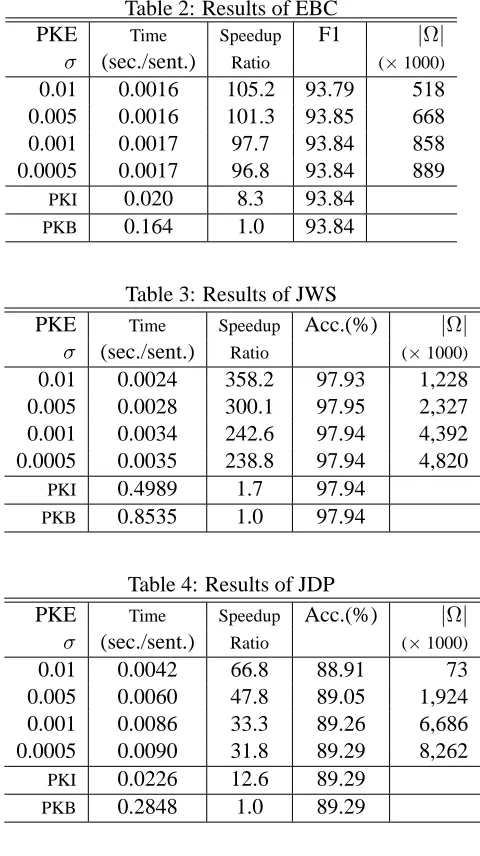
Tables 2, 3 and 4 show the execution time, accu-racy4, and|Ω|(size of extracted subsets), by chang-ingσfrom 0.01 to 0.0005.
The PKI leads to about 2 to 12 times improve-ments over the PKB. In JDP, the improvement is sig-nificant. This is becauseB, the average ofh(i)over all itemsi∈ F, is relatively small in JDP. The im-provement significantly depends on the sparsity of the given support examples.
The improvements of the PKE are more signifi-cant than the PKI. The running time of the PKE is 30 to 300 times faster than the PKB, when we set an appropriateσ, (e.g.,σ = 0.005for EBC and JWS, σ = 0.0005for JDP). In these settings, we could preserve the final accuracies for test data.
5.5 Frequency-based Pruning
The PKE with a Cubic Kernel tends to makeΩlarge (e.g.,|Ω| = 2.32million for JWS,|Ω|= 8.26 mil-lion for JDP).
To reduce the size of Ω, we examined sim-ple frequency-based pruning experiments. Our ex-tension is to simply give a prior threshold ξ(=
1,2,3,4. . .), and erase all subsets which occur in less thanξsupport examples. The calculation of fre-quency can be similarly conducted by the
PrefixS-pan algorithm. Tables 5 and 6 show the results of
frequency-based pruning, when we fixσ=0.005for JWS, andσ=0.0005for JDP.
In JDP, we can make the size of setΩabout one third of the original size. This reduction gives us not only a slight speed increase but an improvement of accuracy (89.29%→89.34%). Frequency-based pruning allows us to remove subsets that have large weight and small frequency. Such subsets may be generated from errors or special outliers in the train-ing examples, which sometimes cause an overfitttrain-ing in training.
In JWS, the frequency-based pruning does not work well. Although we can reduce the size of Ω by half, the accuracy is also reduced (97.94%→97.83%). It implies that, in JWS, features even with frequency of one contribute to the final de-cision hyperplane.
4
Table 1: Details of Data Set
Data Set EBC JWS JDP
# of examples 135,692 265,413 110,355
|SV|# of SVs 11,690 57,672 34,996
# of positive SVs 5,637 28,440 17,528
# of negative SVs 6,053 29,232 17,468
|F|(size of feature) 17,470 11,643 28,157
Avg. of|Xj| 11.90 11.73 17.63
B(Avg. of|h(i)|)) 7.74 58.13 21.92
(Note: In EBC, to handleK-class problems, we use a pairwise
classification; buildingK×(K−1)/2classifiers considering all pairs of classes, and final class decision was given by majority voting. The values in this column are averages over all pairwise classifiers.)
6 Discussion
There have been several studies for efficient classi-fication of SVMs. Isozaki et al. propose an XQK (eXpand the Quadratic Kernel) which can make their Named-Entity recognizer drastically fast (Isozaki and Kazawa, 2002). XQK can be subsumed into PKE. Both XQK and PKE share the basic idea; all feature combinations are explicitly expanded and we convert the kernel-based classifier into a simple lin-ear classifier.
The explicit difference between XQK and PKE is that XQK is designed only for Quadratic Kernel. It implies that XQK can only deal with feature com-bination of size up to two. On the other hand, PKE is more general and can also be applied not only to the Quadratic Kernel but also to the general-style of polynomial kernels(1 +|X∩Y|)d. In PKE, there are no theoretical constrains to limit the size of com-binations.
In addition, Isozaki et al. did not mention how to expand the feature combinations. They seem to use a naive exhaustive method to expand them, which is not always scalable and efficient for extracting three or more feature combinations. PKE takes a basket mining approach to enumerating effective feature combinations more efficiently than their exhaustive method.
7 Conclusion and Future Works
We focused on a Polynomial Kernel of degree d, which has been widely applied in many tasks in NLP
Table 2: Results of EBC
PKE Time Speedup F1 |Ω|
σ (sec./sent.) Ratio (×1000)
0.01 0.0016 105.2 93.79 518 0.005 0.0016 101.3 93.85 668 0.001 0.0017 97.7 93.84 858 0.0005 0.0017 96.8 93.84 889
PKI 0.020 8.3 93.84
PKB 0.164 1.0 93.84
Table 3: Results of JWS
PKE Time Speedup Acc.(%) |Ω|
σ (sec./sent.) Ratio (×1000)
0.01 0.0024 358.2 97.93 1,228 0.005 0.0028 300.1 97.95 2,327 0.001 0.0034 242.6 97.94 4,392 0.0005 0.0035 238.8 97.94 4,820
PKI 0.4989 1.7 97.94
PKB 0.8535 1.0 97.94
Table 4: Results of JDP
PKE Time Speedup Acc.(%) |Ω|
σ (sec./sent.) Ratio (×1000)
0.01 0.0042 66.8 88.91 73
0.005 0.0060 47.8 89.05 1,924 0.001 0.0086 33.3 89.26 6,686 0.0005 0.0090 31.8 89.29 8,262
PKI 0.0226 12.6 89.29
PKB 0.2848 1.0 89.29
Table 5: Frequency-based pruning (JWS)
PKE time Speedup Acc.(%) |Ω|
ξ (sec./sent.) Ratio (×1000)
1 0.0028 300.1 97.95 2,327
2 0.0025 337.3 97.83 954
3 0.0023 367.0 97.83 591
PKB 0.8535 1.0 97.94
Table 6: Frequency-based pruning (JDP)
PKE time Speedup Acc.(%) |Ω|
ξ (sec./sent.) Ratio (×1000)
1 0.0090 31.8 89.29 8,262
2 0.0072 39.3 89.34 2,450
3 0.0068 41.8 89.31 1,360
[image:7.595.73.302.82.204.2]and can attain feature combination that is crucial to improving the performance of tasks in NLP. Then, we introduced two fast classification algorithms for this kernel. One is PKI (Polynomial Kernel In-verted), which is an extension of Inverted Index. The other is PKE (Polynomial Kernel Expanded), where all feature combinations are explicitly expanded.
The concept in PKE can also be applicable to ker-nels for discrete data structures, such as String Ker-nel (Lodhi et al., 2002) and Tree KerKer-nel (Kashima and Koyanagi, 2002; Collins and Duffy, 2001). For instance, Tree Kernel gives a dot product of an ordered-tree, and maps the original ordered-tree onto its all sub-tree space. To apply the PKE, we must efficiently enumerate the effective sub-trees from a set of support examples. We can similarly apply a sub-tree mining algorithm (Zaki, 2002) to this problem.
Appendix A.: Lemma 1 and its proof
cd(r) = d X l=r µ d l
¶³Xr
m=0
(−1)r−m·ml
µ r m ¶´ . Proof.
LetX, Y be subsets ofF ={1,2, . . . , N}. In this case,|X∩
Y|is same as the dot product of vectorx,y, where
x={x1, x2, . . . , xN}, y={y1, y2, . . . , yN}
(xj, yj∈ {0,1})
xj= 1ifj∈X,xj= 0otherwise.
(1 +|X∩Y|)d= (1 +x·y)d
can be expanded as follows
(1 +x·y)d = d X l=0 µ d l
¶³XN
j=1
xjyj ´l = d X l=0 µ d l 
·τ(l)
where
τ(l) =
k1+...+kXN=l
kn≥0
l!
k1!. . . kN!(x1y1) k1. . .(x
NyN)kN.
Note that xkj
j is binary (i.e., x kj
j ∈ {0,1}), the
num-ber of r-size subsets can be given by a coefficient of
(x1y1x2y2. . . xryr). Thus,
cd(r) = d X l=r µ d l
¶µ k1+...+kXr=l
kn≥1,n=1,2,...,r
l!
k1!. . . kr! ¶ = d X l=r µ d l ¶µ
rl−
µ
r
1

(r−1)l+
µ
r
2

(r−2)l−. . .
¶ = d X l=r µ d l
¶³Xr
m=0
(−1)r−m·ml
µ r m ¶´ . 2 References
Junichi Aoe. 1989. An efficient digital search algorithm by us-ing a double-array structure. IEEE Transactions on Software
Engineering, 15(9).
Michael Collins and Nigel Duffy. 2001. Convolution kernels for natural language. In Advances in Neural Information
Processing Systems 14, Vol.1 (NIPS 2001), pages 625–632.
Hideki Isozaki and Hideto Kazawa. 2002. Efficient support vector classifiers for named entity recognition. In
Proceed-ings of the COLING-2002, pages 390–396.
Hisashi Kashima and Teruo Koyanagi. 2002. Svm kernels for semi-structured data. In Proceedings of the ICML-2002, pages 291–298.
Taku Kudo and Yuji Matsumoto. 2000. Japanese Dependency Structure Analysis based on Support Vector Machines. In
Proceedings of the EMNLP/VLC-2000, pages 18–25.
Taku Kudo and Yuji Matsumoto. 2001. Chunking with support vector machines. In Proceedings of the the NAACL, pages 192–199.
Taku Kudo and Yuji Matsumoto. 2002. Japanese dependency analyisis using cascaded chunking. In Proceedings of the
CoNLL-2002, pages 63–69.
Sadao Kurohashi and Makoto Nagao. 1997. Kyoto University text corpus project. In Proceedings of the ANLP-1997, pages 115–118.
Huma Lodhi, Craig Saunders, John Shawe-Taylor, Nello Cris-tianini, and Chris Watkins. 2002. Text classification using string kernels. Journal of Machine Learning Research, 2.
Tetsuji Nakagawa, Taku Kudo, and Yuji Matsumoto. 2002. Re-vision learning and its application to part-of-speech tagging. In Proceedings of the ACL 2002, pages 497–504.
Jian Pei, Jiawei Han, and et al. 2001. Prefixspan: Mining sequential patterns by prefix-projected growth. In Proc. of
International Conference of Data Engineering, pages 215–
224.
Lance A. Ramshaw and Mitchell P. Marcus. 1995. Text chunk-ing uschunk-ing transformation-based learnchunk-ing. In Proceedchunk-ings of
the VLC, pages 88–94.
Vladimir N. Vapnik. 1995. The Nature of Statistical Learning
Theory. Springer.
Mohammed Zaki. 2002. Efficiently mining frequent trees in a forest. In Proceedings of the 8th International Conference
on Knowledge Discovery and Data Mining KDD, pages 71–