Automatic Labelling of Topic Models Learned from Twitter by
Summarisation
Amparo Elizabeth Cano Basave† Yulan He‡ Ruifeng Xu§ †Knowledge Media Institute, Open University, UK
‡School of Engineering and Applied Science, Aston University, UK §Key Laboratory of Network Oriented Intelligent Computation Shenzhen Graduate School, Harbin Institute of Technology, China
[email protected], [email protected], [email protected]
Abstract
Latent topics derived by topic models such as Latent Dirichlet Allocation (LDA) are the result of hidden thematic structures which provide further insights into the data. The automatic labelling of such topics derived from social media poses however new challenges since topics may characterise novel events happening in the real world. Existing automatic topic la-belling approaches which depend on exter-nal knowledge sources become less appli-cable here since relevant articles/concepts of the extracted topics may not exist in ex-ternal sources. In this paper we propose to address the problem of automatic la-belling of latent topics learned from Twit-ter as a summarisation problem. We in-troduce a framework which apply sum-marisation algorithms to generate topic la-bels. These algorithms are independent of external sources and only rely on the identification of dominant terms in doc-uments related to the latent topic. We compare the efficiency of existing state of the art summarisation algorithms. Our results suggest that summarisation algo-rithms generate better topic labels which capture event-related context compared to the top-nterms returned by LDA.
1 Introduction
Topic model based algorithms applied to social media data have become a mainstream technique in performing various tasks including sentiment analysis (He, 2012) and event detection (Zhao et al., 2012; Diao et al., 2012). However, one of the main challenges is the task of understanding the semantics of a topic. This task has been ap-proached by investigating methodologies for iden-tifying meaningful topics through semantic
coher-ence (Aletras and Stevenson, 2013; Mimno et al., 2011; Newman et al., 2010) and for characterising the semantic content of a topic through automatic labelling techniques (Hulpus et al., 2013; Lau et al., 2011; Mei et al., 2007). In this paper we focus on the latter.
Our research task of automatic labelling a topic consists on selecting a set of words that best de-scribes the semantics of the terms involved in this topic. The most generic approach to automatic la-belling has been to use as primitive labels the
top-nwords in a topic distribution learned by a topic model such as LDA (Griffiths and Steyvers, 2004; Blei et al., 2003). Such top words are usually ranked using the marginal probabilities P(wi|tj)
associated with each wordwifor a given topictj.
This task can be illustrated by considering the fol-lowing topic derived from social media related to Education:
school protest student fee choic motherlod tuition teacher anger polic
where the top 10 words ranked by P(wi|tj) for
this topic are listed. Therefore the task is to find the top-n terms which are more representative of the given topic. In this example, the topic certainly relates to a student protest as revealed by the top 3 terms which can be used as a good label for this topic.
However previous work has shown that top terms are not enough for interpreting the coherent meaning of a topic (Mei et al., 2007). More re-cent approaches have explored the use of external sources (e.g. Wikipedia, WordNet) for supporting the automatic labelling of topics by deriving can-didate labels by means of lexical (Lau et al., 2011; Magatti et al., 2009; Mei et al., 2007) or graph-based (Hulpus et al., 2013) algorithms applied on these sources.
Mei et al. (2007) proposed an unsupervised probabilistic methodology to automatically assign a label to a topic model. Their proposed approach
was defined as an optimisation problem involving the minimisation of the KL divergence between a given topic and the candidate labels while max-imising the mutual information between these two word distributions. Lau et al. (2010) proposed to label topics by selecting top-n terms to label the overall topic based on different ranking mecha-nisms including pointwise mutual information and conditional probabilities.
Methods relying on external sources for auto-matic labelling of topics include the work by Ma-gatti et al. (2009) which derived candidate topic labels for topics induced by LDA using the hi-erarchy obtained from the Google Directory ser-vice and expanded through the use of the OpenOf-fice English Thesaurus. Lau et al. (2011) gen-erated label candidates for a topic based on top-ranking topic terms and titles of Wikipedia arti-cles. They then built a Support Vector Regres-sion (SVR) model for ranking the label candidates. More recently, Hulpus et al. (2013) proposed to make use of a structured data source (DBpedia) and employed graph centrality measures to gener-ate semantic concept labels which can characterise the content of a topic.
Most previous topic labelling approaches focus on topics derived from well formatted and static documents. However in contrast to this type of content, the labelling of topics derived from tweets presents different challenges. In nature microp-ost content is sparse and present ill-formed words. Moreover, the use of Twitter as the “what’s-happening-right now” tool, introduces new event-dependent relations between words which might not have a counter part in existing knowledge sources (e.g. Wikipedia). Our original interest in labelling topics stems from work in topic model based event extraction from social media, in par-ticular from tweets (Shen et al., 2013; Diao et al., 2012). As opposed to previous approaches, the research presented in this paper addresses the labelling of topics exposing event-related content that might not have a counter part on existing ex-ternal sources. Based on the observation that a short summary of a collection of documents can serve as a label characterising the collection, we propose to generate topic label candidates based on the summarisation of a topic’s relevant docu-ments. Our contributions are two-fold:
- We propose a novel approach for topics la-belling that relies on term relevance of documents
relating to a topic; and
- We show that summarisation algorithms, which are independent of extenal sources, can be used with success to label topics, presenting a higher perfomance than the top-nterms baseline.
2 Methodology
We propose to approach the topic labelling prob-lem as a multi-document summarisation task. The following describes our proposed framework to characterise documents relevant to a topic.
2.1 Preliminaries
Given a set of documents the problem to be solved by topic modelling is the posterior inference of the variables, which determine the hidden thematic structures that best explain an observed set of doc-uments. Focusing on the Latent Dirichlet Alloca-tion (LDA) model (Blei et al., 2003; Griffiths and Steyvers, 2004), let Dbe a corpus of documents denoted asD={d1,d2, ..,dD}; where each
doc-ument consists of a sequence ofNdwords denoted
by d = (w1, w2, .., wNd); and each word in a
document is an item from a vocabulary index of
V different terms denoted by{1,2, .., V}. Given
Ddocuments containingK topics expressed over
V unique words, LDA generative process is de-scribed as follows:
- For each topic k ∈ {1, ...K} draw φk ∼
Dirichlet(β),
- For each documentd∈ {1..D}:
?drawθd∼Dirichlet(α);
?For each wordn∈ {1..Nd}in documentd: ◦draw a topiczd,n∼Multinomial(θd); ◦draw a wordwd,n∼Multinomial(ϕzd,n).
where φk is the word distribution for topic k,
and θd is the distribution of topics in document
d. Topics are interpreted using the top N terms ranked based on the marginal probabilityp(wi|tj).
2.2 Automatic Labelling of Topic Models
Given K topics over the document collection D, the topic labelling task consists on discovering a sequence of words for each topick ∈ K. We pro-pose to generate topic label candidates by sum-marising topic relevant documents. Such docu-ments can be derived using both the observed data from the corpus D and the inferred topic model variables. In particular, the prominent topic of a documentdcan be found by
kd= arg max
Therefore given a topic k, a set of C documents related to this topic can be obtained via equation 1.
Given the set of documentsCrelevant to topick, we proposed to generate a label of a desired length
xfrom the summarisation ofC.
2.3 Topic Labelling by Summarisation
We compare different summarisation algorithms based on their ability to provide a good label to a given topic. In particular we investigate the use of lexical features by comparing three different well-known multi-document summarisation algorithms against the top-ntopic terms baseline. These al-gorithms include:
Sum Basic (SB) This is a frequency based sum-marisation algorithm (Nenkova and Vanderwende, 2005), which computes initial word probabilities for words in a text. It then weights each sen-tence in the text (in our case a micropost) by computing the average probability of the words in the sentence. In each iteration it picks the high-est weighted document and from it the highhigh-est weighted word. It uses an update function which penalises words which have already been picked.
Hybrid TFIDF (TFIDF) It is similar to SB, however rather than computing the initial word probabilities based on word frequencies it weights terms based on TFIDF. In this case the document frequency is computed as the number of times a word appears in a micropost from the collection
C. Following the same procedure asSBit returns the topxweighted terms.
Maximal Marginal Relevance (MMR) This is a relevance based ranking algorithm (Carbonell and Goldstein, 1998), which avoids redundancy in the documents used for generating a summary. It mea-sures the degree of dissimilarity between the docu-ments considered and previously selected ones al-ready in the ranked list.
Text Rank (TR) This is a graph-based sum-mariser method (Mihalcea and Tarau, 2004) where each word is a vertex. The relevance of a vertex (term) to the graph is computed based on global information recursively drawn from the whole graph. It uses the PageRank algorithm (Brin and Page, 1998) to recursively change the weight of the vertices. The final score of a word is there-fore not only dependent on the terms immediately connected to it but also on how these terms
con-nect to others. To assign the weight of an edge between two terms, TextRank computes word co-occurrence in windows of N words (in our case
N = 10). Once a final score is calculated for each vertex of the graph, TextRank sorts the terms in a reverse order and provided the topT vertices in the ranking. Each of these algorithms produces a label of a desired lengthxfor a given topick.
3 Experimental Setup
3.1 Dataset
Our Twitter Corpus (TW) was collected between November 2010 and January 2011. TWcomprises over 1 million tweets. We used the OpenCalais’ document categorisation service1to generate
cate-gorical sets. In particular, we considered four dif-ferent categories which contain many real-world events, namely: War and Conflict (War), Disaster and Accident (DisAc), Education (Edu) and Law and Crime (LawCri). The finalTWdataset after removing retweets and short microposts (less than 5 words after removing stopwords) contains 7000 tweets in each category.
We preprocessed TW by first removing: punc-tuation, numbers, non-alphabet characters, stop words, user mentions, and URL links. We then performed Porter stemming (Porter, 1980) in order to reduce the vocabulary size. Finally to address the issue of data sparseness in theTWdataset, we removed words with a frequency lower than 5.
3.2 Generating the Gold Standard
Evaluation of automatic topic labelling often re-lied on human assessment which requires heavy manual effort (Lau et al., 2011; Hulpus et al., 2013). However performing human evaluations of Social Media test sets comprising thousands of in-puts become a difficult task. This is due to both the corpus size, the diversity of event-related top-ics and the limited availability of domain experts. To alleviate this issue here, we followed the distri-bution similarity approach, which has been widely applied in the automatic generation of gold stan-dards (GSs) for summary evaluations (Donaway et al., 2000; Lin et al., 2006; Louis and Nenkova, 2009; Louis and Nenkova, 2013). This approach compares two corpora, one for which noGSlabels exist, against a reference corpus for which a GS exists. In our case these corpora correspond to the TWand a Newswire dataset (NW). Since previous
research has shown that headlines are good indi-cators of the main focus of a text, both in struc-ture and content, and that they can act as a human produced abstract (Nenkova, 2005), we used head-lines as the GS labels ofNW.
The News Corpus (NW) was collected during the same period of time as the TW corpus. NW consists of a collection of news articles crawled from traditional news media (BBC, CNN, and New York Times) comprising over 77,000 articles which include supplemental metadata (e.g. head-line, author, publishing date). We also used the OpenCalais’ document categorisation service to automatically label news articles and considered the same four topical categories, (War, DisAc, EduandLawCri). The same preprocessing steps were performed onNW.
Therefore, following a similarity alignment ap-proach we performed the steps oulined in Algo-rithm 1 for generating theGStopic labels of a topic inTW.
Algorithm 1GSfor Topic Labels
Input: LDA topics forTW, and the LDA topics forNWfor categoryc.
Output: Gold standard topic label for each of the LDA top-ics forTW.
1: foreach topici∈ {1,2, ...,100}fromTWdo
2: foreach topicj∈ {1,2...,100}fromNWdo
3: Compute the Cosine similarity between word dis-tributions of topictiand topictj.
4: end for
5: Select topicjwhich has the highest similarity toiand whose similarity measure is greater than a threshold (in this case 0.7)
6: end for
7: foreach of the extracted topic pairs(ti−tj)do 8: Collect relevant news articlesCj
NW of topictjfrom theNWset.
9: Extract the headlines of news articles fromCNWj and select the topxmost frequent words as the gold stan-dard label for topictiin theTWset
10: end for
These steps can be outlined as follows:1) We ran LDA onTWandNWseparately for each cate-gory with the number of topics set to 100; 2) We then aligned the Twitter topics and Newswire top-ics by the similarity measurement of word distri-butions of these topics (Ercan and Cicekli, 2008; Haghighi and Vanderwende, 2009; Wang et al., 2009; Delort and Alfonseca, 2012); 3) Finally to generate the GS label for each aligned topic pair (ti −tj), we extracted the headlines of the news
articles relevant totj and selected the topx most
frequent words (after stop word removal and stem-ming). The generated label was used as the gold
standard label for the corresponding Twitter topic
tiin the topic pair.
4 Experimental Results
We compared the results of the summarisation techniques with the top terms (TT) of a topic as our baseline. These TT set corresponds to the top x terms ranked based on the probability of the word given the topic (p(w|k)) from the topic model. We evaluated these summarisation ap-proaches with the ROUGE-1 method (Lin, 2004), a widely used summarisation evaluation metric that correlates well with human evaluation (Liu and Liu, 2008). This method measures the over-lap of words between the generated summary and a reference, in our case theGSgenerated from the NWdataset.
The evaluation was performed at x =
{1, ..,10}. Figure 1 presents the ROUGE-1 per-formance of the summarisation approaches as the lengthxof the generated topic label increases. We can see in all four categories that the SB and TFIDF approaches provide a better summarisa-tion coverage as the length of the topic label in-creases. In particular, in both the Education and Law & Crime categories, both SB and TFIDFoutperformsTTandTRby a large margin. The obtained ROUGE-1 performance is within the same range of performance previously reported on Social Media summarisation (Inouye and Kalita, 2011; Nichols et al., 2012; Ren et al., 2013).
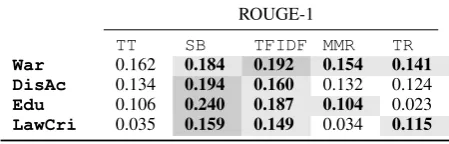
Table 1 presents average results for ROUGE-1 in the four categories. Particularly the SB and TFIDF summarisation techniques consis-tently outperform theTT baseline across all four categories. SBgives the best results in three cate-gories exceptWar.
ROUGE-1
TT SB TFIDF MMR TR
War 0.162 0.184 0.192 0.154 0.141
DisAc 0.134 0.194 0.160 0.132 0.124
Edu 0.106 0.240 0.187 0.104 0.023
[image:4.595.307.532.575.647.2]LawCri 0.035 0.159 0.149 0.034 0.115
Table 1: Average ROUGE-1 for topic labels atx=
{1..10}, generated from theTWdataset.
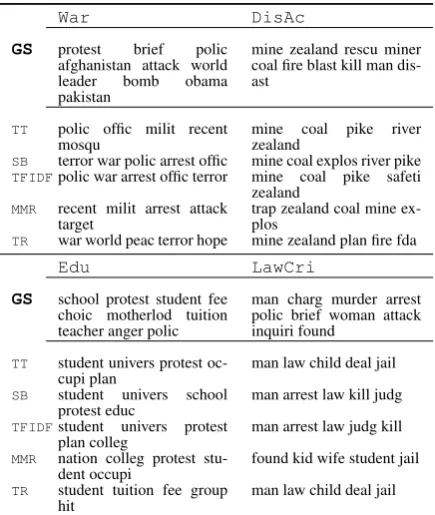
The generated labels with summarisation atx= 5are presented in Table 2, whereGSrepresents the label generated from the Newswire headlines.
0.05 0.10 0.15 0.20 0.25
2.5 5.0 7.5 10.0
x
Rouge
War_Conflict
0.10 0.15 0.20 0.25
2.5 5.0 7.5 10.0
x
Rouge
Disaster_Accident
0.1 0.2
2.5 5.0 7.5 10.0
x
Rouge
Education
0.00 0.05 0.10 0.15 0.20
2.5 5.0 7.5 10.0
x
Rouge
Law_Crime
T
witter T
opics
variable
TT
SB
TFIDF
TR
[image:5.595.82.510.74.172.2]MMR
Figure 1: Performance in ROUGE for Twitter-derived topic labels, wherexis the number of terms in the generated label
which are relevant to the information clustered by the topic. In this way, the labels generated for topics belonging to different categories generally extend the information provided by the top terms. For example in Table 2, the DisAc headline is characteristic of the New Zealand’s Pike River’s coal mine blast accident, which is an event occurred in November 2010.
Although the top 5 terms set from the LDA topic extracted fromTW(listed underTT) does capture relevant information related to the event, it does not provide information regarding the blast. In this sense the topic label generated bySBmore accu-rately describes this event.
We can also notice that theGSlabels generated from Newswire media presented in Table 2 appear on their own, to be good labels for theTWtopics. However as we described in the introduction we want to avoid relaying on external sources for the derivation of topic labels.
This experiment shows that frequency based summarisation techniques outperform graph-based and relevance graph-based summarisation techniques for generating topic labels that im-prove upon the top-terms baseline, without relying on external sources. This is an attractive property for automatically generating topic labels for tweets where their event-related content might not have a counter part on existing external sources.
5 Conclusions and Future Work
In this paper we proposed a novel alternative to topic labelling which do not rely on external data sources. To the best of out knowledge no existing work has been formally studied for automatic la-belling through summarisation. This experiment shows that existing summarisation techniques can be exploited to provide a better label of a topic, extending in this way a topic’s information by
pro-War DisAc
GS protest brief polic
afghanistan attack world
leader bomb obama
pakistan
mine zealand rescu miner coal fire blast kill man dis-ast
TT polic offic milit recent
mosqu mine coal pike riverzealand
SB terror war polic arrest offic mine coal explos river pike
TFIDFpolic war arrest offic terror mine coal pike safeti zealand
MMR recent milit arrest attack
target trap zealand coal mine ex-plos
TR war world peac terror hope mine zealand plan fire fda
Edu LawCri
GS school protest student fee
choic motherlod tuition teacher anger polic
man charg murder arrest polic brief woman attack inquiri found
TT student univers protest
oc-cupi plan man law child deal jail
SB student univers school
protest educ man arrest law kill judg
TFIDFstudent univers protest
plan colleg man arrest law judg kill
MMR nation colleg protest
stu-dent occupi found kid wife student jail
TR student tuition fee group
hit man law child deal jail
Table 2: Labelling examples for topics generated from the TW Dataset. GS represents the gold-standard generated from the relevant Newswire dataset. All terms are Porter stemmed as described in subsection 3.1
viding a richer context than top-terms. These re-sults show that there is room to further improve upon existing summarisation techniques to cater for generating candidate labels.
Acknowledgments
[image:5.595.308.526.239.497.2]References
Nikolaos Aletras and Mark Stevenson. 2013. Evaluat-ing topic coherence usEvaluat-ing distributional semantics. InProceedings of the 10th International Conference on Computational Semantics (IWCS 2013) – Long
Papers, pages 13–22, Potsdam, Germany, March.
Association for Computational Linguistics.
David Meir Blei, Andrew Y. Ng, and Michael I. Jordan. 2003. Latent dirichlet allocation. InJ. Mach. Learn. Res. 3, pages 993–1022.
Sergey Brin and Lawrence Page. 1998. The anatomy of a large-scale hypertextual web search engine* 1. In Computer networks and ISDN systems, vol-ume 30, pages 107–117.
Jaime Carbonell and Jade Goldstein. 1998. The use of mmr, diversity-based reranking for reordering docu-ments and producing summaries. InProceedings of the 21st Annual International ACM SIGIR Confer-ence on Research and Development in Information
Retrieval, SIGIR ’98, pages 335–336, New York,
NY, USA. ACM.
Jean-Yves Delort and Enrique Alfonseca. 2012. Dual-sum: A topic-model based approach for update sum-marization. InProceedings of the 13th Conference of the European Chapter of the Association for
Com-putational Linguistics, EACL ’12, pages 214–223,
Stroudsburg, PA, USA. Association for Computa-tional Linguistics.
Qiming Diao, Jing Jiang, Feida Zhu, and Ee-Peng Lim. 2012. Finding bursty topics from microblogs. In
Proceedings of the 50th Annual Meeting of the As-sociation for Computational Linguistics (Volume 1:
Long Papers), pages 536–544, Jeju Island, Korea,
July. Association for Computational Linguistics. Robert L. Donaway, Kevin W. Drummey, and Laura A.
Mather. 2000. A comparison of rankings produced by summarization evaluation measures. In Proceed-ings of the 2000 NAACL-ANLP Workshop on
Au-tomatic Summarization, NAACL-ANLP-AutoSum
’00, pages 69–78, Stroudsburg, PA, USA. Associ-ation for ComputAssoci-ational Linguistics.
Gonenc Ercan and Ilyas Cicekli. 2008. Lexical co-hesion based topic modeling for summarization. In
Proceedings of the 9th International Conference on Computational Linguistics and Intelligent Text
Pro-cessing, CICLing’08, pages 582–592, Berlin,
Hei-delberg. Springer-Verlag.
Thomas L. Griffiths and Mark Steyvers. 2004. Finding scientific topics. PNAS, 101(suppl. 1):5228–5235. Aria Haghighi and Lucy Vanderwende. 2009.
Ex-ploring content models for multi-document summa-rization. InProceedings of Human Language Tech-nologies: The 2009 Annual Conference of the North American Chapter of the Association for
Compu-tational Linguistics, NAACL ’09, pages 362–370,
Stroudsburg, PA, USA. Association for Computa-tional Linguistics.
Yulan He. 2012. Incorporating sentiment prior knowledge for weakly supervised sentiment
analy-sis. ACM Transactions on Asian Language
Infor-mation Processing, 11(2):4:1–4:19, June.
Ioana Hulpus, Conor Hayes, Marcel Karnstedt, and Derek Greene. 2013. Unsupervised graph-based topic labelling using dbpedia. InProceedings of the sixth ACM international conference on Web search
and data mining, WSDM ’13, pages 465–474, New
York, NY, USA. ACM.
David Inouye and Jugal K. Kalita. 2011. Comparing twitter summarization algorithms for multiple post summaries. InSocialCom/PASSAT, pages 298–306. IEEE.
Jey Han Lau, David Newman, Karimi Sarvnaz, and Timothy Baldwin. 2010. Best Topic Word Selec-tion for Topic Labelling.CoLing.
Jey Han Lau, Karl Grieser, David Newman, and Tim-othy Baldwin. 2011. Automatic labelling of topic models. In Proceedings of the 49th Annual Meet-ing of the Association for Computational LMeet-inguis-
Linguis-tics: Human Language Technologies - Volume 1,
HLT ’11, pages 1536–1545, Stroudsburg, PA, USA. Association for Computational Linguistics.
Chin-Yew Lin, Guihong Cao, Jianfeng Gao, and Jian-Yun Nie. 2006. An information-theoretic approach to automatic evaluation of summaries.
In Proceedings of the Main Conference on
Hu-man Language Technology Conference of the North American Chapter of the Association of
Computa-tional Linguistics, HLT-NAACL ’06, pages 463–
470, Stroudsburg, PA, USA. Association for Com-putational Linguistics.
Chin-Yew Lin. 2004. Rouge: A package for auto-matic evaluation of summaries. In Stan Szpakowicz Marie-Francine Moens, editor, Text Summarization Branches Out: Proceedings of the ACL-04 Work-shop, pages 74–81, Barcelona, Spain, July. Associa-tion for ComputaAssocia-tional Linguistics.
Feifan Liu and Yang Liu. 2008. Correlation between rouge and human evaluation of extractive meeting summaries. In Proceedings of the 46th Annual Meeting of the Association for Computational Lin-guistics on Human Language Technologies: Short
Papers, HLT-Short ’08, pages 201–204,
Strouds-burg, PA, USA. Association for Computational Lin-guistics.
Annie Louis and Ani Nenkova. 2009. Automatically evaluating content selection in summarization with-out human models. In Proceedings of the 2009 Conference on Empirical Methods in Natural
Lan-guage Processing: Volume 1 - Volume 1, EMNLP
’09, pages 306–314, Stroudsburg, PA, USA. Associ-ation for ComputAssoci-ational Linguistics.
standard. Computational Linguistics, 39(2):267– 300.
Davide Magatti, Silvia Calegari, Davide Ciucci, and Fabio Stella. 2009. Automatic labeling of top-ics. InProceedings of the 2009 Ninth International Conference on Intelligent Systems Design and
Appli-cations, ISDA ’09, pages 1227–1232, Washington,
DC, USA. IEEE Computer Society.
Qiaozhu Mei, Xuehua Shen, and ChengXiang Zhai. 2007. Automatic labeling of multinomial topic models. InProceedings of the 13th ACM SIGKDD international conference on Knowledge discovery
and data mining, KDD ’07, pages 490–499, New
York, NY, USA. ACM.
Rada Mihalcea and Paul Tarau. 2004. TextRank: Bringing Order into Texts. InConference on
Em-pirical Methods in Natural Language Processing,
EMNLP ’04, pages 404–411, Barcelona, Spain. As-sociation for Computational Linguistics.
David Mimno, Hanna M. Wallach, Edmund Talley, Miriam Leenders, and Andrew McCallum. 2011. Optimizing semantic coherence in topic models. In
Proceedings of the Conference on Empirical
Meth-ods in Natural Language Processing, EMNLP ’11,
pages 262–272, Stroudsburg, PA, USA. Association for Computational Linguistics.
Ani Nenkova and Lucy Vanderwende. 2005. The im-pact of frequency on summarization. Microsoft Re-search, Redmond, Washington, Tech. Rep. MSR-TR-2005-101.
Ani Nenkova. 2005. Automatic text summarization of newswire: Lessons learned from the document un-derstanding conference. InProceedings of the 20th National Conference on Artificial Intelligence -
Vol-ume 3, AAAI’05, pages 1436–1441. AAAI Press.
David Newman, Jey Han Lau, Karl Grieser, and Tim-othy Baldwin. 2010. Automatic evaluation of topic coherence. InHuman Language Technologies: The 2010 Annual Conference of the North American Chapter of the Association for Computational Lin-guistics, HLT ’10, pages 100–108, Stroudsburg, PA, USA. Association for Computational Linguistics. Jeffrey Nichols, Jalal Mahmud, and Clemens Drews.
2012. Summarizing sporting events using twitter. In
Proceedings of the 2012 ACM International Confer-ence on Intelligent User Interfaces, IUI ’12, pages 189–198, New York, NY, USA. ACM.
Martin Porter. 1980. An algorithm for suffix stripping.
Program, 14(3):130–137.
Zhaochun Ren, Shangsong Liang, Edgar Meij, and Maarten de Rijke. 2013. Personalized time-aware tweets summarization. In Proceedings of the 36th International ACM SIGIR Conference on Research
and Development in Information Retrieval, SIGIR
’13, pages 513–522, New York, NY, USA. ACM.
Chao Shen, Fei Liu, Fuliang Weng, and Tao Li. 2013. A participant-based approach for event summariza-tion using twitter streams. In Proceedings of the 49th Annual Meeting of the Association for Com-putational Linguistics: Human Language
Technolo-gies - Volume 1, HLT ’13, Stroudsburg, PA, USA.
Association for Computational Linguistics.
Dingding Wang, Shenghuo Zhu, Tao Li, and Yihong Gong. 2009. Multi-document summarization us-ing sentence-based topic models. In Proceedings
of the ACL-IJCNLP 2009 Conference Short Papers,
ACLShort ’09, pages 297–300, Stroudsburg, PA, USA. Association for Computational Linguistics. Xin Zhao, Baihan Shu, Jing Jiang, Yang Song, Hongfei
Yan, and Xiaoming Li. 2012. Identifying event-related bursts via social media activities. In Pro-ceedings of the 2012 Joint Conference on Empiri-cal Methods in Natural Language Processing and
Computational Natural Language Learning, pages