Empirical Study of Unsupervised Chinese Word Segmentation Methods
for SMT on Large-scale Corpora
Xiaolin Wang Masao Utiyama Andrew Finch Eiichiro Sumita National Institute of Information and Communications Technology
{xiaolin.wang,mutiyama,andrew.finch,eiichiro.sumita}@nict.go.jp
Abstract
Unsupervised word segmentation (UWS) can provide domain-adaptive segmenta-tion for statistical machine translasegmenta-tion (SMT) without annotated data, and bilin-gual UWS can even optimize segmenta-tion for alignment. Monolingual UWS ap-proaches of explicitly modeling the proba-bilities of words through Dirichlet process (DP) models or Pitman-Yor process (PYP) models have achieved high accuracy, but their bilingual counterparts have only been carried out on small corpora such as ba-sic travel expression corpus (BTEC) due to the computational complexity. This paper proposes an efficient unified PYP-based monolingual and bilingual UWS method. Experimental results show that the pro-posed method is comparable to super-vised segmenters on the in-domain NIST OpenMT corpus, and yields a 0.96 BLEU relative increase on NTCIR PatentMT cor-pus which is out-of-domain.
1 Introduction
Many languages, especially Asian languages such as Chinese, Japanese and Myanmar, have no ex-plicit word boundaries, thus word segmentation (WS), that is, segmenting the continuous texts of these languages into isolated words, is a prerequi-site for many natural language processing applica-tions including SMT.
Though supervised-learning approaches which involve training segmenters on manually seg-mented corpora are widely used (Chang et al., 2008), yet the criteria for manually annotat-ing words are arbitrary, and the available anno-tated corpora are limited in both quantity and genre variety. For example, in machine transla-tion, there are various parallel corpora such as
BTEC for tourism-related dialogues (Paul, 2008) and PatentMT in the patent domain (Goto et al., 2011)1, but researchers working on Chinese-related tasks often use the Stanford Chinese seg-menter (Tseng et al., 2005) which is trained on a small amount of annotated news text.
In contrast, UWS, spurred by the findings that infants are able to use statistical cues to determine word boundaries (Saffran et al., 1996), relies on statistical criteria instead of manually crafted stan-dards. UWS learns from unsegmented raw text, which are available in large quantities, and thus it has the potential to provide more accurate and adaptive segmentation than supervised approaches with less development effort being required.
The approaches of explicitly modeling the probability of words(Brent, 1999; Venkataraman, 2001; Goldwater et al., 2006; Goldwater et al., 2009; Mochihashi et al., 2009) significantly out-performed a heuristic approach (Zhao and Kit, 2008) on the monolingual Chinese SIGHAN-MSR corpus (Emerson, 2005), which inspired the work of this paper.
However, bilingual approaches that model word probabilities suffer from computational complex-ity. Xu et al. (2008) proposed a bilingual method by adding alignment into the generative model, but was only able to test it on small-scale BTEC data. Nguyen et al. (2010) used the local best alignment to increase the speed of the Gibbs sampling in training but the impact on accuracy was not ex-plored.
This paper is dedicated to bilingual UWS on large-scale corpora to support SMT. To this end, we model bilingual UWS under a similar frame-work with monolingual UWS in order to improve efficiency, and replace Gibbs sampling with ex-pectation maximization (EM) in training.
We aware that variational bayes (VB) may be used for speeding up the training of DP-based
1http://ntcir.nii.ac.jp/PatentMT
or PYP-based bilingual UWS. However, VB re-quires formulating themexpectations of(m− 1)-dimensional marginal distributions, where m is the number of hidden variables. For UWS, the hidden variables are indicators that identify sub-strings of sentences in the corpus as words. These variables are large in number and it is not clear how to apply VB to UWS, and as far the authors aware there is no previous work related to the ap-plication of VB to monolingual UWS. Therefore, we have not explored VB methods in this paper, but we do show that our method is superior to the existing methods.
The contributions of this paper include,
• state-of-the-art accuracy in monolingual UWS;
• the first bilingual UWS method practical for large corpora;
• improvement of BLEU scores compared to supervised Stanford Chinese word seg-menter.
2 Methods
This section describes our unified monolingual and bilingual UWS scheme. Table 1 lists the main notation. The setF is chosen to represent an un-segmented foreign language sentence (a sequence of characters), because an unsegmented sentence can be seen as the set of all possible segmentations of the sentence denotedF, i.e.F ∈ F.
Notation Meaning
F an unsegmented foreign sentence Fk′
k unsegmented substring of the
un-derlying string ofFfromktok′
F a segmented foreign sentence
fj thej-th foreign word
M monolingual segmentation model
PM(x) probability ofxbeing a word ac-cording toM
E a tokenized English sentence
ei thei-th English word (F,E) a bilingual sentence pair B bilingual segmentation model
PB(x|ei) probability ofxbeing a word ac-cording toBgivenei
Table 1: Main Notation.
Monolingual and bilingual WS can be formu-lated as follows, respectively,
ˆ
F(F) =argmax
F∈F P(F|F,M), (1)
ˆ
F(F, E) =argmax
F∈F
X
a
P(F, a|F, E,B), (2)
whereais an alignment betweenF andE. The English sentenceE is used in the generation of a segmented sentenceF.
UWS learns models by maximizing the likeli-hood of the unsegmented corpus, formulated as,
ˆ
M= argmax
M
Y
F∈F
³ X
F∈F
P(F|M)´, (3)
ˆ
B= argmax
B
Y
(F,E)∈B
³ X
F∈F
X
a
P(F, a|F, E,B)´.
(4)
Our method of learningMandBproceeds in a similar manner to the EM algorithm. The follow-ing two operations are performed iteratively for each sentence (pair).
• Exclude the previous expected counts of the current sentence (pair) from the model, and then derive the current sentence in all pos-sible ways, calculating the new expected counts for the words (see Section 2.1), that is, we calculate the expected probabilities of theFkk′being words given the data excluding F, i.e.EF/{F}(P(Fkk′|F)) =P(Fkk′|F,M) in a similar manner to the marginalization in the Gibbs sampling process which we are re-placing;
• Update the respective modelMorB accord-ing to these expectations (see Section2.2).
2.1 Expectation
2.1.1 Monolingual Expectation
P(Fk′
k |F,M) is the marginal probability of all
the possible F ∈ F that contain Fkk′ as a word, which can be calculated efficiently through dy-namic programming (the process is similar to the foreward-backward algorithm in training a hidden Markov model (HMM) (Rabiner, 1989)):
Pa(k) = U
X
u=1
Pa(k−u)PM(Fkk−u)
Pb(k′) = U
X
u=1
Pb(k′+u)PM(Fkk′′+u)
whereUis the predefined maximum length of for-eign language words, Pa(k) and Pb(k′) are the forward and backward probabilities, respectively. This section uses a unigram model for description convenience, but the method can be extended to
n-gram models.
2.1.2 Bilingual Expectation
P(Fk′
k |F, E,B)is the marginal probability of all
the possibleF ∈ F that containFkk′as a word and are aligned withE, formulated as:
P(Fk′
k |F, E,B) =
X
F∈F Fk′
k ∈F X
a
P(F, a|E,B)
≈ X
F∈F Fjk=Fk′
k X
a J
Y
j=1
P(aj|j, I, J)PB(fj|eaj)
= X
F∈F fjk=Fk′
k
J
Y
j=1
X
a
P(aj|j, I, J)PB(fj|eaj),
(6)
whereJ andI are the number of foreign and En-glish words, respectively, andaj is the position of the English word that is aligned tofj in the align-menta. For the alignment we employ an approx-imation to IBM model 2 (Brown et al., 1993; Och and Ney, 2003) described below.
We define the conditional probability of fj given the corresponding English sentence E and the modelBas:
PB(fj|E) =
X
a
P(aj|j, I, J)PB(fj|eaj) (7)
Then, the previous dynamic programming method can be extended to the bilingual expecta-tion
Pa(k|E) = U
X
u=1
Pa(k−u|E)PB(Fkk−u|E)
Pb(k′|E) = U
X
u=1
Pb(k′+u|E)PB(Fkk′′+u|E)
P(Fk′
k |F, E,B) =Pa(k|E)PB(Fkk′|E)Pb(k′|E).
(8)
Eq. 7 can be rewritten (as in IBM model 2):
PB(fj|E) = I
X
i=1
P∗(i|j, I, J)PB(fj|ei) (9)
P∗(i|j, I, J) = X a:aj=i
P(aj|, j, I, J)
In order to maintain both speed and accuracy, the following window function is adopted
P∗(i|j, I, J)≈P∗(i|k, I, K) =
e−|i−kI/K|/σ |i−kI/K|6δ b/2
λφ eiis empty word
0 otherwise
(10)
where K is the number of characters in F, and thek-th character is the start of the wordfj, since
j andJ are unknown during the computation of dynamic programming. δb is the window size,λφ is the prior probability of an empty English word, andσensures all the items sum to 1.
2.2 Maximization
Inspired by (Teh, 2006; Mochihashi et al., 2009; Neubig et al., 2010; Teh and Jordan, 2010), we employ a Pitman-Yor process model to build the segmentation model Mor B. The monolingual modelMis
PM(fj) =
max¡n(fj)−Pd,0¢+ (θ+d·nM)G0(fj) f′
jn(f
′ j) +θ
nM =¯¯{fj|n(fj)>d}¯¯, (11) wherefj is a foreign language word, andn(fj)is the observed counts offj,θis named the strength parameter, G0(fj)is named the base distribution offj, anddis the discount.
The bilingual model is
PB(fj|ei) =
max¡n(fj, ei)P−d,0¢+ (θ+d·nei)G0(fj|ei)
f′ jn(f
′
j, ei) +θ
nei =¯¯{x|n(x, ei)>d}¯¯. (12) In Eqs. 11 and 12,
n(fj) =
X
F∈F
P(fj|F,M) (13)
n(fj, ei) =
X
(F,E)∈B
P(fj|F, E,B) P
∗(i|j, I, J)PB(fj|ei)
PI
3 Complexity Analysis
The computational complexity of our method is linear in the number of iterations, the size of the corpus, and the complexity of calculating the ex-pectations on each sentence or sentence pair. In practical applications, the size of the corpus is fixed, and we found empirically that the number of iterations required by the proposed method for convergence is usually small (less than five itera-tions). We now look in more detail at the complex-ity of the expectation calculation in monolingual and bilingual models.
The monolingual expectation is calculated ac-cording to Eq. 5; the complexity is linear in the length of sentences and the square of the prede-fined maximum length of words. Thus its overall complexity is
Ounigram
monoling=O(Ni|F|KU2), (15)
whereNiis the number of iterations,Kis the
av-erage number of characters per sentence, andU is the predefined maximum length of words.
For the monolingual bigram model, the number of states in the HMM is U times more than that of the monolingual unigram model, as the states at specific position of F are not only related to the length of the current word, but also related to the length of the word before it. Thus its complexity isU2times the unigram model’s complexity:
Obigram
monoling=O(Ni|F|KU4). (16)
The bilingual expectation is given by Eq. 8, whose complexity is the same as the monolingual case. However, the complexity of calculating the transition probability, in Eqs. 9 and 10, isO(δb). Thus its overall complexity is:
Ounigram
biling =O(Ni|F|KU2δb). (17) 4 Experiments
In this section, the proposed method is first val-idated on monolingual segmentation tasks, and then evaluated in the context of SMT to study whether the translation quality, measured by BLEU, can be improved.
4.1 Experimental Settings
4.1.1 Experimental Corpora
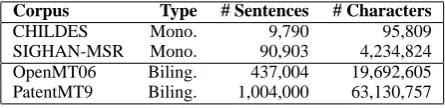
Two monolingual corpora and two bilingual cor-pora are used (Table 2). CHILDES (MacWhin-ney and Snow, 1985) is the most common test
Corpus Type # Sentences # Characters
[image:4.595.307.530.63.117.2]CHILDES Mono. 9,790 95,809 SIGHAN-MSR Mono. 90,903 4,234,824 OpenMT06 Biling. 437,004 19,692,605 PatentMT9 Biling. 1,004,000 63,130,757
Table 2: Experimental Corpora
corpus for UWS methods. The SIGHAN-MSR corpus (Emerson, 2005) consists of manually seg-mented simplified Chinese news text, released in the SIGHAN bakeoff 2005 shared tasks.
The first bilingual corpus: OpenMT06 was used in the NIST open machine translation 2006 Eval-uation 2. We removed the United Nations cor-pus and the traditional Chinese data sets from the constraint training resources. The data sets of NIST Eval 2002 to 2005 were used as the develop-ment for MERT tuning (Och, 2003). This data set mainly consists of news text3. PatentMT9 is from the shared task of NTCIR-9 patent machine trans-lation . The training set consists of 1 million par-allel sentences extracted from patent documents, and the development set and test set both consist of 2000 sentences.
4.1.2 Performance Measurement and Baseline Methods
For the monolingual tasks, the F1 score against the gold annotation is adopted to measure the ac-curacy. The results reported in related papers are listed for comparison.
For the bilingual tasks, the publicly available system of Moses (Koehn et al., 2007) with default settings is employed to perform machine transla-tion, and BLEU (Papineni et al., 2002) was used to evaluate the quality. Character-based segmen-tation, LDC segmenter and Stanford Chinese seg-menters were used as the baseline methods.
4.1.3 Parameter settings
The parameters are tuned on held-out data sets. The maximum length of foreign language words is set to 4. For the PYP model, the base distri-bution adopts the formula in (Chung and Gildea, 2009), and the strength parameter is set to1.0, and the discount is set to1.0×10−6.
For bilingual segmentation,the size of the align-ment window is set to6; the probabilityλφof for-eign language words being generated by an empty
2
http://www.itl.nist.gov/iad/mig/ /tests/mt/2006/
Method Accuracy Time CHILD. MSR CHILD. MSR
NPY(bigram)a 0.750 0.802 17 m – NPY(trigram)a 0.757 0.807 – – HDP(bigram)b 0.723 – 10 h – Fitnessc – 0.667 – – Prop.(unigram) 0.729 0.804 3 s 50 s Prop.(bigram) 0.774 0.806 15 s 2530 s
a
by (Mochihashi et al.,2009); b
by (Goldwater et al.,2009); c
[image:5.595.323.509.59.149.2]by (Zhao and Kit, 2008).
Table 3: Results on Monolingual Corpora.
English word, was set to0.3.
The training was started from assuming that there was no previous segmentations on each sen-tence (pair), and the number of iterations was fixed. It was set to 3 for the monolingual unigram model, and 2 for the bilingual unigram model, which provided slightly higher BLEU scores on the development set than the other settings. The monolingual bigram model, however, was slower to converge, so we started it from the segmenta-tions of the unigram model, and using 10 itera-tions.
4.2 Monolingual Segmentation Results
In monolingual segmentation, the proposed meth-ods with both unigram and bigram models were tested. Experimental results show that they are competitive to state-of-the-art baselines in both ac-curacy and speed (Table 3). Note that the com-parison of speed is only for reference because the times are obtained from their respective papers.
4.3 Bilingual Segmentation Results
Table 4 presents the BLEU scores for Moses using different segmentation methods. Each experiment was performed three times. The proposed method with monolingual bigram model performed poorly on the Chinese monolingual segmentation task; thus, it was not tested. We intended to test (Mochi-hashi et al., 2009), but found it impracticable on large-scale corpora.
The experimental results show that the proposed UWS methods are comparable to the Stanford seg-menters on the OpenMT06 corpus, while achieves a 0.96 BLEU increase on the PatentMT9 corpus. This is because this corpus is out-of-domain for the supervised segmenters. The CTB and PKU Stanford segmenter were both trained on anno-tated news text, which was the major domain of OpenMT06.
Method BLEU
OpenMT06 PatentMT9
[image:5.595.73.295.62.179.2]Character 29.50±0.03 28.36±0.09 LDC 31.33±0.10 30.22±0.14 Stanford(CTB) 31.68±0.25 30.77±0.13 Stanford(PKU) 31.54±0.13 30.86±0.04 Prop.(mono.) 31.47±0.18 31.62±0.06 Prop.(biling.) 31.61±0.14 31.73±0.05
Table 4: Results on Bilingual Corpora.
Method Time
OpenMT06 PatentMT9
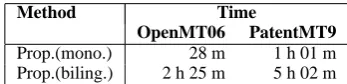
Prop.(mono.) 28 m 1 h 01 m Prop.(biling.) 2 h 25 m 5 h 02 m
Table 5: Time Costs on Bilingual Corpora.
Table 5 presents the run times of the proposed methods on the bilingual corpora. The program is single threaded and implemented in C++. The time cost of the bilingual models is about 5 times that of the monolingual model, which is consistent with the complexity analysis in Section 3.
5 Conclusion
This paper is devoted to large-scale Chinese UWS for SMT. An efficient unified monolingual and bilingual UWS method is proposed and applied to large-scale bilingual corpora.
Complexity analysis shows that our method is capable of scaling to large-scale corpora. This was verified by experiments on a corpus of 1-million sentence pairs on which traditional MCMC ap-proaches would struggle (Xu et al., 2008).
The proposed method does not require any annotated data, but the SMT system with it can achieve comparable performance compared to state-of-the-art supervised word segmenters trained on precious annotated data. Moreover, the proposed method yields 0.96 BLEU improve-ment relative to supervised word segimprove-menters on an out-of-domain corpus. Thus, we believe that the proposed method would benefit SMT related to low-resource languages where annotated data are scare, and would also find application in domains that differ too greatly from the domains on which supervised word segmenters were trained.
[image:5.595.328.502.183.225.2]References
Michael R Brent. 1999. An efficient, probabilistically sound algorithm for segmentation and word discov-ery. Machine Learning, 34(1-3):71–105.
Peter F Brown, Vincent J Della Pietra, Stephen A Della Pietra, and Robert L Mercer. 1993. The mathemat-ics of statistical machine translation: parameter esti-mation. Computational linguistics, 19(2):263–311.
Pi-Chuan Chang, Michel Galley, and Christopher D Manning. 2008. Optimizing Chinese word segmen-tation for machine translation performance. In Pro-ceedings of the 3rd Workshop on Statistical Machine Translation, pages 224–232. Association for Com-putational Linguistics.
Tagyoung Chung and Daniel Gildea. 2009. Unsu-pervised tokenization for machine translation. In Proceedings of the 2009 Conference on Empirical Methods in Natural Language Processing: Volume 2-Volume 2, pages 718–726. Association for Com-putational Linguistics.
Thomas Emerson. 2005. The second international chi-nese word segmentation bakeoff. In Proceedings of the 4th SIGHAN Workshop on Chinese Language Processing, volume 133.
Sharon Goldwater, Thomas L Griffiths, and Mark John-son. 2006. Contextual dependencies in unsu-pervised word segmentation. In Proceedings of the 21st International Conference on Computational Linguistics and the 44th Annual Meeting of the As-sociation for Computational Linguistics, pages 673– 680. Association for Computational Linguistics.
Sharon Goldwater, Thomas L Griffiths, and Mark John-son. 2009. A Bayesian framework for word seg-mentation: exploring the effects of context. Cogni-tion, 112(1):21–54.
Isao Goto, Bin Lu, Ka Po Chow, Eiichiro Sumita, and Benjamin K Tsou. 2011. Overview of the patent machine translation task at the NTCIR-9 workshop. In Proceedings of NTCIR, volume 9, pages 559–578.
Philipp Koehn, Hieu Hoang, Alexandra Birch, Chris Callison-Burch, Marcello Federico, Nicola Bertoldi, Brooke Cowan, Wade Shen, Christine Moran, Richard Zens, et al. 2007. Moses: open source toolkit for statistical machine translation. In Pro-ceedings of the 45th Annual Meeting of the ACL on Interactive Poster and Demonstration Sessions, pages 177–180. Association for Computational Lin-guistics.
Brian MacWhinney and Catherine Snow. 1985. The child language data exchange system. Journal of child language, 12(2):271–296.
Daichi Mochihashi, Takeshi Yamada, and Naonori Ueda. 2009. Bayesian unsupervised word segmen-tation with nested Pitman-Yor language modeling. In Proceedings of the Joint Conference of the 47th
Annual Meeting of the ACL and the 4th International Joint Conference on Natural Language Processing of the AFNLP: Volume 1-Volume 1, pages 100–108. Association for Computational Linguistics.
Graham Neubig, Masato Mimura, Shinsuke Mori, and Tatsuya Kawahara. 2010. Learning a language model from continuous speech. In InterSpeech, pages 1053–1056.
ThuyLinh Nguyen, Stephan Vogel, and Noah A Smith. 2010. Nonparametric word segmentation for ma-chine translation. In Proceedings of the 23rd Inter-national Conference on Computational Linguistics, pages 815–823. Association for Computational Lin-guistics.
Franz Josef Och and Hermann Ney. 2003. A System-atic Comparison of Various Statistical Alignment Models. Computational Linguistics, 29(1):19–51.
Franz Josef Och. 2003. Minimum error rate training in statistical machine translation. In Proceedings of the 41st Annual Meeting on Association for Compu-tational Linguistics-Volume 1, pages 160–167. As-sociation for Computational Linguistics.
Kishore Papineni, Salim Roukos, Todd Ward, and Wei-Jing Zhu. 2002. BLEU: a method for automatic evaluation of machine translation. In Proceedings of the 40th Annual Meeting on Association for Com-putational Linguistics, pages 311–318. Association for Computational Linguistics.
Michael Paul. 2008. Overview of the IWSLT 2008 evaluation campaign. In Proceedings of the Interna-tional Workshop on Spoken Language Translation, pages 1–17.
Lawrence R Rabiner. 1989. A tutorial on hidden Markov models and selected applications in speech recognition. Proceedings of the IEEE, 77(2):257– 286.
Jenny R Saffran, Richard N Aslin, and Elissa L New-port. 1996. Statistical learning by 8-month-old in-fants. Science, 274(5294):1926–1928.
Yee Whye Teh and Michael I Jordan. 2010. Hierar-chical Bayesian nonparametric models with appli-cations. Bayesian Nonparametrics: Principles and Practice, pages 158–207.
Yee Whye Teh. 2006. A hierarchical Bayesian lan-guage model based on Pitman-Yor processes. In Proceedings of the 21st International Conference on Computational Linguistics and the 44th Annual Meeting on Association for Computational Linguis-tics, pages 985–992. Association for Computational Linguistics.
Anand Venkataraman. 2001. A statistical model for word discovery in transcribed speech. Computa-tional Linguistics, 27(3):351–372.
Jia Xu, Jianfeng Gao, Kristina Toutanova, and Her-mann Ney. 2008. Bayesian semi-supervised Chinese word segmentation for statistical machine translation. In Proceedings of the 22nd Interna-tional Conference on ComputaInterna-tional Linguistics-Volume 1, pages 1017–1024. Association for Com-putational Linguistics.