Munich Personal RePEc Archive
Aid and Human Development: Is There
A Role for Good Policy Environment?
Kar, Ashim Kumar
University of Helsinki
2016
Page 1 of 31 Aid and Human Development: Is There A Role for Good Policy Environment?
Ashim Kumar Kar
Address for correspondence Ashim Kumar Kar University of Helsinki Arkadiankatu 7, FI-00101 Helsinki
Finland.
E-mail: [email protected]
Abstract
This paper examines the role that official development assistance (ODA) plays in achieving human development outcomes in the presence of good policy environments. Using data from 96 low and middle-income countries for the period 1996-2014, the paper develops and tests static and dynamic panel data models controlling for potential endogeneity of aid and human development. In exploring the impacts of aid, indicators of economic, political and institutional governance were taken into account. With moderate differences across countries, results suggest that foreign aid is positively and significantly linked with, and hence facilitates, human development indicators. Also, the governance indicators influence human development. So, providing more aid is justified if better economic, political and institutional governance in the recipient countries can be ensured.
Keywords: official development assistance (ODA), human development, governance, panel data, GMM estimation, dynamic panel data (DPD) model.
Page 2 of 31 Aid and Human Development: Is There A Role for Good Policy Environment?
1. Introduction
Recent decades have witnessed a continuous debate on aid effectiveness, but no concrete resolution. While many cross-country studies find that foreign aid positively and robustly affects economic growth on average, others disagree (Gopalan and Rajan, 2016; Clemens et al., 2011). Many, yet again, claim that aid-financed facilities have favourably influenced people’s lives by providing access to education, health care services, safe drinking water and sanitation. But others contend that foreign aid has only helped political leaders of the recipient countries to accumulate huge personal prosperities eventually leaving no trace of development (World Bank, 1998). In this context, some authors argue that countries with good policies or governance may enjoy some positive effects of aid (e.g., Burnside and Dollar, 2000). Debates on aid effectiveness apart, however, objectives of foreign aid announced by the donor community have been greatly changed in recent times (Shah, 2014). Foreign aid was primarily advocated for intensive industrialization in the 1950s (Masud and Yontcheva, 2005). But, nowadays poverty reduction has become the main objective of aid to achieve the Sustainable Development Goals (SDGs) (Akiyama, 2006)1. For
instance, the main objective of OECD’s official development assistance (ODA) is to promote welfare and economic development of developing countries (OECD, 2016). Also the United Nations Development Programme (UNDP) had emphasized that human development should be the core objective of foreign aid (Williamson, 2008).
Aid effectiveness is commonly evaluated through the lens of the much-debated aid-growth nexus. A related question thus emanates: does growth in GDP mean everything to ensure human development? Well, perhaps not. In “Development as Freedom”, Sen (1999) explains how development can be viewed as a process of expanding human freedoms and how growth of gross or individual incomes—though highly important for people’s freedom—provides only a narrower view on development. Thus, development clearly expands beyond just growth in GDP (Sen, 1999). Evidently, higher GDP growth may not reduce high poverty in many developing countries (Fosu,
2011). Also, “merit goods” (such as, basic health services, education, nutrition supports,
vaccinations etc.) are fundamental to the development process and people are interested in the
contribution of aid to “merit goods” (Arndt et al., 2015). Access to these goods are the micro-level impacts of aid that help us look beyond just economic growth and into the qualitative, non-monetary and welfare aspects of development.
Nonetheless, can aid really affect human development or the social welfare outcomes? Well, at least theoretically, foreign aid is to bridge the savings-investment gap in the recipient countries (Chenery and Strout, 1966; Harrington, 2003) and effective aid contributes to poverty reduction (Collier and Dollar, 2001). As foreign aid provides supports for public financial efforts as well, it is a source of public capital (Chatterjee and Turnovsky, 2005). However, provision of aid is highly volatile (Hudson, 2015; Pallage and Robe, 2001). So, higher aid-dependence could make delivery of public services more volatile increasing the vulnerability of the poor. Consequently, by increasing inequality, aid could worsen social development as well. All in all, there is room for
1 Akiyama (2006) had mentioned about the Millennium Development Goals (MDGs). But, as the MDGs
Page 3 of 31 more theoretical arguments on the effect of aid on social outcomes. As a result, the political economy of foreign aid has been a widely debated topic in policy-making and academic circles (Asongu and Nwachukwu, 2016). Hence, as aid is currently more promoted for human development, researchers are now growingly interested in the development effects of aid in recent times (Williamson, 2008; Masud and Yontcheva, 2005).
There is a micro-macro paradox regarding the impact of aid on development in the literature. While targeted aid interventions have positive impacts at the micro level, such impacts are not very obvious at the macro level (Seguino, 2008; Clemens et al., 2011; Pickbourn, and Ndikumana, 2013). Micro-level studies use different health and education indicators—such as infant mortality rate, life expectancy, death rate, primary school enrolments and human development index (HDI)—as the proxies for human development, but the results of these studies are rather mixed. For example, Mishra and Newhouse (2009) claim that health aid is indeed beneficial and helps to lower infant mortality in recipient countries. This is, however, not in line with Boone (1996) as he found no evidence that aid reduces infant mortality. Nevertheless, several studies have supported the view that aid could help social development. For example, Michaelowa and Weber (2006) and Dreher, Nunnnenkamp, and Thiele (2008) find evidence that aid contributes to increasing primary school enrolments. Gormanee, Morrissey, Mosley, and Verschoor (2005b) find that aid is associated with improvements in the overall HDI. Studies of Riddel and Nino-Zarazua (2016) and Pickbourn, and Ndikumana (2013) find that aid could ensure better access to health, education services and gender equity depending on the initial levels of human development and per capita income. Again, the studies of Gopalan and Rajan (2016) and Botting et al. (2010) find that aid helps to improve access to water and sanitation facilities. In this context, good governance is highly important as well. As mentioned before, Burnside and Dollar (2000) noted that countries with good policies or governance may enjoy some positive effects of aid. However, only a few studies (e.g., Asongu and Nwachukwu, 2016; Gopalan and Rajan, 2016; Pickbourn and Ndikumana, 2013; Okada and Samreth, 2012; Williamson, 2008 and Masud and Yontcheva, 2005) have incorporated policy and governance issues in the analyses. To the best of my knowledge, however, studies that examine the impact of ODA on human development in the presence of good policy environment is rare.
Hence, there are scopes for new investigations to assess the human development impacts of foreign aid at the micro-level, over and above its effect on GDP growth, taking policy and governance issues into account. This study, therefore, aims to meet the research gap by investigating if aid, supported by country-level good policy environments, can favourably affect human development. The study uses a set of health indicators (i.e., a set of ‘flash’ indicators) as the proxies for human development2. However, if aid is dependent on some social indicators, then it might not be exogenous with respect to the human development. Therefore, to tackle the endogeneity problems in a dynamic setting, the paper employs the World Bank’s World Development Indicators (WDI) and Worldwide Governance Indicators (WGI) data from 96 low and middle-income countries for the period 1996-20143. Results suggest that development aid is positively and significantly linked with, and hence facilitates, human development as expected. So, the study supports the view that foreign aid help improve human development scenarios of
2Boone (1996) mentioned about these ‘flash’ indicators of human development.
Page 4 of 31 recipient countries and the development community should therefore push for providing more foreign aid. In this way, aid can be viewed as a powerful instrument for human development. The study also finds that human development is significantly affected by income (measured by GDP per capita), urbanization, population growth and trade openness. With clear regional differences, quality of governance is also found to be important in this study. Results in this study are robust to different model specifications, estimations methods and data sets.
By providing new insights, thus the study will deliver the next step to the existing debate and contribute to the literature in at least four ways. First, the study addresses a relatively new research question: what is the impact of ODA on human development indicators in the presence of good policy environment? Although previous studies aimed to address related issues, we extend the analyses to a great extent by adding several years of more recent data, by using different human development proxies and by applying more sophisticate econometric techniques. For instance, Gopalan and Rajan (2016), Pickbourn and Ndikumana (2013), Williamson (2008) and Masud and Yontcheva (2005) are four related studies in this area. This study differs from the study of Gopalan and Rajan (2016) in that they used access to safe water and sanitation as the proxies for human development using the OECD-DAC data. The study departs from Pickbourn and Ndikumana (2013) in that they used HDIs as the outcome variables and the OECD-DAC as the data source4. This study differs from the study of Williamson (2008) in that she used sector-specific health aid as the aid variable and the data sources were different. This study differs from the study of Masud and Yontcheva (2005) in that their study is limited only to the European NGOs and they utilized NGO aid and bilateral aid data collected from the European Commission. So, although the dependent variables used in this study are similar to those used in Williamson (2008) and Masud and Yontcheva (2005), they are dissimilar to those used in Gopalan and Rajan (2016) and Pickbourn and Ndikumana (2013). Also the data used in this study cover recent years and were collected from the World Bank sources which is different from the above four studies. Second, following previous studies, the study employs the system-GMM dynamic panel data (DPD) models to take care of potential endogeneity in the dynamic sense. Third, numerous aid-effectiveness studies concentrate on the links between aid, macroeconomic growth and policy, but very little have been done on the area of aid, human development and policy. This study aims to contribute in that area. Fourth, following previous studies, this cross-country study also provides regional analyses of the impacts of development aid.
The paper consists of four further sections as follows. The next section provides a review of the relevant literature primarily on the linkages between foreign aid and human development. Section 3 describes the data and presents the econometric estimation methodology. Section 4 discusses the results and finally, Section 5 concludes the paper.
2. Literature
Foreign aid takes many forms—such as, ODA, humanitarian aid, food aid and military assistance. Consequently, a voluminous academic literature on the effectiveness of various types of aid has
4 HDI is the weighted average of five indicators representing population health, education, and standard
Page 5 of 31 developed over several decades5. Research evidence on aid effectiveness is generally diverse. A number of studies suggest that foreign aid (not necessarily, ODA) effectively stimulates economic growth depending on country-level policies and institutional settings (see, for instance, Asongu and Jellal, 2013; Clemens et al., 2011; Okada and Samreth, 2012; Minou and Reddy, 2010; Fielding, McGillivray and Torres, 2006; Addison, Mavrotas and McGillivray, 2005; Mosley, Hudson and Verschoor, 2004; Gomane et al., 2003, 2005a, 2005b; Feeny, 2003; Guillaumont and Chauvet, 2001; Collier and Dehn, 2001; Collier and Dollar, 2001; Hansen and Tarp, 2000; Burnside and Dollar, 2000). Another stream of literature essentially suggest that aid has merely failed to contribute to the economic growth in recipient countries (see, for instance, Asongu, 2014; Moyo, 2009; Collier, 2007; Collier and Hoeffler, 2007; Easterly 2006; Rajan and Subramanian 2005; Mosley et al., 2004; Hansen and Tarp, 2001; Boone, 1996; Pedersen, 1996; Reichel, 1995). Again, the effectiveness of ODA is the subject of heated debate (Edwards, 2014) which is largely centred on the micro-level and macro-level impacts of foreign aid. As mentioned earlier, this literature reveals a clear micro-macro paradox since while targeted aid has some positive micro-level impacts, such impact at the macro-level is not very clear. In this study, I have mainly attempted to concentrate on the literature that explores the aid-human development nexus. In other words, the literature that concentrates on the micro-level impacts of foreign aid is the main area of my interest. Many studies provide detailed and recent literature reviews on aid, institutions, governance and development (see, for example, Gopalan and Rajan, 2016; Asongu and Nwachukwu, 2016; Arndt et al., 2015 and Pickbourn and Ndikumana, 2013).
At the macro-level, Howes (2011) provides a convenient typology of the aid effectiveness literature in two major dimensions: “good and bad” and “large and small”. This distinction, again, gives four different views: ‘‘good and large”, ‘‘bad and large”, ‘‘good and small” and ‘‘bad and small” (Howes, 2011; Gopalan and Rajan, 2016). The first group of authors (e.g., Sachs, 2005) claim that aid may produce ‘‘good and large” effects if delivered appropriately and in sufficiently large amounts. The second group of authors (e.g., Bauer and Yamey, 1982 and Moss, Pettersson and van de Walle, 2008) argue that aid can have a large impact, but in a negative rather than positive direction. The
third group finds that aid’s role in determining economic development is minor, but the impacts are positive (e.g., Rodrik, Birdsall and Subramaniam, 2005). The fourth group argues that largely aid is but a minor and negative determinant of economic development (e.g., Easterly, 2006, p. 157).
Several micro-level analyses focus on whether aid interventions have been effective for human development. For instance, Gopalan and Rajan (2016) concentrates on the impact of foreign aid on improved access to Water Supply and Sanitation (WSS) and finds that such effects are strong
and positive in the WSS sector. Pickbourn, and Ndikumana (2013) examine foreign aid’s role in
generating human development goals such as education, health, gender equity, nutrition and access to safe water and better sanitation. They find that many of these outcomes depend on initial human development level and income per capita. Asiama and Quartey (2009) focuses exclusively on countries in Sub-Saharan Africa (SSA) and investigates the impact of foreign aid on the HDIs. Their results suggest that aggregate bilateral aid does not show a significant effect on the HDIs and other welfare variables. While sector and programme specific aid positively impacts on the
5 Recent studies of Edwards (2014), Asongu and Nwachukwu (2016) and Gopalan and Rajan (2016), for
Page 6 of 31 HDIs, but not other welfare variables (e.g., infant mortality rates). Mishra and Newhouse (2009) find that aid helps to lower infant mortality rates in recipient countries, while Dreher et al. (2008) find evidence that aid may contribute to increasing primary school enrolment. Using health aid data from both developed and developing countries, among others, Williamson (2008) examined whether institutional environment to aid affects human development and finds aid as an ineffective human development tool. McGillivray and Noorbakhsh (2007) find that aid alone has a negative impact on HDI scores but disagree with Kosack (2003) in that they do not find a negative effect of democracy on the HDI. Gormanee et al. (2005a) also find that aid is associated with improvements in the Human Development Index. Gomanee et al. (2005b) also find that aid has a direct impact on human development, but little evidence of an indirect effect via pro-poor expenditure (PPE) index. Among others, using both bilateral aid and NGO aid data, Masud and Yontcheva (2005) show that NGO aid reduces infant mortality better than official bilateral aid.
However, as they find, aid’s impact on illiteracy is less significant. According to Ndikumana (2012), however, these positive impacts of aid at the micro level may not always reflect visible macro-level positive results owing to a variety of structural problems. Due to this dichotomy between the micro-level and macro-level effectiveness of aid, the impact of aid on economic development becomes unclear (Pickbourn and Ndikumana, 2013).
On top of measuring aid effectiveness in terms of growth outcomes, several macro-level analyses basically explore the links between foreign aid and other macroeconomic performance indicators—such as democracy, policy, governance, conflicts and so on. For instance, while Collier and Dollar (2002) explores the effects of aid on GDP growth to see which mode of allocation of aid is more efficient in reducing poverty, Kosack (2003) finds aid effectiveness to be greatly dependent on whether the country is democratic or autocratic. They find that aid positively affects human development but only in democracies. In autocracies, however, such effects are negative. Though, democracy by itself is also an aspect of social development. Hansen and Headey (2010) examine the short-run macro effects of aid by splitting the countries in their sample into those that are highly dependent on ODA and those that are not. They find that there is some critical level of aid dependence under which aid cannot be effective and that being overly dependent on aid results in macro distortions or poor governance. Again, Azam and Thelen (2008) show that the level of foreign aid received reduces the supply of terrorist attacks by recipient countries. However, this is just one aspect of human development as reducing terrorist attacks may not be enough to
significantly improve peoples’ well-being.
Page 7 of 31 Thus we see that the aid effectiveness literature is spread over a number of themes that examines different types of nexuses. Also, research interests in many areas are just growing. However, the research literature provides conflicting results. While one stream of literature shows that foreign aid can improve social development, another stream claims the opposite: foreign aid can also worsen social and human development. These disputes can only be dissolved through conducting fresh empirical studies as we really need to know more about how aid affects human development at the micro-level. Besides, it is widely acknowledged that human development is not only a goal of foreign aid, but it is also an important contributor to sustainable and equitable economic growth. Thus, a micro-level analysis of the impact of development aid on human development is not only timely but highly essential. This justifies the need of another study on this topic.
3. Empirical methodology and data 3.1 Baseline model
The empirical model of the effect of ODA on human development is based on reduced form
specifications for a set of human development indicators. The main variable of interest is ODA. In the literature, several ‘flash’ indicators of human development—for example, infant mortality rate, female illiteracy rate, adult life expectancy, death rate, maternal mortality rate and child immunizations—have been used to capture the overall quality of human development in a country (see, for instance, Boone, 1996). To answer the question of whether foreign aid help improve human development in the presence of good policy environments, therefore, we estimate the following specification of human development regression:
Yi,t = α + βAidi,t + δ´Zi,t + γ´Vi,t + ui+ εi,t (1)
where Yi,t represents the measures of human development of country i at time t; Aidi,t is the main variable of our interest, which is proxied by ODA as percent of GNI of country i at time t; Z is a vector of control variables; V is a vector of interaction variables generated through the interactions between the aid variable and the quality of governance measures; β is the vector of coefficients on Aid, δ is the vector of coefficients on the control variables (Z) and γ is the vector of coefficients on the interaction variables (V); ui is the country-level effect; ɛi,t is the usual (idiosyncratic) error term, which is assumed to be uncorrelated with the vector columns (Aid, Z, V and u). β, the parameter of interest, represents the coefficient of the gross ODA disbursements directed at the human development measures. To address the question of our interest in this panel data setting we need to control for country-specific factors that may potentially confound our results. Fixed effects (FE) models that include the country fixed effects in the model are generally estimated in these cases. So, as the baseline first FE models were estimated.
3.2 Endogeneity concerns
Page 8 of 31 rates or HDI levels of countries are determined. Again, improved levels of education, health and incomes contribute greatly to a country’s ability to disburse aid. Contrariwise, countries with low HDIs may have higher incentives for disbursing aid allocations and donors may prefer to assist these countries’ aid disbursements. Similarly, it is difficult to determine whether aid affects, or is affected by, government efforts. Thus, aid might not be exogenous relating to the human development indicators chosen in this study. Taking care of potential simultaneity bias is very important too, since the measure of foreign aid itself can be potentially endogenous. Therefore, to check for potential endogeneity, first the Durbin-Wu-Hausman test was applied. This test may also be employed to a subset of endogenous variables. A rejection of the null hypothesis indicates the existence of endogeneity. Hence, we need to break potential endogeneity and simultaneity problems by choosing an appropriate instrumental variables estimation technique.
3.3 Dynamic model
Yet again, static FE estimations might deliver misleading inferences since aid effectiveness by itself can be dynamic in nature. It is possible that human development might be characterized by informational opacity and persistence. That is, level of human development in the previous year may affect the same in the next year. So, we should include a lagged component of the outcome variable (human development) in the right-hand side of the model we estimate. But, FE models with a lagged dependent variable can be inconsistent and biased in small T panels (Wooldridge, 2010, pp. 371–374) and may result in overinflated estimates of a treatment effect (Nickell, 1981; Gibson et al., 2015).
To deal with the endogeneity problems and handle the dynamic nature of the relationship between aid and human development, therefore, a dynamic panel data (DPD) model is more justified to use. An application of DPD can also guarantee the robustness of the static estimates. Taking care of the endogeneity and dynamism of the context as well as controlling for other country-specific characteristics, a DPD model in this context properly measures the effectiveness of ODA flows directed at human development. Thus, based on reduced form specifications for a set of indicators of human and social development, I estimate the following dynamic version of human development regression:
Yi,t= α + β0Yi,(t-1)+ β1Aidi,t + δ´Zi,t + γ´Vi,t + ui+ εi,t (2)
Where, Yi, (t-1) is the human development measures lagged by one year included to account for the
persistence of the dependent variable. Explanations on other terms included in the model are similar to those given for the terms in equation (1).
As a better estimation strategy, following Gopalan and Rajan (2016) and Hansen and Tarp (2001), the generalized methods of moments (GMM) estimator (the so-called ‘system GMM’) is employed to estimate this model6. By treating the explanatory variables as exogenous, predetermined, or
6 This is the augmented version of Arellano and Bond (1991) outlined by Arellano and Bover (1995) and
Page 9 of 31 endogenous, this GMM estimator removes the fixed effects using first differences and uses appropriate time lags to instrument for the lagged dependent variable. Besides accounting for the specified dynamics, this estimator accommodates the possible endogeneity between human development indicators and some of the independent variables by means of appropriate instruments. The Sargan test and the Hansen test results have been used to select instruments so that the estimated equations are not over-identified (acceptable over-identifying restrictions begin at the 5% level of statistical significance). In some cases, Hansen test statistics were chosen (where Sargan is rejecting and Hansen is failing to reject) as Hansen is more robust than Sargan. For
example, Sargan is not distributed as χ2 under heteroskedasticity, whereas Hansen is, and if this problem is present then it could cause Sargan to incorrectly reject the null. To take care of the likely problem of serial correlation of the error term, estimations are carried out using standard errors corrected by the method from Windmeijer (2005), which provides robust standard errors.
I additionally introduce the following static version of the model mainly to check the robustness of the results.
Yi,t= α + β1Aidi,t+ β2´Zi,t+ β3´Vi,t + ui+ εi,t (3)
Where explanations on the variables are similar to those given for equation (1). Since the explanatory variables encounter the problem of possible endogeneity, use of an instrumental variable estimator is suggested. So, a conventional panel instrumental variable estimation is employed to address potential endogeneity of regressors. We run the ‘fixed effects two stage least squares’ FE2SLS estimators with and without GMM options. Since the FE2SLS yields a consistent estimator, consequently, we choose to report the FE2SLS estimates only.
3.4 Outcome variables
Boone (1996) suggests several ‘flash’ indicators of human development. To capture the overall quality of human development in a country, among them, the ‘flash’ indicators of human development included in the study are infant mortality, life expectancy at birth and death rate. Infant mortality (per 1000 of births) is the number of infants dying before one year of age in a given year. This number should decrease as foreign aid flows to the health sector increase. Life expectancy at the time of birth, reported in years, is another variable we would expect foreign aid to affect, raising the expectancy of one's life. The death rate, estimated per 1000 of the population at midyear, is a crude measure that estimates the number of deaths occurring during the period. If ODA is effective on human development, it should have a negative effect on the death rate. That is, as more ODA flows, the death rate should fall.
Bover (1995), lagged levels tend to be poor instruments for first differences. Hence, to mitigate this
problem they recommend the use of a ‘‘system GMM” estimator. This augmented version uses lagged
Page 10 of 31 3.5 Control variables
A selected set of macroeconomic, demographic, and quality of governance variables affecting social and human development are employed as controls in the model. Use of these variables are largely common in the general aid-growth literature noted above and fall under three categories. The first set are standard macroeconomic policy variables capturing gross domestic product (GDP) per capita, GDP growth rate and trade openness. The second set are the demographic variables such as population growth rate and percent of urban population (a measure of urbanisation). In the analyses, natural logs of the first and the second set of variables have been used. The third set of variables are the proxies for institutional capacity of the recipient countries, viz. control of corruption, regulatory quality and political stability. GDP per capita is based on the purchasing power parity (PPP) and is reported in constant 2005 US dollars. GDP per capita measures the overall levels of economic development in the country. I control for GDP per capita and urban population since these are basically linked with democratization of a country and more populous countries often receive higher levels of aid (Gibson et al., 2015; World Bank, 2012). We expect a positive relation between GDP per capita and improved human development scenarios. GDP growth rate is controlled since growth shocks may increase demand for aid and are also likely to be associated with demand for political reform (Gibson et al., 2015). Trade openness measures the sum of exports and imports of goods and services as a percentage of GDP. It is expected that more openness leads to higher human development. Population growth rate is included as a control variable to examine whether aid effectiveness varies by size or population of the countries under scrutiny. Higher population growth could mean lower administrative costs that could translate to improved human development scenarios of a wider group of the population. Urban population (percent of total), a measure of urbanization, should have a positive influence on human development indicators, but often this variable provides mixed results.
In recent times, the question of whether quality of governance has any real impact on the effective use of aid has become highly crucial. The reason is that, arguably though, aid can be a substitute for government expenditures on the social sector. Thus, foreign aid supported by better governance might have a positive effect on human development in the recipient countries. This view is supported by Burnside and Dollar (2000) as they note that countries with good policies or governance may enjoy some positive effects of aid. Many other studies have also incorporated policy and governance issues in the analyses. Among them, Pickbourn, and Ndikumana (2013), Gopalan and Rajan (2016), Masud and Yontcheva (2005) have examined whether institutional governance have any impact on human development by using measures of governance as the control variables. Williamson (2008) used Fraser freedom index and the political freedom index to control for the institutional environment. Asongu and Nwachukwu (2016), Pickbourn, and Ndikumana (2013) used government stability, Masud and Yontcheva (2005) used international country risk guide (ICRG) and Gopalan and Rajan (2016) have several variables—such as, regulatory quality, rule of law, government effectiveness—as the proxies for governance. To
control for corruption, Okada and Samreth (2012) used the variable ‘control of corruption’. In
Page 11 of 31 Motivated by the general aid-growth literature, therefore, I included three variables to proxy for
the institutional capacity in recipient countries. ‘Political Stability and Absence of
Violence/Terrorism’ captures perceptions of the likelihood that the government will be
destabilized or overthrown by unconstitutional or violent means, including politically-motivated violence and terrorism. This variable controls for political repression, since leaders may sometimes use aid supplies as a leverage on political gains by suppressing opposition groups or voters.
‘Regulatory Quality’ captures perceptions of the ability of the government to formulate and implement sound policies and regulations that permit and promote private sector development. Control of Corruption captures perceptions of the extent to which public power is exercised for private gain, including both petty and grand forms of corruption, as well as "capture" of the state by elites and private interests. These variables are important pre-requisites for aid effectiveness, as the general expectation is that better quality institutions should enhance human development. Thus, we expect all the institutional variables to affect human development positively. To avoid multicollinearity problems, I only included the above three quality of governance variables while a number of others were also available.
3.6 Data
The data used in this empirical exercise were collected from two databases of the World Bank’s
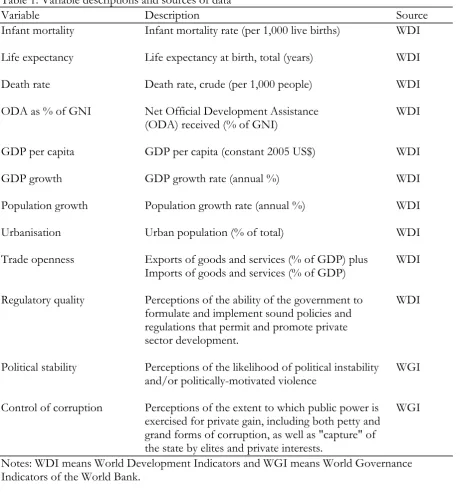
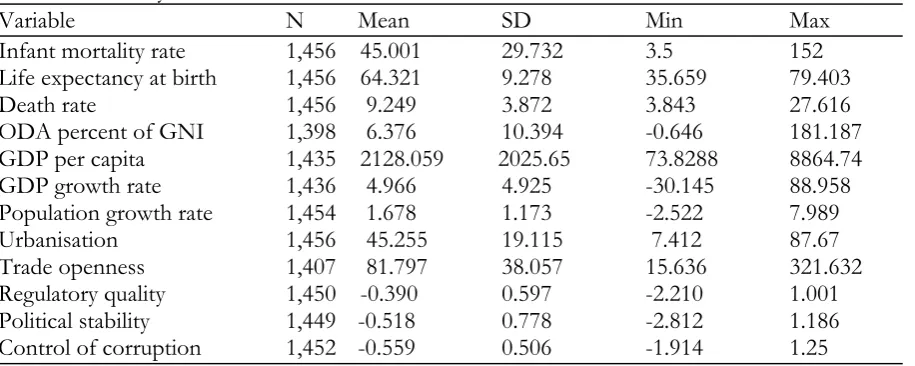
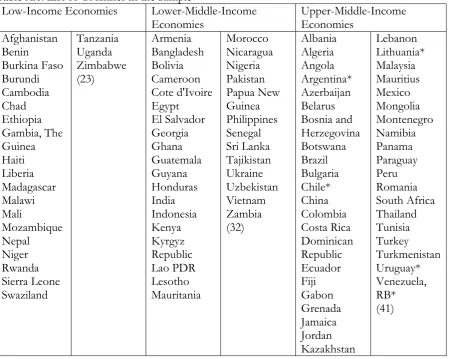
free data portal: World Development Indicators (WDI) and Worldwide Governance Indicators (WGI). The study uses data from a sample of 96 countries at various stages of their economic development (23 low-income countries, 32 lower income countries and 41 higher middle-income countries). Country classifications are according to the World Bank. However, the number of countries actually used in the analysis varies according to the regressions. The period of analysis covers a total of 19 years and goes from 1996 to 2014. But as governance data for some initial years (1997, 1999 and 2001) were not available in the WGI database and there were missing observations for key exogenous variables used in the study, the number of observations was reduced in regressions. Accordingly, in effect the data period reduces to 16 years only. Thus, the sample contains an unbalanced panel data of 96 countries. Details on variable definitions and data sources have been summarized in Table 1. Summary statistics are provided in Table 2.
4. Results
4.1 Econometric evidence on aid and human development
Following the structure of our methodology as mentioned above, therefore, empirical analysis of this section has been conducted in two steps. First, as the baseline exercise, the impact of ODA on the human development indicators has been assessed using the static fixed effects models controlling for several governance quality indicators. Second, robustness checks have been undertaken subsequently by estimating the dynamic versions of the baseline model. We also extend our analysis to understand if aid effectiveness in human development could plausibly vary across low-income and middle-income countries as classified by the World Bank.
4.1.1 Baseline results
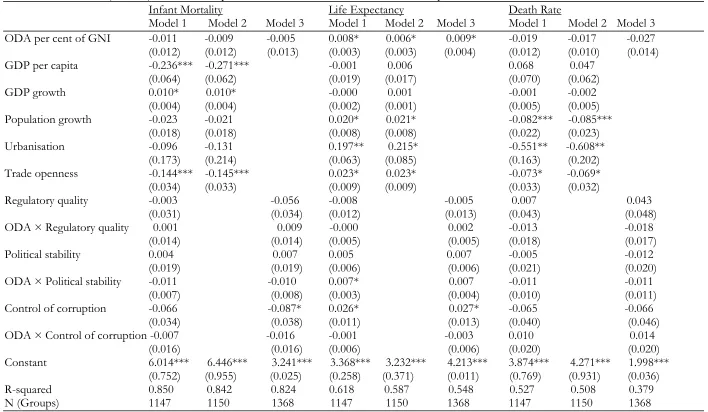
Page 12 of 31 economic, political and institutional governance respectively). All variables are expressed in natural logs excepting the quality of governance variables. As controlling for the level of economic development and quality of institutions and governance are highly important, different regression specifications are needed. For all dependent variables, therefore, three different regression specifications have been presented in columns 1, 2 and 3 to show that the results are convincing. In column (1) the results correspond to the complete model with all the control variables (macroeconomic and governance). Column (2) reports the corresponding results without the institutional quality variables. Finally, column (3) furnishes the corresponding results for ODA regressions without controlling for the macroeconomic variables. All models, however, include country and year dummies (to eliminate any variation due to country-specific and time-specific effects) as additional control variables. Notably, as the data are unbalanced, the number of countries we are left with is 85 in the first two columns of each of the dependent variables, whereas corresponding number of countries in the third model is 89.
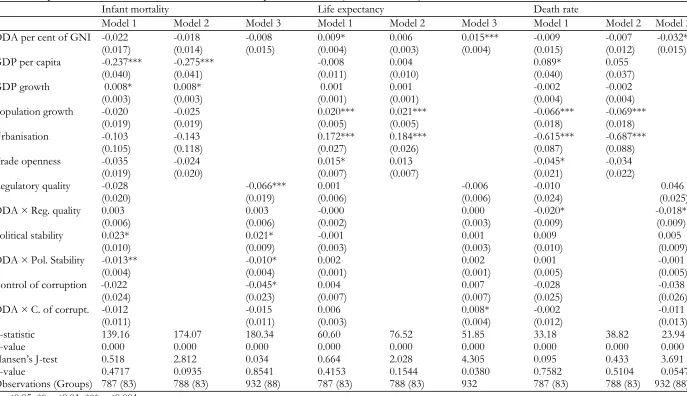
The results provide interesting insights. First, we find significant results for the impact of ODA on human development indicators even after controlling for GDP per capita and the governance indicators (though this is not true for all of the dependent variables). It is also relevant to note that this significant relationship is robust to the choice of different model specifications as shown in Table 1. Second, the coefficient for GDP per capita emerges as significant and negative in infant mortality regressions suggesting that countries with higher per capita income are likely to have lower rate of infant mortality, which is quite intuitive. GDP growth rate emerges as significant and positive in infant mortality regressions, suggesting that countries with higher GDP growth rate are likely to have higher rate of infant mortality. One plausible explanation of this result might be that the benefits of GDP growth is not transmitted to those group of people who are vulnerable to infant mortality. Third, among the macro policy variables, we find that trade openness appears to be extremely significant across all the regressions and higher trade openness decreases infant mortality and death rate and increases life expectancy, suggesting that the more open the country is, the higher it is likely to have an improved state of human development as measured by the selected indicators. Consistent with the larger literature on aid-growth nexus, population growth turns out to be significant in life expectancy and death rate regressions with positive and negative signs respectively. With limited geographical size, higher population in a country means increased population density. This is indicative of the fact that countries with higher population density tend to experience higher life expectancy and lower death rates. Urbanisation is significant in life expectancy and death rate regressions with positive and negative signs respectively. Quite intuitively, these results suggest that countries with higher urbanisation rate that supposedly ensure better health-care facilities tend to experience higher life expectancy and lower death rates.
Three interaction variables, interacted between the institutional quality variables and ODA flows, were included in our empirical model. Conventionally, it is expected that sufficient social and institutional capacities should be developed in the aid recipient countries so that these countries can absorb the aid flows properly and use them in more productive ways. Although most of the interaction terms turned out to be insignificant, the positive significant coefficient for the ‘ODA
Page 13 of 31 corruption’ variable are negative and significant in infant mortality regressions (model 3) and positive and significant in life expectancy regressions (models 1 and 3). Clearly these results indicate that better control of corruption (i.e., better institution governance), leads to lower infant mortality and higher life expectancy in the sampled countries.
4.1.2 Dynamic results
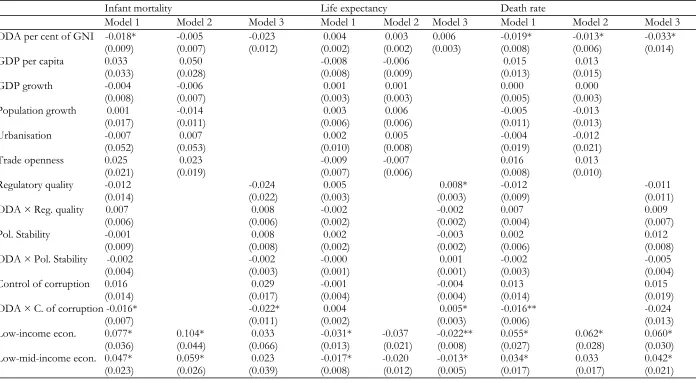
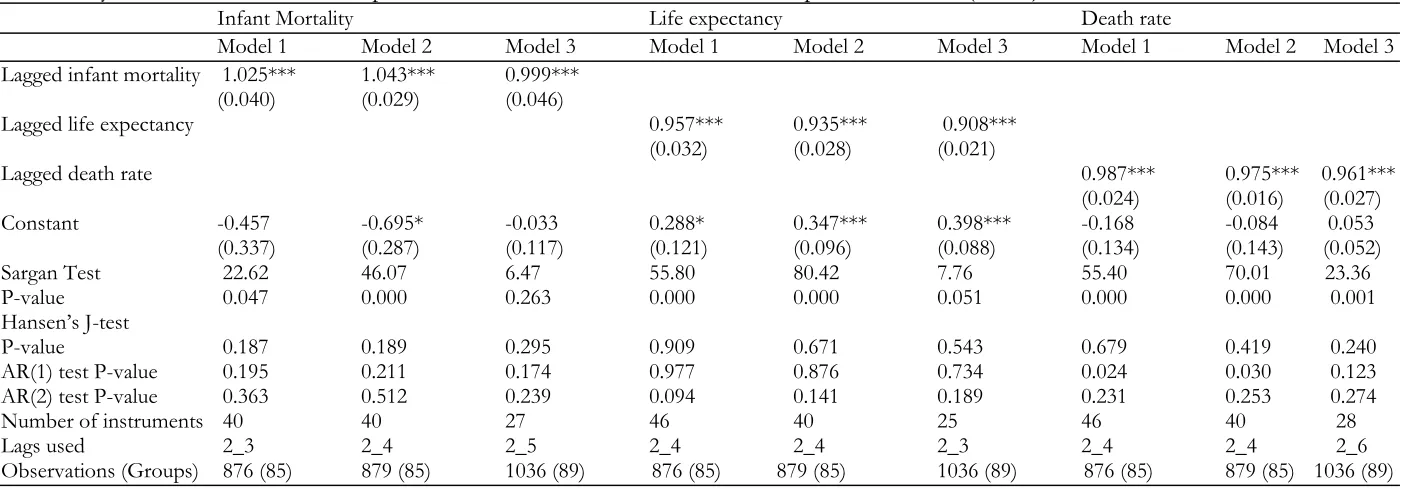
In order to ascertain the consistency of the findings of our baseline fixed effects estimates we now proceed to perform robustness checks through the dynamic system-GMM estimations of model (2). The results essentially are similar. In all model specifications, though the level of statistical significance varies, coefficients for the foreign aid variable always exhibit the correct and expected signs. Dynamic model estimates of Table 4 show that the coefficients for the lagged dependent variable turn out to be extremely significant and they are closer to 1. This provides evidence of serial correlation, hence the use of dynamic system-GMM is justified (Gopalan and Rajan, 2016). Most variables remain consistent after instrumentation. ODA flows, our aid variable, consistently and significantly reduces infant mortality and death rates. Thus, the fundamental relationships of interest are intact and correspond to the baseline results obtained previously. Again, although most of the interaction terms turned out to be insignificant, the negative significant coefficients for the
‘ODA × Control of corruption’ variable (model 1 and 3 of infant mortality regressions and model 1 of the death rate regressions) and the positive significant coefficient of the life expectancy regressions (model 3) indicate that better control of corruption in the ODA recipient countries favourably affects human development outcomes. Among others, quite expectedly, the
coefficients for the ‘control of corruption’ variable are negative and significant in infant mortality (model 3) regressions and positive and significant in life expectancy regressions (models 1 and 3). Clearly these results indicate that better control of corruption leads to lower infant mortality and higher life expectancy in the sampled countries. Tests for serial correlation clearly indicate no significant evidence of serial correlation in the first-differenced errors at orders 1 and 2. Hansen test statistics also confirm that our instruments were correct. So, we may have some confidence that the original results were robust to multiple specifications and estimation techniques.
Page 14 of 31 to the conclusion that foreign aid might reduce public effort in improving human development.
The negative significant coefficient for the ‘ODA × Political stability’ interaction variable indicate
that in aid recipient countries which are politically stable ODA affects infant mortality negatively. In the same way, the positive significant coefficient for the ‘ODA × Control of corruption’ interaction variable in life expectancy regression indicate that in aid recipient countries where better control of corruption is existing, aid improves life expectancy. Explanations of the statistically significant coefficients for the GDP per capita, urbanisation and trade openness variables are similar to those provided above.
This core analysis supports my baseline specification, suggesting that foreign aid is effective at improving human development measured by the selected health indicators. As these results are mostly unperturbed across different models which have been estimated in this exercise, it is logical to claim that the results are robust. The results are mostly consistent across different reduced form model specifications as well as re-estimations.
4.2 Regional regressions: Is there any difference in outcomes
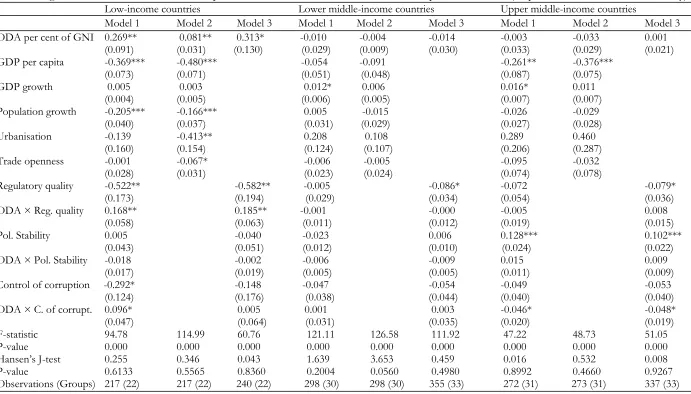
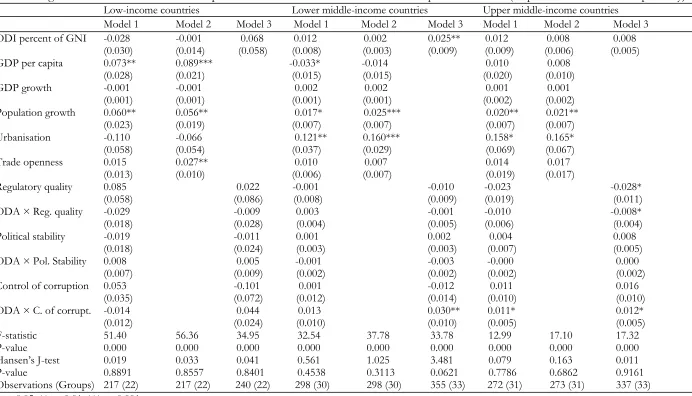
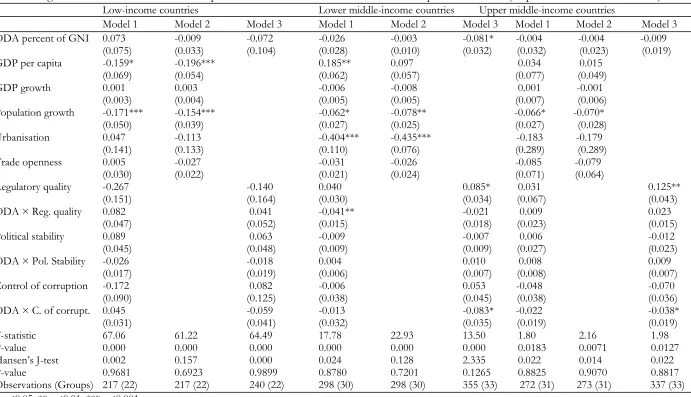
The final empirical exercise is to understand whether there is any regional difference in the impacts of aid on the human development indicators. That is, whether ODA disbursements affect different countries differently? This is an important question, particularly given that the quality of governance in different countries could be very different, which consequently might affect the effectiveness of aid flows to human development. Tables 6-8 compare the impact of ODA disbursements on selected human development indicators in low-income, lower middle-income and upper-middle income countries. As our measures of dependent variable, we use infant mortality, life expectancy and death rate variables. Panel FE2SLS GMM instrumental variables estimates have been presented. Also, we follow the previous regressions in using aid in all its three variations of the models.
Page 15 of 31 fact that quality of governance significantly differs in different countries depending on the income-levels of those countries. Tables 7 and 8 provide the corresponding results for life expectancy and death rate. We find broadly consistent results as before. As regards the direction and significance of the main aid variables, we find positive significant and negative significant results for ODA flows to life expectancy and death rate regressions in different country categories. In terms of the other control variables, we find remarkable consistency as before in the sense of finding similar control variables being significant. Overall, we find interesting results because conventional wisdom appears to expect aid effectiveness to be different in different countries depending on their income levels.
5. Conclusions
Being motivated by the changing international perspectives on economic development, this paper attempts to empirically explore the micro-level impacts of development aid. Thus, the study addresses the issue from the perspective of human development. This is an important of departure from earlier studies that aim to assess if foreign aid could help improve GDP growth of the recipient countries. The study primarily aims to examine the impact of foreign aid on three selected human development indicators—infant mortality, life expectancy at birth and death rate. Estimates of the static and dynamic panel data models confirm the robustness of the results. The analysis suggests that foreign aid improves countries’ human development indicators measured by infant mortality, life expectancy and death rate. This is another point of departure from other studies which have used, for instance, human development indices (HDIs) as the dependent variable. The paper develops and tests a fixed effects model controlling for potential endogeneity of foreign aid and human development. Results in this study are robust to different model specifications, estimations methods and data sets. These results suggest that foreign aid is positively and significantly linked with, and hence facilitates, human development as expected. So, it seems logical that the development community pushes for human development by providing more foreign aid as it is a powerful instrument for fighting poverty. Although there are noticeable regional differences in terms of the impacts, the study also finds that human development is significantly affected by income (measured by GDP per capita), urbanization and trade openness. Also, the governance indicators included in the study are found to have impacts on human development.
Page 16 of 31 References
Addison, T., G. Mavrotas, and M. McGillivray (2005). “Development Assistance and
Development Finance: Evidence and Global Policy Agendas.” Journal of International Development, 17: 819–836.
Akiyama, T. (2006). Recent trends in international aid and their impact on Japan. In Akiyama Takamasa and Yuichi Sasaoka, eds., In search of new approaches to Japan’s development assistance, 1–34. Tokyo: Foundation for Advanced Studies on International Development.
Arelano, M., and Bond, S. (1991). Some tests of specification for panel data: Monte Carlo evidence and an application to employment equations. Review of Economic Studies 58(2): 277–297.
Arellano, M. and Bover, O. (1995). Another look at the instrumental variable estimation of error components models. Journal of Econometrics 68(1): 29–51.
Arndt, C., S. Jones, and F. Tarp (2015). “Assessing Foreign Aid’s Long-Run Contribution to
Growth and Development”, World Development 69: 6-18.
Asiama, J. and P. Quartey (2009). “Foreign aid and the human development indicators in Sub
-Saharan Africa”, Journal of Developing Societies 25(1): 57–83.
Asongu, S. A. (2014). “Fighting African Corruption When Existing Corruption-control Levels
Matter in a Dynamic Cultural Setting.” International Journal of Social Economics 41 (10): 906–922.
Asongu, S. A. and J. C. Nwachukwu (2016). “Foreign aid and governance in Africa”. International
Review of Applied Economics 30(1): 69-88.
Asongu, S. A., and M. Jellal (2013). “On the Channels of Foreign Aid to Corruption.” Economics
Bulletin, 33 (3): 2191–2201.
Azam, J-P and V. Thelen (2008). “The roles of foreign aid and education in the war onterror”,
Pubic Choice 135(3): 375–397.
Bauer, P., & Yamey, B. (1982). Foreign aid: What is at stake? Reprinted in 1984. In G. M. Meier (Ed.), Leading issues in economic development (4th ed.). Palo Alto, CA: Stanford University.
Blundell, R. and Bond, S. (1998) Initial conditions and moment restrictions in dynamic panel data models. Journal of Econometrics 87(1): 115–143.
Boone, P. (1996), “Politics and the Effectiveness of Foreign Aid”, European Economic Review 40(2): 289-330.
Page 17 of 31
Burnside, C. and D. Dollar (2000), “Aid, Policies and Growth”, The American Economic Review, 90(4): 847-868.
Busse, M., and S. Gröning (2009). “Does Foreign Aid Improve Governance?”, Economics Letters 104 (2): 76–78.
Chatterjee, S. and Turnovsky, S. J. (2005). “Financing Public Investment through Foreign Aid:
Consequences for Economic Growth and Welfare”, Review of International Economics, 13(1): 20–44.
Chenery, H. B. and Strout, A. M. (1966). Foreign Assistance and Economic Development, The American Economic Review, 56(4): 679-733.
Clemens, M. A., Radelet, S., Bhavnani, R. R. and Bazzi, S. (2011). Counting Chickens When They Hatch: Timing and the Effects of Aid on Growth. The Economic Journal, 122 (June): 590– 617.
Collier, P. (2007). The Bottom Billion: Why the Poorest Countries are failing and What Can Be Done About It? Oxford, United Kingdom: Oxford University Press.
Collier, P. and J. Dehn (2001). “Aid, Shocks, and Growth.” Policy Research Working Paper 2688. World Bank, Washington, DC.
Collier, P., and D. Dollar. (2001). “Can the World Cut Poverty in Half? How Policy Reform and
Effective Aid Can Meet International Development Goals.” World Development 29 (11): 1787– 1802.
Collier, P. and D. Dollar (2002). “Aid Allocation and Poverty Reduction,” European Economic Review 46(8): 1475-1500.
Collier, P. and A. Hoeffler (2004), “Aid, Policy and Growth in Post-Conflict Societies,” European
Economic Review 48(5): 1125-1145.
Collier, P., and A. Hoeffler (2007). “Unintended Consequences: Does Aid Promote Arms
Races?” Oxford Bulletin of Economics and Statistics 69 (1): 1–27.
Dalgaard, C.-J. and H. Hansen (2001), “On Aid, Growth and Good Policies,” The Journal of
Development Studies, 37(6): 17-41.
Dreher, A., P. Nunnenkamp, and R. Thiele (2008). ‘Does Aid for Education Educate Children?’ World Bank Economic Review 22(2): 291-314.
Page 18 of 31
Easterly, W. (2006). The White Man’s Burden: Why the West’s Efforts to Aid the Rest Have
Done So Much Ill and So Little Good. New York: Penguin Press.
Edwards, S. (2014). Economic development and the effectiveness of foreign aid: A historical perspective. NBER Working Paper No. 20685. Available at:
http://www.nber.org/papers/w20685
Feeny, S. (2003). “The Impact of Foreign Aid on Poverty and Human Well-being in Papua New
Guinea.” Asia-Pacific Development Journal 10 (2): 73–93.
Fielding, D., M. McGillivray, and S. Torres (2006). A Wider Approach to Aid Effectiveness: Correlated Impacts on Health, Wealth, Fertility and Education. Helsinki, Finland: The World Institute for Development Economics Research (UNU-WIDER).
Fosu, A. (2011). Growth, Inequality, and Poverty Reduction in Developing Countries Recent Global Evidence. WIDER Working Paper No. 2011/01. WIDER: Helsinki.
Gomane, K., O. Morrissey, P. Mosley, and A. Verschoor (2003). “Aid, pro-poor Government
Spending and Welfare.” CREDIT Working Paper 03/01.
Gomanee, K., S. Girma, and O. Morrissey (2005a). “Aid public spending and human welfare: Evidence from quantile regressions”, Journal of International Development 17(3): 299-309.
Gomanee, K., O. Morrissey, P. Mosley, and A. Verschoor (2005b). “Aid, government expenditure, and aggregate welfare”, World Development 33(3): 355-370.
Gopalan, S. and Rajan, R. S. (2016). “Has Foreign Aid Been Effective in the Water Supply and
Sanitation Sector? Evidence from Panel Data”, World Development 85: 84–104.
Guillaumont, P., and L. Chauvet (2001). “Aid and Performance: A Reassessment.” Journal of
Development Studies 37: 66–92.
Hansen, H. and D. Headey (2010). “The short-run macroeconomic impact of foreign aid to
small states: An agnostic time series analysis”, The Journal of Development Studies 46(5): 877-896.
Hansen, H. and F. Tarp (2000). ‘Aid Effectiveness Disputed’, Journal of International Development
12(3): 375-98.
Hansen, H. and F. Tarp (2001). “Aid and Growth Regressions,” Journal of Development Economics
64(2): 547-570.
Harrington, J. (2003). “International Finance for Development” In Kirkpatrick, C. H., Clarke, R.
Page 19 of 31 Howes, S. (2011). An overview of aid effectiveness: Determinants and strategies, Discussion Paper 1. Australian National University. Available at:
https://devpolicy.anu.edu.au/pdf/papers/DP_1_-_An_overview_of_aid_effectiveness_determinants_and_strategies.pdf
Hudson, J. (2015). “Consequences of Aid Volatility for Macroeconomic Management and Aid Effectiveness”, World Development, 69; 62–74.
Kaufmann, D., A. Kraay, and M. Mastruzzi (2011). “The Worldwide Governance Indicators:
Methodology and Analytical Issues.” Hague Journal on the Rule of Law, 3: 220–246.
Kosack, S. (2003). “Effective Aid: How Democracy Allows Development Aid to Improve the Quality of Life,” World Development 31(1): 1-22.
Masud, N. and B. Yontcheva (2005). “Does Foreign Aid Reduce Poverty? Empirical Evidence
from Nongovernmental and Bilateral Aid,” IMF Working Paper WP/05/100.
McGillivray, M. (2000). “Aid and Public Sector Behaviour in Developing Countries,” Review of Development Economics 4(2): 156-163.
McGillivray, M. and F. Noorbakhsh (2007). Aid, conflict and human development. Working Papers 2007-03, Department of Economics, University of Glasgow.
Michalowa, K., and A. Weber (2006). ‘Aid Effectivness Reconsidered: Panel Data Evidence for the Education Sector’. Discussion Paper: Hamburg Institute of International Economics.
Minou, C., and S. G. Reddy (2010). “Development Aid and Economic Growth: A Positive Long-run Relation.” The Quarterly Review of Economics and Finance 50: 27–39.
Mishra, P. and D. Newhouse (2009). ‘Does Health Aid Matter?’ Journal of Health Economics 28(4): 855-72.
Mosley, P., J. Hudson, and A. Verschoor (2004). “Aid, Poverty Reduction and the ‘New’
Conditionality.” Economic Journal 114: F217–F243.
Moss, T, Pettersson, G & van de Walle, N (2008). ‘An Aid‐Institutions Paradox? A Review Essay on Aid Dependency and State Building in sub‐Saharan Africa’, Chapter 8 in Easterly, W. (ed.) Reinventing Foreign Aid, MIT Press, Cambridge, MA.
Moyo, D. (2009). Dead Aid: Why Aid is Not Working and How There is Another Way for Africa. New York: Farrar, Straus and Giroux.
Ndikumana, L. (2012). ‘Applying Evaluation to Development and Aid: Can Evaluation Bridge
Page 20 of 31 Naudet, L. Ndikumana, J. Nelson, C. Paradeise, R. Ruben and M. Székely (eds), Evaluation and Its Discontents: Do We Learn from Experience in Development? Paris: Agence Française de
Développement.
Nickell, S. (1981). Biases in dynamic models with fixed effects. Econometrica: Journal of the Econometric Society, 49(6), 1417–1426.
Nourou, M. (2014). “Foreign Aid and Development: Looking Beyond the Growth Effect”, Journal of Economic Development, 39(4): 99-115.
OECD (2016). Net ODA. Available at https://data.oecd.org/oda/net-oda.htm (Accessed on 07 October 2016.
Okada, K., and S. Samreth (2012). “The effect of foreign aid on corruption: A quantile
regression approach.” Economic Letters 11: 240–243.
Pallage, S. and Robe, M. A. (2001). Foreign aid and the business cycle. Review of International Economics, 9(4): 641–672.
Pedersen, K. P. (1996). “Aid, Investment and Incentives.” Scandinavian Journal of Economics 98 (3): 423–438.
Pickbourn, L. and L. Ndikumana (2013). “Impact of sectoral allocation of foreign aid on gender equity and human development, WIDER Working Paper No. 2013/066.
Rajan, R. and A. Subramanian (2005). ‘What Undermine Aid’s Impact on Growth?’ IMF Working Paper WP/05/126.
Reichel, R. (1995). “Development, Aid, Savings and Growth in the 1980s: A Cross-sectional
Analysis.” Savings and Development 19 (3): 279–296.
Riddell, A. and Nino-Zarazua, M. (2016). “The effectiveness of foreign aid to education: What
can be learned?”, International Journal of Educational Development, 48: 23-36.
Rodrik, D, Birdsall, N and Subramaniam, A. (2005). ‘How to help poor countries’ Foreign Affairs, 84(4). Available at:
https://www.foreignaffairs.com/articles/2005-07-01/how-help-poor-countries
Roodman, D. (2009). How to do xtabond2: An introduction to difference and system GMM in Stata. The Stata Journal 9(1): 86–136.
Page 21 of 31 Shah, A. (2014). Foreign Aid for Development Assistance. Global Issues: Social, Political, Economic and Environmental Issues That Affect Us All. Available at:
http://www.globalissues.org/article/35/foreign-aid-development-assistance. Accessed: 16 November 2016.
Seguino, S. (2008). ‘Micro-Macro Linkages between Gender, Development and Growth:
Implications for the Caribbean Region’. Journal of Eastern Caribbean Studies 33(4): 8-42.
Sen, A. (1999). Development as Freedom. Oxford University Press, USA.
Williamson, C.R. (2008). “Foreign Aid and Human Development: The Impact of Foreign Aid to the Health Sector”, Southern Economic Journal 75(1): 188-207.
Windmeijer, F. (2005). A finite sample correction for the variance of linear efficient two-step GMM estimators. Journal of Econometrics 126(1): 25–51.
Wooldridge, J. M. (2010). Econometric analysis of cross section and panel data. Cambridge, MA: MIT Press.
World Bank (1998). “Assessing Aid: What Works, What Doesn’t and Why.” Oxford University Press, New York.
Page 22 of 31 Table 1: Variable descriptions and sources of data
Variable Description Source
Infant mortality Infant mortality rate (per 1,000 live births) WDI
Life expectancy Life expectancy at birth, total (years) WDI
Death rate Death rate, crude (per 1,000 people) WDI
ODA as % of GNI Net Official Development Assistance WDI (ODA) received (% of GNI)
GDP per capita GDP per capita (constant 2005 US$) WDI
GDP growth GDP growth rate (annual %) WDI
Population growth Population growth rate (annual %) WDI
Urbanisation Urban population (% of total) WDI
Trade openness Exports of goods and services (% of GDP) plus WDI Imports of goods and services (% of GDP)
Regulatory quality Perceptions of the ability of the government to WDI formulate and implement sound policies and
regulations that permit and promote private sector development.
Political stability Perceptions of the likelihood of political instability WGI and/or politically-motivated violence
Control of corruption Perceptions of the extent to which public power is WGI exercised for private gain, including both petty and
grand forms of corruption, as well as "capture" of the state by elites and private interests.
Page 23 of 31 Table 2: Summary statistics
Page 24 of 31 Table 3. Fixed effects (baseline) estimates – impact of ODA disbursements on human development indicators
Page 25 of 31 Table 4. Dynamic Model Estimates - impact of ODA disbursements on human development indicators
Infant mortality Life expectancy Death rate
Model 1 Model 2 Model 3 Model 1 Model 2 Model 3 Model 1 Model 2 Model 3 ODA per cent of GNI -0.018* -0.005 -0.023 0.004 0.003 0.006 -0.019* -0.013* -0.033* (0.009) (0.007) (0.012) (0.002) (0.002) (0.003) (0.008) (0.006) (0.014) GDP per capita 0.033 0.050 -0.008 -0.006 0.015 0.013
(0.033) (0.028) (0.008) (0.009) (0.013) (0.015) GDP growth -0.004 -0.006 0.001 0.001 0.000 0.000 (0.008) (0.007) (0.003) (0.003) (0.005) (0.003) Population growth 0.001 -0.014 0.003 0.006 -0.005 -0.013 (0.017) (0.011) (0.006) (0.006) (0.011) (0.013) Urbanisation -0.007 0.007 0.002 0.005 -0.004 -0.012 (0.052) (0.053) (0.010) (0.008) (0.019) (0.021) Trade openness 0.025 0.023 -0.009 -0.007 0.016 0.013 (0.021) (0.019) (0.007) (0.006) (0.008) (0.010) Regulatory quality -0.012 -0.024 0.005 0.008* -0.012 -0.011 (0.014) (0.022) (0.003) (0.003) (0.009) (0.011) ODA × Reg. quality 0.007 0.008 -0.002 -0.002 0.007 0.009 (0.006) (0.006) (0.002) (0.002) (0.004) (0.007) Pol. Stability -0.001 0.008 0.002 -0.003 0.002 0.012 (0.009) (0.008) (0.002) (0.002) (0.006) (0.008) ODA × Pol. Stability -0.002 -0.002 -0.000 0.001 -0.002 -0.005 (0.004) (0.003) (0.001) (0.001) (0.003) (0.004) Control of corruption 0.016 0.029 -0.001 -0.004 0.013 0.015 (0.014) (0.017) (0.004) (0.004) (0.014) (0.019) ODA × C. of corruption -0.016* -0.022* 0.004 0.005* -0.016** -0.024
Page 26 of 31 Table 4. Dynamic Model Estimates - impact of ODA disbursements on human development indicators (contd.)
Infant Mortality Life expectancy Death rate
Model 1 Model 2 Model 3 Model 1 Model 2 Model 3 Model 1 Model 2 Model 3 Lagged infant mortality 1.025*** 1.043*** 0.999***
(0.040) (0.029) (0.046)
Lagged life expectancy 0.957*** 0.935*** 0.908*** (0.032) (0.028) (0.021)
Lagged death rate 0.987*** 0.975*** 0.961*** (0.024) (0.016) (0.027) Constant -0.457 -0.695* -0.033 0.288* 0.347*** 0.398*** -0.168 -0.084 0.053 (0.337) (0.287) (0.117) (0.121) (0.096) (0.088) (0.134) (0.143) (0.052) Sargan Test 22.62 46.07 6.47 55.80 80.42 7.76 55.40 70.01 23.36 P-value 0.047 0.000 0.263 0.000 0.000 0.051 0.000 0.000 0.001
Hansen’s J-test
Page 27 of 31 Table 5. Impact of ODA disbursements on human development indicator (GMM estimates)
Infant mortality Life expectancy Death rate
Model 1 Model 2 Model 3 Model 1 Model 2 Model 3 Model 1 Model 2 Model 3 ODA per cent of GNI -0.022 -0.018 -0.008 0.009* 0.006 0.015*** -0.009 -0.007 -0.032* (0.017) (0.014) (0.015) (0.004) (0.003) (0.004) (0.015) (0.012) (0.015) GDP per capita -0.237*** -0.275*** -0.008 0.004 0.089* 0.055 (0.040) (0.041) (0.011) (0.010) (0.040) (0.037) GDP growth 0.008* 0.008* 0.001 0.001 -0.002 -0.002 (0.003) (0.003) (0.001) (0.001) (0.004) (0.004) Population growth -0.020 -0.025 0.020*** 0.021*** -0.066*** -0.069*** (0.019) (0.019) (0.005) (0.005) (0.018) (0.018) Urbanisation -0.103 -0.143 0.172*** 0.184*** -0.615*** -0.687*** (0.105) (0.118) (0.027) (0.026) (0.087) (0.088) Trade openness -0.035 -0.024 0.015* 0.013 -0.045* -0.034 (0.019) (0.020) (0.007) (0.007) (0.021) (0.022) Regulatory quality -0.028 -0.066*** 0.001 -0.006 -0.010 0.046 (0.020) (0.019) (0.006) (0.006) (0.024) (0.025) ODA × Reg. quality 0.003 0.003 -0.000 0.000 -0.020* -0.018* (0.006) (0.006) (0.002) (0.003) (0.009) (0.009) Political stability 0.023* 0.021* -0.001 0.001 0.009 0.005 (0.010) (0.009) (0.003) (0.003) (0.010) (0.009) ODA × Pol. Stability -0.013** -0.010* 0.002 0.002 0.001 -0.001 (0.004) (0.004) (0.001) (0.001) (0.005) (0.005) Control of corruption -0.022 -0.045* 0.004 0.007 -0.028 -0.038 (0.024) (0.023) (0.007) (0.007) (0.025) (0.026) ODA × C. of corrupt. -0.012 -0.015 0.006 0.008* -0.002 -0.011 (0.011) (0.011) (0.003) (0.004) (0.012) (0.013) F-statistic 139.16 174.07 180.34 60.60 76.52 51.85 33.18 38.82 23.94 P-value 0.000 0.000 0.000 0.000 0.000 0.000 0.000 0.000 0.000
Hansen’s J-test 0.518 2.812 0.034 0.664 2.028 4.305 0.095 0.433 3.691
Page 28 of 31 Table 6. Regional GMM Model Estimates - impact of ODA disbursements on human development indicators (Dependent variable: Infant mortality)
Low-income countries Lower middle-income countries Upper middle-income countries
Model 1 Model 2 Model 3 Model 1 Model 2 Model 3 Model 1 Model 2 Model 3 ODA per cent of GNI 0.269** 0.081** 0.313* -0.010 -0.004 -0.014 -0.003 -0.033 0.001 (0.091) (0.031) (0.130) (0.029) (0.009) (0.030) (0.033) (0.029) (0.021) GDP per capita -0.369*** -0.480*** -0.054 -0.091 -0.261** -0.376*** (0.073) (0.071) (0.051) (0.048) (0.087) (0.075) GDP growth 0.005 0.003 0.012* 0.006 0.016* 0.011 (0.004) (0.005) (0.006) (0.005) (0.007) (0.007) Population growth -0.205*** -0.166*** 0.005 -0.015 -0.026 -0.029 (0.040) (0.037) (0.031) (0.029) (0.027) (0.028) Urbanisation -0.139 -0.413** 0.208 0.108 0.289 0.460 (0.160) (0.154) (0.124) (0.107) (0.206) (0.287) Trade openness -0.001 -0.067* -0.006 -0.005 -0.095 -0.032 (0.028) (0.031) (0.023) (0.024) (0.074) (0.078) Regulatory quality -0.522** -0.582** -0.005 -0.086* -0.072 -0.079* (0.173) (0.194) (0.029) (0.034) (0.054) (0.036) ODA × Reg. quality 0.168** 0.185** -0.001 -0.000 -0.005 0.008 (0.058) (0.063) (0.011) (0.012) (0.019) (0.015) Pol. Stability 0.005 -0.040 -0.023 0.006 0.128*** 0.102*** (0.043) (0.051) (0.012) (0.010) (0.024) (0.022) ODA × Pol. Stability -0.018 -0.002 -0.006 -0.009 0.015 0.009 (0.017) (0.019) (0.005) (0.005) (0.011) (0.009) Control of corruption -0.292* -0.148 -0.047 -0.054 -0.049 -0.053 (0.124) (0.176) (0.038) (0.044) (0.040) (0.040) ODA × C. of corrupt. 0.096* 0.005 0.001 0.003 -0.046* -0.048* (0.047) (0.064) (0.031) (0.035) (0.020) (0.019) F-statistic 94.78 114.99 60.76 121.11 126.58 111.92 47.22 48.73 51.05 P-value 0.000 0.000 0.000 0.000 0.000 0.000 0.000 0.000 0.000
Hansen’s J-test 0.255 0.346 0.043 1.639 3.653 0.459 0.016 0.532 0.008
Page 29 of 31 Table 7. Regional GMM Model Estimates - impact of ODA disbursements on human development indicators (Dependent variable: Life expectancy)
Low-income countries Lower middle-income countries Upper middle-income countries
Model 1 Model 2 Model 3 Model 1 Model 2 Model 3 Model 1 Model 2 Model 3 ODI percent of GNI -0.028 -0.001 0.068 0.012 0.002 0.025** 0.012 0.008 0.008 (0.030) (0.014) (0.058) (0.008) (0.003) (0.009) (0.009) (0.006) (0.005) GDP per capita 0.073** 0.089*** -0.033* -0.014 0.010 0.008 (0.028) (0.021) (0.015) (0.015) (0.020) (0.010) GDP growth -0.001 -0.001 0.002 0.002 0.001 0.001 (0.001) (0.001) (0.001) (0.001) (0.002) (0.002) Population growth 0.060** 0.056** 0.017* 0.025*** 0.020** 0.021** (0.023) (0.019) (0.007) (0.007) (0.007) (0.007) Urbanisation -0.110 -0.066 0.121** 0.160*** 0.158* 0.165* (0.058) (0.054) (0.037) (0.029) (0.069) (0.067) Trade openness 0.015 0.027** 0.010 0.007 0.014 0.017 (0.013) (0.010) (0.006) (0.007) (0.019) (0.017) Regulatory quality 0.085 0.022 -0.001 -0.010 -0.023 -0.028* (0.058) (0.086) (0.008) (0.009) (0.019) (0.011) ODA × Reg. quality -0.029 -0.009 0.003 -0.001 -0.010 -0.008* (0.018) (0.028) (0.004) (0.005) (0.006) (0.004) Political stability -0.019 -0.011 0.001 0.002 0.004 0.008 (0.018) (0.024) (0.003) (0.003) (0.007) (0.005) ODA × Pol. Stability 0.008 0.005 -0.001 -0.003 -0.000 0.000 (0.007) (0.009) (0.002) (0.002) (0.002) (0.002) Control of corruption 0.053 -0.101 0.001 -0.012 0.011 0.016 (0.035) (0.072) (0.012) (0.014) (0.010) (0.010) ODA × C. of corrupt. -0.014 0.044 0.013 0.030** 0.011* 0.012* (0.012) (0.024) (0.010) (0.010) (0.005) (0.005) F-statistic 51.40 56.36 34.95 32.54 37.78 33.78 12.99 17.10 17.32 P-value 0.000 0.000 0.000 0.000 0.000 0.000 0.000 0.000 0.000
Hansen’s J-test 0.019 0.033 0.041 0.561 1.025 3.481 0.079 0.163 0.011