Proceedings of the 45th Annual Meeting of the Association of Computational Linguistics, pages 608–615,
Beyond Projectivity: Multilingual Evaluation
of Constraints and Measures on Non-Projective Structures
Jiˇr´ı Havelka
Institute of Formal and Applied Linguistics Charles University in Prague
Czech Republic
Abstract
Dependency analysis of natural language has gained importance for its applicability
to NLP tasks. Non-projective structures
are common in dependency analysis, there-fore we need fine-grained means of describ-ing them, especially for the purposes of machine-learning oriented approaches like
parsing. We present an evaluation on
twelve languages which explores several constraints and measures on non-projective
structures. We pursue an edge-based
ap-proach concentrating on properties of in-dividual edges as opposed to properties of whole trees. In our evaluation, we include previously unreported measures taking into account levels of nodes in dependency trees. Our empirical results corroborate theoreti-cal results and show that an edge-based ap-proach using levels of nodes provides an accurate and at the same time expressive means for capturing non-projective struc-tures in natural language.
1 Introduction
Dependency analysis of natural language has been gaining an ever increasing interest thanks to its ap-plicability in many tasks of NLP—a recent example is the dependency parsing work of McDonald et al. (2005), which introduces an approach based on the search for maximum spanning trees, capable of han-dling non-projective structures naturally.
The study of dependency structures occurring in natural language can be approached from two sides:
by trying to delimit permissible dependency struc-tures through formal constraints (for a recent review paper, see Kuhlmann and Nivre (2006)), or by pro-viding their linguistic description (see e.g. Vesel´a et al. (2004) and Hajiˇcov´a et al. (2004) for a linguistic
analysis of non-projective constructions in Czech.1)
We think that it is worth bearing in mind that neither syntactic structures in dependency tree-banks, nor structures arising in machine-learning ap-proaches, such as MST dependency parsing, need a priori fall into any formal subclass of dependency trees. We should therefore aim at formal means ca-pable of describing all non-projective structures that are both expressive and fine-grained enough to be useful in statistical approaches, and at the same time
suitable for an adequate linguistic description.2
Holan et al. (1998) first defined an infinite hierar-chy of classes of dependency trees, going from pro-jective to unrestricted dependency trees, based on the notion of gap degree for subtrees (cf. Section 3). Holan et al. (2000) present linguistic considerations concerning Czech and English with respect to this hierarchy (cf. also Section 6).
In this paper, we consider all constraints and mea-sures evaluated by Kuhlmann and Nivre (2006)— with some minor variations, cf. Section 4.2.
Ad-1These two papers contain an error concerning an alternative
condition of projectivity, which is rectified in Havelka (2005).
2The importance of such means becomes more evident from
the asymptotically negligible proportion of projective trees to all dependency trees; there are super-exponentially many unre-stricted trees compared to exponentially many projective trees
onnnodes. Unrestricted dependency trees (i.e. labelled rooted
trees) and projective dependency trees are counted by sequences A000169 and A006013 (offset 1), respectively, in the On-Line Encyclopedia of Sequences (Sloane, 2007).
ditionally, we introduce several measures not con-sidered in their work. We also extend the empirical basis from Czech and Danish to twelve languages, which were made available in the CoNLL-X shared task on dependency parsing.
In our evaluation, we do not address the issue of what possible effects the annotations and/or conver-sions used when creating the data might have on non-projective structures in the different languages.
The newly considered measures have the first or both of the following desiderata: they are based on properties of individual non-projective edges (cf. Definition 3); and they take into account levels of nodes in dependency trees explicitly. None of the constraints and measures in Kuhlmann and Nivre (2006) take into account levels of nodes explicitly.
Level types of non-projective edges, introduced by Havelka (2005), have both desiderata. They pro-vide an edge-based means of characterizing all non-projective structures; they also have some further in-teresting formal properties.
We propose a novel, more detailed measure,level
signaturesof non-projective edges, combining lev-els of nodes with the partitioning of gaps of non-projective edges into components. We derive a for-mal property of these signatures that links them to the constraint of well-nestedness, which is an exten-sion of the result for level types (see also Havelka (2007b)).
The paper is organized as follows: Section 2 con-tains formal preliminaries; in Section 3 we review the constraint of projectivity and define related no-tions necessary in Section 4, where we define and discuss all evaluated constraints and measures; Sec-tion 5 describes our data and experimental setup; empirical results are presented in Section 6.
2 Formal preliminaries
Here we provide basic definitions and notation used in subsequent sections.
Definition 1 A dependency tree is a triple
(V,→,), whereV is a finite set of nodes,→a
de-pendencyrelation onV, anda total order onV.3
3We adopt the following convention: nodes are drawn
top-down according to their increasing level, with nodes on the same level being the same distance from the root; nodes are drawn from left to right according to the total order on nodes; edges are drawn as solid lines, paths as dotted curves.
Relation→models linguistic dependency, and so
represents a directed, rooted tree onV. There are
many ways of characterizing rooted trees, we give
here a characterization via the properties of→: there
is aroot r∈V such thatr→∗vfor allv∈Vand there
is a uniqueedge p→vfor allv∈V,v6=r, and no
edge intor. Relation→∗ is the reflexive transitive
closure of→and is usually calledsubordination.
For each nodeiwe define itslevelas the length of
the pathr→∗i; we denote itlevel
i. The
symmetriza-tion↔=→ ∪ →−1makes it possible to talk about
edges (pairs of nodes i,j such that i→ j) without
explicitly specifying the parent (head; i here) and
the child (dependent; j here); so → represents
di-rected edges and↔undirected edges. To retain the
ability to talk about the direction of edges, we define
Parenti↔j=
i ifi→j
j ifj→iandChildi↔j=
j ifi→j i if j→i.
To make the exposition clearer by avoiding overuse
of the symbol→, we introduce notation for rooted
subtrees not only for nodes, but also for edges:
Subtreei={v∈V |i→∗v},Subtreei↔j={v∈V|
Parenti↔j→∗v}(note that the subtree of an edge is
defined relative to its parent node). To be able to talk
concisely about the total order on nodes, we
de-fineopen intervals whose endpoints need not be in
a prescribed order(i,j) ={v∈V|min{i,j} ≺v≺
max{i,j}}.
3 Condition of projectivity
Projectivity of a dependency tree can be character-ized both through the properties of its subtrees and
through the properties of its edges.4
Definition 2 A dependency treeT = (V,→,) is projectiveif it satisfies the following equivalent con-ditions:
i→ j &v∈(i,j) =⇒v∈Subtreei,
(Harper & Hays)
j∈Subtreei &v∈(i,j) =⇒v∈Subtreei, (Lecerf & Ihm)
j1,j2∈Subtreei &v∈(j1,j2) =⇒v∈Subtreei .
(Fitialov)
OtherwiseT isnon-projective.
4There are many other equivalent characterizations of
It was Marcus (1965) who proved the equivalence of the conditions in Definition 2, proposed in the early 1960’s (we denote them by the names of those to whom Marcus attributes their authorship).
We see that the antecedents of the projectiv-ity conditions move from edge-focused to subtree-focused (i.e. from talking about dependency to talk-ing about subordination).
It is the condition of Fitialov that has been mostly explored when studying so-called relaxations of pro-jectivity. (The condition is usually worded as fol-lows: A dependency tree is projective if the nodes of all its subtrees constitute contiguous intervals in the total order on nodes.)
However, we find the condition of Harper & Hays to be the most appealing from the linguistic point of view because it gives prominence to the primary notion of dependency edges over the derived notion of subordination. We therefore use an edge-based approach whenever we find it suitable.
To that end, we need the notion of a non-projective edge and its gap.
Definition 3 For any edge i↔ j in a dependency
treeT we define itsgapas follows
Gapi↔j={v∈V|v∈(i,j)&v∈/Subtreei↔j}.
An edge with an empty gap is projective, an edge
whose gap is non-empty isnon-projective.5
We see that non-projective are those edgesi↔ j
for which there is a node v such that together they
violate the condition of Harper & Hays; we group
all such nodes v into Gapi↔j, the gap of the
non-projective edgei↔ j.
The notion of gap is defined differently for sub-trees of a dependency tree (Holan et al., 1998; Bodirsky et al., 2005). There it is defined through the nodes of the whole dependency tree not in the considered subtree that intervene between its nodes
in the total order on nodes.
4 Relaxations of projectivity: evaluated constraints and measures
In this section we present all constraints and mea-sures on dependency trees that we evaluate
empir-5In figures with sample configurations we adopt this
con-vention: for a non-projective edge, we draw all nodes in its gap explicitly and assume that no node on any path crossing the span of the edge lies in the interval delimited by its endpoints.
ically in Section 6. First we give definitions of
global constraints on dependency trees, then we present measures of non-projectivity based on prop-erties of individual non-projective edges (some of the edge-based measures have corresponding tree-based counterparts, however we do not discuss them in detail).
4.1 Tree constraints
We consider the following three global constraints on dependency trees: projectivity, planarity, and well-nestedness. All three constraints can be applied to more general structures, e.g. dependency forests or even general directed graphs. Here we adhere to their primary application to dependency trees.
Definition 4 A dependency treeT isnon-planarif
there are two edgesi1↔ j1,i2↔ j2inT such that
i1∈(i2,j2) & i2∈(i1,j1).
OtherwiseT isplanar.
Planarity is a relaxation of projectivity that cor-responds to the “no crossing edges” constraint. Al-though it might get confused with projectivity, it is in fact a strictly weaker constraint. Planarity is equiv-alent to projectivity for dependency trees with their root node at either the left or right fringe of the tree. Planarity is a recent name for a constraint stud-ied under different names already in the 1960’s— we are aware of independent work in the USSR (weakly non-projective trees; see the survey paper by Dikovsky and Modina (2000) for references) and in Czechoslovakia (smooth trees; Nebesk´y (1979) presents a survey of his results).
Definition 5 A dependency treeT is ill-nested if
there are two non-projective edgesi1↔ j1,i2↔ j2
inT such that
i1∈Gapi2↔j2 & i2∈Gapi1↔j1 .
OtherwiseT iswell-nested.
Well-nestedness was proposed by Bodirsky et al. (2005). The original formulation forbids interleav-ing of disjoint subtrees in the total order on nodes; we present an equivalent formulation in terms of non-projective edges, derived in (Havelka, 2007b).
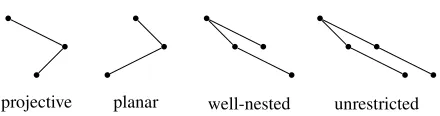
Figure 1 illustrates the subset hierarchy between classes of dependency trees satisfying the particular constraints:
projective planar well-nested unrestricted
Figure 1: Sample dependency trees(trees satisfy
corre-sponding constraints and violate all preceding ones)
4.2 Edge measures
The first two measures are based on two ways of partitioning the gap of a non-projective edge—into intervals and into components. The third measure, level type, is based on levels of nodes. We also pro-pose a novel measure combining levels of nodes and the partitioning of gaps into components.
Definition 6 For any edge i↔ j in a dependency
treeT we define itsinterval degreeas follows
idegi↔j=number of intervals inGapi↔j.
By an interval we mean a contiguous interval in,
i.e. a maximal set of nodes comprising all nodes
be-tween its endpoints in the total order on nodes.
This measure corresponds to the tree-based gap
degree measure in (Kuhlmann and Nivre, 2006), which was first introduced in (Holan et al., 1998)— there it is defined as the maximum over gap degrees of all subtrees of a dependency tree (the gap degree of a subtree is the number of contiguous intervals in the gap of the subtree). The interval degree of an edge is bounded from above by the gap degree of the subtree rooted in its parent node.
Definition 7 For any edge i↔ j in a dependency
treeT we define itscomponent degreeas follows
cdegi↔j=number of components inGapi↔j.
By a component we mean a connected component
in the relation↔, in other words a weak component
in the relation→(we consider relations induced on
the setGapi↔j by relations onT).
This measure was introduced by Nivre (2006);
Kuhlmann and Nivre (2006) call it edge degree.
Again, they define it as the maximum over all edges. Each component of a gap can be represented by
a single node, itsrootin the dependency relation
in-duced on the nodes of the gap (i.e. a node of the com-ponent closest to the root of the whole tree). Note that a component need not constitute a full subtree
positive type type 0 negative type
Figure 2: Sample configurations with non-projective edges of different level types
of the dependency tree (there may be nodes in the subtree of the component root that lie outside the span of the particular non-projective edge).
Definition 8 Thelevel type(or justtype) of a
non-projective edgei↔ jin a dependency treeT is
de-fined as follows
Typei↔j=levelChildi↔j−minn∈Gapi↔jleveln.
The level type of an edge is the relative distance in levels of its child node and a node in its gap closest to the root; there may be more than one node wit-nessing an edge’s type. For sample configurations see Figure 2. Properties of level types are presented
in Havelka (2005; 2007b).6
We propose a new measure combining level types and component degrees. (We do not use interval de-grees, i.e. the partitioning of gaps into intervals, be-cause we cannot specify a unique representative of an interval with respect to the tree structure.)
Definition 9 Thelevel signature(or justsignature)
of an edgei↔ jin a dependency treeT is a mapping
Signaturei↔j:
P
(V)→ZN0defined as follows
Signaturei↔j={levelChildi↔j−levelr|
ris component root inGapi↔j}.
(The right-hand side is considered as a multiset, i.e. elements may repeat.) We call the elements of a
sig-naturecomponent levels.
The signature of an edge is a multiset consisting of the relative distances in levels of all component roots in its gap from its child node.
Further, we disregard any possible orderings on signatures and concentrate only on the relative
dis-tances in levels. We present signatures as
non-6For example, presence of non-projective edges of
[image:4.612.317.536.81.160.2]decreasing sequences and write them in angle
brack-etsh i, component levels separated by commas (by
doing so, we avoid combinatorial explosion). Notice that level signatures subsume level types: the level type of a non-projective edge is the com-ponent level of any of possibly several comcom-ponent roots closest to the root of the whole tree. In other words, the level type of an edge is equal to the largest component level occurring in its level signature.
Level signatures share interesting formal proper-ties with level types of non-projective edges. The following result is a direct extension of the results presented in Havelka (2005; 2007b).
Theorem 10 Let i↔ j be a non-projective edge in a dependency tree T . For any component c inGapi↔j
represented by root rc with component level lc ≤0
(<0) there is a non-projective edge v→rcin T with
Typev↔rc≥0(>0) such that either i∈Gapv↔rc, or
j∈Gapv↔rc.
PROOF. From the assumptions lc ≤0 and rc ∈
Gapi↔j the parent v of node rc lies outside the
span of the edge i↔ j, hence v∈/ Gapi↔j. Thus
either i ∈ (v,rc), or j ∈ (v,rc). Since levelv ≥
levelParenti↔j, we have thatParenti↔j∈/Subtreev, and
so eitheri∈Gapv↔rc, or j∈Gapv↔rc. Finally from
lc=levelChildi↔j−levelrc ≤0 (<0) we getlevelrc− levelChildi↔j ≥0 (>0), henceTypev↔rc≥0 (>0).
This result links level signatures to well-nestedness: it tells us that whenever an edge’s sig-nature contains a nonpositive component level, the whole dependency tree is ill-nested (because then there are two edges satisfying Definition 5).
All discussed edge measures take integer values: interval and component degrees take only nonneg-ative values, level types and level signatures take integer values (in all cases, their absolute values are bounded by the size of the whole dependency tree). Both interval and component degrees are de-fined also for projective edges (for which they take value 0), level type is undefined for projective edges, however the level signature of projective edges is defined—it is the empty multiset/sequence.
5 Data and experimental setup
We evaluate all constraints and measures described in the previous section on 12 languages, whose tree-banks were made available in the CoNLL-X shared
Figure 3: Sample non-projective tree considered planar in empirical evaluation
task on dependency parsing (Buchholz and Marsi, 2006). In alphabetical order they are: Arabic, Bul-garian, Czech, Danish, Dutch, German, Japanese, Portuguese, Slovene, Spanish, Swedish, and Turk-ish (Hajiˇc et al., 2004; Simov et al., 2005; B¨ohmov´a et al., 2003; Kromann, 2003; van der Beek et al., 2002; Brants et al., 2002; Kawata and Bartels, 2000; Afonso et al., 2002; Dˇzeroski et al., 2006; Civit Tor-ruella and Mart´ı Anton´ın, 2002; Nilsson et al., 2005;
Oflazer et al., 2003).7 We do not include Chinese,
which is also available in this data format, because all trees in this data set are projective.
We take the data “as is”, although we are aware that structures occurring in different languages de-pend on the annotations and/or conversions used (some languages were not originally annotated with dependency syntax, but only converted to a unified dependency format from other representations).
The CoNLL data format is a simple tabular for-mat for capturing dependency analyses of natural language sentences. For each sentence, it uses a technical root node to which dependency analyses of parts of the sentence (possibly several) are attached. Equivalently, the representation of a sentence can be viewed as a forest consisting of dependency trees.
By conjoining partial dependency analyses under one technical root node, we let all their edges inter-act. Since the technical root comes before the sen-tence itself, no new non-projective edges are intro-duced. However, edges from technical roots may introduce non-planarity. Therefore, in our empirical evaluation we disregard all such edges when count-ing trees conformcount-ing to the planarity constraint; we also exclude them from the total numbers of edges. Figure 3 exemplifies how this may affect counts of
non-planar trees;8 cf. also the remark after
Defini-tion 4. Counts of well-nested trees are not affected.
7All data sets are the train parts of the CoNLL-X shared task.
8The sample tree is non-planar according to Definition 4,
6 Empirical results
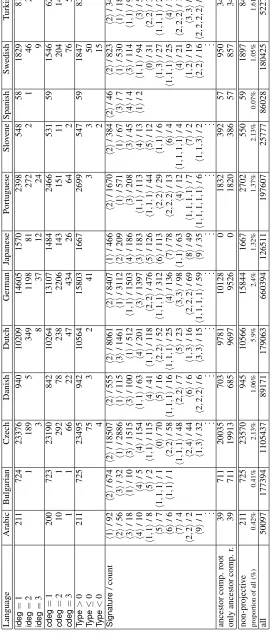
Our complete results for global constraints on de-pendency trees are given in Table 1. They confirm the findings of Kuhlmann and Nivre (2006): pla-narity seems to be almost as restrictive as projectiv-ity; well-nestedness, on the other hand, covers large proportions of trees in all languages.
In contrast to global constraints, properties of in-dividual non-projective edges allow us to pinpoint the causes of non-projectivity. Therefore they pro-vide a means for a much more fine-grained classifi-cation of non-projective structures occurring in natu-ral language. Table 2 presents highlights of our anal-ysis of edge measures.
Both interval and component degrees take gen-erally low values. On the other hand, Holan et al. (1998; 2000) show that at least for Czech neither of these two measures can in principle be bounded.
Taking levels of nodes into account seems to bring both better accuracy and expressivity. Since level signatures subsume level types as their last compo-nents, we only provide counts of edges of positive, nonpositive, and negative level types. For lack of space, we do not present full distributions of level types nor of level signatures.
Positive level types give an even better fit with real linguistic data than the global constraint of well-nestedness (an ill-nested tree need not contain a non-projective edge of nonpositive level type; cf. The-orem 10). For example, in German less than one tenth of ill-nested trees contain an edge of nonpos-itive level type. Minimum negative level types for Czech, Slovene, Swedish, and Turkish are
respec-tively−1,−5,−2, and−4.
Level signatures combine level types and compo-nent degrees, and so give an even more detailed pic-ture of the gaps of non-projective edges. In some languages the actually occurring signatures are quite limited, in others there is a large variation.
Because we consider it linguistically relevant, we also count how many non-projective edges contain in their gaps a component rooted in an ancestor of
the edge (anancestorof an edge is any node on the
path from the root of the whole tree to the parent node of the edge). The proportions of such non-projective edges vary widely among languages and for some this property seems highly important.
Empirical evidence shows that edge measures of non-projectivity taking into account levels of nodes
fit very well with linguistic data. This supports
our theoretical results and confirms that properties of non-projective edges provide a more accurate as well as expressive means for describing non-projective structures in natural language than the constraints and measures considered by Kuhlmann and Nivre (2006).
7 Conclusion
In this paper, we evaluate several constraints and measures on non-projective dependency structures. We pursue an edge-based approach giving promi-nence to properties of individual edges. At the same time, we consider levels of nodes in dependency trees. We find an edge-based approach also more appealing linguistically than traditional approaches based on properties of whole dependency trees or their subtrees. Furthermore, edge-based properties allow machine-learning techniques to model global phenomena locally, resulting in less sparse models.
We propose a new edge measure of
non-projectivity, level signatures of non-projective
edges. We prove that, analogously to level types, they relate to the constraint of well-nestedness.
Our empirical results on twelve languages can be summarized as follows: Among the global con-straints, well-nestedness fits best with linguistic data. Among edge measures, the previously unre-ported measures taking into account levels of nodes stand out. They provide both the best fit with lin-guistic data of all constraints and measures we have considered, as well as a substantially more detailed capability of describing non-projective structures.
The interested reader can find a more in-depth and broader-coverage discussion of properties of depen-dency trees and their application to natural language syntax in (Havelka, 2007a).
As future work, we plan to investigate more lan-guages and carry out linguistic analyses of non-projective structures in some of them. We will also apply our results to statistical approaches to NLP tasks, such as dependency parsing.
References
A. Abeill´e, editor. 2003. Treebanks: Building and Using
Parsed Corpora, volume 20 ofText, Speech and Language Technology. Kluwer Academic Publishers, Dordrecht.
S. Afonso, E. Bick, R. Haber, and D. Santos. 2002. “Floresta
sint´a(c)tica”: a treebank for Portuguese. InProceedings of
the 3rd Intern. Conf. on Language Resources and Evaluation (LREC), pages 1698–1703.
Manuel Bodirsky, Marco Kuhlmann, and Matthias M¨ohl. 2005. Well-nested drawings as models of syntactic structure. In
Proceedings of Tenth Conference on Formal Grammar and Ninth Meering on Mathematics of Language.
A. B¨ohmov´a, J. Hajiˇc, E. Hajiˇcov´a, and B. Hladk´a. 2003. The PDT: a 3-level annotation scenario. In Abeill´e (2003), chap-ter 7.
S. Brants, S. Dipper, S. Hansen, W. Lezius, and G. Smith. 2002.
The TIGER treebank. InProceedings of the 1st Workshop on
Treebanks and Linguistic Theories (TLT).
S. Buchholz and E. Marsi. 2006. CoNLL-X shared task on
multilingual dependency parsing. InProceedings of
CoNLL-X. SIGNLL.
M. Civit Torruella and Ma A. Mart´ı Anton´ın. 2002. Design
principles for a Spanish treebank. InProceedings of the 1st
Workshop on Treebanks and Linguistic Theories (TLT).
Alexander Dikovsky and Larissa Modina. 2000. Dependencies
on the other side of the Curtain. Traitement Automatique des
Langues (TAL), 41(1):67–96.
S. Dˇzeroski, T. Erjavec, N. Ledinek, P. Pajas, Z. ˇZabokrtsky, and
A. ˇZele. 2006. Towards a Slovene dependency treebank. In
Proceedings of the 5th Intern. Conf. on Language Resources and Evaluation (LREC).
J. Hajiˇc, O. Smrˇz, P. Zem´anek, J. ˇSnaidauf, and E. Beˇska. 2004. Prague Arabic dependency treebank: Development in data
and tools. InProceedings of the NEMLAR Intern. Conf. on
Arabic Language Resources and Tools, pages 110–117.
Eva Hajiˇcov´a, Jiˇr´ı Havelka, Petr Sgall, Kateˇrina Vesel´a, and Daniel Zeman. 2004. Issues of Projectivity in the Prague
Dependency Treebank. Prague Bulletin of Mathematical
Linguistics, 81:5–22.
Jiˇr´ı Havelka. 2005. Projectivity in Totally Ordered Rooted Trees: An Alternative Definition of Projectivity and Optimal Algorithms for Detecting Non-Projective Edges and
Projec-tivizing Totally Ordered Rooted Trees. Prague Bulletin of
Mathematical Linguistics, 84:13–30.
Jiˇr´ı Havelka. 2007a. Mathematical Properties of Dependency
Trees and their Application to Natural Language Syntax. Ph.D. thesis, Institute of Formal and Applied Linguistics, Charles University in Prague, Czech Republic.
Jiˇr´ı Havelka. 2007b. Relationship between Non-Projective
Edges, Their Level Types, and Well-Nestedness. In
Pro-ceedings of HLT/NAACL; Companion Volume, Short Papers, pages 61–64.
Tom´aˇs Holan, Vladislav Kuboˇn, Karel Oliva, and Martin Pl´atek. 1998. Two Useful Measures of Word Order Complexity.
In Alain Polgu`ere and Sylvain Kahane, editors,Proceedings
of Dependency-Based Grammars Workshop, COLING/ACL, pages 21–28.
Tom´aˇs Holan, Vladislav Kuboˇn, Karel Oliva, and Martin Pl´atek.
2000. On Complexity of Word Order. Traitement
Automa-tique des Langues (TAL), 41(1):273–300.
Y. Kawata and J. Bartels. 2000. Stylebook for the Japanese treebank in VERBMOBIL. Verbmobil-Report 240, Seminar f¨ur Sprachwissenschaft, Universit¨at T¨ubingen.
M. T. Kromann. 2003. The Danish dependency treebank and
the underlying linguistic theory. InProceedings of the 2nd
Workshop on Treebanks and Linguistic Theories (TLT).
Marco Kuhlmann and Joakim Nivre. 2006. Mildly
Non-Projective Dependency Structures. InProceedings of
COL-ING/ACL, pages 507–514.
Solomon Marcus. 1965. Sur la notion de projectivit´e [On the
notion of projectivity]. Zeitschrift f¨ur Mathematische Logik
und Grundlagen der Mathematik, 11:181–192.
Ryan McDonald, Fernando Pereira, Kiril Ribarov, and Jan
Hajiˇc. 2005. Non-Projective Dependency Parsing using
Spanning Tree Algorithms. InProceedings of HLT/EMNLP,
pages 523–530.
Ladislav Nebesk´y. 1979. Graph theory and linguistics (chapter
12). In R. J. Wilson and L. W. Beineke, editors,Applications
of Graph Theory, pages 357–380. Academic Press.
J. Nilsson, J. Hall, and J. Nivre. 2005. MAMBA meets TIGER:
Reconstructing a Swedish treebank from antiquity. In
Pro-ceedings of the NODALIDA Special Session on Treebanks.
Joakim Nivre. 2006. Constraints on Non-Projective
Depen-dency Parsing. InProceedings of EACL, pages 73–80.
K. Oflazer, B. Say, D. Zeynep Hakkani-T¨ur, and G. T¨ur. 2003. Building a Turkish treebank. In Abeill´e (2003), chapter 15.
K. Simov, P. Osenova, A. Simov, and M. Kouylekov. 2005. Design and implementation of the Bulgarian HPSG-based
treebank. InJournal of Research on Language and
Com-putation – Special Issue, pages 495–522. Kluwer Academic Publishers.
Neil J. A. Sloane. 2007. On-Line Encyclopedia
of Integer Sequences. Published electronically at
www.research.att.com/˜njas/sequences/.
L. van der Beek, G. Bouma, R. Malouf, and G. van Noord.
2002. The Alpino dependency treebank. InComputational
Linguistics in the Netherlands (CLIN).
Kateˇrina Vesel´a, Jiˇr´ı Havelka, and Eva Hajiˇcov´a. 2004. Con-dition of Projectivity in the Underlying Dependency