Segregation of Dopants at WC
/
Co and WC
/
WC Interfaces
in Solid-State-Sintered WC-VC-Cr
3C
2-Co Cemented Carbides
Masaru Kawakami
+and Kozo Kitamura
Fuji Die Co. Ltd., 36-1, Hadano 257-0015, Japan
The segregation of V and Cr at WC/Co and WC/WC interfaces in ultrafine-grained WC-0.7VC-1.4Cr3C2-10Co (mass%) cemented
carbides produced through solid-state sintering and semi-sintering was investigated. This segregation was compared against that of a liquid-state-sintered specimen to elucidate the mechanism by which WC grain growth is inhibited by V and Cr. The V and Cr were found to segregate at the WC/Co and WC/WC interfaces during solid-state sintering and semi-sintering, but no differences were observed in the V and Cr concentrations at the interfaces among the liquid-state-sintered, solid-state-sintered and semi-sintered specimens. Furthermore, these concentrations were unchanged by quenching of the solid-state-sintered specimen. From these results, it was concluded that (V,W,Cr)Cxsegregation layers are stably
formed at the WC/Co and WC/WC interfaces at a temperature below the solidus of the Co phase, but almost dissolve in the liquid Co phase once the temperature exceeds its liquidus. Thus, the (V,W,Cr)Cxsegregation layers observed at the WC/Co and WC/WC interfaces at room
temperature are formed during the cooling that follows the liquid-state sintering. This supports thefinding that WC grain growth is inhibited by the adsorption of dopant atoms onto steps/kinks on the WC surface during liquid-state sintering, as well as by the segregation layers formed on the WC surface during solid-state sintering. [doi:10.2320/matertrans.M2015198]
(Received May 25, 2015; Accepted August 19, 2015; Published October 2, 2015)
Keywords: ultrafine-grained cemented carbide, segregation layer, solid-state sintering, semi-sintering, phase equilibrium
1. Introduction
Submicron- and ultrafine-grained WC-Co-based cemented carbides are being used more frequently in micro-punches and sharp blades, as these have the advantages of superior hardness and higher compressive and edge strengths than medium-grained cemented carbides. These submicron- and ultrafine-grained cemented carbides are typically produced via liquid-state sintering using dispersed grains of WC powder less than 1 µm in size, in combination with Co powder as a binder phase and grain-growth inhibitors such as VC, Cr3C2, TaC or TiC powder.13)To ensure the stable production of cemented carbides with good mechanical properties, it is important to fully understand the WC grain-growth inhibition mechanism caused by the dopants during liquid-state sintering. This is because the appropriate amount of grain-growth inhibitor is dependent on the inhibition mechanism.
Lay et al. have reported that grain growth in VC-doped
WC-Co cemented carbides is inhibited by thin (V,W)Cx layers on the WC(0001) surface, which act as barriers to the precipitation of W onto the surface from the liquid Co phase.4)This is based on investigations of VC-doped WC-Co cemented carbides using high-resolution transmission mi-croscopy (HRTEM) and energy dispersive X-ray spectrosco-py (EDS), which have revealed segregation layers at the WC/Co interface that exhibit good matching between the (0001)WC and (111)VC lattice parameters. The presence of (V,W)Cx platelets within the WC grains and at stepped interfaces has also been identified. Based on investigation of an oil-quenched specimen, Sugiyama et al. have also reported that the (V,W)Cxlayer inhibits WC grain growth.5) On the other hand, Hayashi previously suggested (i.e., prior to studies4,5)) that WC grain growth is inhibited by the adsorption-desorption of dopants such as V, Cr, Ta and Ti at
steps/kinks during sintering.6)This was based on the premise that the solubility limit of dopants in the WC phase is fairly_low, and suggests that there is no segregation layer formed during liquid state sintering. It has been verified that the extent of segregation concentration at the WC/Co and WC/WC interfaces is reduced by an increase in the cooling rate following sintering,7)and although the grain growth rate is independent of the WC crystal orientation during liquid-state sintering, the degree of segregation at the interface is nevertheless dependent on the WC crystal orientation.7) Furthermore, the inhibition of grain growth by TaC addition in TaC-doped WC-Co cemented carbide is greater than that seen with TiC addition, despite their being no visible segregation layer on the WC(0001) surface.8)Based on these results, it would seem that the segregation layer of grain-growth inhibitors at the WC/Co interface cannot be present at the liquid-state-sintering temperature, but rather is formed during the cooling stage that follows sintering. Thus, the most important factor in determining the grain-growth inhibition mechanism during liquid-state sintering of sub-micron- and ultrafine-grained cemented carbide is knowing precisely when the grain-growth inhibitors segregate at the WC/Co and WC/WC interfaces.
If we consider the solubility of V in the Co-W-V-C phase (i.e., the liquid and solid Co phases) of a WC-VC-Co cemented carbide based on a pseudo-binary VC-Co phase diagram,9)then it is apparent that the amount of V added in a previous work7)was less than the solubility limit of V in the liquid Co phase, but greater than that in the solid Co phase. Given this difference in solubility limits, it is only natural to assume that (V,W)Cx segregates on the WC surface during cooling. However, if (V,W)Cxsegregates on the WC surface during sintering at temperatures below the Co solidus, then this would suggest not only that the (V,W)Cx layer exists stably at solid-state-sintering temperatures, but also that the V atoms have sufficient diffusion force to form a layer in the solid phase. The possibility also exists that the grain growth
+Corresponding author, E-mail: kawakami.2008@fujidie.co.jp
microstructures and chemical concentrations at the WC/Co and WC/WC interfaces in ultrafine-grained WC-VC-Cr3C2 -Co cemented carbides produced using liquid-state sintering, solid-state sintering and semi-sintering. The grain-growth-inhibitor segregation mechanism is also herein discussed by relating it to the phase equilibrium.
2. Experimental Procedure
A mixed powder of WC+0.7VC+1.4Cr3C2+10Co (mass%) was prepared by ball-milling commercially avail-able powders of WC (average particle size: 0.07 µm, produced by A.L.M.T. Corp., Japan), VC (0.8 µm, same producer as above), Cr3C2(1.5 µm, same producer as above) and Co (0.7 µm, produced by Umicore, Belgium). The carbon content was adjusted so that the value after sintering would be the middle value in the WC+Co two-phase region. This mixed powder was then uniaxially pressed at 1500 MPa to form green compacts with dimensions of 5 mm©10 mm©30 mm. These green compacts were sin-tered at 1273, 1473 and 1593 K for 3.6 ks under vacuum for semi-sintering, solid-state sintering and liquid-state sintering, respectively, and then cooled at a rate of 0.067 K/s. The temperatures of 1273 and 1473 K were chosen so as to be below the solidus of the Co phase (or more specifically, the Co-W-V-Cr-C solution), whereas the temperature of 1593 K was selected on the basis that it was above the liquidus of the Co phase. Specimens of WC-0.7 mass%VC-1.4 mass%Cr3C2-10 mass%Co (W-0.9 at%V-0.7 at%Cr-36.6 at%C-26.6 at%Co) without any discernible third phases, similar to carbon-deficient M6C-type complex carbides or graphite, were obtained. For comparative purposes, a quenched specimen was also prepared using a specimen sintered at 1473 K, which was achieved by reheating at 1473 K for 1.8 ks, followed by quenching in icy water. The quenching rate was estimated to be approximately 50 K/s based on the color variation of the specimen during the process.
Each of the four specimen types was fractured into two samples using a three-point bending method. One sample was used for scanning electron microscopy (SEM) analysis using an S-4800-type field emission scanning electron microscope (FE-SEM; Hitachi High-Technologies Corporation), while the other was used for HRTEM observation with a HF-2000-type field emission transmission electron microscope (FE-TEM; Hitachi High-Technologies Corporation) operating at an acceleration voltage of 200 kV. The fracture surfaces of the specimens used for SEM observation, excluding that sintered at 1273 K, were etched using dilute hydrochloric acid to remove the Co binder phase and allow the WC grains to be observed more clearly. The specimens for HRTEM observa-tion were cut to a size of 1 mm©2 mm©2 mm using a diamond blade cutter, polished to a thickness of 10 µm using a diamond wheel, and finally thinned to 3070 nm using an Ar-ion milling apparatus. The micro-region concentration of elements at the WC/Co and WC/WC interfaces was examined using a SIGMA-type EDS (Kevex Co. Ltd) with an effective analysis diameter of 3 nm. These concentrations
by EDS.
3. Results
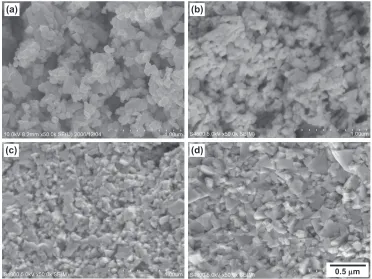
Figure 1 shows SEM micrographs of the mixed powder (a) and the fracture surfaces of specimens sintered at 1273 (b), 1473 (c) and 1593 K (d). It was noted that the specimen semi-sintered at 1273 K did not shrink because of the overly low temperature used, whereas almost fully densified sintered compacts were obtained by solid-state sintering at 1473 K and liquid-state sintering at 1593 K. The rounded WC grains of the semi-sintered specimen shown in Fig. 1(b) also reveal no evidence of grain growth from the mixed powder in Fig. 1(a). At the higher temperature of solid-state sintering (Fig. 1(c)), angular grains were formed as a result of intensified atom migration, but the grain size remained almost identical to that of the semi-sintered specimen. In the case of the specimen produced by liquid-state sintering (Fig. 1(d)), columnar triangle-shaped WC grains were observed to be scattered throughout the microstructure, with the WC grain size increased a little by the dissolution-reprecipitation of WC during liquid-state sintering. The grain growth rate is considered independent of the WC crystal orientation, because grains with a high aspect ratio that would indicate a difference in rate were not found in the microstructure.
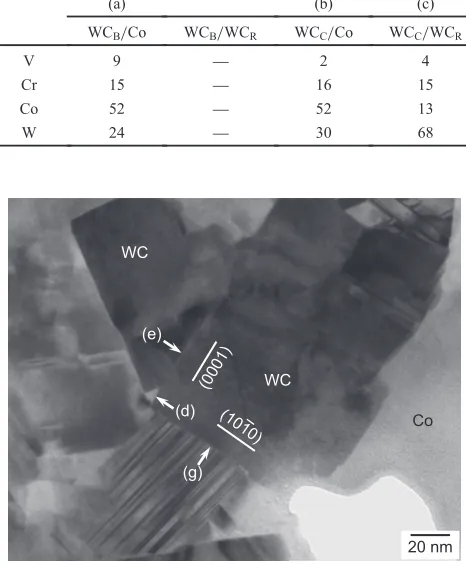
In the HRTEM micrograph of the liquid-state-sintered specimen shown in Fig. 2, the dark to light gray quadrangular regions are WC grains, whereas the other light gray region surrounding the WC grains is the Co phase. The right facet of the large WC grain at the center of the micrograph was determined to be the WC(0001) basal plane from the electron diffraction pattern. An enlarged micrograph of the interface between this WC(0001) basal plane and the Co phase (hereafter referred to as WCB/Co), indicated by arrow (a) in Fig. 2, is shown in Fig. 3, in which a layer of approximately 1 nm in thickness can be seen. The variation in the concentrations of V and Cr in the vicinity of this WCB/Co interface was therefore analyzed, as shown in Fig. 4, this revealed that the interface layer is enriched in V and Cr. The concentrations of the elements at the WCð1010Þ columnar plane/Co (WCC/Co) interface and theWCð1010Þ columnar plane/WC randomly oriented plane (WCC/WCR) interface, indicated by arrows (b) and (c) in Fig. 2, were also analyzed, the results of which are shown in Table 1. No data was obtained for the WC(0001) basal plane/WC randomly oriented plane (WCB/WCR) interface. It is evident from this that the V concentration at the interface is dependent on the WC crystal orientation, as was the case with a WC-VC-Co cemented carbide examined in a previous work.7) On the other hand, the Cr concentration at the interface is clearly independent of the WC crystal orientation. It was also confirmed that V, Cr and Co are segregated at the WCC/WCR interface.
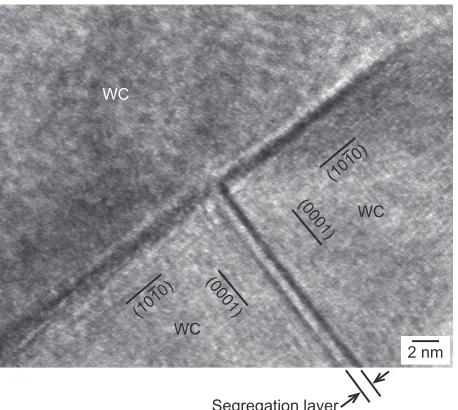
rearrangement of WC atoms was not significant. An enlarged micrograph taken in the vicinity of arrow (d) is shown in Fig. 6, in which a layer as pronounced as that seen in the liquid-state-sintered specimen can be observed at the WCB/ Co and WCB/WCRinterfaces. The concentration of elements at the WCB/Co, WCB/WCR and WCC/WCR interfaces, as indicated by arrows (e), (d) and (g) in Fig. 5, are listed in Table 2. The EDS result for the WCC/Co interface (Column (f ), Table 2) was obtained from another grain in the same specimen. With the solid-state-sintered specimen, it was found that V and Cr were segregated at all interfaces, while
Co segregation was confirmed only at the WCB/WCR and WCC/WCR interfaces. The V and Cr concentrations at the interface of solid-state-sintered specimen were identical to those of the liquid-state-sintered specimen.
Figure 7 shows a HRTEM micrograph of the specimen that was semi-sintered at 1273 K, in which rounded rectangle-shaped agglomerates of WC grains can be observed. The crystal orientation of the WC grains was determined from the electron diffraction pattern, but the orientation of the uppermost WC grain next to the agglomerates remains unknown. Layers were observed at (a)
0.5μμm
(d) (c)
(b)
Fig. 1 SEM micrographs of (a) mixed powder and fracture surfaces of WC-0.7VC-1.4Cr3C2-10Co cemented carbides sintered at (b) 1273,
(c) 1473 and (d) 1593 K. The fracture surfaces of the specimens sintered at 1473 and 1593 K were etched using dilute hydrochloric acid to remove the Co phase surrounding the WC grain.
(a)
(b)
(c)
20 nm
WC
Co
Co
WC
Fig. 2 HRTEM micrograph of a liquid-state-sintered specimen at 1593 K. Arrows (a), (b) and (c) indicate the concentration analysis points listed in Table 1.
WC Co
Segregation layer
2 nm
[image:3.595.112.484.70.349.2] [image:3.595.311.542.403.598.2] [image:3.595.54.284.405.588.2]the WCB/WCB and WCB/WCR interfaces, as shown in Fig. 8, with the concentration of elements at the WCB/Co, WCB/WCR and WCC/Co and WCC/WCC interfaces (the interfaces are indicated by arrows (h), (i), ( j) and (k), respectively) given in Table 3. Hence, it was found that both V and Cr segregated at the WCB/Co, WCB/WCR, WCC/Co and WCC/WCR interfaces, whereas Co segregated at the WCB/WCRand WCC/WCRinterfaces.
4. Discussion
Segregation of V and Cr was observed at the WC/Co and
WC/WC interfaces of all specimens examined in this study which, based on reports by Lay et al.,10) suggests that the segregated phase is most likely (V,W,Cr)C. We believe that the segregation layer does not exist above the liquidus
㻜 㻞 㻠 㻢 㻤 㻝㻜 㻝㻞
㻙㻝㻜 㻙㻤 㻙㻢 㻙㻠 㻙㻞 㻜 㻞 㻠 㻢 㻤 㻝㻜
㻯㼛
㼚㼏㼑㼚㼠
㼞㼍
㼠㼕
㼛
㼚㻌
㻔㼍
㼠㻑㻕
㻯㼞
㼂
㼃㻯 㻯㼛
㻰㼕㼟㼠㼍㼚㼏㼑㻌㼒㼞㼛㼙㻌㼃㻯㻔㻜㻜㻜㻝㻕㻛㻯㼛㻌㼕㼚㼠㼑㼞㼒㼍㼏㼑㻘㻌㻸㻛㼚㼙
[image:4.595.68.270.70.216.2]Fig. 4 Variation in V and Cr concentration as a function of distance from the WC(0001)/Co interface shown in Fig. 2.
Table 1 Concentration of elements (at%) at WCB/Co, WCC/Co and WCC/ WCR interfaces in WC-0.7VC-1.4Cr3C2-10Co (W-0.9 at%V-0.7 at%
Cr-36.6 at%C-26.6 at%Co) cemented carbide produced by liquid-state sintering at 1593 K for 3.6 ks. The analysis point is indicated in Fig. 2.
(a) (b) (c)
WCB/Co WCB/WCR WCC/Co WCC/WCR
V 9 ® 2 4
Cr 15 ® 16 15
Co 52 ® 52 13
W 24 ® 30 68
WC
Co
2 nm
WC
Fig. 6 HRTEM micrograph showing the WCB/Co interface of a specimen solid-state-sintered at 1473 K. This is a magnification of the region indicated by arrow (d) in Fig. 5.
Table 2 Concentration of elements (at%) at WCB/Co, WCC/Co and WCC/ WCR interfaces in WC-0.7VC-1.4Cr3C2-10Co (W-0.9 at%V-0.7 at%
Cr-36.6 at%C-26.6 at%Co) cemented carbide produced by solid-state sinter-ing at 1473 K for 3.6 ks. The analysis results (d), (e) and (g) were obtained from the corresponding analysis points shown in Fig. 5. The EDS result (f ) was obtained from another grain within the same specimen.
(d) (e) (f ) (g) WCB/Co WCB/WCR WCC/Co WCC/WCR
V 9 11 4 3
Cr 11 23 18 18
Co 36 10 40 14
W 44 56 38 65
(g) (e)
(d)
20 nm
WC
Co
WC
Fig. 5 HRTEM micrograph of a specimen solid-state-sintered at 1473 K. Arrows (d), (e) and (g) indicate the EDS analysis points listed in Table 2.
(h) (j)
(k) (i)
20 nm
WC
Co
WC
[image:4.595.311.543.73.277.2] [image:4.595.52.285.310.595.2] [image:4.595.310.543.441.686.2]temperature, but rather crystallizes during cooling after sintering because of the difference in the solubility limits of V and Cr in the liquid and solid Co phases. It is this association between the sintering temperature and phase diagram that is discussed below.
The liquidus temperature of undoped WC-Co cemented carbide in the WC+Co two-phase region is 1630 K for a low carbon content (L.C.), or 1571 K for a high carbon content (H.C.). This is based on the pseudobinary WC-Co phase diagram shown in Fig. 9, which was modified from that given in Ref. 11). However, the actual Co liquidus temperature of the specimen decreases from that given in Fig. 9 with increasing V, Cr and C. For example, Hashiya
et al. have reported that the temperature at which the
solidification of WC-1.7VC-1.7Cr3C2-31Co (mass%) begins is 1591 and 1522 K for L.C. and H.C., respectively.12)Since the carbon content of the specimens used in this study coincided with the middle value of the two-phase region, a sintering temperature of 1593 K was considered sufficiently high relative to the liquidus temperature of the Co phase. Also, as the added amounts of V and Cr were both below the solubility limit of these elements in liquid Co, the specimen consisted of solid WC grains and a liquid Co phase
containing W, C, V and Cr (i.e., a Co-W-V-Cr-C liquid solution) at the 1593 K sintering temperature.
We next considered the phase equilibrium between Co and VC using the VC-Co pseudobinary phase diagram shown in Fig. 10, excluding the solid WC grains for the sake of simplicity. The diagram was modified here based on Ref. 9). The VC phase most likely becomes a (V,W,Cr)C phase in a WC-VC-Cr3C2-Co cemented carbide, because W and Cr can replace a large number of the V atoms in the VC crystalline structure. The actual phase equilibrium of the VC and Co phase shifts to a lower temperature; i.e., the Co liquidus temperature is reduced by the inclusion of W, C, V and Cr. Based on Hashiya’s study,12) this lower temperature is estimated to be 3050 K. The solubility limit of V in the liquid and solid Co phases also decreases as a result of carbide formation, but as the liquid-state-sintering temper-ature was above the Co liquidus and the V : Co atomic composition ratio (0.7 : 26.6) of the specimen was still less than the reduced liquid solubility limit, no stable VC phase WC
2 nm
WC
WC
Segregation layer
Fig. 8 HRTEM micrograph of WC/WC interfaces in the vicinity of the WC/WC/WC triple point (the intersection point between the interfaces indicated by arrows (i) and (k)) in a specimen semi-sintered at 1273 K.
36
37
39
40
1423
Content of C / at%
38
1523
1573
1623
1473
1723
1673
1773
WC + L WC + L
+ CCo2W4
WC + Co + CCo2W4
WC +
Co
C + WC + Co
WC +
Co +
L
Te
mperature,
T
/ K
1571 1630
[image:5.595.319.533.68.284.2]Fig. 9 Vertical section of the C-Co-W ternary phase diagram at WC-16 mass%Co (modified from Ref. 11)).
Table 3 Concentrations of elements (at%) at WCB/Co, WCB/WCR, WCC/
Co and WCC/WCR interfaces in WC-0.7VC-1.4Cr3C2-10Co (W-0.9
at%V-0.7 at%Cr-36.6 at%C-26.6 at%Co) cemented carbide produced by semi-sintering at 1273 K for 3.6 ks. The analysis results (h), (i), (j) and (k) were obtained at the corresponding analysis points shown in Fig. 7.
(h) (i) ( j) (k) WCB/Co WCB/WCR WCC/Co WCC/WCR
V 12 6 5 6
Cr 9 13 13 8
Co 19 14 15 8
W 60 67 67 78
L
Co
VC + Co VC + L
VC + Co + L
1613
1873
1173 1573 1473
1373
1273 1773
1673
50 40 30 20 10 0
Content of VC / mol%
Te
mperature,
T
/ K
Co 1073
[image:5.595.56.285.69.274.2]1573
[image:5.595.329.520.335.523.2] [image:5.595.48.292.394.474.2]was formed during liquid-state sintering. It can therefore be concluded that the V dissolved completely in the Co liquid phase at the liquid-state-sintering temperature of 1593 K. During subsequent solidification of the Co phase, the VC phase (most likely a (V,W,Cr)Cxphase) should segregate due to the solubility limit of V in the solid Co phase being less than the amount added. Furthermore, this segregation is likely to preferentially occur at the interface between the WC grains and solid Co phase.
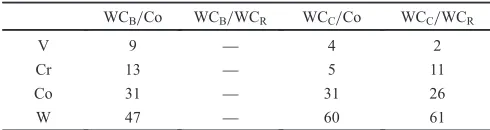
Given the phase equilibrium of VC and Co at the solid-state-sintering and semi-sintering temperatures, it is apparent from the pseudobinary VC-Co phase diagram in Fig. 10 that the (V,W,Cr)Cxphase at the WC/Co and WC/Co interfaces is in an equilibrium state at the sintering temperatures of 1473 and 1273 K. To investigate whether the V and Cr were segregated at the interfaces before holding or during cooling of the solid-state-sintered specimen, the V and Cr concen-trations at the interfaces of the specimens reheated to 1473 K and quenched were also investigated using a solid-state-sintered specimen, as shown in Table 4. The difference in the V concentration between Tables 2 and 4 (specifically, the effect of quenching from the Co solid state) is very small in comparison with the large difference in this value observed between specimens subjected to quenching and typical cooling from the Co liquid state in previous studies.7,13) The slight variation in concentration seen between the two different cooling rates for the solid-state-sintered specimen does, however, suggest the presence of a segregation layer at 1473 K. The minimal grain growth during solid-state sintering could be caused by a strong restriction of the dissolution-reprecipitation of the WC phase due to the existence of the (V,W,Cr)Cxsegregation layer formed under increasing temperature. Based on a thermodynamic calcu-lation by Johansson and Wahnström,14)the (V,W,Cr)C
xphase would be expected to dissolve in the Co phase. Moreover, the fact that the WC grain size of the liquid-state-sintered specimen was larger than that of the solid-state-sintered specimen suggests that grain growth during liquid-state sintering is made possible by dissolution of the (V,W,Cr)Cx layer on the WC surface formed under increasing temper-atures, in addition to an increase in the sintering temperature. Johansson and Wahnström reported that an ultrathin (V,W)Cxlayer with just two V atoms in thickness may exist stably on the WC(0001) surface at the high temperatures required for liquid-state sintering, under realistic condi-tions.14)They also determined that this ultrathin layer would hinder W diffusion into or out of the WC grains. If such an ultrathin layer were to exist stably at the WC(0001) surface, it is believed that the WC grain growth would then be strongly
increase in holding time during liquid-state sintering regard-less of their crystal orientation.4)Assuming that an ultrathin layer of 2-V atomic thickness exists on a WC(0001) surface with a triangular prismatic shape of 0.1-µm in side-length and 0.05-µm in height, in imitation of the specimens used in this study, the VC atomic ratio necessary for layer formation on the WC(0001) surface is estimated to be approximately 1.23%of the W atomic amount. If the grain growth inhibition mechanism is based on the presence of such an ultrathin layer, then WC grain growth cannot be sufficiently inhibited because the estimated atomic ratio necessary for the ultrathin layer to form is much greater than the actual V content of the specimen. However, in this study, ultrafine-grained WC-Co cemented carbide with sufficiently inhibited WC grain growth were in fact obtained, as shown in Fig. 1(d). On the other hand, if we assume a submicron-grained WC-Co cemented carbide consisting of WC grains with a triangular prismatic shape of 0.5-µm in side-length and 0.25-µm in height, WC grain growth can be inhibited using only a small amount of doped V because an ultrathin layer can form with just a small amount of V (0.25 at%) relative to the W content. Based on Ref. 15), WC grain growth inhibition due to VC increases with VC content up to the solubility limit in liquid Co (in this case, 2.2 at%V), where a WC-VC-20 mass%Co is reached. This means that if a stable (V,W)Cxlayer forms on a WC(0001) surface during liquid-state sintering, when the V content in the specimen is below the solubility limit of V in liquid Co, the grain growth inhibition effect is immune to the effects of any additional VC content. The above two considerations suggest that the WC(0001) surface in the VC-doped WC-Co cemented carbide is almost never covered by a (V,W)Cxlayer.
The authors support the conclusion that grain growth during liquid-state sintering is inhibited by the adsorption-desorption of dopants at steps/kinks on the WC grain surfaces.6,7) The formation of the segregation layer during solid-state sintering suggests that sufficient diffusion force is applied to the V and Cr atoms by heating to 1473 K for 3.6 ks to rearrange the original WC, VC, Cr3C2 and Co powder configurations in the solid phase. Hence, it is concluded that the (V,W,Cr)Cx segregation layers seen at the WC/Co and WC/WC interfaces at room temperature are formed during the cooling that follows the liquid-state sintering as a result of the solubility difference between the liquid and solid Co. Thus, the most effective amount of grain-growth inhibitor to use with WC is a value that lies immediately below its solubility limit in the liquid Co phase at the applied sintering temperature.
5. Conclusion
Through HRTEM and EDS analysis of the microstructure and chemical composition at the WC/Co and WC/WC interfaces in WC-0.7VC-1.4Cr3C2-10Co (mass%) cemented carbides produced by liquid-state-sintering, solid-state-sinter-ing and semi-sintersolid-state-sinter-ing, and their relation to the phase equilibrium of the WC-Co and VC-Co pseudobinary systems, the following conclusions have been reached:
for 1.8 ks using a solid-state-sintered specimen.
WCB/Co WCB/WCR WCC/Co WCC/WCR
V 9 ® 4 2
Cr 13 ® 5 11
Co 31 ® 31 26
[image:6.595.46.291.104.169.2](1) Both V and Cr segregate at WC/Co and WC/WC interfaces in liquid-state-sintered, solid-state-sintered and semi-sintered specimens, but their concentrations are independent of the sintering temperature.
(2) In solid-state sintering, the V and Cr concentrations at the WC/Co and WC/WC interfaces are independent of the cooling rate.
(3) A (V,W,Cr)Cx segregation layer is stably formed at sintering temperatures below the solidus temperature of the solid Co phase, but dissolves in the liquid Co phase once the sintering temperature exceeds the Co liquidus temperature.
(4) The (V,W,Cr)Cx segregation layer observed in the specimen at room temperature is mainly formed during solidification of Co, which occurs as a result of the difference in the solubility limit between liquid and solid Co.
(5) The WC grain growth inhibition mechanism during liquid-state sintering is based on the dopant adsorption/ desorption process at steps/kinks, which hinders W precipitation.
Acknowledgments
The authors would like to express their considerable appreciation to Prof. N. Masahashi (Institute for Materials Research, Tohoku University), who provided carefully considered feedback and valuable comments during the course of this research.
REFERENCES
1) K. Hayashi, Y. Fuke and H. Suzuki: J. Jpn. Soc. Powder Powder Metall.19(1972) 6771 [in Japanese].
2) H. Tulhoff: Mod. Develop. Powder Metall.14(1980) 269279. 3) A. Bock: Powder Metall. Int.24(1992) 2026.
4) S. Lay, J. Thibault and S. Hamar-Thibault: Philos. Mag.83(2003) 11751190.
5) I. Sugiyama, Y. Mizukami, T. Taniuchi, K. Okada, F. Shirase, T. Tanase, Y. Ikuhara and T. Yamamoto:Int. J. Refract. Met. Hard Mater.
30(2012) 185187.
6) K. Hayashi: Handbook of Ultrafine Powder, (Fuji Technosystem, Tokyo, 1990) pp. 509515 [in Japanese].
7) M. Kawakami, O. Terada and K. Hayashi:J. Powder Powder Metall.51
(2004) 576585.
8) M. Kawakami, O. Terada and K. Hayashi: J. Powder Powder Metall.52
(2005) 166171.
9) G. P. Dmitrieva, Z. B. Krasnokutskaya, N. N. Belyavina and A. K. Shurin:Sov. Powder Metall. Met. Ceram.28(1989) 233238.
10) S. Lay, S. Hamar-Thibault and A. Lackner:Int. J. Refract. Met. Hard Mater.20(2002) 6169.
11) J. Gurland: Trans. Metall. Soc. AIME200(1954) 285290. 12) M. Hashiya, Y. Kubo, C. Gieri and W. D. Schubert: Proc. the 17th Int.
Plansee Seminar Vol. 2, (Reutte, Plansee 2009) HM55, pp. 117. 13) M. Kawakami, O. Terada and K. Hayashi: Proc. Int. Plansee Seminar
Vol. 2, (Reutte, Plansee 2005) pp. 653667.
14) S. A. E. Johansson and G. Wahnström:Philos. Mag.90(2010) 599 609.
15) K. Hayashi, Y. Fuke and H. Suzuki: J. Powder Powder Metall. 19