Detecting and Correcting Morpho-syntactic Errors in Real
Texts
T h e o V o s s e *
Nijmegen Institute for Cognition and Information
University of Nijmegen
and
Cognitive Technology Foundation
P.O. Box 9104
6500 HE Nijmegen, The Netherlands
e-mail: [email protected]
Abstract
This paper presents a system which detects and corrects morpho-syntactic errors in Dutch texts. It includes a spelling corrector and a shift-reduce parser for Augmented Context-free Grammars. The spelling corrector is based on trigram and triphone analysis. The parser is an extension of the well-known Tomita algorithm (Tomita, 1986). The parser interacts with the spelling corrector and handles certain types of structural errors. Both modules have been integrated with a compound analyzer and a dictionary of 275,000 word forms into a program for stand-alone proof-reading of Dutch texts on a large scale. The system is in its final testing phase and will be commercially available as from 1992.
1. Introduction
One of the m o s t widely used applications of natural language processing is spell, g r a m m a r and style checking. Although m o s t p r o b a b l y semantic analysis is required to obtain entirely satisfactory results, it is n e v e r used - - for obvious reasons. Even worse, m o s t language checkers t o d a y even restrain from syntactic analysis. This denies them the possibility to find morpho-syntactic errors, which form a large a n d fre- quently occurring class of spelling errors. One of the best k n o w n systems for English, which does p e r f o r m syntactic analysis, is Critique (Richardson, 1988).
In order to detect and correct morpho-syntactic errors a system needs (I) m o d u l e s for word-level spell checking and correction, (2) a parser which contains a c o m p r e h e n s i v e g r a m m a r and an efficient parsing algorithm, a n d (3) a m e c h a n i s m to detect and correct g r a m m a t i c a l errors as well as to assist in correcting spelling errors. I will first define the domain of morpho-syntactic errors and motivate the
*The author's current address is: Experimental Psychology Unit, Leiden University, P.O. Box 9555, 2300 RB Leiden, The Netherlands.
need for a parser. After a brief o v e r v i e w of the sys- tem and a discussion of the word-level modules, I will describe the g r a m m a r formalism, the parser, its m e c h a n i s m for error detection, and a pre-processor for w o r d lattices. Finally, after looking at the integra- tion of the m o d u l e s a n d at some useful heuristics, I will give a s u m m a r y of the results obtained by a non-interactive Dutch g r a m m a r - d r i v e n spell checker.
2. Morpho-syntactic Errors
This p a p e r is concerned with three types of errors:
typographical errors
(typing errors or OCR scanning errors),orthographical
errors (erroneous translitera- tions of p h o n e m e s to g r a p h e m e s ) and, m o s t i m p o r - tantly,morpho-syntactic
errors (resulting from mis- application of morphological inflection and syntactic rules). Simple spell checkers are only able to spot er- rors leading to non-words; errors involving legally spelled w o r d s go unnoticed. These morpho-syntacfic errors occur quite frequently in Dutch texts, though, a n d are considered serious because they are seen as resulting from insufficient language competence rather than from incidental mistakes, such as typo- graphical errors. Therefore they constitute an inter- esting area for g r a m m a r checking in office and lan- g u a g e teaching applications. I will n o w present a classification of the morpho-syntacfic errors and some related errors in Dutch (Kempen and Vosse,1990).
2.1. Agreement violations
Typically syntactic errors are a g r e e m e n t violations. Though none of the w o r d s in the sentence
She walk
home
is incorrect, the sentence is ungrammatical. N o simple spelling checking m e c h a n i s m can find the er- ror, let alone correct it, since it is caused b y a relation between two w o r d s that need not be direct neigh- hours. Detection a n d correction of this type of error requires a robust parser, that can handle u n g r a m - matical input.2.2. Homophonous words
H o m o p h o n y is an important source of orthographi- cal errors: w o r d s having the same pronunciation but a different spelling. Dutch examples are ze/and zij, sectie and sexy, wort and wordt and achterruit and
achteruit. Such words are easily replaced by one of its h o m o p h o n o u s counterparts in written text.
The problem of current spell checkers is that they do not notice this substitution as the substitutes are legal words themselves. In order to detect this sub- stitution, a parser is required since often a change of syntactic category is involved. In section 4.3.2 1 will demonstrate that the treatment of these errors strongly resembles the treatment of non-words 1. Unfortunately, a parser cannot detect substitutions by h o m o p h o n e s which have the same syntactic properties.
2.3. H o m o p h o n o u s inflections
A special case of h o m o p h o n o u s w o r d s are words which differ only in inflection. This type of homo- p h o n y is very frequent in Dutch and French. French examples are donner, donnez, donnd, donnde, donnds
and donndes or cherche, cherches and cherchent. Dutch examples typically involve d/t-errors: -d, -t and -dt
sound identical at the end of a w o r d but they often signal different verb inflections. Examples are the forms gebeurt (third person singular, present tense) and gebeurd (past participle) of the verb gebeuren; word (first person, singular, present tense) and wordt
(third person, singular, present tense) of the verb
worden; and besteden (infinitive and plural, present
tense),besteedden (plural, past tense), and bestede (an adjective, derived from the past participle).
H o w e v e r , unlike the general case of h o m o p h o n - ous words, h o m o p h o n o u s inflections, by their very nature, do not alter the syntactic category of the w o r d but rather its (morpho-syntactic) features. So this type of error can be regarded as a h o m o p h o n o u s word or a spelling error, or as an agreement
violation.
2.4. Word doubling
Notoriously difficult to spot are w o r d doubling errors, especially at the end of a line ("Did you actually see the the error in this sentence?"). A parser surely notices it, b u t it should not fail to analyze the sentence because of this.
2.5. Errors in idiomatic expressions
Idiomatic expressions often cause problems for parsers since they often do not have a regular syn- tactic structure and some of their w o r d s m a y be ille- gal outside the idiomatic context. A Dutch example is te allen tijde (English: at all times), with the word
1I will not discuss typographical errors resulting in legal words (such as rotsen and rosten) since their treatment is similar.
tijde only occurring in idiomatic expressions. Whenever it occurs in a normal sentence it must be considered to be a spelling error. (An English exam- ple might be in lieu of.) The problem is even more serious in case of spelling errors. E.g. the expression above is more often than not written as te alle tijden,
which consists of legal w o r d s and is syntactically correct as well.
2.6. Split Compounds
Somewhat similar to idiomatic expressions is the case of c o m p o u n d nouns, verbs, etc. In both Dutch and German these must be written as single words. However, u n d e r the ever advancing influence of English on Dutch, m a n y c o m p o u n d s , especially new ones such as tekst verwerker (text processor) and
computer terminal are written separated by a blank, thus usually confusing the parser.
3. S y s t e m o v e r v i e w
The system presented here consists of two main levels: word level and sentence level. Before entering the sentence level (i.e., parsing a sentence), a spelling m o d u l e should check on all the w o r d s in the sen- tence. This is a rather simple task for a language such as English, but for morphologically complex languages such as Dutch and German, it is b y no means trivial. Because c o m p o u n d nouns, verbs and adjectives are written as a single word, they cannot always be looked u p in a dictionary, but have to be analyzed instead. There are three problems involved in c o m p o u n d analysis: (1) not e v e r y sequence of dic- tionary w o r d s forms a legal c o m p o u n d , (2) certain parts of a c o m p o u n d cannot be f o u n d in the dic- tionary and (3) full analysis usually comes u p with too m a n y alternatives. M y solution follows the lines set out in (Daelemans, 1987): a deterministic w o r d parser, constrained by the g r a m m a r for legal com- pounds, that comes u p with the left-most longest solution first. This solution is rather fast on legal c o m p o u n d s , while it takes at most O(n 2) time for nonexistent w o r d s and illegal compounds. The w o r d parser is built u p o n a simple morphological
analyzer, which can analyze prefixes, suffixes and some types of inflection. Both use a dictionary, containing 250,000 w o r d forms 2, derived from 90,000 Dutch lemmata, which appears to be sufficient for most purposes. There is also a possibility to add extra dictionaries for special types of text.
If a w o r d does not appear in one of the dictionar- ies and is not a legal c o m p o u n d either, the spell checker can resort to a correction module. In an interactive situation such a m o d u l e might present the user as m a n y alternatives as it can find.
Although this 'the-more-the-better' approach is very p o p u l a r in commercially available spell checkers, it is not a very pleasant one. It is also unworkable in a batch oriented system, such as the one I am describ- ing here. Ideally, a spelling corrector should come u p with one (correct!) solution, but if the corrector finds more than one alternative, it should assign a score or ranking order to each of the alternatives.
The system presented here employs a correction mechanism based on both a variation of trigram analysis (Angell et al., 1983) and triphone analysis (Van Berkel and De Smedt, 1988), extended with a scoring and ranking mechanism. The latter is also used in pruning the search space 3. Thus the system can handle typographical errors as well as ortho- graphical errors, and includes a satisfactory mecha- nism for ranking correction alternatives, which is suitable both for interactive environments as well as for stand-alone systems.
When all w o r d s of a text have been checked and, if necessary, corrected, a pre-processor (to be described in section 4.4) combines the words and their corrections into a word lattice. The syntactic parser then checks the grammatical relations be- tween the elements in this lattice. If the parsing re- sult indicates that the sentence contains errors, a syntactic corrector inspects the parse tree and pro- poses corrections. If there is more than one possible correction, it ranks the correction alternatives and executes the top-most one. Section 4 will describe the parser and the pre-processor in some detail. Due to space limitations, I have to refer to (Vosse, 1991) for further information, e.g. the adaptations that need to be m a d e to the Tomita algorithm in order to keep the parsing process efficient.
4. Shift-Reduce Parsing with ACFGs
4.1. Augmented Context-free Grammars
A u g m e n t e d Context-Free Grammars (ACFGs for short) form an appropriate basis for error detection and correction. Simply put, an ACFG is a Context- Free G r a m m a r where each non-terminal symbol has a (finite) sequence of attributes, each of which can have a set of a finite n u m b e r of symbols as its value.
3pruning the search space is almost obligatory, since trigram and triphone analysis require O(n*m) space, where n is the length of the word and m the number of entries in the dictionary. The constant factor involved can be very large, e.g. for words containing the substring ver, which occurs in more than seven out of every hundred words (13,779 triphones and 16,881 trigrams in 237,000 words).
In a rule, the value of an attribute can be represented by a constant or by a variable.
A simple fragment of an ACFG is for example:
1 S -~ N P ( N u m nora) V P ( N u m )
2 N P ( N u m ) -9 D e t ( N u m ) A D J s N o u n ( N u m ) 3 N P ( N u m C a s e ) -4 P r o ( N u m Case)
4 V P ( N u m ) -~ V e r b ( N u m i n t r a n s )
5 V P ( N u m ) - - ) V e r b ( N u m t r a n s ) N P ( acc) 6 A D J s -9
7 A D J s -9 A D J A D J s
The derivation of a sentence might go like this:
S ~ N P ( s g 3 nom) V P ( s g 3 ) ~ D e t (sg3) A D J s N o u n ( s g 3 ) V P ( s g 3 ) ~ D e t (sg3) N o u n ( s g 3 ) V P ( s g 3 )
D e t ( s g 3 ) N o u n ( s g 3 ) V e r b ( s g 3 i n t r a n s ) ~ a m a n e a t s
In the actual implementation of the parser, the grammatical formalism is slightly more complex as it uses strongly typed attributes and allows restric- t i o n s on the values the variables can take, thereby
making g r a m m a r writing easier and parsing more reliable. The Dutch g r a m m a r employed in the sys- tem contains nearly 500 rules.
4.2. T h e parser
The construction of the parsing table is accom- plished b y means of standard LR-methods, e.g. SLR(0) or LALR(1), using the "core" g r a m m a r (i.e. leaving out the attributes). The parsing algorithm it- self barely changes as compared to a standard shift- reduce algorithm. The shift step is not changed except for the need to copy the attributes from lexi- cal entries w h e n using a lexicon and a g r a m m a r with pre-terminals. The reduction step needs to be ex- tended with an instantiation algorithm to compute the value of the variables and a succeed/fail result. It should fail w h e n e v e r an instantiation fails or the value of a constant is not met.
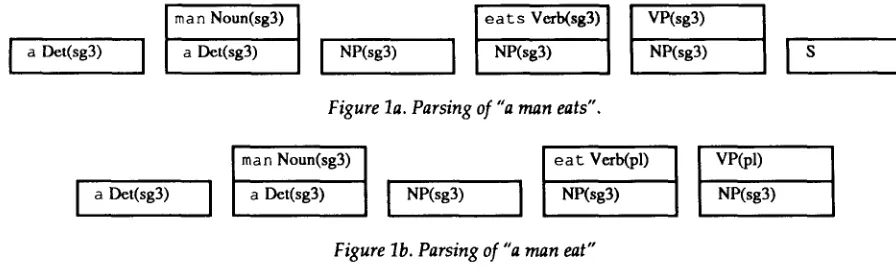
To accomplish this, the trees stored on the stack should include the values resulting from the evalua- tion of the right-hand side of the reduced rule. This makes the instantiation step fairly straightforward. The variables can be b o u n d while the elements are p o p p e d from the stack. If a variable is already bound, it must be instantiated with the correspond- ing value on the stack. If this cannot be done or if a constant value in a rule does not match the value on the stack, the reduction step fails. A simple example (not completely) following the g r a m m a r sample above m a y clarify this.
In Figure la parsing succeeds just as it w o u l d have done if only the context-free part of the gram- mar had been used. The only difference is that the symbols on the stack have attributes attached to them. In Figure l b however, parsing fails - - not be- cause the context-free part of the g r a m m a r does not accept the sentence (the parse table does contain an entry for this case) b u t because the instantiation of p l and s g 3 in rule 1 causes the reduction to fail.
Note that the mechanism for variable binding is not completely equivalent to unification. It typically differs from unification in the reduction of the fol- lowing two rules
a Det(sg3)
I man Noun(sg3) [
a
Det(sg3)
I NP(sg3)
e a t s
Verb(sg3)
NP(sg3)
[ VP(sg3)
NP(sg3)
[image:4.612.135.583.64.201.2]I
S Figure la. Parsing of "a man eats".a Det(sg3)
,I
man Noun(sg3)
a Det(sg3)
eat Verb(pl)
I NP(sg3) I NP(sg3)
VP(pl)
NP(sg3)
Figure lb. Parsing of " a man eat"
1 A --~ ... B ( X , Y) ... 2 B ( X , X) --~ ...
T h e reduction of rule 2 will leave t w o values o n the stack rather than an indication that the t w o vari- ables are o n e a n d the same. Therefore X a n d Y m a y differ after the reduction of rule 1.
4.3. Parsing Erroneous Input
4.3.1. Coercing syntactic agreement
Figure l b shows one type of problem I am interested in, but clearly not the w a y to solve it. Though the parser actually detects the error, it does not give enough information on h o w to correct it. It does not even stop at the right place 4, since the incongruity is only detected once the entire sentence has been read. Therefore the reduction step should undergo further modification. It should not fail w h e n e v e r the instan- tiation of a variable fails or a constant in the left- hand side of the rule being r e d u c e d does not match the corresponding value on the stack, but mark the incongruity and continue parsing instead. Later in the process, w h e n the parsing has finished, the syn- tactic corrector checks the marks for incongruity and coerces agreement b y feature propagation.
This approach contrasts with, e.g., the approach taken b y (Schwind, 1988), w h o proposes to devise an error rule (cf. section 4.3.3) for e v e r y unification error of interest. However, this makes efficient pars- ing with a large g r a m m a r nearly impossible since the size of the parsing table is exponentially related to the n u m b e r of rules.
4.3.2. Syntactic filtering
Consider the error in The yelow cab stops. The English spelling corrector on m y w o r d processor (MS-Word) offers two alternatives: yellow and yellows. Since the
4This of course is caused by the context-free part of the grammar. If we had created a unique non-terminal for every non-terminal-feature combination, e.g. s ->
N P _ s i n g 3 _ n o m V P _ s i n g 3 , parsing would have stopped at
the right place (i.e. between "man" and "eat"). This however depends mainly on the structure of the grammar. E.g. in Dutch the direct object may precede the finite verb, in which case agreement can only be checked after having parsed the subject following the finite verb. Then the parser cannot fail before the first NP following the finite verb. This is too late in general.
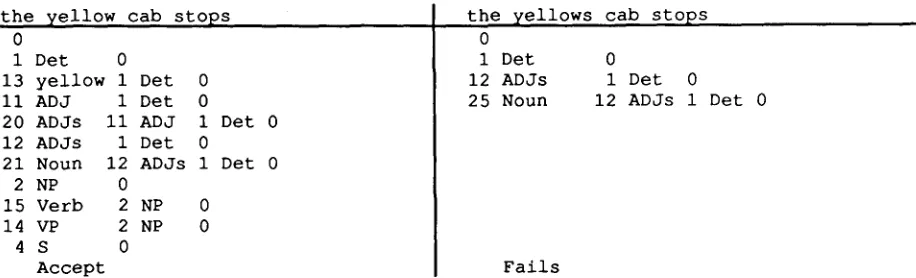
string yelow is obviously incorrect, it has no syntactic category and the sentence cannot be parsed. One might therefore try to substitute both alternatives and see what the parser comes u p with, as in Figure 2. This example clearly shows that the only gram- matically correct alternative is yellow. In this w a y a parser can help the spelling corrector to reduce the set of correction alternatives. Since a realistic natural language parser is capable of parsing w o r d s with multiple syntactic categories (e.g. stop is both a n o u n and a verb), the two entries for yelow can be parsed in a similar fashion. The grammatical alternative(s) can be found b y inspecting the resulting parse trees afterwards.
In order to handle errors caused by h o m o p h o n e s as well, this mechanism needs to be extended. When dealing with legal words it should use their syntactic categories plus the syntactic categories of all possible homophones, plus - - to be on the safe side - - e v e r y alternative suggested by the spelling corrector. Afterwards the parse trees need to be examined to see whether the original w o r d or one of its alterna- tives is preferred.
4.3.3. Error rules
The third and last category of errors the system attempts to deal with consists of the structural errors. General techniques for parsing sentences con- taining errors are difficult, computationaUy rather expensive and not completely fool-proof. For these reasons, and because only a v e r y limited n u m b e r of structural errors occur in real texts, I have developed a different approach. Instead of having a special mechanism in the parser find out the p r o p e r alterna- tive, I a d d e d error rules to the formalism. The g r a m m a r should n o w contain foreseen i m p r o p e r constructions. These might treat some rare con- stituent order problems and punctuation problems.
4.3.4. Parsing weights
t h e y e l l o w c a b s t o p s
0
1 D e t 0
13 y e l l o w 1 Det 0 ii A D J 1 D e t 0 20 A D J s ii A D J 1 Det 12 A D J s 1 D e t 0 21 N o u n 12 A D J s 1 D e t
2 NP 0
15 V e r b 2 NP 0
14 V P 2 NP 0
4 S 0
A c c e p t
t h e y e l l o w s c a b s t o p s
0
1 Det 0
12 A D J s 1 D e t 0 25 N o u n 12 A D J s 1 Det
[image:5.612.63.521.55.194.2]F a i l s
Figure 2. The parsing of the two alternatives for "the yelow cab stops".
would result in one parse tree without an error mes- sage and five parse trees indicating that the n u m b e r of they does not agree with the n u m b e r of think. By using sets of values instead of single values this n u m b e r can be reduced, but in general the n u m b e r of parses will be very large. Especially with larger grammars and longer sentences there will be large amounts of parses with all sorts of error messages. A simple m e t h o d to differentiate between these parses is to simply count the n u m b e r of errors, agreement violations, structural errors and spelling errors in each parse, and to order the parses accord- ingly. Then one only has to look at the parse(s) with the smallest n u m b e r of errors. However, this concept of weight needs to be extended since not all errors are equally probable. Some types of agreement viola- tion simply never occur whereas others are often found in written texts. Orthographical and typo- graphical errors and h o m o p h o n e substitution are frequent p h e n o m e n a while structural errors are rela- tively rare. Suppose the parser encounters a sentence like Word je broer geopereerd? (Eng.: Are your brother (being) operated?). In Dutch this is a frequent error (see section 2.3), since the finite verb should indeed
be word if je instead of je broer were the subject. (Translating w o r d - b y - w o r d into English, the correc- tion is either/s your brother (being) operated? or Are
you brother (being) operated? Je is either you or your.)
The most likely correction is the first one. H o w can a syntactic parser distinguish between these two alternatives? M y solution involves adding error weights to g r a m m a r rules. These cause a parse in which verb transitivity is violated to receive a heav- ier penalty than one with incorrect subject verb agreement. Thus, parse trees can be ordered accord- ing to the sum of the error weight of each of their nodes.
4.4. W o r d Lattices
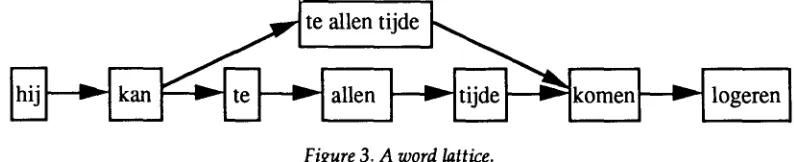
As noted in section 2.5, idiomatic expressions cause parsers a lot of trouble. I therefore propose that the parser should not operate directly on a linear sen- tence, but on a w o r d lattice that has been prepared b y a pre-processor. For a sentence like Hij kan te allen tijde komen logeren (he can come to stay at all tim~)
such a structure might look like Figure 3. Instead of parsing each w o r d of the expression te allen tijde sep-
arately, the parser can take it as a single w o r d span- n i n g three w o r d positions at once or as three sepa- rate words. Should one of the words in the expres- sion have been misspelled, the pre-processor builds a similar structure, but labels it with an error mes- sage containing the correct spelling obtained from the spelling corrector. Word lattices can of course become much more complex than this example.
Since there is a pre-processor that is able to com- bine multiple w o r d s into a single item, it might as well be used to aid the parser in detecting two fur- ther types of errors as well. The first one is the Dutch split compound. By simply joining all the adjacent nouns (under some restrictions) the g r a m m a r and the parser can proceed as if split c o m p o u n d s do not occur. The second error type is w o r d doubling. The pre-processor can join every subsequent repetition of a word with the previous occurrence so that they will be seen both as two distinct w o r d s and as one single word (since not e v e r y occurrence of w o r d repetition is wrong). Another possibility is to con- catenate adjacent words w h e n the concatenated form occurs as one entry in the dictionary. E.g. m a n y people do not k n o w w h e t h e r to write er op toe zien, erop toezien, erop toezien or a n y other combination (though a parser might not always have the right answer either).
5. Integration and Heuristics
The combination of the modules described above - - a spell checker with c o m p o u n d analysis, a spelling corrector, a robust parser and a syntactic corrector - - does not lead by itself to a batch- oriented proof-reading system. Most texts do not only contain sentences, but also rifles and chapter headings, captions, jargon, p r o p e r names, neolo- gisms, interjections, dialogues ("yes", she sa/d, "yes, that is true, but..."), quotations in other languages, literature references, et cetera, not to mention mark- u p and typesetting codes. The system therefore has a mechanism for dealing with the layout aspects of
° o
[image:6.612.154.551.63.144.2]logeren I
Figure 3. A word lattice.
texts and some heuristics for dealing with p r o p e r names, jargon and neologisms. The layout aspects include m a r k - u p codes and graphics, title markers and a mechanism for representing diacritics, such as the diaeresis, which is frequent in Dutch.
Dictionaries seldom contain all words found in a text. In Dutch, part of the problem can be solved by using c o m p o u n d analysis. However, a misspelled word can sometimes be interpreted as a c o m p o u n d , or as two w o r d s accidentally written together. I par- tially solved this problem b y having the c o m p o u n d analyzer repeat the analysis without the word gram- mar if it fails with the w o r d grammar, and by defin- ing a criterion which marks certain c o m p o u n d s as "suspicious "s. If the analyzer marks the c o m p o u n d
as either suspicious or ungrammatical, the spelling corrector is invoked to see if a good alternative (i.e. closely resembling and frequent word) can be found instead, or, else, if the c o m p o u n d was ungrammati- cal, whether it can be split into separate words. This process is further i m p r o v e d by adding the correct c o m p o u n d s in the text to the internal word list of the spelling corrector.
Other w o r d s that do not appear in a dictionary are p r o p e r names, jargon and neologisms. Therefore the system first scans the entire text for all w o r d types while counting the tokens before it starts pars- ing. M y rule of t h u m b is to treat words, that appear mainly capitalized in the text as p r o p e r names. Frequently occurring words, that do not have a good correction, are supposed to be neologisms. Both p r o p e r n o u n s and neologisms are a d d e d to the in- ternal w o r d list of the spelling corrector. The main disadvantage of this approach is that it misses con- sistently misspelled words. At the end of the run therefore, the system provides a list of all the words it tacitly assumed to be correct, which must then be checked manually.
Another feature of the system is that it coerces variant spelling into preferred spelling. This feature also takes c o m p o u n d s which have is no official pre- ferred spelling into consideration, thus preventing c o m p o u n d to be written in different ways. E.g. both
5Misspelled word can often be analyzed as sequences of very small words. E.g. the misspelled
kwaliteitesverbetering (which should be kwaliteitsverbetering,
Eng.: quality improvement) can be divided into
kwaliteit +es+verbetering, which could mean quality ash
improvement. The amount of overgeneration correlates strongly with the size of the dictionary.
spellingcorrectie and spellingscorrectie (Eng.: spelling correction) are correct in Dutch. M y system only allows one to occur in a text and coerces the least frequently occurring variants into the most frequent one.
The last but not least important tricks help to re- duce parsing time. Since the system cannot detect all types of errors with equal reliability (cf. section 6), I a d d e d a d/t-mode in which only sentences that might
contain a d/t-error (cf. section 2.2) are parsed. In this m o d e a pre-processor first checks w h e t h e r the sen- tence contains such a "d/t-risk" word. If this is the case the parser is invoked, b u t the error messages not pertaining to this class of errors are suppressed. As d/t-risks show u p in less than a quarter of all sen- tences, parsing time is cut b y a factor of four at least. Although this solution can hardly be called elegant, it gives the user a faster and m o r e reliable system.
There also is an u p p e r b o u n d on the n u m b e r of allowed parses. Because analyzing a parse tree takes some time, this speeds u p the process. The disadvan- tage is that the system m a y choose an unlikely cor- rection more often as it cannot c o m p a r e all parse trees. Large sentences with multiple errors m a y pro- duce thousands of parse trees, each of which has to be scored for comparison. As the allowed n u m b e r of parses becomes less than the potential n u m b e r of parses, the probability that the system overlooks a likely correction grows. But since it produces an error message anyway, albeit an unlikely one, the advantage outweighs the disadvantage.
6. Results and Evaluation
The system described in this p a p e r has been built as a practical writing aid that operates non-inter- actively, because the first phase (determining w o r d types, c o m p o u n d analysis, initial spelling correction, and cross-checking corrections for the entire text) takes too long. Nevertheless, it can easily process more than 25 w o r d s per second 6 for a large text, which m a y easily take u p half an h o u r or more.
As an example of the performance in the word level checking phase, I presented the system with a
6I have written the system in the programming language C. The results reported below were obtained
r a n d o m sample of 1000 lines from two large texts 7. The sample contained nearly 6000 words, with 30 true spelling errors. Of these, 14 were corrected appropriately, and 14 were found but substituted by an incorrect alternative or not corrected at all. Of the 14 appropriately corrected errors, 9 were errors in diacritics only. The system only missed 2 errors, which it assumed to be p r o p e r names (both reported at the end of the file (cf. section 5)). It also produced 18 false alarms, 11 of which were caused by very in- frequent jargon or inflected w o r d forms missing from the dictionary.
Comparison with other spell checkers is hardly possible. For Dutch, only elementary spell checkers based on simple w o r d lookup are available. If this m e t h o d is applied to the sample text with the same dictionary as used in the full system, the result is en- tirely different. Such a simple spell checker marks 217 w o r d s as misspelled. Among these are not only the 21 true errors and the 9 errors wrongly placed diacritics, but also 37 abbreviations and p r o p e r names, and 150 compounds. This amounts to a total of 187 false alarms!
The sentence level requires considerably more time. Error-free short sentences can be parsed at a speed of four or more w o r d s per second, but long sentences containing one or more errors m a y require several seconds per w o r d (including correction, which is also rather time consuming). For the texts mentioned in footnote 7 (110,000 w o r d s in total), the CPU time required for parsing was approximately 7 hours.
But what counts is not only speed; quality is at least equally important. Preliminary tests have shown satisfactory results. A 150 sentence spelling test for secretaries and typists, with an average sen- tence length between six and seven, was performed within nine minutes (elapsed time) leaving only three errors undetected, correcting the other 72 errors appropriately and producing no false alarms. (Human subjects passed the test if they could com- plete it within ten minutes making at most ten mis- takes.) The three undetected errors involved seman- tic factors, and were therefore b e y o n d the scope of the system. The rightly corrected errors were typo- graphical and (mainly) orthographical errors, agreement errors and errors in idiomatic expres- sions.
7These manuscripts are representative for texts
s u b m i t t e d to the system by a publisher who has access to
it. A typical example is a text concerning employment legislation and collective wage legislation of over 660,000 characters (a total of 92,000 words) of plain text with mark-up instructions. Checking the words and correcting misspelled words took 16 CPU minutes, which results in a speed of nearly 100 words per CPU second. A smaller text
in the same content domain (150,000 characters in 27,500 words) was checked and corrected at word level in 4.5 minutes of CPU time, which is over 100 words per CPU second.
Other spelling exercises also showed good results (most errors detected and most corrected properly, very few false alarms, if any). A typical text was cho- sen from a text book with correction exercises for pupils. In contrast with the spelling test described in the previous paragraph, most sentences in this test contained more than one spelling error. The errors varied from superfluous or missing diaeresis to split c o m p o u n d s and d/t-errors. On a total of 30 sentences,
the system discovered 75 errors, of which 62 were corrected properly, 12 miscorrected and one was given no correction at all; it missed 7 errors, while producing one false alarm. Although the total num- ber of words was only half the n u m b e r of words in the previous test (457 to be precise), the system took almost three times as much time to process it. This was partly due to the greater average sentence length (over 15 words per sentence) and the occur- rence of more than one error per sentence (up to four per sentence). The n u m b e r of errors that could not have been detected w i t h o u t a parser was 18. Of these, 10 were corrected and 1 was detected but substituted by a w r o n g alternative, while the parser missed the 7 errors mentioned earlier.
On large real texts, i.e. not constructed for the purpose of testing one's knowledge of spelling, the system performed less well due to parsing problems. As an example of a well written text, I took the first 1000 lines of a text mentioned in footnote 7. This sample consisted of 7443 words in 468 sentences (an average of nearly 16 words per sentence). At w o r d level it performed quite satisfactorily. It caused 12 false alarms 8, while detecting 11 true errors, of which only 4 were properly corrected. The com- p o u n d analysis functioned almost flawlessly. However, it caused 6 of the 12 false alarms, because one single word, which was not in the dictionary, appeared in 4 different compounds. The heuristics for suspicious w o r d s cooperated very well with the spelling correcter (6 correct guesses, 2 wrong).
The parser's performance h o w e v e r degraded considerably. One reason was the great length of m a n y sentences (up to 86 words). This sometimes caused the parser to exceed its built-in time limit, so that it could not give a correct error message 9. Long sentences are also highly ambiguous. This increases the probability of finding a very awkward but error- free parse, thereby overlooking real errors. Another reason for the performance degradation was the a b u n d a n t use of interjections, names (between quotes, dashes or parentheses) and colloquial (ungrammatical) expressions. Although the parser has some provisions for simply skipping such con-
8In 4 cases, the false alarm was caused by word contraction. E.g. the word echtgeno(o)t(e), which is supposed to mean echtgenoot of echtgenote (husband or wife),
was marked incorrect and substituted by echtgenoot.
9Unfortunately, the program does not keep track of
this, so no data can be specified.
structions, they more often than not interfere with error detection. Fortunately, subject-verb agreement errors indicating
d/t-errors
were spotted quite reli- ably, although their number (two in this sample, which were both corrected) is too small to draw any firm conclusion. The detection of punctuation errors and split compounds still needs improvement. Whether the results justify the 30 minutes CPU time it took to parse the 468 sentences remains to be seen.7.
Conclusions
I have shown the feasibility of building a practical grammar-based spell checker that detects and cor- rects the important class of morpho-syntactic errors in normal texts (i.e., texts that have not been spe- dally prepared before processing). The system de- scribed in this paper is the first example of such a spell checker for Dutch. It is currently being tested at a large publishing company.
I have demonstrated what can be expected of the approach I have taken. Depending on the complexity of the sentences, the combination of a word-level spell checker plus a syntactic parser performs from nearly perfect to satisfactory in regard to morpho- syntactic errors. Other types of errors cannot be handled reliably with the current framework, partly due to the permissive nature of both grammar and dictionary. However, enrichment of grammar and lexicon is only possible on an ad hoc basis. It will not lead to a systematic improvement of the correction process. Moreover, it is likely to interfere with the other components. Although many details still have to be worked out, the limits of this approach become visible. The next major improvement must come from analysis beyond syntax.
Acknowledgements
The author would like to thank (in random order): Edwin Bos for commenting on earlier versions of this paper; Alice Dijkstra, for her work on this pro- ject and for proof-reading and commenting on this paper; and Gerard Kempen, project leader, for dis- cussions and comments.
References
Angell, R.C., G.E. Freund, P. Willet. 1983. Automatic spelling correction using a trigram similarity measure.
Information Processing and Management
(19), pp. 255-261.Berkel, Brigitte van, and Koenraad de Smedt. 1988. Triphone analysis: a combined method for the correction of orthographical and typographical errors. In:
Proc. 2nd Conference on applied natural
language processing.
Association for Computational Linguistics, pp. 77-83.Daelemans, W. 1987.
Studies in language technology:
an object-oriented model of morpho-phonological aspects
of Dutch.
Ph.D. dissertation, University of Leuven.Kempen, Gerard, and Theo Vosse. 1990. A language sensitive editor for Dutch. In:
Proc. Computer &
Writing III Conference,
Edinburgh.Nakazawa, Tsuneko. 1991. An extended LR parsing algorithm for grammars using feature-based syntactic categories. In:
Proc. 5th Conference of the
European chapter of the ACL,
Berlin. pp. 69-74.Richardson, S.D. 1988. The experience of developing a large-scale natural language text processing system: CRITIQUE. In:
Proc. 2nd Conference on
Applied Natural Language Processing.
Association for Computational Linguistics.Schwind, Camilla. 1988. Sensitive parsing: error analysis and explanation in an intelligent language tutoring system. In:
Proc. COLING "88,
Budapest, pp. 608-613.Tomita, Masaru. 1986.
Efficient parsing for natural
language: a fast algorithm for practical systems.
Dordrecht, Kluwer.
Vosse, Theo. 1991. Detection and correction of morpho-syntactic errors in shift-reduce parsing. In:
Tomita' s Algorithm: Extensions and Applications. R.