Munich Personal RePEc Archive
Commitment Problems in Conflict
Resolution
Kimbrough, Erik and Rubin, Jared and Sheremeta, Roman
and Shields, Timothy
10 January 2015
Online at
https://mpra.ub.uni-muenchen.de/61463/
Commitment Problems in Conflict Resolution
Erik O. Kimbrough, Simon Fraser University
Jared Rubin, Chapman University
Roman M. Sheremeta, Case Western Reserve University
Timothy W. Shields, Chapman University
January 2015
Abstract
Commitment problems are inherent to non-binding conflict resolution mechanisms, since an unsatisfied party can ignore the resolution and initiate conflict. We provide experimental evidence suggesting that even in the absence of binding contractual agreements individuals often avoid conflict by committing to the outcome of a conflict resolution mechanism. Commitment problems are mitigated to a greater extent for groups that opt-in to the conflict resolution mechanism, but only when opting-in is costly. Although conflict rates are higher when opting-in is costly than when it is free or exogenously imposed, commitment problems are greatly reduced among those groups who choose to opt-in.
JEL Classifications: C72, C91, D72
Keywords: conflict resolution, commitment problem, opting-in, contests, experiments
Corresponding author: Roman M. Sheremeta, [email protected]
1 1. Introduction
Since Schelling (1960) initiated the formal study of conflict, economists and others have
developed numerous models highlighting the resources wasted when conflict occurs (Tullock,
1980; Konrad, 2009). Empirical studies testing these models indicate that in practice the costs of
conflict are substantially higher than predicted by the theory (Sheremeta, 2013; Dechenaux et al.,
2015). For this reason, there has been extensive research on mechanisms of conflict resolution
that allow parties to avoid these costs, all of which depend on the ability to make credible
commitments and/or binding contracts enforced by a third party (see e.g., Schelling, 1960;
Williamson, 1985; Charness et al., 2007; Kimbrough and Sheremeta, 2013; Kimbrough et al.,
2014). Yet, in reality, many conflict resolution efforts cannot rely on credible commitments or
enforceable contracts.
The problems associated with the inability to commit are well known: in the absence of
credible commitment, parties on the less favored side of any proposed resolution face incentives
to ignore the resolution. Such commitment problems arise both on a macro level between
countries and competing economies, as well as on a micro level between individuals. For
example, a country that finds a UN resolution counter to its interests could simply exit the
organization and ignore the international community. A similar commitment problem can help to
explain the failures of recent WTO negotiations and the Kyoto Protocol as well as the difficulty
of enforcing nuclear restrictions in North Korea and Iran.1 Agreements between individuals often
face similar problems, especially when third-party enforcement mechanisms are unavailable.
Historically, weak and decentralized political rule made many contractual agreements legally
unenforceable (Milgrom et al., 1990; Greif et al., 1994; Greif, 2000), and similar troubles plague
2
contemporary societies where the rule of law is absent or weak. Even when the rule of law is
present many contracts remain unenforceable, and commitment problems arise due to imperfect
information and incomplete contracts (Harris and Raviv, 1979; Holmström, 1979; Baker, 1992;
Tirole, 1999).
Given the ubiquity of commitment problems in conflict resolution, there has been
surprisingly little empirical work exploring the possibility of conflict resolution in the absence of
binding commitments.2 Some conflict resolution mechanisms have been examined in the lab,
including side-payment agreements (Charness et al., 2007; Kimbrough and Sheremeta, 2013,
2014), pre-commitment to an allocation proposed by a random device (Kimbrough et al., 2014),
communication (Cason et al., 2013), and repeated interactions (Lacomba et al., 2014). Also,
some animal behavior studies indicate that many non-human species employ non-binding
resource-allocation conventions built around asymmetries between parties that are uncorrelated
with their fighting abilities (Petrie et al., 1991; Maher and Lott, 2000).3 The main difference of
our paper is that we examine an environment in which parties may choose to ignore their
previously made commitments to a conflict resolution mechanism. This is a crucial difference
that allows us to examine commitment problems in conflict resolution.
In this paper, we explore whether (and how) non-binding conflict resolution mechanisms
reduce conflict and overcome commitment problems. We conduct an experiment where
participants face potential conflict over a valuable, indivisible resource. Parties may choose to
2 See, for example, the review of experimental literature on conflicts by Dechenaux et al. (2015).
3 An important difference between the papers cited in this paragraph, as well as the present paper, and other papers
3
allocate the resource by costly conflict (i.e., a rent-seeking contest), or they can choose to
employ a conflict resolution mechanism that allocates the resource at random (i.e., a coin flip),
allowing them to avoid the costs of fighting. However, for this mechanism to be effective, both
participants must first opt-in to learn the proposed allocation and then mutually commit to the
outcome. If either party chooses not to commit, the parties fight over the resource. In the stage
game, the indivisibility of the resource is crucial because it creates a “hard case” for conflict
resolution efforts: commitment requires one party to accept inequality.
In our experiment the game is finitely repeated in fixed groups of two subjects.
Money-maximizing game theoretic arguments for finitely repeated games predict that even if both
parties opt-in to observe the proposed allocation, the losing party will never commit to the
outcome. However, if we relax the assumption of homogenous agents, and instead allow for the
existence of ‘types’, then in repeated setting a strategic agent might mimic a cooperative type
and commit to the outcome. While the stage game is different from our own, other analytical
work solves for the equilibrium behavior where a strategic agent mimics the behavior of another
‘cooperative type’ before revealing their true type (e.g., Kreps and Wilson, 1982; Kreps et al.,
1982).4 Also, if one allows for subjects to have other-regarding social preference (e.g., Fehr and
Schmidt, 1999), then cooperation can be sustained in finitely repeated games. Indeed, existing
experimental studies provides evidence of cooperation (Camerer, 2003) which is not predicted
by a finitely repeated game theoretic analysis but which can be rationalized by the existence of
‘types’ and/or pro-social preferences. In light of this work, the repeated nature of our game may
allow subjects to avoid the costs of conflict by mutually agreeing to conflict resolution in each
4 Kreps and Wilson (1982) solve a sequential equilibrium in a finitely repeated entry-deterrence game. Kreps,
4
period – effectively taking turns receiving the prize. Since the conflict resolution mechanism is
unbiased and procedurally fair (a coin flip), with repetition, expected payoffs for a cooperating
pair are equal and double the expected earnings from conflict. Thus, given the potential gains
from cooperation, individuals may agree to avoid conflict despite such behavior being
inconsistent with the money-maximizing equilibrium.
Our treatments are designed to explore the willingness of individuals to commit to such
conflict mitigating agreements in three settings that help us understand their motivations for
commitment. The Exogenous-Free treatment, in which there is no opt-in decision and all pairs
see the proposed random allocation, allows us to measure the willingness to commit in a strict
test of the model. The Endogenous-Free and Endogenous-Costly treatments, in which parties
must first opt-in to learn the proposed allocation and then choose whether to commit, allow us to
examine alternative mechanisms for encouraging cooperation. In particular, these treatments are
motivated by the idea that endogenizing the decision to employ an institution may increase that
institution’s effectiveness by encouraging individuals to adhere to it. This effect may operate
through a number of channels: (1) endogenizing the decision may increase the “legitimacy” of
the proposed allocation, (2) it may increase the expected costs of conflict by encouraging
retaliation by those who receive the resource provisionally and then learn that their counterpart
has rejected the proposed allocation, and (3) the act of opting-in may reveal information about a
player’s willingness to adhere to the institution, particularly when opting-in is costly (i.e., in the
Endogenous-Costly treatment, opting-in may be seen as “expensive talk”).
In fact, we observe many instances in which individuals avoid conflict by committing to
the outcome of a coin flip; conflict resolution rates range between 20%-54%, depending on the
5
is strategic, consistent with the idea that our repeated game facilitates cooperation. Commitment
problems are further mitigated when groups endogenously choose to opt-in to the conflict
resolution mechanism, but only when opting-in is costly. Although conflict rates are higher when
opting-in is costly than when it is free or exogenously imposed (in many instances pairs do not
opt-in), commitment problems are greatly reduced amongst those groups that opt-in. This is
inconsistent with models that are typically offered to explain cooperation in repeated settings.
For example, a standard model incorporating social preferences into a contest setting (e.g.,
Sheremeta, 2015) would predict a difference between conflict expenditures of flip winners and
losers, for which we do not find any evidence. Moreover, conditional on conflict, social
preferences would predict similar expenditures across treatments, for which again we do not find
evidence. Instead, our data are consistent with the idea that costly opting-in may serve as a
credible signal of a participant’s willingness to cooperate in the finitely repeated game.
Thus, our paper makes two key contributions. First, we provide evidence that conflict
resolution efforts can overcome commitment problems. This suggests that the prospects for
reducing the costs of conflict are not as bleak as theory would suggest (Tullock, 1980; Konrad,
2009). This finding assumes additional importance given the extensive experimental literature
demonstrating the very high costs of conflict (Sheremeta, 2013; Dechenaux et al., 2015).5
Second, we show that imposing explicit costs for using conflict resolution mechanisms can
further mitigate commitment problems. A costly mechanism serves two purposes: it encourages
reciprocity because parties both know that their counterpart paid a cost to potentially avoid
conflict, and it facilitates self-selection, since individuals who are unwilling to commit are less
5 Sheremeta (2013) reviews 30 conflict experiments and finds that in 28 of those experiments individuals exert
6
likely to incur the cost in the first place.6 Thus, we argue that designers of conflict resolution
mechanisms should consider ways of ensuring that parties are invested in the conflict resolution
process, and we hope that theorists can further develop models to explain the source of this
effect.
2. Experimental Design and Procedures
2.1. Experimental Design
Our experiment employs a simple conflict resolution game in which participants play a finitely
repeated game with a known ending, repeatedly bargaining over an indivisible resource valued at
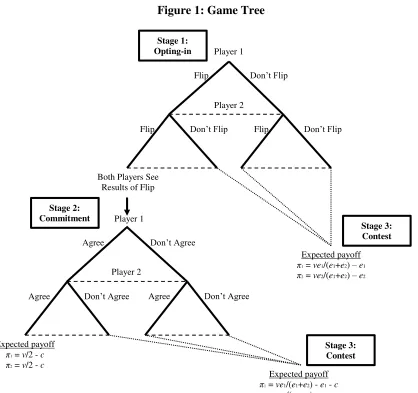
v by both players. The game, shown in Figure 1, consists of three stages. In stage 1, participants
choose whether or not to use the conflict resolution device by choosing either ‘Flip’ or ‘Don’t
Flip’. If at least one participant chooses Don’t Flip then neither participant incurs any cost, and
both proceed to stage 3. If both participants choose to Flip then they each incur a cost c, and after
observing a realization of a fair coin flip, which randomly assigns the resource to one player,
they proceed to stage 2. In stage 2, participants decide whether to ‘Agree’ to the proposed
allocation. If both participants choose Agree (i.e., if they choose to commit) then the participant
who was favored by the coin flip receives v = 100 francs, and the game is over. However, if at
least one participant chooses ‘Don’t Agree’, then both participants proceed to stage 3. In stage 3,
both participants participate in a lottery contest to allocate the resource. In the lottery contest,
both participants make irreversible conflict expenditures e1, e2 [0, v] to increase their
probabilities of receiving the prize. Specifically, for participant 1 (similarly for participant 2), the
6 There is a large literature in biology suggesting that costly signals are more reliable than cheap signals (Zahavi,
7
probability of receiving is p1(e1,e2) = e1/(e1 + e2); if both players bid 0, the allocation is
determined by flipping a fair coin.
Using backward induction and assuming risk neutrality, we examine the last occurrence
of the finitely repeated game. The Nash equilibrium in stage 3 is for both participants to choose
expenditures of e1* = e2* = 25 (Tullock, 1980), receiving the expected payoff of 25 each (v/2 –
e* = 50 – 25). Because each participant has a positive expected value from conflict in stage 3, a
participant interested in maximizing her wealth should never commit to the outcome after losing
the coin flip. Therefore, in any subgame perfect Nash equilibrium, money-maximizing
participants end up in a conflict stage 3 regardless of the cost of the coin flip c and exert wasteful
expenditures competing for the resource.7 Since conflict is certain along the equilibrium path, it
follows that participants are indifferent between opting-in and not opting-in if and only if the
cost of opting-in is zero (i.e., c = 0), and they should never opt-in when doing so is costly (i.e., c
> 0).
To examine whether a non-binding coin flip can reduce the cost of conflict, we employ a
partial two-by-two experimental design. On one dimension, we vary whether the decision to
opt-in is endogenous or exogenous, and on the other dimension, we vary whether opting-in carries a
cost. For obvious reasons, we impose the cost only when opting-in is endogenous, hence our
partial design. In the Exogenous-Free baseline treatment, participants first observe the outcome
of a coin flip. That is, there is no stage 1 decision to ‘Flip’ or ‘Don’t Flip’; instead, the ‘Flip’
decision is exogenously imposed. In stage 2, participants decide whether to commit to the
outcome. If either participant disagrees then the game proceeds to stage 3. In stage 3, participants
7 While we focus on the case of risk-neutrality, we can extend this argument to cases in which players have
8
participate in a simple two-person contest for the resource valued at 100. In the
Endogenous-Free treatment, participants first endogenously decide whether to observe the outcome of a coin
flip for free in stage 1. Then in stage 2 they decide whether to commit to the outcome. If either
participant disagrees in either stage 1 or stage 2 then the game proceeds to stage 3. Finally, the
Endogenous-Costly treatment is similar to the Endogenous-Free treatment, but opting-in in stage
1 is costly, i.e., c = 5 francs.
2.2. Experimental Procedures
To study behavior in the proposed treatments, a total of 198 participants were recruited at
random from the subject-pool consisting of graduate and undergraduate students at a private
university in the United States. Participants received a participation fee for arriving to the
experiment on time and received their earnings in cash privately at the end of each session.
Participants were randomly assigned into treatments (44 in Exogenous-Free, 62 in
Endogenous-Free and 92 in Endogenous-Costly) and nobody participated more than once.8 Participants sat at,
and interacted via, visually isolated computer terminals, and instructions were read aloud by the
experimenter as participants followed along on paper (see the online Appendix A for
instructions). The experiments were programmed using z-Tree (Fischbacher, 2007). Before the
experiment began participants took a quiz (non-incentivized) to confirm their understanding of
the experimental procedures. An experimenter reviewed the quiz answers and privately answered
questions.
Each experimental session consisted of 30 periods of a single treatment. Participants were
randomly assigned to a group of two and remained within this group for all 30 periods of the
9
experiment (fixed matching). We chose a fixed matching protocol because we believe that it is
more realistic, as most interactions in the real world are repeated (especially macro level
conflicts between countries and competing economies). In such a setting, participants seeking to
avoid costly conflict might be more motivated than in one-shot games to signal their desire to
other group members. Moreover, the fact that we chose the fixed matching protocol does not
affect the comparison across treatments (as the same protocol was used in all three treatments).9
In every session, each period proceeded according to one of the treatments. In stage 1
participants chose between `Flip’ and `Don’t Flip’ (except in the Exogenous-Free treatment). In
stage 2, those who opted to see the coin flip chose between `Agree’ and `Don’t Agree’ after
seeing the result of the flip. In stage 3, participants chose to expend any number between 0 and
100 francs, in order to increase the probability of winning the prize of 100 francs. At the end of
each period, the computer displayed individual decisions, as well as corresponding payoffs, to
each participant.
At the end of each experimental session, participants completed a brief demographic
survey and their total earnings from all 30 periods of the experiment were added to or subtracted
from an initial endowment of 2,000 francs (which we described as a participation fee). We
converted francs to USD at a rate of 100 francs = $1, and participants were paid privately in cash
and dismissed from the experiment. The average experimental earnings, including the $20
participation fee, were $25.24, ranging from a low of $16.00 to a high of $46.70. Sessions lasted
approximately one hour each.
9 Baik et al. (2013) examined behavior of subjects in contests using fixed-matching and random-matching protocols
10 3. Results
We observed early period variation that settled down after a few periods and endgame effects,
both of which introduced noise into our data. Thus, we restrict our analysis to periods 5-29.10
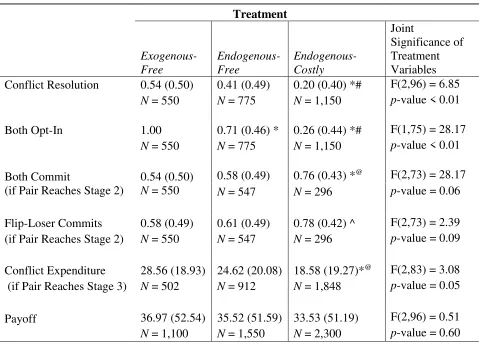
Table 1 reports average frequency of conflict resolution, opting-in and commitment, as well as
conflict expenditures and payoffs. We also report the statistical significance of estimated
treatment effects for each of the outcome variables of interest. To control for repeated measures,
our ordinary least squares (OLS) regressions use each pair averaged over all periods as a single
observation.11 Rows 1, 2 and 6 of Table 1 examine averages based upon all 25 periods, and rows
3-5 examine averages conditional upon entering stage 2 or stage 3. In rows 3-5, we use
probability weighting to control for the fact that each pair was observed making those decisions a
different number of times (and thus has a different variance). We report two-sided p-values.
3.1. Conflict Resolution
In the Exogenous-Free treatment, pairs avoided conflict 54% of the time (i.e., they agree to the
result of the Flip), while in the Endogenous-Free and Endogenous-Costly treatments, pairs
avoided conflict 41% and 20% of the time, respectively. OLS regression analysis indicates that
the rate of conflict resolution is significantly lower in the Endogenous-Costly treatment than in
the Exogenous-Free and Endogenous-Free treatments (p-values < 0.01), while there is no
significant difference between the Exogenous-Free and Endogenous-Free treatments (p-value =
0.22).
10 None of our results are qualitatively altered when we vary these cutoffs, and additional regression output is
available from the authors upon request. We examine end-game effects in Section 3.6.1.
11 The results are comparable if using non-parametric analysis (i.e., Wilcoxon rank-sum test) when each pair has the
11
Result 1: There is substantial conflict resolution in all three treatments, although pairs avoid
conflict more frequently in the Exogenous-Free and Endogenous-Free treatments than in the
Endogenous-Costly treatment.
This finding provides support for the idea that non-binding conflict resolution
mechanisms can reduce the frequency of conflict, despite incentives to renege. When using the
mechanism is a default, some groups are able to coordinate on a reciprocal strategy in which the
losing party is willing to accept an unfavorable resolution. However, the mechanism is far from
perfect. When the decision to use the mechanism is endogenous and costly, conflict frequency
increased as some groups opted not to see the coin flip. Similarly, there is extensive
heterogeneity in the willingness to commit to the outcome, which we discuss further in Section
3.5.
3.2. Opting-In
A major source of increased conflict in the Endogenous-Free and Endogenous-Costly treatments
is failure to opt-in to the coin flip mechanism. While pairs were required to see the flip in the
Exogenous-Free treatment, they opted to see the coin flip 71% of the time in the
Endogenous-Free treatment and only 26% of the time in the Endogenous-Costly treatment. OLS regression
analysis indicates that the rate of opting-in is significantly lower in the Endogenous-Costly
treatment than in the Endogenous-Free treatment (p-value < 0.01). Here we exclude the
12
Result 2: Subjects opted-in to the coin flip mechanism less frequently in the Endogenous-Costly
treatment than in the Endogenous-Free treatment, although the likelihood was far greater than 0
(and less than 1) in both treatments.
While it is clear that the cost of observing the coin flip played an important role in
reducing the frequency with which participants opted-in in the Endogenous-Costly treatment, the
reasons are less clear in the Endogenous-Free treatment. In theory, participants should be
indifferent between observing the coin flip and not observing the flip. However, if there was any
probability that a player who lost the flip would tremble and mistakenly accept the outcome,
players would strictly prefer to flip the coin. Unfortunately, our design does not allow us to test
this hypothesis directly.
3.3. Commitment
The money-maximizing subgame perfect Nash equilibrium predicts that participants losing the
coin flip will never commit to the outcome in a finitely repeated game. Comparing averages
across treatments in Table 1, we found that the probability that both parties committed to the
outcome (conditional on seeing the flip) were 54% in the Exogenous-Free, 58% in the
Endogenous-Free, and 76% in the Endogenous-Costly treatment. Probability weighted OLS
regression analysis indicates that the conditional probability that both parties commit to the coin
flip resolution is higher in the Endogenous-Costly treatment than in the Endogenous-Free (p
-value = 0.08) and Exogenous-Free (p-value = 0.03) treatments.
The treatment differences were almost solely driven by an increased willingness of
13
committing to the flip among those receiving unfavorable outcomes was 58% in the
Exogenous-Free, 61% in the Endogenous-Free, and 78% in the Endogenous-Costly treatment.12 To provide
statistical support for treatment differences in the loser’s commitment decisions, we estimate an
additional regression. The dependent variable is the probability that the loser of the coin flip in
each pair committed to the coin flip, conditional on seeing it, and the independent variables are
treatment dummies. The coefficient on the Endogenous-Costly treatment is positive and
significant (p-value = 0.05), and the difference between the Endogenous-Free and
Endogenous-Costly coefficients is marginally significant (p-value = 0.10). These findings are summarized in
Result 3.
Result 3: The conditional probability of commitment is higher in the Endogenous-Costly
treatment than either in the Endogenous-Free or Exogenous-Free treatments. There is no
significant difference between the Endogenous-Free and Exogenous-Free treatments.
These results suggest that merely endogenizing the decision to seek third-party conflict
resolution does not have an impact on the probability that parties commit to the proposed
resolution – we find no difference in commitment rates in the Endogenous-Free and
Exogenous-Free treatments. However, the commitment problem is significantly mitigated when both parties
must incur a cost to learn the proposed allocation.
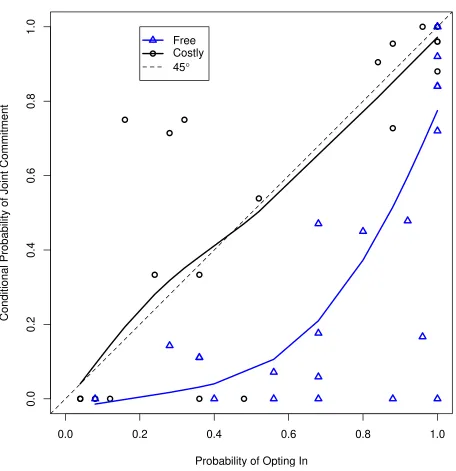
The relationship between opting-in and the commitment problem in the Endogenous-Free
and Endogenous-Costly treatments is demonstrated in Figure 2, which plots the relative
frequency of opting-in against the conditional probability of commitment for each pair with
12 In all treatments the conditional probability of commitment for flip winners was at least 95%. Rejections are
14
smoothing splines fit to the data by treatment.13 Only the Endogenous-Free and
Endogenous-Costly treatments are plotted, since participants in the Exogenous-Free treatment always saw the
coin flip. Figure 2 indicates that there is a linear relationship between opting-in and committing
to the outcome of the flip in the Endogenous-Costly treatment, but there is a convex relationship
between the two in the Endogenous-Free treatment; indeed, there is a pair that sees the flip in
every period, but never commits to the outcome. And, while the Endogenous-Costly treatment
data is roughly symmetrically distributed around the 45-degree line, every Endogenous-Free
treatment observation lies on or below the line. In the Endogenous-Free treatment, commitment
is regularly sustained only at high rates of opting-in. This provides further evidence that the
opportunity cost of opting-in in the Endogenous-Costly treatment facilitates the solution of the
commitment problem, while the absence of such a cost in the Endogenous-Free treatment
renders the cooperative signal less informative and is thus less effective at encouraging
commitment.
3.4. Conflict Expenditures
If groups did not opt-in or failed to solve the commitment problem, the group entered the conflict
stage in which they exerted expenditures to win the prize.14 Returning to Table 1, note that the
average expenditure, conditional on reaching stage 3, was greatest in the Exogenous-Free
treatment (28.6), followed by the Endogenous-Free treatment (24.6), and the least in the
Endogenous-Costly treatment (18.6). 15 OLS regression analysis indicates that conflict
13 An alternative figure containing data from all 30 periods is in Appendix B.
14 Figures B1-B3 in Appendix B report time series of conflict expenditures for each pair by treatment.
15 Although we did not run a control treatment without the coin flip, our results in the Exogenous-Free treatment are
15
expenditures are significantly lower in the Endogenous-Costly treatment than in the
Exogenous-Free treatment (p-value = 0.03). Expenditures are marginally lower in the Endogenous-Costly
treatment than in the Endogenous-Free treatment (p-value = 0.08). There is no significant
difference between the Endogenous-Free and Exogenous-Free treatments (p-value = 0.41).
Result 4: Conflict expenditures are lower in the Endogenous-Costly treatment than in either the
Exogenous-Free or the Endogenous-Free treatment. There is no statistically significant
difference between the Endogenous-Free and Exogenous-Free treatments.
3.5. Between-Pair Heterogeneity
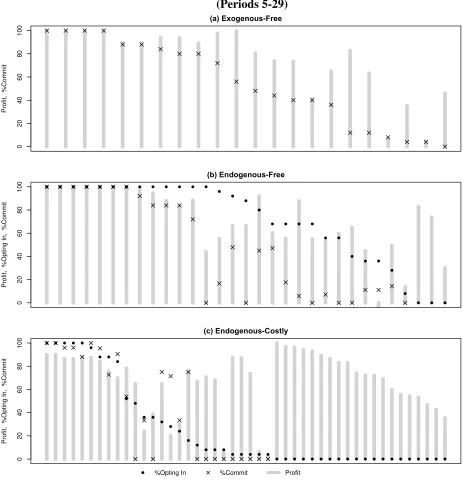
Figure 3 displays, for each pair in each treatment, the relative frequency of opting-in, conditional
frequency of commitment, and average payoff, where the pairs are sorted from left to right in
each panel by opting-in rate with ties broken by commitment rate and then average payoff.
In the Endogenous-Free treatment, there is a significant positive correlation between a
pair’s observed probability of opting-in and average payoff (ρ = 0.62, p-value < 0.01) but in the
Endogenous-Costly treatment, this relationship is not statistically significant (ρ = 0.23, p-value =
0.12). This is driven by a number of pairs in the Endogenous-Costly treatment that never
opted-in to see the coopted-in flip but nevertheless received very high payoffs.
It is possible to visually identify three types of pairs in the Endogenous-Costly treatment:
(1) pairs with a high rate of both opting-in and commitment, (2) pairs with low (but positive)
16
rates of both opting-in and commitment, and (3) pairs with zero rates of opting-in. Heuristically,
we define high flip pairs as those with opting-in rates in the interval (0.5, 1], low flip pairs as
those with opting-in rates in (0, 0.5], and no flip pairs as those with opting-in rates of exactly 0.
High flip pairs earn on average 84 francs/period (SD = 6.77), low flip pairs earn 49 francs/period
(SD = 30.13), and no flip pairs earn 73 francs/period (SD = 20.01). Interestingly, 5 of the no flip
pairs in the Endogenous-Costly treatment (i.e., pairs that engaged in conflict in each period 5-29)
generated average earnings greater than the maximum that could be earned per period by
opting-in and committing in every period (i.e., greater than 90 francs). None of the no flip pairs in the
Endogenous-Free treatment were able to generate average earnings greater than 90 francs.
While our data do not allow us to directly identify the source of this behavior, we
conjecture the positive commitment cost generated an endogenous focal point for conflict
expenditures that allowed some pairs to coordinate on expenditures far below the Nash
equilibrium of 25. Specifically, we observe a number of pairs in which individuals consistently
submit bids less than or equal to 5 (the cost of opting-in). This suggests that they attempt to
cooperate and tacitly agree to only engage in conflict that leaves them better off in expectation
than conflict resolution by the random device we have offered them. Such strategies are not
always effective, but some pairs manage to sustain them, and attempts by other pairs to
implement them tend to drive conflict expenditures down. Thus, Wald tests on the regression
reported in row 5 of Table 1 cannot reject the null hypotheses that the average conflict
expenditure for the Exogenous-Free or Endogenous-Free treatments is equal to the Nash
Equilibrium value of 25 (p-value = 0.92 and p-value = 0.35, respectively). However, in the
Exogenous-Costly treatment the average expenditure is significantly less than 25 (p-value <
17
average expenditure in the Endogenous-Costly treatment rises and is not significantly different
from 25 (p-value = 0.97).
3.6 Dynamics of Behavior
In this section, we highlight a number of interesting features of our data that we found after
testing our main hypotheses. Specifically, we focus on behavioral dynamics, emphasizing
patterns in the data that are inconsistent with the equilibrium of the finitely repeated game but
nevertheless appear important for understanding behavior in our setting. Given the endogeneity
issues with this analysis, we report summary statistics only, avoiding statistical tests.
3.6.1 Endgame Effects
As noted above, our main analysis excludes the final period because of the presence of endgame
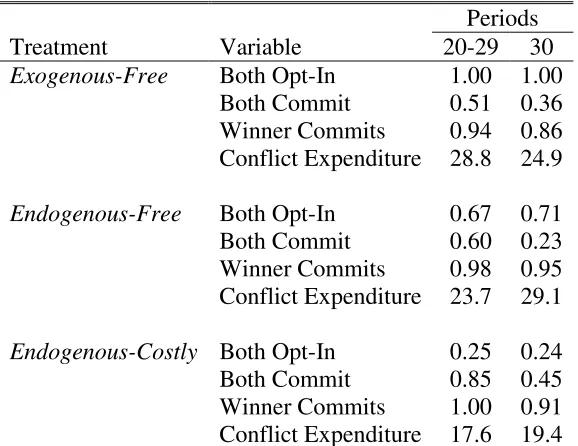
effects. Table 2 displays comparisons of opt-in rates, commitment rates, and conflict
expenditures over periods 20-29 and period 30. Note that pairs in all treatments opt-in at roughly
equal rates in periods 20-29 and period 30, but in the final period, the data reveal a sharp
decrease in commitment rates. In fact, even those who win the coin flip are slightly less likely to
commit in period 30. This is particularly striking and puzzling in the Endogenous-Costly
treatment – if a player plans to opt-out, then there is no reason to incur the cost of seeing the flip
in the first place. Nevertheless, the presence of an endgame effect is consistent with models of
repeated games in which some players are cooperative types, and others, knowing this, cooperate
strategically until revealing their true type eventually (e.g., Kreps et al., 1982). Not surprisingly,
in the Endogenous-Free and Endogenous-Costly treatments, this endgame defection leads to
18
Another interesting observation is that there are treatment differences in behavior in the
conflict stage of those who were either the “victims” or the “instigators” of endgame defection.
Consider only pairs that opted-in and agreed in period 29 and then also opted-in in period 30. We
define victims as players who chose agree in period 30 when their partner, the instigator, chose
don’t agree. In both Exogenous-Free and Endogenous-Free treatments, victims respond to
defection by submitting very high conflict expenditures (31 and 46, respectively), while
instigators submit relatively low bids (17 and 24, respectively). In the Endogenous-Costly
treatment, the pattern is reversed. Victims submit very small bids averaging 13 while instigators
submit large bids averaging 34. Observed behavior in the Exogenous-Free and Endogenous-Free
treatments can be rationalized as retaliation, and this is consistent with evidence in Kimbrough
and Sheremeta (2013, 2014) in a related lottery contest environment that “reneging” leads to
retaliation. The pattern in the Endogenous-Costly treatment is more puzzling. Compared to
participants in the Exogenous-Free and Endogenous-Free treatments, victims in the last period
of Endogenous-Costly treatment had relatively little experience with bidding and defection.
When there is opting-in and defection in the last round in the Endogenous-Costly treatment, then
there was likely a history of cooperation (as prior defection in the Endogenous-Costly tended to
result in subsequently not opting-in, see below). One possibility is that defection after paying to
opt-in reveals new information about the defector’s type, which initially bewilders the victims
(i.e. “this guy must be nuts”).
3.6.2 Path Dependence
While path dependence does not appear to move behavior within a pair in one direction or the
19
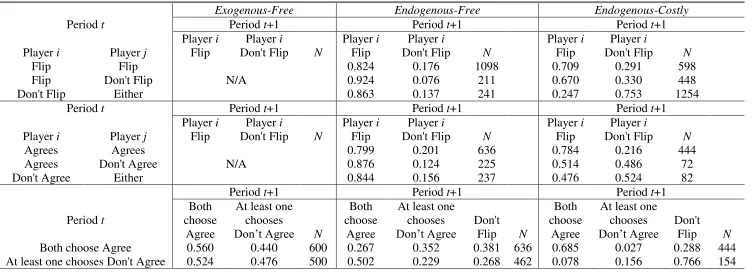
time, Table 3 presents a transition matrix of actions. The top panel reports how a group’s choice
of whether to see the flip in period t affects their decision to see the flip in period t + 1 (note that
subjects automatically see the flip in the Exogenous-Free treatment).16 There is no discernable
trend in the Endogenous-Free treatment; subjects choose to flip at relatively consistent and high
rates (0.82-0.92) regardless of their own and their partner’s behavior in the previous period. In
the Endogenous-Costly treatment, however, it appears that there are two “types”: those that
frequently see the flip and those that do not, regardless of their partner’s actions. Those that are
willing to pay to see the flip in period t (note that they only actually pay if their partner chooses
to see the flip too) choose to see the flip in period t + 1 with probability 0.71 if their partner
chose to see the flip in period t and with probability 0.67 if their partner did not. On the other
hand, those that do not choose to see the flip in period t also do not choose to see the flip in
period t + 1 with probability 0.75 (since they do not see the flip, they do not know what their
partner chose).
The second panel analyzes the effect of subjects’ decisions whether to agree to the
outcome of the flip (conditional on seeing the flip) on their decision to see the flip in the next
period. Again, there is no discernable trend in the Endogenous-Free treatment. Subjects choose
to see the flip at relatively consistent and high rates (0.80-0.88) regardless of their own and their
partner’s behavior in the previous period. In the Endogenous-Costly treatment, however, the
decision to accept the outcome or not in period t clearly affects the (costly) choice to see the flip
in the following period. When a subject and her partner agree to the outcome of the flip, she
chooses to see the flip in the following period with probability 0.78. In other words, when both
16 In Appendix B, we report a transition matrix that focuses solely on the actions of those who lost the flip in the
20
players cooperate, they use the mechanism that facilitated their cooperation in the following
period over three-quarters of the time. However, when one subject does not agree to the outcome
in period t, subjects choose to see the flip only around half of the time (0.48-0.51). This suggests
that, amongst those pairs who choose to see the flip, uncooperative behavior makes cooperation
much harder to sustain in the future.
Finally, the third panel reveals how a subject’s willingness to agree to the outcome of the
flip in period t (conditional on seeing the flip) affects their willingness to agree to the outcome of
the flip in period t + 1 (if there is a flip). These are most important results presented in this table,
since they shed light on how cooperation is sustained over time. In the Exogenous-Free
treatment, there is no discernable inter-period effect: both players tend to agree to the flip a little
more than half of the time (0.52-0.56) regardless of actions in the previous period. In the
Endogenous-Free treatment, an unexpected result arises: cooperation rates are higher in period t
+ 1 if both players did not agree in the previous period (0.50) than if they did (0.27). There is no
obvious interpretation of this result, but it does at the very least suggest that subjects are not
coordinating around the random device when viewing the outcome is free. We find substantial
path dependence in the Endogenous-Costly treatment. Groups in which both subjects agree in
period t (conditional on seeing the flip) see the flip and agree to its outcome in period t + 1 with
probability 0.69. On the other hand, when at least one subject does not agree to the outcome of
the flip in period t, groups only agree to the outcome of the flip in period t + 1 with probability
0.08, and they do not see the flip, which is costly to view, with probability 0.77. This suggests
that the cost of seeing the flip encourages path dependence: those that agree to the outcome of
the flip are more likely to do so in the future (despite the fact that seeing the flip is costly), while
21 4. Discussion
In all three treatments, the money-maximizing prediction from game theory is that the loser of
the coin flip will never choose to commit, as the expected value from conflict is strictly positive
and the game is finitely repeated. Nevertheless, our experiment shows that individuals often
avoid conflict in the finitely repeated game by committing to the outcome of a randomizing
conflict resolution mechanism, even in the absence of binding contractual agreements. What can
explain these non-zero levels of commitment? There are several reasons why commitment
problems can be solved in the absence of external enforcement. First, if the parties expect to
engage in repeated interaction, they may be able to overcome the commitment problem due to
reputational concerns (Rabin, 1991; Andreoni and Miller, 1993; Dellarocas, 2006) or fear of
incurring retaliation and spite (Abbink et al., 2010; Schniter et al., 2013; Lacomba et al., 2014;
Mago et al., 2015). Similarly, some individuals may simply prefer to avoid conflict or be
cooperative (Dorris, 1972; Molander, 1985), and given repeated interaction, they establish a
reputation for cooperation that allows both parties to gain from exchange. As long as one
member of the group is a cooperative type, the other member may be willing to forgo conflict to
reap the gains from exchange (e.g., Kreps et al. 1982). For these reasons, it may not be that
surprising that in all three treatments we observe substantial conflict resolution.
One of the main research questions was whether commitment problems could be
mitigated when participants are given the option of opting-in to the conflict resolution
mechanism (with and without cost). Here, the failure of participants to opt-in reduced the
22
was costly. However, for participants that did opt-in, we observed significantly higher
commitment, but only when opting-in was costly.
Money-maximizing models do not predict these treatment differences. What can explain
these differences in commitment rates? There are several mutually exclusive (and
non-exhaustive) possibilities. First, when individuals act collectively to propose a solution to a social
dilemma, the result may be seen as more legitimate than when the proposed solution comes from
“outside”, thus increasing cooperation levels. Evidence from both field studies and laboratory
experiments suggests that endogenous participation in democratic institutions may encourage
both cooperation and compliance (Dal Bo et al., 2010). Although we believe that legitimacy may
play a role in helping groups to resolve commitment problems, our data do not provide support
for this hypothesis. Specifically, the legitimacy hypothesis would suggest that since participants
choose to opt-in to the conflict resolution mechanism, the coin flip outcome will acquire
additional legitimacy in both participants’ eyes and will thus facilitate solving the commitment
problem. Hence, we would expect commitment rates to be greater in both the Endogenous-Free
and Endogenous-Costly treatments than in the Exogenous-Free treatment. However, we find no
significant difference in commitment rates between the Endogenous-Free and Exogenous-Free
treatments.
A second possible explanation of our observations is that fears of retaliation and spite
may discourage participants from reneging; i.e., opting-in and then not abiding by the outcome
may encourage high bids by angered flip winners (Andreoni and Miller, 1993; Dellarocas, 2006;
Schniter et al., 2013; Lacomba et al., 2014). While we cannot rule out this explanation, our data
do not reveal notable differences in the conflict expenditures of flip winners and losers.
23
difference is that flip losers bid more than winners in the Endogenous-Costly treatment, which is
opposite of the direction of the retaliation hypothesis.
A third explanation is that individuals who pay to see the coin flip may be subject to a
sunk cost fallacy; they might justify committing to the coin flip in order to avoid the regret of
wasting money on unused advice (Arkes and Blumer, 1985; Gino, 2008). We cannot rule out this
explanation – though it seems implausible since the expected value of conflict is positive and
greater than the sunk cost of seeing the flip.
A final explanation receives the most substantial support from our data: the act of
opting-in may serve as a signal of a participant’s willingness to cooperate. That is, commitment is
encouraged when both parties know that the other has deliberately sent a signal of willingness to
cooperate, but this signal is more than cheap talk only when it involves incurring an opportunity
cost.17 Under this interpretation, the willingness to incur a cost of opting-in indicates a
willingness to accept the outcome of the coin flip, and agents are able to infer cooperative
intentions (to commit) more readily from costly opting-in than from free opting-in. In this sense,
the mechanism encourages self-selection among cooperative types. In the repeated game setting,
non-cooperative types are going to be found out early on unless they feign being a cooperative
type. It may therefore be worthwhile to opt-in to see whether one is paired with a cooperative
type, since they can always avoid the costly conflict resolution mechanism in the future after
they have been cheated once. These considerations may explain why commitment rates are
greater in treatments where opting-in is costly than when it is exogenous or costless. They may
also explain why we find significant path dependence in the treatment where opting-in is costly
17 Indeed, there is evidence for this in other contexts where incurred opportunity costs facilitate reciprocity (McCabe
24
but not in the other treatments: once the players have sent each other costly signals in the past,
coordinating around the cooperative outcome is easier in the future.
5. Conclusion
This paper explores the effectiveness of non-binding institutions for conflict resolution and the
effect of endogenous institutional choice on their success. Empirically, the main problem with
such mechanisms is: how do groups commit to abiding by the outcome of a conflict resolution
mechanism? This paper suggests that one way of mitigating this problem is to make the choice of
opting-in to the mechanism costly. Although the mere act of opting-in has no significant impact
on commitment rates, costly opting-in substantially increases commitment for groups who pay
the price.
Our results have important implications for the sustainability of cooperation and the
mitigation of conflict in environments with repeated interaction and weak contract enforcement.
First, using a coin flip as a conflict resolution mechanism has numerous benefits for studying the
commitment problems inherent in conflict resolution: it is transparent and easy to understand, it
provides an unbiased means of allocating indivisible resources (consistent with egalitarian
norms), and its “all-or-nothing” nature exacerbates the commitment problem, since losing
participants must commit to receiving nothing.18 Second, endogenizing and imposing a cost on
the decision to opt-in can encourage reciprocity – by requiring individuals to undertake a cost to
seek conflict resolution, the decision substantially increases the rate at which parties commit to
18 Using a random device as a conflict resolution mechanism has a long history. Iannaccone et al. (2011) argue that
25
conflict resolution. These and similar behavioral mechanisms are clearly important drivers of
economic behavior and thus have an important role in any institutional design framework. When
developing institutions to reduce conflict and facilitate mutually beneficial exchange, designers
should consider not only standard incentive-compatibility issues but also the interaction between
institutions and norms of cooperation and reciprocity. In particular, when the absence of
exogenous enforcement mechanisms renders incentive-compatible arrangements infeasible, one
way to reduce the costs of conflict may involve institutions designed to encourage
26 References
Abbink, K., Brandts, J., Herrmann, B. & Orzen, H. (2010). Inter-group conflict and intra-group punishment in an experimental contest game. American Economic Review, 100, 420-447. Abramitzky, R. (2008). The limits of equality: Insights from the Israeli Kibbutz. Quarterly
Journal of Economics, 123, 1111-1159.
Aimone, J., L.R. Iannaccone, M. Makowsky, & J. Rubin. (2013). Endogenous group formation via unproductive costs. Review of Economic Studies, 80, 1215-1236.
Andreoni, J.A., & Miller, J.H. (1993). Rational cooperation in the finitely repeated Prisoner's Dilemma: Experimental evidence. Economic Journal, 103, 570-585.
Arkes, H.R., & Blumer, C. (1985). The psychology of sunk cost. Organizational Behavior and Human Decision Processes, 35, 124-140.
Baik, K.H., Chowdhury, S.M., & Ramalingam, A. (2013). Matching Protocol in Contest Experiments. Working Paper.
Baker, G.P. (1992). Incentive contracts and performance measurement. Journal of Political Economy, 100, 598-614.
Bardhan, P. (2000). Irrigation and cooperation: An empirical analysis of 48 irrigation communities in south India. Economic Development and Cultural Change, 48, 847-865. Berman, E. (2000). Sect, subsidy, and sacrifice: An economist's view of ultra-orthodox Jews.
Quarterly Journal of Economics, 65, 905-953.
Bernstein, P. (1996). Against the Gods: The remarkable story of risk. New York: John Wiley & Sons.
Camerer, C. (2003). Behavioral game theory: Experiments in strategic interaction. Princeton University Press.
Carvalho, J-P. (2013). Veiling. Quarterly Journal of Economics, 128, 337-370.
Cason, T.N., Sheremeta, R.M. & Zhang, J. (2012). Communication and efficiency in competitive coordination games. Games and Economic Behavior, 76, 26-43.
Charness, G., Frechette, G.R., & Qin, C.Z. (2007). Endogenous transfers in the Prisoner's Dilemma game: An experimental test of cooperation and coordination. Games and Economic Behavior, 60, 287-306.
Chowdhury, S.M., Sheremeta, R.M., & Turocy, T. (2014). Overbidding and overspreading in rent-seeking experiments: Cost structure and prize allocation rules. Games and Economic Behavior, 87, 224-238.
Dal Bó, P., Foster, A., & Putterman, L. (2010). Institutions and behavior: Experimental evidence on the effects of democracy. American Economic Review, 100, 2205-2229.
Dechenaux, E., Kovenock, D., & Sheremeta, R.M. (2015). A survey of experimental research on contests, all-pay auctions and tournaments. Experimental Economics, forthcoming.
Deck, C. & Sheremeta, R.M. (2012). Fight or flight? Defending against sequential attacks in the Game of Siege. Journal of Conflict Resolution, 56, 1069-1088.
Dellarocas, C. (2006). Reputation mechanisms. Handbooks in Information Systems, Vol. I, Handbook on Economics and Information Systems, edited by Terrence J. Hendershott, Elsevier, 629-660.
27
Fehr, E., & Schmidt, K. (1999). A Theory of Fairness, Competition, and Cooperation. Quarterly Journal of Economics, 114, 817-868.
Fischbacher, U. (2007). z-Tree: Zurich toolbox for ready-made economic experiments. Experimental Economics, 10, 171-178.
Gino, F. (2008). Do we listen to advice just because we paid for it? The impact of advice cost on its use. Organizational Behavior and Human Decision Processes, 107, 234-245.
Grafen, A. (1990). Biological signals as handicaps. Journal of Theoretical Biology, 144, 517-546.
Greif, A. (2000). The fundamental problem of exchange. Review of European Economic History, 4, 251-284.
Greif, A., P. Milgrom, & B. Weingast (1994). Coordination, commitment, and enforcement: The case of the merchant guild. Journal of Political Economy, 102, 745-776.
Harris, M., & Raviv, A. (1979). Optimal incentive contracts with imperfect information. Journal of Economic Theory, 20, 231-259.
Holmström, B. (1979). Moral hazard and observability. Bell Journal of Economics, 10, 74-91. Iannaccone, L.R. (1992). Sacrifice and stigma: Reducing free-riding in cults, communes, and
other collectives. Journal of Political Economy, 100, 271-291.
Iannaccone, L.R. (1994). Why strict churches are strong. American Journal of Sociology, 99, 1180-1211.
Iannaccone, L.R., Haight, C.E., & Rubin, J. (2011). Lessons from Delphi: Religious markets and spiritual capitals. Journal of Economic Behavior and Organization, 77, 326-338.
Kimbrough, E.O. & Sheremeta, R.M. (2013). Side-payments and the costs of conflict. International Journal of Industrial Organization, 31, 278-286.
Kimbrough, E.O. & Sheremeta, R.M. (2014). Why can’t we be friends? Entitlements and the costs of conflict. Journal of Peace Research, 51, 487-500.
Kimbrough, E.O., Sheremeta, R.M. & Shields, T. (2014). When parity promotes peace: Resolving conflict between asymmetric agents. Journal of Economic Behavior and Organization, 99, 96-108.
Konrad, K. A. (2009). Strategy and dynamics in contests. New York, NY: Oxford University Press.
Kreps, D. M. and R. Wilson, (1982). Reputation and Imperfect Information. Journal of Economic Theory, 27, 253 – 279.
Kreps, D.M., P. Milgrom, J. Roberts, and R. Wilson, (1982). Rational Cooperation in the Finitely
Repeated Prisoners’ Dilemma. Journal of Economic Theory, 27, 245-252.
Lacomba, J. A., Lagos, F., Reuben, E., & Van Winden, F. (2014). On the escalation and de-escalation of conflict. Games and Economic Behavior, 86, 40-57.
Leeson, P. (2014). Oracles. Rationality and Society, 26, 141-169.
Lissau, R. (2011). Coin flips choose winners in Island Lake, Green Oaks. Daily Herald. Mago, S.D., Savikhin, A.C. & Sheremeta, R.M. (2015). Facing your opponents: Social
identification and information feedback in contests. Journal of Conflict Resolution, forthcoming.
Maher, C.R., & Lott, D.F. (2000) A review of ecological determinants of territoriality within vertebrate species. American Midland Naturalist, 143, 1-29.
28
McCabe, K.A., Smith, V.L., & Lepore, M. (2000). Intentionality detection and ‘mindreading’: Why does game form matter? Proceedings of the National Academy of Sciences, 97, 4404-4409.
Milgrom, P.R., North, D.C., & Weingast, B.R. (1990). The role of institutions in the revival of trade: The law merchant, private judges, and the champagne fairs. Economics and Politics, 2, 1-23.
Molander, P. (1985). The optimal level of generosity in a selfish, uncertain environment. Journal of Conflict Resolution, 29, 611-618.
Petrie, M., Halliday, T., & Sanders, C. (1991). Peahens prefer peacocks with elaborate trains. Animal Behavior, 41, 323-331.
Powell, R. (2006). War as a commitment problem. International Organization, 60, 169-203. Price, C.R., & Sheremeta, R.M. (2011). Endowment effects in contests. Economics Letters, 111,
217-219.
Price, C.R., & Sheremeta, R.M. (2015). Endowment origin, demographic effects and individual preferences in contests. Journal of Economics and Management Strategy, forthcoming. Rabin, M. (1991). Reneging and renegotiating. Working Paper.
Schelling, T. (1960). The strategy of conflict. Cambridge, MA: Harvard University Press.
Schniter, E., Sheremeta, R.M., & Sznycer, D. (2013). Building and rebuilding trust with promises and apologies. Journal of Economic Behavior and Organization, 94, 242-256. Sheremeta, R.M. (2010a). Expenditures and information disclosure in two-stage political
contests. Journal of Conflict Resolution, 54, 771-798.
Sheremeta, R.M. (2010b). Experimental comparison of multi-stage and one-stage contests. Games and Economic Behavior, 68, 731-747.
Sheremeta, R.M. (2013). Overbidding and heterogeneous behavior in contest experiments. Journal of Economic Surveys, 27, 491-514.
Sheremeta, R.M. (2015). Behavioral dimensions of contests. In Congleton, R.D., Hillman, A.L., (Eds.), Companion to political economy of rent seeking, London: Edward Elgar.
Skaperdas, S. (2006) Bargaining versus fighting. Defence and Peace Economics, 17, 657-676. Skaperdas, S., & Syropoulos, C. (2002). Insecure property and the efficiency of exchange.
Economic Journal, 112, 133-146.
Tirole, J. (1999). Incomplete contracts: Where do we stand? Econometrica, 67, 741-781.
Tullock, G. (1980). Efficient rent seeking. In Toward a Theory of the Rent-seeking Society, ed. James M. Buchanan, Robert D. Tollison, and Gordon Tullock. 97-112. College Station, TX: Texas A&M University Press.
Williamson, O. (1985). Credible commitments: Using hostages to support exchange. American Economic Review, 73, 519-540.
Zahavi, A. (1975). Mate selection: a selection for a handicap. Journal of Theoretical Biology, 53, 205-214.
29
Table 1: Average Conflict Resolution, Opting-in, Commitment, Conflict Expenditures and Payoffs (Periods 5-29)
Treatment
Exogenous-Free
Endogenous-Free
Endogenous-Costly
Joint
Significance of Treatment Variables Conflict Resolution 0.54 (0.50) 0.41 (0.49) 0.20 (0.40) *# F(2,96) = 6.85
N = 550 N = 775 N = 1,150 p-value < 0.01
Both Opt-In 1.00 0.71 (0.46) * 0.26 (0.44) *# F(1,75) = 28.17
N = 550 N = 775 N = 1,150 p-value < 0.01
Both Commit
(if Pair Reaches Stage 2)
0.54 (0.50)
N = 550
0.58 (0.49) 0.76 (0.43) *@ F(2,73) = 28.17
N = 547 N = 296 p-value = 0.06
Flip-Loser Commits 0.58 (0.49) 0.61 (0.49) 0.78 (0.42) ^ F(2,73) = 2.39 (if Pair Reaches Stage 2) N = 550 N = 547 N = 296 p-value = 0.09
Conflict Expenditure 28.56 (18.93) 24.62 (20.08) 18.58 (19.27)*@ F(2,83) = 3.08 (if Pair Reaches Stage 3) N = 502 N = 912 N = 1,848 p-value = 0.05
Payoff 36.97 (52.54) 35.52 (51.59) 33.53 (51.19) F(2,96) = 0.51
N = 1,100 N = 1,550 N = 2,300 p-value = 0.60 Standard deviation reported in parentheses. Rows 1 through 4 report frequency, and rows 5 and 6 report the experimental currency francs, where 100 francs equals one US $1. Each reported variable was averaged over all periods per pair and the average was regressed against treatment dummy variables. For rows 3 through 5, we used probability-weighted regressions, as each pair did not always have the same number of observations (e.g., reached stage 2 or stage 3). Amounts noted with * signify the treatment coefficient was significantly different from the
30
Table 2: Average Endgame Effects, by Treatment
Periods
Treatment Variable 20-29 30
Exogenous-Free Both Opt-In 1.00 1.00
Both Commit 0.51 0.36 Winner Commits 0.94 0.86 Conflict Expenditure 28.8 24.9
Endogenous-Free Both Opt-In 0.67 0.71
Both Commit 0.60 0.23 Winner Commits 0.98 0.95 Conflict Expenditure 23.7 29.1
Endogenous-Costly Both Opt-In 0.25 0.24
31
Table 3: Transition Matrix of Actions, Periods 5-29
Exogenous-Free Endogenous-Free Endogenous-Costly
Period t Period t+1 Period t+1 Period t+1
Player i Player j
Player i
Flip
Player i
Don't Flip N
Player i
Flip
Player i
Don't Flip N
Player i
Flip
Player i
Don't Flip N
Flip Flip 0.824 0.176 1098 0.709 0.291 598
Flip Don't Flip N/A 0.924 0.076 211 0.670 0.330 448
Don't Flip Either 0.863 0.137 241 0.247 0.753 1254
Period t Period t+1 Period t+1 Period t+1
Player i Player j
Player i
Flip
Player i
Don't Flip N
Player i
Flip
Player i
Don't Flip N
Player i
Flip
Player i
Don't Flip N
Agrees Agrees 0.799 0.201 636 0.784 0.216 444
Agrees Don't Agree N/A 0.876 0.124 225 0.514 0.486 72
Don't Agree Either 0.844 0.156 237 0.476 0.524 82
Period t+1 Period t+1 Period t+1
Period t
Both choose
Agree
At least one chooses
Don’t Agree N
Both choose
Agree
At least one chooses
Don’t Agree Don't Flip N
Both choose
Agree
At least one chooses
Don’t Agree
Don't Flip N
32
Figure 1: Game Tree
Player 1
Player 2
Flip Don’t Flip
Don’t Flip
Flip Flip Don’t Flip
Stage 1: Opting-in
Player 1
Player 2
Agree Don’t Agree
Don’t Agree
Agree
Agree Don’t Agree
Both Players See Results of Flip
Expected payoff
π1 = v/2 - c π2 = v/2 - c
Stage 2: Commitment
Stage 3: Contest
Expected payoff
π1 = ve1/(e1+e2) - e1 - c
π2 = ve2/(e1+e2) - e2 - c
Stage 3: Contest
Expected payoff
π1 = ve1/(e1+e2) –e1
33
Figure 2: Probability of Both Opting-in vs. Conditional Probability of Both Committing (Endogenous-Free and Endogenous-Costly Treatments, Periods 5-29)
Note: Each point represents the probability of opting-in and the conditional probability of commitment for a single pair over periods 5-29; the lines plot smoothing spline fits to the data with 3 DF.
0.0 0.2 0.4 0.6 0.8 1.0
0
.0
0
.2
0.
4
0
.6
0
.8
1
.0
Probability of Opting In
C
o
nd
it
ion
al
P
ro
b
abi
lit
y
o
f
J
oi
nt
C
om
m
it
m
e
nt
34
Figure 3: Average Profits, Opting-in, and Commitment by Pair and Treatment (Periods 5-29)
Note: Each column displays the average of three variables for a single pair over periods 5-29. Colored bars represent profits, black dots represent the opt-in rate, and black x’s represent the commitment rate, conditional on opting-in. The pairs are sorted by opt-in rate with ties broken by commitment rate, and then profit to allow visual identification of relationships between the variables. Note, that there is a strong relationship between commitment and profit only in the Exogenous-Free and Endogenous-Free treatments.
0 2 0 4 0 6 0 8 0 1 0 0 (a) Exogenous-Free P ro fi t, % C o m m it 0 2 0 4 0 6 0 8 0 1 0 0 (b) Endogenous-Free P ro fi t, % O p ti n g I n , % C o m m it 0 2 0 4 0 6 0 8 0 1 0 0 (c) Endogenous-Costly P ro fi t, % O p ti n g I n , % C o m m it