Evaluating the Portability of Revision Rules
for Incremental S u m m a r y Generation
Jacques Robin
h t t p : / / w w w . d i . u f p e . b r / ~ j rj r @ d i . u f p e . b r
D e p a r t a m e n t o de I n f o r m £ t i c a , U n i v e r s i d a d e F e d e r a l de P e r n a m b u c o C a i x a P o s t a l 7851, C i d a d e U n i v e r s i t £ r i a
Recife, P E 50732-970 B r a z i l
A b s t r a c t
This paper presents a quantitative evalu- ation of the portability to the stock mar- ket domain of the revision rule hierarchy used by the system STREAK to incremen- tally generate newswire sports summaries. The evaluation consists of searching a test corpus of stock market reports for sentence pairs whose (semantic and syntactic) struc- tures respectively match the triggering con- dition and application result of each revi- sion rule. The results show that at least 59% of all rule classes are fully portable, with at least another 7% partially portable.
1 I n t r o d u c t i o n
The project STREAK 1 focuses on the specific issues involved in generating short, newswire style, natural language texts that summarize vast amount of in- put tabular data in their historical context. A series of previous publications presented complementary aspects of this project: motivating corpus analysis in (Robin and McKeown, 1993), new revision-based text generation model in (Robin, 1993), system im- plementation and rule base in (Robin, 1994a) and empirical evaluation of the robustness and scalabil- ity of this new model as compared to the traditional single pass pipeline model in (Robin and McKeown, 1995). The present paper completes this series by describing a second, empirical, corpus-based evalu- ation, this time quantifying the portability to an- other domain (the stock market) of the revision rule hierarchy acquired in the sports domain and imple- mented in STREAK. The goal of this paper is twofold: (1) assessing the generality of this particular rule hi- erarchy and (2) providing a general, semi-automatic
1 Surface Text Reviser Expressing Additional Knowledge.
methodology for evaluating the portability of seman- tic and syntactic knowledge structures used for nat- ural language generation. The results reveal that at least 59% of the revision rule hierarchy abstracted from the sports domain could also be used to incre- mentally generate the complex sentences observed in a corpus of stock market reports.
I start by providing the context of the evalua- tion with a brief overview of S T R E A K ' s revision-based generation model, followed by some details about the empirical acquisition of its revision rules from cor- pus data. I then present the methodology of this evaluation, followed by a discussion of its quantita- tive results. Finally, I compare this evaluation with other empirical evaluations in text generation and conclude by discussing future directions.
2 A n o v e r v i e w o f STREAK
The project STREAK was initially motivated by an- alyzing a corpus of newswire summaries written by professional sportswriters 2. This analysis revealed four characteristics of summaries that challenge the capabilities of previous text generators: concise lin- guistic forms, complex sentences, optional and back- ground facts opportunistically slipped as modifiers of obligatory facts and high paraphrasing power. By greatly increasing the number of content planning and linguistic realization options that the genera- tor must consider, as well as the mutual constraints among them, these characteristics make generating summaries in a single pass impractical.
The example run given in Fig. 1 illustrates how STREAK overcomes these difficulties. It first gener- ates a simple draft sentence that contains only the obligatory facts to include in any game report (lo- cation, date, game result and key player statistic). It then applies a series of revision rules 3, each one
2This 800,000 word corpus covers a whole NBA (Na- tional Basketball Association) season.
1. I n i t i a l d r a f t ( b a s i c s e n t e n c e p a t t e r n ) :
"Dallas, TX - Charles Barkley scored 42 points Sunday as the Phoenix Suns defeated the Dallas Mavericks 123-97."
2. Adjunctization of Created into Instrument:
"Dallas, TX - Charles Barkley tied a season high w l t h 42 points Sunday as the Phoenix Suns defeated the Dallas Mavericks 123-97."
3. Coordinative Conjoin of Clause:
"Dallas, T X - Charles Barkley tied a season high with 42 points a n d D a n n y A | n g e a d d e d 21 Sunday as the Phoenix Suns defeated the Dallas Mavericks 123-97."
4. Absorb of Clause in Clause as Result with Agent Control:
"Dallas, T X - Charles Barkley tied a season high with 42 points and D a n n y A i n g e c a m e oIT the b e n c h
to add 21 Sunday as the Phoenix Suns defeated the Dallas Mavericks 123-97."
5. l~ominalization with 0rdinal Adjoin:
"Dallas, TX - Charles Barldey tied a season high with 42 points and Danny Ainge came off the bench to add 21 Sunday as the Phoenix Suns h a n d e d the Dallas Mavericks t h e i r 13th s t r a i g h t h o m e defeat 123-97."
6. Adjoin of Classifier to NP:
"Dallas, TX - Charles Barkley tied a season high with 42 points and Danny Ainge came off the bench to add 21 Sunday as the Phoenix Suns handed the Dallas Mavericks their league w o r s t 13th straight home defeat 123-97."
Figure 1: Complex sentence generation through incremental revisions in STREAK
opportunistically adding a new fact 4 that either: • Complements an Mready included fact (e.g., re-
vision of sentence 2 into 3).
• Justifies its relevance b y providing its historical background (e.g., revision of sentence 1 into 2). Some of these revisions are non-monotonic, rewording 5 a draft fact to more concisely accommo- date the additional fact (e.g., revision of sentence
1 into 2). Popping additional facts from a prior- ity stack, STREAK stops revising when the s u m m a r y
vised sentence.
4Highlighted in bold in Fig. 1.
5In Fig. 1, words that get deleted are italicized and words that get modified are underlined.
Charles Barldey scored 42 points. Those 42 points equal his best scoring performance of the season. Danny Ainge is a teammate of Barkley. They play for the Phoenix Suns. Ainge is a reserve player. Yet he scored 21 points. The high scoring performances by Barkley and Ainge helped the Suns defeat the Dallas Mavericks. The Mav- ericks played on their homecourt in Texas. They had already lost their 12 previous games there. No other team in the league has lost so many games in a row at home. The final score was 123-97. The game was played Sunday.
Figure 2: P a r a g r a p h of simple sentences paraphrasing a single complex sentence
sentence reaches linguistic complexity limits empir- icMly observed in the corpus (e.g., 50 word long or parse tree of depth 10).
While STREAK generates only single sentences, those complex sentences convey as much information as whole paragraphs made of simple sentences, only far more fluently and concisely. This is illustrated by the 12 sentence paragraph 6 of Fig. 2, which para- phrases sentence 6 of Fig. 1. Because they express facts essentially independently of one another, such multi-sentence paragraphs are much easier to gener- ate than the complex single sentences generated by STREAK.
3
A c q u i r i n g revision rules from
corpus data
The rules driving the revision process in STREAK were acquired by reverse engineering 7 a b o u t 300 cor- pus sentences. These sentences were initially classi- fied in terms of:
• The combination of domain concepts they ex- pressed.
• The thematic role and top-level syntactic cate- gory used for each of these concepts.
6This paragraph was not generated by STREAK, it is shown here only for contrastive purposes.
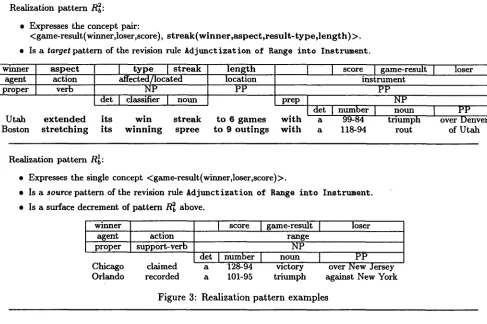
The resulting classes, called realization patterns, abstract the mapping from semantic to syntactic structure by factoring out lexical material and syn- tactic details. Two examples of realization patterns are given in Fig. 3. Realization patterns were then grouped into surface decrement pairs consisting of:
• A more complex pattern (called the target pat- tern).
• A simpler pattern (called the source pattern) that is structurally the closest to the target pat- tern among patterns with one less concept s .
T h e structural transformations from source to tar- get p a t t e r n in each surface decrement pair were then hierarchically classified, resulting in the revi- sion rule hierarchy shown in Fig. 4-10. For ex- ample, the surface decrement pair < R~, R 1 >, shown in Fig. 3, is one of the pairs from which
the revision rule Adjunctization of Range into Instrument, shown in Fig. 10 was abstracted.
It involves displacing the Range argument of the source clause as an Instrument adjunct to accom- modate a n e w verb and its argument. This revi- sion rule is a sibling of the rule Adjunctization of
Created into Instrument used to revise sentence i into 2 in STREAK'S run shown in Fig. 1 (where the Created argument role "42 points" of the verb "to score" in I becomes an Instrument adjunct in 2).
T h e bottom level of the revision rule hierarchy specifies the side revisions that are orthogonal and sometimes accompany the restructuring revisions discussed up to this point. Side revisions do not m a k e the draft more informative, but instead im- prove its style, conciseness and unambiguity. For ex- ample, w h e n S T R E A K revises sentence (3) into (4) in the example run of Fig. 1, the Agent of the absorbed clause "Danny Ainge added 21 points" becomes con- trolled by the new embedding clause "Danny Ainge came off the bench" to avoid the verbose form: ? "Danny Ainge came off the bench for Danny Ainge to add 21 points".
4 E v a l u a t i o n m e t h o d o l o g y
In the spectrum of possible evaluations, the eval- uation presented in this paper is characterized as follows:
• Its object is the revision rule hierarchy acquired from the sports s u m m a r y corpus. It thus does not directly evaluate the o u t p u t of STREAK, but rather the special knowledge structures required by its underlying revision-based model.
s i.e., the source pattern expresses the same concept combination than the target pattern minus one concept.
The particular property of this revision rule hi- erarchy that is evaluated is cross-domain porta- bility: how much of it could be re-used to gener- ate summaries in another domain, namely the stock market?
The basis for this evaluation is corpus data 9. The original sports s u m m a r y corpus from which the revision rules were acquired is used as the 'training' (or acquisition) corpus and a cor- pus of stock market reports taken from several newswires is used as the 'test' corpus. This test corpus comprises over 18,000 sentences.
The evaluation procedure is quantitative, mea- suring percentages of revision rules whose target and source realization patterns are observable in the test corpus. It is also semi-automated through the use of the corpus search tool CREP (Duford, 1993) (as explained below).
Basic p r i n c i p l e As explained in section 3, a re- vision rule is associated with a list of surface decre- ment pairs, each one consisting of:
A source pattern whose content and linguistic form match the triggering conditions of the rule (e.g., R~ in Fig. 3 for the rule A d j u n c t i z a t i o n
of Range i n t o I n s t r u m e n t ) .
A target pattern whose content and linguis- tic form can be derived from the source pat- tern by applying the rule (e.g., R 2 in Fig. 3
for the rule Adjunctization of Range into
Instrument).
This list of decrement pairs can thus be used as the signature of the revision rule to detect its usage in the test corpus. The needed evidence is the simul- taneous presence of two test corpus sentences 1° , each one respectively matching the source and target pat- terns of at least one element in this list. Requiring occurrence of the source pattern in the test corpus is necessary for the computation of conservative porta- bility estimates: while it may seem that one target pattern alone is enough evidence, without the pres- ence of the corresponding source pattern, one cannot rule out the possibility that, in the test domain, this target pattern is either a basic pattern or derived from another source pattern using another revision rule.
9Only the corpus analysis was performed for both do- mains. The implementation was not actually ported to the stock market domain.
Realization pattern R~:
• Expresses the concept pair:
<game-result(winner,loser,score), s t r e a k ( w i n n e r , a s p e c t , r e s u l t - t y p e , l e n g t h) >.
• Is a target pattern of the revision rule Adjunctization of Range i n t o Instrument.
winner aspect l type l streak length [ agent action affected/located location
proper verb NP PP
d e t ] classifier I noun prep ]
Utah e x t e n d e d its win s t r e a k to 6 games w i t h Boston s t r e t c h i n g its w i n n i n g spree to 9 o u t i n g s w i t h
[ score ]game-result [ loser instrument
PP NP
L_J n u m b e ~ J PP a 99-84 triumph - over enl3-d-~V-~
a 118-94 rout of Utah
Realization pattern R~:
* Expresses the single concept <game-result(winner,loser,score)>.
• Is a s o u r c e pattern of the revision rule Adjunctization of Range into Instrument.
• Is a surface decrement of pattern R~ above.
winner
agent action proper support-verb
I score ] game-result I loser range
NP det I number I noun
Chicago claimed a Y
Orlando recorded a 1 0 1 - 9 5 triumph
I
PP over New Jersey against New YorkFigure 3: Realization pattern examples
P a r t i a l l y a u t o m a t i n g t h e e v a l u a t i o n T h e soft- ware tool C R E P 11 w a s developed to partially auto- mate detection of realization patterns in a text cor- pus. T h e basic idea behind CREP is to approximate a realization pattern by a regular expression whose terminals are words or parts-of-speech tags (POS- tags). CR~.P will then automatically retrieve the cor- pus sentences matching those expressions. For ex- ample, the CREP expression C~1 below approximates the realization pattern R~ shown in Fig. 3:
(61) TEAM Of (claimed[recorded)@VBD I- SCORE O= (victory[triumph)@NN O= (over[against)@IN O= TEAM
In the expression above, 'VBD', 'NN' and 'IN' are the POS-tags for past verb, singular noun and preposi- tion (respectively), and the sub-expressions 'TEAH' and 'SCORE' (whose recursive definitions are not shown here) m a t c h the team names and possible fi- nal scores (respectively) in the NBA. The CREP op- erators 'N=' and 'N-' (N being an arbitrary integer) respectively specify exact and minimal distance of N words, and ' l ' encodes disjunction.
l l c R E P w a s implemented (on top of FLEX, GNUS' ver- sion of LEX) and to a large extent also designed by Du- ford. It uses Ken Church's POS tagger.
Because a realization p a t t e r n abstracts away from lexical items to capture the mapping from concepts to syntactic structure, approximating such a p a t t e r n by a regular expression of words and POS-tags in- volves encoding each concept of the p a t t e r n by the disjunction of its alternative lexicalizations. In a given domain, there are therefore two sources of in- accuracy for such an approximation:
• Lexical ambiguity resulting in false positives by over-generalization.
• Incomplete vocabulary resulting in false nega- tives by over-specialization 12.
Lexical ambiguities can be alleviated by writing more context-sensitive expressions. T h e vocabu- lary can be acquired through additional exploratory C R E P runs with expressions containing wild-cards for some concept slots. Although a u t o m a t e d corpus search using C R E P expressions considerably speeds- up corpus analysis, manual intervention remains
[image:4.612.68.555.90.414.2]necessary to filter out incorrect matches resulting from imperfect approximations.
C r o s s - d o m a i n d i s c r e p a n c i e s Basic similarities between the finance and sports domains form the basis for the portability of the revision rules. In both domains, the core facts reported are statis- tics compiled within a standard temporal unit (in sports, one ballgame; in finance, one stock market session) together with streaks 13 and records com- piled across several such units. This correspondence is, however, imperfect. Consequently, before they can track down usage of a revision rule in the test do- main, the CREP expressions approximating the sig- nature of the rule in the acquisition domain must be adjusted for cross-domain discrepancies to prevent false negatives. Two m a j o r types of adjustments are necessary: lexical and thematic.
Lexical adjustments handle cases of partial mis- match between the respective vocabularies used to lexicalize matching conceptual structures in each do- main. (e.g.,, the verb "to rebound from" expresses the interruption of a streak in the stock market do- main, while in the basketball domain "to break" or "to snap" are preferred since "to rebound" is used to express a different concept).
T h e m a t i c adjustments handle cases of partial dif- ferences between corresponding conceptual struc- tures in the acquisition and test domains. For ex- ample, while in sports g a r a e - r e s u l t involves an- tagonistic teams, its financial domain counterpart s e s s i o n - r e s u l t concerns only a single indicator. Consequently, the sub-expression for the l o s e r role in the example CI:tEP expression (~1 shown before, and which approximates realization pattern / ~ for g a m e - r e s u l l ; (shown in Fig. 3), needs to become optional in order to also approximate patterns for session-resul~. This is done using the CREP op- erator ? as shown below:
(C1/): TEAM O= (claimedlrecorded)@VBD 1- SCORE O= (victoryltriumph) @NN O=
( (over] against)@IN 0= TEAM) ?
Note that it is the CREP expressions used to auto- matically retrieve test corpus sentence pairs attest- ing usage of a revision rule that require this type of adjustment and not the revision rule itself 14. For example, the A d j o i n o f F r e q u e n c y PP t o C l a u s e revision rule attaches a streak to a s e s s i o n - r e s u l t clause without l o s e r role in exactly the same way than it attaches a streak to a g a m e - r e s u l t with
13i.e., series of events with similar outcome.
14Some revision rules do require adjustment, but of another type (cfl Sect. 5).
l o s e r role. This is illustrated by the two corpus sentences below:
P~: "The Chicago Bulls beat the Phoenix Suns 99 91 f o r t h e i r 3 r d s t r a i g h t w i n "
p t : "The Amex Market Value Index inched up 0.16 to 481.94 f o r i t s s i x t h s t r a i g h t a d v a n c e "
D e t a i l e d e v a l u a t i o n p r o c e d u r e The overall procedure to test portability of a revision rule con- sists of considering the surface decrement pairs in the rule signature in order, and repeating the following steps:
1. Write a CREP expression for the acquisition tar- get pattern.
2. Iteratively delete, replace or generalize sub- expressions in the CREP expression - to gloss over thematic and lexical discrepancies between the acquisition and test domains, and prevent false negatives - until it matches some test cor- pus sentence(s).
3. Post-edit the file containing these matched sen- tences. If it contains only false positives of the sought target pattern, go back to step 2. Oth- erwise, proceed t o step 4.
4. Repeat step (1-3) with the source pattern of the pair under consideration. If a valid match can also be found for this source pattern, stop: the revision rule is portable. Otherwise, start over from step 1 with the next surface decrement pair in the revision rule signature. If there is no next pair left, stop: the revision rule is considered non-portable.
Steps (2,3) constitute a general, generate-and-test procedure to detect realization patterns usage in a corpus 15. Changing one CKEP sub-expression may result in going from too specific an expression with no valid match to either: (1) a well-adjusted ex- pression with a valid match, (2) still too specific an expression with no valid match, or (3) already too general an expression with too m a n y matches to be manually post-edited.
It is in fact always possible to write more context- sensitive expressions, to manually edit larger no- match files, or even to consider larger test corpora in the hope of finding a match. At some point however, one has to estimate, guided by the results of previ- ous runs, that the likelihood of finding a match is too
small to justify the cost of further attempts. This is why the last line in the algorithm reads "considered non-portable" as opposed to "non-portable". The algorithm guarantees the validity of positive (i.e., portable) results only. Therefore, the figures pre- sented in the next section constitute in fact a lower- bound estimate of the actual revision rule portability. 5 E v a l u a t i o n r e s u l t s
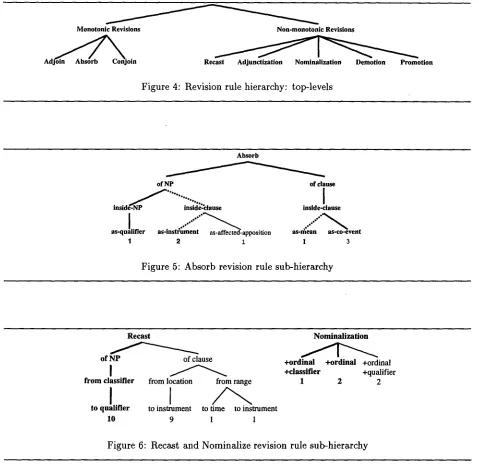
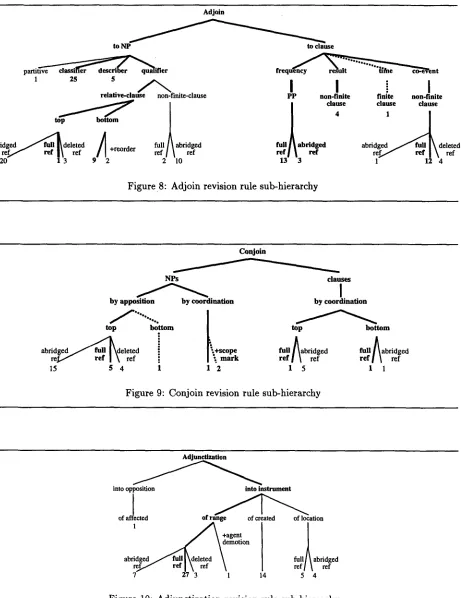
The results of the evaluation are summarized in Fig. 4-10. They show the revision rule hierarchy, with portable classes highlighted in bold. The fre- quency of occurrence of each rule in the acquisition corpus is given below the leaves of the hierarchy.
Some rules are same-concept portable: they are used to attach corresponding concepts in each do- main
(e.g.,
Adjoin of Frequency PP to Clause,as explained in Sect. 4). T h e y could be re-used "as is" in the financial domain. Other rules, however, are only
different-concept
portable:
they are used to attach altogether different concepts in each domain. This is the case for example of Adjoin Finite Time Clause to Clause, as illustrated by the two corpus sentences below, where the added temporal adjunct (in bold) conveys a streak in the sports sentence, but a complementary statistics in the financial one:T~: "to lead Utah to a 119-89 trouncing of Denver as t h e J a z z d e f e a t e d t h e N u g g e t s for t h e 1 2 t h s t r a i g h t t i m e a t h o m e . "
T~: "Volume amounted to a solid 349 million shares as a d v a n c e s o u t - p a c e d declines 299 t o 218.".
For different-concept portable rules, the left-hand side field specifying the concepts incorporable to the draft using this rule will need to be changed when porting the rule to the stock market domain. In Fig. 4-10, the arcs leading same-concept portable classes are full and thick, those leading to different- concept portable classes are dotted, and those lead- ing to a non-portable classes are full but thin.
59% of all revision rule classes turned out to be same-concept portable, with another 7% different- concept portable. Remarkably, all eight top-level classes identified in the sports domain had instances same-concept portable to the financial domain, even those involving the most complex non-monotonic re- visions, or those with only a few instances in the sports corpus. Among the bottom-level classes that distinguish between revision rule applications in very specific semantic and syntactic contexts, 42% are same-concept portable with another 10% different- concept portable. Finally, the correlation between high usage frequency in the acquisition corpus and portability to the test corpus is not statistically sig- nificant (i.e., the hypothesis that the more common
a rule, the more likely it is to be portable could not be confirmed on the analyzed sample). See (Robin, 1994b) for further details on the evMuation results.
There are two main stumbling blocks to porta- bility: thematic role mismatch and side revisions. Thematic role mismatches are cases where the se- mantic label or syntactic sub-category of a con- stituent added or displaced by the rule differ in each domain (e.g., A d j u n c t i z a t i o n of Created
into Instrument vs. Adjoin of Affected into
Instrument). They push portability from 92% down
to 71%. Their effect could be reduced by allowing STREAK'S reviser to manipulate the draft down to the surface syntactic role level (e.g., in both cor- pora Created and Affected surface as object). Cur- rently, the reviser stops at the thematic role level to allow S T R E A K to take full advantage of the syntac- tic processing front-end S U R G E (Elhadad and Robin, 1996), which accepts such thematic structures as in- put.
Accompanying side revisions push portability from 71% to 52%. This suggests that the design of S T R E A K could be improved by keeping side revisions separate from re-structuring revisions and interleav- ing the applications of the two. Currently, they are integrated together at the bottom of the revision rule hierarchy.
6 R e l a t e d w o r k
Apart from STREAK, only three generation projects feature an empirical and quantitative evaluation: ANA (Kukich, 1983), KNIGHT (Lester, 1993) and IM- A G E N E (Van der Linden, 1993).
ANA generates short, newswire style summaries of the daily fluctuations of several stock market indexes from half-hourly updates of their values. For eval- uation, Kukich measures both the conceptual and linguistic (lexical and syntactic) coverages of ANA by comparing the number of concepts and realiza- tion patterns identified during a corpus analysis with those actually implemented in the system.
KNIGHT generates natural language concept defi- nitions from a large biological knowledge base, rely- ing on SURGE for syntactic realization. For evalua- tion, Lester performs a Turing test in which a panel of human judges rates 120 sample definitions by as- signing grades (from A to F) for:
• Semantic accuracy (defined as "Is the definition adequate, providing correct information and fo- cusing on what's important?" in the instruc- tions provided to the judges).
Monotonic Revisions Non-monotonic Revisions
A d l ~ j o i n Recast Adjunctization Nomlnalization Demotion Promotion
Figure 4: Revision rule hierarchy: top-levels
Absorb
of NP ofclause
insidc-NP ~ ¢ ~ ' ~ ... ~d~lause inslde!lanse
as querier - as- ns rument as-affected-apposition i t ... " ° " ' ~ as-mean as-co-event " ' ' " ~
1 2 l 1 3
Figure 5: Absorb revision rule sub-hierarchy
Recast
of NP of clause
from classifier from location from range
to qualifier to instrument to time to instrument
10 9 1 1
Nominalization
+ordinal +ordinal +ordinal +classifier +qualifier
1 2 2
Figure 6: Recast and Nominalize revision rule sub-hierarchy
Demotion
f r o m ~ f f e c t e d
] to qualifleJ(affeeted) I
to score(co-event) to determiner(affected)
1 2 1
Coordination Promotion
simple w/Adjunctization
1 1
[image:7.612.55.534.93.563.2]Adjoin
to NT to clause
1
25
rel ve-cla
aSfi
•use4~non.fi
.rote clause
• °abridged / ~ d e l e t e d
~ +reorder
ref
full abridged
ref
2ref/''-
ref~ 3 ref 9 2
2 10
f r e q u e n ~ n t
I
I
i
I
PP non-finite finite non-finite d a e clause clause
2
,
full I ~ abridged
abridg~ ~
deleted
refl~
ref
r e f ~
ref J \ ref
13 3
1
12 4
Figure 8: Adjoin revision rule sub-hierarchy
Conjoin
NPs
by apposition
/
%%%%%abridged ~ d e l e t e d
re~ f
ref I
\ ref
15
5 4
1
clauses
I
by coordination
by coordination
"+scope
full ~bridged
full Aabridged
l~mark
refl ~ ref
refl ~ ref
1 2 1 5 1 1
Figure 9: Conjoin revision rule sub-hierarchy
into opposition
into instrument
of affected
of range
of created
of location
1
~
\demotion
+agent
1
abridged /
full,deleted \
full abridged
ref//
refJ\ ref
\
ref/~ ref
[image:8.612.91.552.89.687.2]7
27 3
1
14
5 4
[image:8.612.81.552.93.279.2]ANA
KNIGHT
Object of Evaluation knowledge structures
output text
IMAGENE output text
knowledge structures STREAK
Evaluated Properties conceptual coverage linguistic coverage semantic accuracy stylistic accuracy stylistic accuracy stylistic robustness cross-domain p o r t a b i l i t y
same-domain robustness same-domain scalability
Empirical Basis textual corpus
human judges
textual corpus
textual corpus
Evaluation Procedure m a n u a l
m a l l u a l
m a n u a l
semi-automatic
Figure 11: Empirical evaluations in language generation
conveys well organized" in the instructions pro- vided to the judges).
The judges did not know that half the definitions were computer-generated while the other half were written by four h u m a n domain experts. Impres- sively, the results show that:
• With respect to semantic accuracy, the human judges could not tell KNIGHT apart from the hu-
m a n writers.
* While as a group, humans got statistically sig- nificantly better grades for stylistic accuracy t h a n KNIGHT, the best h u m a n writer was single- handly responsible for this difference.
IMAGENE generates instructions on how to oper- ate household devices relying on NIGEL (Mann and Matthiessen, 1983) for syntactic realization. T h e implementation focuses on a very limited aspect of text generation: the realization of purpose relations. Taking as input the description of a pair <operation, purpose of the operation>, augmented by a set of features simulating the communicative context of generation, IMAGENE selects, among the many real- izations of purpose generable by NIGEL (e.g., fronted to-infinitive clause vs. trailing for-gerund clauses), the one that is most appropriate for the simulated context (e.g., in the context of several operations sharing the same purpose, the latter is preferentially expressed before those actions than after them). IM- AGENE's contextual preference rules were abstracted by analyzing an acquisition corpus of about 300 pur- pose clauses from cordless telephone manuMs. For evaluation, Van der Linden compares the purpose realizations picked by IMAGENE to the one in the corresponding corpus text, first on the acquisition corpus and then on a test corpus of about 300 other purpose clauses from manuals for other devices than
cordless telephones (ranging from clock radio to au- tomobile). The results show a 71% match on the acquisition corpus 16 and a 52% match on the test corpus.
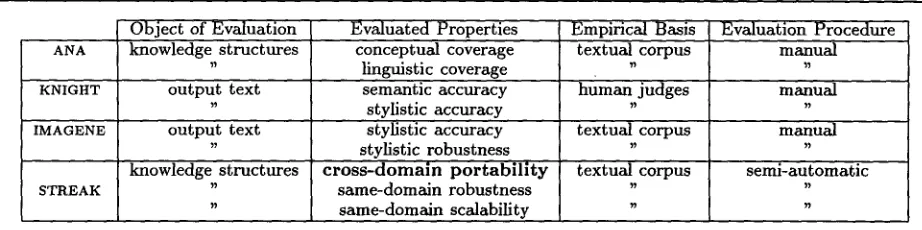
The table of Fig. 11 summarizes the difference on both goal and methodology between the eval- uations carried out in the projects ANA, KNIGHT, IMAGENE and STREAK. In terms of goals, while Kukich and Lester evaluate the coverage or accu- racy of a particular implementation, I instead fo- cus on three properties inherent to the use of the revision-based generation model underlying STREAK: robustness (how much of other text samples from the same domain can be generated without acquiring new knowledge?) and scalability (how much more new knowledge is needed to fully cover these other samples?) discussed in (Robin and McKeown, 1995), and portability to another domain in the present pa- per. Van der Linden does a little bit of both by first measuring the stylistic accuracy of his system for a very restricted sub-domain, and then measuring how it degrades for a more general domain.
In itself, measuring the accuracy and coverage of a particular implementation in the sub-domain for which it was designed brings little insights about what generation approach should be adopted in fu- ture work. Indeed, even a system using mere canned text can be very accurate and attain substantial cov- erage if enough hand-coding effort is put into it. However, all this effort will have to be entirely du- plicated each time the system is scaled up or ported to a new domain. Measuring how much of this effort duplication can be avoided when relying on revision- based generation was the very object of the three evaluations carried in the STREAK project.
[image:9.612.60.521.83.198.2]In terms of methodology, the main originality of these three evaluations is the use of CREP to par- tially automate reverse engineering of corpus sen- tences. Beyond evaluation, CREP is a simple, but general and very handy tool that should prove use- ful to speed-up a wide range of corpora analyses.
7 C o n c l u s i o n
In this paper, I presented a quantitative evaluation of the portability to the stock market domain of the revision rule hierarchy used by the system S T R E A K to
incrementally generate newswire sports summaries. The evaluation procedure consists of searching a test corpus of stock market reports for sentence pairs whose (semantic and syntactic) structures respec- tively match the triggering condition and application result of each revision rule. The results show that at least 59% of all rule classes are fully portable, with at least another 7% partially portable.
Since the sports domain is not closer to the finan- cial domain than to other quantitative domains such as meteorology, demography, business auditing or computer surveillance, these results are very encour- aging with respect to the general cross-domain re- usability potential of the knowledge structures used in revision-based generation. However, the present evaluation concerned only one type of such knowl- edge structures: revision rules. In future work, sim- ilar evaluations will be needed for the other types of knowledge structures: content selection rules, phrase planning rules and lexicalization rules.
A c k n o w l e d g e m e n t s
Many thanks to Kathy McKeown for stressing the im- portance of empirically evaluating STREAK. The re-
search presented in this paper is currently supported by CNPq (Brazilian Research Council) under post-doctoral research grant 150130-95.3. It started out while I was at Columbia University supported by of a joint grant from the Office of Naval Research, by the Advanced Research Projects Agency under contract N00014-89-J- 1782, by National Science Foundation Grants IRT-84- 51438 and GER-90-2406, and by the New York State Science and Technology Foundation under this auspices of the Columbia University CAT in High Performance Computing and Communications in Health Care, a New York State Center for Advanced Technology.
R e f e r e n c e s
Duford, D. 1 9 9 3 . caEP: a regular expression- matching textual corpus tool. Technical Report
CU-CS-005-93. Computer Science Department, Columbia University, New York.
Elhadad, M. and Robin, J. 1996. An overview of SURGE: a re-usable comprehensive syntactic realization component. Technical Report 96-03. Computer Science and Mathematics Department, Ben Gurion University, Beer Sheva, Israel.
Kukich, K. 1983. Knowledge-based report genera- tion: a knowledge engineering approach to natural language report generation. PhD. Thesis. Depart- ment of Information Science. University of Pitts- burgh.
Lester, J.C. 1993. Generating natural language explanations from large-scale knowledge bases. PhD. Thesis. Computer Science Department, University of Texas at Austin.
Mann, W.C. and Matthiessen, C. M. 1983. NIGEL: a systemic grammar for text generation. Research Report RR-83-105. ISI. Marina Del Rey, CA.
Robin, J. and McKeown, K.R. 1993. Corpus anal- ysis for revision-based generation of complex sen- tences. In Proceedings of the 11th National Con- ference on Artificial Intelligence, Washington DC.
(AAAI'93).
Robin, J. and McKeown, K.R. 1995. Empirically designing and evaluating a new revision-based model for summary generation. Artificial Intel- ligence. Vol 85. Special Issue on Empirical Meth- ods. North-Holland.
Robin, J. 1993. A revision-based generation archi- tecture for reporting facts in their historical con- text. In New Concepts in Natural Language Gen- eration: Planning, Realization and System. Ho- racek, H. and Zock, M., Eds. Frances Pinter.
Robin, J. 1994a. Automatic generation and revision of natural language summaries providing histori- cal background In Proceedings of the 11th Brazil- ian Symposium on Artificial Intelligence, Fort- aleza, Brazil. (SBIA'94).
Robin, J. 1994b. Revision-based generation of natu- ral language summaries providing historical back- ground: corpus-based analysis, design, implemen- tation and evaluation. PhD. Thesis. Available as Technical Report CU-CS-034-94. Computer Science Department, Columbia University, New York.