Open Information Extraction using Wikipedia
Fei Wu
University of Washington Seattle, WA, USA
Daniel S. Weld
University of Washington Seattle, WA, USA
Abstract
Information-extraction (IE) systems seek to distill semantic relations from natural-language text, but most systems use super-vised learning of relation-specific examples and are thus limited by the availability of training data. Open IE systems such as TextRunner, on the other hand, aim to handle the unbounded number of relations found on the Web. But how well can these open systems perform?
This paper presents WOE, an open IE system which improves dramatically on TextRunner’s precision and recall. The key to WOE’s per-formance is a novel form of self-supervised learning for open extractors — using heuris-tic matches between Wikipedia infobox at-tribute values and corresponding sentences to construct training data. Like TextRunner, WOE’s extractor eschews lexicalized features and handles an unbounded set of semantic relations. WOE can operate in two modes: when restricted to POS tag features, it runs as quickly as TextRunner, but when set to use dependency-parse features its precision and recall rise even higher.
1 Introduction
The problem of information-extraction (IE), gen-erating relational data from natural-language text, has received increasing attention in recent years. A large, high-quality repository of extracted tu-ples can potentially benefit a wide range of NLP tasks such as question answering, ontology learn-ing, and summarization. The vast majority of IE work uses supervised learning of relation-specific examples. For example, the WebKB project (Craven et al., 1998) used labeled exam-ples of thecourses-taught-byrelation to in-duce rules for identifying additional instances of the relation. While these methods can achieve
high precision and recall, they are limited by the availability of training data and are unlikely to scale to the thousands of relations found in text on the Web.
An alternative paradigm, Open IE, pioneered by the TextRunner system (Banko et al., 2007) and the “preemptive IE” in (Shinyama and Sekine, 2006), aims to handle an unbounded number of relations and run quickly enough to process Web-scale corpora. Domain independence is achieved by extracting the relation name as well as its two arguments. Most open IE systems use self-supervised learning, in which automatic heuristics generate labeled data for training the extractor. For example, TextRunner uses a small set of hand-written rules to heuristically label training exam-ples from sentences in the Penn Treebank.
This paper presents WOE (Wikipedia-based Open Extractor), the first system that au-tonomously transfers knowledge from random ed-itors’ effort of collaboratively editing Wikipedia to train an open information extractor. Specifically, WOEgeneratesrelation-specifictraining examples by matching Infobox1 attribute values to corre-sponding sentences (as done in Kylin (Wu and Weld, 2007) and Luchs (Hoffmann et al., 2010)), but WOE abstracts these examples to relation-independent training data to learn an unlexical-ized extractor, akin to that of TextRunner. WOE can operate in two modes: when restricted to shallow features like part-of-speech (POS) tags, it runs as quickly as Textrunner, but when set to use dependency-parse features its precision and recall rise even higher. We present a thorough experi-mental evaluation, making the following contribu-tions:
• We present WOE, a new approach to open IE that uses Wikipedia for self-supervised
learn-1An infobox is a set of tuples summarizing the key at-tributes of the subject in a Wikipedia article. For example, the infobox in the article on “Sweden” contains attributes like Capital, PopulationandGDP.
ing of unlexicalized extractors. Compared with TextRunner (the state of the art) on three corpora, WOE yields between 72% and 91% improved F-measure — generalizing well be-yond Wikipedia.
• Using the same learning algorithm and fea-tures as TextRunner, we compare four dif-ferent ways to generate positive and negative training data with TextRunner’s method, con-cluding that our Wikipedia heuristic is respon-sible for the bulk ofWOE’s improved accuracy. • The biggest win arises from using parser fea-tures. Previous work (Jiang and Zhai, 2007) concluded that parser-based features are un-necessary for information extraction, but that work assumed the presence of lexical features. We show that abstract dependency paths are a highly informative feature when performing unlexicalized extraction.
2 Problem Definition
An open information extractor is a function from a document, d, to a set of triples, {harg1,rel,arg2i}, where the args are noun phrases and rel is a textual fragment indicat-ing an implicit, semantic relation between the two noun phrases. The extractor should produce one triple for every relation statedexplicitlyin the text, but is not required to infer implicit facts. In this paper, we assume that all relational instances are stated within a single sentence. Note the dif-ference between open IE and the traditional ap-proaches (e.g., as in WebKB), where the task is to decide whether some pre-defined relation holds between (two) arguments in the sentence.
We wish to learn an open extractorwithout di-rect supervision, i.e. without annotated training examples or hand-crafted patterns. Our input is Wikipedia, a collaboratively-constructed encyclo-pedia2. As output,WOEproduces an unlexicalized and relation-independent open extractor. Our ob-jective is an extractor which generalizes beyond Wikipedia, handling other corpora such as the gen-eral Web.
3 Wikipedia-based Open IE
The key idea underlying WOE is the automatic construction of training examples by heuristically matching Wikipedia infobox values and corre-sponding text; these examples are used to generate
2
We also use DBpedia (Auer and Lehmann, 2007) as a collection of conveniently parsed Wikipediainfoboxes
Sentence Splitting NLP Annotating Synonyms Compiling
Preprocessor
Primary Entity Matching
Sentence Matching Matcher
Triples
Pattern Classifier over Parser Features
[image:2.595.306.525.65.160.2]CRF Extractor over Shallow Features Learner
Figure 1: Architecture ofWOE.
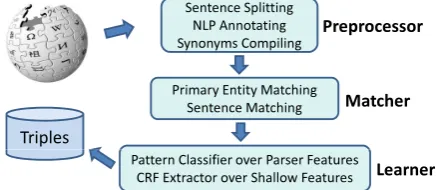
an unlexicalized, relation-independent (open) ex-tractor. As shown in Figure 1,WOEhas three main components: preprocessor, matcher, and learner.
3.1 Preprocessor
The preprocessor converts the raw Wikipedia text into a sequence of sentences, attaches NLP anno-tations, and builds synonym sets for key entities. The resulting data is fed to the matcher, described in Section 3.2, which generates the training set.
Sentence Splitting:The preprocessor first renders
each Wikipedia article into HTML, then splits the article into sentences using OpenNLP.
NLP Annotation: As we discuss fully in
Sec-tion 4 (Experiments), we consider several varia-tions of our system; one version, WOEparse, uses parser-based features, while another,WOEpos, uses shallow features like POS tags, which may be more quickly computed. Depending on which version is being trained, the preprocessor uses OpenNLP to supply POS tags and NP-chunk an-notations — or uses the Stanford Parser to create a dependency parse. When parsing, we force the hy-perlinked anchor texts to be a single token by con-necting the words with an underscore; this trans-formation improves parsing performance in many cases.
Compiling Synonyms: As a final step, the
back-ward links to automatically construct synonym sets. Redirection pages are a natural choice, be-cause they explicitly encode synonyms; for ex-ample, “USA” is redirected to the article on the “United States.” Backward links for a Wiki-pedia entity such as the “Massachusetts Institute of Technology” are hyperlinks pointing to this entity from other articles; the anchor text of such links (e.g., “MIT”) forms another source of synonyms.
3.2 Matcher
The matcher constructs training data for the learner component by heuristically matching attribute-value pairs from Wikipedia articles con-taining infoboxes with corresponding sentences in the article. Given the article on “Stanford Univer-sity,” for example, the matcher should associate hestablished,1891i with the sentence “The university was founded in 1891 by . . . ” Given a Wikipedia page with an infobox, the matcher iter-ates through all its attributes looking for a unique sentence that contains references to both the sub-ject of the article and the attribute value; these noun phrases will be annotated arg1 and arg2
in the training set. The matcher considers a sen-tence to contain the attribute value if the value or its synonym is present. Matching the article sub-ject, however, is more involved.
Matching Primary Entities: In order to match
shorthand terms like “MIT” with more complete names, the matcher uses an ordered set of heuris-tics like those of (Wu and Weld, 2007; Nguyen et al., 2007):
• Full match: strings matching the full name of the entity are selected.
• Synonym set match: strings appearing in the entity’s synonym set are selected.
• Partial match: strings matching a prefix or suf-fix of the entity’s name are selected. If the full name contains punctuation, only a prefix is allowed. For example, “Amherst” matches “Amherst, Mass,” but “Mass” does not. • Patterns of “the <type>”: The matcher first
identifies the type of the entity (e.g., “city” for “Ithaca”), then instantiates the pattern to create the string “the city.” Since the first sentence of most Wikipedia articles is stylized (e.g. “The city of Ithaca sits . . . ”), a few patterns suffice to extract most entity types.
• The most frequent pronoun: The matcher as-sumes that the article’s most frequent pronoun
denotes the primary entity, e.g., “he” for the page on “Albert Einstein.” This heuristic is dropped when “it” is most common, because the word is used in too many other ways.
When there are multiple matches to the primary entity in a sentence, the matcher picks the one which is closest to the matched infobox attribute value in the parser dependency graph.
Matching Sentences:The matcher seeks aunique
sentence to match the attribute value. To produce the best training set, the matcher performs three filterings. First, it skips the attribute completely when multiple sentences mention the value or its synonym. Second, it rejects the sentence if the subject and/or attribute value are not heads of the noun phrases containing them. Third, it discards the sentence if the subject and the attribute value do not appear in the same clause (or in parent/child clauses) in the parse tree.
Since Wikipedia’s Wikimarkup language is se-mantically ambiguous, parsing infoboxes is sur-prisingly complex. Fortunately, DBpedia (Auer and Lehmann, 2007) provides a cleaned set of in-foboxes from 1,027,744 articles. The matcher uses this data for attribute values, generating a training dataset with a total of 301,962 labeled sentences.
3.3 Learning Extractors
We learn two kinds of extractors, one (WOEparse) using features from dependency-parse trees and the other (WOEpos) limited to shallow features like POS tags. WOEparse uses a pattern learner to classify whether the shortest dependency path be-tween two noun phrases indicates a semantic rela-tion. In contrast,WOEpos(like TextRunner) trains a conditional random field (CRF) to output certain text between noun phrases when the text denotes such a relation. Neither extractor uses individual words or lexical information for features.
3.3.1 Extraction with Parser Features
Despite some evidence that parser-based features have limited utility in IE (Jiang and Zhai, 2007), we hoped dependency paths would improve preci-sion on long sentences.
Shortest Dependency Path as Relation: Unless
noted in (de Marneffe and Manning, 2008), this collapsed format often yields simplified patterns which are useful for relation extraction. Consider the sentence:
Dan was not born in Berkeley.
The Stanford Parser dependencies are:
nsubjpass(born-4, Dan-1) auxpass(born-4, was-2) neg(born-4, not-3)
prep in(born-4, Berkeley-6)
where each atomic formula represents a binary de-pendence from dependent token to the governor token.
These dependencies form a directed graph, hV, Ei, where each token is a vertex in V, andE
is the set of dependencies. For any pair of tokens, such as “Dan” and “Berkeley”, we use the shortest connecting path to represent the possible relation between them:
Dan−−−−−−−−−→nsubjpass born←−−−−−−prep in Berkeley
We call such a path acorePath. While we will see that corePaths are useful for indicating when
a relation exists between tokens, they don’t neces-sarily capture thesemantics of that relation. For example, the path shown above doesn’t indicate the existence of negation! In order to capture the
meaningof the relation, the learner augments the corePath into a tree by adding all adverbial and adjectival modifiers as well as dependencies like “neg” and “auxpass”. We call the result an ex-pandPathas shown below:
WOE traverses the expandPath with respect to the token orders in the original sentence when out-puttingthe final expression ofrel.
Building a Database of Patterns:For each of the
301,962 sentences selected and annotated by the matcher, the learner generates a corePath between the tokens denoting the subject and the infobox at-tribute value. Since we are interested in eventu-ally extracting “subject, relation, object” triples, the learner rejects corePaths that don’t start with subject-like dependencies, such as nsubj, nsubj-pass,partmod andrcmod. This leads to a collec-tion of 259,046 corePaths.
To combat data sparsity and improve learn-ing performance, the learner further generalizes the corePaths in this set to create a smaller set of generalized-corePaths. The idea is to
elimi-nate distinctions which are irrelevant for recog-nizing (domain-independent) relations. Lexical words in corePaths are replaced with their POS tags. Further, all Noun POS tags and “PRP” are abstracted to “N”, all Verb POS tags to “V”, all Adverb POS tags to “RB” and all Adjective POS tags to “J”. The preposition dependencies such as “prep in” are generalized to “prep”. Take the corePath “Dan−−−−−−−−−→nsubjpass born←−−−−−−prep in Berkeley” for example, its generalized-corePath is “N −−−−−−−−−→nsubjpass V ←−−−−prep N”. We call such a generalized-corePath an extraction pattern. In total, WOE builds a database (named DBp) of
15,333 distinct patterns and each patternpis asso-ciated with a frequency — the number of matching sentences containingp. Specifically, 185 patterns havefp ≥100and 1929 patterns havefp≥5.
Learning a Pattern Classifier: Given the large
number of patterns inDBp, we assume few valid
open extraction patterns are left behind. The learner builds a simple pattern classifier, named WOEparse, which checks whether the generalized-corePath from a test triple is present inDBp, and
computes the normalized logarithmic frequency as the probability3:
w(p) = max(log(fp)−log(fmin),0)
log(fmax)−log(fmin)
wherefmax (50,259 in this paper) is the maximal
frequency of pattern in DBp, andfmin (set 1 in
this work) is the controlling threshold that deter-mines the minimal frequency of a valid pattern.
Take the previous sentence “Dan was not born in Berkeley” for example. WOEparse first identi-fies Dan as arg1 and Berkeley as arg2 based on NP-chunking. It then computes the corePath “Dan −−−−−−−−−→nsubjpass born ←−−−−−−prep in Berkeley” and abstracts to p=“N −−−−−−−−−→nsubjpass V ←−−−−prep N”. It then queries DBp to retrieve the
fre-quency fp = 29112 and assigns a
probabil-ity of 0.95. Finally, WOEparse traverses the triple’s expandPath to output the final expression
hDan, wasN otBornIn, Berkeleyi. As shown
in the experiments on three corpora, WOEparse achieves an F-measure which is between 72% to 91% greater than TextRunner’s.
3.3.2 Extraction with Shallow Features
WOEparse has a dramatic performance ment over TextRunner. However, the improve-ment comes at the cost of speed — TextRunner
3
0.0 0.1 0.2 0.3 0.4 0.5 0.6
0.0
0.2
0.4
0.6
0.8
1.0
recall
precision
P/R Curve on WSJ
WOEparse
WOEpos
TextRunner
0.0 0.1 0.2 0.3 0.4 0.5 0.6
0.0
0.2
0.4
0.6
0.8
1.0
recall
precision
P/R Curve on Web
WOEparse
WOEpos
TextRunner
0.0 0.1 0.2 0.3 0.4 0.5 0.6
0.0
0.2
0.4
0.6
0.8
1.0
recall
precision
P/R Curve on Wikipedia
WOEparse
WOEpos
[image:5.595.85.514.66.188.2]TextRunner
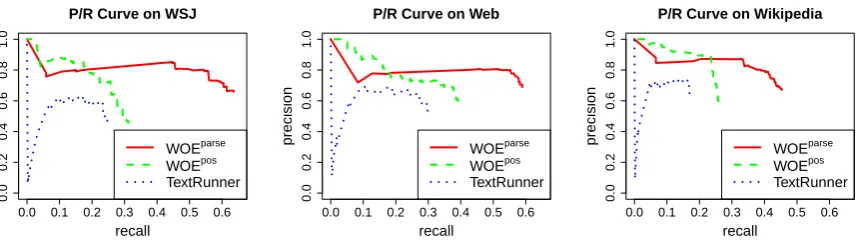
Figure 2: WOEposperforms better than TextRunner, especially on precision. WOEparsedramatically im-proves performance, especially on recall.
runs about30Xfaster by only using shallow fea-tures. Since high speed can be crucial when pro-cessing Web-scale corpora, we additionally learn a CRF extractor WOEpos based on shallow features like POS-tags. In both cases, however, we gen-erate training data from Wikipedia by matching sentences with infoboxes, while TextRunner used a small set of hand-written rules to label training examples from the Penn Treebank.
We use the same matching sentence set behind
DBp to generate positive examples for WOEpos.
Specifically, for each matching sentence, we label the subject and infobox attribute value as arg1
and arg2 to serve as the ends of a linear CRF chain. Tokens involved in the expandPath are la-beled as rel. Negative examples are generated from random noun-phrase pairs in other sentences when their generalized-CorePaths are not inDBp.
WOEpos uses the same learning algorithm and selection of features as TextRunner: a two-order CRF chain model is trained with the Mallet pack-age (McCallum, 2002). WOEpos’s features include POS-tags, regular expressions (e.g., for detecting capitalization, punctuation, etc..), and conjunc-tions of features occurring in adjacent posiconjunc-tions within six words to the left and to the right of the current word.
As shown in the experiments,WOEposachieves an improved F-measure over TextRunner between 18% to 34% on three corpora, and this is mainly due to the increase on precision.
4 Experiments
We used three corpora for experiments: WSJ from Penn Treebank, Wikipedia, and the general Web. For each dataset, we randomly selected 300 sen-tences. Each sentence was examined by two peo-ple to label all reasonable tripeo-ples. These candidate
triples are mixed with pseudo-negative ones and submitted to Amazon Mechanical Turk for veri-fication. Each triple was examined by 5 Turk-ers. We mark a triple’s final label as positive when more than 3 Turkers marked them as positive.
4.1 Overall Performance Analysis
In this section, we compare the overall perfor-mance of WOEparse, WOEpos and TextRunner (shared by the Turing Center at the University of Washington). In particular, we are going to answer the following questions: 1) How do these systems perform against each other? 2) How does perfor-mance vary w.r.t. sentence length? 3) How does extraction speed vary w.r.t. sentence length?
Overall Performance Comparison
The detailed P/R curves are shown in Figure 2. To have a close look, for each corpus, we ran-domly divided the 300 sentences into 5 groups and compared the best F-measures of three systems in Figure 3. We can see that:
• WOEpos is better than TextRunner, especially on precision. This is due to better training data from Wikipedia via self-supervision. Sec-tion 4.2 discusses this in more detail.
• WOEparse achieves the best performance, es-pecially on recall. This is because the parser features help to handle complicated and long-distance relations in difficult sentences. In par-ticular, WOEparseoutputs 1.42 triples per sen-tence on average, while WOEpos outputs 1.05 and TextRunner outputs 0.75.
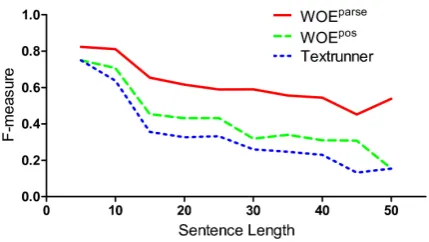
Figure 3: WOEposachieves an F-measure, which is between 18% and 34% better than TextRunner’s. WOEparseachieves an improvement between 72% and 91% over TextRunner. The error bar indicates one standard deviation.
the frequency ofrelis over a threshold. Our ex-periments show that focussing on concrete triples generally improves precision at the expense of re-call.4 Of course, one can apply a concreteness fil-ter to any open extractor in order to trade recall for precision.
The extraction errors by WOEparse can be cat-egorized into four classes. We illustrate them with the WSJ corpus. In total, WOEparse got 85 wrong extractions on WSJ, and they are caused by: 1) Incorrect arg1 and/or arg2
from NP-Chunking (18.6%); 2) A erroneous de-pendency parse from Stanford Parser (11.9%); 3) Inaccurate meaning (27.1%) — for
exam-ple,hshe, isN ominatedBy, P residentBushiis
wrongly extracted from the sentence “If she is nominated by President Bush ...”5; 4) A pattern inapplicable for the test sentence (42.4%).
NoteWOEparseis worse thanWOEposin the low recall region. This is mainly due to parsing er-rors (especially on long-distance dependencies), which misleads WOEparse to extract false high-confidence triples. WOEposwon’t suffer from such parsing errors. Therefore it has better precision on high-confidence extractions.
We noticed that TextRunner has a dip point in the low recall region. There are two typical errors responsible for this. A sample error of the first type is hSources, sold, theCompanyi extracted from the sentence “Sources said
4
For example, consider the Wikipedia corpus. From our 300 test sentences, TextRunner extracted 257 triples (at
72.0%precision) but only extracted 16 concrete triples (with
87.5%precision). 5
[image:6.595.76.295.67.196.2]These kind of errors might be excluded by monitor-ing whether sentences contain words such as ‘if,’ ‘suspect,’ ‘doubt,’etc.. We leave this as a topic for the future.
Figure 4: WOEparse’s F-measure decreases more slowly with sentence length thanWOEposand Tex-tRunner, due to its better handling of difficult sen-tences using parser features.
he sold the company”, where “Sources” is wrongly treated as the subject of the object clause. A sample error of the second type is
hthisY ear, willStarIn, theM oviei extracted
from the sentence “Coming up this year, Long will star in the new movie.”, where “this year” is wrongly treated as part of a compound subject. Taking the WSJ corpus for example, at the dip point with recall=0.002 and precision=0.059, these two types of errors account for 70% of all errors.
Extraction Performancevs.Sentence Length
We tested how extractors’ performance varies with sentence length; the results are shown in Fig-ure 4. TextRunner andWOEposhave good perfor-mance on short sentences, but their perforperfor-mance deteriorates quickly as sentences get longer. This is because long sentences tend to have compli-cated and long-distance relations which are diffi-cult for shallow features to capture. In contrast, WOEparse’s performance decreases more slowly w.r.t. sentence length. This is mainly because parser features are more useful for handling diffi-cult sentences and they helpWOEparseto maintain a good recall with only moderate loss of precision.
Extraction Speedvs.Sentence Length
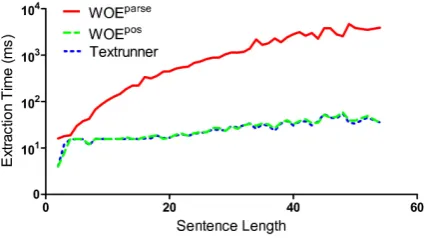
Figure 5: Textrnner and WOEpos’s running time seems to grow linearly with sentence length, while WOEparse’s time grows quadratically.
quadratically (R2 = 0.935) due to its reliance on parsing.
4.2 Self-supervision with Wikipedia Results
in Better Training Data
In this section, we consider how the process of matching Wikipedia infobox values to correspond-ing sentences results in better traincorrespond-ing data than the hand-written rules used by TextRunner.
To compare with TextRunner, we tested four different ways to generate training examples from Wikipedia for learning a CRF extractor. Specif-ically, positive and/or negative examples are se-lected by TextRunner’s hand-written rules (tr for short), by WOE’s heuristic of matching sentences with infoboxes (w for short), or randomly (r for short). We use CRF+h1−h2 to denote a particu-lar approach, where “+” means positive samples, “-” means negative samples, and hi ∈ {tr,w,r}.
In particular, “+w” results in 221,205 positive ex-amples based on the matching sentence set6. All extractors are trained using about the same num-ber of positive and negative examples. In contrast, TextRunner was trained with 91,687 positive ex-amples and 96,795 negative exex-amples generated from the WSJ dataset in Penn Treebank.
The CRF extractors are trained using the same learning algorithm and feature selection as Tex-tRunner. The detailed P/R curves are in Fig-ure 6, showing that using WOE heuristics to la-bel positive examples gives the biggest perfor-mance boost. CRF+tr−tr (trained using TextRun-ner’s heuristics) is slightly worse than TextRunner. Most likely, this is because TextRunner’s heuris-tics rely on parse trees to label training examples,
6
This number is smaller than the total number of corePaths (259,046) because we requirearg1to appear be-forearg2in a sentence — as specified by TextRunner.
and the Stanford parse on Wikipedia is less accu-rate than the gold parse on WSJ.
4.3 Design Desiderata ofWOEparse
There are two interesting design choices in WOEparse: 1) whether to requirearg1 to appear before arg2 (denoted as 1≺2) in the sentence; 2) whether to allow corePaths to contain prepo-sitional phrase (PP) attachments (denoted asPPa). We tested how they affect the extraction perfor-mance; the results are shown in Figure 7.
We can see that filtering PP attachments (PPa) gives a large precision boost with a noticeable loss in recall; enforcing a lexical ordering of relation arguments (1≺2) yields a smaller improvement in precision with small loss in recall. Take the WSJ corpus for example: setting1≺2andPPaachieves a precision of 0.792 (with recall of 0.558). By changing 1≺2 to 1∼2, the precision decreases to 0.773 (with recall of 0.595). By changingPPa to PPa and keeping 1≺2, the precision decreases to 0.642 (with recall of 0.687) — in particular, if we use gold parse, the precision decreases to 0.672 (with recall of 0.685). We set1≺2andPPaas de-fault inWOEparseas a logical consequence of our preference for high precision over high recall.
4.3.1 Different parsing options
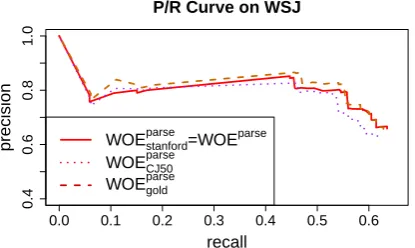
We also tested how different parsing might ef-fectWOEparse’s performance. We used three pars-ing options on the WSJ dataset: Stanford parspars-ing, CJ50 parsing (Charniak and Johnson, 2005), and the gold parses from the Penn Treebank. The Stan-ford Parser is used to derive dependencies from CJ50 and gold parse trees. Figure 8 shows the detailed P/R curves. We can see that although today’s statistical parsers make errors, they have negligible effect on the accuracy ofWOE.
5 Related Work
Open or Traditional Information Extraction:
0.0 0.1 0.2 0.3 0.4
0.0
0.2
0.4
0.6
0.8
1.0
recall
precision
P/R Curve on WSJ
CRF+w−w=WOEpos
CRF+w−tr
CRF+w−r
CRF+tr−tr
TextRunner
0.0 0.1 0.2 0.3 0.4
0.0
0.2
0.4
0.6
0.8
1.0
recall
precision
P/R Curve on Web
CRF+w−w=WOEpos
CRF+w−tr
CRF+w−r
CRF+tr−tr
TextRunner
0.0 0.1 0.2 0.3 0.4
0.0
0.2
0.4
0.6
0.8
1.0
recall
precision
P/R Curve on Wikipedia
CRF+w−w=WOEpos
CRF+w−tr
CRF+w−r
CRF+tr−tr
[image:8.595.76.518.67.199.2]TextRunner
[image:8.595.77.526.252.380.2]Figure 6: Matching sentences with Wikipedia infoboxes results in better training data than the hand-written rules used by TextRunner.
Figure 7: Filtering prepositional phrase attachments (PPa) shows a strong boost to precision, and we see a smaller boost from enforcing a lexical ordering of relation arguments (1≺2).
0.0 0.1 0.2 0.3 0.4 0.5 0.6
0.4
0.6
0.8
1.0
recall
precision
P/R Curve on WSJ
WOEstanfordparse =WOEparse WOECJ50parse
WOEgold parse
Figure 8: Although today’s statistical parsers make errors, they have negligible effect on the accuracy of WOE compared to operation on gold standard, human-annotated data.
on identifying general relations such as class at-tributes, while open IE aims to extract relation instances from given sentences. Another seed-based system StatSnowball (Zhu et al., 2009) can perform both relation-specific and open IE by iteratively generating weighted extraction pat-terns. Different fromWOE, StatSnowball only em-ploys shallow features and uses L1-normalization to weight patterns. Shinyama and Sekine
[image:8.595.73.281.445.569.2]301,962 Wikipedia sentences. The KNext sys-tem (Durme and Schubert, 2008) performs open knowledge extraction via significant heuristics. Its output is knowledge represented as logical state-ments instead of information represented as seg-mented text fragments.
Information Extraction with Wikipedia: The
YAGO system (Suchanek et al., 2007) extends WordNet using facts extracted from Wikipedia categories. It only targets a limited number of pre-defined relations. Nakayama et al. (Nakayama and Nishio, 2008) parse selected Wikipedia sentences and perform extraction over the phrase structure trees based on several handcrafted patterns. Wu and Weld proposed the KYLIN system (Wu and Weld, 2007; Wu et al., 2008) which has the same spirit of matching Wikipedia sentences with in-foboxes to learn CRF extractors. However, it only works for relations defined in Wikipedia in-foboxes.
Shallow or Deep Parsing: Shallow features, like
POS tags, enable fast extraction over large-scale corpora (Davidov et al., 2007; Banko et al., 2007). Deep features are derived from parse trees with the hope of training better extractors (Zhang et al., 2006; Zhao and Grishman, 2005; Bunescu and Mooney, 2005; Wang, 2008). Jiang and Zhai (Jiang and Zhai, 2007) did a systematic ex-ploration of the feature space for relation extrac-tion on the ACE corpus. Their results showed lim-ited advantage of parser features over shallow fea-tures for IE. However, our results imply that ab-stracted dependency path features are highly in-formative for open IE. There might be several rea-sons for the different observations. First, Jiang and Zhai’s results are tested for traditional IE where lo-cal lexilo-calized tokens might contain sufficient in-formation to trigger a correct classification. The situation is different when features are completely unlexicalized in open IE. Second, as they noted, many relations defined in the ACE corpus are short-range relations which are easier for shallow features to capture. In practical corpora like the general Web, many sentences contain complicated long-distance relations. As we have shown ex-perimentally, parser features are more powerful in handling such cases.
6 Conclusion
This paper introduces WOE, a new approach to open IE that uses self-supervised learning over un-lexicalized features, based on a heuristic match
between Wikipedia infoboxes and corresponding text. WOE can run in two modes: a CRF extrac-tor (WOEpos) trained with shallow features like POS tags; a pattern classfier (WOEparse) learned from dependency path patterns. Comparing with TextRunner, WOEpos runs at the same speed, but achieves an F-measure which is between 18% and 34% greater on three corpora;WOEparse achieves an F-measure which is between 72% and 91% higher than that of TextRunner, but runs about
30X times slower due to the time required for parsing.
Our experiments uncovered two sources of WOE’s strong performance: 1) the Wikipedia heuristic is responsible for the bulk ofWOE’s im-proved accuracy, but 2) dependency-parse features are highly informative when performing unlexi-calized extraction. We note that this second con-clusion disagrees with the findings in (Jiang and Zhai, 2007).
In the future, we plan to run WOEover the bil-lion document CMU ClueWeb09 corpus to com-pile a giant knowledge base for distribution to the NLP community. There are several ways to further improveWOE’s performance. Other data sources, such as Freebase, could be used to create an ad-ditional training dataset via self-supervision. For example, Mintz et al. consider all sentences con-taining both the subject and object of a Freebase record as matching sentences (Mintz et al., 2009); while they use this data to learn relation-specific extractors, one could also learn an open extrac-tor. We are also interested in merging lexical-ized and open extraction methods; the use of some domain-specific lexical features might help to im-prove WOE’s practical performance, but the best way to do this is unclear. Finally, we wish to com-bineWOEparse withWOEpos(e.g., with voting) to produce a system which maximizes precision at low recall.
Acknowledgements
findings, and conclusion or recommendations ex-pressed in this material are those of the author(s) and do not necessarily reflect the view of the Air Force Research Laboratory (AFRL).
References
E. Agichtein and L. Gravano. 2000. Snowball: Ex-tracting relations from large plain-text collections. InICDL.
Alan Akbik and J¨ugen Broß. 2009. Wanderlust: Ex-tracting semantic relations from natural language text using dependency grammar patterns. InWWW
Workshop.
S¨oren Auer and Jens Lehmann. 2007. What have inns-bruck and leipzig in common? extracting semantics from wiki content. InESWC.
M. Banko, M. Cafarella, S. Soderland, M. Broadhead, and O. Etzioni. 2007. Open information extraction from the Web. InProcs. of IJCAI.
Razvan C. Bunescu and Raymond J. Mooney. 2005. Subsequence kernels for relation extraction. In NIPS.
R. Bunescu and R.Mooney. 2005. A shortest path dependency kernel for relation extraction. In
HLT/EMNLP.
Eugene Charniak and Mark Johnson. 2005. Coarse-to-fine n-best parsing and maxent discriminative reranking. InACL.
M. Craven, D. DiPasquo, D. Freitag, A. McCallum, T. Mitchell, K. Nigam, and S. Slattery. 1998. Learn-ing to extract symbolic knowledge from the world wide web. InAAAI.
Dmitry Davidov and Ari Rappoport. 2008. Unsuper-vised discovery of generic relationships using pat-tern clusters and its evaluation by automatically gen-erated sat analogy questions. InACL.
Dmitry Davidov, Ari Rappoport, and Moshe Koppel. 2007. Fully unsupervised discovery of concept-specific relationships by web mining. InACL.
Marie-Catherine de Marneffe and Christopher D. Man-ning. 2008. Stanford typed dependencies manual. http://nlp.stanford.edu/downloads/lex-parser.shtml.
Benjamin Van Durme and Lenhart K. Schubert. 2008. Open knowledge extraction using compositional language processing. InSTEP.
R. Hoffmann, C. Zhang, and D. Weld. 2010. Learning 5000 relational extractors. InACL.
Jing Jiang and ChengXiang Zhai. 2007. A systematic exploration of the feature space for relation extrac-tion. InHLT/NAACL.
A. Gangemi M. Ciaramita. 2005. Unsupervised learn-ing of semantic relations between concepts of a molecular biology ontology. InIJCAI.
Andrew Kachites McCallum. 2002. Mallet: A machine learning for language toolkit. In http://mallet.cs.umass.edu.
Mike Mintz, Steven Bills, Rion Snow, and Dan Juraf-sky. 2009. Distant supervision for relation extrac-tion without labeled data. InACL-IJCNLP.
T. H. Kotaro Nakayama and S. Nishio. 2008. Wiki-pedia link structure and text mining for semantic re-lation extraction. InCEUR Workshop.
Dat P.T Nguyen, Yutaka Matsuo, and Mitsuru Ishizuka. 2007. Exploiting syntactic and semantic informa-tion for relainforma-tion extracinforma-tion from wikipedia. In
IJCAI07-TextLinkWS.
Marius Pasca. 2008. Turning web text and search queries into factual knowledge: Hierarchical class attribute extraction. InAAAI.
Fuchun Peng and Andrew McCallum. 2004. Accurate Information Extraction from Research Papers using Conditional Random Fields. InHLT-NAACL.
Hoifung Poon and Pedro Domingos. 2008. Joint Infer-ence in Information Extraction. InAAAI.
Y. Shinyama and S. Sekine. 2006. Preemptive infor-mation extraction using unristricted relation discov-ery. InHLT-NAACL.
Rion Snow, Daniel Jurafsky, and Andrew Y. Ng. 2005. Learning syntactic patterns for automatic hypernym discovery. InNIPS.
Fabian M. Suchanek, Gjergji Kasneci, and Gerhard Weikum. 2007. Yago: A core of semantic knowl-edge - unifying WordNet and Wikipedia. InWWW.
Mengqiu Wang. 2008. A re-examination of depen-dency path kernels for relation extraction. In
IJC-NLP.
Fei Wu and Daniel Weld. 2007. Autonomouslly Se-mantifying Wikipedia. InCIKM.
Fei Wu, Raphael Hoffmann, and Danel S. Weld. 2008. Information extraction from Wikipedia: Moving down the long tail. InKDD.
Min Zhang, Jie Zhang, Jian Su, and Guodong Zhou. 2006. A composite kernel to extract relations be-tween entities with both flat and structured features. InACL.
Shubin Zhao and Ralph Grishman. 2005. Extracting relations with integrated information using kernel methods. InACL.