Improving Arabic Dependency Parsing with Form-based and Functional
Morphological Features
Yuval Marton T.J. Watson Research Center
IBM
Nizar Habash and Owen Rambow Center for Computational Learning Systems
Columbia University
{habash,rambow}@ccls.columbia.edu
Abstract
We explore the contribution of morphologi-cal features – both leximorphologi-cal and inflectional – to dependency parsing of Arabic, a morpho-logically rich language. Using controlled ex-periments, we find that definiteness, person, number, gender, and the undiacritzed lemma are most helpful for parsing on automatically tagged input. We further contrast the contri-bution of form-based and functional features, and show that functional gender and number (e.g., “broken plurals”) and the related ratio-nality feature improve over form-based fea-tures. It is the first time functional morpho-logical features are used for Arabic NLP.
1 Introduction
Parsers need to learn the syntax of the modeled lan-guage in order to project structure on newly seen sentences. Parsing model design aims to come up with features that best help parsers to learn the syn-tax and choose among different parses. One as-pect of syntax, which is often not explicitly mod-eled in parsing, involves morphological constraints on syntactic structure, such as agreement, which of-ten plays an important role in morphologically rich languages. In this paper, we explore the role of morphological features in parsing Modern Standard Arabic (MSA). For MSA, the space of possible mor-phological features is fairly large. We determine which morphological features help and why. We also explore going beyond the easily detectable, reg-ular form-based (“surface”) features, by represent-ingfunctional values for some morphological fea-tures. We expect that representing lexical
abstrac-tions and inflectional features participating in agree-ment relations would help parsing quality, but other inflectional features would not help. We further ex-pect functional features to be superior to surface-only features.
The paper is structured as follows. We first present the corpus we use (Section 2), then rele-vant Arabic linguistic facts (Section 3); we survey related work (Section 4), describe our experiments (Section 5), and conclude with an analysis of pars-ing error types (Section 6).
2 Corpus
We use the Columbia Arabic Treebank (CATiB) (Habash and Roth, 2009). Specifically, we use the portion converted automatically from part 3 of the Penn Arabic Treebank (PATB) (Maamouri et al., 2004) to the CATiB format, which enriches the CATiB dependency trees with full PATB morpho-logical information. CATiB’s dependency represen-tation is based on traditional Arabic grammar and emphasizes syntactic case relations. It has a re-duced POS tagset (with six tags only – henceforth CATIB6), but a standard set of eight dependency re-lations:SBJandOBJfor subject and (direct or indi-rect) object, respectively, (whether they appear pre-or post-verbally);IDFfor the idafa (possessive) re-lation;MODfor most other modifications; and other less common relations that we will not discuss here. For more information, see Habash et al. (2009). The CATiB treebank uses the word segmentation of the PATB: it splits off several categories of orthographic clitics, but not the definite article
È@
Al. In all of the experiments reported in this paper, we use the goldVRB
ÉÒªKtςml ‘work’
MOD
PRT
ú ¯fy
‘in’
OBJ
NOM
P@YÖÏ@AlmdArs ‘the-schools’
MOD
NOM
éJÓñºmÌ'@AlHkwmy~
‘the-governmental’
SBJ
NOM
H@YJ®kHfydAt ‘granddaughters’
MOD
NOM
HAJ»YË@AlðkyAt ‘smart’
IDF
NOM
[image:2.612.94.283.59.273.2]I. KA¾Ë@AlkAtb ‘the-writer’
Figure 1:CATiB Annotation example (tree display from right to left).
éJÓñºmÌ'@ P@YÖÏ@ ú
¯
HAJ»
YË@ I
.
KA¾Ë@ H@YJ ®k ÉÒªK
tςml HfydAt AlkAtb AlðkyAt fy AlmdArs AlHkwmy~ ‘The writer’s smart granddaughters work for public schools.’segmentation. An example CATiB dependency tree is shown in Figure 1.
3 Relevant Linguistic Concepts
In this section, we present the linguistic concepts rel-evant to our discussion of Arabic parsing.
OrthographyThe Arabic script uses optional di-acritics to represent short vowels, consonantal dou-bling and the indefininteness morpheme (nunation). For example, the word
I
.
J
»
kataba‘he wrote’ is of-ten writof-ten asI
.
J»
ktb, which can be ambiguous withother words such as
I
.
J
»
kutub˜u‘books’. In news text, only around 1.6% of all words have any critic (Habash, 2010). As expected, the lack of dia-critics contributes heavily to Arabic’s morphological ambiguity. In this work, we only use undiacritized text; however, some of our parsing features which are derived through morphological disambiguation include diacritics (specifically,lemmas, see below).MorphemesWords can be described in terms of their morphemes; in Arabic, in addition to concate-native prefixes and suffixes, there are templatic mor-phemes called root and pattern. For example, the word
àñJ.KA¾K
yu+kAtib+uwn‘they correspond’ has one prefix and one suffix, in addition to a stemcom-posed of the root
H. H¼
k-t-b‘writing related’ and the pattern1A2i3.1Lexeme and features Alternatively, Arabic words can be described in terms of lexemes and inflectional features. The set of word forms that only vary inflectionally among each other is called thelexeme. Alemmais a specific word form cho-sen to reprecho-sent the lexeme word set; for example, Arabic verb lemmas are third person masculine sin-gular perfective. We explore using both the dia-critized lemma and the undiadia-critized lemma (here-after LMM). Just as the lemma abstracts over in-flectional morphology, theroot abstracts over both inflectional and derivational morphology and thus provides a deeper level of lexical abstraction, indi-cating the “core” meaning of the word. The pat-ternis a generally complementary abstraction some-times indicating sematic notions such causation and reflexiveness. We use the pattern of the lemma, not of the word form. We group the ROOT, PATTERN, LEMMA and LMMin our discussion as lexical fea-tures. Nominal lexemes can also be classified into two groups: rational (i.e., human) or irrational (i.e.„ non-human).2 The rationality feature interacts with syntactic agreement and other inflectional features (discussed next); as such, we group it with those fea-tures in this paper’s experiments.
The inflectional features define the the space of variations of the word forms associated with a lex-eme. PATB-tokenized words vary along nine di-mensions:GENDERandNUMBER(for nominals and verbs); PERSON, ASPECT, VOICE and MOOD (for verbs); and CASE, STATE, and the attached defi-nite article procliticDET(for nominals). Inflectional features abstract away from the specifics of mor-pheme forms. Some inflectional features affect more than one morpheme in the same word. For exam-ple, changing the value of the ASPECT feature in the example above from imperfective to perfective yields the word form
@ñJ.
KA¿
kAtab+uwA‘they corre-sponded’, which differs in terms of prefix, suffix and pattern.1
The digits in the pattern correspond to the positions root radicals are inserted.
2
Surface vs. functional features Additionally, some inflectional features, specifically gender and number, are expressed using different morphemes in different words (even within the same part-of-speech). There are foursoundgender-number suf-fixes in Arabic:3 +φ(null morpheme)for masculine
singular,
è
++~for feminine singular,àð
++wnfor masculine plural andH@
+ +Atfor feminine plural. Plurality can be expressed usingsound plural suf-fixes or using a pattern change together with singu-larsuffixes. A sound plural example is the word pairH@YJ
®k
/èYJ
®k
Hafiyd+a~/Hafiyd+At ‘granddaugh-ter/granddaughters’. On the other hand, the plural of the inflectionally and morphemically feminine sin-gular wordéPYÓ
madras+a~‘school’ is the wordP@YÓ
madAris+φ‘schools’, which is feminine and plural inflectionally, but has a masculine singular suffix. This irregular inflection, known as broken plural, is similar to the Englishmouse/mice, but is much more common in Arabic (over 50% of plurals in our training data). A similar inconsistency ap-pears in feminine nouns that are not inflected usingsoundgender suffixes, e.g., the feminine form of the masculine singular adjective
P P
@
Âzraq+φ‘blue’ isZA
¯P P
zarqA’+φnoté
¯P P
@
* *Âzraq+a~. To address this inconsistency in the correspondence between in-flectional features and morphemes, and inspired by (Smrž, 2007), we distinguish between two types of inflectional features: surface (or form-based)4 fea-tures and functional feafea-tures.Most available Arabic NLP tools and resources model morphology using surface inflectional fea-tures and do not mark rationality; this includes the PATB (Maamouri et al., 2004), the Buckwalter mor-phological analyzer (BAMA) (Buckwalter, 2004) and tools using them such as the Morphological Analysis and Disambiguation for Arabic (MADA) system (Habash and Rambow, 2005). The Elixir-FM analyzer (Smrž, 2007) readily provides the tional inflectional number feature, but not full func-tional gender (only for adjectives and verbs but not for nouns), nor rationality. Most recently, Alkuhlani and Habash (2011) present a version of the PATB (part 3) that is annotated for functional gender,
num-3
We ignore duals, which are regular in Arabic, and case/state variations in this discussion for simplicity.
4
Smrž (2007) uses the termillusoryfor surface features.
ber and rationality features for Arabic. We use this resource in modeling these features in Section 5.5.
Morpho-syntactic interactionsInflectional fea-tures and rationality interact with syntax in two ways. Inagreement relations, two words in a spe-cific syntactic configuration have coordinated values for specific sets of features. MSA has standard (i.e., matching value) agreement for subject-verb pairs on PERSON, GENDER, and NUMBER, and for noun-adjective pairs on NUMBER, GENDER, CASE, and DET. There are three very common cases of excep-tional agreement: verbs preceding subjects are al-ways singular, adjectives of irrational plural nouns are always feminine singular, and verbs whose sub-jects are irrational plural are also always feminine singular. See the example in Figure 1: the adjective,
HAJ»
YË@
AlðkyAt‘smart’, of the feminine plural (and rational)H@YJ
®k
HafiydAt‘granddaughters’ is fem-inine plural; but the adjective,éJÓñºmÌ'@
AlHkwmy~‘the-governmental’, of the feminine plural (and irra-tional)
P@YÓ
madAris‘schools’ is feminine singu-lar. These agreement rules always refer to functional morphology categories; they are orthogonal to the morpheme-feature inconsistency discussed above.MSA exhibits marking relations in CASE and STATE marking. Different types of dependents have different CASE, e.g., verbal subjects are al-ways marked NOMINATIVE. CASE and STATE are rarely explicitly manifested in undiacritized MSA. The DET feature plays an important role in distin-guishing between the N-N idafa (possessive) con-struction, in which only the last noun may bear the definite article, and the N-A modifier construction, in which both elements generally exhibit agreement in definiteness.
Lexical features do not constrain syntactic struc-ture as inflectional feastruc-tures do. Instead, bilexical dependencies are used to model semantic relations which often are the only way to disambiguate among different possible syntactic structures. Lexical ab-straction also reduces data sparseness.
com-parison, the tagset of the Buckwalter Morphologi-cal Analyzer (Buckwalter, 2004) used in the PATB has a core POS set of 44 tags (before morphologi-cal extension). Cross-linguistimorphologi-cally, a core set con-taining around 12 tags is often assumed, including: noun, proper noun, verb, adjective, adverb, preposi-tion, particles, connectives, and punctuation. Hence-forth, we reduceCORE44 to such a tagset, and dub it CORE12. The CATIB6 tagset can be viewed as a further reduction, with the exception thatCATIB6 contains a passive voice tag; however, this tag con-stitutes only 0.5% of the tags in the training.
Extended POS tagsets The notion of “POS tagset” in natural language processing usually does
not refer to a core set. Instead, the Penn English Treebank (PTB) uses a set of 46 tags, including not only the core POS, but also the complete set of morphological features (this tagset is still fairly small since English is morphologically impover-ished). In PATB-tokenized MSA, the corresponding type of tagset (core POS extended with a complete description of morphology) would contain upwards of 2,000 tags, many of which are extremely rare (in our training corpus of about 300,000 words, we en-counter only 430 of such POS tags with complete morphology). Therefore, researchers have proposed tagsets for MSA whose size is similar to that of the English PTB tagset, as this has proven to be a useful size computationally. These tagsets are hybrids in the sense that they are neither simply the core POS, nor the complete morphologically enriched tagset, but instead they selectively enrich the core POS tagset with only certain morphological features. A full dicussion of how these tagsets affect parsing is presented in Marton et al. (2010); we summarize the main points here.
The following are the various tagsets we use in this paper: (a) the core POS tagset CORE12; (b) the CATiB treebank tagset CATIBEX, a newly in-troduced extension of CATIB6 (Habash and Roth, 2009) by simple regular expressions of the word form, indicating particular morphemes such as the prefix
È@
Al+ or the suffixàð
+wn; this tagset is the best-performing tagset for Arabic on pre-dicted values. (c) the PATB full tagset (BW), size≈2000+ (Buckwalter, 2004); We only discuss here the best performing tagsets (on predicted values), andBWfor comparison.
4 Related Work
Much work has been done on the use of morpholog-ical features for parsing of morphologmorpholog-ically rich lan-guages. Collins et al. (1999) report that an optimal tagset for parsing Czech consists of a basic POS tag plus aCASEfeature (when applicable). This tagset (size 58) outperforms the basic Czech POS tagset (size 13) and the complete tagset (size ≈3000+). They also report that the use of gender, number and person features did not yield any improvements. We got similar results forCASEin the gold experimen-tal setting (Marton et al., 2010) but not when using predicted POS tags (POS tagger output). This may be a result ofCASEtagging having a lower error rate in Czech (5.0%) (Hajiˇc and Vidová-Hladká, 1998) compared to Arabic (≈14.0%, see Table 2). Simi-larly, Cowan and Collins (2005) report that the use of a subset of Spanish morphological features (num-ber for adjectives, determiners, nouns, pronouns, and verbs; and mode for verbs) outperforms other combinations. Our approach is comparable to their work in terms of its systematic exploration of the space of morphological features. We also find that the number feature helps for Arabic. Looking at He-brew, a Semitic language related to Arabic, Tsarfaty and Sima’an (2007) report that extending POS and phrase structure tags with definiteness information helps unlexicalized PCFG parsing.
As for work on Arabic, results have been reported on PATB (Kulick et al., 2006; Diab, 2007; Green and Manning, 2010), the Prague Dependency Tree-bank (PADT) (Buchholz and Marsi, 2006; Nivre, 2008) and the Columbia Arabic Treebank (CATiB) (Habash and Roth, 2009). Recently, Green and Manning (2010) analyzed the PATB for annotation consistency, and introduced an enhanced split-state constituency grammar, including labels for short
we also extend this morphologically enhanced fea-ture set to include additional lexical and inflectional features. Previous work with MaltParser in Russian, Turkish and Hindi showed gains with case but not with agreement features (Nivre et al., 2008; Eryigit et al., 2008; Nivre, 2009). Our work is the first using MaltParser to show gains using agreement-oriented features (Marton et al., 2010), and the first to use functional features for this task (this paper).
5 Experiments
Throughout this section, we only report results us-ing predicted input feature values (e.g., generated automatically by a POS tagger). After presenting the parser we use (Section 5.1), we examine a large space of settings in the following order: the contri-bution of numerous inflectional features in a con-trolled fashion (Section 5.2);5 the contribution of the lexical features in a similar fashion, as well as the combination of lexical and inflectional features (Section 5.3); an extension of theDETfeature (Sec-tion 5.4); using func(Sec-tional NUMBER and GENDER feature values, as well as theRATIONALITYfeature (Section 5.5); finally, putting best feature combina-tions to test with the best-performing POS tagset, and on an unseen test set (Section 5.6). All results are reported mainly in terms of labeled attachment accuracy score (parent word and the dependency re-lation to it, a.k.a. LAS). Unlabeled attachment ac-curacy score (UAS) is also given. We use McNe-mar’s statistical significance test as implemented by Nilsson and Nivre (2008), and denotep <0.05and
p <0.01with+and++, respectively.
5.1 Parser
For all experiments reported here we used the syn-tactic dependency parser MaltParser v1.3 (Nivre, 2003; Nivre, 2008; Kübler et al., 2009) – a transition-based parser with an input buffer and a stack, using SVM classifiers to predict the next state in the parse derivation. All experiments were done using the Nivre "eager" algorithm.6 For training,
de-5In this paper, we do not examine the contribution of
differ-ent POS tagsets, see Marton et al. (2010) for details.
6
Nivre (2008) reports that non-projective and pseudo-projective algorithms outperform the "eager" pseudo-projective algo-rithm in MaltParser, but our training data did not contain any non-projective dependencies. The Nivre "standard" algorithm
velopment and testing, we follow the splits used by Roth et al. (2008) for PATB part 3 (Maamouri et al., 2004). We kept the test unseen during training.
There are five defaultattributes, in the MaltParser terminology, for each token in the text: word ID (or-dinal position in the sentence), word form, POS tag, head (parent word ID), and deprel (the dependency relation between the current word and its parent). There are default MaltParser features (in the ma-chine learning sense),7which are the values of func-tions over these attributes, serving as input to the MaltParser internal classifiers. The most commonly used feature functions are the top of the input buffer (next word to process, denoted buf[0]), or top of the stack (denoted stk[0]); following items on buffer or stack are also accessible (buf[1], buf[2], stk[1], etc.). Hence MaltParser features are defined as POS tag at stk[0], word form at buf[0], etc. Kübler et al. (2009) describe a “typical” MaltParser model con-figuration of attributes and features.8 Starting with it, in a series of initial controlled experiments, we settled on using buf[0-1] + stk[0-1] for wordforms, and buf[0-3] + stk[0-2] for POS tags. For features of new MaltParser-attributes (discussed later), we used buf[0] + stk[0]. We did not change the features for deprel. This new MaltParser configuration resulted in gains of 0.3-1.1% in labeled attachment accuracy (depending on the POS tagset) over the default Malt-Parser configuration.9 All experiments reported be-low were conducted using this new configuration.
5.2 Inflectional features
In order to explore the contribution of inflectional and lexical information in a controlled manner, we focused on the best performing core (“morphology-free”) POS tagset,CORE12, as baseline; using three
is also reported to do better on Arabic, but in a preliminary ex-perimentation, it did similarly or slightly worse than the "eager” one, perhaps due to high percentage of right branching (left headed structures) in our Arabic training set – an observation already noted in Nivre (2008).
7
The terms “feature” and “attribute” are overloaded in the literature. We use them in the linguistic sense, unless specifi-cally noted otherwise, e.g., “MaltParser feature(s)”.
8It is slightly different from the default configuration. 9
setup LAS LASdif f UAS
All CORE+ all inflectional features12 78.6877.91 -0.77— 82.4882.14
Sep
+DET 79.82++ 1.14
83.18
+STATE 79.34++ 0.66 82.85
+GENDER 78.75 0.07 82.35
+PERSON 78.74 0.06 82.45
+NUMBER 78.66 -0.02 82.39
+VOICE 78.64 -0.04 82.41
+ASPECT 78.60 -0.08 82.39
+MOOD 78.54 -0.14 82.35
+CASE 75.81 -2.87 80.24
Greedy
+DET+STATE 79.42++ 0.74 82.84
+DET+GENDER 79.90++ 1.22 83.20
+DET+GENDER+PERSON 79.94++ 1.26 83.21
+DET+PNG 80.11++ 1.43
83.29
+DET+PNG+VOICE 79.96++ 1.28 83.18
+DET+PNG+ASPECT 80.01++ 1.33 83.20
[image:6.612.77.298.60.280.2]+DET+PNG+MOOD 80.03++ 1.35 83.21
Table 1: CORE12 with inflectional features, predicted input. Top: Adding all nine features toCORE12. Second part: Adding each feature separately, comparing difference from CORE12. Third part: Greedily adding best features from second part.
different setups, we added nine morphological fea-tures with values predicted by MADA: DET (pres-ence of the definite determiner),PERSON, ASPECT, VOICE, MOOD, GENDER, NUMBER, STATE (mor-phological marking as head of an idafa construc-tion), and CASE. In setup All, we augmented the baseline model with all nine MADA features (as nine additional MaltParser attributes); in setupSep, we augmented the baseline model with the MADA features, one at a time; and in setup Greedy, we combined them in a greedy heuristic (since the entire feature space is too vast to exhaust): starting with the most gainful feature fromSep, adding the next most gainful feature, keeping it if it helped, or discarding it otherwise, and continuing through the least gainful feature. See Table 1.
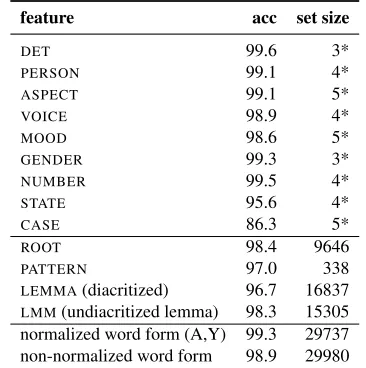
Somewhat surprisingly, setup All hurts perfor-mance. This can be explained if one examines the prediction accuracy of each feature (top of Table 2). Features which are not predicted with very high ac-curacy, such as CASE (86.3%), can dominate the negative contribution, even though they are top con-tributors when provided as gold input (Marton et al., 2010); when all features are provided as gold in-put,Allactually does better than individual features, which puts to rest a concern that its decrease here
feature acc set size
DET 99.6 3*
PERSON 99.1 4*
ASPECT 99.1 5*
VOICE 98.9 4*
MOOD 98.6 5*
GENDER 99.3 3*
NUMBER 99.5 4*
STATE 95.6 4*
CASE 86.3 5*
ROOT 98.4 9646
PATTERN 97.0 338
LEMMA(diacritized) 96.7 16837
[image:6.612.333.516.61.245.2]LMM(undiacritized lemma) 98.3 15305 normalized word form (A,Y) 99.3 29737 non-normalized word form 98.9 29980
Table 2:Feature prediction accuracy and set sizes. * = The set includes a "N/A" value.
setup LAS LASdif f UAS
All CORE+ all lexical features12(repeated) 78.6878.85 0.17— 82.4882.46
Sep
+LMM 78.96+ 0.28 82.54
+ROOT 78.94+ 0.26 82.64
+LEMMA 78.80 0.12 82.42
+PATTERN 78.59 -0.09 82.39
Greedy
+LMM+ROOT 79.04++ 0.36 82.63
+LMM+ROOT+LEMMA 79.05++ 0.37 82.63
+LMM+ROOT+PATTERN 78.93 0.25 82.58
Table 3: Lexical features. Top part: Adding each feature separately; difference fromCORE12 (predicted). Bottom part: Greedily adding best features from previous part.
is due to data sparseness. Here, when features are predicted, theDETfeature (determiner), followed by theSTATE(construct state,idafa) feature, are top in-dividual contributors in setupSep. AddingDETand the so-calledφ-features (PERSON, NUMBER, GEN -DER, also shorthanded PNG) in the Greedy setup, yields 1.43% gain over theCORE12 baseline.
5.3 Lexical features
[image:6.612.319.534.290.411.2]with-CORE12 + . . . LAS LASdif f UAS
+DET+PNG(repeated) 80.11++ 1.43 83.29 +DET+PNG+LMM 80.23++ 1.55 83.34
+DET+PNG+LMM+ROOT 80.10++ 1.42 83.25
[image:7.612.313.541.62.284.2]+DET+PNG+LMM+PATTERN 80.03++ 1.35 83.15
Table 4:Inflectional+lexical features together.
CORE12 + . . . LAS LASdif f UAS
+DET(repeated) 79.82++ — 83.18
+DET2 80.13++ 0.31 83.49
[image:7.612.77.295.161.233.2]+DET+PNG+LMM(repeated) 80.23++ — 83.34 +DET2+PNG+LMM 80.21++ -0.02 83.39
Table 5:Extended inflectional features.
out LEMMA) was the best greedy combination in setupGreedy. See Table 3. All lexical features are predicted with high accuracy (bottom of Table 2).
Following the same greedy heuristic, we augmented the best inflection-based model CORE12+DET+PNG with lexical features, and found that only the undiacritized lemma (LMM) alone improved performance (80.23%). See Table 4.
5.4 Inflectional feature engineering
So far we experimented with morphological fea-ture values as predicted by MADA. However, it is likely that from a machine-learning perspective, rep-resenting similar categories with the same tag may be useful for learning. Therefore, we next exper-imented with modifying inflectional features that proved most useful.
AsDETmay help distinguish the N-Nidafa con-struction from the N-A modifier concon-struction, we attempted modeling also the DET values of pre-vious and next elements (as MaltParser’s stk[1] + buf[1], in addition to stk[0] + buf[0]). This vari-ant, denoted DET2, indeed helps: when added to theCORE12,DET2 improves non-gold parsing qual-ity by more than 0.3%, compared to DET (Ta-ble 5). This improvement unfortunately does not carry over to our best feature combination to date, CORE12+DET+PNG+LMM. However, in subsequent feature combinations, we see thatDET2 helps again, or at least, doesn’t hurt: LAS goes up by 0.06% in conjunction with featuresLMM+PERSON+FN*NGR in Table 6.
CORE12 + . . . LAS LASdif f UAS
CORE12(repeated) 78.68 – 82.48
+PERSON(repeated) 78.74 0.06 82.45
+GENDER(repeated) 78.75 0.07 82.35
+NUMBER(repeated) 78.66 -0.02 82.39
+FN*GENDER 78.96++ 0.28 82.53
+FN*NUMBER 78.88+ 0.20 82.53
+FN*NUMDGTBIN 78.87 0.19 82.53
+FN*RATIONALITY 78.91+ 0.23 82.60
+FN*GNR 79.32++ 0.64 82.78
+PERSON+FN*GNR 79.34++ 0.66 82.82
+DET+LMM+PERSON+FN*NGR 80.47++ 1.79 83.57
+DET2+LMM+PERSON+FN*NGR 80.53++ 1.85 83.66
+DET2+LMM+PERSON+FN*NG 80.43++ 1.75 83.56
+DET2+LMM+PNG+FN*NGR 80.51++ 1.83 83.66
CATIBEX 79.74 – 83.30
+DET2+LMM+PERSON+FN*NGR 80.83++
1.09 84.02
BW 72.64 – 77.91
+DET2+LMM+PERSON+FN*NGR 74.40++ 1.76 79.40
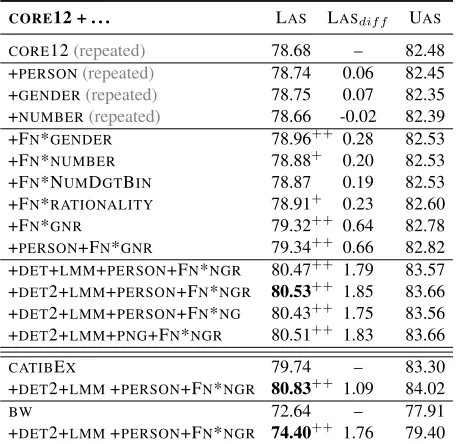
Table 6:Functional features: gender, number, rationality.
We also experimented with PERSON. We changed the values of proper names from “N/A” to “3” (third person), but it resulted in a similar or slightly de-creased performance, so it was abandoned.
5.5 Functional feature values
The NUMBER and GENDER features we have used so far only reflectsurface(as opposed tofunctional) values, e.g., broken plurals are marked as singular. This might have a negative effect on learning gen-eralizations over the complex agreement patterns in MSA (see Section 3), beyond memorization of word pairs seen together in training.
Predicting functional features To predict func-tional GENDER, functional NUMBER and RATIO -NALITY, we build a simple maximum likelihood es-timate (MLE) model using these annotations in the corpus created by Alkuhlani and Habash (2011). We train using the same training data we use through-out this paper. For all three features, we select the most seen value in training associated with the triple
word-CATIBEX-lemma; we back off to CATIBEX -lemma and then to lemma. For gender and num-ber, we further back off to the surface values; for rationality, we back off to the most common value (irrational). On our predicted dev set, the over-all accuracy baseline of predicting correct functional
85.1% (for all POS tags). Our MLE model reduces the error by two thirds reaching an overall accuracy of 95.5%. The high accuracy may be a result of the low percentage of words in the dev set that do not appear in training (around 4.6%).
Digit tokens (e.g., “4”) are also marked singu-lar by default. They don’t show surface agreement, even though the corresponding number-word token (
éªK.P@
Arbς~‘four.fem.sing’) would. We further ob-serve that MSA displays complex agreement pat-terns with numbers (Dada, 2007). Therefore, we alternatively experimented with binning the digit to-kens’NUMBERvalue accordingly:• the number 0 and numbers ending with 00
• the number 1 and numbers ending with 01
• the number 2 and numbers ending with 02
• the numbers 3-10 and those ending with 03-10
• the numbers, and numbers ending with, 11-99
• all other number tokens (e.g., 0.35 or 7/16)
and denoted these experiments with NUMDGTBIN. Almost 1.5% of the tokens are digit tokens in the training set, and 1.2% in the dev set.10
Results using these new features are shown in Ta-ble 6. The first part repeats the CORE12 baseline. The second part repeats previous experiments with surface morphological features. The third part uses the new functional morphological features instead. The performance using NUMBER and GENDER in-creases by 0.21% and 0.22%, respectively, as we re-place surface features with functional features. (Re-call that there is no functionalPERSON.) We then see that the change in the representation of digits does not help; in the large space of experiments we have performed, we saw some improvement through the use of this alternative representation, but not in any of the feature combinations that performed best and that we report on in this paper. We then use just the RATIONALITYfeature, which results in an increase over the baseline. The combination of all three func-tional features (NUMBER,GENDER,RATIONALITY) provides for a nice cumulative effect. AddingPER -SONhardly improves further.
In the fourth part of the table, we include the other features which we found previously to be helpful,
10We didn’t mark the number-words since in our training data
there were less than 30 lemmas of less than 2000 such tokens, so presumably their agreement patterns can be more easily learned.
namelyDETandLMM. Here, usingDET2 instead of DET(see Section 5.4) gives us a slight improvement, providing our best result using the CORE12 POS tagset: 80.53%. This is a 1.85% improvement over using only theCORE12 POS tags (an 8.7% error re-duction); of this improvement, 0.3% absolute (35% relative) is due to the use of functional features. We then use the best configuration, but without theRA -TIONALITY feature; we see that this feature on its own contributes 0.1% absolute, confirming its place in Arabic syntax. In gold experiments which we do not report here, the contribution was even higher (0.6-0.7%). The last row in the fourth part of Table 6 shows that using both surface and functional variants of NUMBER and GENDER does not help (hurts, in fact); the functional morphology features carry suf-ficient information for syntactic disambiguation.
The last part of the table revalidates the gains achieved of the best feature combination using the two other POS tagsets mentioned in Section 3:CAT -IBEX(the best performing tagset with predicted val-ues), and BW (the best POS tagset with gold val-ues in Marton et al. (2010), but results shown here are with predicted values). The CATIBEX result of 80.83% is our overall best result. The result using BWreconfirms that BWis not the best tagset to use for parsing Arabic with current prediction ability.
5.6 Validating results on unseen test set
Once experiments on the development set were done, we ran the best performing models on the pre-viously unseen test set (Section 5.1). Table 7 shows that the same trends hold on this set as well.
Model LAS LASdif f UAS
CATIBEX 78.46 — 81.81
[image:8.612.314.538.514.556.2]+DET2+LMM+PER+FN*NGR 79.45++ 0.99 82.56
Table 7:Results on unseen test set for models which performed best on dev set – predicted input.
6 Error Analysis
Features SBJ OBJ MN MP IDF Tot.
CORE12 67.9 90.4 72.0 70.3 94.5 78.7
CORE12 +LMM 68.8 90.4 72.6 70.9 94.6 79.0
CORE12 +DET2
+LMM+PNG 71.7 91.0 74.9 72.4 95.5 80.2
CORE12 +DET2 +LMM+PERS
[image:9.612.74.302.60.154.2]+FN*NGR 72.3 91.0 76.0 73.3 95.4 80.5
Table 8: Error analysis: Accuracy by attachment type (se-lected): subject, object, modification by a noun, modification (of a verb or a noun) by a preposition, idafa, and overall results (which match previously shown results)
adding LMM, all attachment types improve a little bit; this is as expected, since this feature provides a slight lexical abstraction. We then add features designed to improve idafa and those relations sub-ject to agreement, subsub-ject and nominal modification (DET2,PERSON, NUMBER, GENDER). We see that as expected, subject, nominal modification (MN), and idafa reduce error by substantial margins (error reduction over CORE12+LMM greater than 8%, in the case of idafa the error reduction is 16.7%), while object and prepositional attachment (MP) improve to a lesser degree (error reduction of 6.2% or less). We assume that the relations not subject to agree-ment (object and prepositional attachagree-ment) improve because of the overall improvement in the parse due to the improvements in the other relations.
When we move to the functional features, we again see a reduction in the attachments which are subject to agreement, namely subject and nomi-nal modification (error reductions over surface fea-tures of 2.1% and 4.4%, respectively). Idafa de-creases slightly (since this relation is not affected by the functional features), while object stays the same. Surprisingly, prepositional attachment also improves, with an error reduction of 3.3%. Again, we can only explain this by proposing that the im-provement in nominal modification attachment has the indirect effect of ruling out some bad preposi-tional attachments as well.
In summary, we see that not only do morphologi-cal features – and functional morphology features in particular – improve parsing, but they improve pars-ing in the way that we expect: those relations subject to agreement improve more than those that are not.
Last, we point out that MaltParser does not model
generalized feature checking or matching directly, i.e., it has not learned that certain syntactic relations require identical (functional) morphological feature values. The gains in parsing quality reflect that the MaltParser SVM classifier has learned that the pair-ing of specific morphological feature values – e.g.,
fem.sing. for both the verb and its subject – is use-ful, with no generalization from each specific value to other values, or to general pair-wise value match-ing.
7 Conclusions and Future Work
We explored the contribution of different morpho-logical (inflectional and lexical) features to depen-dency parsing of Arabic. We find that definiteness (DET), φ-features (PERSON, NUMBER, GENDER), and undiacritized lemma (LMM) are most helpful for Arabic dependency parsing on predicted input. We further find that functional morphology features and rationality improve over surface morphological fea-tures, as predicted by the complex agreement rules of Arabic. To our knowledge, this is the first result in Arabic NLP that uses functional morphology fea-tures, and that shows an improvement over surface features.
In future work, we intend to improve the predic-tion of funcpredic-tional morphological features in order to improve parsing accuracy. We also intend to investi-gate how these features can be integrated into other parsing frameworks; we expect them to help inde-pendently of the framework. We plan to make our parser available to other researchers. Please contact the authors if interested.
Acknowledgments
References
Sarah Alkuhlani and Nizar Habash. 2011. A corpus for modeling morpho-syntactic agreement in Arabic: gen-der, number and rationality. InProceedings of the 49th Annual Meeting of the Association for Computational Linguistics (ACL), Portland, Oregon, USA.
Sabine Buchholz and Erwin Marsi. 2006. CoNLL-X shared task on multilingual dependency parsing. In Proceedings of Computational Natural Language Learning (CoNLL), pages 149–164.
Timothy A. Buckwalter. 2004. Buckwalter Arabic Mor-phological Analyzer Version 2.0. Linguistic Data Consortium, University of Pennsylvania, 2002. LDC Cat alog No.: LDC2004L02, ISBN 1-58563-324-0. Michael Collins, Jan Hajic, Lance Ramshaw, and
Christoph Tillmann. 1999. A statistical parser for czech. InProceedings of the 37th Annual Meeting of the Association for Computational Linguistics (ACL), College Park, Maryland, USA, June.
Brooke Cowan and Michael Collins. 2005. Morphology and reranking for the statistical parsing of spanish. In
Proceedings of Human Language Technology (HLT) and the Conference on Empirical Methods in Natural Language Processing (EMNLP), pages 795–802. Ali Dada. 2007. Implementation of Arabic numerals and
their syntax in GF. InProceedings of the Workshop on Computational Approaches to Semitic Languages, pages 9–16, Prague, Czech Republic.
Mona Diab. 2007. Towards an optimal pos tag set for modern standard arabic processing. In Proceedings of Recent Advances in Natural Language Processing (RANLP), Borovets, Bulgaria.
Gülsen Eryigit, Joakim Nivre, and Kemal Oflazer. 2008. Dependency parsing of turkish. Computational Lin-guistics, 34(3):357–389.
Spence Green and Christopher D. Manning. 2010. Better Arabic parsing: Baselines, evaluations, and analysis. InProceedings of the 23rd International Conference on Computational Linguistics (COLING), pages 394– 402, Beijing, China.
Nizar Habash and Owen Rambow. 2005. Arabic Tok-enization, Part-of-Speech Tagging and Morphological Disambiguation in One Fell Swoop. InProceedings of the 43rd Annual Meeting of the Association for Com-putational Linguistics (ACL), pages 573–580, Ann Ar-bor, Michigan.
Nizar Habash and Ryan Roth. 2009. Catib: The columbia arabic treebank. InProceedings of the ACL-IJCNLP 2009 Conference Short Papers, pages 221– 224, Suntec, Singapore, August.
Nizar Habash, Reem Faraj, and Ryan Roth. 2009. Syn-tactic Annotation in the Columbia Arabic Treebank. In
Proceedings of MEDAR International Conference on Arabic Language Resources and Tools, Cairo, Egypt.
Nizar Habash. 2010. Introduction to Arabic Natural Language Processing. Morgan & Claypool Publish-ers.
Jan Hajiˇc and Barbora Vidová-Hladká. 1998. Tag-ging Inflective Languages: Prediction of Morpholog-ical Categories for a Rich, Structured Tagset. In Pro-ceedings of the International Conference on Com-putational Linguistics (COLING)- the Association for Computational Linguistics (ACL), pages 483–490. Sandra Kübler, Ryan McDonald, and Joakim Nivre.
2009. Dependency Parsing. Synthesis Lectures on Human Language Technologies. Morgan and Claypool Publishers.
Seth Kulick, Ryan Gabbard, and Mitch Marcus. 2006. Parsing the Arabic Treebank: Analysis and improve-ments. InProceedings of the Treebanks and Linguis-tic Theories Conference, pages 31–42, Prague, Czech Republic.
Mohamed Maamouri, Ann Bies, Timothy A. Buckwalter, and Wigdan Mekki. 2004. The Penn Arabic Treebank: Building a Large-Scale Annotated Arabic Corpus. In
Proceedings of the NEMLAR Conference on Arabic Language Resources and Tools, pages 102–109, Cairo, Egypt.
Yuval Marton, Nizar Habash, and Owen Rambow. 2010. Improving Arabic dependency parsing with inflec-tional and lexical morphological features. In Proceed-ings of Workshop on Statistical Parsing of Morpho-logically Rich Languages (SPMRL) at the 11th Meet-ing of the North American Chapter of the Association for Computational Linguistics (NAACL) - Human Lan-guage Technology (HLT), Los Angeles, USA.
Jens Nilsson and Joakim Nivre. 2008. MaltEval: An evaluation and visualization tool for dependency pars-ing. InProceedings of the sixth International Confer-ence on Language Resources and Evaluation (LREC), Marrakech, Morocco.
Joakim Nivre, Johan Hall, Jens Nilsson, Atanas Chanev, Gulsen Eryigit, Sandra Kubler, Svetoslav Marinov, and Erwin Marsi. 2007. MaltParser: A language-independent system for data-driven dependency pars-ing.Natural Language Engineering, 13(2):95–135. Joakim Nivre, Igor M. Boguslavsky, and Leonid K.
Iomdin. 2008. Parsing the SynTagRus Treebank of Russian. In Proceedings of the 22nd International Conference on Computational Linguistics (COLING), pages 641–648.
Joakim Nivre. 2003. An efficient algorithm for pro-jective dependency parsing. In Proceedings of the 8th International Conference on Parsing Technologies (IWPT), pages 149–160, Nancy, France.
Joakim Nivre. 2009. Parsing Indian languages with MaltParser. InProceedings of the ICON09 NLP Tools Contest: Indian Language Dependency Parsing, pages 12–18.
Ryan Roth, Owen Rambow, Nizar Habash, Mona Diab, and Cynthia Rudin. 2008. Arabic morphological tag-ging, diacritization, and lemmatization using lexeme models and feature ranking. InProceedings of ACL-08: HLT, Short Papers, pages 117–120, Columbus, Ohio, June. Association for Computational Linguis-tics.
Otakar Smrž. 2007.Functional Arabic Morphology. For-mal System and Implementation. Ph.D. thesis, Charles University, Prague.