Proceedings of the 49th Annual Meeting of the Association for Computational Linguistics, pages 1336–1345,
Using Bilingual Parallel Corpora
for Cross-Lingual Textual Entailment
Yashar Mehdad
FBK - irst and Uni. of Trento Povo (Trento), Italy [email protected]
Matteo Negri
FBK - irst Povo (Trento), Italy
Marcello Federico
FBK - irst Povo (Trento), Italy [email protected]
Abstract
This paper explores the use of bilingual par-allel corpora as a source of lexical knowl-edge for cross-lingual textual entailment. We claim that, in spite of the inherent difficul-ties of the task, phrase tables extracted from parallel data allow to capture both lexical re-lations between single words, and contextual information useful for inference. We experi-ment with a phrasal matching method in or-der to: i)build a system portable across lan-guages, and ii) evaluate the contribution of lexical knowledge in isolation, without inter-action with other inference mechanisms. Re-sults achieved on an English-Spanish corpus obtained from the RTE3 dataset support our claim, with an overall accuracy above average scores reported by RTE participants on mono-lingual data. Finally, we show that using par-allel corpora to extract paraphrase tables re-veals their potential also in the monolingual setting, improving the results achieved with other sources of lexical knowledge.
1 Introduction
Cross-lingual Textual Entailment (CLTE) has been proposed by (Mehdad et al., 2010) as an extension of Textual Entailment (Dagan and Glickman, 2004) that consists in deciding, given two texts T and Hin different languages, if the meaning of H can be in-ferred from the meaning of T. The task is inherently difficult, as it adds issues related to the multilingual dimension to the complexity of semantic inference at the textual level. For instance, the reliance of cur-rent monolingual TE systems on lexical resources
(e.g. WordNet, VerbOcean, FrameNet) and deep processing components (e.g. syntactic and semantic parsers, co-reference resolution tools, temporal ex-pressions recognizers and normalizers) has to con-front, at the cross-lingual level, with the limited availability of lexical/semantic resources covering multiple languages, the limited coverage of the ex-isting ones, and the burden of integrating language-specific components into the same cross-lingual ar-chitecture.
As a first step to overcome these problems, (Mehdad et al., 2010) proposes a “basic solution”, that brings CLTE back to the monolingual scenario by translating H into the language of T. Despite the advantages in terms of modularity and portability of the architecture, and the promising experimental re-sults, this approach suffers from one main limitation which motivates the investigation on alternative so-lutions. Decoupling machine translation (MT) and TE, in fact, ties CLTE performance to the availabil-ity of MT components, and to the qualavailabil-ity of the translations. As a consequence, on one side trans-lation errors propagate to the TE engine hampering the entailment decision process. On the other side such unpredictable errors reduce the possibility to control the behaviour of the engine, and devise ad-hocsolutions to specific entailment problems.
start from the acquisition and use of lexical knowl-edge, which represents the basic building block of any TE system. Using the basic solution proposed by (Mehdad et al., 2010) as a term of comparison, we experiment with different sources of multilingual lexical knowledge to address the following ques-tions:
(1) What is the potential of the existing mul-tilingual lexical resources to approach CLTE?
To answer this question we experiment with lex-ical knowledge extracted from bilingual dictionar-ies, and from a multilingual lexical database. Such experiments show two main limitations of these re-sources, namely: i) their limited coverage, and ii)
the difficulty to capture contextual information when only associations between single words (or at most named entities and multiword expressions) are used to support inference.
(2) Does MT provide useful resources or tech-niques to overcome the limitations of existing re-sources? We envisage several directions in which inputs from MT research may enable or improve CLTE. As regards the resources, phrase and para-phrase tables extracted from bilingual parallel cor-pora can be exploited as an effective way to cap-ture both lexical relations between single words, and contextual information useful for inference. As re-gards the algorithms, statistical models based on co-occurrence observations, similar to those used in MT to estimate translation probabilities, may contribute to estimate entailment probabilities in CLTE. Focus-ing on the resources direction, the main contribu-tion of this paper is to show that the lexical knowl-edge extracted from parallel corpora allows to sig-nificantly improve the results achieved with other multilingual resources.
(3) In the cross-lingual scenario, can we achieve results comparable to those obtained in mono-lingual TE? Our experiments show that, although CLTE seems intrinsically more difficult, the results obtained using phrase and paraphrase tables are bet-ter than those achieved by average systems on mono-lingual datasets. We argue that this is due to the fact that parallel corpora are a rich source of cross-lingual paraphrases with no equivalents in monolin-gual TE.
(4) Can parallel corpora be useful also for mono-lingual TE?To answer this question, we experiment
on monolingual RTE datasets using paraphrase ta-bles extracted from bilingual parallel corpora. Our results improve those achieved with the most widely used resources in monolingual TE, namely Word-Net, Verbocean, and Wikipedia.
The remainder of this paper is structured as fol-lows. Section 2 shortly overviews the role of lexical knowledge in textual entailment, highlighting a gap between TE and CLTE in terms of available knowl-edge sources. Sections 3 and 4 address the first three questions, giving motivations for the use of bilingual parallel corpora in CLTE, and showing the results of our experiments. Section 5 addresses the last ques-tion, reporting on our experiments with paraphrase tables extracted from phrase tables on the monolin-gual RTE datasets. Section 6 concludes the paper, and outlines the directions of our future research.
2 Lexical resources for TE and CLTE
All current approaches to monolingual TE, ei-ther syntactically oriented (Rus et al., 2005), or applying logical inference (Tatu and Moldovan, 2005), or adopting transformation-based techniques (Kouleykov and Magnini, 2005; Bar-Haim et al., 2008), incorporate different types of lexical knowl-edge to support textual inference. Such information ranges from i) lexical paraphrases (textual equiva-lences between terms) to ii) lexical relations pre-serving entailment between words, and iii) word-level similarity/relatedness scores. WordNet, the most widely used resource in TE, provides all the three types of information. Synonymy relations can be used to extract lexical paraphrases indicat-ing that words from the text and the hypothesis en-tail each other, thus being interchangeable. Hy-pernymy/hyponymy chains can provide entailment-preserving relations between concepts, indicating that a word in the hypothesis can be replaced by a word from the text. Paths between con-cepts and glosses can be used to calculate simi-larity/relatedness scores between single words, that contribute to the computation of the overall similar-ity between the text and the hypothesis.
ones, DIRT (Lin and Pantel, 2001), VerbOcean (Chklovski and Pantel, 2004), FrameNet (Baker et al., 1998), and Wikipedia (Mehdad et al., 2010; Kouylekov et al., 2009). DIRT is a collection of sta-tistically learned inference rules, that is often inte-grated as a source of lexical paraphrases and entail-ment rules. VerbOcean is a graph of fine-grained semantic relations between verbs, which are fre-quently used as a source of precise entailment rules between predicates. FrameNet is a knowledge-base of frames describing prototypical situations, and the role of the participants they involve. It can be used as an alternative source of entailment rules, or to determine the semantic overlap between texts and hypotheses. Wikipedia is often used to extract probabilistic entailment rules based word similar-ity/relatedness scores.
Despite the consensus on the usefulness of lexi-cal knowledge for textual inference, determining the actual impact of these resources is not straightfor-ward, as they always represent one component in complex architectures that may use them in differ-ent ways. As emerges from the ablation tests re-ported in (Bentivogli et al., 2010), even the most common resources proved to have a positive impact on some systems and a negative impact on others. Some previous works (Bannard and Callison-Burch, 2005; Zhao et al., 2009; Kouylekov et al., 2009) indicate, as main limitations of the mentioned re-sources, their limited coverage, their low precision, and the fact that they are mostly suitable to capture relations mainly between single words.
Addressing CLTE we have to face additional and more problematic issues related to: i) the stronger need of lexical knowledge, andii)the limited avail-ability of multilingual lexical resources. As regards the first issue, it’s worth noting that in the monoligual scenario simple “bag of words” (or “bag of n-grams”) approaches areper sesufficient to achieve results above baseline. In contrast, their applica-tion in the cross-lingual setting is not a viable so-lution due to the impossibility to perform direct lex-ical matches between texts and hypotheses in differ-ent languages. This situation makes the availability of multilingual lexical knowledge a necessary con-dition to bridge the language gap. However, with the only exceptions represented by WordNet and Wikipedia, most of the aforementioned resources
are available only for English. Multilingual lexi-cal databases aligned with the English WordNet (e.g.
MultiWordNet (Pianta et al., 2002)) have been cre-ated for several languages, with different degrees of coverage. As an example, the 57,424 synsets of the Spanish section of MultiWordNet aligned to English cover just around 50% of the WordNet’s synsets, thus making the coverage issue even more problem-atic than for TE. As regards Wikipedia, the cross-lingual links between pages in different languages offer a possibility to extract lexical knowledge use-ful for CLTE. However, due to their relatively small number (especially for some languages), bilingual lexicons extracted from Wikipedia are still inade-quate to provide acceptable coverage. In addition, featuring a bias towards named entities, the infor-mation acquired through cross-lingual links can at most complement the lexical knowledge extracted from more generic multilingual resources (e.g bilin-gual dictionaries).
3 Using Parallel Corpora for CLTE
Bilingual parallel corpora represent a possible solu-tion to overcome the inadequacy of the existing re-sources, and to implement a portable approach for CLTE. To this aim, we exploit parallel data to: i)
learn alignment criteria between phrasal elements in different languages,ii)use them to automatically extract lexical knowledge in the form ofphrase ta-bles, andiii)use the obtained phrase tables to create monolingualparaphrase tables.
Given a cross-lingual T/H pair (with the text in
l1and the hypothesis inl2), our approach leverages the vast amount of lexical knowledge provided by phrase and paraphrase tables to map H into T. We perform such mapping with two different methods. The first method uses a single phrase table to di-rectly map phrases extracted from the hypothesis to phrases in the text. In order to improve our system’s generalization capabilities and increase the cover-age, thesecond method combines the phrase table with two monolingual paraphrase tables (one inl1, and one inl2). This allows to:
1. use the paraphrase table in l2 to find para-phrases of para-phrases extracted from H;
3. use the paraphrase table in l1 to find para-phrases of the extracted fragments inl1;
4. map such paraphrases to phrases in T.
With the second method, phrasal matches between the text and the hypothesis are indirectly performed through paraphrases of the phrase table entries.
The final entailment decision for a T/H pair is as-signed considering a model learned from the similar-ity scores based on the identified phrasal matches. In particular, “YES” and “NO” judgements are as-signed considering the proportion of words in the hypothesis that are found also in the text. This way to approximate entailment reflects the intuition that, as a directional relation between the text and the hy-pothesis, the full content of H has to be found in T.
3.1 Extracting Phrase and Paraphrase Tables
Phrase tables (PHT) contain pairs of correspond-ing phrases in two languages, together with associa-tion probabilities. They are widely used in MT as a way to figure out how to translate input in one lan-guage into output in another lanlan-guage (Koehn et al., 2003). There are several methods to build phrase ta-bles. The one adopted in this work consists in learn-ing phrase alignments from a word-aligned billearn-ingual corpus. In order to build English-Spanish phrase ta-bles for our experiments, we used the freely avail-able Europarl V.4, News Commentary and United Nations Spanish-English parallel corpora released for the WMT101. We run TreeTagger (Schmid, 1994) for tokenization, and used the Giza++ (Och and Ney, 2003) to align the tokenized corpora at the word level. Subsequently, we extracted the bi-lingual phrase table from the aligned corpora using the Moses toolkit (Koehn et al., 2007). Since the re-sulting phrase table was very large, we eliminated all the entries with identical content in the two lan-guages, and the ones containing phrases longer than 5 words in one of the two sides. In addition, in or-der to experiment with different phrase tables pro-viding different degrees of coverage and precision, we extracted 7 phrase tables by pruning the initial one on the direct phrase translation probabilities of 0.01,0.05,0.1,0.2,0.3,0.4 and 0.5. The resulting
1
http://www.statmt.org/wmt10/
phrase tables range from 76 to 48 million entries, with an average of3.9words per phrase.
Paraphrase tables (PPHT)contain pairs of corre-sponding phrases in the same language, possibly as-sociated with probabilities. They proved to be use-ful in a number of NLP applications such as natural language generation (Iordanskaja et al., 1991), mul-tidocument summarization (McKeown et al., 2002), automatic evaluation of MT (Denkowski and Lavie, 2010), and TE (Dinu and Wang, 2009).
One of the proposed methods to extract para-phrases relies on a pivot-based approach using phrase alignments in a bilingual parallel corpus (Bannard and Callison-Burch, 2005). With this method, all the different phrases in one language that are aligned with the same phrase in the other lan-guage are extracted as paraphrases. After the extrac-tion, pruning techniques (Snover et al., 2009) can be applied to increase the precision of the extracted paraphrases.
In our work we used available2 paraphrase databases for English and Spanish which have been extracted using the method previously outlined. Moreover, in order to experiment with different paraphrase sets providing different degrees of cov-erage and precision, we pruned the main paraphrase table based on the probabilities, associated to its en-tries, of0.1,0.2and0.3. The number of phrase pairs extracted varies from6million to about80000, with an average of3.2words per phrase.
3.2 Phrasal Matching Method
In order to maximize the usage of lexical knowledge, our entailment decision criterion is based on similar-ity scores calculated with a phrase-to-phrase match-ing process.
A phrase in our approach is ann-gramcomposed of up to 5 consecutive words, excluding punctua-tion. Entailment decisions are estimated by com-bining phrasal matching scores (Scoren) calculated for each level of n-grams , which is the number of1-grams, 2-grams,..., 5-grams extracted from H that match withn-grams in T. Phrasal matches are performed either at the level of tokens, lemmas, or stems, can be of two types:
2
1. Exact: in the case that two phrases are identical at one of the three levels (token, lemma, stem);
2. Lexical: in the case that two different phrases can be mapped through entries of the resources used to bridge T and H (i.e.phrase tables, para-phrases tables, dictionaries or any other source of lexical knowledge).
For each phrase in H, we first search for exact matches at the level of token with phrases in T. If no match is found at a token level, the other levels (lemma and stem) are attempted. Then, in case of failure with exact matching, lexical matching is per-formed at the same three levels. To reduce redun-dant matches, the lexical matches between pairs of phrases which have already been identified as exact matches are not considered.
Once matching for each n-gram level has been concluded, the number of matches (Mn) and the number of phrases in the hypothesis (N n) are used to estimate the portion of phrases in H that are matched at each level (n). The phrasal matching score for eachn-gramlevel is calculated as follows:
Scoren=
Mn
N n
To combine the phrasal matching scores obtained at each n-gram level, and optimize their relative weights, we trained a Support Vector Machine clas-sifier, SVMlight (Joachims, 1999), using each score as a feature.
4 Experiments on CLTE
To address the first two questions outlined in Sec-tion 1, we experimented with the phrase matching method previously described, contrasting the effec-tiveness of lexical information extracted from par-allel corpora with the knowledge provided by other resources used in the same way.
4.1 Dataset
The dataset used for our experiments is an English-Spanish entailment corpus obtained from the orig-inal RTE3 dataset by translating the English hy-pothesis into Spanish. It consists of 1600 pairs derived from the RTE3 development and test sets (800+800). Translations have been generated by
the CrowdFlower3 channel to Amazon Mechanical Turk4(MTurk), adopting the methodology proposed by (Negri and Mehdad, 2010). The method relies on translation-validation cycles, defined as separate jobs routed to MTurk’s workforce. Translation jobs return one Spanish version for each hypothesis. Val-idation jobs ask multiple workers to check the cor-rectness of each translation using the original En-glish sentence as reference. At each cycle, the trans-lated hypothesis accepted by the majority of trust-ful validators5 are stored in the CLTE corpus, while wrong translations are sent back to workers in a new translation job. Although the quality of the re-sults is enhanced by the possibility to automatically weed out untrusted workers using gold units, we per-formed a manual quality check on a subset of the ac-quired CLTE corpus. The validation, carried out by a Spanish native speaker on 100 randomly selected pairs after two translation-validation cycles, showed the good quality of the collected material, with only 3 minor “errors” consisting in controversial but sub-stantially acceptable translations reflecting regional Spanish variations.
The T-H pairs in the collected English-Spanish entailment corpus were annotated using TreeTagger (Schmid, 1994) and the Snowball stemmer6with to-ken, lemma, and stem information.
4.2 Knowledge sources
For comparison with the extracted phrase and para-phrase tables, we use a large bilingual dictionary and MultiWordNet as alternative sources of lexical knowledge.
Bilingual dictionaries (DIC) allow for precise mappings between words in H and T. To create a large bilingual English-Spanish dictionary we processed and combined the following dictionaries and bilingual resources:
-XDXF Dictionaries7: 22,486 entries.
3
http://crowdflower.com/
4https://www.mturk.com/mturk/ 5
Workers’ trustworthiness can be automatically determined by means of hidden gold units randomly inserted into jobs.
6http://snowball.tartarus.org/ 7
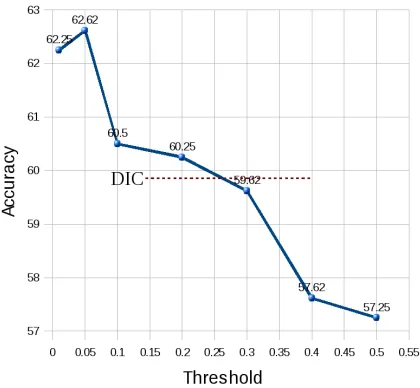
Figure 1: Accuracy on CLTE by pruning the phrase table with different thresholds.
-Universal dictionary database8: 9,944 entries.
-Wiktionary database9: 5,866 entries.
-Omegawiki database10: 8,237 entries.
-Wikipedia interlanguage links11: 7,425 entries. The resulting dictionary features 53,958 entries, with an average length of1.2words.
MultiWordNet (MWN)allows to extract mappings between English and Spanish words connected by entailment-preserving semantic relations. The ex-traction process is dataset-dependent, as it checks for synonymy and hyponymy relations only between terms found in the dataset. The resulting collection of cross-lingual words associations contains 36,794 pairs of lemmas.
4.3 Results and Discussion
Our results are calculated over 800 test pairs of our CLTE corpus, after training the SVM classifier over 800 development pairs. This section reports the percentage of correct entailment assignments (accu-racy), comparing the use of different sources of lex-ical knowledge.
Initially, in order to find a reasonable trade-off be-tween precision and coverage, we used the 7 phrase tables extracted with different pruning thresholds
8
http://www.dicts.info/
9http://en.wiktionary.org/ 10
http://www.omegawiki.org/
11
http://www.wikipedia.org/
MWN DIC PHT PPHT Acc. δ
x 55.00 0.00
x 59.88 +4.88
x 62.62 +7.62
x x 62.88 +7.88
Table 1: Accuracy results on CLTE using different lexical resources.
(see Section 3.1). Figure 1 shows that with the prun-ing threshold set to0.05, we obtain the highest re-sult of 62.62% on the test set. The curve demon-strates that, although with higher pruning thresholds we retain more reliable phrase pairs, their smaller number provides limited coverage leading to lower results. In contrast, the large coverage obtained with the pruning threshold set to 0.01 leads to a slight performance decrease due to probably less precise phrase pairs.
Once the threshold has been set, in order to prove the effectiveness of information extracted from bilingual corpora, we conducted a series of ex-periments using the different resources mentioned in Section 4.2.
As it can be observed in Table 1, the highest results are achieved using the phrase table, both alone and in combination with paraphrase tables (62.62% and 62.88% respectively). These results suggest that, with appropriate pruning thresholds, the large number and the longer entries contained in the phrase and paraphrase tables represent an ef-fective way to: i)obtain high coverage, andii) cap-ture cross-lingual associations between multiple lex-ical elements. This allows to overcome the bias to-wards single words featured by dictionaries and lex-ical databases.
As regards the other resources used for compari-son, the results show that dictionaries substantially outperform MWN. This can be explained by the low coverage of MWN, whose entries also repre-sent weaker semantic relations (preserving entail-ment, but with a lower probability to be applied) than the direct translations between terms contained in the dictionary.
[image:6.612.80.290.71.265.2]Dataset WN VO WIKI PPHT PPHT 0.1 PPHT 0.2 PPHT 0.3 AVG
RTE3 61.88 62.00 61.75 62.88 63.38 63.50 63.00 62.37
RTE5 62.17 61.67 60.00 61.33 62.50 62.67 62.33 61.41
RTE3-G 62.62 61.5 60.5 62.88 63.50 62.00 61.5
-Table 2: Accuracy results on monolingual RTE using different lexical resources.
5 Using parallel corpora for TE
This section addresses the third and the fourth re-search questions outlined in Section 1. Building on the positive results achieved on the cross-lingual scenario, we investigate the possibility to exploit bilingual parallel corpora in the traditional monolin-gual scenario. Using the same approach discussed in Section 4, we compare the results achieved with English paraphrase tables with those obtained with other widely used monolingual knowledge resources over two RTE datasets.
For the sake of completeness, we report in this section also the results obtained adopting the “basic solution” proposed by (Mehdad et al., 2010). Al-though it was presented as an approach to CLTE, the proposed method brings the problem back to the monolingual case by translating H into the language of T. The comparison with this method aims at ver-ifying the real potential of parallel corpora against the use of a competitive MT system (Google Trans-late) in the same scenario.
5.1 Dataset
We experiment with the original RTE3 and RTE5 datasets, annotated with token, lemma, and stem in-formation using the TreeTagger and the Snowball stemmer.
In addition to confront our method with the solu-tion proposed by (Mehdad et al., 2010) we translated the Spanish hypotheses of our CLTE dataset into En-glish using Google Translate. The resulting dataset was annotated in the same way.
5.2 Knowledge sources
We compared the results achieved with paraphrase tables (extracted with different pruning thresh-olds12) with those obtained using the three most
12We pruned the paraphrase table (PPHT), with probabilities
set to 0.1 (PPHT 0.1), 0.2 (PPHT 0.2), and 0.3 (PPHT 0.3)
widely used English resources for Textual Entail-ment (Bentivogli et al., 2010), namely:
WordNet (WN). WordNet 3.0 has been used to extract a set of 5396 pairs of words connected by the hyponymy and synonymy relations.
VerbOcean (VO). VerbOcean has been used to extract 18232 pairs of verbs connected by the “stronger-than” relation (e.g. “kill” stronger-than “injure”).
Wikipedia (WIKI). We performed Latent Se-mantic Analysis (LSA) over Wikipedia using the jLSI tool (Giuliano, 2007) to measure the relat-edness between words in the dataset. Then, we filtered all the pairs with similarity lower than0.7as proposed by (Kouylekov et al., 2009). In this way we obtained 13760 word pairs.
5.3 Results and Discussion
Table 2 shows the accuracy results calculated over the original RTE3 and RTE5 test sets, training our classifier over the corresponding development sets.
[image:7.612.95.515.73.133.2]but also in the monolingual scenario.
The comparison with the results achieved on monolingual data obtained by automatically trans-lating the Spanish hypotheses (RTE3-G row in Ta-ble 2) leads to four main observations. First, we no-tice that dealing with MT-derived inputs, the optimal pruning threshold changes from0.2 to0.1, leading to the highest accuracy of 63.50%. This suggests that the noise introduced by incorrect translations can be tackled by increasing the coverage of the paraphrase table. Second, in line with the findings of (Mehdad et al., 2010), the results obtained over the MT-derived corpus are equal to those we achieve over the original RTE3 dataset (i.e.63.50%). Third, the accuracy obtained over the CLTE corpus using combined phrase and paraphrase tables (62.88%, as reported in Table 1) is comparable to the best re-sult gained over the automatically translated dataset (63.50%). In all the other cases, the use of phrase and paraphrase tables on CLTE data outperforms the results achieved on the same data after transla-tion. Finally, it’s worth remarking that applying our phrase matching method on the translated dataset without any additional source of knowledge would result in an overall accuracy of 62.12%, which is lower than the result obtained using only phrase ta-bles on cross-lingual data (62.62%). This demon-strates that phrase tables can successfully replace MT systems in the CLTE task.
In light of this, we suggest that extracting lexi-cal knowledge from parallel corpora is a preferable solution to approach CLTE. One of the main rea-sons is that placing a black-box MT system at the front-end of the entailment process reduces the pos-sibility to cope with wrong translations. Further-more, the access to MT components is not easy (e.g.
Google Translate limits the number and the size of queries, while open source MT tools cover few lan-guage pairs). Moreover, the task of developing a full-fledged MT system often requires the availabil-ity of parallel corpora, and is much more complex than extracting lexical knowledge from them.
6 Conclusion and Future Work
In this paper we approached the cross-lingual Tex-tual Entailment task focusing on the role of lexi-cal knowledge extracted from bilingual parallel
cor-pora. One of the main difficulties in CLTE raises from the lack of adequate knowledge resources to bridge the lexical gap between texts and hypothe-ses in different languages. Our approach builds on the intuition that the vast amount of knowledge that can be extracted from parallel data (in the form of phrase and paraphrase tables) offers a possible so-lution to the problem. To check the validity of our assumptions we carried out several experiments on an English-Spanish corpus derived from the RTE3 dataset, using phrasal matches as a criterion to ap-proximate entailment. Our results show that phrase and paraphrase tables allow to:i)outperform the sults achieved with the few multilingual lexical re-sources available, and ii)reach performance levels above the average scores obtained by participants in the monolingual RTE3 challenge. These improve-ments can be explained by the fact that the lexi-cal knowledge extracted from parallel data provides good coverage both at the level of single words, and at the level of phrases.
As a further contribution, we explored the appli-cation of paraphrase tables extracted from parallel data in the traditional monolingual scenario. Con-trasting results with those obtained with the most widely used resources in TE, we demonstrated the effectiveness of paraphrase tables as a mean to over-come the bias towards single words featured by the existing resources.
Acknowledgments
This work has been partially supported by the EC-funded project CoSyne (FP7-ICT-4-24853).
References
Collin F. Baker, Charles J. Fillmore, and John B. Lowe. 1998. The Berkeley FrameNet project. Proceedings of COLING-ACL.
Colin Bannard and Chris Callison-Burch. 2005. Para-phrasing with Bilingual Parallel Corpora. Proceed-ings of the 43rd Annual Meeting of the Association for Computational Linguistics (ACL 2005).
Roy Bar-haim , Jonathan Berant , Ido Dagan , Iddo Greental , Shachar Mirkin , Eyal Shnarch , and Idan Szpektor. 2008. Efficient semantic deduction and ap-proximate matching over compact parse forests. Pro-ceedings of the TAC 2008 Workshop on Textual Entail-ment.
Luisa Bentivogli, Peter Clark, Ido Dagan, Hoa Trang Dang, and Danilo Giampiccolo. 2010. The Sixth PASCAL Recognizing Textual Entailment Challenge. Proceedings of the the Text Analysis Conference (TAC 2010).
Timothy Chklovski and Patrick Pantel. 2004. Verbocean: Mining the web for fine-grained semantic verb rela-tions. Proceedings of Conference on Empirical Meth-ods in Natural Language Processing (EMNLP-04). Ido Dagan and Oren Glickman. 2004. Probabilistic
tex-tual entailment: Generic applied modeling of language variability. Proceedings of the PASCAL Workshop of Learning Methods for Text Understanding and Min-ing.
Ido Dagan, Bill Dolan, Bernardo Magnini, and Dan Roth. 2009. Recognizing textual entailment: Rational, eval-uation and approaches. Journal of Natural Language Engineering, Volume 15, Special Issue 04, pp i-xvii. Michael Denkowski and Alon Lavie. 2010. Extending
the METEOR Machine Translation Evaluation Metric to the Phrase Level. Proceedings of Human Language Technologies (HLT-NAACL 2010).
Georgiana Dinu and Rui Wang. 2009. Inference Rules and their Application to Recognizing Textual Entail-ment. Proceedings of the 12th Conference of the Eu-ropean Chapter of the ACL (EACL 2009).
Claudio Giuliano. 2007. jLSI a tool for la-tent semantic indexing. Software avail-able at http://tcc.itc.it/research/textec/tools-resources/jLSI.html.
Lidija Iordanskaja, Richard Kittredge, and Alain Polg re.. 1991. Lexical selection and paraphrase in a meaning text generation model. Natural Language Generation in Articial Intelligence and Computational Linguistics.
Thorsten Joachims. 1999. Making large-scale support vector machine learning practical.
Philipp Koehn, Franz Josef Och, and Daniel Marcu 2003. Statistical Phrase-Based Translation. Proceedings of HLT/NAACL.
Philipp Koehn, Hieu Hoang, Alexandra Birch, Chris Callison-Burch, Marcello Federico, Nicola Bertoldi, Brooke Cowan, Wade Shen, Christine Moran, Richard Zens, Chris Dyer, Ondrej Bojar, Alexandra Con-stantin, and Evan Herbst. 2007. Moses: Open Source Toolkit for Statistical Machine Translation. Proceed-ings of the Conference of the Association for Compu-tational Linguistics (ACL).
Milen Kouleykov and Bernardo Magnini. 2005. Tree edit distance for textual entailment. Proceedings of RALNP-2005, International Conference on Recent Ad-vances in Natural Language Processing.
Milen Kouylekov, Yashar Mehdad, and Matteo Negri. 2010. Mining Wikipedia for Large-Scale Repositories of Context-Sensitive Entailment Rules. Proceedings of the Language Resources and Evaluation Conference (LREC 2010).
Yashar Mehdad, Alessandro Moschitti and Fabio Mas-simo Zanzotto. 2010. Syntactic/semantic structures for textual entailment recognition. Proceedings of the 11th Annual Conference of the North American Chap-ter of the Association for Computational Linguistics (NAACL HLT 2010).
Dekang Lin and Patrick Pantel. 2001. DIRT - Discovery of Inference Rules from Text.. Proceedings of ACM Conference on Knowledge Discovery and Data Mining (KDD-01).
Kathleen R. McKeown, Regina Barzilay, David Evans, Vasileios Hatzivassiloglou, Judith L. Klavans, Ani Nenkova, Carl Sable, Barry Schiffman, and Sergey Sigelman. 2002. Tracking and summarizing news on a daily basis with Columbias Newsblaster. Proceed-ings of the Human Language Technology Conference.. Yashar Mehdad, Matteo Negri, and Marcello Federico. 2010. Towards Cross-Lingual Textual Entailment. Proceedings of the 11th Annual Conference of the North American Chapter of the Association for Com-putational Linguistics (NAACL HLT 2010).
Dan Moldovan and Adrian Novischi. 2002. Lexical chains for question answering. Proceedings of COL-ING.
Matteo Negri and Yashar Mehdad. 2010. Creating a Bi-lingual Entailment Corpus through Translations with Mechanical Turk: $100 for a 10-day Rush. Proceed-ings of the NAACL 2010 Workshop on Creating Speech and Language Data With Amazons Mechanical Turk. Franz Josef Och and Hermann Ney. 2003. A
Emanuele Pianta, Luisa Bentivogli, and Christian Gi-rardi. 2002. MultiWordNet: Developing and Aligned Multilingual Database. Proceedings of the First Inter-national Conference on Global WordNet.
Vasile Rus, Art Graesser, and Kirtan Desai 2005. Lexico-Syntactic Subsumption for Textual Entailment. Proceedings of RANLP 2005.
Helmut Schmid 2005. Probabilistic Part-of-Speech Tag-ging Using Decision Trees. Proceedings of the In-ternational Conference on New Methods in Language Processing.
Marta Tatu andDan Moldovan. 2005. A semantic ap-proach to recognizing textual entailment. Proceed-ings of the Human Language Technology Conference and Conference on Empirical Methods in Natural Lan-guage Processing (HLT/EMNLP 2005).
Matthew Snover, Nitin Madnani, Bonnie Dorr, and Richard Schwartz. 2009. Fluency, Adequacy, or HTER? Exploring Different Human Judgments with a Tunable MT Metric. Proceedings of WMT09. Rui Wang and Yi Zhang,. 2009. Recognizing
Tex-tual Relatedness with Predicate-Argument Structures. Proceedings of the Conference on Empirical Methods in Natural Language Processing (EMNLP 2009). Kenji Yamada and Kevin Knight 2001. A Syntax-Based
Statistical Translation Model. Proceedings of the Con-ference of the Association for Computational Linguis-tics (ACL).