Proceedings of the 49th Annual Meeting of the Association for Computational Linguistics, pages 663–672,
Neutralizing Linguistically Problematic Annotations
in Unsupervised Dependency Parsing Evaluation
Roy Schwartz1 Omri Abend1∗ Roi Reichart2 Ari Rappoport1
1
Institute of Computer Science Hebrew University of Jerusalem
{roys02|omria01|arir}@cs.huji.ac.il
2
Computer Science and Artificial Intelligence Laboratory Massachusetts Institute of Technology
Abstract
Dependency parsing is a central NLP task. In this paper we show that the common eval-uation for unsupervised dependency parsing is highly sensitive to problematic annotations. We show that for three leading unsupervised parsers (Klein and Manning, 2004; Cohen and Smith, 2009; Spitkovsky et al., 2010a), a small set of parameters can be found whose mod-ification yields a significant improvement in standard evaluation measures. These param-eters correspond to local cases where no lin-guistic consensus exists as to the proper gold annotation. Therefore, the standard evaluation does not provide a true indication of algorithm quality. We present a new measure, Neutral
Edge Direction (NED), and show that it greatly reduces this undesired phenomenon.
1 Introduction
Unsupervised induction of dependency parsers is a major NLP task that attracts a substantial amount of research (Klein and Manning, 2004; Cohen et al., 2008; Headden et al., 2009; Spitkovsky et al., 2010a; Gillenwater et al., 2010; Berg-Kirkpatrick et al., 2010; Blunsom and Cohn, 2010, inter alia). Parser quality is usually evaluated by comparing its output to a gold standard whose annotations are lin-guistically motivated. However, there are cases in which there is no linguistic consensus as to what the correct annotation is (K ¨ubler et al., 2009). Examples include which verb is the head in a verb group struc-ture (e.g., “can” or “eat” in “can eat”), and which
∗
Omri Abend is grateful to the Azrieli Foundation for the award of an Azrieli Fellowship.
noun is the head in a sequence of proper nouns (e.g., “John” or “Doe” in “John Doe”). We refer to such annotations as (linguistically) problematic. For such cases, evaluation measures should not punish the al-gorithm for deviating from the gold standard.
In this paper we show that the evaluation mea-sures reported in current works are highly sensitive to the annotation in problematic cases, and propose a simple new measure that greatly neutralizes the problem.
We start from the following observation: for three leading algorithms (Klein and Manning, 2004; Co-hen and Smith, 2009; Spitkovsky et al., 2010a), a small set (at most 18 out of a few thousands) of pa-rameters can be found whose modification dramati-cally improves the standard evaluation measures (the attachment score measure by 9.3-15.1%, and the undirected measure by a smaller but still significant 1.3-7.7%). The phenomenon is implementation in-dependent, occurring with several algorithms based on a fundamental probabilistic dependency model1.
We show that these parameter changes can be mapped to edge direction changes in local structures in the dependency graph, and that these correspond to problematic annotations. Thus, the standard eval-uation measures do not reflect the true quality of the evaluated algorithm.
We explain why the standard undirected evalua-tion measure is in fact sensitive to such edge
direc-1
It is also language-independent; we have produced it in five different languages: English, Czech, Japanese, Portuguese, and Turkish. Due to space considerations, in this paper we focus on English, because it is the most studied language for this task and the most practically useful one at present.
tion changes, and present a new evaluation measure,
Neutral Edge Direction (NED), which greatly allevi-ates the problem by ignoring the edge direction in lo-cal structures. UsingNED, manual modifications of model parameters always yields small performance differences. Moreover, NED sometimes punishes such manual parameter tweaking by yielding worse results. We explain this behavior using an exper-iment revealing that NED always prefers the struc-tures that are more consistent with the modeling as-sumptions lying in the basis of the algorithm. When manual parameter modification is done against this preference, theNEDresults decrease.
The contributions of this paper are as follows. First, we show the impact of a small number of an-notation decisions on the performance of unsuper-vised dependency parsers. Second, we observe that often these decisions are linguistically controversial and therefore this impact is misleading. This reveals a problem in the common evaluation of unsuper-vised dependency parsing. This is further demon-strated by noting that recent papers evaluate the task using three gold standards which differ in such deci-sions and which yield substantially different results. Third, we present theNEDmeasure, which is agnos-tic to errors arising from choosing the non-gold di-rection in such cases.
Section 2 reviews related work. Section 3 de-scribes the performed parameter modifications. Sec-tion 4 discusses the linguistic controversies in anno-tating problematic dependency structures. Section 5 presentsNED. Section 6 describes experiments with it. A discussion is given in Section 7.
2 Related Work
Grammar induction received considerable attention over the years (see (Clark, 2001; Klein, 2005) for reviews). For unsupervised dependency parsing, the
Dependency Model with Valence (DMV) (Klein and
Manning, 2004) was the first to beat the simple right-branching baseline. A technical description of DMV is given at the end of this section.
The great majority of recent works, including those experimented with in this paper, are elabora-tions of DMV. Smith and Eisner (2005) improved the DMV results by generalizing the function maxi-mized by DMV’s EM training algorithm. Smith and
Eisner (2006) used a structural locality bias, experi-menting on five languages. Cohen et al. (2008) ex-tended DMV by using a variational EM training al-gorithm and adding logistic normal priors. Cohen and Smith (2009, 2010) further extended it by us-ing a shared logistic normal prior which provided a new way to encode the knowledge that some POS tags are more similar than others. A bilingual joint learning further improved their performance.
Headden et al. (2009) obtained the best reported results on WSJ10 by using a lexical extension of DMV. Gillenwater et al. (2010) used posterior reg-ularization to bias the training towards a small num-ber of parent-child combinations. Berg-Kirkpatrick et al. (2010) added new features to the M step of the DMV EM procedure. Berg-Kirkpatrick and Klein (2010) used a phylogenetic tree to model parame-ter drift between different languages. Spitkovsky et al. (2010a) explored several training protocols for DMV. Spitkovsky et al. (2010c) showed the benefits of Viterbi (“hard”) EM to DMV training. Spitkovsky et al. (2010b) presented a novel
lightly-supervised approach that used hyper-text mark-up
annotation of web-pages to train DMV.
A few non-DMV-based works were recently pre-sented. Daum´e III (2009) used shift-reduce tech-niques. Blunsom and Cohn (2010) used tree sub-stitution grammar to achieve best results on WSJ∞.
Druck et al. (2009) took a semi-supervised ap-proach, using a set of rules such as “A noun is usu-ally the parent of a determiner which is to its left”, experimenting on several languages. Naseem et al. (2010) further extended this idea by using a single set of rules which globally applies to six different languages. The latter used a model similar to DMV. The controversial nature of some dependency structures was discussed in (Nivre, 2006; K ¨ubler et al., 2009). Klein (2005) discussed controversial constituency structures and the evaluation problems stemming from them, stressing the importance of a consistent standard of evaluation.
w3 w2 w1
(a)
w3 w2 w1
[image:3.612.359.522.52.99.2](b)
Figure 1: A dependency structure on the words w1, w2, w3 before (Figure 1(a)) and after (Figure 1(b))
an edge-flip ofw2→w1.
thus improving performance. Klein and Manning (2004) observed that a large portion of their errors is caused by predicting the wrong direction of the edge between a noun and its determiner. K ¨ubler (2005) compared two different conversion schemes in Ger-man supervised constituency parsing and found one to have positive influence on parsing quality.
Dependency Model with Valence (DMV). DMV (Klein and Manning, 2004) defines a probabilistic grammar for unlabeled dependency structures. It is defined as follows: the root of the sentence is first generated, and then each head recursively generates its right and left dependents. The parameters of the model are of two types: PST OP and PAT T ACH.
PST OP(dir, h, adj) determines the probability to
stop generating arguments, and is conditioned on 3 arguments: the head h, the direction dir ((L)ef t
or (R)ight) and adjacency adj (whether the head already has dependents ((Y)es) in direction dir or not ((N)o)). PAT T ACH(arg|h, dir) determines the
probability to generateargas headh’s dependent in directiondir.
3 Significant Effects of Edge Flipping
In this section we present recurring error patterns in some of the leading unsupervised dependency parsers. These patterns are all local, confined to a sequence of up to three words (but mainly of just two consecutive words). They can often be mended by changing the directions of a few types of edges.
The modified parameters described in this section were handpicked to improve performance: we ex-amined the local parser errors occurring the largest number of times, and found the corresponding pa-rameters. Note that this is a valid methodology, since our goal is not to design a new algorithm but to demonstrate that modifying a small set of param-eters can yield a major performance boost and even-tually discover problems with evaluation methods or algorithms.
I
PRP
want
VBP to
TO eat
VB .
ROOT
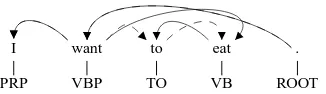
Figure 2: A parse of the sentence “I want to eat”, before (straight line) and after (dashed line) an edge-flip of the edge “to”←“eat”.
We start with a few definitions. Consider Fig-ure 1(a) that shows a dependency structFig-ure on the wordsw1, w2, w3. Edge flipping (henceforth,
edge-flip) the edgew2→w1is the following modification
of a parse tree: (1) settingw2’s parent asw1(instead
of the other way around), and (2) setting w1’s
par-ent asw3 (instead of the edgew3→w2). Figure 1(b)
shows the dependency structure after the edge-flip. Note that (1) imposes setting a new parent tow2,
as otherwise it would have had no parent. Setting this parent to bew3 is the minimal modification of
the original parse, since it does not change the at-tachment of the structure [w2, w1]to the rest of the
sentence, but only the direction of the internal edge. Figure 2 presents a parse of the sentence “I want to eat”, before and after an edge-flip of the edge “to”←“eat”.
Since unsupervised dependency parsers are gen-erally structure prediction models, the predictions of the parse edges are not independent. Therefore, there is no single parameter which completely con-trols the edge direction, and hence there is no direct way to perform an edge-flip by parameter modifica-tion. However, setting extreme values for the param-eters controlling the direction of a certain edge type creates a strong preference towards one of the direc-tions, and effectively determines the edge direction. This procedure is henceforth termed parameter-flip. We show that by performing a few
parameter-flips, a substantial improvement in the attachment
score can be obtained. Results are reported for three algorithms.
Parameter Changes. All the works experimented with in this paper are not lexical and use sequences of POS tags as their input. In addition, they all use the DMV parameter set (PST OP andPAT T ACH) for
parsing. We will henceforth refer to this set, condi-tioned on POS tags, as the model parameter set.
model prefers setting “to” (POS tag: T O) as a de-pendent of the infinitive verb (POS tag: V B) to its right (e.g., “to eat”). This is reflected by a high value of PAT T ACH(T O|V B, L), a low value of
PAT T ACH(V B|T O, R), since “to” tends to be a left
dependent of the verb and not the other way around, and a low value of PST OP(V B, L, N), as the verb
usually has at least one left argument (i.e., “to”). A parameter-flip of w1→w2 is hence performed
by setting PAT T ACH(w2|w1, R) to a very low
value and PAT T ACH(w1|w2, L) to a very high
value. When the modifications to PAT T ACH
are insufficient to modify the edge direction,
PST OP(w2, L, N) is set to a very low value and
PST OP(w1, R, N)to a very high value2.
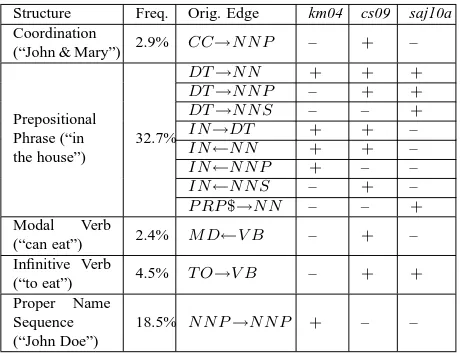
Table 1 describes the changes made for the three algorithms. The ‘+’ signs in the table correspond to edges in which the algorithm disagreed with the gold standard, and were thus modified. Similarly, the ‘–’ signs in the table correspond to edges in which the algorithm agreed with the gold standard, and were thus not modified. The number of modified param-eters does not exceed 18 (out of a few thousands).
The Freq.column in the table shows the percent-age of the tokens in sections 2-21 of PTB WSJ that participate in each structure. Equivalently, the per-centage of edges in the corpus which are of either of the types appearing in the Orig. Edge column.
As the table shows, the modified structures cover a significant portion of the tokens. Indeed, 42.9% of the tokens in the corpus participate in at least one of them3.
Experimenting with Edge Flipping. We experi-mented with three DMV-based algorithms: a repli-cation of (Klein and Manning, 2004), as appears in (Cohen et al., 2008) (henceforth, km04), Cohen and Smith (2009) (henceforth, cs09), and Spitkovsky et al. (2010a) (henceforth, saj10a). Decoding is done using the Viterbi algorithm4. For each of these algo-rithms we present the performance gain when com-pared to the original parameters.
The training set is sections 2-21 of the Wall Street
2Note that this yields unnormalized models. Again, this is
justified since the resulting model is only used as a basis for discussion and is not a fully fledged algorithm.
3
Some tokens participate in more than one structure. 4
http://www.cs.cmu.edu/∼scohen/parser.html.
Structure Freq. Orig. Edge km04 cs09 saj10a
Coordination
(“John & Mary”) 2.9% CC→N N P – + –
Prepositional Phrase (“in the house”)
32.7%
DT→N N + + +
DT→N N P – + + DT→N N S – – +
IN→DT + + –
IN←N N + + –
IN←N N P + – – IN←N N S – + – P RP$→N N – – +
Modal Verb
(“can eat”) 2.4% M D←V B – + –
Infinitive Verb
(“to eat”) 4.5% T O→V B – + +
Proper Name Sequence (“John Doe”)
[image:4.612.313.543.71.249.2]18.5% N N P→N N P + – –
Table 1: Parameter changes for the three algorithms. The Freq.column shows what percentage of the tokens in sec-tions 2-21 of PTB WSJ participate in each structure. The Orig. column indicates the original edge. The modified edge is of the opposite direction. The other columns show the different algorithms: km04: basic DMV model (repli-cation of (Klein and Manning, 2004)); cs09; (Cohen and Smith, 2009); saj10a: (Spitkovsky et al., 2010a).
Journal Penn TreeBank (Marcus et al., 1993). Test-ing is done on section 23. The constituency annota-tion was converted to dependencies using the rules of (Yamada and Matsumoto, 2003)5.
Following standard practice, we present the at-tachment score (i.e., percentage of words that have a correct head) of each algorithm, with both the origi-nal parameters and the modified ones. We present results both on all sentences and on sentences of length≤10, excluding punctuation.
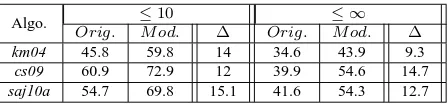
Table 2 shows results for all algorithms6. The performance difference between the original and the modified parameter set is considerable for all data sets, where differences exceed 9.3%, and go up to 15.1%. These are enormous differences from the perspective of current algorithm evaluation results.
4 Linguistically Problematic Annotations
In this section, we discuss the controversial nature of the annotation in the modified structures (K ¨ubler
5http://www.jaist.ac.jp/
∼h-yamada/ 6
Algo. ≤10 ≤ ∞ Orig. M od. ∆ Orig. M od. ∆
km04 45.8 59.8 14 34.6 43.9 9.3
cs09 60.9 72.9 12 39.9 54.6 14.7
[image:5.612.75.299.70.122.2]saj10a 54.7 69.8 15.1 41.6 54.3 12.7
Table 2: Results of the original (Orig. columns), the modified (M od.columns) parameter sets and their dif-ference (∆columns) for the three algorithms.
et al., 2009). We remind the reader that structures for which no linguistic consensus exists as to their correct annotation are referred to as (linguistically) problematic.
We begin by showing that all the structures mod-ified are indeed linguistically problematic. We then note that these controversies are reflected in the eval-uation of this task, resulting in three, significantly different, gold standards currently in use.
Coordination Structures are composed of two proper nouns, separated by a conjunctor (e.g., “John and Mary”). It is not clear which token should be the head of this structure, if any (Nilsson et al., 2006).
Prepositional Phrases (e.g., “in the house” or “in Rome”), where every word is a reasonable candidate to head this structure. For example, in the annotation scheme used by (Collins, 1999) the preposition is the head, in the scheme used by (Johansson and Nugues, 2007) the noun is the head, while TUT annotation, presented in (Bosco and Lombardo, 2004), takes the determiner to be the noun’s head.
Verb Groups are composed of a verb and an aux-iliary or a modal verb (e.g., “can eat”). Some schemes choose the modal as the head (Collins, 1999), others choose the verb (Rambow et al., 2002).
Infinitive Verbs (e.g., “to eat”) are also in contro-versy, as in (Yamada and Matsumoto, 2003) the verb is the head while in (Collins, 1999; Bosco and Lom-bardo, 2004) the “to” token is the head.
Sequences of Proper Nouns (e.g., “John Doe”) are also subject to debate, as PTB’s scheme takes the last proper noun as the head, and BIO’s scheme de-fines a more complex scheme (Dredze et al., 2007).
Evaluation Inconsistency Across Papers. A fact that may not be recognized by some readers is that comparing the results of unsupervised dependency parsers across different papers is not directly pos-sible, since different papers use different gold stan-dard annotations even when they are all derived from
the Penn Treebank constituency annotation. This
happens because they use different rules for con-verting constituency annotation to dependency an-notation. A probable explanation for this fact is that people have tried to correct linguistically problem-atic annotations in different ways, which is why we note this issue here7.
There are three different annotation schemes in current use: (1) Collins head rules (Collins, 1999), used in e.g., (Berg-Kirkpatrick et al., 2010; Spitkovsky et al., 2010a); (2) Conversion rules of (Yamada and Matsumoto, 2003), used in e.g., (Co-hen and Smith, 2009; Gillenwater et al., 2010); (3) Conversion rules of (Johansson and Nugues, 2007) used, e.g., in the CoNLL shared task 2007 (Nivre et al., 2007) and in (Blunsom and Cohn, 2010).
The differences between the schemes are substan-tial. For instance, 14.4% of section 23 is tagged dif-ferently by (1) and (2)8.
5 The Neutral Edge Direction (NED) Measure
As shown in the previous sections, the annotation of problematic edges can substantially affect perfor-mance. This was briefly discussed in (Klein and Manning, 2004), which used undirected evaluation as a measure which is less sensitive to alternative annotations. Undirected accuracy was commonly used since to assess the performance of unsuper-vised parsers (e.g., (Smith and Eisner, 2006; Head-den et al., 2008; Spitkovsky et al., 2010a)) but also of supervised ones (Wang et al., 2005; Wang et al., 2006). In this section we discuss why this measure is in fact not indifferent to edge-flips and propose a new measure, Neutral Edge Direction (NED).
7Indeed, half a dozen flags in the LTH
Constituent-to-Dependency Conversion Tool (Johansson and Nugues, 2007) are used to control the conversion in problematic cases.
8
w1
w2
w3
(a) w1
w3
w2
(b) w4
w3
w2
[image:6.612.146.224.71.127.2](c)
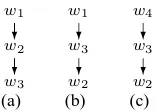
Figure 3: A dependency structure on the words w1, w2, w3before (Figure 3(a)) and after (Figure 3(b)) an
edge-flip ofw2→w3, and when the direction of the edge
betweenw2andw3is switched and the new parent ofw3
is set to be some other word,w4(Figure 3(c)).
Undirected Evaluation. The measure is defined as follows: traverse over the tokens and mark a cor-rect attachment if the token’s induced parent is either (1) its gold parent or (2) its gold child. The score is the ratio of correct attachments and the number of tokens.
We show that this measure does not ignore
edge-flips. Consider Figure 3 that shows a depen-dency structure on the wordsw1, w2, w3before
(Fig-ure 3(a)) and after (Fig(Fig-ure 3(b)) an edge-flip of
w2→w3. Assume that 3(a) is the gold standard and
that 3(b) is the induced parse. Consider w2. Its
induced parent (w3) is its gold child, and thus
undi-rected evaluation does not consider it an error. On the other hand,w3is assignedw2’s gold parent,w1.
This is considered an error, sincew1is neitherw3’s
gold parent (as it isw2), nor its gold child9.
There-fore, one of the two tokens involved in the edge-flip is penalized by the measure.
Recall the example “I want to eat” and the
edge-flip of the edge “to”←“eat” (Figure 2). As “to”’s parent in the induced graph (“want”) is neither its gold parent nor its gold child, the undirected evalu-ation measure marks it as an error. This is an exam-ple where an edge-flip in a problematic edge, which should not be considered an error, was in fact con-sidered an error by undirected evaluation.
Neutral Edge Direction (NED). TheNEDmeasure
is a simple extension of the undirected evaluation measure10. Unlike undirected evaluation, NED ig-nores all errors directly resulting from an edge-flip.
9
Otherwise, the gold parse would have contained a
w1→w2→w3→w1cycle. 10An implementation of
NEDis available at http://www.cs.huji.ac.il/∼roys02/software/ned.html
NED is defined as follows: traverse over the to-kens and mark a correct attachment if the token’s in-duced parent is either (1) its gold parent (2) its gold child or (3) its gold grandparent. The score is the ra-tio of correct attachments and the number of tokens.
NED, by its definition, ignores edge-flips. Con-sider again Figure 3, where we assume that 3(a) is the gold standard and that 3(b) is the induced parse. Much like undirected evaluation,NEDwill mark the attachment ofw2as correct, since its induced parent
is its gold child. However, unlike undirected evalua-tion,w3’s induced attachment will also be marked as
correct, as its induced parent is its gold grandparent. Now consider another induced parse in which the direction of the edge betweenw2andw3is switched
and the w3’s parent is set to be some other word,
w4 (Figure 3(c)). This should be marked as an
er-ror, even if the direction of the edge betweenw2and
w3is controversial, since the structure[w2, w3]is no
longer a dependent ofw1. It is indeed aNED error.
Note that undirected evaluation gives the parses in Figure 3(b) and Figure 3(c) the same score, while if the structure[w2, w3]is problematic, there is a major
difference in their correctness.
Discussion. Problematic structures are ubiquitous, with more than 40% of the tokens in PTB WSJ appearing in at least one of them (see Section 3). Therefore, even a substantial difference in the at-tachment between two parsers is not necessarily in-dicative of a true quality difference. However, an at-tachment score difference that persists underNED is an indication of a true quality difference, since gen-erally problematic structures are local (i.e., obtained by an edge-flip) andNED ignores such errors.
Reporting NEDalone is insufficient, as obviously the edge direction does matter in some cases. For example, in adjective–noun structures (e.g., “big house”), the correct edge direction is widely agreed upon (“big”←“house”) (K ¨ubler et al., 2009), and thus choosing the wrong direction should be con-sidered an error. Therefore, we suggest evaluating using bothNEDand attachment score in order to get a full picture of the parser’s performance.
ROOT
John
and Mary (a)
ROOT
John
and
Mary (b)
ROOT
in
house
the (c)
ROOT
in
the
house (d)
ROOT
house
in
[image:7.612.81.294.68.144.2]the (e)
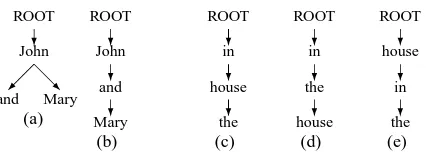
Figure 4: Alternative parses of “John and Mary” and “in the house”. Figure 4(a) follows (Collins, 1999), ure 4(b) follows (Johansson and Nugues, 2007). Fig-ure 4(c) follows (Collins, 1999; Yamada and Matsumoto, 2003). Figure 4(d) and Figure 4(e) show induced parses made by (km04,saj10a) and cs09, respectively.
(see Section 4). For example, Figure 4(a) and Fig-ure 4(b) present two alternative annotations of the sentence “John and Mary”. Assume the parse in Fig-ure 4(a) is the gold parse and that in FigFig-ure 4(b) is the induced parse. The word “Mary” is aNEDerror,
since its induced parent (“and”) is neither its gold child nor its gold grandparent. Thus, NEDdoes not accept all possible annotations of structures of size 3. On the other hand, using a method which accepts all possible annotations of structures of size 3 seems too permissive. A better solution may be to modify the gold standard annotation, so to explicitly anno-tate problematic structures as such. We defer this line of research to future work.
NED is therefore an evaluation measure which is indifferent to edge-flips, and is consequently less sensitive to alternative annotations. We now show thatNEDis indifferent to the differences between the structures originally learned by the algorithms men-tioned in Section 3 and the gold standard annotation in all the problematic cases we consider.
Most of the modifications made are edge-flips, and are therefore ignored by NED. The exceptions are coordinations and prepositional phrases which are structures of size 3. In the former, the alter-native annotations differ only in a single edge-flip (i.e.,CC→N N P), and are thus notNEDerrors. Re-garding prepositional phrases, Figure 4(c) presents the gold standard of “in the house”, Figure 4(d) the parse induced by km04 and saj10a and Figure 4(e) the parse induced by cs09. As the reader can verify, both induced parses receive a perfectNEDscore.
In order to further demonstrate NED’s insensitiv-ity to alternative annotations, we took two of the three common gold standard annotations (see
Sec-tion 4) and evaluated them one against the other. We considered section 23 of WSJ following the scheme of (Yamada and Matsumoto, 2003) as the gold stan-dard and of (Collins, 1999) as the evaluated set. Re-sults show that the attachment score is only 85.6%, the undirected accuracy is improved to 90.3%, while theNEDscore is 95.3%. This shows thatNEDis sig-nificantly less sensitive to the differences between the different annotation schemes, compared to the other evaluation measures.
6 Experimenting withNED
In this section we show that NED indeed reduces the performance difference between the original and the modified parameter sets, thus providing empiri-cal evidence for its validity. For brevity, we present results only for the entire WSJ corpus. Results on WSJ10 are similar. The datasets and decoding algo-rithms are the same as those used in Section 3.
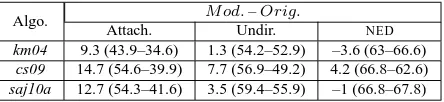
Table 3 shows the score differences between the parameter sets using attachment score, undirected evaluation and NED. A substantial difference
per-sists under undirected evaluation: a gap of 7.7% in
cs09, of 3.5% in saj10a and of 1.3% in km04.
The differences are further reduced using NED. This is consistent with our discussion in Section 5, and shows that undirected evaluation only ignores some of the errors inflicted by edge-flips.
For cs09, the difference is substantially reduced, but a 4.2% performance gap remains. For km04 and
saj10a, the original parameters outperform the new
ones by 3.6% and 1% respectively.
We can see that even when ignoring edge-flips, some difference remains, albeit not necessarily in the favor of the modified models. This is because we did not directly perform edge-flips, but rather
parameter-flips. The difference is thus a result of
second-order effects stemming from the
parameter-flips. In the next section, we explain why the
remain-ing difference is positive for some algorithms (cs09) and negative for others (km04, saj10a).
Algo. M od.–Orig.
Attach. Undir. NED
km04 9.3 (43.9–34.6) 1.3 (54.2–52.9) –3.6 (63–66.6)
cs09 14.7 (54.6–39.9) 7.7 (56.9–49.2) 4.2 (66.8–62.6)
[image:8.612.76.298.71.122.2]saj10a 12.7 (54.3–41.6) 3.5 (59.4–55.9) –1 (66.8–67.8)
Table 3: Differences between the modified and original parameter sets when evaluated using attachment score (Attach.), undirected evaluation (Undir.), andNED.
measures. This is an indication thatNEDprovides a different perspective on algorithm quality11.
Algo. Att10 Att∞ U n10 U n∞ NED10 NED∞ bbdk10 66.1 49.6 70.1 56.0 75.5 61.8
bc10 67.2 53.6 73 61.7 81.6 70.2
cs09 61.5 42 66.9 50.4 81.5 62.9
gggtp10 57.1 45 62.5 53.2 80.4 65.1
km04 45.8 34.6 60.3 52.9 78.4 66.6
saj10a 54.7 41.6 66.5 55.9 78.9 67.8
saj10c 63.8 46.1 72.6 58.8 84.2 70.8
saj10b∗
67.9 48.2 74.0 57.7 86.0 70.7
Table 4: A comparison of recent works, usingAtt
(at-tachment score)U n(undirected evaluation) andNED, on sentences of length ≤ 10 (excluding punctuation) and on all sentences. The gold standard is obtained using the rules of (Yamada and Matsumoto, 2003). bbdk10: (Berg-Kirkpatrick et al., 2010), bc10: (Blunsom and Cohn, 2010), cs09: (Cohen and Smith, 2009), gggtp10: (Gillenwater et al., 2010), km04: A replication of (Klein and Manning, 2004), saj10a: (Spitkovsky et al., 2010a),
saj10c: (Spitkovsky et al., 2010c), saj10b∗: A
lightly-supervised algorithm (Spitkovsky et al., 2010b).
7 Discussion
In this paper we explored two ways of dealing with cases in which there is no clear theoretical justifi-cation to prefer one dependency structure over an-other. Our experiments suggest that it is crucial to deal with such structures if we would like to have a proper evaluation of unsupervised parsing algo-rithms against a gold standard.
The first way was to modify the parameters of the parsing algorithms so that in cases where such prob-lematic decisions are to be made they follow the gold standard annotation. Indeed, this modification leads to a substantial improvement in the attachment score of the algorithms.
11
Results may be different than the ones published in the original papers due to the different conversion procedures used in each work. See Section 4 for discussion.
The second way was to change the evaluation. TheNED measure we proposed does not punish for differences between gold and induced structures in the problematic cases. Indeed, in Section 6 (Table 3) we show that the differences between the original and modified models are much smaller when eval-uating withNED compared to when evaluating with the traditional attachment score.
As Table 3 reveals, however, even when evaluat-ing withNED, there is still some difference between the original and the modified model, for each of the algorithms we consider. Moreover, for two of the al-gorithms (km04 and saj10a)NEDprefers the original model while for one (cs09) it prefers the modified version. In this section we explain these patterns and show that they are both consistent and predictable.
Our hypothesis, for which we provide empirical justification, is that in cases where there is no theo-retically preferred annotation,NEDprefers the struc-tures that are more learnable by DMV. That is,NED
gives higher scores to the annotations that better fit the assumptions and modeling decisions of DMV, the model that lies in the basis of the parsing algo-rithms.
To support our hypothesis we perform an experi-ment requiring two preparatory steps for each algo-rithm. First, we construct a supervised version of the algorithm. This supervised version consists of the same statistical model as the original unsuper-vised algorithm, but the parameters are estimated to maximize the likelihood of a syntactically annotated training corpus, rather than of a plain text corpus.
Second, we construct two corpora for the algo-rithm, both consist of the same text and differ only in their syntactic annotation. The first is annotated with the gold standard annotation. The second is similarly annotated except in the linguistically prob-lematic structures. We replace these structures with the ones that would have been created with the un-supervised version of the algorithm (see Table 1 for the relevant structures for each algorithm)12. Each
12
corpus is divided into a training and a test set. We then train the supervised version of the algo-rithms on each of the training sets. We parse the test data twice, once with each of the resulting models. We evaluate both parsed corpora against the corpus annotation from which they originated.
The training set of each corpus consists of sec-tions 2–21 of WSJ20 (i.e., WSJ sentences of length
≤20, excluding punctuation)13and the test set is sec-tion 23 of WSJ∞. Evaluation is performed using
both NED and attachment score. The patterns we observed are very similar for both. For brevity, we report only attachment score results.
km04 cs09 saj10a
Orig. Gold Orig. Gold Orig. Gold
NED,
Unsup. 66.6 63 62.6 66.8 67.8 66.8
Sup. 71.3 69.9 63.3 69.9 71.8 69.9
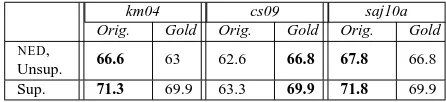
Table 5: The first line shows the NED results from Section 6, when using the original parameters (Orig. columns) and the modified parameters (Gold columns). The second line shows the results of the supervised ver-sions of the algorithms using the corpus which agrees with the unsupervised model in the problematic cases (Orig.) and the gold standard (Gold).
The results of our experiment are presented in Ta-ble 5 along with a comparison to the NED scores from Section 6. The table clearly demonstrates that a set of parameters (original or modified) is preferred byNEDin the unsupervised experiments reported in Section 6 (top line) if and only if the structures pro-duced by this set are better learned by the supervised version of the algorithm (bottom line).
This observation supports our hypothesis that in cases where there is no theoretical preference for one structure over the other, NED (unlike the other measures) prefers the structures that are more con-sistent with the modeling assumptions lying in the basis of the algorithm. We consider this to be a de-sired property of a measure since a more consistent model should be preferred where no theoretical pref-erence exists.
learned structure.
13In using WSJ20, we follow (Spitkovsky et al., 2010a),
which showed that training the DMV on sentences of bounded length yields a higher score than using the entire corpus. We use it as we aim to use an optimal setting.
8 Conclusion
In this paper we showed that the standard evalua-tion of unsupervised dependency parsers is highly sensitive to problematic annotations. We modified a small set of parameters that controls the annotation in such problematic cases in three leading parsers. This resulted in a major performance boost, which is unindicative of a true difference in quality.
We presented Neutral Edge Direction (NED), a measure that is less sensitive to the annotation of local structures. As the problematic structures are generally local,NEDis less sensitive to their alterna-tive annotations. In the future, we suggest reporting
NEDalong with the current measures.
Acknowledgements. We would like to thank Shay Cohen for his assistance with his implementation of the DMV parser and Taylor Berg-Kirkpatrick, Phil Blunsom and Jennifer Gillenwater for providing us with their data sets. We would also like to thank Valentin I.Spitkovsky for his comments and for pro-viding us with his data sets.
References
Taylor Berg-Kirkpatrick, Alexandre Bouchard-Cˆot´e, John DeNero and Dan Klein, 2010. Painless
unsu-pervised learning with features. In Proc. of NAACL.
Taylor Berg-Kirkpatrick and Dan Klein, 2010.
Phyloge-netic Grammar Induction. In Proc. of ACL.
Cristina Bosco and Vincenzo Lombardo, 2004.
Depen-dency and relational structure in treebank annotation.
In Proc. of the Workshop on Recent Advances in
De-pendency Grammar at COLING’04.
Phil Blunsom and Trevor Cohn, 2010. Unsupervised
Induction of Tree Substitution Grammars for Depen-dency Parsing. In Proc. of EMNLP.
Shay B. Cohen, Kevin Gimpel and Noah A. Smith, 2008.
Logistic Normal Priors for Unsupervised Probabilistic Grammar Induction. In Proc. of NIPS.
Shay B. Cohen and Noah A. Smith, 2009. Shared
Logis-tic Normal Distributions for Soft Parameter Tying. In Proc. of HLT-NAACL.
Michael J. Collins, 1999. Head-driven statistical models
for natural language parsing. Ph.D. thesis, University
of Pennsylvania, Philadelphia.
Alexander Clark, 2001. Unsupervised language
acquisi-tion: theory and practice. Ph.D. thesis, University of
Sussex.
Hal Daum´e III, 2009. Unsupervised search-based
[image:9.612.73.296.266.317.2]Mark Dredze, John Blitzer, Partha Pratim Talukdar, Kuz-man Ganchev, Jo˜ao V. Grac¸a and Fernando Pereira, 2007. Frustratingly Hard Domain Adaptation for
De-pendency Parsing. In Proc. of the CoNLL 2007 Shared Task. EMNLP-CoNLL.
Gregory Druck, Gideon Mann and Andrew McCal-lum, 2009. Semi-supervised learning of dependency
parsers using generalized expectation criteria. In
Proc. of ACL.
Jennifer Gillenwater, Kuzman Ganchev, Jo˜ao V. Grac¸a, Ben Taskar and Fernando Preira, 2010. Sparsity in
dependency grammar induction. In Proc. of ACL.
William P. Headden III, David McClosky, and Eugene Charniak, 2008. Evaluating Unsupervised
Part-of-Speech Tagging for Grammar Induction. In Proc. of COLING.
William P. Headden III, Mark Johnson and David Mc-Closky, 2009. Improving unsupervised dependency
parsing with richer contexts and smoothing. In Proc. of HLT-NAACL.
Richard Johansson and Pierre Nugues, 2007. Ex-tended Constituent-to-Dependency Conversion for En-glish. In Proc. of NODALIDA.
Dan Klein, 2005. The unsupervised learning of natural
language structure. Ph.D. thesis, Stanford University.
Dan Klein and Christopher Manning, 2004.
Corpus-based induction of syntactic structure: Models of de-pendency and constituency. In Proc. of ACL.
Sandra K¨ubler, 2005. How Do Treebank Annotation
Schemes Influence Parsing Results? Or How Not to Compare Apples And Oranges. In Proc. of RANLP.
Sandra K¨ubler, R. McDonald and Joakim Nivre, 2009.
Dependency Parsing. Morgan And Claypool
Publish-ers.
Mitchell Marcus, Beatrice Santorini and Mary Ann Marcinkiewicz, 1993. Building a large annotated
cor-pus of English: The Penn treebank. Computational Linguistics 19:313-330.
Tahira Naseem, Harr Chen, Regina Barzilay and Mark Johnson, 2010. Using universal linguistic knowledge
to guide grammar induction. In Proc. of EMNLP.
Joakim Nivre, 2006. Inductive Dependency Parsing. Springer.
Joakim Nivre, Johan Hall and Jens Nilsson, 2006.
Malt-Parser: A data-driven parser-generator for depen-dency parsing. In Proc. of LREC-2006.
Joakim Nivre, Johan Hall, Sandra K¨ubler, Ryan McDon-ald, Jens Nilsson, Sebastian Riedel and Deniz Yuret, 2007. The CoNLL 2007 shared task on dependency
parsing. In Proc. of the CoNLL Shared Task, EMNLP-CoNLL, 2007.
Jens Nilsson, Joakim Nivre and Johan Hall, 2006. Graph
transformations in data-driven dependency parsing.
In Proc. of ACL.
Owen Rambow, Cassandre Creswell, Rachel Szekely, Harriet Tauber and Marilyn Walker, 2002. A
depen-dency treebank for English. In Proc. of LREC.
Noah A. Smith and Jason Eisner, 2005. Guiding
unsu-pervised grammar induction using contrastive estima-tion. In Proc. of IJCAI.
Noah A. Smith and Jason Eisner, 2006. Annealing
struc-tural bias in multilingual weighted grammar induc-tion. In Proc. of ACL.
Valentin I. Spitkovsky, Hiyan Alshawi and Daniel Juraf-sky, 2010a. From Baby Steps to Leapfrog: How “Less
is More” in Unsupervised Dependency Parsing. In Proc. of NAACL-HLT.
Valentin I. Spitkovsky, Hiyan Alshawi and Daniel Juraf-sky, 2010b. Profiting from Mark-Up: Hyper-Text
An-notations for Guided Parsing. In Proc. of ACL.
Valentin I. Spitkovsky, Hiyan Alshawi, Daniel Jurafsky and Christopher D. Manning, 2010c. Viterbi training
improves unsupervised dependency parsing. In Proc. of CoNLL.
Qin Iris Wang, Dale Schuurmans and Dekang Lin, 2005.
Strictly Lexical Dependency Parsing. In IWPT.
Qin Iris Wang, Colin Cherry, Dan Lizotte and Dale Schu-urmans, 2006. Improved Large Margin Dependency
Parsing via Local Constraints and Laplacian Regular-ization. In Proc. of CoNLL.
Hiroyasu Yamada and Yuji Matsumoto, 2003. Statistical