Offspring from Reproduction Problems:
What Replication Failure Teaches Us
Antske Fokkens and Marieke van Erp
The Network Institute VU University Amsterdam Amsterdam, The Netherlands
{a.s.fokkens,m.g.j.van.erp}@vu.nl
Marten Postma
Utrecht University Utrecht, The Netherlands
Ted Pedersen
Dept. of Computer Science University of Minnesota Duluth, MN 55812 USA
Piek Vossen
The Network Institute VU University Amsterdam Amsterdam, The Netherlands
Nuno Freire
The European Library The Hague, The Netherlands
Abstract
Repeating experiments is an important in-strument in the scientific toolbox to vali-date previous work and build upon exist-ing work. We present two concrete use cases involving key techniques in the NLP domain for which we show that reproduc-ing results is still difficult. We show that the deviation that can be found in repro-duction efforts leads to questions about how our results should be interpreted. Moreover, investigating these deviations provides new insights and a deeper under-standing of the examined techniques. We identify five aspects that can influence the outcomes of experiments that are typically not addressed in research papers. Our use cases show that these aspects may change the answer to research questions leading us to conclude that more care should be taken in interpreting our results and more research involving systematic testing of methods is required in our field.
1 Introduction
Research is a collaborative effort to increase knowledge. While it includes validating previous approaches, our experience is that most research output in our field focuses on presenting new ap-proaches, and to a somewhat lesser extent building upon existing work.
In this paper, we argue that the value of research that attempts to replicate previous approaches goes beyond simplyvalidating what is already known. It is also an essential aspect for building upon existing approaches. Especially when validation
fails or variations in results are found, systematic testing helps to obtain a clearer picture of both the approach itself and of the meaning of state-of-the-art results leading to abetter insightinto the qual-ity of new approaches in relation to previous work. We support our claims by presenting two use cases that aim to reproduce results of previous work in two key NLP technologies: measuring WordNet similarity and Named Entity Recogni-tion (NER). Besides highlighting the difficulty of repeating other researchers’ work, new insights about the approaches emerged that were not pre-sented in the original papers. This last point shows that reproducing results is not merely part of good practice in science, but also an essential part in gaining a better understanding of the methods we use. Likewise, the problems we face in reproduc-ing previous results are not merely frustratreproduc-ing in-conveniences, but also pointers to research ques-tions that deserve deeper investigation.
We investigated five aspects that cause exper-imental variation that are not typically described in publications: preprocessing (e.g. tokenisa-tion),experimental setup (e.g. splitting data for cross-validation),versioning(e.g. which version of WordNet), system output(e.g. the exact fea-tures used for individual tokens in NER), and sys-tem variation(e.g. treatment of ties).
As such, reproduction provides a platform for systematically testing individual aspects of an ap-proach that contribute to a given result. What is the influence of the size of the dataset, for exam-ple? How does using a different dataset affect the results? What is a reasonable divergence between different runs of the same experiment? Finding answers to these questions enables us to better in-terpret our state-of-the-art results.
Moreover, the experiments in this paper show that even while strictly trying to replicate a pre-vious experiment, results may vary up to a point where they lead to different answers to the main question addressed by the experiment. The Word-Net similarity experiment use case compares the performance of different similarity measures. We will show that the answer as to which measure works best changes depending on factors such as the gold standard used, the strategy towards part-of-speech or the ranking coefficient, all aspects that are typically not addressed in the literature.
The main contributions of this paper are the following:
1) An in-depth analysis of two reproduction use cases in NLP
2) New insights into the state-of-the-art results for WordNet similarities and NER, found because of problems in reproducing prior research
3) A categorisation of aspects influencing reproduction of experiments and suggestions on testing their influence systematically
The code, data and experimental setup for the WordNet experiments are
avail-able at http://github.com/antske/
WordNetSimilarity, and for the NER exper-iments at http://github.com/Mvanerp/ NER. The experiments presented in this paper have been repeated by colleagues not involved in the development of the software using the code included in these repositories. The remainder of this paper is structured as follows. In Section 2, previous work is discussed. Sections 3 and 4 describe our real-world use cases. In Section 5, we present our observations, followed by a more general discussion in Section 6. In Section 7, we present our conclusions.
2 Background
This section provides a brief overview of recent work addressing reproduction and benchmark re-sults in computer science related studies and dis-cusses how our research fits in the overall picture. Most researchers agree that validating results entails that a method should lead to the same over-all conclusions rather than producing the exact same numbers (Drummond, 2009; Dalle, 2012; Buchert and Nussbaum, 2012, etc.). In other words, we should strive toreproducethe same an-swer to a research question by different means,
perhaps by re-implementing an algorithm or eval-uating it on a new (in domain) data set. Replica-tionhas a somewhat more limited aim, and simply involves running the exact same system under the same conditions in order to get the exact same re-sults as output.
According to Drummond (2009) replication is not interesting, since it does not lead to new in-sights. On this point we disagree with Drum-mond (2009) as replication allows us to: 1) vali-date prior research, 2) improve on prior research without having to rebuild software from scratch, and 3) compare results of reimplementations and obtain the necessary insights to perform reproduc-tion experiments. The outcome of our use cases confirms the statement that deeper insights into an approach can be obtained when all resources are available, an observation also made by Ince et al. (2012).
Even if exact replication is not a goal many strive for, Ince et al. (2012) argue that insightful reproduction can be an (almost) impossible un-dertaking without the source code being available. Moreover, it is not always clear where replication stops and reproduction begins. Dalle (2012) dis-tinguishes levels of reproducing results related to how close they are to the original work and how each contributes to research. In general, an in-creasing awareness of the importance of reproduc-tion research and open code and data can be ob-served based on publications in high-profile jour-nals (e.g. Nature (Ince et al., 2012)) and initiatives such as myExperiment.1
Howison and Herbsleb (2013) point out that, even though this is important, often not enough (academic) credit is gained from making resources available. What is worse, the same holds for re-search that investigates existing methods rather than introducing new ones, as illustrated by the question that is found on many review forms ‘how novel is the presented approach?’. On the other hand, initiatives for journals addressing exactly this issue (Neylon et al., 2012) and tracks focus-ing on results verification at conferences such as VLDB2show that this opinion is not universal.
A handful of use cases on reproducing or repli-cating results have been published. Louridas and Gousios (2012) present a use case revealing that source code alone is not enough for reproducing
results, a point that is also made by Mende (2010) who provides an overview of all information re-quired to replicate results.
The experiments in this paper provide use cases that confirm the points brought out in the litera-ture mentioned above. This includes both obser-vations that a detailed level of information is re-quired for truly insightful reproduction research as well as the claim that such research leads to better understanding of our techniques. Furthermore, the work in this paper relates to Bikel (2004)’s work. He provides all information needed in addition to Collins (1999) to replicate Collins’ benchmark re-sults. Our work is similar in that we also aim to fill in the blanks needed to replicate results. It must be noted, however, that the use cases in this paper have a significantly smaller scale than Bikel’s.
Our research distinguishes itself from previous work, because it links the challenges of reproduc-tion to what they mean for reported results be-yond validation. Ruml (2010) mentions variations in outcome as a reason not to emphasise compar-isons to benchmarks. Vanschoren et al. (2012) propose to use experimental databases to system-atically test variations for machine learning, but neither links the two issues together. Raeder et al. (2010) come closest to our work in a critical study on the evaluation of machine learning. They show that choices in the methodology, such as data sets, evaluation metrics and type of cross-validation can influence the conclusions of an experiment, as we also find in our second use case. However, they focus on the problem of evaluation and recom-mendations on how to achieve consistent repro-ducible results. Our contribution is to investigate how much results vary. We cannot control how fellow researchers carry out their evaluation, but if we have an idea of the variations that typically occur within a system, we can better compare ap-proaches for which not all details are known.
3 WordNet Similarity Measures
Patwardhan and Pedersen (2006) and Pedersen (2010) present studies where the output of a va-riety of WordNet similarity and relatedness mea-sures are compared. They rank Miller and Charles (1991)’s set (henceforth “mc-set”) of 30 word pairs according to their semantic relatedness with several WordNet similarity measures.
Each measure ranks the mc-set of word pairs and these outputs are compared to Miller and
Charles (1991)’s gold standard based on human rankings using the Spearman’s Correlation Coeffi-cient (Spearman, 1904,ρ). Pedersen (2010) also
ranks the original set of 65 word pairs ranked by humans in an experiment by Rubenstein and Goodenough (1965) (rg-set) which is a superset of Miller and Charles’s set.
3.1 Replication Attempts
This research emerged from a project run-ning a similar experiment for Dutch on Cor-netto (Vossen et al., 2013). First, an attempt was made to reproduce the results reported in Patwardhan and Pedersen (2006) and Peder-sen (2010) on the English WordNet using their WordNet::Similarity web-interface.3 Results
dif-fered from those reported in the aforementioned works, even when using the same versions as the original, WordNet::Similarity-1.02 and Word-Net 2.1 (Patwardhan and Pedersen, 2006) and WordNet::Similarity-2.05 and WordNet 3.0 (Ped-ersen, 2010), respectively.4
The fact that results of similarity measures on WordNet can differ even while the same software and same versions are used indicates that proper-ties which are not addressed in the literature may influence the output of similarity measures. We therefore conducted a range of experiments that, in addition to searching for the right settings to replicate results of previous research, address the following questions:
1) Which properties have an impact on the per-formance of WordNet similarity measures?
2) How much does the performance of individ-ual measures vary?
3) How do commonly used measures compare when the variation of their performance are taken into account?
3.2 Methodology and first observations The questions above were addressed in two stages. In the first stage, Fokkens, who was not involved in the first replication attempt implemented a script to calculate similarity measures using Word-Net::Similarity. This included similarity mea-sures introduced by Wu and Palmer (1994) (wup),
3Obtained from http://talisker.d.umn.edu/ cgi-bin/similarity/similarity.cgi, Word-Net::Similarity version 2.05. This web interface has now moved tohttp://maraca.d.umn.edu
Leacock and Chodorow (1998) (lch), Resnik (1995) (res), Jiang and Conrath (1997) (jcn), Lin (1998) (lin), Banerjee and Pedersen (2003) (lesk), Hirst and St-Onge (1998) (hso) and Patwardhan and Pedersen (2006) (vector and
vpairs) respectively.
Consequently, settings and properties were changed systematically and shared with Pedersen who attempted to produce the new results with his own implementations. First, we made sure that the script implemented by Fokkens could produce the same WordNet similarity scores for each in-dividual word pair as those used to calculate the ranking on themc-setby Pedersen (2010). Finally, the gold standard and exact implementation of the Spearman ranking coefficient were compared.
Differences in results turned out to be related to variations in the experimental setup. First, we made different assumptions on the restriction of part-of-speech tags (henceforth “PoS-tag”) con-sidered in the comparison. Miller and Charles (1991) do not discuss how they deal with words with more than one PoS-tag in their study. Ped-ersen therefore included all senses with any PoS-tag in his study. The first replication attempt had restricted PoS-tags to nouns based on the idea that most items are nouns and subjects would be primed to primarily think of the noun senses. Both assumptions are reasonable. Pos-tags were not re-stricted in the second replication attempt, but be-cause of a bug in the code only the first identified PoS-tag (“noun” in all cases) was considered. We therefore mistakenly assumed that PoS-tag restric-tions did not matter until we compared individual scores between Pedersen and the replication at-tempts.
Second, there are two gold standards for the Miller and Charles (1991) set: one has the scores assigned during the original experiment run by Rubenstein and Goodenough (1965), the other has the scores assigned during Miller and Charles (1991)’s own experiment. The ranking correlation between the two sets is high, but they are not iden-tical. Again, there is no reason why one gold stan-dard would be a better choice than the other, but in order to replicate results, it must be known which of the two was used. Third, results changed be-cause of differences in the treatment of ties while calculating Spearmanρ. The influence of the
ex-act gold standard and calculation of Spearman ρ
could only be found because Pedersen could
pro-measure Spearmanρ Kendallτ ranking min max min max variation
path based similarity
path 0.70 0.78 0.55 0.62 1-8 wup 0.70 0.79 0.53 0.61 1-6 lch 0.70 0.78 0.55 0.62 1-7
path based information content res 0.65 0.75 0.26 0.57 4-11 lin 0.49 0.73 0.36 0.53 6-10 jcn 0.46 0.73 0.32 0.55 5, 7-11
path based relatedness
[image:4.595.312.521.61.225.2]hso 0.73 0.80 0.36 0.41 1-3,5-10 dictionary and corpus based relatedness vpairs 0.40 0.70 0.26 0.50 7-11 vector 0.48 0.92 0.33 0.76 1,2,4,6-11 lesk 0.66 0.83 -0.02 0.61 1-8,11,12
Table 1: Variation WordNet measures’ results
vide the output of the similarity measures he used to calculate the coefficient. It is unlikely we would have been able to replicate his results at all with-out the with-output of this intermediate step. Finally, results forlch, leskandwup changed accord-ing to measure specific configuration settaccord-ings such as including a PoS-tag specific root node or turn-ing on normalisation.
In the second stage of this research, we ran ex-periments that systematically manipulate the influ-ential factors described above. In this experiment, we included both themc-setand the complete rg-set. The implementation of Spearman ρ used in
Pedersen (2010) assigned the lowest number in ranking to ties rather than the mean, resulting in an unjustified drop in results for scores that lead to many ties. We therefore experimented with a different correlation measure, Kendall tau coeffi-cient (Kendall, 1938,τ) rather than two versions
of Spearmanρ.
3.3 Variation per measure
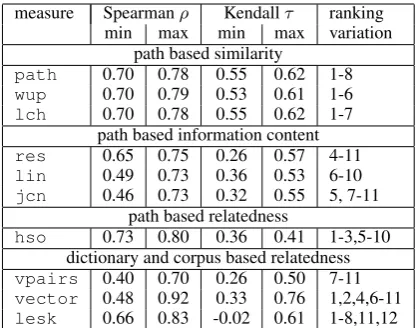
All measures varied in their performance. The complete outcome of our experiments (both the similarity measures assigned to each pair as well as the output of the ranking coefficients) are included in the data set pro-vided at http://github.com/antske/ WordNetSimilarity. Table 1 presents an overview of the main point we wish to make through this experiment: the minimal and maxi-mal results according to both ranking coefficients. Results for similarity measures varied from 0.06-0.42 points for Spearman ρ and from 0.05-0.60
points for Kendall τ. The last column
compared to the other measures, where 1 is the best performing measure and 12 is the worst.5
For instance, path has been best performing measure, second best, eighth best and all positions in between,vectorhas ranked first, second and fourth, but also occupied all positions from six to eleven.
In principle, it is to be expected that num-bers are not exactly the same while evaluating against a different data set (themc-set versus the rg-set), taking a different set of synsets to evalu-ate on (changing PoS-tag restrictions) or changing configuration settings that influence the similarity score. However, a variation of up to 0.44 points in Spearman ρ and 0.60 in Kendall τ6 leads to the question of how indicative these results really are. A more serious problem is the fact that the comparative performance of individual measure changes. Which measure performs best depends on the evaluation set, ranking coefficient, PoS-tag restrictions and configuration settings. This means that the answer to the question of which similarity measure is best to mimic human similarity scores depends on aspects that are often not even men-tioned, let alone systematically compared.
3.4 Variation per category
For each influential category of experimental vari-ation, we compared the variation in Spearman ρ
and Kendallτ, while similarity measure and other
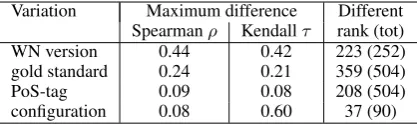
influential categories were kept stable. The cat-egories we varied include WordNet and Word-Net::Similarity version, the gold standard used to evaluate, restrictions on PoS-tags, and measure specific configurations. Table 2 presents the maxi-mum variation found across measures for each cat-egory. The last column indicates how often the ranking of a specific measure changed as the cat-egory changed, e.g. did the measure ranking third using specific configurations, PoS-tag restrictions and a specific gold standard using WordNet 2.1 still rank third when WordNet 3.0 was used in-stead? The number in parentheses next to the ‘dif-ferent ranks’ in the table presents the total ber of scores investigated. Note that this num-ber changes for each category, because we
com-5Some measures ranked differently as their individual configuration settings changed. In these cases, the measure was included in the overall ranking multiple times, which is why there are more ranking positions than measures.
6Section 3.4 explains why the variation in Kendall is this extreme andρis more appropriate for this task.
Variation Maximum difference Different Spearmanρ Kendallτ rank (tot) WN version 0.44 0.42 223 (252) gold standard 0.24 0.21 359 (504)
PoS-tag 0.09 0.08 208 (504)
[image:5.595.312.521.62.124.2]configuration 0.08 0.60 37 (90)
Table 2: Variations per category
pared two WordNet versions (WN version), three gold standard and PoS-tag restriction variations and configuration only for the subset of scores where configuration matters.
There are no definite statements to make as to which version (Patwardhan and Pedersen (2006) vs Pedersen (2010)), PoS-tag restriction or con-figuration gives the best results. Likewise, while most measures do better on the smaller data set, some achieve their highest results on the full set. This is partially due to the fact that ranking coef-ficients are sensitive to outliers. In several cases where PoS-tag restrictions led to different results, only one pair received a different score. For in-stance, path assigns a relatively high score to the pairchord-smilewhen verbs are included, be-cause the hierarchy of verbs in WordNet is rela-tively flat. This effect is not observed inwupand
lchwhich correct for the depth of the hierarchy. On the other hand,res,linandjcnscore bet-ter on the same set when verbs are considered, be-cause they cannot detect any relatedness for the paircrane-implementwhen restricted to nouns.
On top of the variations presented above, we no-tice a discrepancy between the two coefficients. Kendall τ generally leads to lower coefficiency
scores than Spearman ρ. Moreover, they each
give different relative indications: where lesk
achieves its highest Spearman ρ, it has an
ex-tremely low Kendallτ of 0.01. Spearman ρuses
the difference in rank as its basis to calculate a cor-relation, where Kendallτuses the number of items
with the correct rank. The low Kendallτ forlesk
is the result of three pairs receiving a score that is too high. Other pairs that get a relatively accurate score are pushed one place down in rank. Because only items that receive the exact same rank help to increaseτ, such a shift can result in a drastic drop
in the coefficient. In our opinion, Spearmanρ is
therefore preferable over Kendallτ. We included τ, because many authors do not mention the
com-monly used coefficients.
Except for WordNet, which Budanitsky and Hirst (2006) hold accountable for minor variations in a footnote, the influential categories we investi-gated in this paper, to our knowledge, have not yet been addressed in the literature. Cramer (2008) points out that results from WordNet-Human sim-ilarity correlations lead to scattered results report-ing variations similar to ours, but she compares studies using different measures, data and exper-imental setup. This study shows that even if the main properties are kept stable, results vary enough to change the identity of the measure that yields the best performance. Table 1 reveals a wide variation in ranking relative to alternative ap-proaches. Results in Table 2 show that it is com-mon for the ranking of a score to change due to variations that are not at the core of the method.
This study shows that it is far from clear how different WordNet similarity measures relate to each other. In fact, we do not know how we can obtain the best results. This is particularly chal-lenging, because the ‘best results’ may depend on the intended use of the similarity scores (Meng et al., 2013). This is also the reason why we presented the maximum variation observed, rather than the average or typical variation (mostly be-low 0.10 points). The experiments presented in this paper resulted in a vast amount of data. An elaborate analysis of this data is needed to get a better understanding of how measures work and why results vary to such an extent. We leave this investigation to future work. If there is one take-home message from this experiment, it is that one should experiment with parameters such as restric-tions on PoS-tags or configurarestric-tions and determine which score to use depending on what it is used for, rather than picking something that did best in a study using different data for a different task and may have used a different version of WordNet.
4 Reproducing a NER method
Freire et al. (2012) describe an approach to clas-sifying named entities in the cultural heritage do-main. The approach is based on the assumption that domain knowledge, encoded in complex fea-tures, can aid a machine learning algorithm in NER tasks when only little training data is avail-able. These features include information about person and organisation names, locations, as well as PoS-tags. Additionally, some general features
are used such as a window of three preceding and two following tokens, token length and capitalisa-tion informacapitalisa-tion. Experiments are run in a 10-fold cross-validation setup using an open source ma-chine learning toolkit (McCallum, 2002).
4.1 Reproducing NER Experiments
This experiment can be seen as a real-world case ofthe sad tale of the Zigglebottom tagger (Peder-sen, 2008). The (fictional) Zigglebottom tagger is a tagger with spectacular results that looks like it will solve some major problems in your system. However, the code is not available and a new im-plementation does not yield the same results. The original authors cannot provide the necessary de-tails to reproduce their results, because most of the work has been done by a PhD student who has fin-ished and moved on to something else. In the end, the newly implemented Zigglebottom tagger is not used, because it does not lead to the promised bet-ter results and all effort went to waste.
Van Erp was interested in the NER approach presented in Freire et al. (2012). Unfortunately, the code could not be made available, so she de-cided to reimplement the approach. Despite feed-back from Freire about particular details of the system, results remained 20 points below those reported in Freire et al. (2012) in overall F-score (Van Erp and Van der Meij, 2013).
The reimplementation process involved choices about seemingly small details such as rounding to how many decimals, how to tokenise or how much data cleanup to perform (normalisation of non-alphanumeric characters for example). Try-ing different parameter combinations for feature generation and the algorithm never yielded the ex-act same results as Freire et al. (2012). The results of the best run in our first reproduction attempt, together with the original results from Freire et al. (2012) are presented in Table 3. Van Erp and Van der Meij (2013) provide an overview of the imple-mentation efforts.
4.2 Following up from reproduction
Since the experiments in Van Erp and Van der Meij (2013) introduce several new research questions regarding the influence of data cleaning and the limitations of the dataset, we performed some ad-ditional experiments.
(Freire et al., 2012) results Van Erp and Van der Meij’s replication results Precision Recall Fβ=1 Precision Recall Fβ=1
LOC (388) 92% 55% 69 77.80% 39.18% 52.05
ORG (157) 90% 57% 70 65.75% 30.57% 41.74
PER (614) 91% 56% 69 73.33% 37.62% 49.73
[image:7.595.121.479.61.126.2]Overall (1,159) 91% 55% 69 73.33% 37.19% 49.45
Table 3: Precision, recall and Fβ=1 scores for the original experiments from Freire et al. 2012 and our
replication of their approach as presented in Van Erp and Van der Meij (2013)
tokens vs 12,510), and a 15 point drop in over-all F-score. Then, we investigated whether vari-ation in the cross-validvari-ation splits made any dif-ference as we noticed that some NEs were only present in particular fields in the data, which can have a significant impact on a small dataset. We inspected the difference between different cross-validation folds by computing the standard devi-ations of the scores and found devidevi-ations of up to 25 points in F-score between the 10 splits. In the general setup, database records were randomly distributed over the folds and cut off to balance the fold sizes. In a different approach to dividing the data by distributing individual sentences from the records over the folds, performance increases by 8.57 points in overall F-score to 58.02. This is not what was done in the original Freire et al. (2012) paper, but shows that the results obtained with this dataset are quite fragile.
As we worried about the complexity of the fea-ture set relative to the size of the data set, we de-viated somewhat from Freire et al. (2012)’s exper-iments in that we switched some features on and off. Removal of complex features pertaining to the window around the focus token improved our re-sults by 3.84 points in overall F-score to 53.39. The complex features based on VIAF,7
GeoN-ames8and WordNet do contribute to the
classifica-tion in the Mallet setup as removing them and only using the focus token, window and generic fea-tures causes a slight drop in overall F-score from 49.45 to 47.25.
When training the Stanford NER system (Finkel et al., 2005) on just the tokens from the Freire data set and the parameters from en-glish.all.3class.distsim.prop (included in the Stan-ford NER release, see also Van Erp and Van der Meij (2013)), our F-scores come very close to those reported by Freire et al. (2012), but mostly with a higher recall and lower precision. It is puz-zling that the Stanford system obtains such high
7http://www.viaf.org 8http://www.geonames.org
results with only very simple features, whereas for Mallet the complex features show improve-ment over simpler features. This leads to ques-tions about the differences between the CRF im-plementations and the influence of their parame-ters, which we hope to investigate in future work.
4.3 Reproduction difficulties explained Several reasons may be the cause of why we fail to reproduce results. As mentioned, not all resources and data were available for this experiment, thus causing us to navigate in the dark as we could not reverse-engineer intermediate steps, but only com-pare to the final precision, recall and F-scores.
The experiments follow a general machine learning setup consisting roughly of four steps: preprocess data, generate features, train model and test model. The novelty and replication problems lie in the first three steps. How the data was pre-processed is a major factor here. The data set con-sisted of XML files marked up with inline named entity tags. In order to generate machine learn-ing features, this data has to be tokenised, possi-bly cleaned up and the named entity markup had to be converted to a token-based scheme. Each of these steps can be carried out in several ways, and choices made here can have great influence on the rest of the pipeline.
Similar choices have to be made for prepro-cessing external resources. From the descriptions in the original paper, it is unclear how records in VIAF and GeoNames were preprocessed, or even which versions of these resources were used. Preprocessing and calculating occurrence statis-tics over VIAF takes 30 hours for each run. It is thus not feasible to identify the main potential variations without the original data to verify this prepatory step.
fea-tures versus several boolean feafea-tures can have sig-nificant impact. These settings are not mentioned in the paper, making reproduction very difficult.
As the project in which the original research was performed has ended, and there is no cen-tral repository where such information can be re-trieved, we are left to wonder how to reuse this approach in order to further domain-specific NER.
5 Observations
In this section, we generalise the observations from our use cases to the main categories that can influence reproduction.
Despite our efforts to describe our systems as clearly as possible, details that can make a tremen-dous difference are often omitted in papers. It will be no surprise to researchers in the field that pre-processing of data can make or break an experi-ment.
The choice of which steps we perform, and how each of these steps is carried out exactly are part of ourexperimental setup. A major difference in the results for the NER experiments was caused by variations in the way in which we split the data for cross-validation.
As we fine-tune our techniques, software gets updated, data sets are extended or annotation bugs are fixed. In the WordNet experiment, we found that there were two different gold standard data sets. There are also different versions of Word-Net, and the WordNet::Similarity packages. Sim-ilarly for the NER experiment, GeoNames, VIAF and Mallet are updated regularly. It is therefore critical to pay attention toversioning.
Our experiments often consist of several differ-ent steps whose outputs may be difficult to retrace. In order to check the output of a reproduction ex-periment at every step of the way, system out-putof experiments, including intermediate steps, is vital. The WordNet replication was only pos-sible, because Pedersen could provide the similar-ity scores of each word pair. This enabled us to compare the intermediate output and identify the source of differences in output.
Lastly, there may be inherentsystem variations in the techniques used. Machine learning algo-rithms may for instance use coin flips in case of a tie. This was not observed in our experiments, but such variations may be determined by running an experiment several times and taking the average over the different runs (cf. Raeder et al. (2010)).
All together, these observations show that shar-ing data and software play a key role in gainshar-ing in-sight into how our methods work. Vanschoren et al. (2012) propose a setup that allows researchers to provide their full experimental setup, which should include exact steps followed in preprocess-ing the data, documentation of the experimen-tal setup, exact versions of the software and re-sources used and experimental output. Having access to such a setup allows other researchers to validate research, but also tweak the approach to investigate system variation, systematically test the approach in order to learn its limitations and strengths and ultimately improve on it.
6 Discussion
Many of the aspects addressed in the previous sec-tion such as preprocessing are typically only men-tioned in passing, or not at all. There is often not enough space to capture all details, and they are generally not the core of the research described. Still, our use cases have shown that they can have a tremendous impact on reproduction, and can even lead to different conclusions. This leads to serious questions on how we can interpret our results and how we can compare the performance of different methods. Is an improvement of a few per cent re-ally due to the novelty of the approach if larger variations are found when the data is split differ-ently? Is a method that does not quite achieve the highest reported state-of-the-art result truly less good? What does a state-of-the-art result mean if it is only tested on one data set?
If one really wants to know whether a result is better or worse than the state-of-the-art, the range of variation within the state-of-the-art must be known. Systematic experiments such as the ones we carried out for WordNet similarity and NER, can help determine this range. For results that fall within the range, it holds that they can only be judged by evaluations going beyond com-paring performance numbers, i.e. an evaluation of how the approach achieves a given result and how that relates to alternative approaches.
Naturally, our use cases do not represent the en-tire gamut of research methodologies and prob-lems in the NLP community. However, they do represent two core technologies and our observa-tions align with previous literature on replication and reproduction.
in our experiments, they do not answer all ques-tions that the problems in reproduction evoked. For the WordNet experiments, deeper analysis is required to gain full understanding of how indi-vidual influential aspects interact with each mea-surement. For the NER experiments, we are yet to identify the cause of our failure to reproduce.
The considerable time investment required for such experiments forms a challenge. Due to pres-sure to publish or other time limitations, they can-not be carried out for each evaluation. There-fore, it is important to share our experiments, so that other researchers (or students) can take this up. This could be stimulated by instituting repro-duction tracks in conferences, thus rewarding sys-tematic investigation of research approaches. It can also be aided by adopting initiatives that en-able authors to easily include data, code and/or workflows with their publications such as the PLOS/figshare collaboration.9 We already do a
similar thing for our research problems by organ-ising challenges or shared tasks, why not extend this to systematic testing of our approaches?
7 Conclusion
We have presented two reproduction use cases for the NLP domain. We show that repeating other researchers’ experiments can lead to new research questions and provide new insights into and better understanding of the investigated techniques.
Our WordNet experiments show that the perfor-mance of similarity measures can be influenced by the PoS-tags considered, measure specific varia-tions, the rank coefficient and the gold standard used for comparison. We not only find that such variations lead to different numbers, but also dif-ferent rankings of the individual measures, i.e. these aspects lead to a different answer to the question as to which measure performs best. We did not succeed in reproducing the NER results of Freire et al. (2012), showing the complexity of what seems a straightforward reproduction case based on a system description and training data only. Our analyses show that it is still an open question whether additional complex features im-prove domain specific NER and that this may par-tially depend on the CRF implementation.
Some observations go beyond our use cases. In particular, the fact that results vary significantly
9http://blogs.plos.org/plos/2013/01/ easier-access-to-plos-data/
because of details that are not made explicit in our publications. Systematic testing can provide an indication of this variation. We have classi-fied relevant aspects in five categories occurring across subdisciplines of NLP:preprocessing, ex-perimental setup, versioning, system output, andsystem variation.
We believe that knowing the influence of differ-ent aspects in our experimdiffer-ental workflow can help increase our understanding of the robustness of the approach at hand and will help understand the meaning of the state-of-the-art better. Some tech-niques are reused so often (the papers introducing WordNet similarity measures have around 1,000-2,000 citations each as of February 2013, for ex-ample) that knowing their strengths and weak-nesses is essential for optimising their use.
As mentioned many times before, sharing is key to facilitating reuse, even if the code is imper-fect and contains hacks and possibly bugs. In the end, the same holds for software as for documen-tation: it is like sex: if it is good, it is very good and if it is bad, it is better than nothing!10 But
most of all: when reproduction fails, regardless of whether original code or a reimplementation was used, valuable insights can emerge from investi-gating the cause of this failure. So don’t let your failing reimplementations of theZigglebottom tag-ger collect dusk on a shelf while others reimple-ment their own failingZigglebottoms. As a com-munity, we need to know where our approaches fail, as much –if not more– as where they succeed.
Acknowledgments
We would like to thank the anonymous review-ers for their eye to detail and useful comments to make this a better paper. We furthermore thank Ruben Izquierdo, Lourens van der Meij, Christoph Zwirello, Rebecca Dridan and the Se-mantic Web Group at VU University for their help and useful feedback. The research leading to this paper was supported by the European Union’s 7th Framework Programme via the NewsReader Project (ICT-316404), the Agora project, by NWO CATCH programme, grant 640.004.801, and the BiographyNed project, a joint project with Huy-gens/ING Institute of the Dutch Academy of Sci-ences funded by the Netherlands eScience Center
(http://esciencecenter.nl/).
References
Stanjeev Banerjee and Ted Pedersen. 2003. Extended gloss overlaps as a measure of semantic relatedness. InProceedings of the Eighteenth International Joint Conference on Artificial Intelligence, pages 805– 810, Acapulco, August.
Daniel M. Bikel. 2004. Intricacies of Collins’ parsing model. Computational Linguistics, 30(4):479–511.
Tomasz Buchert and Lucas Nussbaum. 2012. Lever-aging business workflows in distributed systems re-search for the orchestration of reproducible and scal-able experiments. In Anne Etien, editor, 9`eme ´edition de la conf´erence MAnifestation des JE-unes Chercheurs en Sciences et Technologies de l’Information et de la Communication - MajecSTIC 2012 (2012).
Alexander Budanitsky and Graeme Hirst. 2006. Eval-uating WordNet-based measures of lexical semantic relatedness. Computational Linguistics, 32(1):13– 47.
Michael Collins. 1999. Head-Driven Statistical Mod-els for Natural Language Parsing. Phd dissertation, University of Pennsylvania.
Irene Cramer. 2008. How well do semantic related-ness measures perform? a meta-study. InSemantics in Text Processing. STEP 2008 Conference Proceed-ings, volume 1, pages 59–70.
Olivier Dalle. 2012. On reproducibility and trace-ability of simulations. In WSC-Winter Simulation Conference-2012.
Chris Drummond. 2009. Replicability is not repro-ducibility: nor is it good science. InProceedings of the Twenty-Sixth International Conference on Ma-chine Learning: Workshop on Evaluation Methods for Machine Learning IV.
Jenny Finkel, Trond Grenager, and Christopher D. Manning. 2005. Incorporating non-local informa-tion into informainforma-tion extracinforma-tion systems by Gibbs sampling. InProceedings of the 43rd Annual Meet-ing of the Association for Computational LMeet-inguis- Linguis-tics, pages 363–370, Ann Arbor, USA.
Nuno Freire, Jos´e Borbinha, and P´avel Calado. 2012. An approach for named entity recognition in poorly structured data. InProceedings of ESWC 2012.
Graeme Hirst and David St-Onge. 1998. Lexical chains as representations of context for the detection and correction of malapropisms. In C. Fellbaum, ed-itor,WordNet: An electronic lexical database, pages 305–332. MIT Press.
James Howison and James D. Herbsleb. 2013. Shar-ing the spoils: incentives and collaboration in sci-entific software development. InProceedings of the 2013 conference on Computer Supported Coopera-tive Work, pages 459–470.
Darrel C. Ince, Leslie Hatton, and John Graham-Cumming. 2012. The case for open computer pro-grams. Nature, 482(7386):485–488.
Jay J. Jiang and David W. Conrath. 1997. Semantic similarity based on corpus statistics and lexical tax-onomy. InProceedings of the International Confer-ence on Research in Computational Linguistics (RO-CLING X), pages 19–33, Taiwan.
Maurice Kendall. 1938. A new measure of rank corre-lation.Biometrika, 30(1-2):81–93.
Claudia Leacock and Martin Chodorow. 1998. Com-bining local context and WordNet similarity for word sense identification. In C. Fellbaum, edi-tor,WordNet: An electronic lexical database, pages 265–283. MIT Press.
Dekang Lin. 1998. An information-theoretic defini-tion of similarity. In Proceedings of the 15th In-ternational Conference on Machine Learning, pages 296—304, Madison, USA.
Panos Louridas and Georgios Gousios. 2012. A note on rigour and replicability. SIGSOFT Softw. Eng. Notes, 37(5):1–4.
Andrew K. McCallum. 2002. MALLET: A machine learning for language toolkit. http://mallet.
cs.umass.edu.
Thilo Mende. 2010. Replication of defect prediction studies: problems, pitfalls and recommendations. In
Proceedings of the 6th International Conference on Predictive Models in Software Engineering. ACM.
Lingling Meng, Runqing Huang, and Junzhong Gu. 2013. A review of semantic similarity measures in wordnet. International Journal of Hybrid Informa-tion Technology, 6(1):1–12.
George A. Miller and Walter G. Charles. 1991. Con-textual correlates of semantic similarity. Language and Cognitive Processes, 6(1):1–28.
Cameron Neylon, Jan Aerts, C Titus Brown, Si-mon J Coles, Les Hatton, Daniel Lemire, K Jar-rod Millman, Peter Murray-Rust, Fernando Perez, Neil Saunders, Nigam Shah, Arfon Smith, Ga¨el Varoquaux, and Egon Willighagen. 2012. Chang-ing computational research. the challenges ahead.
Source Code for Biology and Medicine, 7(2).
Siddharth Patwardhan and Ted Pedersen. 2006. Us-ing wordnet based context vectors to estimate the semantic relatedness of concepts. InProceedings of the EACL 2006 Workshop Making Sense of Sense -Bringing Computational Linguistics and Psycholin-guistics Together, pages 1–8, Trento, Italy.
Ted Pedersen. 2010. Information content measures of semantic similarity perform better without sense-tagged text. InProceedings of the 11th Annual Con-ference of the North American Chapter of the Asso-ciation for Computational Linguistics (NAACL-HLT 2010), pages 329–332, Los Angeles, USA.
Troy Raeder, T. Ryan Hoens, and Nitesh V. Chawla. 2010. Consequences of variability in classifier per-formance estimates. InProceedings of ICDM’2010.
Philip Resnik. 1995. Using information content to evaluate semantic similarity in a taxonomy. In Pro-ceedings of the 14th International Joint Conference on Artificial Intelligence (IJCAI), pages 448–453, Montreal, Canada.
Herbert Rubenstein and John B. Goodenough. 1965. Contextual correlates of synonymy. Communica-tions of the ACM, 8(10):627–633.
Wheeler Ruml. 2010. The logic of benchmarking: A case against state-of-the-art performance. In Pro-ceedings of the Third Annual Symposium on Combi-natorial Search (SOCS-10).
Charles Spearman. 1904. Proof and measurement of association between two things. American Journal of Psychology, 15:72—101.
Marieke Van Erp and Lourens Van der Meij. 2013. Reusable research? a case study in named entity recognition. CLTL 2013-01, Computational Lexi-cology & Terminology Lab, VU University Amster-dam.
Joaquin Vanschoren, Hendrik Blockeel, Bernhard Pfahringer, and Geoffrey Holmes. 2012. Experi-ment databases.Machine Learning, 87(2):127–158. Piek Vossen, Isa Maks, Roxane Segers, Hennie van der Vliet, Marie-Francine Moens, Katja Hofmann, Erik Tjong Kim Sang, and Maarten de Rijke. 2013. Cor-netto: a Combinatorial Lexical Semantic Database for Dutch. In Peter Spyns and Jan Odijk, editors, Es-sential Speech and Language Technology for Dutch Results by the STEVIN-programme, number XVII in Theory and Applications of Natural Language Pro-cessing, chapter 10. Springer.