Hydrogen Permeation of Thin Pd-25Ag Membranes Prepared
by Cold Rolling and Microsystem Technology
Yi Zhang
1;*, Jian Lu
1, Ryutaro Maeda
1and Chikashi Nishimura
21
Networked MEMS Technology Group, Advanced Manufacturing Research Institute, National Institute of Advanced Industrial Science and Technology (AIST), Tsukuba 305-8564, Japan
2Hydrogen Purification Materials Group, Fuel Cell Materials Center, National Institute
of Materials Science, Tsukuba 305-0047, Japan
Hydrogen permeation of thin Pd-25Ag membranes with the thickness down to 1.2mmwas investigated by conventional gas permeation method within the temperature range of 473–673 K. The thin Pd-25Ag membranes with the thickness down to 51mmwere prepared by cold rolling method. The 1.2mm-thick 25Ag membrane was prepared by microsystem technology. The hydrogen permeation of the prepared Pd-25Ag membranes was independent of the membrane thickness until down to 51mm. The 51mm-thick Pd-25Ag membrane had the hydrogen permeability lower by 60% than that of the bulk Pd-25Ag metal. It mainly resulted from slow surface reaction and lower hydrogen solubility near the surface of the 51mm-thick Pd-25Ag membrane. The hydrogen permeability of the 1.2mm-thick Pd-25Ag membrane was one order lower than that of bulk Pd-25Ag metal because the hydrogen permeation was mainly limited by surface reaction. However, literature review indicated that the microfabricated 1.2mm-thick Pd-25Ag membrane had the hydrogen permeability superior to those conventional Pd-25Ag membranes supported by porous materials, suggesting attractive advantages of the microsystem technology in hydrogen-separation membrane applications. [doi:10.2320/matertrans.MRA2007260]
(Received October 30, 2007; Accepted January 24, 2008; Published March 5, 2008)
Keywords: palladium-silver alloy, hydrogen permeation, membrane, microsystem
1. Introduction
Membrane materials with high hydrogen permeability are necessary for hydrogen-separation applications such as on-site production of high purity hydrogen and other chemicals including phenol1) and H
2O2.2) Costly palladium-based
metals are the most commonly used membrane materials for the hydrogen-separation applications.3)Large-scale
com-mercial application of the palladium-based membranes, however, is difficult because of the extremely limited resource of Pd metal on Earth. Therefore, much of recent effort has been devoted to developing low-cost metallic membranes with high hydrogen permeability.4–8)As a matter
of facts, thin Pd-based membranes are necessary for low-cost metallic membranes because of their high oxidation resist-ance and excellent catalytic capability on atomic splitting and recombination of hydrogen molecular. In addition, the hydrogen permeation of the Pd-based membranes has not been completely understood so that there are still consid-erable interests.9–15)
It is noteworthy that the hydrogen permeation of the Pd-based membranes has apparent dependencies on the mem-brane thickness,i.e. hydrogen permeability of the Pd-based membranes is subject to decreasing with thinner membrane. There are numerous reports on the thickness dependencies of the hydrogen permeation through pure Pd membrane. Hurlbertet al.16)experimentally confirmed that the hydrogen
permeation of Pd membrane is independent of the membrane thickness until 20mm. Ward et al.17) predicted that nearly
diffusion-limited permeation is possible for the clean Pd membrane with the thickness down to 1mm if the external mass transfer resistance is absent. The prediction has been well supported by our recent work.18)As a matter of facts,
there is much less effort on the thickness dependency of hydrogen permeation through thin Pd-25Ag membrane. The Pd-25Ag membrane is more important than pure Pd membrane in practical applications because the former has higher hydrogen permeability and higher resistance to the hydrogen-induced embrittlement. It is therefore imperative to clarify the thickness dependency of the hydrogen permeation through thin Pd-25Ag membranes, which is also helpful for understanding the hydrogen permeation behavior of those aforementioned metallic membrane candidates.
In this work, we would investigate the hydrogen perme-ation of the Pd-25Ag alloy membrane with the thickness ranged from 1.2 to 510mmby conventional gas permeation method. The Pd-25Ag membranes with the thickness down to 51mmwere prepared by cold rolling while the 1.2mm-thick one was prepared by microsystem technology.
2. Experimental
510mm-thick Pd-25Ag membrane was directly prepared from commercial Pd-25Ag alloy sheet (VACOM GmbH, Germany). The 110, 81 and 51mm-thick Pd-25Ag mem-branes were prepared by cold rolling of the commercial Pd-25Ag alloy sheet. All the membrane samples were then annealed in vacuum at 973 K. Just before performing hydrogen permeation experiment, the membrane samples were mechanically polished and ultrasonically cleaned in acetone. Purposes of the mechanical polishing were to remove oxide and contamination layer and to achieve same surface conditions for hydrogen permeation experiment.
The 1.2mm-thick Pd-25Ag film was prepared by multi-target sputtering. Pd (99.99% pure) and Ag (99.99% pure) targets were used. Table 1 lists the optimized parameters of the multi-target sputtering. The 1.2mm-thick Pd-25Ag membrane was prepared using the microsystem technology, *Corresponding author, E-mail: [email protected]
which has been described in details in our previous work.18)
We chose 50mm-thick nickel metal layer as the mechanical support because it has excellent mechanical properties and much lower hydrogen permeability than the Pd-25Ag metal.19)The 1.2mm-thick Pd-25Ag membrane was cleaned using electron cyclotron resonance (ECR) before hydrogen permeation experiment.
Hydrogen permeation experiment was performed using high purity hydrogen within the temperature range of 473– 673 K and in a homemade gas permeation apparatus describ-ed in previous work.20) The downstream side was kept in
vacuum during the hydrogen permeation experiment. We had examined the gas-tightness of the 1.2, 51 and 81mm-thick Pd-25Ag membrane as follows. After the membrane sample was loaded, the gas permeation apparatus was evacuated to
1104Pa and heated up to 673 K for 30 minutes. Air was
introduced slowly into the upstream side until 20 kPa while the downstream side was kept in vacuum by continuous evacuation. If there were any leakages in the loaded membrane sample, there would be gas flow through a mass flow meter at the downstream side. After the gas-tightness examination, baking treatment was carried out using air in order to activate the Pd-25Ag membranes.21)
The hydrogen permeability was measured using the following equation,22)
J¼ ðP
0:5
u P
0:5
d Þ
L ; ð1Þ
where , J, L and P denote hydrogen permeability, permeation flux, membrane thickness and hydrogen pressure, respectively. The subscript u and d denote the upstream and downstream side, respectively. Since the downstream side was in vacuum during the permeation experiment in this work, the eq. (1) was written as follows:
J¼P
0:5 u
L ; ð2Þ
The hydrogen diffusion coefficient of the 510 and 110mm -thick Pd-25Ag alloy membranes were measured using a time-lag method.23) The Pd-25Ag alloy membranes were
exam-ined in scanning electron microscope (SEM) before and after the hydrogen permeation experiment.
3. Results and Discussion
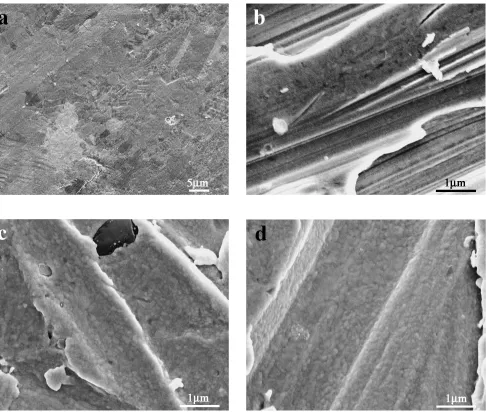
Figure 1(a) and (b) show SEM image of the 510mm-thick Pd-25Ag membrane before and after the mechanical polish-ing, respectively. Some grain boundaries were visible in Fig. 1(a). The grain size ranged from several to tensmm. The grains became invisible after the mechanical polishing. Similar surface morphologies and roughness were achieved, too, for the other cold-rolled Pd-25Ag membranes by the
mechanical polishing. Figure 1(c) and (d) are SEM image of the 510 and 51mm-thick Pd-25Ag membrane, respectively, after the hydrogen permeation experiment. Fine grain boundary-like morphologies were dominant in Fig. 1(c) and (d). The recrystallization had occurred on the membrane surface during the hydrogen permeation experiment.24,25) Figure 2 is SEM image of the 1.2mm-thick Pd-25Ag alloy membrane. There were no pinholes and other visible defects. Figure 3 plots x-ray diffraction (XRD) pattern of the 1.2mm -thick Pd-25Ag alloy membrane and the Ni metal support. The 1.2mm-thick Pd-25Ag alloy membrane was polycrystalline in Pd structure mainly with (1 1 1) orientation. The Ni metal support prepared by electroplating was polycrystalline mainly with (2 0 0) orientation.
Figure 4(a) is top-view SEM image of the Ni-supported 1.2mm-thick Pd-25Ag membrane. There was some residual resist on the Pd-25Ag membrane next to the Ni wall, which was pointed out by white arrows. The negative resist residual is usually difficult to be removed.26)Figure 4(b) shows cross-sectional SEM image of the Ni-supported 1.2mm-thick Pd-25Ag membrane. The Pd-Pd-25Ag membrane had peeled off from the Ni support. Actually, the peel-off had only occurred when we had tried to cut the membrane sample for the cross-sectional observation.
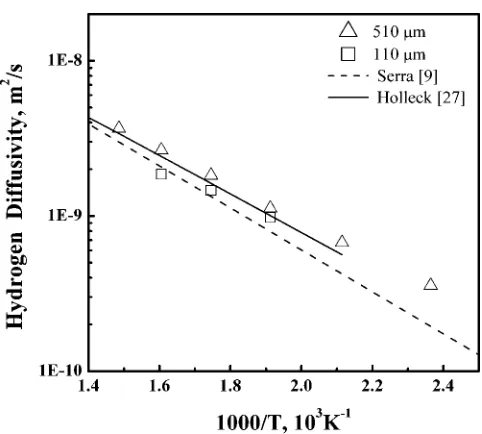
Figure 5 plots the measured hydrogen diffusion coeffi-cients of the 510 and 110mm-thick Pd-25Ag alloy membrane. The hydrogen diffusion coefficients of the 110mm-thick Pd-25Ag membranes were slightly deviated from those of the 510mm-thick one in particular at higher temperatures. It mainly resulted from that the time-lag measurement became more difficult with thinner membrane because the time-lag is proportional toL2 (L, membrane thickness).23)For example,
the measured time-lag of the 510mm-thick Pd-25Ag mem-brane was 16.3 second at 623 K while that of 110mm-thick membrane was only 1.1 second. The measured hydrogen diffusion coefficients were independent of the membrane thickness and within the literature range.9,27)It agreed with that the hydrogen diffusivity of metal is independent of membrane thickness until 300 nm.16,17,29)
Figure 6 is Arrhenius plot of temperature dependency of hydrogen permeability of the prepared Pd-25Ag membranes. The measured hydrogen permeability of the Pd-25Ag membranes with the thickness ranged from 81 to 510mm
fitted well with each other and the literature result,9)whereas
[image:2.595.48.549.85.135.2]the 1.2 and 51mm-thick Pd-25Ag alloy membrane had much lower hydrogen permeability. It demonstrated that the hydrogen permeation through the thin Pd-25Ag membranes exhibited strong dependencies on the membrane thickness. The measured hydrogen permeability of the 1.2 and 51mm -thick Pd-25Ag membrane was lower by about one order and 60%, respectively, than that of the 510mm-thick Pd-25Ag alloy membrane. For example, the hydrogen permeability of
Table 1 Optimal parameters of sputtering.
d. c. Power for Ag target
RF Power for Pd target Rotation speed Work pressure Base pressure Substrate temperature Target/substrate distance
100 W 180 W 10 rpm 0.2 Pa <3105Pa Room 150 mm
Fig. 2 SEM image of the 1.2mm-thick Pd-25Ag membrane.
Fig. 1 (a) SEM image of the 510mm-thick Pd-25Ag alloy membrane after the vacuum annealing. (b) SEM image of the 510mm-thick Pd-25Ag alloy membrane after the mechanical polishing. (c) SEM image of the 510 mm-thick Pd-Pd-25Ag alloy membrane after the hydrogen permeation experiments. (d) SEM image of the 51mm-thick Pd-25Ag alloy membrane after the hydrogen permeation.
[image:3.595.60.546.72.484.2] [image:3.595.307.547.579.757.2] [image:3.595.49.289.587.766.2]the 510, 51 and 1.2mm-thick Pd-25Ag alloy membrane was
1:8108,6:97109and2:29109mol H
2s1Pa0:5,
respectively, at 673 K. At 473 K, they were 1:39108,
5:23109 and4:221010mol H2 s1 Pa0:5 at 473 K,
respectively. Similar phenomenon had been reported by Tosti et al.11) They observed that the hydrogen permeability of
50mm-thick Pd-25Ag membrane was very low at the beginning and increased gradually with the continuing hydrogen permeation. Finally, the hydrogen permeability reached to 50–65% of that of Pd-25Ag metal after the long-term hydrogen permeation.11) They attributed the
phenom-enon to the fact that the 50mm-thick Pd-25Ag alloy membrane had lower hydrogen solubility near the surface.11)
It thus indicated that high hydrogen permeability could be possible if the surface conditions of the cold-rolled Pd-25Ag membrane could be improved. Roshan et al.28) found that mechanical polishing and chemical cleaning could improve the hydrogen permeability of Pd alloy membranes by one order. In this work, all the cold rolled Pd-25Ag alloy membranes had similar surface morphologies and conditions after the mechanical polishing. The hydrogen permeability of the 51mm-thick Pd-25Ag alloy membrane was about 40% of that of the Pd-25Ag bulk metal at the very beginning of the hydrogen permeation. The long-term permeation was not necessary here. Therefore, this work supported the conclu-sions of Tostiet al.although the mechanisms were not clear. One possible reason was that Ag element, which has very poor affinity to hydrogen, had enhanced the formation of microstructure defects including voids and dislocations during the cold roll process. Therefore, the effective hydro-gen solubility was reduced for the hydrohydro-gen permeation.
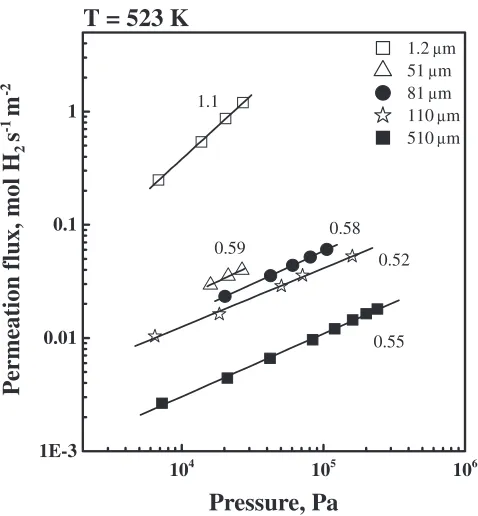
In order to clarify these thickness dependencies, we measured the variation of the hydrogen permeation flux through the prepared Pd-25Ag membranes as the function of pressure at 523 K. The results were plotted in Fig. 7. The hydrogen permeation flux through solids could be described as follows.22)
J¼ ðP
n
uPndÞ
L ; ð3Þ
wherendenotes pressure exponent. If hydrogen permeation is bulk-diffusion limited, the pressure exponent is 0.5. If
Fig. 4 (a) Top view of the Ni-supported 1.2mm-thick Pd-25Ag membrane. (b) Cross sectional image of the Ni-supported 1.2mm-thick Pd-25Ag membrane.
Fig. 5 Measured hydrogen diffusivity of the 110 and 510mm-thick Pd-25Ag alloy membranes.
[image:4.595.48.291.72.443.2] [image:4.595.304.550.73.239.2] [image:4.595.49.290.540.757.2]hydrogen permeation is limited by surface reaction, the pressure exponent is 1. The pressure exponent of the 510 and 110mm-thick Pd-25Ag alloy membrane ranged from 0.52 and 0.55, respectively, suggesting that the hydrogen perme-ation was mainly limited by the hydrogen diffusion in bulk. The pressure exponent of the 1.2mm-thick Pd-25Ag mem-brane was about 1.1 so that the hydrogen permeation was mainly limited by the surface reaction and thereby the measured hydrogen permeability was much lower. The pressure exponents of 81mm-thick Pd-25Ag membrane was 0.58. Since the measured hydrogen permeability of the 81mm-thick Pd-25Ag membrane fitted well with the liter-ature values, the hydrogen permeation is mainly limited by the hydrogen diffusion in bulk. The higher pressure exponent was mainly resulted from that the 81mm-thick Pd-25Ag membrane had slightly deformed upon the hydrogen per-meation because there was not mechanical support and thereby the effective permeation area had increased. Con-sequently, the hydrogen feed pressure was reduced for the hydrogen permeation of the 51mm-thick Pd-25Ag membrane in order to reduce the deformation. Figure 7 shows that the pressure exponent of the 51mm-thick Pd-25Ag membrane was 0.59, which was still higher than 0.5. The surface reactions became significant on determining the hydrogen permeation. We could draw the conclusions that except for the aforementioned lower hydrogen solubility near the membrane surface, slow surface reactions were also respon-sible for the lower hydrogen permeability of the 51mm-thick Pd-25Ag membrane.
Figure 8 plots the hydrogen permeation flux through Pd-25Ag membranes with the thickness less than 3mmfrom this work and the literatures.30–36)The hydrogen permeation flux using the hydrogen feed pressure of 105Pa. The hydrogen permeation flux was normalized by the membrane thickness
for comparisons. The thin Pd-25Ag alloy membranes prepared by the microsystem technology show much higher values than those supported by porous materials.32–35) For
example, the thickness normalized permeation flux of the 1.2mm-thick Pd-25Ag membrane prepared in this work was one order higher than that of the 1.43mm-thick membrane at 673 K in the literature.30)It mainly resulted from that there was less resistance to external mass transfer owing to the absence of the porous support. The microsystem technology exhibited superior advantages for hydrogen-separation mem-brane applications.
Another noteworthy point was that there was no good agreement between the thickness normalized hydrogen permeation fluxes through those microfabricated Pd-25Ag membranes in particular at lower temperature.31,32,35) We
thought the disagreement was mainly due to varied mem-brane microstructure, surface morphology and conditions. For example, the resist residual had been found in our samples. However, there is little information available on the membrane structure and surface conditions from the liter-atures so that it is difficult for further discussion.
4. Conclusions
We investigated the hydrogen permeation of the Pd-25Ag membranes with the thickness ranged from 1.2 to 510mm
using the gas permeation method. The hydrogen permeability of the Pd-25Ag membrane decreased by 60% when the membrane thickness decreased from 510 to 51mm. The lower hydrogen permeability mainly resulted from the slow surface reaction and the lower hydrogen solubility near the surface of the 51mm-thick Pd-25Ag membrane. The hydrogen perme-ation of the microfabricated 1.2mm-thick Pd-25Ag mem-brane was limited by the surface reaction. It had much lower hydrogen permeability than the Pd-25Ag bulk metal. How-ever, the literature review here indicated that the micro-fabricated Pd-25Ag membranes exhibited superior perme-ability to those prepared by conventional methods,
104 105 106
1E-3 0.01 0.1 1
1.2µm 51 µm 81 µm 110 µm 510 µm
P
ermeation f
lux, mol H
2
s
-1
m
-2
Pressure, Pa
0.52 0.58 0.59
1.1
0.55
T = 523 K
Fig. 7 Measured pressure dependence of the hydrogen permeation flux through the prepared Pd-25Ag alloy membranes.
[image:5.595.50.289.72.330.2] [image:5.595.305.545.72.281.2]suggesting that the microsystem technology had attractive advantage for the preparation of thin Pd-25Ag membrane in practical applications.
REFERENCES
1) S. I. Niwa, M. Eswaramoorthy, J. Nari, A. Raj, N. Itoh, H. Shoji, T. Namba and F. Mizukami: Science295(2002) 105–107.
2) S. Melada, F. Pinna, G. Strukul, S. Perathoner and G. Centi: Journal of Catalysis235(2005) 241–248.
3) S. N. Paglieri and J. D. Way: Separation and Purification Methods31
(2002) 1–169.
4) K. Ishikawa, T. Takano, T. Matsuda and K. Aoki: Applied Physics Letters87(2005) 081906.
5) Y. Zhang, T. Ozaki, M. Komaki and C. Nishimura: Materials Science Forum426(2003) 3365–3370.
6) Y. Zhang, T. Ozaki, M. Komaki and C. Nishimura: Scrita Materialia
47(2002) 601–606.
7) Y. Shimpo, S. Yamaura, H. Okouchi, M. Nishida, O. Kajita, H. Kimura and A. Inoue: J. Alloys and Compounds372(2004) 197–200. 8) S. Hara, N. Hatakeyama, N. Itoh, H.-M. Kimura and A. Inoue:
J. Membrane Sci.211(2003) 149–156.
9) E. Serra, M. Kemali, A. Perujo and D. K. Ross: Metall. Mater. Trans. A
29(1998) 1023–1028.
10) H. Amandusson, L.-G. Ekedahl and H. Dannetun: J. Membrane Sci.
193(2001) 35–47.
11) S. Tosti, L. Bettinali and V. Violante: Inter. J. Hydrogen Energy25
(2000) 319–325.
12) I. B. Elkina and J. H. Meldon: Desalination147(2002) 445–448. 13) H. Barlag, L. Opara, H. Zu¨chner: J. Alloys and Compounds330–332
(2002) 434–437.
14) K. Yamakawa, M. Ege, B. Ludescher, M. Hirscher and H. Kronmu¨ller: J. Alloys and Compounds321(2001) 17–23.
15) S. Tosti: Inter. J. Hydrogen. Energy28(2003) 1445–1454.
16) R. C. Hurlbert and J. O. Konecny: The Journal of Chemical Physics
34(1961) 655–658.
17) T. L. Ward and T. Dao: J. Membrane Sci.153(1999) 211–231. 18) Y. Zhang, J. Gwak, Y. Murakoshi, T. Ikehara, R. Maeda and
C. Nishimura: J. Membrane Sci.277(2006) 203–209.
19) W. M. Robertson: Zeitschrift fur Metallkunde64(1973) 436–443. 20) M. Amano, M. Komaki and C. Nishimura: J. Less-Common Met.172
(1991) 727–731.
21) R. G. Musket: J. Less-Common Metals45(1976) 173–183. 22) A. D. Le Claire: Diffusion and Defect Data33(1983) 1.
23) R. M. Barrer and E. K. Rideal: Permeation, Trans. Faraday Soc.35
(1939) 628–644.
24) J. Shu, B. E. W. Bondondo, B. P. A. Grandjean and S. Kaliguine: J. Mater. Sci. Lett.16(1997) 294–297.
25) Y. Zhang, M. Komaki and C. Nishimura: J. Membrane Sci.246(2005) 173–180.
26) J. M. Shaw, J. D. Gelorme, N. C. Labianca, W. E. Conley and S. J. Homles: IBM J. Res. Develop.41(1997) 81–94.
27) G. L. Holleck: The Journal of Physical Chemistry74(1970) 503–511. 28) N. R. Roshan, A. P. Mishchenko, V. P. Polyyakova, N. I. Parefenova, E. M. Savitsky, E. A. Voitekhova, V. M. Grayznov and M. E. Sarylova: J. Less-Common Metals89(1983) 423–428.
29) M. D. Vece, A. Remhof and J. J. Kelly: Electrochemistry Communi-cations6(2004) 17–21.
30) J. N. Keuler and L. Lorenzen: J. Membrane Sci.195(2002) 203–213. 31) H. D. Tong, F. C. Gielens, J. G. E Gardeniers, H. V. Jansen, J. W. Berenschot, M. J. De Boer, C. J. M. Van Rijn and M. C. Elwenspoek: J. Microelectromechanical Sys.14(2005) 113–124.
32) F. C. Gielens, H. D. Tong, C. J. M. Van Rijn, M. A. G. Vortsman and J. T. F. Keurentjes: J. Membrane Sci.243(2004) 203–213.
33) B. McCool, G. Xomeritakis and Y. S. Lin: J. Membrane Sci.161(1999) 67–76.
34) V. Jayaraman and Y. S. Lin: J. Membrane Sci.104(1995) 251–262. 35) B. A. Wilhite, M. A. Schmidt and K. F. Jensen: Ind. Eng. Chem. Res.
43(2004) 7083–7091.
36) A. L. Athayde, R. W. Baker and P. Nguyen: J. Membrane Sci.94