A U T O M A T I C A L L Y G E N E R A T I N G N A T U R A L L A N G U A G E R E P O R T S I N A N O F F I C E E N V I R O N M E N T
J u g a l K a l i t a a n d S u n i l S h e n d e
D e p a r t m e n t of C o m p u t e r a n d I n f o r m a t i o n Sciences U n i v e r s i t y of P e n n s y l v a n i a , P h i l a d e l p h i a , PA 19104
A B S T R A C T
In this paper, we describe a system which models a set of concurrent processes that are encountered in a typical office environment, using a body of explic- itly sequenced production rules. The system employs an interval-based temporal network for storing histor- ical information. A text planning module traverses this network to search for events which need to be mentioned in a coherent report describing the current status of the system. In addition, the planner also combines similar information for succinct presentation whenever applicable. Finally, we elaborate on how we adapt an available generation module to produce well- structured textual report for our chosen domain.
1. I N T R O D U C T I O N
This paper describes the implementation of a text gen- erating system which produces n a t u r a l language re- ports on the status of a system of inter-related pro- cesses at various stages of progress. The motivations behind this project were to model a system of concur- rent processes and to successfully generate well-formed text about their temporal behavior. We view a process as an ordered sequence of events over time where an event refers to an atomic action by one of the partic- ipating agents. In many AI applications, monitoring the state of a system of processes is deemed essential. T h e ability of a system in such an environment to de- scribe its actions in n a t u r a l language will be certainly very useful.
As our sample domain, we chose a scenario where the system is used to assist the secretary for an aca- demic journal by keeping track of a paper submitted for publication. The process being modeled is that of paper-submission with the usual participating agents being the author of the paper, the journal editor, the reviewers assigned to evaluate the paper and the jour- nal secretary.
In the rest of the paper we present methods to rep- resent the knowledge of the chosen domain, to model historical knowledge base of events and processes, to appropriately order the contents of the historical in- formation store for presentation based on temporal re- lationships and other relevant factors, and to produce coherent English text describing the events in the do- main. T h e system as described herein has been fully implemented, and currently avenues for further im- provement are actively being pursued.
Section 2 of this paper gives a brief description of the domain being modeled along with an overview of the system components. Section 3 describes the rep- resentation of the processes in terms of a network of rules. Section 4 elaborates the n a t u r e of the historical information store. Section 5 deals with text planning which is crucial for selecting information to be pre- sented in a coherent manner. Section 6 details the actual process of text generation. Finally, we con- clude with a discussion about enhancements to the existing system which can contribute towards a more general implementation with the added power of ex- pected future inference and and the ability to reason about viewpoints of agents external to the system. Further details about the system's design and imple- mentation, and other relevant discussions can be found in [Kalita 86].
2. O V E R V I E W O F T H E S Y S T E M
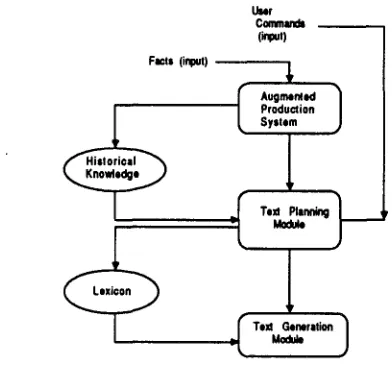
T h e system consists of three main modules as shown in figure 1. They are
• an augmented production system for domain knowledge representation,
• a text planner module (strategic component), • a text generation module (tactical component).
~ e r Commands
(inpot)
F~ts (injxJt)
System
F i g u r e 1: O v e r v i e w of t h e s y s t e m
[image:2.612.82.278.82.266.2]ture for rule sequencing; this representation is due to [Zisman 78]. The execution of these rules builds a his- tory network of events and processes. This network is modeled loosely on the notion of intervals proposed in [Allen 83,Allen 84].
The creation of a report in n a t u r a l language entails t h a t the actual description be easy to understand. The report must omit inessential information, be cogent, and give the user a sense of temporal structure. To- wards this end, planning at the representational level is required of the system. Processes can be looked at as being composed of sub-processes; clearly the de- scription of the history must be able to account for this compositional structure.
The text generator used in this project is MUMBLE [McDonald 83], [McDonald 85], which is a collection of morphology and grammar modules driven by user cre- ated objects cMled realization specifications containing information about the high-level specifics of the text.
3. R E P R E S E N T A T I O N O F D O M A I N K N O W L E D G E
The domain described above has been modeled us- ing a production system whose rules are sequenced by imposing a Petri net structure on them. The decision to employ a production system has been influenced by the event-driven nature of the processes in the domain allowing declarative encoding of relevant knowledge.
In the domain under consideration, there are sev- eral concurrent, independent processes. All activities in the domain can be viewed as constituting a single process - - the overall process of journal editing. The overall process comprises a collection of time-ordered
atomic actions a n d / o r subprocesses. In addition to several atomic actions, the j o u r n a l editing process con- taJns three subprocesses: referee review processes - - one for each referee designated by the editor. In turn, each referee review process contains a number of atomic actions. Communication and coordination is required among these processes. Additionally, com- munication is also necessary among the atomic actions constituting these processes for achieving proper tem- poral ordering.
In our implementation, the system of actions and processes is represented as a set of production rules. Since in a pure production system, it is difficult to achieve substantial interrule communication, a more acceptable control structure can be devised where the current state of the system in conjunction with the history of prior rule execution determines what needs to be done next. Such a control structure, first pro- posed in the context of an augmented Petri net model in [Zisman 78], has been adopted in our system. In our implementation, a state in the Petri net represents a state of the journal secretary (since our representation is from the viewpoint of the secretary). A transition between two states denotes an interaction between an external agent (such as the author, the editor or one of the referees) and the secretary. Each interaction is represented by a production rule which resides on a transition in the augmented Petri net.
The Petri net structure of the rules is implemented by m a i n t a i n i n g a list of active rules as suggested in [Zisman 78]. States in the Petri net structure are not explicitly represented in the implementation. The set of active rules (in other words, the set of enabled tran- sitions) at a given point in time determines the current state of the system. When a transition is enabled, its firing is determined by the rule residing at the transi- tion. All rules at all enabled transitions constitute the active rule set. In summary, the production system models individual actions, whereas the execution of the Petri net models the dynamic relationships among the various processes.
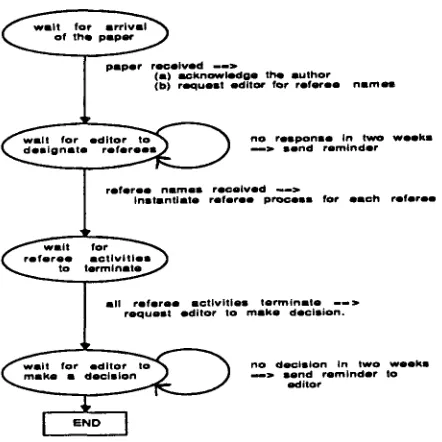
In the augmented Petri net representation of our do- main, the system (representing the editor's secretary) can exist in several states such as,
• waiting for the paper to arrive;
• waiting for the editor to designate referees; • waiting for a referee to respond;
• waiting for a referee to submit his report; • waiting for the editor to make a a decision.
I E N D I
no response in two weeks .m>
send letter to ~ send reminder
referee requesting / I
s e r v i c e s ~
f wait for ~ A alternate f w s!t for ~
referee to J - name r e c o i v e d ~ o o l l o r . /
referee returns card, can't review M > request editor for alternate
roferee name
referee returns c4ud, c4tn review mi• weir one month for report
no report in one month .~=D send reminder
] report received . - > s e ~ l thank you letter
eferee
F i g u r e 2: P e t r i n e t c o r r e s p o n d i n g to t h e j o u r n a l e d i t i n g process
F i g u r e 3: P e t r i n e t c o r r e s p o n d i n g to a referee re- view process
one corresponding to the overall journal editing pro- cess and the other corresponding to a generic referee review process. Some of the rules in the production system are shown in figure 4.
4. T H E N E T W O R K O F I N T E R V A L S : H I S - T O R I C A L K N O W L E D G E
T h e production system described in the previous sec- tion models the domain knowledge. In order to gen- erate a report about a particular paper, the produc- tion system must build an historical record of event instances as they take place over time. The represen- tation must adequately capture temporal relationships among events, and also minimize the amount of com- putation necessary in order to achieve reasonable levels of efficiency.
Most generally accepted approaches to modeling time such as the state space approach [Fikes 71] and situation calculus [McCarthy 69] are inadequate for the representation of concurrency, and are based on the notion of time points with accompanying seman- tic difficulties. [Allen 83,Allen 84] propose a model of time based on intervals. The model allows for repre- senting the relationships between temporal intervals in a hierarchical m a n n e r using a constraint propagation technique. It also facilitates structuring knowledge in a way convenient for typical reasoning tasks, and also is intuitively more appealing due to the observation that notwithstanding the instantaneous appearance of
• R u l e - l : If a paper is received,
• acknowledge the author of its receipt, and • request the editor to designate names of referees. • R u l e - 5 : If the author withdraws the paper, instanti-
ate termination procedure.
• R u l e - 6 : If the editor does not respond within two weeks, send him a reminder letter.
F i g u r e 4: E x a m p l e s of p r o d u c t i o n rules
many real-world events, they can be decomposed re- cursively for closer examination, if desired.
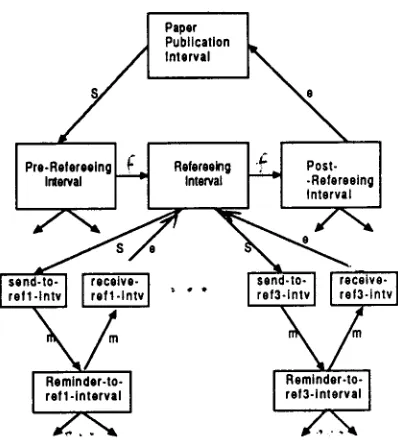
[image:3.612.342.559.65.283.2] [image:3.612.87.308.66.287.2]An interval (or reference interval) is said to be in- stantiated if it becomes part of the history network. In particular, every instantiated interval has slots which contain its starting event, its ending event and a link to its predecessor interval in the history network. In addition to the starting and ending events, an interval may also contain side events that neither start nor end the interval but which occur in the domain process as a m a t t e r of course between the starting and ending events and do not have any further consequences.
An interval is, designated open f l i t has been started by some event but which is yet to be completed by a n -
other event. A completed interval is called a closed interval. Since the representation is from the jour- nal secretary's point of view, it can be seen that in- teractions are almost always initiated by agents other than the secretary but are terminated by some action taken by the secretary. Thus, in our representation, an instantiated open interval has as its starting event, an action performed by the secretary, whereas input from the external agents determines the ending event of some hitherto open interval.
In effect, the relationships among intervals are maintained in the network where nodes represent in- dividual intervals, and each a r t ' s label indicates the possible relationships between the two intervals repre- sented by its end nodes. Since the network built by our production system is historic in nature, there is no temporal uncertainty, and therefore, each arc has only one label which indicates strict temporal precedence among the intervals.
Although our system is basically input-driven at the user-system interface, there are many situations where the script of the domain process demands some tem- poral deadlines or monitors. For instance, in the event that the editor fails to respond (by way of input) to the request for names of reviewers, the system has to generate, perforce, another request as a reminder. To enable the system to faithfully retrieve such timeout activity from the network, we employ d e m o n s to ex- plicitly monitor open intervals pending response. On timeout, the system simply creates another open in- terval with the same starting event as the previous one timed out by its associated demon.
It is often the case t h a t processes (sub-processes) are generic in nature; i.e. they can be repeatedly instan-
tiated for different agents. For example, our domain
calls for a certain sequence of interactions between the secretary and a referee. This sequence defines a generic process and our system needs to keep track of three such processes, one for each referee assigned to review a paper. The second type of interval in our system, the reference interval which corresponds to processes and sub-processes, help the text planner combine multiple
Paper Publication Interval
Interval - .Refereeing Interval
I
refl-intervalI
ref3-1ntervalF i g u r e 5: T h e n e t w o r k c o n f i g u r a t i o n ( p a r t i a l )
instances of events into succinct specifications without having to repeat descriptions for each individual in- stance. It is also desirable in an application like ours to annotate the text describing a process with sum-
m a r i e s or paraphrases of key sub-processes t h a t occur
naturally in the domain. Since it is clear that an open reference interval captures our intuitions about an on-
going process, the planner can generate appropriate
temporal cues from the interval representation to de- termine text parameters like tense and aspect for a papraphrase.
An instance of the network configuration built up by the production system is shown in figure 5. However, not all details are shown in the figure.
5. T E X T P L A N N I N G
Our computational goal, as stated earlier, was to de- scribe or report on a set of processes in a compact manner, without disturbing the temporal nature of the process description. The text planning module thus needs to ensure that the text plan is ordered in time and that multiple event instances in processes be encapsulated, if possible, into concise descriptions.
[image:4.612.350.549.77.297.2]some points, to combine information which is common to more t h a n one interaction sequence (sub-process) without ruining the n a t u r e of the then current plan. Our representation of reference intervals associated with ordinary intervals gives the extra information necessary to guide the planner in such cases.
Briefly, the planner goes through three phases: it determines the content of the overall plan by way of a controlled search over the network of intervals and then produces a sequence of specifications for the ac- tual text generator in the order in which they are to be realized into text along with information regarding discourse focus. Since our intention is to provide as in- formed a description (report) of the system's activity as possible, we have chosen to restrict the content of a report to the interactions occurring from the time the previous request was issued to the time of the current request. In this respect, the interval d a t a structure provides us with some useful information pertaining to what happened just before the previous report was requested and what is ezpected to occur just after the current one. This information is contained in the open intervals at the time of the previous request, and at the present moment respectively. The current version of the system does not utilize the expectation informa- tion contained in the intervals - the report could be extended appropriately to reflect it in future. In fact, the same information could be used to detect and re- port the occurrence of unexpected events occurring in the system.
The first phase, then, combines a search over the required part of the interval network starting from the intervals that are currently open with an order- ing over the events which occurred in the intervals in the search space. Since reports can be generated at any pont in time during the life of a paper, and one can ask for repeated reports at later times, only events that have not been reported in an earlier report need to be included in it. However, to ensure that the current report establishes a relationship with the im- mediately preceding report, one or more events that have been reported earlier may be included. This will be clear from the example presented later. The order- ing ra~aks events tagged with their associated intervals (called "situations") temporally, while simultaneously ensuring that similar events corresponding to different instances of the same generic process axe clubbed to- gether. It should be noted that during this phase when similar events with one or more different participants are combined together for the purposes of generation, the system's decision need not be totally based on tem- poral sequentiality. Combinations may be performed for similar events although they occurred widely sep- arated on a linear time scale. For example, suppose a referee sends his review quite early (say, at a time tl), whereas a second referee does so with considerable a m o u n t of delay (at a time t2), and several other things
happen during the interval (tl,t2). While reporting, the system will combine the two reviewing events into a single sentence such as The two referees A and B sent their ret6ews by date tl, and report the events that took place in the interval (tl, t2) either before this sentence or after it depending on other considerations. T h e second phase processes this stream of ranked situations to create the appropriate specifications for the text generator. This includes information about the sentence content (derived directly from the event in the situation) along with various features of the sentence like tense and indications to conjoin noun phrases etc. For the present, our tense assignment is rather naive and only relies on the network to pro- vide temporal indicators based on the relationship of the time at which an event occurred in the con- text of the overall time interval covered by the plan. T h u s we only assign present, present perfect, past and past perfect tenses to sentences. A more sophis- ticated tense assignment, perhaps along the lines of [Matthiesen 84], would be necessary for future exten- sions of this project.
the PFL, the old focus is pushed onto the stack. When conversation returns to an item previously discussed, the stack is popped to yield that item. The focus rules used are as follows (in order): shift focus to a member of previous PFL, i.e. CF(new sentence) E PFL(last sentence), maintain the same focus, i.e., CF(new sen- tence) --- CF(last sentence), and return to a previous focus, i.e., CF(new sentence) E FS.
In summary, the text planner traverses, orders and translates the intervals desired to be reported into a stream of specifications which can be realized directly by the text generator.
6. T H E T A C T I C A L C O M P O N E N T
The tactical component used by the system to generate actual text is MUMBLE [McDonald 83,McDonald 85]. T h e decision to employ MUMBLE was primar- ily influenced by its success in generating a large variety of grammatical constructs in sev- eral text generation applications as reported in [Kaxlin 85],[McDonald 83],[McDonald 85],[Rubinoff 86], the flexibility in the design of its input as well a~ its ready availability. Its design is based on the as- sumption that division between planning the content of speech and its verbalization is unambiguously de- fined. This partitioning of the generative decisions into levels marks one aspect of difference between MUMBLE and Appelt's generation system [Appelt 83] which emphasizes the homogeneity of various deci- sional procedures. 2
The input to MUMBLE consists of realization spec- ifications (r-specs) representing the system's commu- nicative goal, and produced by the planner (or the strategic component). Given the input r-spec, MUM- BLE assigns (or, attaches) it to an appropriate posi- tion in an incipient surface structure tree. A depth- first traversal of the tree accompanied by recursive phrasal realization of unprocessed embedded elements results in the production of well-defined English text. It must be stressed at this point that the tacti- cal component plays a strong supporting role to the strategic component in the pursuit of coherence in the generated text. One method for enhancing coherence is by appropriate lexical substitution for referring ex- pressions allowing previously generated sentences to exert influence on the realization of the current sen- tence. The system keeps track of the objects which have been referred to so far and how this reference has 2It is relevant to note at this point that Hovy, in his proposed approach to generation [Hovy 85], assumes a well- defined boundary between planning and actual generation, but allows the generational component to seek advice from the planner at limited decision points.
been made. This along with focus information enables the system to refer to objects by incomplete descrip- tions and to introduce pronominalization. This avoids unnecessary repetition leading to succinctness in the text. More importantly, it enables the hearer to distin- guish new information from old so that comprehension is not hampered. Otherwise, it may lead to misunder- standing on the part of the hearer; examples of this phenomenon can be seen in [Granville 84].
Incomplete description of referring noun phrases in our system include usage of phrases such as "the au- thor" or "the paper" in subsequent references instead of the complete phrases "the author D.D. McDon- ald" or "the paper entitled 'Generation Using MUM- BLE'" which are used for introduction. Additionally, when a person introduced earlier by name is referred to subsequently at a point where pronominalization is deemed inappropriate, the person is referred to by his/her name. Similarly a group of people may be introduced by a phrase such as "the three referees, viz., B.L. Webber, A.K. Joshi and T. Finin". Subse- quently, the first time one of these persons is referred to alone, we refer to h i m / h e r by name. If the same per- son is referred to again, only then pronominalization is resorted to provided it does not lead to ambiguity. Incomplete description also enables us to use phrases such as "on the same day", "yesterday", and "today" instead of always producing the complete phrase such as "on January 18, 1986" at all times. Also note that, the first time the system specifies a date, it specifies the year. However, in subsequent specifications, the year is not mentioned unless it is different from that of the immediately preceding date mentioned.
Adapting MUMBLE to our system required sub- stantial additional extensions for handling of cardinal numbers, proper names, various tenses, etc. A number of new structures had to be added to support the de- sired features in the final text. Some of these are sim- ple, others complex. Some are general while others are domain specific. At this point, we feel that it is per- tinent to corroborate the observations in [Karlin 85] that it is difficult to create new structures that cap- ture language generalizations due to the total absence of constraints on their nature.
I received the paper entitled "Generation Using M U M B L E " from the author D.M. McDonald on January 1, 1986. He was informed of the receipt of the paper on the same day. I requested the names of three referees f o r the paper from the editor A.K. Joshi on the same day. He sent the names, viz., T. Finin, N. Badler and B. Webber a week later. I have sent a post. card inquiring availability to review the paper to each of them today.
Assuming we continue the simulation performed to the end and ask the system to produce a r e p o r t again, the system generates the following text.
I had sent a postcard inquiring availabil- ity to review the paper entitled "Genera- tion Using M U M B L E " to each of the re]- crees, T. Finin, N. Badler, and B. Web- ber on January 15, 1986. Each sent a letter expressing ability to review the pa- per to me by January 30. I sent a copy of the paper to each of them. Each sent a review of the paper to me by February 15. I requested the editor to make a deci- sion regarding publication of the paper on the same day. He sent a positive decision regarding publication of the paper to me yesterday. I informed the author of the decision yesterday.
7. C O N C L U S I O N S
Our goal here was to generate a natural language text report on a set of concurrent processes. A full- fledged activity r e p o r t should comprise three distinct segments. The preamble of the r e p o r t should contain a succinct description of events which had occurred prior to the point in time when the last report was gener- ated (in cases where multiple reports are requested). This should be followed by the main b o d y of the re- port stating the events which have occurred between the time of the last r e p o r t and the current time. Fi- nally, there should be a brief mention of events which are expected to occur in the i m m e d i a t e future.
Although a t t e m p t s have been made in the current project to provide information about the past, the approach taken is simplistic. Improving this section of the report will involve reasoning about saliency of events in order to select events from past history for reporting. In addition, investigation regarding the for- mulation of the actual t e x t for summarization must also be carried out.
We believe t h a t representation of s t a t u s should al- low the system, in principle, to draw inferences about expected future events. Our implementation does not address the issue of expectation, b u t can be a starting point toward the goal of including inferred knowledge a b o u t the i m m e d i a t e future with the description of the s y s t e m ' s history.
A n o t h e r direction in which we intend to pursue fur- ther research is regarding presentation of unexpected events. This will necessitate incorporation of the abil- ity to make inferences about what is expected and w h a t is not. Additionally, a p p r o p r i a t e text to report such events has to generated.
Currently, in our system, no explicit textual links are established between the contents of a sentence and t h a t of its predecessor(s). This seems satisfactory due to the general characteristics of narrative text where temporal succession as well as simultaneity is indicated implicitly by simple sequencing of sentences. How- ever, further improvement in the naturalness of the text can be achieved by inclusion of a p p r o p r i a t e clue words which function as explicit inter-sentential links. T h e P R O T E U S sentence planner in [Ritchie 84] may be able to provide helpful insights in this a t t e m p t . Furthermore, the quality of text produced can be im- proved substantially by incorporating a selection of commonly used temporal expressions in English. A rich compendium of such expressions is available in [Smith 78].
Finally, we want to investigate the issues involved in generating reports from the points of view of var- ious participants. This will involve selecting events relevant to the person for whom the report is being prepared, and generating text in a p p r o p r i a t e English. Choice of events will be dictated by various factors such as direct or indirect involvement of the repor- tee, his/her goals and responsibilities, and limitations regarding w h a t h e / s h e is allowed to know. Appro- priate textual generation, i.e., choices of voice, sen- tence and clause structures, subjects and objects for the sentences as well as those of words will be gov- erned by the nature of the listener's involvement with the events being described among other factors to be investigated. This will involve making a distinction between real events as stored in the historic knowl- edge base and virtual events characterizing how real events are reported from various perspectives.
A C K N O W L E D G E M E N T S
84-10413 during the course of his work on this project.
We would llke to thank Dr. Bonnie Webber for her
painstaking reviewing of several drafts of the techni-
cal report on which this paper is based. We also thank
Robin Karlin and Michael Niv for going through ear-
lier drafts of this paper and making useful comments.
References
[Appelt 83] Appelt, D.E., Planning Natural Language
Utterances,
Proceedings of the Eighth Interna.
tional Joint Conference on Artificial Intelligence,
1983, pp. 59-62.
[Allen 83] Allen, J.E., Maintaining Knowledge about
Temporal Intervals,
Communications of ACM,
Volume 26, November 1983, pp. 832-843.
[Alien 84] Allen, J.E., Towards a General Theory of
Action and Time,
Artificial Intelligence,
Volume
23, 1984, pp. 123-154.
[Fikes 71] Fikes, R.E., and Nilsson, N.J., STRIPS: A
New Approach to the Application of Theorem
Proving to Problem Solving,
Artificial Intelli-
gence,
Volume 2, 1971, pp. 189-205.
[Granville 84] Granville, R., Controlling Lexical Sub-
stitution in Text Generation,
Proceedings of the
Annual Conference on Computational Linguis-
tics,
1984, pp. 381-384.
[Hovy 85] Hovy, E.H., Integrating Text Planning and
production in Generation,
Proceeding of the
Ninth International Joint Conference in Artifi-
cial Intelligence,
Volume 2, 1985, pp. 848-851.
[Karlin 85] Karlin, R.F.,
ROMPER Mumbles,
Techni-
cal Report MS-CIS-85-41, Department of Com-
puter and Information Sciences, University of
Pennsylvania, Philadelphia, 1985.
[Kalita 86] Kalita, J.K., and S. Shende,
Generation of
Natural Language Text Describing a System of
Asynchronous, Concurrent Processes,
Technical
Report MS-CIS-86-66, Department of Computer
and Information Science, University of Pennsyl-
vania, Philadelphia, PA, 1986.
[Matthiesen 84] Matthiesen,
C., Choosing Tense in
English ,
ISI Research Report ISI/RR-84-143,
University of Southern California, November,
1984.
[McCarthy 69] McCarthy, J., and Hayes, P.J., Some
Philosophical Problems from the Standpoint of
Artificial Intelligence,
Machine Intelligence,
Vol-
ume 4, Edinburgh University Press, 1969.
[McDonald 83] McDonald, D.D., Description Di-
rected Control: Its Implications for Natural Lan-
guage Generation,
Computer and Mathematics
with Applications,
Volume 9, No. 1, 1983, pp.
111-129.
[McDonald 85] McDonald D.D., and Pustejovsky,
J.D., Description Directed Natural Language
Generation,
Proceedings of Ninth International
Joint Conference on Artificial Intelligence,
Vol-
ume 2, 1985, pp. 799-805.
[McKeown 85] McKeown,
K., Text Generation: Us-
ing Discourse Strategies and Focus Constraints
to Generate Natural Language Text,
Cambridge
University Press, 1985.
[Ritchie 84] Ritchie, G., A Rational Reconstruction of
the PROTEUS Sentence Planner,
Proceedings of
the Annual Conference on Computational Lin-
guistics,
1984, pp.327-329.
[Rubinoff 86] Rubinoff, R., Adapting Mumble: Expe-
rience with Natural Language Generation, Pro-
ceedings of AAAI, 1986.
[Sidner 83] Sidner, C., Focusing in the Comprehen-
sion of Definite Anaphora, in
Computational
Models of Discourse,
ed. Brady, M., MIT Press,
1983, pp. 209-265.
[Smith 78] Smith, C.S., The Syntax and Interpreta-
tion of Temporal Expressions in English,
Lin-
guistics and Philosophy,
Volume 2, No. 1, 1978,
pp. 43-100.
[Zisman 78] Zisman, M.D., Use of Production Sys-
tems for Modeling Asynchronous, Concurrent
Processes, in
Pattern-Directed Inference Sys-