Phase Relations and Distribution of Some Minor Elements
in Cu-Fe-Sb System Saturated with Carbon at 1473 K
Leandro Voisin, Hector M. Henao and Kimio Itagaki
Institute of Multidisciplinary Research for Advanced Materials, Tohoku University, Sendai 980-8577, Japan
As a fundamental study to develop a new process for eliminating detrimental elements and for recovering valuable ones from secondary Cu-Fe base alloys with a considerably high content of antimony, both the phase relations in a miscibility gap of the Cu-Fe-Sb system saturated with carbon and the distribution of some minor elements such as silver, platinum, cobalt, nickel and sulfur between two phases in the miscibility gap were investigated at 1473 K by a quenching method. The phase separation into copper-rich and iron-rich phases occurred when the Cu-Fe-Sb system was saturated with carbon. The antimony content in the copper-rich phase was very large compared with that in the iron-rich phase, and carbon was mostly distributed in the iron-rich phase. Cobalt and nickel were distributed preferentially in the iron-rich phase and platinum and sulfur were distributed almost evenly in both phases, while silver mostly in the copper-rich phase. The experimental results for the phase separation and the distribution of the minor elements were discussed on the basis of activity coefficients in the copper-rich and iron-rich phases and were compared with the results for the Cu-Fe-As system saturated with carbon. By utilizing this phase separation, recovery of valuable silver and copper into the copper-rich phase and elimination of less valuable iron into the iron-rich phase are feasible for treating the secondary Cu-Fe-Sb base alloys.
(Received October 20, 2004; Accepted November 30, 2004)
Keywords: phase relations, miscibility gap, distribution ratio, copper-iron-antimony, secondary alloy, speiss, minor element, by-product treatment
1. Introduction
In recent years, the content of antimony in the sulfide concentrates of non-ferrous metals tends to rise. This results in the formation of matte, slag and flue dust or dross with a considerably high content of antimony in the nonferrous smelting processes. The recovery of valuable metals from the speiss of antimony generated in copper smelting of sulphide ores containing bituminous coal1,2)has offered a challenging
subject. The speiss may be also made when these intermedi-ate products are treintermedi-ated in a strongly reducing condition where the metallic iron is formed. Therefore, the behaviour of antimony and valuable metals in the speiss is of importance for treating the sulfide concentrates and by-products with the high content of antimony.
The Cu-Fe-Sb ternary system is a base for the speiss phase related to the production of copper and the treatment of by-products. The Cu-Fe system saturated with carbon3)exhibits a miscibility gap at considerably low temperatures below 1500 K, which will be useful for developing a new recovery process to treat the Cu-Fe-Sb base speiss, in which the less valuable iron is to be removed into the iron-rich phase, while the valuable copper and other metals are enriched in the copper-rich phase.
Information on the phase relations and the distribution of minor elements in the miscibility gap of the Cu-Fe-Sb system saturated with carbon is of very importance for the process development in which two clearly separated immiscible liquid phases coexist. Nevertheless, no data have been reported on this system though the Cu-Fe-Sb ternary system4)
and the Cu-Fe-Sb-S quaternary system5)were studied by one of the authors. Hence, following the study of the Cu-Fe-As system saturated with carbon,6) the phase relations and the distribution of some minor elements such as silver, platinum, cobalt, nickel and sulfur in the region of miscibility gap of the Cu-Fe-Sb system saturated with carbon were investigated at
1473 K by a quenching method. As a part of this quaternary system, the Fe-Sb-C ternary system was also investigated.
2. Experimental Method and Procedure
The quenching method combined with the metallographic observation and chemical analyses using combustion-infra-red spectrometry for carbon, electron probe micro analysis (EPMA) and inductively coupled plasma spectrometry (ICP) was used to determine the phase relations and the distribution of the minor elements.
2.1 Phase relations in Fe-Sb-C ternary system
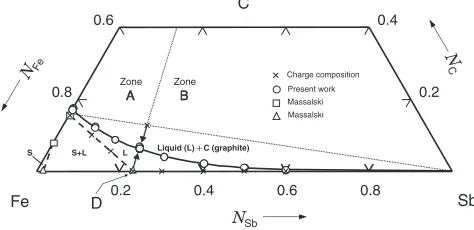
The phase relations in the Fe-Sb-C system were deter-mined at 1473 K. The system, as shown in Fig. 1, was divided into two experimental zones or pseudo ternary systems; the zone A or Fe-C-D and the zone B or D-C-Sb pseudo ternary systems, where D corresponds to the saturation point of iron with a mole fraction of antimony, NSb¼0:23.7) For the
experimental zone A, the samples were prepared with pig iron and Sb with the compositions close to the liquidus line, which was anticipated from the constituted binary
dia-0.2 0.4 0.6 0.8
0.2 0.4 0.6
0.8
NSb
Sb Fe
C
NFe
N
C
D
Present work Charge composition
L
S S+L Liquid (L) C (graphite)
Zone
A
Zone
B Massalski
Massalski
Fig. 1 Phase relations in the Fe-Sb-C ternary system at 1473 K.
[image:1.595.307.544.652.767.2]grams.7,8) For the experimental zone B, the samples were prepared with Fe and Sb. In both zones, 5 g of sample together with a graphite rod was charged in a MgO crucible and then vacuum sealed in a quartz ampoule. The ternary alloy sample was heated and kept at 1473 K for 43.2 ks and then quenched into water. It was confirmed in a preliminary experiment that the equilibration between the coexisting phases was attained within 43.2 ks.
2.2 Phase relations in miscibility gap of Cu-Fe-Sb-C system
5 g of sample was prepared by proportionally mixing the pure elements (99.99% purity) of Cu, Fe and Sb according to the required charge composition in the Cu-Fe-Sb system saturated with carbon. The mass ratios of Cu to Fe ([mass% Cu]/[mass% Fe]) in the total charge,MCu=MFe, were fixed at
1/3, 1/1 and 3/1. The sample together with a graphite rod was charged in a MgO crucible, and then vacuum sealed in a quartz ampoule of 0.09 m length and 0.026 m ID. The ampoule was heated and kept at 1473 K for 43.2 ks to establish the equilibrium between the two phases in the miscibility gap, and then it was quenched into water. The solidified sample was examined by the metallographic analysis and EPMA to confirm the presence of two clearly separated immiscible phases. Once this was confirmed, the two phases were separated with a cutting blade and representative samples were taken for each phase and later on analyzed for their components.
2.3 Distribution of minor elements in miscibility gap of Cu-Fe-Sb-C system
Three different sets of experiments were conducted to analyze the distribution of minor elements between two liquid phases in equilibrium at the miscibility gap of Cu-Fe-Sb-C system at 1473 K. The first set is concerned with cobalt and nickel, the second one with silver and platinum, while the
last one with sulfur as the minor elements. The mass% ratio of the total charge,MFe=MCu, was kept at 1/1, and the content
of antimony was varied from 0 to 10 mass%, while the weight composition was 1 mass% for each minor element. The experimental procedure was identical to that previously described.
3. Results
3.1 Phase relations in Fe-Sb-C ternary system
The liquidus line saturated with carbon at 1473 K is shown in Fig. 1. It represents a smooth concave against the iron content, and the solubility of carbon in the melt sharply decreases with increasing antimony content. The obtained liquidus composition saturated with carbon in the Fe-C binary system agrees well with the reported value.8) The solubility of carbon8)and antimony7)in the liquid iron and
solid-iron phases was also plotted with and in Fig. 1. The estimated liquidus and solidus lines in the iron-rich corner of the Fe-Sb-C system are also illustrated in Fig. 1, with dashed lines which simply connect between the compositions in each binary system.
3.2 Phase relations in miscibility gap of Cu-Fe-Sb-C system
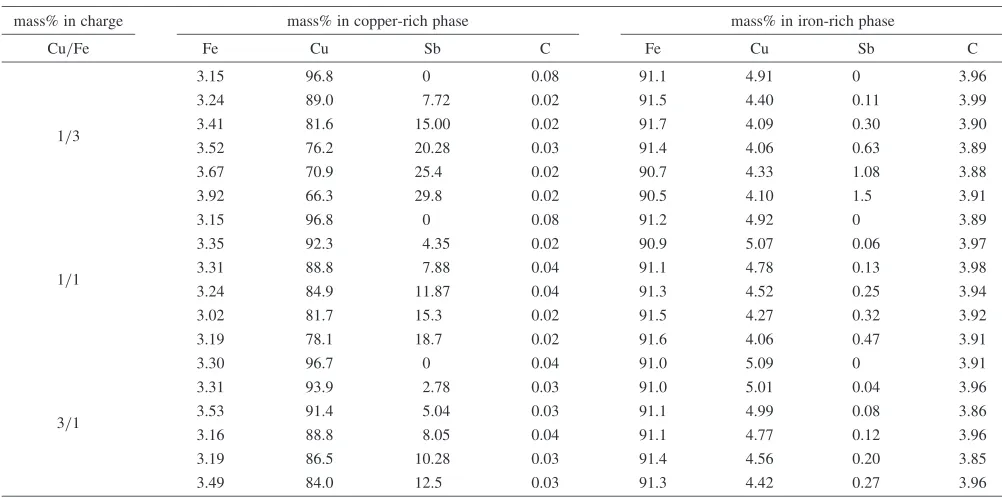
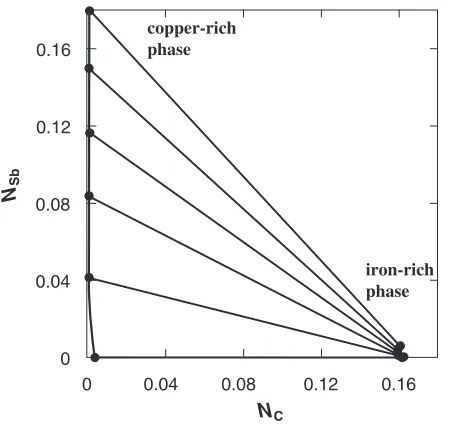
The Cu-Fe-Sb system saturated with carbon at 1473 K presents a large miscibility gap where iron-rich and copper-rich phases coexist. The compositions of these phases are listed in Table 1, while the phase relations for the mass% ratios of the charge, MCu=MFe, with 1/3, 1/1 and 3/1 are
illustrated in Figs. 2, 3 and 4, respectively, in relation to the mole fractions of carbon (NC) and antimony (NSb) in both
[image:2.595.46.547.536.785.2]phases. When antimony is added to the Cu-Fe system saturated with carbon, antimony and copper form a copper-rich phase, while carbon and iron form an iron-copper-rich phase. With increasing antimony content in the charge, antimony is
Table 1 Phase equilibrium compositions of copper-rich and iron-rich phases in the Fe-Cu-Sb system saturated with carbon at 1473 K.
mass% in charge mass% in copper-rich phase mass% in iron-rich phase
Cu/Fe Fe Cu Sb C Fe Cu Sb C
3.15 96.8 0 0.08 91.1 4.91 0 3.96
3.24 89.0 7.72 0.02 91.5 4.40 0.11 3.99
1/3 3.41 81.6 15.00 0.02 91.7 4.09 0.30 3.90
3.52 76.2 20.28 0.03 91.4 4.06 0.63 3.89
3.67 70.9 25.4 0.02 90.7 4.33 1.08 3.88
3.92 66.3 29.8 0.02 90.5 4.10 1.5 3.91
3.15 96.8 0 0.08 91.2 4.92 0 3.89
3.35 92.3 4.35 0.02 90.9 5.07 0.06 3.97
1/1 3.31 88.8 7.88 0.04 91.1 4.78 0.13 3.98
3.24 84.9 11.87 0.04 91.3 4.52 0.25 3.94
3.02 81.7 15.3 0.02 91.5 4.27 0.32 3.92
3.19 78.1 18.7 0.02 91.6 4.06 0.47 3.91
3.30 96.7 0 0.04 91.0 5.09 0 3.91
3.31 93.9 2.78 0.03 91.0 5.01 0.04 3.96
3/1 3.53 91.4 5.04 0.03 91.1 4.99 0.08 3.86
3.16 88.8 8.05 0.04 91.1 4.77 0.12 3.96
3.19 86.5 10.28 0.03 91.4 4.56 0.20 3.85
distributed almost completely in the copper-rich phase and dissolved to very few concentrations in the iron-rich phase, while carbon shows an opposite tendency. The contents of carbon in both the copper-rich and iron-rich phases are almost constant at about 0.03 and 3.9 mass%. Furthermore, as listed in Table 1, the copper content in the copper-rich phase decreases with increasing antimony content, while the iron content is almost constant. On the contrary, the copper content in the iron-rich phase smoothly decreases with increasing antimony content while the iron content is almost constant at about 91 mass%.
The phase relations in a miscibility gap of the Cu-Fe-As system saturated with carbon at 1473 K, which are reported by the authors,6)are also shown in Fig. 3 with broken lines. It is noted that the gradient of the tie lines is considerably less steep when one may compare with that in the Cu-Fe-As system saturated with carbon. The similar tendency is
observed for the samples with other mass ratio of Cu and Fe.6)
Since the solubility of carbon in the copper-rich phase in the Cu-Fe-Sb system saturated with carbon is very small, the composition diagram for the quaternary system can be expressed in a simplified form of pseudo-ternary diagram in which iron and carbon are regarded as one constituent. The phase relations in the Cu-(Fe-C)-Sb pseudo ternary system saturated with carbon at 1473 K are shown in Fig. 5, together with those in the Cu-Fe-Sb ternary system at 1423 K, which were determined by one of the authors.4) The immiscible region composed of the liquid iron-rich phase, L1, and the
liquid copper-rich phase,L2, is clearly reproduced in Fig. 5.
It is found that the end points of the tie lines in the copper-rich region for three systems withMCu=MFe¼1=3, 1/1 and
3/1 are almost located on a line which corresponds to the miscibility gap boundery. Furthermore, it is noted that this miscibility gap line is very close to the liquidus line in equilibrium with the solid -iron in the Cu-Fe-Sb ternary system.
3.3 Distribution of minor elements in miscibility gap of Cu-Fe-Sb-C system
The distribution ratio of a minor element X between the liquid iron-rich and copper-rich phases in the Cu-Fe-Sb system saturated with carbon,LXFe/Cu, is defined as, iron-rich
phase copper-rich
phase
0 0.04 0.08 0.12 0.16
0 0.04 0.08 0.12 0.16
NC NSb
Fig. 2 Relation betweenNSbandNCin copper-rich and iron-rich phases in the Cu-Fe-Sb system saturated with carbon at 1473 K: mass%Cu/ mass%Fe = 1/3 in the charge.
iron-rich phase copper-rich
phase
0 0.04 0.08 0.12
0 0.04 0.08 0.12 0.16
N
CN
Sb, N
As
Present work
Voisin et al.
Cu-Fe-As-C at 1473 K
Fig. 3 Relation betweenNSbandNCin copper-rich and iron-rich phases in the Cu-Fe-Sb system saturated with carbon at 1473 K: mass%Cu/ mass%Fe = 1/1 in the charge.
iron-rich phase copper-rich
phase
0 0.04 0.08 0.12
0 0.04 0.08 0.12 0.16
N
CN
SbFig. 4 Relation betweenNSbandNCin copper-rich and iron-rich phases in the Cu-Fe-Sb system saturated with carbon at 1473 K: mass%Cu/ mass%Fe = 3/1 in the charge.
Lee and Itagaki Present work
Cu-Fe-Sb at 1423 K Cu / Fe (in weight)
3 / 1 1 / 1 1 / 3
Fe-rich Phase (L1)
0.2 0.4 0.6 0.8
0.2 0.4 0.6
0.8
NCu
Cu (Fe+C)
N(Fe+C)
N
Sb
Cu-rich Phase (L2) Sb
( L1+L2 )
[image:3.595.60.285.71.283.2] [image:3.595.310.547.74.242.2] [image:3.595.306.548.307.437.2] [image:3.595.52.291.343.521.2]LXFe/Cu¼ ½mass% XFe=hmass% XiCu; ð1Þ
where½ Fe andh iCu indicate the iron-rich and the
copper-rich phases, respectively. By the definition, the element X will be concentrated in the copper-rich phase when the value of distribution ratio is less than unity. Hence, the smaller value is preferable when a process for treating the by-products containing antimony is considered, in which the valuable elements including copper will be recovered into the copper-rich phase, while the less valuable iron eliminated into the iron-rich phase.
The distribution ratios of silver, platinum, cobalt, nickel and sulfur are shown in Fig. 6, in relation to the antimony content in the charge. The distribution ratios of silver and sulfur tend to decrease, while that of platinum increases with increasing antimony content. It is noted that the distribution ratio over 2 mass% of antimony content decreases in the order of cobalt, nickel, platinum, sulfur and silver. LAgFe/Cu
presents very small values of less than 0.007 in the whole range of antimony composition, whileLCoFe/Cuin the range
of lower antimony composition considerably large values of more than 10.LNiFe/Cuis also larger than unity in the whole
range of antimony composition.LSFe/Cuis slightly less than
unity, whileLPtFe/Cuslightly larger than unity.
The distribution ratios in the Cu-Fe-As system saturated with carbon at 1473 K, which were determined by the authors,6)are also shown in Fig. 6 with broken lines.LFe/Cu
for nickel and sulfur are similar between these two systems, while those for cobalt, platinum and silver considerably differ in the dependency on the antimony and arsenic compositions.
4. Discussion
4.1 Activity coefficient of antimony in miscibility gap of Cu-Fe-Sb-C system
The thermodynamic properties of antimony in the Cu-Fe-Sb system saturated with carbon are of major concern for the
phase relations in this system as well as the treatment of antimony in the by-products. On the basis of the present data for the miscibility gap and the activity data for the Cu-Fe-Sb system reported by one of the authors,9)Raoultian activity
coefficients of antimony in the copper-rich and iron-rich phases in a miscibility gap of the Cu-Fe-Sb system saturated with carbon at 1473 K were derived as follows.
Equation (2) is established in the equilibrium condition because of the same standard state for two liquid phases,
½aSb ¼ ½Sb½NSb ¼ hSbihNSbi ¼ haSbi; ð2Þ
whereSbis Raoultian activity coefficient of antimony,NSbis
mole fraction of antimony, and [ ] andh idenote the iron-rich and copper-rich phases, respectively.
The content of carbon in the copper-rich phase was barely different from that indicated in the Cu-Fe system saturated with carbon.3) Since this value is very small at about
0.03 mass%, this phase can be treated as the Cu-Fe-Sb ternary system. Hence,hSbi in eq. (2) is known by combining the
reported activity data in the ternary system9)with the present
data for the miscibility gap line in the copper-rich phase. Then,Sbin the iron-rich phase can be derived from eq. (2),
in relation to the antimony content.
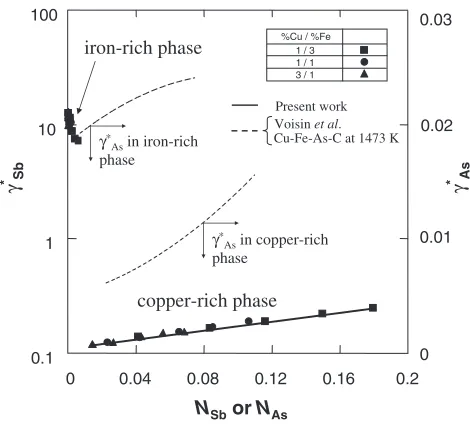
The activity coefficients of antimony (the standard state of antimony activity is pure liquid antimony) in the iron-rich and copper-rich phases in the miscibility gap of Cu-Fe-Sb system saturated with carbon for the mass% ratios of the charge with MCu=MFe¼1=3, 1/1 and 3/1 at 1473 K are
shown in Fig. 7, in relation to the antimony content in both phases. It is found that the activity coefficients in the iron-rich phase represent considerably large values around 10, while those in the copper-rich phase are considerably small at about
0:10:5. It is interesting to note that, at a given antimony content, the activity coefficient in the iron-rich phase is about 100 times larger than that in the copper-rich phase.
The activity coefficients of arsenic (the standard state of arsenic activity is pure liquid arsenic) in a miscibility gap of
mass% Sb or As in charge 0.001
0.01 0.1 1 10 100
0 2 4 6 8 10 12
LX
Fe/Cu
Co Ni
S
Pt
Ag
Present work
Voisin et al.
Cu-Fe-As-C at 1473 K
Fig. 6 Distribution ratios of minor elements in relation to the antimony content in the charge in the Cu-Fe-Sb system saturated with carbon at 1473 K.
0.1 1 10 100
0 0.04 0.08 0.12 0.16 0.2
NSbor NAs
iron-rich phase
copper-rich phase γ*
Asin iron-rich
phase
γ*
Asin copper-rich
phase
%Cu / %Fe 1 / 3 1 / 1 3 / 1
γ
* As
γ
* Sb
0 0.01 0.02 0.03
Present work
Voisin et al.
Cu-Fe-As-C at 1473 K
[image:4.595.58.286.71.282.2] [image:4.595.309.544.536.748.2]the Cu-Fe-As system saturated with carbon at 1473 K, which were derived by the authors,6)are also shown in Fig. 7 with
broken lines. It is found thatAsin the copper-rich and
iron-rich phases are very small at less than 0.03, and thatAsin the
iron-rich phase is only about twice of that in the copper-rich phase.
It is considered from the activity data4,9)for the Fe-X and
Cu-X (X¼As, Sb) binary systems that the chemical affinity of X for iron is similar to that for copper. Therefore, the observed difference in the activity coefficient between antimony and arsenic in the iron-rich phase may be ascribed to the effect of carbon present in this phase with the amount of about 4 mass%. The effect will be discussed more or less quantitatively on the basis of interaction parameters.
It was assumed that the activity coefficients of X (As and Sb) in the Cu-Fe-C-X quaternary systems with Fe as a solvent and Cu, C and X as solutes might be expressed by eq. (3), which is valid when the higher order terms in Taylor’s series expansion can be neglected. Although the mole fraction of carbon in the present iron-rich phase is considerably high at about 0.16, we have tried to apply eq. (3) to the present system, assuming thatlnAschanges proportionally toNCup
to the saturation point of carbon.
lnX¼lnXþ"XXNXþ"XCuNCuþ"XCNC
ðX¼As; SbÞ ð3Þ
Where X is the limiting activity coefficient.NX,NCu and NC, and"XX,"XCuand"XCare mole fractions and interaction
parameters of X, Cu and C, respectively. First,X,"XXand "XCu were determined using the reported values ofXin the
Fe-X binary and Cu-Fe-X ternary systems for arsenic9)and
antimony.4)Then,"
AsC and"SbC in eq. (3) were derived by
combiningXin the Cu-Fe-C-X quaternary systems shown in
Fig. 7. The results for arsenic and antimony are given in eqs. (4) and (5), respectively.
lnAs¼ 6:0þ13NAs5:7NCuþ14NC ð4Þ
lnSb¼ 2:1þ3:3NSb3:4NCuþ28NC ð5Þ
The standard deviations for "AsC and"SbC are considerably
small at 0.5 and 1, respectively.
It is noted in eqs. (4) and (5) thatAsandSbincrease by
the addition of carbon because of positive value for"AsCand "SbC, and that the contribution of carbon to Sb is much
greater than that toAsin eq. (4). Due to the lack in reported
data for the C-As and C-Sb binary systems, it is hard to explain, from a physico-chemical point of view, the reason why the contribution of carbon is remarkably different between arsenic and antimony.
4.2 Thermodynamic analysis for distribution ratio of minor elements
Using the present data for the distribution ratio, shown in Fig. 6, and for the composition of iron-rich and copper-rich phases, listed in Table 1, the ratio of activity coefficients of minor elements (X),hXi=½X, can be derived from eq. (6),6)
LXFe/Cu¼ ½nThXi=hnTi½X; ð6Þ
where [nT] and hnTi denote the total number of moles of
100 g iron-rich and copper-rich phases in the miscibility gap of Cu-Fe-Sb system saturated with carbon, respectively. The
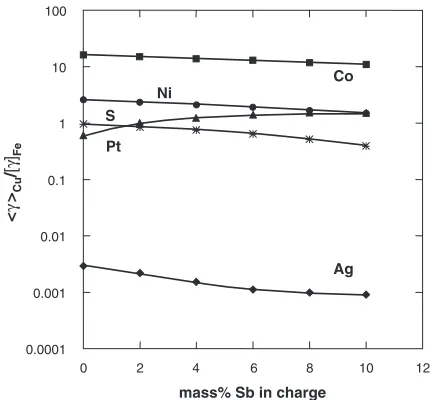
calculated results for cobalt, nickel, sulfur, platinum and silver are shown in Fig. 8, in relation to the antimony content in the charged material.
The tendency observed in Fig. 8 can be discussed on the basis of available data for the activity coefficients of these elements in the Cu-X and Fe-X binary alloys without carbon.6)It is considered that the very small ratio for silver is ascribed to the very large activity coefficient in the iron phase, while the considerably large ratio for cobalt to the considerably large activity coefficient in the copper phase. This may suggest that the chemical affinity of silver for copper is much stronger than that for iron, while the chemical affinity of cobalt for iron is stronger than that for copper.
4.3 Material balances in the proposed process
Based on the present experimental results, the material balances were evaluated for the new process proposed by the authors. In the process, excess carbon is added to the Cu-Fe base speiss to make immiscible copper-rich and iron-rich phases at a fairly low temperature of about 1500 K and to recover valuable copper and some other metals in the copper-rich phase and eliminate less valuable iron into the iron-copper-rich phase. It might be disposed in a less stringent condition if stable in the atmosphere.
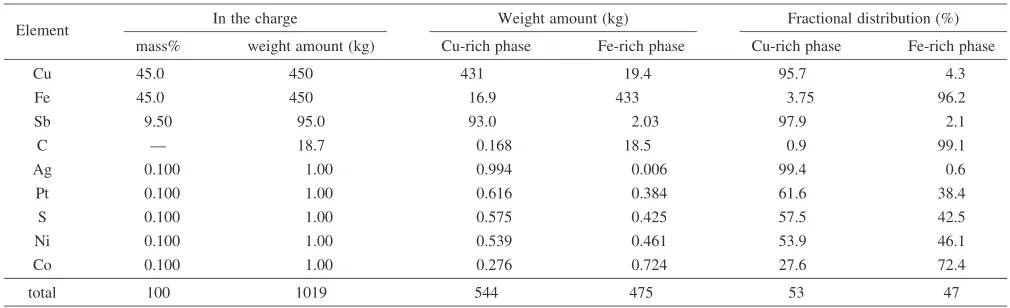
It is supposed in the calculation that 1000 kg of speiss containing iron, copper and antimony with 45, 45 and 9.5 mass%, respectively, and silver, platinum, sulfur, nickel and cobalt with each 0.1 mass% is treated at 1473 K by adding 18.7 kg of carbon corresponding to the minimum amount required for its saturation in the melts. Since the total equilibrium partial pressures of predominant Sb and Sb2gas
species over the corresponding Cu-Fe-Sb alloy at 1473 K is very small at about 4.5 Pa, the loss of antimony by volatilization was neglected in the calculation. The calcu-lated results are listed in Table 2, representing the weight kg of all the elements in each phase and their fractional distribution (%) between both phases.
It is indicated in Table 2 that more than 96% of iron and
<
γ
>Cu
/
[γ
]Fe
mass% Sb in charge 0.0001
0.001 0.01 0.1 1 10 100
0 2 4 6 8 10 12
Co Ni
S
Pt
Ag
[image:5.595.319.536.72.272.2]more than 99% of carbon in the charged materials will be distributed into the iron-rich phase, while more than 95% of copper into the copper-rich phase. The fractional distribution of antimony in the copper-rich phase is also very large at 97.9%. It is noted that the fractional distribution of silver in the copper-rich phase is extremely large as much as 99% and that of cobalt in the iron-rich phase is also considerably large at 72.4%. These results suggest that, when the recovery of valuable elements and the elimination of iron from the Cu-Fe base speiss are considered by means of the phase separation, the recovery of valuable silver and copper into the copper-rich phase as well as the elimination of less valuable iron into the iron-rich phase might be feasible even though the proportions of valuable cobalt and nickel lost in the iron-rich phase are considerably large. The copper-iron-rich alloy may be further treated in a pyrometallurgical or hydrometallur-gical process to extract silver, copper and antimony while the less valuable iron-rich alloy may be deposited if the contents of cobalt and nickel in the initial charge are small.
The material balances for the Cu-Fe-As base speiss,6)
which were calculated under the same condition as for the present Cu-Fe-Sb base speiss, are similar to those listed in Table 2, except that the fractional distribution of arsenic in the copper-rich phase is considerably small as much as 54.4% as compared with that of antimony with 97.9%.
5. Summary
As a fundamental study for treating the speiss, which is a by-product with a considerably high content of antimony in nonferrous smelting processes, the phase relations in the miscibility gap of Cu-Fe-Sb system saturated with carbon and the distribution of some minor elements between the phases in the miscibility gap were investigated at 1473 K. The results are summarized as follows.
(1) A miscibility gap composed of copper-rich and iron-rich phases extends over the wide concentration range.
Antimony and carbon preferentially distributed in copper-rich and iron-rich phase, respectively. The mutual solubility between these two phases is very small
(2) Raoultian activity coefficients of antimony in the iron-rich phase are about 10 and about 100 times larger than those in the copper-rich phase.
(3) For the minor elements, the distribution ratios,LXFe/Cu,
over 2 mass% of antimony in the charged materials decrease in the order of cobalt, nickel, platinum, sulfur and silver. TheLAgFe/Cuin the range of lower antimony
content is very small with the value of less than 0.01, while that for cobalt and nickel are considerably large with estimated values of more than 10 and 4, respec-tively. These suggest that most of silver will be enriched in the copper-rich phase, while a large part of cobalt and nickel will be in the iron-rich phase.
REFERENCES
1) A. Parviainene and S. Fugleberg: Proceedings of Cobalt 80, CIM, Edmonton, Canada, (1980) 38–46.
2) J. Dobrzanski and W. Kozminski: Proceedings of Copper 2003, Vol. IV, Santiago, Chile, (2003) 239–252.
3) Y. Chang, J. Newmann, A. Mikula and D. Goldberg:INCRA Series on the Metallurgy of Copper - Phase Diagrams and Thermodynamic
Properties of Ternary Copper - Metal Systems, (International Copper
Research Association, Milwaukee, Wisconsin, USA, 1979) 367–386. 4) Y. Lee and K. Itagaki: J. Min. Mater. Inst. Japan102(1986) 591–595. 5) D. G. Mendoza, M. Hino and K. Itagaki: Mater. Trans.43(2002) 1166–
1172.
6) L. Voisin, Hector M. Henao and K. Itagaki: Mater. Trans.45(2004) 2851–2856.
7) T. B. Massalski:Binary Alloy Phase Diagrams, Second Edition, Vol. 2, (ASM International, Materials Park, Ohio, 1990) p. 1766.
8) T. B. Massalski:Binary Alloy Phase Diagrams, Second Edition, Vol. 2, (ASM International, Materials Park, Ohio, 1990) p. 843.
[image:6.595.45.550.83.237.2]9) M. Hino and T. Azakami: J. Min. Metall. Inst. Japan97(1981) 1269– 1283.
Table 2 Material balances in the treatment of 1000 kg of Cu-Fe-Sb speiss under saturation of carbon at 1473 K.
Element In the charge Weight amount (kg) Fractional distribution (%)
mass% weight amount (kg) Cu-rich phase Fe-rich phase Cu-rich phase Fe-rich phase
Cu 45.0 450 431 19.4 95.7 4.3
Fe 45.0 450 16.9 433 3.75 96.2
Sb 9.50 95.0 93.0 2.03 97.9 2.1
C — 18.7 0.168 18.5 0.9 99.1
Ag 0.100 1.00 0.994 0.006 99.4 0.6
Pt 0.100 1.00 0.616 0.384 61.6 38.4
S 0.100 1.00 0.575 0.425 57.5 42.5
Ni 0.100 1.00 0.539 0.461 53.9 46.1
Co 0.100 1.00 0.276 0.724 27.6 72.4