Randomized Algorithms and NLP: Using Locality Sensitive Hash Function
for High Speed Noun Clustering
Deepak Ravichandran, Patrick Pantel, and Eduard Hovy Information Sciences Institute
University of Southern California 4676 Admiralty Way Marina del Rey, CA 90292.
{ravichan, pantel, hovy}@ISI.EDU
Abstract
In this paper, we explore the power of randomized algorithm to address the chal-lenge of working with very large amounts of data. We apply these algorithms to gen-erate noun similarity lists from 70 million pages. We reduce the running time from quadratic to practically linear in the num-ber of elements to be computed.
1 Introduction
In the last decade, the field of Natural Language Pro-cessing (NLP), has seen a surge in the use of cor-pus motivated techniques. Several NLP systems are modeled based on empirical data and have had vary-ing degrees of success. Of late, however, corpus-based techniques seem to have reached a plateau in performance. Three possible areas for future re-search investigation to overcoming this plateau in-clude:
1. Working with large amounts of data (Banko and
Brill, 2001)
2. Improving semi-supervised and unsupervised
al-gorithms.
3. Using more sophisticated feature functions.
The above listing may not be exhaustive, but it is probably not a bad bet to work in one of the above directions. In this paper, we investigate the first two avenues. Handling terabytes of data requires more efficient algorithms than are currently used in NLP. We propose a web scalable solution to clustering nouns, which employs randomized algorithms. In
doing so, we are going to explore the literature and techniques of randomized algorithms. All cluster-ing algorithms make use of some distance similar-ity (e.g., cosine similarsimilar-ity) to measure pair wise dis-tance between sets of vectors. Assume that we are givennpoints to cluster with a maximum ofk fea-tures. Calculating the full similarity matrix would take time complexityn2k. With large amounts of data, saynin the order of millions or even billions, having ann2k algorithm would be very infeasible. To be scalable, we ideally want our algorithm to be proportional tonk.
Fortunately, we can borrow some ideas from the Math and Theoretical Computer Science community to tackle this problem. The crux of our solution lies in defining Locality Sensitive Hash (LSH) functions. LSH functions involve the creation of short signa-tures (fingerprints) for each vector in space such that those vectors that are closer to each other are more likely to have similar fingerprints. LSH functions are generally based on randomized algorithms and are probabilistic. We present LSH algorithms that can help reduce the time complexity of calculating our distance similarity atrix tonk.
Rabin (1981) proposed the use of hash func-tions from random irreducible polynomials to cre-ate short fingerprint representations for very large strings. These hash function had the nice property that the fingerprint of two identical strings had the same fingerprints, while dissimilar strings had dif-ferent fingerprints with a very small probability of collision. Broder (1997) first introduced LSH. He proposed the use of Min-wise independent functions to create fingerprints that preserved the Jaccard
ilarity between every pair of vectors. These tech-niques are used today, for example, to eliminate du-plicate web pages. Charikar (2002) proposed the use of random hyperplanes to generate an LSH func-tion that preserves the cosine similarity between ev-ery pair of vectors. Interestingly, cosine similarity is widely used in NLP for various applications such as clustering.
In this paper, we perform high speed similarity list creation for nouns collected from a huge web corpus. We linearize this step by using the LSH proposed by Charikar (2002). This reduction in complexity of similarity computation makes it pos-sible to address vastly larger datasets, at the cost, as shown in Section 5, of only little reduction in accuracy. In our experiments, we generate a simi-larity list for each noun extracted from 70 million page web corpus. Although the NLP community has begun experimenting with the web, we know of no work in published literature that has applied complex language analysis beyond IR and simple surface-level pattern matching.
2 Theory
The core theory behind the implementation of fast cosine similarity calculation can be divided into two parts: 1. Developing LSH functions to create sig-natures; 2. Using fast search algorithm to find near-est neighbors. We describe these two components in greater detail in the next subsections.
2.1 LSH Function Preserving Cosine Similarity
We first begin with the formal definition of cosine similarity.
Definition: Let u and v be two vectors in a k
dimensional hyperplane. Cosine similarity is de-fined as the cosine of the angle between them:
cos(θ(u, v)). We can calculate cos(θ(u, v))by the following formula:
cos(θ(u, v)) = |u.v|
|u||v| (1)
Here θ(u, v) is the angle between the vectors u
andvmeasured in radians. |u.v|is the scalar (dot) product of u and v, and |u| and |v| represent the length of vectorsuandvrespectively.
The LSH function for cosine similarity as pro-posed by Charikar (2002) is given by the following theorem:
Theorem: Suppose we are given a collection of
vectors in akdimensional vector space (as written as
Rk). Choose a family of hash functions as follows: Generate a spherically symmetric random vectorr
of unit length from this k dimensional space. We define a hash function,hr, as:
hr(u) =
1 : r.u≥0
0 : r.u <0 (2)
Then for vectorsuandv,
P r[hr(u) =hr(v)] = 1− θ(u, v)
π (3)
Proof of the above theorem is given by Goemans and Williamson (1995). We rewrite the proof here for clarity. The above theorem states that the prob-ability that a random hyperplane separates two vec-tors is directly proportional to the angle between the two vectors (i,e., θ(u, v)). By symmetry, we have
P r[hr(u)6=hr(v)] = 2P r[u.r ≥0, v.r <0]. This corresponds to the intersection of two half spaces, the dihedral angle between which is θ. Thus, we haveP r[u.r ≥0, v.r <0] =θ(u, v)/2π. Proceed-ing we have P r[hr(u) 6= hr(v)] = θ(u, v)/πand
P r[hr(u) = hr(v)] = 1−θ(u, v)/π. This
com-pletes the proof.
Hence from equation 3 we have,
cos(θ(u, v)) =cos((1−P r[hr(u) =hr(v)])π)
(4) This equation gives us an alternate method for finding cosine similarity. Note that the above equa-tion is probabilistic in nature. Hence, we generate a large (d) number of random vectors to achieve the process. Having calculated hr(u) with d random
can represent each vector by a bit stream of length
d.
Carefully looking at equation 4, we can ob-serve that P r[hr(u) = hr(v)] = 1 −
(hamming distance)/d1 . Thus, the above theo-rem, converts the problem of finding cosine distance between two vectors to the problem of finding ham-ming distance between their bit streams (as given by equation 4). Finding hamming distance between two bit streams is faster and highly memory efficient. Also worth noting is that this step could be consid-ered as dimensionality reduction wherein we reduce a vector inkdimensions to that ofdbits while still preserving the cosine distance between them.
2.2 Fast Search Algorithm
To calculate the fast hamming distance, we use the search algorithm PLEB (Point Location in Equal Balls) first proposed by Indyk and Motwani (1998). This algorithm was further improved by Charikar (2002). This algorithm involves random permuta-tions of the bit streams and their sorting to find the vector with the closest hamming distance. The algo-rithm given in Charikar (2002) is described to find the nearest neighbor for a given vector. We mod-ify it so that we are able to find the top B closest neighbor for each vector. We omit the math of this algorithm but we sketch its procedural details in the next section. Interested readers are further encour-aged to read Theorem 2 from Charikar (2002) and Section 3 from Indyk and Motwani (1998).
3 Algorithmic Implementation
In the previous section, we introduced the theory for calculation of fast cosine similarity. We implement it as follows:
1. Initially we are givennvectors in a hugek di-mensional space. Our goal is to find all pairs of vectors whose cosine similarity is greater than a particular threshold.
2. Choose d number of (d << k) unit random vectors{r0, r1, ..., rd}each ofkdimensions.
A k dimensional unit random vector, in gen-eral, is generated by independently sampling a
1Hamming distance is the number of bits which differ be-tween two binary strings.
Gaussian function with mean0and variance1,
knumber of times. Each of the k samples is used to assign one dimension to the random vector. We generate a random number from a Gaussian distribution by using Box-Muller transformation (Box and Muller, 1958).
3. For every vectoru, we determine its signature by using the functionhr(u)(as given by equa-tion 4). We can represent the signature of vec-toru as: u¯ = {hr1(u), hr2(u), ..., hrd(u)}.
Each vector is thus represented by a set of a bit streams of lengthd. Steps 2 and 3 takesO(nk)
time (We can assumedto be a constant since
d << k).
4. The previous step givesnvectors, each of them represented by dbits. For calculation of fast hamming distance, we take the original bit in-dex of all vectors and randomly permute them (see Appendix A for more details on random permutation functions). A random permutation can be considered as random jumbling of the bits of each vector2. A random permutation function can be approximated by the following function:
π(x) = (ax+b)mod p (5)
where,pis prime and0 < a < p,0≤b < p, andaandbare chosen at random.
We apply q different random permutation for every vector (by choosing random values fora
andb,qnumber of times). Thus for every vec-tor we haveqdifferent bit permutations for the original bit stream.
5. For each permutation function π, we lexico-graphically sort the list ofnvectors (whose bit streams are permuted by the functionπ) to ob-tain a sorted list. This step takes O(nlogn)
time. (We can assumeqto be a constant).
6. For each sorted list (performed after applying the random permutation functionπ), we calcu-late the hamming distance of every vector with
2
B of its closest neighbors in the sorted list. If the hamming distance is below a certain prede-termined threshold, we output the pair of vec-tors with their cosine similarity (as calculated by equation 4). Thus,B is the beam parameter of the search. This step takesO(n), since we can assumeB, q, dto be a constant.
Why does the fast hamming distance algorithm work? The intuition is that the number of bit streams,d, for each vector is generally smaller than the number of vectorsn(ie. d << n). Thus, sort-ing the vectors lexicographically after jumblsort-ing the bits will likely bring vectors with lower hamming distance closer to each other in the sorted lists.
Overall, the algorithm takesO(nk+nlogn)time. However, for noun clustering, we generally have the number of nouns,n, smaller than the number of fea-tures,k. (i.e.,n < k). This implieslogn << k and
nlogn << nk. Hence the time complexity of our algorithm is O(nk +nlogn) ≈ O(nk). This is a huge saving from the originalO(n2k)algorithm. In the next section, we proceed to apply this technique for generating noun similarity lists.
4 Building Noun Similarity Lists
A lot of work has been done in the NLP community on clustering words according to their meaning in text (Hindle, 1990; Lin, 1998). The basic intuition is that words that are similar to each other tend to occur in similar contexts, thus linking the semantics of words with their lexical usage in text. One may ask why is clustering of words necessary in the first place? There may be several reasons for clustering, but generally it boils down to one basic reason: if the words that occur rarely in a corpus are found to be distributionally similar to more frequently occurring words, then one may be able to make better infer-ences on rare words.
However, to unleash the real power of clustering one has to work with large amounts of text. The NLP community has started working on noun clus-tering on a few gigabytes of newspaper text. But with the rapidly growing amount of raw text avail-able on the web, one could improve clustering per-formance by carefully harnessing its power. A core component of most clustering algorithms used in the NLP community is the creation of a similarity
ma-trix. These algorithms are of complexity O(n2k), wherenis the number of unique nouns andkis the feature set length. These algorithms are thus not readily scalable, and limit the size of corpus man-ageable in practice to a few gigabytes. Clustering al-gorithms for words generally use the cosine distance for their similarity calculation (Salton and McGill, 1983). Hence instead of using the usual naive cosine distance calculation between every pair of words we can use the algorithm described in Section 3 to make noun clustering web scalable.
To test our algorithm we conduct similarity based experiments on 2 different types of corpus: 1. Web Corpus (70 million web pages, 138GB), 2. Newspa-per Corpus (6 GB newspaNewspa-per corpus)
4.1 Web Corpus
We set up a spider to download roughly 70 million web pages from the Internet. Initially, we use the links from Open Directory project3as seed links for our spider. Each webpage is stripped of HTML tags, tokenized, and sentence segmented. Each docu-ment is language identified by the software TextCat4 which implements the paper by Cavnar and Trenkle (1994). We retain only English documents. The web contains a lot of duplicate or near-duplicate docu-ments. Eliminating them is critical for obtaining bet-ter representation statistics from our collection. The problem of identifying near duplicate documents in linear time is not trivial. We eliminate duplicate and near duplicate documents by using the algorithm de-scribed by Kolcz et al. (2004). This process of dupli-cate elimination is carried out in linear time and in-volves the creation of signatures for each document. Signatures are designed so that duplicate and near duplicate documents have the same signature. This algorithm is remarkably fast and has high accuracy. This entire process of removing non English docu-ments and duplicate (and near-duplicate) docudocu-ments reduces our document set from 70 million web pages to roughly 31 million web pages. This represents roughly 138GB of uncompressed text.
We identify all the nouns in the corpus by us-ing a noun phrase identifier. For each noun phrase, we identify the context words surrounding it. Our context window length is restricted to two words to
3
http://www.dmoz.org/
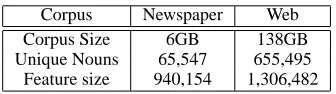
Table 1: Corpus description
Corpus Newspaper Web
Corpus Size 6GB 138GB
Unique Nouns 65,547 655,495 Feature size 940,154 1,306,482
the left and right of each noun. We use the context words as features of the noun vector.
4.2 Newspaper Corpus
We parse a 6 GB newspaper (TREC9 and TREC2002 collection) corpus using the dependency parser Minipar (Lin, 1994). We identify all nouns. For each noun we take the grammatical context of the noun as identified by Minipar5. We do not use grammatical features in the web corpus since pars-ing is generally not easily web scalable. This kind of feature set does not seem to affect our results. Cur-ran and Moens (2002) also report comparable results for Minipar features and simple word based proxim-ity features. Table 1 gives the characteristics of both corpora. Since we use grammatical context, the fea-ture set is considerably larger than the simple word based proximity feature set for the newspaper cor-pus.
4.3 Calculating Feature Vectors
Having collected all nouns and their features, we now proceed to construct feature vectors (and values) for nouns from both corpora using mu-tual information (Church and Hanks, 1989). We first construct a frequency count vector C(e) = (ce1, ce2, ..., cek), where k is the total number of
features and cef is the frequency count of feature
f occurring in word e. Here, cef is the number
of times word e occurred in context f. We then construct a mutual information vector M I(e) = (mie1, mie2, ..., miek)for each worde, wheremief
is the pointwise mutual information between worde
and featuref, which is defined as:
mief =log
cef
N
Pn
i=1
cif
N ×
Pk
j=1
cej
N
(6)
where n is the number of words and N =
5We perform this operation so that we can compare the per-formance of our system to that of Pantel and Lin (2002).
Pn
i=1
Pm
j=1cij is the total frequency count of all
features of all words.
Having thus obtained the feature representation of each noun we can apply the algorithm described in Section 3 to discover similarity lists. We report re-sults in the next section for both corpora.
5 Evaluation
Evaluating clustering systems is generally consid-ered to be quite difficult. However, we are mainly concerned with evaluating the quality and speed of our high speed randomized algorithm. The web cor-pus is used to show that our framework is web-scalable, while the newspaper corpus is used to com-pare the output of our system with the similarity lists output by an existing system, which are calculated using the traditional formula as given in equation 1. For this base comparison system we use the one built by Pantel and Lin (2002). We perform 3 kinds of evaluation: 1. Performance of Locality Sensitive Hash Function; 2. Performance of fast Hamming distance search algorithm; 3. Quality of final simi-larity lists.
5.1 Evaluation of Locality sensitive Hash function
To perform this evaluation, we randomly choose 100 nouns (vectors) from the web collection. For each noun, we calculate the cosine distance using the traditional slow method (as given by equation 1), with all other nouns in the collection. This process creates similarity lists for each of the 100 vectors. These similarity lists are cut off at a threshold of 0.15. These lists are considered to be the gold stan-dard test set for our evaluation.
For the above 100 chosen vectors, we also calcu-late the cosine similarity using the randomized ap-proach as given by equation 4 and calculate the mean squared error with the gold standard test set using the following formula:
errorav =
s X
i
(CSreal,i−CScalc,i)2/total
(7) whereCSreal,i andCScalc,i are the cosine
re-Table 2: Error in cosine similarity
Number of ran-dom vectorsd
Average error in cosine similarity
Time (in hours)
1 1.0000 0.4
10 0.4432 0.5
100 0.1516 3
1000 0.0493 24
3000 0.0273 72
10000 0.0156 241
spectively. iis the index over all pairs of elements that haveCSreal,i>= 0.15
We calculate the error (errorav) for various
val-ues ofd, the total number of unit random vectorsr
used in the process. The results are reported in Table 26. As we generate more random vectors, the error rate decreases. For example, generating 10 random vectors gives us a cosine error of 0.4432 (which is a large number since cosine similarity ranges from 0 to 1.) However, generation of more random vectors leads to reduction in error rate as seen by the val-ues for 1000 (0.0493) and 10000 (0.0156). But as we generate more random vectors the time taken by the algorithm also increases. We choosed = 3000
random vectors as our optimal (time-accuracy) cut off. It is also very interesting to note that by using only 3000 bits for each of the 655,495 nouns, we are able to measure cosine similarity between every pair of them to within an average error margin of 0.027. This algorithm is also highly memory effi-cient since we can represent every vector by only a few thousand bits. Also the randomization process makes the the algorithm easily parallelizable since each processor can independently contribute a few bits for every vector.
5.2 Evaluation of Fast Hamming Distance Search Algorithm
We initially obtain a list of bit streams for all the vectors (nouns) from our web corpus using the ran-domized algorithm described in Section 3 (Steps 1 to 3). The next step involves the calculation of ham-ming distance. To evaluate the quality of this search algorithm we again randomly choose 100 vectors (nouns) from our collection. For each of these 100 vectors we manually calculate the hamming distance
6The time is calculated for running the algorithm on a single Pentium IV processor with 4GB of memory
with all other vectors in the collection. We only re-tain those pairs of vectors whose cosine distance (as manually calculated) is above 0.15. This similarity list is used as the gold standard test set for evaluating our fast hamming search.
We then apply the fast hamming distance search algorithm as described in Section 3. In particular, it involves steps 3 to 6 of the algorithm. We evaluate the hamming distance with respect to two criteria: 1. Number of bit index random permutations functions
q; 2. Beam search parameterB.
For each vector in the test collection, we take the topNelements from the gold standard similarity list and calculate how many of these elements are actu-ally discovered by the fast hamming distance algo-rithm. We report the results in Table 3 and Table 4 with beam parameters of (B = 25) and (B = 100) respectively. For each beam, we experiment with various values forq, the number of random permu-tation function used. In general, by increasing the value for beam B and number of random permu-tation q , the accuracy of the search algorithm in-creases. For example in Table 4 by using a beam
B = 100and using 1000 random bit permutations, we are able to discover 72.8% of the elements of the Top 100 list. However, increasing the values ofqand
B also increases search time. With a beam (B) of 100 and the number of random permutations equal to 100 (i.e.,q= 1000) it takes 570 hours of process-ing time on a sprocess-ingle Pentium IV machine, whereas withB = 25andq = 1000, reduces processing time by more than 50% to 240 hours.
We could not calculate the total time taken to build noun similarity list using the traditional tech-nique on the entire corpus. However, we estimate that its time taken would be at least 50,000 hours (and perhaps even more) with a few of Terabytes of disk space needed. This is a very rough estimate. The experiment was infeasible. This estimate as-sumes the widely used reverse indexing technique, where in one compares only those vector pairs that have at least one feature in common.
5.3 Quality of Final Similarity Lists
train-Table 3: Hamming search accuracy (BeamB = 25)
Random permutationsq Top 1 Top 5 Top 10 Top 25 Top 50 Top 100
25 6.1% 4.9% 4.2% 3.1% 2.4% 1.9%
50 6.1% 5.1% 4.3% 3.2% 2.5% 1.9%
100 11.3% 9.7% 8.2% 6.2% 5.7% 5.1%
500 44.3% 33.5% 30.4% 25.8% 23.0% 20.4%
1000 58.7% 50.6% 48.8% 45.0% 41.0% 37.2%
Table 4: Hamming search accuracy (BeamB = 100)
Random permutationsq Top 1 Top 5 Top 10 Top 25 Top 50 Top 100
25 9.2% 9.5% 7.9% 6.4% 5.8% 4.7%
50 15.4% 17.7% 14.6% 12.0% 10.9% 9.0%
100 27.8% 27.2% 23.5% 19.4% 17.9% 16.3%
500 73.1% 67.0% 60.7% 55.2% 53.0% 50.5%
1000 87.6% 84.4% 82.1% 78.9% 75.8% 72.8%
ing by Pantel and Lin (2002) so that the results are comparable. We randomly choose 100 nouns and calculate the top N elements closest to each noun in the similarity lists using the randomized algorithm described in Section 3. We then compare this output to the one provided by the system of Pantel and Lin (2002). For every noun in the topN list generated by our system we calculate the percentage overlap with the gold standard list. Results are reported in Table 5. The results shows that we are able to re-trieve roughly 70% of the gold standard similarity list. In Table 6, we list the top 10 most similar words for some nouns, as examples, from the web corpus.
6 Conclusion
NLP researchers have just begun leveraging the vast amount of knowledge available on the web. By searching IR engines for simple surface patterns, many applications ranging from word sense disam-biguation, question answering, and mining seman-tic resources have already benefited. However, most language analysis tools are too infeasible to run on the scale of the web. A case in point is generat-ing noun similarity lists usgenerat-ing co-occurrence statis-tics, which has quadratic running time on the input size. In this paper, we solve this problem by pre-senting a randomized algorithm that linearizes this task and limits memory requirements. Experiments show that our method generates cosine similarities between pairs of nouns within a score of 0.03.
In many applications, researchers have shown that
more data equals better performance (Banko and Brill, 2001; Curran and Moens, 2002). Moreover, at the web-scale, we are no longer limited to a snap-shot in time, which allows broader knowledge to be learned and processed. Randomized algorithms pro-vide the necessary speed and memory requirements to tap into terascale text sources. We hope that ran-domized algorithms will make other NLP tools fea-sible at the terascale and we believe that many al-gorithms will benefit from the vast coverage of our newly created noun similarity list.
Acknowledgement
We wish to thank USC Center for High Performance Computing and Communications (HPCC) for help-ing us use their cluster computers.
References
Banko, M. and Brill, E. 2001. Mitigating the paucity of dat-aproblem. In Proceedings of HLT. 2001. San Diego, CA. Box, G. E. P. and M. E. Muller 1958. Ann. Math. Stat. 29,
610–611.
Broder, Andrei 1997. On the Resemblance and Containment of Documents. Proceedings of the Compression and
Complex-ity of Sequences.
Table 5: Final Quality of Similarity Lists
[image:8.612.82.531.152.267.2]Top 1 Top 5 Top 10 Top 25 Top 50 Top 100 Accuracy 70.7% 71.9% 72.2% 71.7% 71.2% 71.1%
Table 6: Sample Top 10 Similarity Lists
JUST DO IT computer science TSUNAMI Louis Vuitton PILATES
HAVE A NICE DAY mechanical engineering tidal wave PRADA Tai Chi
FAIR AND BALANCED electrical engineering LANDSLIDE Fendi Cardio
POWER TO THE PEOPLE chemical engineering EARTHQUAKE Kate Spade SHIATSU NEVER AGAIN Civil Engineering volcanic eruption VUITTON Calisthenics
NO BLOOD FOR OIL ECONOMICS HAILSTORM BURBERRY Ayurveda
KINGDOM OF HEAVEN ENGINEERING Typhoon GUCCI Acupressure
If Texas Wasn’t Biology Mudslide Chanel Qigong
BODY OF CHRIST environmental science windstorm Dior FELDENKRAIS
WE CAN PHYSICS HURRICANE Ferragamo THERAPEUTIC TOUCH
Weld with your mouse information science DISASTER Ralph Lauren Reflexology
Charikar, Moses 2002. Similarity Estimation Techniques from Rounding Algorithms In Proceedings of the 34th Annual
ACM Symposium on Theory of Computing.
Church, K. and Hanks, P. 1989. Word association norms, mu-tual information, and lexicography. In Proceedings of
ACL-89. pp. 76–83. Vancouver, Canada.
Curran, J. and Moens, M. 2002. Scaling context space. In Proceedings of ACL-02 pp 231–238, Philadelphia, PA. Goemans, M. X. and D. P. Williamson 1995. Improved
Ap-proximation Algorithms for Maximum Cut and Satisfiability Problems Using Semidefinite Programming. JACM 42(6): 1115–1145.
Hindle, D. 1990. Noun classification from predicate-argument structures. In Proceedings of ACL-90. pp. 268–275. Pitts-burgh, PA.
Lin, D. 1998. Automatic retrieval and clustering of similar words. In Proceedings of COLING/ACL-98. pp. 768–774. Montreal, Canada.
Indyk, P., Motwani, R. 1998. Approximate nearest neighbors: towards removing the curse of dimensionality Proceedings of 30th STOC, 604–613.
A. Kolcz, A. Chowdhury, J. Alspector 2004. Improved ro-bustness of signature-based near-replica detection via lexi-con randomization. Proceedings of ACM-SIGKDD (2004). Lin, D. 1994 Principar - an efficient, broad-coverage,
principle-based parser. Proceedings of COLING-94, pp. 42– 48. Kyoto, Japan.
Pantel, Patrick and Dekang Lin 2002. Discovering Word Senses from Text. In Proceedings of SIGKDD-02, pp. 613– 619. Edmonton, Canada
Rabin, M. O. 1981. Fingerprinting by random polynomials. Center for research in Computing technology , Harvard Uni-versity, Report TR-15-81.
Salton, G. and McGill, M. J. 1983. Introduction to Modern
Information Retrieval. McGraw Hill.
Appendix A. Random Permutation Functions
We define[n] ={0,1,2, ..., n−1}.
[n]can thus be considered as a set of integers from
0ton−1.
Letπ : [n]→ [n]be a permutation function chosen at random from the set of all such permutation func-tions.
Considerπ: [4]→[4].
A permutation function π is a one to one mapping from the set of[4]to the set of[4].
Thus, one possible mapping is:
π:{0,1,2,3} → {3,2,1,0}
Here it means: π(0) = 3, π(1) = 2, π(2) = 1,
π(3) = 0
Another possible mapping would be:
π:{0,1,2,3} → {3,0,1,2}
Here it means: π(0) = 3, π(1) = 0, π(2) = 1,
π(3) = 2