Detecting Errors in Discontinuous Structural Annotation
Markus Dickinson Department of Linguistics The Ohio State University
W. Detmar Meurers Department of Linguistics The Ohio State University
Abstract
Consistency of corpus annotation is an essential property for the many uses of annotated corpora in computational and theoretical linguistics. While some re-search addresses the detection of inconsis-tencies in positional annotation (e.g., part-of-speech) and continuous structural an-notation (e.g., syntactic constituency), no approach has yet been developed for au-tomatically detecting annotation errors in discontinuous structural annotation. This is significant since the annotation of po-tentially discontinuous stretches of ma-terial is increasingly relevant, from tree-banks for free-word order languages to se-mantic and discourse annotation.
In this paper we discuss how the variation
n-gram error detection approach (Dickin-son and Meurers, 2003a) can be extended to discontinuous structural annotation. We exemplify the approach by showing how it successfully detects errors in the syntactic annotation of the German TIGER corpus (Brants et al., 2002).
1 Introduction
Annotated corpora have at least two kinds of uses: firstly, as training material and as “gold standard” testing material for the development of tools in com-putational linguistics, and secondly, as a source of data for theoretical linguists searching for analyti-cally relevant language patterns.
Annotation errors and why they are a problem
The high quality annotation present in “gold stan-dard” corpora is generally the result of a manual or semi-automatic mark-up process. The annota-tion thus can contain annotaannota-tion errors from auto-matic (pre-)processes, human post-editing, or hu-man annotation. The presence of errors creates prob-lems for both computational and theoretical linguis-tic uses, from unreliable training and evaluation of natural language processing technology (e.g., van Halteren, 2000; Kvˇetˇon and Oliva, 2002, and the work mentioned below) to low precision and recall of queries for already rare linguistic phenomena. In-vestigating the quality of linguistic annotation and improving it where possible thus is a key issue for the use of annotated corpora in computational and theoretical linguistics.
Illustrating the negative impact of annotation er-rors on computational uses of annotated corpora, van Halteren et al. (2001) compare taggers trained and tested on the Wall Street Journal (WSJ, Marcus et al., 1993) and the Lancaster-Oslo-Bergen (LOB, Johansson, 1986) corpora and find that the results for the WSJ perform significantly worse. They report that the lower accuracy figures are caused by incon-sistencies in the WSJ annotation and that 44% of the errors for their best tagging system were caused by “inconsistently handled cases.”
Turning from training to evaluation, Padro and Marquez (1998) highlight the fact that the true ac-curacy of a classifier could be much better or worse than reported, depending on the error rate of the cor-pus used for the evaluation. Evaluating two taggers on the WSJ, they find tagging accuracy rates for
biguous words of 91.35% and92.82%. Given the estimated 3% error rate of the WSJ tagging (Marcus et al., 1993), they argue that the difference in perfor-mance is not sufficient to establish which of the two taggers is actually better.
In sum, corpus annotation errors, especially er-rors which are inconsistencies, can have a profound impact on the quality of the trained classifiers and the evaluation of their performance. The problem is compounded for syntactic annotation, given the dif-ficulty of evaluating and comparing syntactic struc-ture assignments, as known from the literastruc-ture on parser evaluation (e.g., Carroll et al., 2002).
The idea that variation in annotation can indicate annotation errors has been explored to detect errors in part-of-speech (POS) annotation (van Halteren, 2000; Eskin, 2000; Dickinson and Meurers, 2003a) and syntactic annotation (Dickinson and Meurers, 2003b). But, as far as we are aware, the research we report on here is the first approach to error detec-tion for the increasing number of annotadetec-tions which make use of more general graph structures for the syntactic annotation of free word order languages or the annotation of semantic and discourse properties.
Discontinuous annotation and its relevance The simplest kind of annotation is positional in nature, such as the association of a part-of-speech tag with each corpus position. On the other hand, struc-tural annotation such as that used in syntactic tree-banks (e.g., Marcus et al., 1993) assigns a syntactic category to a contiguous sequence of corpus posi-tions. For languages with relatively free constituent order, such as German, Dutch, or the Slavic lan-guages, the combinatorial potential of the language encoded in constituency cannot be mapped straight-forwardly onto the word order possibilities of those languages. As a consequence, the treebanks that have been created for German (NEGRA, Skut et al., 1997; VERBMOBIL, Hinrichs et al., 2000; TIGER, Brants et al., 2002) have relaxed the requirement that constituents have to be contiguous. This makes it possible to syntactically annotate the language data as such, i.e., without requiring postulation of empty elements as placeholders or other theoretically mo-tivated changes to the data. We note in passing that discontinuous constituents have also received some support in theoretical linguistics (cf., e.g., the
arti-cles collected in Huck and Ojeda, 1987; Bunt and van Horck, 1996).
Discontinuous constituents are strings of words which are not necessarily contiguous, yet form a single constituent with a single label, such as the noun phrase Ein Mann, der lacht in the German rel-ative clause extraposition example (1) (Brants et al., 2002).1
(1) Ein a
Mann
man
kommt comes
, ,
der
who
lacht
laughs
‘A man who laughs comes.’
In addition to their use in syntactic annotation, discontinuous structural annotation is also rele-vant for semantic and discourse-level annotation— essentially any time that graph structures are needed to encode relations that go beyond ordinary tree structures. Such annotations are currently employed in the mark-up for semantic roles (e.g., Kings-bury et al., 2002) and multi-word expressions (e.g., Rayson et al., 2004), as well as for spoken language corpora or corpora with multiple layers of annota-tion which cross boundaries (e.g., Blache and Hirst, 2000).
In this paper, we present an approach to the de-tection of errors in discontinuous structural annota-tion. We focus on syntactic annotation with poten-tially discontinuous constituents and show that the approach successfully deals with the discontinuous syntactic annotation found in the TIGER treebank (Brants et al., 2002).
2 The variationn-gram method
Our approach builds on the variation n-gram al-gorithm introduced in Dickinson and Meurers (2003a,b). The basic idea behind that approach is that a string occurring more than once can occur with different labels in a corpus, which we refer to as
variation. Variation is caused by one of two reasons:
i) ambiguity: there is a type of string with multiple possible labels and different corpus occurrences of that string realize the different options, or ii) error: the tagging of a string is inconsistent across compa-rable occurrences.
1The ordinary way of marking a constituent with
The more similar the context of a variation, the more likely the variation is an error. In Dickin-son and Meurers (2003a), contexts are composed of words, and identity of the context is required. The term variationn-gram refers to ann-gram (of words) in a corpus that contains a string annotated differently in another occurrence of the samen-gram in the corpus. The string exhibiting the variation is referred to as the variation nucleus.
2.1 Detecting variation in POS annotation
In Dickinson and Meurers (2003a), we explore this idea for part-of-speech annotation. For example, in the WSJ corpus the string in (2) is a variation 12-gram since off is a variation nucleus that in one cor-pus occurrence is tagged as a preposition (IN), while in another it is tagged as a particle (RP).2
(2) to ward off a hostile takeover attempt by two European shipping concerns
Once the variation n-grams for a corpus have been computed, heuristics are employed to classify the variations into errors and ambiguities. The first heuristic encodes the basic fact that the label assign-ment for a nucleus is dependent on the context: vari-ation nuclei in longn-grams are likely to be errors. The second takes into account that natural languages favor the use of local dependencies over non-local ones: nuclei found at the fringe of an n-gram are more likely to be genuine ambiguities than those oc-curring with at least one word of surrounding con-text. Both of these heuristics are independent of a specific corpus, annotation scheme, or language.
We tested the variation error detection method on the WSJ and found 2495 distinct3nuclei for the vari-ation n-grams between the 6-grams and the 224-grams. 2436 of these were actual errors, making for a precision of 97.6%, which demonstrates the value of the long context heuristic. 57 of the 59 genuine ambiguities were fringe elements, confirming that fringe elements are more indicative of a true ambi-guity.
2
To graphically distinguish the variation nucleus within a variationn-gram, the nucleus is shown in grey.
3Being distinct means that each corpus position is only taken
into account for the longest variationn-gram it occurs in.
2.2 Detecting variation in syntactic annotation
In Dickinson and Meurers (2003b), we decompose the variationn-gram detection for syntactic annota-tion into a series of runs with different nucleus sizes. This is needed to establish a one-to-one relation be-tween a unit of data and a syntactic category annota-tion for comparison. Each run detects the variaannota-tion in the annotation of strings of a specific length. By performing such runs for strings from length 1 to the length of the longest constituent in the corpus, the approach ensures that all strings which are ana-lyzed as a constituent somewhere in the corpus are compared to the annotation of all other occurrences of that string.
For example, the variation 4-gram from a year
earlier appears 76 times in the WSJ, where the
nu-cleus a year is labeled noun phrase (NP) 68 times, and 8 times it is not annotated as a constituent and is given the special label NIL. An example with two syntactic categories involves the nucleus next
Tuesday as part of the variation 3-gram maturity next Tuesday, which appears three times in the WSJ.
Twice it is labeled as a noun phrase (NP) and once as a prepositional phrase (PP).
To be able to efficiently calculate all variation nu-clei of a treebank, in Dickinson and Meurers (2003b) we make use of the fact that a variation necessar-ily involves at least one constituent occurrence of a nucleus and calculate the set of nuclei for a win-dow of length iby first finding the constituents of that length. Based on this set, we then find non-constituent occurrences of all strings occurring as constituents. Finally, the variationn-grams for these variation nuclei are obtained in the same way as for POS annotation.
In the WSJ, the method found 34,564 variation nuclei, up to size 46; an estimated 71% of the 6277 non-fringe distinct variation nuclei are errors.
3 Discontinuous constituents
(SBAR), depending on the properties of the clause it refers to.
(3) a. For cities losing business to suburban shop-ping centers , it *EXP* may be a wise busi-ness investment [S * to help * keep those
jobs and sales taxes within city limits] . b. But if the market moves quickly enough , it
*EXP* may be impossible [SBAR for the
broker to carry out the order] because the in-vestment has passed the specified price .
We found that removing null elements as variation nuclei of size 1 increased the precision of error de-tection to 78.9%.
Essentially, null elements represent discontinu-ous constituents in a formalism with a context-free backbone (Bies et al., 1995). Null elements are co-indexed with a non-adjacent constituent; in the pred-icate argument structure, the constituent should be interpreted where the null element is.
To be able to annotate discontinuous material without making use of inserted null elements, some treebanks have instead relaxed the definition of a lin-guistic tree and have developed more complex graph annotations. An error detection method for such cor-pora thus does not have to deal with the problems arising from inserted null elements discussed above, but instead it must function appropriately even if constituents are discontinuously realized.
A technique such as the variationn-gram method is applicable to corpora with a one-to-one map-ping between the text and the annotation. For corpora with positional annotation—e.g., part-of-speech annotated corpora—the mapping is triv-ial given that the annotation consists of one-to-one correspondences between words (i.e., tokens) and labels. For corpora annotated with more complex structural information—e.g., syntactically-annotated corpora—the one-to-one mapping is ob-tained by considering every interval (continuous string of any length) which is assigned a category label somewhere in the corpus.
While this works for treebanks with continuous constituents, a one-to-one mapping is more com-plicated to establish for syntactic annotation involv-ing discontinuous constituents (NEGRA, Skut et al., 1997; TIGER, Brants et al., 2002). In order to apply
the variationn-gram method to discontinuous con-stituents, we need to develop a technique which is capable of comparing labels for any set of corpus positions, instead of for any interval.
4 Extending the variationn-gram method
To extend the variation n-gram method to handle discontinuous constituents, we first have to define the characteristics of such a constituent (section 4.1), in other words our units of data for comparison. Then, we can find identical non-constituent (NIL) strings (section 4.2) and expand the context into variationn-grams (section 4.3).
4.1 Variation nuclei: Constituents
For traditional syntactic annotation, a variation nu-cleus is defined as a contiguous string with a sin-gle label; this allows the variation n-gram method to be broken down into separate runs, one for each constituent size in the corpus. For discontinuous syntactic annotation, since we are still interested in comparing cases where the nucleus is the same, we will treat two constituents as having the same size if they consist of the same number of words, regard-less of the amount of intervening material, and we can again break the method down into runs of differ-ent sizes. The intervening material is accounted for when expanding the context inton-grams.
A question arises concerning the word order of elements in a constituent. Consider the German ex-ample (4) (M¨uller, 2004).
(4) weil because
der the
Mann mannom
der the
Frau womandat
das the Buch
bookacc
gab. gave
‘because the man gave the woman the book.’
The three arguments of the verb gab (’give’) can be permuted in all six possible ways and still result in a well-formed sentence. It might seem, then, that we would want to allow different permutations of nuclei to be treated as identical. If das Buch der Frau gab is a constituent in another sentence, for instance, it should have the same category label as der Frau das
Buch gab.
order-ings are always the same. But even “free word or-der” languages are more appropriately called free constituent order; for example, in (4), the argument noun phrases can be freely ordered, but each argu-ment noun phrase is an atomic unit, and in each unit the determiner precedes the noun.
Since we want our method to remain data-driven and order can convey information which might be reflected in an annotation system, we keep strings with different orders of the same words distinct, i.e., ordering of elements is preserved in our method.
4.2 Variation nuclei: Non-constituents
The basic idea is to compare a string annotated as a constituent with the same string found elsewhere— whether annotated as a constituent or not. So we need to develop a method for finding all string oc-currences not analyzed as a constituent (and assign them the special category label NIL). Following Dickinson and Meurers (2003b), we only look for non-constituent occurrences of those strings which also occur at least once as a constituent.
But do we need to look for discontinuous NIL
strings or is it sufficient to assume only continuous ones? Consider the TIGER treebank examples (5).
(5) a. in on
diesem this
Punkt point
seien are
sich
SELF
Bonn Bonn
und and London
London nicht not
einig
agreed . .
‘Bonn and London do not agree on this point.’
b. in on
diesem this
Punkt point
seien are
sich
SELF
Bonn Bonn
und and London
London
offensichtlich clearly
nicht einig
not agreed . .
In example (5a), sich einig (’SELF agree’) forms an adjective phrase (AP) constituent. But in ex-ample (5b), that same string is not analyzed as a constituent, despite being in a nearly identical sen-tence. We would thus like to assign the discontinu-ous string sich einig in (5b) the labelNIL, so that the labeling of this string in (5a) can be compared to its occurrence in (5b).
In consequence, our approach should be able to detect NIL strings which are discontinuous—an is-sue which requires special attention to obtain an al-gorithm efficient enough to handle large corpora.
Use sentence boundary information The first consideration makes use of the fact that syntactic an-notation by its nature respects sentence boundaries. In consequence, we never need to search for NIL
strings that span across sentences.4
Use tries to store constituent strings The sec-ond consideration concerns how we calculate the
NIL strings. To find every non-constituent string in the corpus, discontinuous or not, which is identical to some constituent in the corpus, a basic approach would first generate all possible strings within a sen-tence and then test to see which ones occur as a constituent elsewhere in the corpus. For example, if the sentence is Nobody died when Clinton lied, we would see if any of the 31 subsets of strings occur as constituents (e.g., Nobody, Nobody when,
Clin-ton lied, Nobody when lied, etc.). But such a
gener-ate and test approach clearly is intractable given that it generates generates2n−1potential matches for a sentence ofnwords.
We instead split the task of findingNILstrings into
two runs through the corpus. In the first, we store all constituents in the corpus in a trie data structure (Fredkin, 1960), with words as nodes. In the sec-ond run through the corpus, we attempt to match the strings in the corpus with a path in the trie, thus iden-tifying all strings occurring as constituents some-where in the corpus.
Filter out unwanted NIL strings The final con-sideration removes “noisy”NILstrings from the can-didate set. CertainNILstrings are known to be
use-less for detecting annotation errors, so we should re-move them to speed up the variationn-gram calcu-lations. Consider example (6) from the TIGER cor-pus, where the continuous constituent die Menschen is annotated as a noun phrase (NP).
(6) Ohne without
diese these
Ausgaben, expenses
so
according to die the Weltbank,
world bank seien are
die Menschen
the people
totes dead
Kapital capital
‘According to the world bank, the people are dead capital without these expenses.’
4This restriction clearly is syntax specific and other
topo-logical domains need to be identified to make searching forNIL
Our basic method of finding NIL strings would de-tect another occurrence of die Menschen in the same sentence since nothing rules out that the other occur-rence of die in the sentence (preceding Weltbank) forms a discontinuous NIL string with Menschen. Comparing a constituent with aNILstring that
con-tains one of the words of the constituent clearly goes against the original motivation for wanting to find discontinuous strings, namely that they show varia-tion between different occurrences of a string.
To prevent such unwanted variation, we eliminate occurrences ofNIL-labeled strings that overlap with
identical constituent strings from consideration.
4.3 Variationn-grams
The more similar the context surrounding a varia-tion nucleus, the more likely it is for a variavaria-tion in its annotation to be an error. For detecting errors in traditional syntactic annotation (see section 2.2), the context consists of the elements to the left and the right of the nucleus. When nuclei can be discontinu-ous, however, there can also be internal context, i.e., elements which appear between the words forming a discontinuous variation nucleus.
As in our earlier work, an instance of the a pri-ori algpri-orithm is used to expand a nucleus into a longern-gram by stepwise adding context elements. Where previously it was possible to add an element to the left or the right, we now also have the option of adding it in the middle—as part of the new, internal context. But depending on how we fill in the internal context, we can face a serious tractability problem. Given a nucleus with j gaps within it, we need to potentially expand it inj+ 2directions, instead of in just 2 directions (to the right and to the left).
For example, the potential nucleus was werden appears as a verb phrase (VP) in the TIGER corpus in the string was ein Seeufer werden; elsewhere in the corpus was and werden appear in the same sentence with 32 words between them. The chances of one of the middle 32 elements matching something in the internal context of theVPis relatively high, and
in-deed the twenty-sixth word is ein. However, if we move stepwise out from the nucleus in order to try to match was ein Seeufer werden, the only options are to find ein directly to the right of was or Seeufer directly to the left of werden, neither of which oc-curs, thus stopping the search.
In conclusion, we obtain an efficient application of the a priori algorithm by expanding the context only to elements which are adjacent to an element already in the n-gram. Note that this was already implicitly assumed for the left and the right context. There are two other efficiency-related issues worth mentioning. Firstly, as with the variation nu-cleus detection, we limit then-grams expansion to sentences only. Since the category labels do not rep-resent cross-sentence dependencies, we gain no new information if we find more context outside the sen-tence, and in terms of efficiency, we cut off what could potentially be a very large search space.5
Secondly, the methods for reducing the number of variation nuclei discussed in section 4.2 have the consequence of also reducing the number of possi-ble variation n-grams. For example, in a test run on the NEGRA corpus we allowed identical strings to overlap; this generated a variation nucleus of size 63, with 16 gaps in it, varying betweenNPandNIL
within the same sentence. Fifteen of the gaps can be filled in and still result in variation. The filter for un-wantedNILstrings described in the previous section eliminates theNIL value from consideration. Thus, there is no variation and no tractability problem in constructingn-grams.
4.3.1 Generalizing then-gram context
So far, we assumed that the context added around variation nuclei consists of words. Given that tree-banks generally also provide part-of-speech infor-mation for every token, we experimented with part-of-speech tags as a less restrictive kind of context. The idea is that it should be possible to find more variation nuclei with comparable contexts if only the part-of-speech tags of the surrounding words have to be identical instead of the words themselves.
As we will see in section 5, generalizingn-gram contexts in this way indeed results in more variation
n-grams being found, i.e., increased recall.
4.4 Adapting the heuristics
To determine which nuclei are errors, we can build on the two heuristics from previous research
(Dick-5Note that similar sentences which were segmented
inson and Meurers, 2003a,b)—trust long contexts and distrust the fringe—with some modification, given that we have more fringe areas to deal with for discontinuous strings. In addition to the right and the left fringe, we also need to take into account the internal context in a way that maintains the non-fringe heuristic as a good indicator for errors. As a solution that keeps internal context on a par with the way external context is treated in our previous work, we require one word of context around every terminal element that is part of the variation nucleus. As discussed below, this heuristic turns out to be a good predictor of which variations are annotation er-rors; expanding to the longest possible context, as in Dickinson and Meurers (2003a), is not necessary.
5 Results on the TIGER Corpus
We ran the variationn-grams error detection method for discontinuous syntactic constituents on v. 1 of TIGER (Brants et al., 2002), a corpus of 712,332 tokens in 40,020 sentences. The method detected a total of 10,964 variation nuclei. From these we sampled 100 to get an estimate of the number of er-rors in the corpus which concern variation. Of these 100, 13 variation nuclei pointed to an error; with this point estimate of .13, we can derive a 95% confi-dence interval of (0.0641, 0.1959),6 which means that we are 95% confident that the true number of variation-based errors is between 702 and 2148. The effectiveness of a method which uses context to nar-row down the set of variation nuclei can be judged by how many of these variation errors it finds.
Using the non-fringe heuristic discussed in the previous section, we selected the shortest non-fringe variation n-grams to examine. Occurrences of the same strings within largern-grams were ignored, so as not to artificially increase the resulting set ofn -grams.
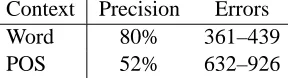
When the context is defined as identical words, we obtain 500 variationn-grams. Sampling 100 of these and labeling for each position whether it is an error or an ambiguity, we find that 80 out of the 100 samples point to at least one token error. The 95% confidence interval for this point estimate of .80 is
6The 95% confidence interval was calculated using the
stan-dard formula ofp±1.96
q
p(1−p)
n , wherepis the point estimate
andnthe sample size.
(0.7216, 0.8784), so we are 95% confident that the true number of error types is between 361 and 439. Note that this precision is comparable to the esti-mates for continuous syntactic annotation in Dick-inson and Meurers (2003b) of 71% (with null ele-ments) and 78.9% (without null eleele-ments).
When the context is defined as identical parts of speech, as described in section 4.3.1, we obtain 1498 variationn-grams. Again sampling 100 of these, we find that 52 out of the 100 point to an error. And the 95% confidence interval for this point estimate of .52 is (0.4221, 0.6179), giving a larger estimated number of errors, between 632 and 926.
[image:7.612.355.499.245.284.2]Context Precision Errors Word 80% 361–439 POS 52% 632–926
Figure 1: Accuracy rates for the different contexts
Words convey more information than part-of-speech tags, and so we see a drop in precision when using part-of-speech tags for context, but these re-sults highlight a very practical benefit of using a generalized context. By generalizing the context, we maintain a precision rate of approximately 50%, and we substantially increase the recall of the method. There are, in fact, likely twice as many errors when using POS contexts as opposed to word contexts. Corpus annotation projects willing to put in some extra effort thus can use this method of finding vari-ationn-grams with a generalized context to detect and correct more errors.
6 Summary and Outlook
We have described the first method for finding er-rors in corpora with graph annotations. We showed how the variationn-gram method can be extended to discontinuous structural annotation, and how this can be done efficiently and with as high a preci-sion as reported for continuous syntactic annotation. Our experiments with the TIGER corpus show that generalizing the context to part-of-speech tags in-creases recall while keeping precision above 50%. The method can thus have a substantial practical benefit when preparing a corpus with discontinuous annotation.
discontinuous constituents, as we have done, has significant potential for future work given the in-creasing number of free word order languages for which corpora and treebanks are being developed.
Acknowledgements We are grateful to George Smith and Robert Langner of the University of Pots-dam TIGER team for evaluating the variation we de-tected in the samples. We would also like to thank the three ACL reviewers for their detailed and help-ful comments, and the participants of the OSU CLip-pers meetings for their encouraging feedback.
References
Ann Bies, Mark Ferguson, Karen Katz and Robert MacIntyre, 1995. Bracketing Guidelines for
Tree-bank II Style Penn TreeTree-bank Project. University
of Pennsylvania.
Philippe Blache and Daniel Hirst, 2000. Multi-level annotation for spoken-language corpora. In
Pro-ceedings of ICSLP-00. Beijing, China.
Sabine Brants, Stefanie Dipper, Silvia Hansen, Wolfgang Lezius and George Smith, 2002. The TIGER Treebank. In Proceedings of TLT-02. So-zopol, Bulgaria.
Harry Bunt and Arthur van Horck (eds.), 1996.
Dis-continuous Constituency. Mouton de Gruyter, Berlin and New York.
John Carroll, Anette Frank, Dekang Lin, Detlef Prescher and Hans Uszkoreit (eds.), 2002.
Pro-ceedings of the LREC Workshop “Beyond PAR-SEVAL. Towards Improved Evaluation Measures for Parsing Systems”, Las Palmas, Gran Canaria.
Markus Dickinson and W. Detmar Meurers, 2003a. Detecting Errors in Part-of-Speech Annotation. In
Proceedings of EACL-03. Budapest, Hungary.
Markus Dickinson and W. Detmar Meurers, 2003b. Detecting Inconsistencies in Treebanks. In
Pro-ceedings of TLT-03. V¨axj¨o, Sweden.
Eleazar Eskin, 2000. Automatic Corpus Correc-tion with Anomaly DetecCorrec-tion. In Proceedings of
NAACL-00. Seattle, Washington.
Edward Fredkin, 1960. Trie Memory. CACM,
3(9):490–499.
Erhard Hinrichs, Julia Bartels, Yasuhiro Kawata, Valia Kordoni and Heike Telljohann, 2000. The T¨ubingen Treebanks for Spoken German, En-glish, and Japanese. In Wolfgang Wahlster (ed.),
Verbmobil: Foundations of Speech-to-Speech Translation, Springer, Berlin, pp. 552–576.
Geoffrey Huck and Almerindo Ojeda (eds.), 1987.
Discontinuous Constituency. Academic Press, New York.
Stig Johansson, 1986. The Tagged LOB Corpus:
Users’ Manual. Norwegian Computing Centre for
the Humanities, Bergen.
Paul Kingsbury, Martha Palmer and Mitch Marcus, 2002. Adding Semantic Annotation to the Penn TreeBank. In Proceedings of HLT-02. San Diego. Pavel Kvˇetˇon and Karel Oliva, 2002. Achieving an Almost Correct PoS-Tagged Corpus. In Petr Sojka, Ivan Kopeˇcek and Karel Pala (eds.), TSD
2002. Springer, Heidelberg, pp. 19–26.
M. Marcus, Beatrice Santorini and M. A. Marcinkiewicz, 1993. Building a large an-notated corpus of English: The Penn Treebank.
Computational Linguistics, 19(2):313–330.
Stefan M¨uller, 2004. Continuous or Discontinu-ous Constituents? A Comparison between Syn-tactic Analyses for Constituent Order and Their Processing Systems. Research on Language and
Computation, 2(2):209–257.
Lluis Padro and Lluis Marquez, 1998. On the Eval-uation and Comparison of Taggers: the Effect of Noise in Testing Corpora. In COLING/ACL-98. Paul Rayson, Dawn Archer, Scott Piao and Tony
McEnery, 2004. The UCREL Semantic Analy-sis System. In Proceedings of the Workshop on
Beyond Named Entity Recognition: Semantic la-belling for NLP tasks. Lisbon, Portugal, pp. 7–12.
Wojciech Skut, Brigitte Krenn, Thorsten Brants and Hans Uszkoreit, 1997. An Annotation Scheme for Free Word Order Languages. In Proceedings
of ANLP-97. Washington, D.C.
Hans van Halteren, 2000. The Detection of Inconsis-tency in Manually Tagged Text. In Anne Abeill´e, Thorsten Brants and Hans Uszkoreit (eds.),
Pro-ceedings of LINC-00. Luxembourg.
Hans van Halteren, Walter Daelemans and Jakub Za-vrel, 2001. Improving Accuracy in Word Class Tagging through the Combination of Machine Learning Systems. Computational Linguistics,