Latent Variable Models of Concept-Attribute Attachment
Joseph Reisinger∗
Department of Computer Sciences The University of Texas at Austin
Austin, Texas 78712
Marius Pas¸ca Google Inc.
1600 Amphitheatre Parkway Mountain View, California 94043
Abstract
This paper presents a set of Bayesian methods for automatically extending the WORDNET ontology with new concepts and annotating existing concepts with generic property fields, orattributes. We base our approach on Latent Dirichlet Al-location and evaluate along two dimen-sions: (1) the precision of the ranked lists of attributes, and (2) the quality of the attribute assignments to WORDNET concepts. In all cases we find that the principled LDA-based approaches outper-form previously proposed heuristic meth-ods, greatly improving the specificity of attributes at each concept.
1 Introduction
We present a Bayesian approach for simultane-ously extending Is-A hierarchies such as those found in WORDNET(WN) (Fellbaum, 1998) with additional concepts, and annotating the resulting concept graph with attributes, i.e., generic prop-erty fields shared by instances of that concept. Ex-amples of attributes include “height” and “eye-color” for the conceptPersonor “gdp” and “pres-ident” for Country. Identifying and extracting such attributes relative to a set of flat (i.e., non-hierarchically organized) labeled classes of in-stances has been extensively studied, using a vari-ety of data, e.g., Web search query logs (Pas¸ca and Van Durme, 2008), Web documents (Yoshinaga and Torisawa, 2007), and Wikipedia (Suchanek et al., 2007; Wu and Weld, 2008).
Building on the current state of the art in at-tribute extraction, we propose a model-based ap-proach for mapping flat sets of attributes anno-tated with class labels into an existing ontology. This inference problem is divided into two main components: (1) identifying the appropriate par-ent concept for each labeled class and (2) learning
∗
Contributions made during an internship at Google.
the correct level of abstraction for each attribute in the extended ontology. For example, consider the task of annotating WN with the labeled class re-naissance painterscontaining the class instances Pisanello, Hieronymus Bosch, and Jan van Eyck and associated with the attributes “famous works” and “style.” Since there is no WN concept for renaissance painters, the latter would need to be mapped into WN under, e.g., Painter. Further-more, since “famous works” and “style” are not specific torenaissance painters (or even the WN concept Painter), they should be placed at the most appropriate level of abstraction, e.g., Artist. In this paper, we show that both of these goals can be realized jointly using a probabilistic topic model, namely hierarchical Latent Dirichlet Allo-cation (LDA) (Blei et al., 2003b).
There are three main advantages to using a topic model as the annotation procedure: (1) Unlike hi-erarchical clustering (Duda et al., 2000), the at-tribute distribution at a concept node is not com-posed of the distributions of its children; attributes found specific to the concept Painter would not need to appear in the distribution of attributes for Person, making the internal distributions at each concept more meaningful as attributes specific to that concept; (2) Since LDA is fully Bayesian, its model semantics allow additional prior informa-tion to be included, unlike standard models such as Latent Semantic Analysis (Hofmann, 1999), im-proving annotation precision; (3) Attributes with multiple related meanings (i.e., polysemous at-tributes) are modeled implicitly: if an attribute (e.g., “style”) occurs in two separate input classes (e.g., poets and car models), then that attribute might attach at two different concepts in the ontol-ogy, which is better than attaching it at their most specific common ancestor (Whole) if that ancestor is too general to be useful. However, there is also a pressure for these two occurrences to attach to a single concept.
We use WORDNET 3.0 as the specific test on-tology for our annotation procedure, and
anticancer drugs: mechanism of action, uses, extrava-sation, solubility, contraindications, side effects, chem-istry, molecular weight, history, mode of action
bollywood actors: biography, filmography, age, bio-data, height, profile, autobiography, new wallpapers, lat-est photos, family pictures
citrus fruits: nutrition, health benefits, nutritional value, nutritional information, calories, nutrition facts, history
european countries: population, flag, climate, presi-dent, economy, geography, currency, population density, topography, vegetation, religion, natural resources
london boroughs: population, taxis, local newspapers, mp, lb, street map, renault connexions, local history
microorganisms: cell structure, taxonomy, life cycle, reproduction, colony morphology, scientific name, vir-ulence factors, gram stain, clipart
renaissance painters: early life, bibliography, short bi-ography, the david, bio, painting, techniques, homosexu-ality, birthplace, anatomical drawings, famous paintings
Figure 1: Examples of labeled attribute sets ex-tracted using the method from (Pas¸ca and Van Durme, 2008).
ate three variants: (1) a fixed structure approach where each flat class is attached to WN using a simple string-matching heuristic, and concept nodes are annotated using LDA, (2) an extension of LDA allowing forsense selectionin addition to annotation, and (3) an approach employing a non-parametric prior over tree structures capable of in-ferring arbitrary ontologies.
The remainder of this paper is organized as fol-lows: §2 describes the full ontology annotation framework, §3 introduces the LDA-based topic models,§4 gives the experimental setup,§5 gives results,§6 gives related work and§7 concludes.
2 Ontology Annotation
Input to our ontology annotation procedure con-sists of sets of class instances (e.g., Pisanello, Hieronymus Bosch) associated with class labels (e.g., renaissance painters) and attributes (e.g., “birthplace”, “famous works”, “style” and “early life”). Clusters of noun phrases (instances) are constructed using distributional similarity (Lin and Pantel, 2002; Hearst, 1992) and are labeled by applying “such-as” surface patterns to raw Web text (e.g., “renaissance painterssuch as Hierony-mous Bosch”), yielding 870K instances in more than 4500 classes (Pas¸ca and Van Durme, 2008).
Attributes for each flat labeled class are ex-tracted from anonymized Web search query logs using the minimally supervised procedure in (Pas¸ca, 2008)1. Candidate attributes are ranked based on their weighted Jaccard similarity to a set of 5 manually provided seed attributes for the
1
Similar query data, including query strings and fre-quency counts, is available from, e.g., (Gao et al., 2007)
LDA
β θ
z α
D
T w η
β θ
z α
D
T w η
c
Fixed Structure LDA
β θ
z α
D
∞ w η
T c
γ
nCRP
T
w
[image:2.595.312.535.67.157.2]w w
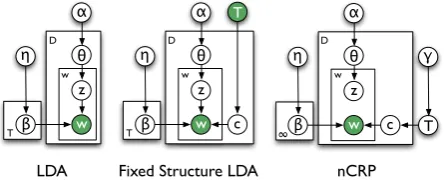
Figure 2: Graphical models for the LDA variants; shaded nodes indicate observed quantities.
classeuropean countries. Figure 1 illustrates sev-eral suchlabeled attribute sets(the underlying in-stances are not depicted). Naturally, the attributes extracted are not perfect, e.g., “lb” and “renault connexions” as attributes forlondon boroughs.
We propose a set of Bayesian generative models based on LDA that take as inputlabeled attribute setsgenerated using an extraction procedure such as the above and organize the attributes in WN ac-cording to their level of generality. Annotating WN with attributes proceeds in three steps: (1) attaching labeled attribute sets to leaf concepts in WN using string distance, (2) inferring an attribute model using one of the LDA variants discussed in
§3, and (3) generating ranked lists of attributes for each concept using the model probabilities (§4.3).
3 Hierarchical Topic Models
3.1 Latent Dirichlet Allocation
The underlying mechanism for our annotation procedure is LDA (Blei et al., 2003b), a fully Bayesian extension of probabilistic Latent Seman-tic Analysis (Hofmann, 1999). GivenD labeled attribute setswd, d∈D, LDA infers an
unstruc-tured set of T latent annotated concepts over which attribute sets decompose as mixtures.2 The latent annotated concepts represent semantically coherent groups of attributes expressed in the data, as shown in Example 1.
The generative model for LDA is given by
θd|α ∼ Dir(α), d∈1. . . D
βt|η ∼ Dir(η), t∈1. . . T
zi,d|θd ∼ Mult(θd), i∈1. . .|wd|
wi,d|βzi,d ∼ Mult(βzi,d), i∈1. . .|wd|
(1) where α and η are hyperparameters smoothing the per-attribute set distribution over concepts and per-concept attribute distribution respectively (see Figure 2 for the graphical model). We are inter-ested in the case wherewis known and we want
2
to compute the conditional posterior of the remain-ing random variablesp(z,β,θ|w). This distribu-tion can be approximated efficiently using Gibbs sampling. See (Blei et al., 2003b) and (Griffiths and Steyvers, 2002) for more details.
(Example 1) Given 26 labeled attribute sets falling into three broad semantic categories: philosophers, writers and actors (e.g., sets for contemporary philosophers,
women writers,bollywood actors), LDA is able to infer a meaningful set of latent annotated concepts:
quotations teachings virtue ethics philosophies biography
sayings
new movies filmography official website
biography email address autobiography
writing style influences achievements
bibliography family tree short biography
(philosopher) (writer) (actor)
(concept labels manually added for the latent annotated concepts are shown in parentheses). Note that with a flat concept structure, attributes can only be separated into broad clusters, so the generality/specificity of attributes cannot be inferred. Parameters wereα=1,η=0.1,T=3.
3.2 Fixed-Structure LDA
In this paper, we extend LDA to model structural dependencies between latent annotated concepts (cf. (Li and McCallum, 2006; Sivic et al., 2008)); In particular, we fix the concept structure to cor-respond to the WN Is-A hierarchy. Each labeled attribute set is assigned to a leaf concept in WN based on the edit distance between the concept la-bel and the attribute set lala-bel. Possible latent con-cepts for this set include the concon-cepts along all paths from its attachment point to the WN root, following Is-A relation edges. Therefore, any two labeled attribute sets share a number of latent con-cepts based on their similarity in WN: all labeled attribute sets share at least the root concept, and may share more concepts depending on their most specific, common ancestor. Under such a model, more general attributes naturally attach to latent concept nodes closer to the root, and more specific attributes attach lower (Example 2).
Formally, we introduce into LDA an extra set of random variablescdidentifying the subset of
con-cepts in T available to attribute set d, as shown in the diagram at the middle of Figure 2.3 For example, with a tree structure, cd would be
con-strained to correspond to the concept nodes in T
on the path from the root to the leaf containingd. Equation 1 can be adapted to this case if the in-dextis taken to range over concepts applicable to attribute setd.
3
Abusing notation, we useTto refer to a structured set of conceptsandto refer to thenumberof concepts in flat LDA
(Example 2) Fixing the latent concept structure to cor-respond to WN (dark/purple nodes), and attaching each labeled attribute set (examples depicted by light/orange nodes) yields the annotated hierarchy:
works picture writings
history biography
philosophy natural rights
criticism ethics
law
literary criticism books essays short stories
novels
tattoos funeral filmography biographies net worth person
philosopher writer actor
scholar intellectual
performer entertainer literate
communicator
bollywood actors women
writers contemporary
philosophers
Attribute distributions for the small nodes are not shown. Dotted lines indicate multiple paths from the root, which can be inferred using sense selection. Unlike with the flat annotated concept structure, with a hierarchical concept structure, attributes can be separated by their generality. Parameters were set atα=1andη=0.1.
3.3 Sense-Selective LDA
For each labeled attribute set, determining the ap-propriate parent concept in WN is difficult since a single class label may be found in many different synsets (for example, the class bollywood actors might attach to the “thespian” sense of Actor or the “doer” sense). Fixed-hierarchy LDA can be extended to perform automatic sense selection by placing a distribution over the leaf conceptsc, de-scribing the prior probability of each possible path through the concept tree. For WN, this amounts to fixing the set of concepts to which a labeled at-tribute set can attach (e.g., restricting it to a seman-tically similar subset) and assigning a probability to each concept (e.g., using the relative WN con-cept frequencies). The probability for each sense attachmentcdbecomes
p(cd|w,c−d,z)∝p(wd|c,w−d,z)p(cd|c−d),
i.e., the complete conditionals for sense selection.
p(cd|c−d)is the conditional probability for
attach-ing attribute set d at cd (e.g., simply the prior
p(cd|c−d)
def
= p(cd) in the WN case). A closed
form expression for p(wd|c,w−d,z) is derived
in (Blei et al., 2003a).
3.4 Nested Chinese Restaurant Process
from data. Unlike the fixed-structure and sense-selective approaches which use the WN hierarchy directly, the nCRP generates its own annotated hi-erarchy whose concept nodes do not necessarily correspond to WN concepts (Example 3). Each node in the tree instead corresponds to a latent an-notated concept with an arbitrary number of sub-concepts, distributed according to a Dirichlet Pro-cess (Ferguson, 1973). Due to its recursive struc-ture, the underlying model is called thenested Chi-nese Restaurant Process (nCRP). The model in Equation 1 is extended withcd|γ ∼nCRP(γ, L),
d∈Di.e., latent concepts for each attribute set are drawn from an nCRP. The hyperparameterγ con-trols the probability of branching via the per-node Dirichlet Process, and L is the fixed tree depth. An efficient Gibbs sampling procedure is given in (Blei et al., 2003a).
(Example 3) Applying nCRP to the same three semantic categories: philosophers, writers and actors, yields the model:
biography date of birth
childhood picture
family
works books quotations
critics poems
teachings virtue ethics structuralism philosophies political theory
criticism short stories
style poems complete works
accomplishments official website
profile life story achievements
filmography pictures new movies
official site works
(root)
(philosopher) (writer) (actor)
bollywood actors women
writers contemporary
philosophers
(manually added labels are shown in parentheses). Un-like in WN, the inferred structure naturally places philosopher and writer under the same subconcept, which is also separate from actor. Hyperparameters were α=0.1,η=0.1,γ=1.0.
4 Experimental Setup
4.1 Data Analysis
We employ two data sets derived using the pro-cedure in (Pas¸ca and Van Durme, 2008): the full set of automatic extractions generated in§2, and a subsetconsisting of all attribute sets that fall under the hierarchies rooted at the WN concepts living thing#1 (i.e., the first sense ofliving thing), sub-stance#7, location#1, person#1, organization#1 and food#1, manually selected to cover a high-precision subset of labeled attribute sets. By com-paring the results across the two datasets we can
measure each model’s robustness to noise. In thefulldataset, there are 4502 input attribute sets with a total of 225K attributes (24K unique), of which 8121 occur only once. The 10 attributes occurring in the most sets (history, definition, pic-ture(s), images, photos, clipart, timeline, clip art, types) account for 6% of the total. For thesubset, there are 1510 attribute sets with 76K attributes (11K unique), of which 4479 occur only once.
4.2 Model Settings
Baseline: Each labeled attribute set is mapped to the most common WN concept with the closest la-bel string distance (Pas¸ca, 2008). Attributes are propagated up the tree, attaching to nodecif they are contained in a majority ofc’s children.
LDA: LDA is used to infer a flat set ofT = 300
latent annotated concepts describing the data. The concept selection smoothing parameter is set as
α=100. The smoother for the per-concept multi-nomial over words is set asη=0.1.4The effects of concept structure on attribute precision can be iso-lated by comparing the structured models to LDA.
Fixed-Structure LDA (fsLDA): The latent
con-cept hierarchy is fixed based on WN (§3.2), and labeled attribute sets are mapped into it as in base-line. The concept graph for each labeled attribute setwdis decomposed into (possibly overlapping)
chains, one for each unique path from the WN root towd’s attachment point. Each path is assigned a
copywd, reducing the bias in attribute sets with
many unique ancestor concepts.5 The final
mod-els contain 6566 annotated concepts on average.
Sense-Selective LDA (ssLDA): For the sense se-lective approach (§ 3.3), the set of possible sense attachments for each attribute set is taken to be all WN concepts with the lowest edit distance to its label, and the conditional probability of each sense attachmentp(cd)is set proportional to its relative
frequency. This procedure results in 2 to 3 senses per attribute set on average, yielding models with 7108 annotated concepts.
Arbitrary hierarchy (nCRP): For the arbitrary
hierarchy model (§ 3.4), we set the maximum tree depth L=5, per-concept attribute smoother
η=0.05, concept assignment smootherα=10and nCRP branching proportionγ=1.0. The resulting
4
(Parameter setting)Across all models, the main results in this paper are robust to changes inα. For nCRP, changes inηandγaffect the size of the learned model but have less effect on the final precision. Larger values forL give the model more flexibility, but take longer to train.
5
models span 380 annotated concepts on average.
4.3 Constructing Ranked Lists of Attributes
Given an inferred model, there are several ways to construct ranked lists of attributes:
Per-Node Distribution: In fsLDA and ssLDA,
attribute rankings can be constructed directly for each WN conceptc, by computing the likelihood of attributewattaching toc,L(c|w) =p(w|c) av-eraged over all Gibbs samples (discarding a fixed number of samples for burn-in). Sincec’s attribute distribution is not dependent on the distributions of its children, the resulting distribution is biased towards more specific attributes.
Class-Entropy (CE): In all models, the inferred latent annotated concepts can be used to smooth the attribute rankings for each labeled attribute set. Each sample from the posterior is composed of two components: (1) a multinomial distribution over a set of WN nodes, p(c|wd, α) for each
at-tribute setwd, where the (discrete) values ofcare
WN concepts, and (2) a multinomial distribution over attributesp(w|c, η) for each WN conceptc. To compute an attribute ranking forwd, we have
p(w|wd) =
X
c
p(w|c, η)p(c|wd, α).
Given this new ranking for each attribute set, we can compute new rankings for each WN concept
c by averaging again over all thewd that appear
as (possible indirect) descendants ofc. Thus, this method uses LDA to first perform reranking on the raw extractions before applying the baseline ontol-ogy induction procedure (§4.2).6
CE ranking exhibits a “conservation of entropy” effect, whereby the proportion of general to spe-cific attributes in each attribute setwdremains the
same in the posterior. If setAcontains 10 specific attributes and 30 generic ones, then the latter will be favored over the former in the resulting distri-bution 3 to 1. Conservation of entropy is a strong assumption, and in particular it hinders improving thespecificityof attribute rankings.
Class-Entropy+Prior: The LDA-based models
do not inherently make use of any ranking infor-mation contained in the original extractions. How-ever, such information can be incorporated in the form of a prior. The final ranking method com-bines CE with an exponential prior over the at-tribute rank in the baseline extraction. For each attribute set, we compute the probability of each
6
One simple extension is to run LDA again on the CE ranked output, yielding an iterative procedure; however, this was not found to significantly affect precision.
attributep(w|wd) = plda(w|wd)pbase(w|wd),
as-suming a parametric form for pbase(w|wd)
def
= θr(w,wd). Here, r(w,w
d) is the rank of w in
at-tribute setd. In all experiments reported,θ=0.9.
4.4 Evaluating Attribute Attachment
For the WN-based models, in addition to mea-suring the average precision of the reranked at-tributes, it is also useful to evaluate the assign-ment of attributes to WN concepts. For this eval-uation, human annotators were asked to determine the most appropriate WN synset(s) for a set of gold attributes, taking into account polysemous usage. For each model, ranked lists of possible concept assignmentsC(w)are generated for each attribute
w, usingL(c|w)for ranking. The accuracy of a list
C(w)for an attribute wis measured by a scoring metric that corresponds to a modification (Pas¸ca and Alfonseca, 2009) of the mean reciprocal rank score (Voorhees and Tice, 2000):
DRR= max 1
rank(c)×(1 +P athT oGold)
whererank(c)is the rank (from 1 up to 10) of a conceptcinC(w), and PathToGold is the length of the minimum path along Is-A edges in the con-ceptual hierarchies between the conceptc, on one hand, and any of the gold-standard concepts man-ually identified for the attribute w, on the other hand. The length PathToGold is 0, if the returned concept is the same as the gold-standard concept. Conversely, a gold-standard attribute receives no credit (that is, DRR is 0) if no path is found in the hierarchies between the top 10 concepts of
C(w)and any of the gold-standard concepts, or if
C(w) is empty. The overalll precision of a given model is the average of the DRR scores of individ-ual attributes, computed over the gold assignment set (Pas¸ca and Alfonseca, 2009).
5 Results
5.1 Attribute Precision
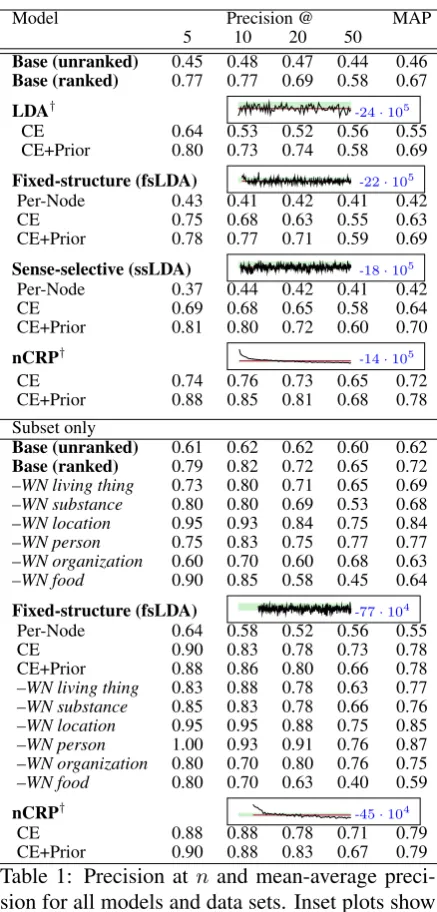
Precision was manually evaluated relative to 23 concepts chosen for broad coverage.7 Table 1 shows precision atnand the Mean Average Preci-sion (MAP); In all LDA-based models, the Bayes average posterior is taken over all Gibbs samples
7
Model Precision @ MAP
5 10 20 50
Base (unranked) 0.45 0.48 0.47 0.44 0.46
Base (ranked) 0.77 0.77 0.69 0.58 0.67
LDA† -24·105
CE 0.64 0.53 0.52 0.56 0.55
CE+Prior 0.80 0.73 0.74 0.58 0.69
Fixed-structure (fsLDA) -22·105
Per-Node 0.43 0.41 0.42 0.41 0.42
CE 0.75 0.68 0.63 0.55 0.63
CE+Prior 0.78 0.77 0.71 0.59 0.69
Sense-selective (ssLDA) -18·105
Per-Node 0.37 0.44 0.42 0.41 0.42
CE 0.69 0.68 0.65 0.58 0.64
CE+Prior 0.81 0.80 0.72 0.60 0.70
nCRP† -14·105
CE 0.74 0.76 0.73 0.65 0.72
CE+Prior 0.88 0.85 0.81 0.68 0.78
Subset only
Base (unranked) 0.61 0.62 0.62 0.60 0.62
Base (ranked) 0.79 0.82 0.72 0.65 0.72
–WN living thing 0.73 0.80 0.71 0.65 0.69
–WN substance 0.80 0.80 0.69 0.53 0.68
–WN location 0.95 0.93 0.84 0.75 0.84
–WN person 0.75 0.83 0.75 0.77 0.77
–WN organization 0.60 0.70 0.60 0.68 0.63
–WN food 0.90 0.85 0.58 0.45 0.64
Fixed-structure (fsLDA) -77·104
Per-Node 0.64 0.58 0.52 0.56 0.55
CE 0.90 0.83 0.78 0.73 0.78
CE+Prior 0.88 0.86 0.80 0.66 0.78
–WN living thing 0.83 0.88 0.78 0.63 0.77
–WN substance 0.85 0.83 0.78 0.66 0.76
–WN location 0.95 0.95 0.88 0.75 0.85
–WN person 1.00 0.93 0.91 0.76 0.87
–WN organization 0.80 0.70 0.80 0.76 0.75
–WN food 0.80 0.70 0.63 0.40 0.59
nCRP† -45·104
CE 0.88 0.88 0.78 0.71 0.79
[image:6.595.72.291.59.516.2]CE+Prior 0.90 0.88 0.83 0.67 0.79
Table 1: Precision at n and mean-average preci-sion for all models and data sets. Inset plots show log-likelihood of each Gibbs sample, indicating convergence except in the case of nCRP. † indi-cates models that do not generate annotated con-cepts corresponding to WN nodes and hence have no per-node scores.
after burn-in.8 The improvements in average pre-cision are important, given the amount of noise in the raw extracted data.
When prior attribute rank information (Per-Node and CE scores) from the baseline extractions isnotincorporated, all LDA-based models outper-form the unranked baseline (Table 1). In particu-lar, LDA yields a 17% reduction in error (MAP)
8
(Bayes average vs. maximum a-posteriori) The full Bayesian average posterior consistently yielded higher preci-sion than the maximum a-posteriori model. For the per-node distributions, the fsLDA Bayes average model exhibits a 17% reduction in relative error over the maximum a-posteriori es-timate and for ssLDA there was a 26% reduction.
Model DRR Scores
all (n) found (n)
Base (unranked) 0.14 (150) 0.24 (91)
Base (ranked) 0.17 (150) 0.21 (123)
Fixed-structure
(fsLDA) 0.31 (150) 0.37 (128)
Sense-selective
(ssLDA) 0.31 (150) 0.37 (128)
Subset only
Base (unranked) 0.15 (97) 0.27 (54)
Base (ranked) 0.18 (97) 0.24 (74)
WN living thing 0.29 (27) 0.35 (22)
WN substance 0.21 (12) 0.32 (8)
WN location 0.12 (30) 0.17 (20)
WN person 0.37 (18) 0.44 (15)
WN organization 0.15 (31) 0.17 (27)
WN food 0.15 (6) 0.22 (4)
Fixed-structure
(fsLDA) 0.37 (97) 0.47 (77)
WN living thing 0.45 (27) 0.55 (22)
WN substance 0.48 (12) 0.64 (9)
WN location 0.34 (30) 0.44 (23)
WN person 0.44 (18) 0.52 (15)
WN organization 0.44 (31) 0.71 (19)
WN food 0.60 (6) 0.72 (5)
Table 2: All measures the DRR score relative to the entire gold assignment set; found measures DRR only for attributes with DRR(w)>0;nis the number of scores averaged.
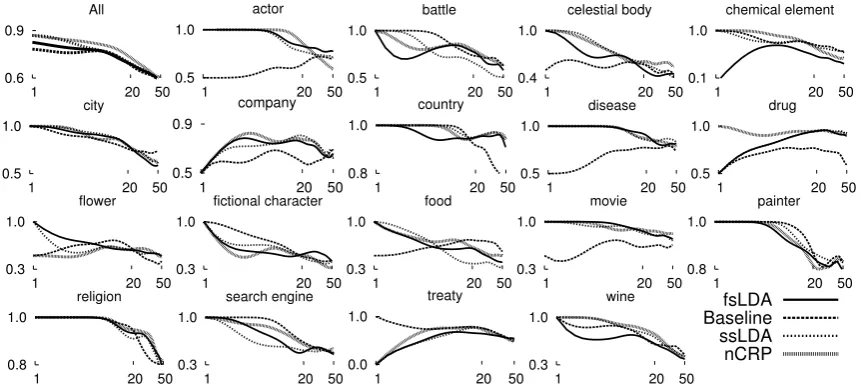
over the baseline, fsLDA yields a 31% reduction, ssLDA yields a 33% reduction and nCRP yields a 48% reduction (24% reduction over fsLDA). Performance also improves relative to theranked baseline when prior ranking information is incor-porated in the LDA-based models, as indicated by CE+Prior scores in Table 1. LDA and fsLDA reduce relative error by 6%, ssLDA by 9% and nCRP by 33%. Furthermore, nCRP precision without ranking information surpasses the base-line with ranking information, indicating robust-ness to extraction noise. Precision curves for indi-vidual attribute sets are shown in Figure 3. Over-all, learning unconstrained hierarchies (nCRP) in-creases precision, but as the inferred node distri-butions do not correspond to WN concepts they cannot be used for annotation.
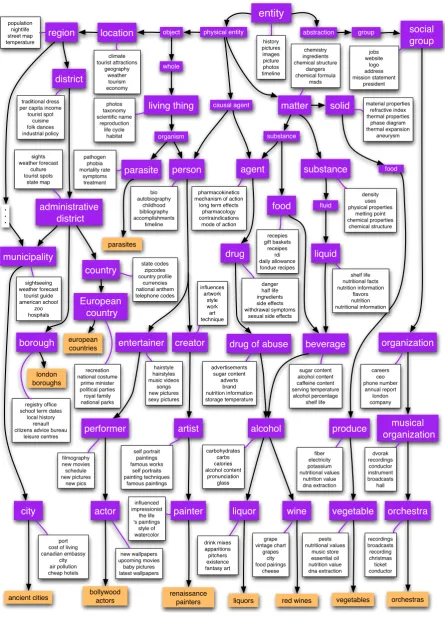
One benefit to using an admixture model like LDA is that each concept node in the resulting model contains a distribution over attributes spe-cific only to that node (in contrast to, e.g., hierar-chical agglomerative clustering). Although abso-lute precision is lower as more general attributes have higher average precision (Per-Node scores in Table 1), these distributions are semantically meaningful in many cases (Figure 4) and further-more can be used to calculate concept assignment precision for each attribute.9
[image:6.595.309.528.64.320.2]evalu-Figure 3: Precision (%) vs. rank plots (log scale) of attributes broken down across 18 labeled test attribute sets. Ranked lists of attributes are generated using the CE+Prior method.
5.2 Concept Assignment Precision
The precision of assigning attributes to various concepts is summarized in Table 2. Two scores are given:allmeasures DRR relative to the entire gold assignment set, andfoundmeasures DRR only for attributes with DRR(w)>0. Comparing the scores gives an estimate of whether coverage or precision is responsible for differences in scores. fsLDA and ssLDA both yield a 20% reduction in relative er-ror (17.2% increase in absolute DRR) over the un-ranked baseline and a 17.2% reduction (14.2% ab-solute increase) over the ranked baseline.
5.3 Subset Precision and DRR
Precision scores for the manually selected subset of extractions are given in the second half of Ta-ble 1. Relative to the unranked baseline, fsLDA and nCRP yield 42% and 44% reductions in er-ror respectively, and relative to the ranked base-line they both yield a 21.4% reduction. In terms of absolute precision, there is no benefit to adding in prior ranking knowledge to fsLDA or nCRP, in-dicating diminishing returns as average baseline precision increases (Baseline vs. fsLDA/nCRP CE scores). Broken down across each of the subhier-archies, LDA helps in all cases exceptfood.
DRR scores for the subset are given in the lower half of Table 2. Averaged over all gold test at-tributes, DRR scores double when using fsLDA. These results can be misleading, however, due to artificially low coverage. Hence, Table 2 also shows DRR scores broken down over each sub-hierarchy, In this case fsLDA more than doubles the DRR relative to the baseline forsubstanceand location, and triples it fororganizationandfood.
ated for LDA or nCRP, because they are not mapped to WN.
6 Related Work
A large body of previous work exists on extend-ing WORDNET with additional concepts and in-stances (Snow et al., 2006; Suchanek et al., 2007); these methods do not address attributes directly. Previous literature in attribute extraction takes ad-vantage of a range of data sources and extraction procedures (Chklovski and Gil, 2005; Tokunaga et al., 2005; Pas¸ca and Van Durme, 2008; Yoshi-naga and Torisawa, 2007; Probst et al., 2007; Van Durme et al., 2008; Wu and Weld, 2008). How-ever these methods do not address the task of de-termining the level of specificity for each attribute. The closest studies to ours are (Pas¸ca, 2008), im-plemented as the baseline method in this paper; and (Pas¸ca and Alfonseca, 2009), which relies on heuristics rather than formal models to estimate the specificity of each attribute.
7 Conclusion
[image:7.595.84.517.61.254.2]entity physical entity bollywood actors actor new wallpapers upcoming movies baby pictures latest wallpapers performer filmography new movies schedule new pictures new pics entertainer hairstyle hairstyles music videos songs new pictures sexy pictures person bio autobiography childhood bibliography accomplishments timeline organism causal agent living thing photos taxonomy scientific name reproduction life cycle habitat whole object history pictures images picture photos timeline renaissance painters painter influenced impressionist the life 's paintings style of watercolor artist self portrait paintings famous works self portraits painting techniques famous paintings creator influences artwork style work art technique european countries European country recreation national costume prime minister political parties royal family national parks
country state codeszipcodes country profile currencies national anthem telephone codes administrative district sights weather forecast culture tourist spots state map district traditional dress per capita income tourist spot cuisine folk dances industrial policy region population nightlife street map temperature location climate tourist attractions geography weather tourism economy drug danger half life ingredients side effects withdrawal symptoms
sexual side effects
agent
pharmacokinetics mechanism of action
long term effects pharmacology contraindications
mode of action
substance matter chemistry ingredients chemical structure dangers chemical formula msds liquors liquor drink mixes apparitions pitchers existence fantasy art alcohol carbohydrates carbs calories alcohol content pronunciation glass beverage drug of abuse
sugar content alcohol content caffeine content serving temperature alcohol percentage shelf life liquid food advertisements sugar content adverts brand nutrition information storage temperature shelf life nutritional facts nutrition information flavors nutrition nutritional information fluid recepies gift baskets receipes rdi daily allowance fondue recipes substance density uses physical properties melting point chemical properties chemical structure abstraction london boroughs borough registry office school term dates
local history renault citizens advice bureau
leisure centres vegetables vegetable pests nutritional values music store essential oil nutrition value dna extraction produce fiber electricity potassium nutritional values nutrition value dna extraction food
[image:8.595.78.524.67.689.2]solid material properties refractive index thermal properties phase diagram thermal expansion aneurysm parasites parasite pathogen phobia mortality rate symptoms treatment orchestras orchestra recordings broadcasts recording christmas ticket conductor musical organization dvorak recordings conductor instrument broadcasts hall organization careers ceo phone number annual report london company social group jobs website logo address mission statement president group ancient cities city port cost of living canadian embassy city air pollution cheap hotels municipality sightseeing weather forecast tourist guide american school zoo hospitals • • • red wines wine grape vintage chart grapes city food pairings cheese
References
D. Blei, T. Griffiths, M. Jordan, and J. Tenenbaum. 2003a. Hierarchical topic models and the nested Chinese restaurant process. In Proceedings of the 17th Conference on Neural Information Process-ing Systems (NIPS-2003), pages 17–24, Vancouver, British Columbia.
D. Blei, A. Ng, and M. Jordan. 2003b. Latent dirich-let allocation. Machine Learning Research, 3:993– 1022.
T. Chklovski and Y. Gil. 2005. An analysis of knowl-edge collected from volunteer contributors. In Pro-ceedings of the 20th National Conference on Arti-ficial Intelligence (AAAI-05), pages 564–571, Pitts-burgh, Pennsylvania.
R. Duda, P. Hart, and D. Stork. 2000.Pattern Classifi-cation. John Wiley and Sons.
C. Fellbaum, editor. 1998. WordNet: An Electronic Lexical Database and Some of its Applications. MIT Press.
T. Ferguson. 1973. A bayesian analysis of some non-parametric problems. Annals of Statistics, 1(2):209– 230.
W. Gao, C. Niu, J. Nie, M. Zhou, J. Hu, K. Wong, and H. Hon. 2007. Cross-lingual query suggestion using query logs of different languages. InProceedings of the 30th ACM Conference on Research and Devel-opment in Information Retrieval (SIGIR-07), pages 463–470, Amsterdam, The Netherlands.
T. Griffiths and M. Steyvers. 2002. A probabilistic ap-proach to semantic representation. InProceedings of the 24th Conference of the Cognitive Science So-ciety (CogSci02), pages 381–386, Fairfax, Virginia.
M. Hearst. 1992. Automatic acquisition of hy-ponyms from large text corpora. InProceedings of the 14th International Conference on Computational Linguistics (COLING-92), pages 539–545, Nantes, France.
T. Hofmann. 1999. Probabilistic latent semantic in-dexing. In Proceedings of the 22nd ACM Confer-ence on Research and Development in Information Retrieval (SIGIR-99), pages 50–57, Berkeley, Cali-fornia.
W. Li and A. McCallum. 2006. Pachinko alloca-tion: DAG-structured mixture models of topic cor-relations. In Proceedings of the 23rd International Conference on Machine Learning (ICML-06), pages 577–584, Pittsburgh, Pennsylvania.
D. Lin and P. Pantel. 2002. Concept discovery from text. InProceedings of the 19th International Con-ference on Computational linguistics (COLING-02), pages 1–7, Taipei, Taiwan.
M. Pas¸ca and E. Alfonseca. 2009. Web-derived re-sources for Web Information Retrieval: From con-ceptual hierarchies to attribute hierarchies. In Pro-ceedings of the 32nd International Conference on Research and Development in Information Retrieval (SIGIR-09), Boston, Massachusetts.
M. Pas¸ca and B. Van Durme. 2008. Weakly-supervised acquisition of open-domain classes and class attributes from web documents and query logs. InProceedings of the 46th Annual Meeting of the As-sociation for Computational Linguistics (ACL-08), pages 19–27, Columbus, Ohio.
M. Pas¸ca. 2008. Turning Web text and search queries into factual knowledge: Hierarchical class attribute extraction. InProceedings of the 23rd Na-tional Conference on Artificial Intelligence (AAAI-08), pages 1225–1230, Chicago, Illinois.
K. Probst, R. Ghani, M. Krema, A. Fano, and Y. Liu. 2007. Semi-supervised learning of attribute-value pairs from product descriptions. InProceedings of the 20th International Joint Conference on Artificial Intelligence (IJCAI-07), pages 2838–2843, Hyder-abad, India.
J. Sivic, B. Russell, A. Zisserman, W. Freeman, and A. Efros. 2008. Unsupervised discovery of visual object class hierarchies. InProceedings of the IEEE Conference on Computer Vision and Pattern Recog-nition (CVPR-08), pages 1–8, Anchorage, Alaska.
R. Snow, D. Jurafsky, and A. Ng. 2006. Semantic tax-onomy induction from heterogenous evidence. In Proceedings of the 21st International Conference on Computational Linguistics and 44th Annual Meet-ing of the Association for Computational LMeet-inguistics (COLING-ACL-06), pages 801–808, Sydney, Aus-tralia.
F. Suchanek, G. Kasneci, and G. Weikum. 2007. Yago: a core of semantic knowledge unifying WordNet and Wikipedia. InProceedings of the 16th World Wide Web Conference (WWW-07), pages 697–706, Banff, Canada.
K. Tokunaga, J. Kazama, and K. Torisawa. 2005. Au-tomatic discovery of attribute words from Web doc-uments. In Proceedings of the 2nd International Joint Conference on Natural Language Processing (IJCNLP-05), pages 106–118, Jeju Island, Korea.
B. Van Durme, T. Qian, and L. Schubert. 2008. Class-driven attribute extraction. In Proceedings of the 22nd International Conference on Computa-tional Linguistics (COLING-2008), pages 921–928, Manchester, United Kingdom.
E.M. Voorhees and D.M. Tice. 2000. Building a question-answering test collection. InProceedings of the 23rd International Conference on Research and Development in Information Retrieval (SIGIR-00), pages 200–207, Athens, Greece.
F. Wu and D. Weld. 2008. Automatically refining the Wikipedia infobox ontology. InProceedings of the 17th World Wide Web Conference (WWW-08), pages 635–644, Beijing, China.