Multilingual Pseudo-Relevance Feedback: Performance Study of
Assisting Languages
Manoj K. Chinnakotla Karthik Raman Pushpak Bhattacharyya
Department of Computer Science and Engineering Indian Institute of Technology, Bombay,
Mumbai, India
{manoj,karthikr,pb}@cse.iitb.ac.in
Abstract
In a previous work of ours Chinnakotla et al. (2010) we introduced a novel framework for Pseudo-Relevance Feed-back (PRF) called MultiPRF. Given a query in one language calledSource, we used English as theAssisting Languageto improve the performance of PRF for the source language. MulitiPRF showed re-markable improvement over plain Model Based Feedback (MBF) uniformly for 4 languages,viz., French, German,
Hungar-ian and Finnish with English as the
as-sisting language. This fact inspired us to study the effect ofany source-assistant pair on MultiPRF performance from out of a set of languages with widely differ-ent characteristics, viz., Dutch, English,
Finnish, French, German and Spanish.
Carrying this further, we looked into the effect of usingtwo assisting languages
to-getheron PRF.
The present paper is a report of these in-vestigations, their results and conclusions drawn therefrom. While performance im-provement on MultiPRF is observed what-ever the assisting language and whatwhat-ever the source, observations are mixed when two assisting languages are used simul-taneously. Interestingly, the performance improvement is more pronounced when the source and assisting languages are closely related, e.g., French and Spanish.
1 Introduction
The central problem of Information Retrieval (IR) is to satisfy the user’s information need, which is typically expressed through a short (typically 2-3 words) and often ambiguous query. The problem of matching the user’s query to the documents is rendered difficult by natural language phenomena
likemorphological variations,polysemyand
syn-onymy. Relevance Feedback (RF) tries to
over-come these problems by eliciting user feedback on the relevance of documents obtained from the initial ranking and then uses it to automatically refine the query. Since user input is hard to ob-tain, Pseudo-Relevance Feedback (PRF) (Buckley et al., 1994; Xu and Croft, 2000; Mitra et al., 1998) is used as an alternative, wherein RF is performed
byassumingthe topkdocuments from the initial
retrieval as beingrelevantto the query. Based on the above assumption, the terms in the feedback document set are analyzed to choose the most dis-tinguishing set of terms that characterize the feed-back documents and as a result the relevance of a document. Query refinement is done by adding the terms obtained through PRF, along with their weights, to the actual query.
Although PRF has been shown to improve re-trieval, it suffers from the following drawbacks: (a) the type of term associations obtained for query expansion is restricted to co-occurrence based re-lationships in the feedback documents, and thus other types of term associations such as lexical and semantic relations (morphological variants, syn-onyms) are not explicitly captured, and (b) due to the inherent assumption in PRF,i.e., relevance of topk documents, performance is sensitive to that of the initial retrieval algorithm and as a result is not robust.
Multilingual Pseudo-Relevance Feedback
(MultiPRF) (Chinnakotla et al., 2010) is a novel
framework for PRF to overcome both the above limitations of PRF. It does so by taking the help of a different language called theassisting language. In MultiPRF, given a query in source language
L1, the query is automatically translated into
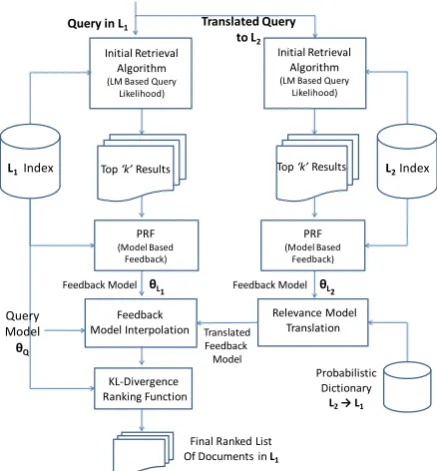
the assisting language L2 and PRF performed in the assisting language. The resultant terms are translated back into L1 using a probabilistic bi-lingual dictionary. The translated feedback
model, is then combined with the original feed-back model ofL1to obtain the final model which is used to re-rank the corpus. MulitiPRF showed remarkable improvement on standard CLEF collections over plain Model Based Feedback (MBF) uniformly for 4 languages, viz., French,
German, HungarianandFinnish withEnglish as
the assisting language. This fact inspired us to study the effect of any source-assistant pair on PRF performance from out of a set of languages with widely different characteristics, viz., Dutch,
English, Finnish, French, German and Spanish.
Carrying this further, we looked into the effect of usingtwo assisting languages togetheron PRF.
The present paper is a report of these in-vestigations, their results and conclusions drawn therefrom. While performance improvement on PRF is observed whatever the assisting language and whatever the source, observations are mixed when two assisting languages are used simulta-neously. Interestingly, the performance improve-ment is more pronounced when the source and as-sisting languages areclosely related, e.g., French and Spanish.
The paper is organized as follows: Section 2, discusses the related work. Section 3, explains the Language Modeling (LM) based PRF approach. Section 4, describes the MultiPRF approach. Sec-tion 5 discusses the experimental set up. SecSec-tion 6 presents the results, and studies the effect of vary-ing the assistvary-ing language and incorporates mul-tiple assisting languages. Finally, Section 7 con-cludes the paper by summarizing and outlining fu-ture work.
2 Related Work
PRF has been successfully applied in various IR frameworks like vector space models, probabilis-tic IR and language modeling (Buckley et al., 1994; Jones et al., 2000; Lavrenko and Croft, 2001; Zhai and Lafferty, 2001). Several ap-proaches have been proposed to improve the per-formance and robustness of PRF. Some of the rep-resentative techniques are (i) Refining the feed-back document set (Mitra et al., 1998; Sakai et al., 2005), (ii) Refining the terms obtained through PRF by selecting good expansion terms (Cao et al., 2008) and (iii) Using selective query expan-sion (Amati et al., 2004; Cronen-Townsend et al., 2004) and (iv) Varying the importance of docu-ments in the feedback set (Tao and Zhai, 2006). Another direction of work, often reported in the
TREC Robust Track, is to use a large external col-lection like Wikipedia or the Web as a source of expansion terms (Xu et al., 2009; Voorhees, 2006). The intuition behind the above approach is that if the query does not have many relevant docu-ments in the collection then any improvedocu-ments in the modeling of PRF is bound to perform poorly due to query drift.
Several approaches have been proposed for including different types of lexically and se-mantically related terms during query expansion. Voorhees (1994) use Wordnet for query expan-sion and report negative results. Recently, random walk models (Lafferty and Zhai, 2001; Collins-Thompson and Callan, 2005) have been used to learn a rich set of term level associations by com-bining evidence from various kinds of information sources like WordNet, Webetc. Metzler and Croft (2007) propose a feature based approach called
la-tent concept expansionto model term
dependen-cies.
All the above mentioned approaches use the re-sources availablewithin the language to improve the performance of PRF. However, we make use of
asecond languageto improve the performance of
PRF. Our proposed approach is especially attrac-tive in the case of resource-constrained languages where the original retrieval is bad due to poor cov-erage of the collection and/or inherent complexity of query processing (for exampleterm conflation) in those languages.
(2008) uses English to improve the performance over a subset of Chinese queries whose transla-tions in English are unambiguous. They use inter-document similarities across languages to improve the ranking performance. However, cross lan-guage document similarity measurement is in it-self known to be an hard problem and the scale of their experimentation is quite small.
3 PRF in the LM Framework
The Language Modeling (LM) Framework allows PRF to be modelled in a principled manner. In the LM approach, documents and queries are modeled using multinomial distribution over words called document language modelP(w|D)andquery lan-guage modelP(w|ΘQ)respectively. For a given query, the document language models are ranked based on their proximity to the query language model, measured using KL-Divergence.
KL(ΘQ||D) =
X
w
P(w|ΘQ)·log
P(w|ΘQ)
P(w|D)
Since the query length is short, it is difficult to es-timate ΘQ accurately using the query alone. In PRF, the topkdocuments obtained through the ini-tial ranking algorithm are assumed to be relevant and used as feedback for improving the estima-tion ofΘQ. The feedback documents contain both relevant and noisy terms from which the feedback language model is inferred based on a Generative Mixture Model (Zhai and Lafferty, 2001).
LetDF = {d1, d2, . . . , dk} be the topk docu-ments retrieved using the initial ranking algorithm. Zhai and Lafferty (Zhai and Lafferty, 2001) model the feedback document setDF as a mixture of two distributions: (a) thefeedback language modeland (b) the collection model P(w|C). The feedback language model is inferred using the EM Algo-rithm (Dempster et al., 1977), which iteratively accumulates probability mass on the most
distin-guishing terms, i.e. terms which are more
fre-quent in the feedback document set than in the entire collection. To maintain query focus the fi-nal converged feedback model,ΘF is interpolated with the initial query modelΘQto obtain the final query modelΘF inal.
ΘF inal= (1−α)·ΘQ+α·ΘF
ΘF inal is used to re-rank the corpus using the KL-Divergence ranking function to obtain the fi-nal ranked list of documents. Henceforth, we refer
Initial Retrieval Algorithm
(LM Based Query Likelihood)
Initial Retrieval Algorithm
(LM Based Query Likelihood)
Top ‘k’Results Top ‘k’Results
PRF
(Model Based Feedback)
PRF
(Model Based Feedback)
L1Index L2 Index
Final Ranked List Of Documents in L1
Feedback Model Interpolation
Relevance Model Translation
KL-Divergence Ranking Function
Feedback Model θL2 Feedback Model θL1
Query in L1 Translated Query
to L2
Probabilistic Dictionary
L2→ L1
Translated Feedback Model
Query Model
[image:3.595.308.527.62.298.2]θQ
Figure 1:Schematic of the Multilingual PRF Approach
Symbol Description
ΘQ Query Language Model
ΘF
L1 Feedback Language Model obtained from PRF inL1
ΘF
L2 Feedback Language Model obtained from PRF inL2
ΘT ransL
1 Feedback Model Translated fromL2toL1 t(f|e) Probabilistic Bi-Lingual Dictionary fromL2toL1 β, γ Interpolation coefficients coefficients used in MultiPRF
Table 2:Glossary of Symbols used in explaining MultiPRF
to the above technique asModel Based Feedback
(MBF).
4 Multilingual PRF (MultiPRF)
The schematic of the MultiPRF approach is shown in Figure 1. Given a queryQ in the source lan-guage L1, we automatically translate the query into the assisting languageL2. We then rank the documents in the L2 collection using the query likelihood ranking function (John Lafferty and Chengxiang Zhai, 2003). Using the top k doc-uments, we estimate the feedback model using MBF as described in the previous section. Simi-larly, we also estimate a feedback model using the original query and the topk documents retrieved from the initial ranking in L1. Let the resultant feedback models be ΘFL2 and ΘFL1 respectively. The feedback model estimated in the assisting lan-guage ΘFL2 is translated back into language L1 using a probabilistic bi-lingual dictionary t(f|e) fromL2 →L1as follows:
P(f|ΘT ransL
1 ) =
X
∀e inL2
t(f|e)·P(e|ΘFL
2) (1)
[image:3.595.307.533.332.413.2]Language CLEF Collection
Identifier Description
No. of Documents
No. of Unique Terms
CLEF Topics (No. of Topics)
English
EN-00+01+02 LA Times 94 113005 174669 -EN-03+05+06 LA Times 94, Glasgow Herald 95 169477 234083 -EN-02+03 LA Times 94, Glasgow Herald 95 169477 234083 91-200 (67)
French
FR-00 Le Monde 94 44013 127065 1-40 (29) FR-01+02 Le Monde 94, French SDA 94 87191 159809 41-140 (88) FR-02+03 Le Monde 94, French SDA 94-95 129806 182214 91-200 (67) FR-03+05 Le Monde 94, French SDA 94-95 129806 182214 141-200,251-300 (99) FR-06 Le Monde 94-95, French SDA 94-95 177452 231429 301-350 (48)
German
DE-00 Frankfurter Rundschau 94, Der Spiegel 94-95 153694 791093 1-40 (33)
DE-01+02 Frankfurter Rundschau 94, Der Spiegel 94-95, German SDA 94 225371 782304 41-140 (85)
DE-02+03 Frankfurter Rundschau 94, Der Spiegel 94-95, German SDA 94-95 294809 867072 91-200 (67)
DE-03 Frankfurter Rundschau 94, Der Spiegel 94-95, German SDA 94-95 294809 867072 141-200 (51)
Finnish FI-02+03+04 Aamulehti 94-95 55344 531160 91-250 (119)
FI-02+03 Aamulehti 94-95 55344 531160 91-200 (67)
Dutch NL-02+03 NRC Handelsblad 94-95, Algemeen Dagblad 94-95 190604 575582 91-200 (67)
[image:4.595.82.518.66.242.2]Spanish ES-02+03 EFE 94, EFE 95 454045 340250 91-200 (67)
Table 1:Details of the CLEF Datasets used for Evaluating the MultiPRF approach. The number shown in brackets of the final column CLEF Topics indicate the actual number of topics used during evaluation.
Source Term Top Aligned Terms in Target
French English
am´ericain american, us, united, state, america nation nation, un, united, state, country e´tude study, research, assess, investigate, survey
German English
flugzeug aircraft, plane, aeroplane, air, flight spiele play, game, stake, role, player verh¨altnis relationship, relate, balance, proportion
Table 3:Top Translation Alternatives for some sample words in Probabilistic Bi-Lingual Dictionary
learned from a parallel sentence-aligned corpora inL1−L2based on word level alignments. Tiede-mann (TiedeTiede-mann, 2001) has shown that the trans-lation alternatives found using word alignments could be used to infer various morphological and semantic relations between terms. In Table 3, we show the top translation alternatives for some
sample words. For example, the French word
am´ericain (american) brings different variants of the translation likeamerican, america, us, united,
state, america which are lexically and
semanti-cally related. Hence, the probabilistic bi-lingual dictionary acts as a rich source of morphologically and semantically related feedback terms. Thus, during this step, of translating the feedback model as given in Equation 1, the translation model adds related terms inL1which have their source as the term from feedback modelΘFL2. The final Multi-PRF model is obtained by interpolating the above translated feedback model with the original query model and the feedback model of languageL1 as given below:
ΘM ultiL
1 = (1−β−γ)·ΘQ+β·Θ
F L1+γ·Θ
T rans L1 (2)
Since we want to retain the query focus during
back translation the feedback model inL2is inter-polated with the translated query before transla-tion of theL2 feedback model. The parametersβ andγ control the relative importance of the orig-inal query model, feedback model ofL1 and the translated feedback model obtained from L1 and are tuned based on the choice ofL1andL2.
5 Experimental Setup
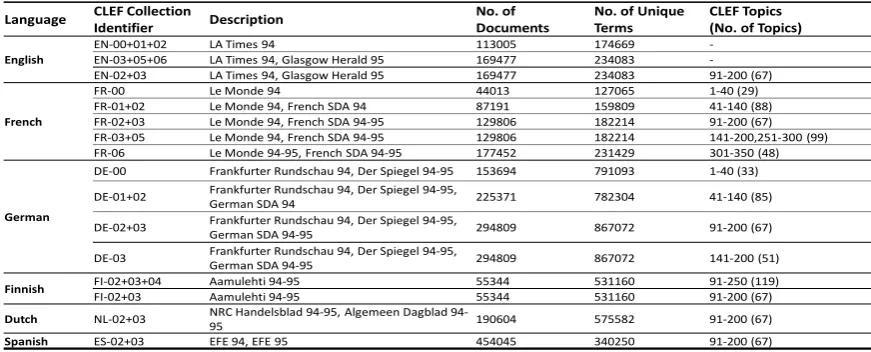
We evaluate the performance of our system us-ing the standard CLEF evaluation data in six lan-guages, widely varying in their familial relation-ships - Dutch, German, English, French, Span-ish and FinnSpan-ish using more than 600 topics. The details of the collections and their corresponding topics used for MultiPRF are given in Table 1. Note that, in each experiment, we choose assist-ing collections such that the topics in the source language are covered in the assisting collection so as to get meaningful feedback terms. In all the top-ics, we only use thetitlefield. We ignore the top-ics which have no relevant documents as the true performance on those topics cannot be evaluated.
Collection Assist. Lang
P@5 P@10 MAP GMAP
MBF MultiPRF % Impr. MBF MultiPRF % Impr. MBF MultiPRF % Impr. MBF MultiPRF % Impr.
FR-00 EN
0.4690
0.5241 11.76‡
0.4000 0.4000 0.00 0.4220 0.4393 4.10 0.2961 0.3413 15.27 ES 0.5034 7.35‡ 0.4103 2.59 0.4418 4.69 0.3382 14.22 NL 0.5034 7.35 0.4103 2.59 0.4451 5.47 0.3445 16.34
FR-01+02 EN
0.4636
0.4818 3.92
0.4068
0.4386 7.82‡
0.4342
0.4535 4.43‡
0.2395
0.2721 13.61 ES 0.4977 7.35‡ 0.4363 7.26‡ 0.4416 1.70 0.2349 -1.92 NL 0.4818 3.92 0.4409 8.38‡ 0.4375 0.76 0.2534 5.80
FR-03+05 EN
0.4545
0.4768 4.89‡
0.4040
0.4202 4‡
0.3529
0.3694 4.67‡
0.1324
0.1411 6.57
ES 0.4727 4.00 0.4080 1.00 0.3582 1.50 0.1325 0.07
NL 0.4525 -0.44 0.4010 -0.75 0.3513 0.45 0.1319 -0.38
FR-06 EN 0.4917 0.5083 3.39 0.4625 0.4729 2.25 0.3837 0.4104 6.97 0.2174 0.2810 29.25 ES 0.5083 3.39 0.4687 1.35 0.3918 2.12 0.2617 20.38
NL 0.5083 3.39 0.4646 0.45 0.3864 0.71 0.2266 4.23
DE-00 EN
0.2303
0.3212 39.47‡
0.2394
0.2939 22.78‡
0.2158
0.2273 5.31 0.0023
0.0191 730.43 ES 0.3212 39.47‡ 0.2818 17.71‡ 0.2376 10.09 0.0123 434.78 NL 0.3151 36.82‡ 0.2818 17.71‡ 0.2331 8.00 0.0122 430.43
DE-01+02 EN
0.5341
0.6000 12.34‡
0.4864
0.5318 9.35‡
0.4229
0.4576 8.2‡
0.1765
0.2721 9.19 ES 0.5682 6.39‡ 0.5091 4.67‡ 0.4459 5.43 0.2309 30.82 NL 0.5773 8.09‡ 0.5114 5.15‡ 0.4498 6.35‡ 0.2355 33.43
DE-03 EN 0.5098 0.5412 6.15 0.4784 0.4980 4.10 0.4274 0.4355 1.91 0.1243 0.1771 42.48 ES 0.5647 10.77‡ 0.4980 4.10 0.4568 6.89‡ 0.1645 32.34 NL 0.5529 8.45‡ 0.4941 3.27 0.4347 1.72 0.1490 19.87
FI-02+03+04 EN
0.3782
0.4034 6.67‡
0.3059
0.3319 8.52‡
0.3966
0.4246 7.06‡
0.1344
[image:5.595.75.528.63.279.2]0.2272 69.05 ES 0.3879 2.58 0.3267 6.81 0.3881 -2.15 0.1755 30.58 NL 0.3948 4.40 0.3301 7.92 0.4077 2.79 0.1839 36.83
Table 4:Results comparing the performance of MultiPRF over baseline MBF on CLEF collections with English (EN), Spanish (ES) and Dutch (NL) as assisting languages. Results marked as‡indicate that the improvement was found to be statistically significant over the baseline at 90% confidence level (α= 0.01) when tested using a paired two-tailed t-test.
since some function words likel’,d’ etc.,occur as prefixes to a word, we strip them off during index-ing and query processindex-ing, since it significantly im-proves the baseline performance. We use standard evaluation measures like MAP, P@5 and P@10 for evaluation. Additionally, for assessing robust-ness, we use the Geometric Mean Average Preci-sion (GMAP) metric (Robertson, 2006) which is also used in the TREC Robust Track (Voorhees, 2006). The probabilistic bi-lingual dictionary used in MultiPRF was learnt automatically by running GIZA++: a word alignment tool (Och and Ney, 2003) on a parallel sentence aligned corpora. For all the above language pairs we used theEuroparl
Corpus (Philipp, 2005). We use Google
Trans-late as the query translation system as it has been shown to perform well for the task (Wu et al., 2008). We use the MBF approach explained in Section 3 as a baseline for comparison. We use two-stage Dirichlet smoothing with the optimal parameters tuned based on the collection (Zhai and Lafferty, 2004). We tune the parameters of MBF, specificallyλandα, and choose the values which give the optimal performance on a given collec-tion. We uniformly choose the top ten documents for feedback. Table 4 gives the overall results.
6 Results and Discussion
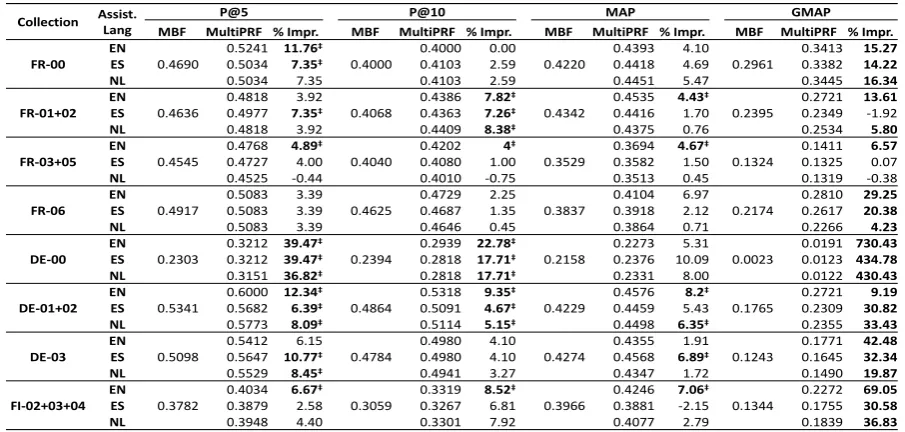
In Table 4, we see the performance of the Multi-PRF approach for three assisting languages, and how it compares with the baseline MBF meth-ods. We find MultiPRF to consistently outperform
the baseline value on all metrics, namely MAP (where significant improvements range from 4.4% to 7.1%); P@5 (significant improvements range from 4.9% to 39.5% and P@10 (where MultiPRF has significant gains varying from 4% to 22.8%). Additionally we also find MultiPRF to be more ro-bust than the baseline, as indicated by the GMAP score, where improvements vary from 4.2% to 730%. Furthermore we notice these trends hold across different assisting languages, with Span-ish and Dutch outperforming EnglSpan-ish as the as-sisting language on some of the French and Ger-man collections. On performing a more detailed study of the results we identify the main reason for improvements in our approach is the ability to obtain good feedback terms in the assisting lan-guage coupled with the introduction of lexically and semantically related terms during the back-translation step.
TOPIC NO ASSIST LANG. SOURCE LANGUAGE QUERY TRANSLATED QUERY QUERY MEANING MBF MAP MPRF MAP
MBF- Top Representative Terms (With Meaning) Excl. Query Terms
MultiPRF- Top Representative Terms (With Meaning) Excl. Query Terms
GERMAN '01: TOPIC 61 EN
Ölkatastrophe in
Sibirien Oil Spill in Siberia
Siberian Oil
Catastrophe 0.618 0.812
exxon, million, ol (oil), tonn, russisch (russian), olp (oil), moskau (moscow), us
olverschmutz (oil pollution), ol, russisch, erdol (petroleum), russland (russia), olunfall(oil spill), olp
GERMAN '02:
TOPIC 105 ES Bronchialasthma El asma bronquial Bronchial
Asthma 0.062 0.636
chronisch (chronic), pet, athlet (athlete), ekrank (ill), gesund (healthy), tuberkulos (tuberculosis), patient, reis (rice), person
asthma, allergi, krankheit (disease), allerg (allergenic), chronisch, hauterkrank (illness of skin), arzt (doctor), erkrank (ill) FRENCH '02:
TOPIC 107 NL Ingénierie génétique
Genetische Manipulatie
Genetic
Engineering 0.145 0.357
développ (developed), évolu (evolved), product, produit (product), moléculair (molecular)
genetic, gen, engineering, développ, product
FRENCH '06: TOPIC 256 EN
Maladie de
Creutzfeldt-Jakob Creutzfeldt-Jakob
Creutzfeldt-Jakob Disease 0.507 0.688
malad (illness), produit (product), animal (animal), hormon (hormone)
malad, humain (human), bovin (bovine), encéphalopath (suffering from encephalitis), scientif, recherch (research)
GERMAN '03: TOPIC 157 EN
Siegerinnen von Wimbledon
Champions of Wimbledon
Wimbledon
Lady Winners 0.074 0.146
telefonbuch (phone book), sieg (victory), titelseit (front page), telekom (telecommunication), graf
gross (large), verfecht (champion), sampra (sampras), 6, champion, steffi, verteidigt (defendending), martina, jovotna, navratilova
GERMAN '01:
TOPIC 91 ES AI in Lateinamerika
La gripe aviar en América Latina
AI in Latin
America 0.456 0.098
international, amnesty, strassenkind (street child), kolumbi (Columbian), land, brasili (Brazil), menschenrecht (human rights), polizei (police)
karib (Caribbean), land, brasili, schuld (blame), amerika, kalt (cold), welt (world), forschung (research)
GERMAN '03: TOPIC 196 EN
Fusion japanischer Banken
Fusion of Japanese banks
Merger of
Japanese Banks0.572 0.264
daiwa, tokyo, filial (branch), zusammenschluss (merger)
kernfusion (nuclear fusion), zentralbank (central bank), daiwa, weltbank (world bank), investitionsbank (investment bank) FRENCH '03:
TOPIC 152 NL Les droits de l'enfant
De rechten van het
kind Child Rights 0.479 0.284
convent (convention), franc, international, onun (united nations), réserv (reserve)
[image:6.595.87.522.64.279.2]per (father), convent, franc, jurid (legal), homm (man), cour (court), biolog
Table 5:Qualitative comparison of feedback terms given by MultiPRF and MBF on representative queries where positive and negative results were observed in French and German collections.
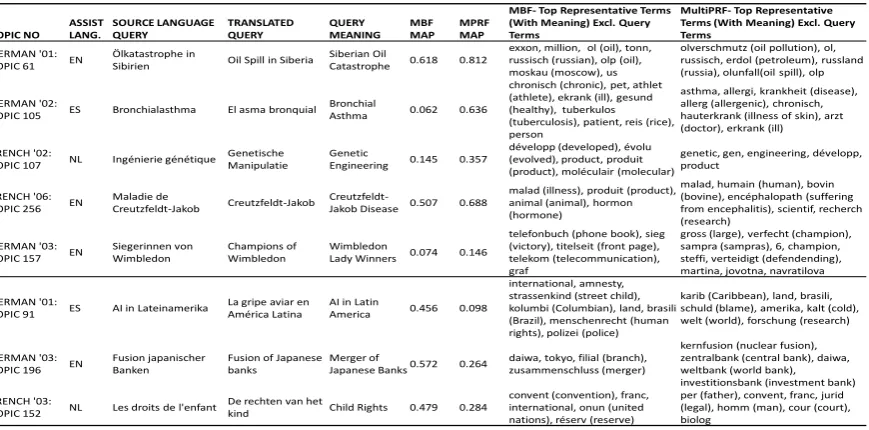
quite strongly with a MAP score of 0.507. Al-though there is no significant topic drift in this case, there are not many relevant terms apart from the query terms. However the same query per-forms very well in English with all the documents in the feedback set of the English corpus being rel-evant, thus resulting in informative feedback terms such as {bovin, scientif, recherch}. (b) Finding Synonyms/Morphological Variations: Another sit-uation in which MultiPRF leads to large improve-ments is when it finds semantically/lexically re-lated terms to the query terms which the origi-nal feedback model was unable to. For example, consider the French query“Ing´enierie g´n´tique”. While the feedback model was unable to find any of the synonyms of the query terms, due to their lack of co-occurence with the query terms, the MultiPRF model was able to get these terms, which are introduced primarily during the back-translation process. Thus terms like{genetic, gen,
engineering}, which are synonyms of the query
words, are found thus resulting in improved per-formance. (c) Combination of Above Factors: Sometimes a combination of the above two factors causes improvements in the performance as in the German query “ ¨Olkatastrophein Sibirien”. For this query, MultiPRF finds good feedback terms such as{russisch, russland}while also obtaining semantically related terms such as{olverschmutz, erdol, olunfall}.
Although all of the previously described exam-ples had good quality translations of the query in the assisting language, as mentioned in
(Chin-nakotla et al., 2010), the MultiPRF approach is robust to suboptimal translation quality as well. To see how MultiPRF leads to improvements even with errors in query translation consider the Ger-man Query“Siegerinnen von Wimbledon”. When this is translated to English, the term “Lady” is dropped, this causes only “Wimbledon Champi-ons” to remain. As can be observed, this causes terms like sampras to come up in the MultiPRF model. However, while the MultiPRF model has some terms pertaining to Men’s Winners of Wim-bledon as well, the original feedback model suf-fers from severe topic drift, with irrelevant terms such as {telefonbuch, telekom} also amongst the top terms. Thus we notice that despite the er-ror in query translation MultiPRF still manages to correct the drift of the original feedback model, while also introducing relevant terms such as
{verfecht, steffi, martina, novotna, navratilova}
transla-(a) Source:French (FR-01+02) Assist:Spanish (b) Source:German (DE-01+02) Assist:Dutch
[image:7.595.116.485.66.296.2](c) Source:Finnish (FI-02+03+04) Assist:English
Figure 2:Results showing the sensitivity of MultiPRF performance to parametersβandγfor French, German and Finnish.
tion affects performance as well.
6.1 Parameter Sensitivity Analysis
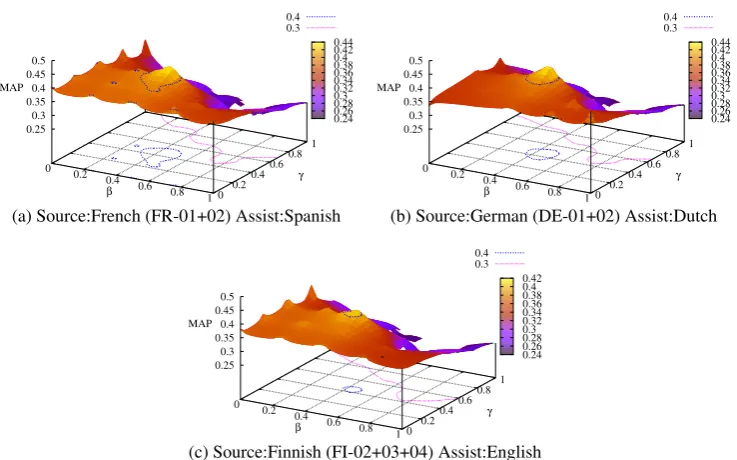
The MultiPRF parameters β and γ in Equation 2 control the relative importance assigned to the original feedback model in source language L1, the translated feedback model obtained from as-sisting languageL2 and the original query terms. We varied theβandγparameters for French, Ger-man and Finnish collections with English, Dutch and Spanish as assisting languages and studied its effect on MAP of MultiPRF. The results are shown in Figure 2. The results show that, in all the three collections, the optimal value of the parameters almost remains the same and lies in the range of 0.4-0.48. Due to the above reason, we arbitrarily choose the parameters in the above range and do not use any technique to learn these parameters.
6.2 Effect of Assisting Language Choice
In this section, we discuss the effect of varying the assisting language. Besides, we also study the inter and intra familial behaviour of source-assisting language pairs. In order to ensure that the results are comparable across languages, we indexed the collections from the years 2002, 2003 and use common topics from the topic range 91-200 that have relevant documents across all the six languages. The number of such common topics were 67. For each source language, we use the other languages as assisting collections and study the performance of MultiPRF. Since query trans-lation quality varies across language pairs, we
an-alyze the behaviour of MultiPRF in the following two scenarios: (a) Using ideal query translation (b) Using Google Translate for query translation. In ideal query translation setup, in order to elim-inate its effect, we skip the query translation step and use the corresponding original topics for each target language instead. The results for both the above scenarios are given in Tables 6 and 7.
Source Lang.
Assisting Language Source
Lang.MBF
English German Dutch Spanish French Finnish
English
MAP
-0.4464 (-0.7%) 0.4471 (-0.5%) 0.4566 (+1.6%) 0.4563 (+1.5%) 0.4545 (+1.1%) 0.4495 P@5 0.4925 (-0.6%) 0.5045 (+1.8%) 0.5164 (+4.2%) 0.5075 (+2.4%) 0.5194 (+4.8%) 0.4955 P@10 0.4343 (+0.4%) 0.4373 (+1.0%) 0.4537 (+4.8%) 0.4343 (+0.4%) 0.4373 (+1.0%) 0.4328
German
MAP 0.4229 (+4.9%)
-0.4346 (+7.8%) 0.4314 (+7.0%) 0.411 (+1.9%) 0.3863 (-4.2%) 0.4033 P@5 0.5851 (+14%) 0.5851 (+14%) 0.5791 (+12.8%) 0.594 (+15.7%) 0.5522 (+7.6%) 0.5134 P@10 0.5284 (+11.3%) 0.5209 (+9.8%) 0.5179 (+9.1%) 0.5149 (+8.5%) 0.5075 (+6.9%) 0.4746
Dutch
MAP 0.4317 (+4%) 0.4453 (+7.2%)
-0.4275 (+2.9%) 0.4241 (+2.1%) 0.3971 (-4.4%) 0.4153 P@5 0.5642 (+11.8%) 0.5731 (+13.6%) 0.5343 (+5.9%) 0.5582 (+10.6%) 0.5045 (0%) 0.5045 P@10 0.5075 (+9%) 0.4925 (+5.8%) 0.4896 (+5.1%) 0.5015 (+7.7%) 0.4806 (+3.2%) 0.4657
Spanish MAP 0.4667 (-2.9%) 0.4749 (-1.2%) 0.4744 (-1.3%)
-0.4609 (-4.1%)
0.4311
(-10.3%) 0.4805
P@5 0.62 (-2.9%) 0.6418 (+0.5%) 0.6299 (-1.4%) 0.6269 (-1.6%) 0.6149 (-3.7%) 0.6388 P@10 0.5625 (-1.8%) 0.5806 (+1.3%) 0.5851 (+2.1%) 0.5627 (-1.8%) 0.5478 (-4.4%) 0.5731
French
MAP 0.4658 (+6.9%) 0.4526 (+3.9%) 0.4374 (+0.4%) 0.4634 (+6.4%)
-0.4451 (+2.2%) 0.4356 P@5 0.4925 (+3.1%) 0.4806 (+0.6%) 0.4567 (-4.4%) 0.4925 (+3.1%) 0.4836 (+1.3%) 0.4776 P@10 0.4358 (+3.9%) 0.4239 (+1%) 0.4224 (+0.7%) 0.4388 (+4.6%) 0.4209 (+0.4%) 0.4194
Finnish
MAP 0.3411 (-4.7%) 0.3796 (+6.1%) 0.3722 (+4%) 0.369 (+3.1%) 0.3553 (-0.7%)
[image:8.595.80.535.65.283.2]
-0.3578 P@5 0.394 (+3.1%) 0.403 (+5.5%) 0.406 (+6.3%) 0.4119 (+7.8%) 0.397 (+3.9%) 0.3821 P@10 0.3463 (+11.5%) 0.3582 (+15.4%) 0.3478 (+12%) 0.3448 (+11%) 0.3433 (+10.6%) 0.3105
Table 6: Results showing the performance of MultiPRF with different source and assisting languages using Google Translate for query translation step. The intra-familial affinity could be observed from the elements close to the diagonal.
ease of processing in these languages. (b)Familial
Similarity Between Languages: We observe that
the performance of MultiPRF is good if the as-sisting language is from the same language fam-ily. Birch et al. (2008) show that the language family is a strong predictor of machine transla-tion performance. Hence, the query translatransla-tion and back translation quality improves if the source and assisting languages belong to the same family. For example, in the Germanic family, the source-assisting language pairs German-English, Dutch-English, Dutch-German and German-Dutch show good performance. Similarly, in Romance family, the performance of French-Spanish confirms this behaviour. In some cases, we observe that Multi-PRF scores decent improvements even when the assisting language does not belong to the same language family as witnessed in French-English and English-French. This is primarily due to their strong monolingual MBF performance.
6.3 Effect of Language Family on Back
Translation Performance
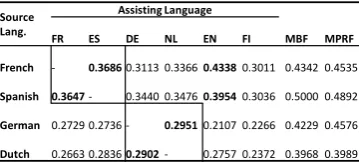
As already mentioned, the performance of Multi-PRF is good if the source and assisting languages belong to the same family. In this section, we ver-ify the above intuition by studying the impact of language family on back translation performance. The experiment designed is as follows: Given a query in source languageL1, the ideal translation in assisting language L2 is used to compute the query model in L2 using only the query terms. Then, without performing PRF the query model
Source Lang.
Assisting Language
MBF MPRF
FR ES DE NL EN FI
French - 0.36860.3113 0.33660.43380.3011 0.4342 0.4535
Spanish 0.3647- 0.3440 0.34760.39540.3036 0.5000 0.4892
German 0.2729 0.2736 - 0.29510.2107 0.2266 0.4229 0.4576
Dutch 0.2663 0.28360.2902- 0.2757 0.2372 0.3968 0.3989
Table 8: Effect of Language Family on Back Translation Performance measured through MultiPRF MAP. 100 Topics from years 2001 and 2002 were used for all languages.
is directly back translated from L2 into L1 and finally documents are re-ranked using this trans-lated feedback model. Since the automatic query translation and PRF steps have been eliminated, the only factor which influences the MultiPRF per-formance is the back-translation step. This means that the source-assisting language pairs for which the back-translation is good will score a higher performance. The results of the above experiment is shown in Table 8. For each source language, the best performing assisting languages have been highlighted.
[image:8.595.326.506.322.403.2]lan-Source Lang.
Assisting Language Source
Lang.MBF
English German Dutch Spanish French Finnish
English
MAP
-0.4513 (+0.4%) 0.4475 (-0.4%) 0.4695 (+4.5%) 0.4665 (+3.8%) 0.4416 (-1.7%) 0.4495 P@5 0.5104 (+3.0%) 0.5104 (+3.0%) 0.5343 (+7.8%) 0.5403 (+9.0%) 0.4806 (-3.0%) 0.4955 P@10 0.4373 (+1.0%) 0.4358 (+0.7%) 0.4597 (+6.2%) 0.4582 (+5.9%) 0.4164 (-3.8%) 0.4328
German
MAP 0.4427 (+9.8%)
-0.4306 (+6.8%) 0.4404 (+9.2%) 0.4104 (+1.8%) 0.3993 (-1.0%) 0.4033 P@5 0.606 (+18%) 0.5672 (+10.5%) 0.594 (+15.7%) 0.5761 (+12.2%) 0.5552 (+8.1%) 0.5134 P@10 0.5373 (+13.2%) 0.503 (+6.0%) 0.5299 (+11.7%) 0.494 (+4.1%) 0.5 (+5.4%) 0.4746
Dutch
MAP 0.4361 (+5.0%) 0.4344 (+4.6%)
-0.4227 (+1.8%) 0.4304 (+3.6%) 0.4134 (-0.5%) 0.4153 P@5 0.5761 (+14.2%) 0.5552 (+10%) 0.5403 (+7.1%) 0.5463 (+8.3%) 0.5433 (+7.7%) 0.5045 P@10 0.5254 (+12.8%) 0.497 (+6.7%) 0.4776 (+2.6%) 0.5134 (+10.2%) 0.4925 (+5.8%) 0.4657
Spanish
MAP 0.4665 (-2.9%) 0.4773 (-0.7%) 0.4733 (-1.5%)
-0.4839 (+0.7%) 0.4412 (-8.2%) 0.4805 P@5 0.6507 (+1.8%) 0.6448 (+0.9%) 0.6507 (+1.8%) 0.6478 (+1.4%) 0.597 (-6.5%) 0.6388 P@10 0.5791 (+1.0%) 0.5791 (+1.0%) 0.5761 (+0.5%) 0.5866 (+2.4%) 0.5567 (-2.9%) 0.5731
French
MAP 0.4591 (+5.4%) 0.4514 (+3.6%) 0.4409 (+1.2%) 0.4712 (+8.2%)
-0.4354 (0%) 0.4356 P@5 0.4925 (+3.1%) 0.4776 (0%) 0.4776 (0%) 0.4995 (+4.6%) 0.4955 (+3.8%) 0.4776 P@10 0.4463 (+6.4%) 0.4313 (+2.8%) 0.4373 (+4.3%) 0.4448 (+6.1%) 0.4209 (+0.3%) 0.4194
Finnish
MAP 0.3733 (+4.3%) 0.3559 (-0.5%) 0.3676 (+2.7%) 0.3594 (+0.4%) 0.371 (+3.7%)
[image:9.595.83.536.66.264.2]
-0.3578 P@5 0.4149 (+8.6%) 0.385 (+0.7%) 0.388 (+1.6%) 0.388 (+1.6%) 0.3911 (+2.4%) 0.3821 P@10 0.3567 (+14.9%) 0.31 (-0.2%) 0.3253 (+4.8%) 0.32 (+3.1%) 0.3239 (+4.3%) 0.3105
Table 7:Results showing the performance of MultiPRF without using automatic query translationi.e.by using corresponding original queries in assisting collection. The results show the potential of MultiPRF by establishing a performance upper bound.
guage which shows good performance across both families.
6.4 Multiple Assisting Languages
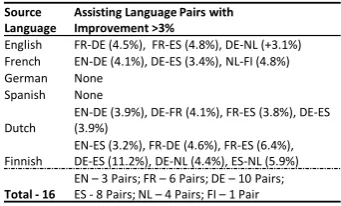
So far, we have only considered a single assist-ing language. However, a natural extension to the method which comes to mind, is using mul-tiple assisting languages. In other words, com-bining the evidence from all the feedback mod-els of more than one assisting language, to get a feedback model which is better than that obtained using a single assisting language. To check how this simple extension works, we performed exper-iments using a pair of assisting languages. In these experiments for a given source language (from amongst the 6 previously mentioned languages) we tried using all pairs of assisting languages (for each source language, we have 10 pairs possible). To obtain the final model, we simply interpolate all the feedback models with the initial query model, in a similar manner as done in MultiPRF. The re-sults for these experiments are given in Table 9. As we see, out of the 60 possible combinations of source language and assisting language pairs, we obtain improvements of greater than 3% in 16 cases. Here the improvements are with respect to the best model amongst the two MultiPRF mod-els corresponding to each of the two assisting lan-guages, with the same source language. Thus we observe that a simple linear interpolation of mod-els is not the best way of combining evidence from multiple assisting languages. We also observe than when German or Spanish are used as one of the two assisting languages, they are most likely to
Source Language
Assisting Language Pairs with Improvement >3%
English FR-DE (4.5%), FR-ES (4.8%), DE-NL (+3.1%) French EN-DE (4.1%), DE-ES (3.4%), NL-FI (4.8%) German None
Spanish None
Dutch
EN-DE (3.9%), DE-FR (4.1%), FR-ES (3.8%), DE-ES (3.9%)
Finnish
EN-ES (3.2%), FR-DE (4.6%), FR-ES (6.4%), DE-ES (11.2%), DE-NL (4.4%), ES-NL (5.9%)
Total - 16
EN – 3 Pairs; FR – 6 Pairs; DE – 10 Pairs; ES - 8 Pairs; NL – 4 Pairs; FI – 1 Pair
Table 9: Summary of MultiPRF Results with Two Assisting Languages. The improvements described above are with re-spect to maximum MultiPRF MAP obtained using eitherL1
orL2alone as assisting language.
lead to improvements. A more detailed study of this observation needs to be done to explain this.
7 Conclusion and Future Work
We studied the effect of differentsource-assistant pairs and multiple assisting languages on the per-formance of MultiPRF. Experiments across a wide range of language pairs with varied degree of fa-milial relationships show that MultiPRF improves performance in most cases with the performance improvement being more pronounced when the source and assisting languages areclosely related. We also notice that the results are mixed when two assisting languages are used simultaneously. As part of future work, we plan to vary the model interpolation parameters dynamically to improve the performance in case of multiple assisting lan-guages.
Acknowledgements
[image:9.595.330.501.303.406.2]References
Giambattista Amati, Claudio Carpineto, and Giovanni Ro-mano. 2004. Query Difficulty, Robustness, and Selec-tive Application of Query Expansion. InECIR ’04, pages 127–137.
Alexandra Birch, Miles Osborne and Philipp Koehn. 2008. Predicting Success in Machine Translation. InEMNLP ’08, pages 745-754, ACL.
Martin Braschler and Carol Peters. 2004. Cross-Language Evaluation Forum: Objectives, Results, Achievements.
Inf. Retr., 7(1-2):7–31.
Martin Braschler and Peter Sch¨auble. 1998. Multilingual In-formation Retrieval based on Document Alignment Tech-niques. InECDL ’98, pages 183–197, Springer-Verlag. Chris Buckley, Gerald Salton, James Allan, and Amit
Sing-hal. 1994. Automatic Query Expansion using SMART : TREC 3. InTREC-3, pages 69–80.
Guihong Cao, Jian-Yun Nie, Jianfeng Gao, and Stephen Robertson. 2008. Selecting Good Expansion Terms for Pseudo-Relevance Feedback. InSIGIR ’08, pages 243– 250. ACM.
Manoj K. Chinnakotla, Karthik Raman, and Pushpak Bhat-tacharyya. 2010. Multilingual PRF: English Lends a Helping Hand. InSIGIR ’10, ACM.
Kevyn Collins-Thompson and Jamie Callan. 2005. Query Expansion Using Random Walk Models. InCIKM ’05, pages 704–711. ACM.
Steve Cronen-Townsend, Yun Zhou, and W. Bruce Croft. 2004. A Framework for Selective Query Expansion. In
CIKM ’04, pages 236–237. ACM.
Ido Dagan, Alon Itai, and Ulrike Schwall. 1991. Two Lan-guages Are More Informative Than One. In ACL ’91, pages 130–137. ACL.
A. Dempster, N. Laird, and D. Rubin. 1977. Maximum Like-lihood from Incomplete Data via the EM Algorithm. Jour-nal of the Royal Statistical Society, 39:1–38.
T. Susan Dumais, A. Todd Letsche, L. Michael Littman, and K. Thomas Landauer. 1997. Automatic Cross-Language Retrieval Using Latent Semantic Indexing. InAAAI ’97, pages 18–24.
Wei Gao, John Blitzer, and Ming Zhou. 2008. Using English Information in Non-English Web Search. IniNEWS ’08, pages 17–24. ACM.
David Hawking, Paul Thistlewaite, and Donna Harman. 1999. Scaling Up the TREC Collection. Inf. Retr., 1(1-2):115–137.
Hieu Hoang, Alexandra Birch, Chris Callison-burch, Richard Zens, Rwth Aachen, Alexandra Constantin, Marcello Fed-erico, Nicola Bertoldi, Chris Dyer, Brooke Cowan, Wade Shen, Christine Moran, and Ondej Bojar. 2007. Moses: Open Source Toolkit for Statistical Machine Translation. InACL ’07, pages 177–180.
P. Jourlin, S. E. Johnson, K. Sp¨arck Jones and P. C. Wood-land. 1999. Improving Retrieval on Imperfect Speech Transcriptions (Poster Abstract). In SIGIR ’99, pages 283–284. ACM.
John Lafferty and Chengxiang Zhai. 2003. Probabilistic Rel-evance Models Based on Document and Query Genera-tion. Language Modeling for Information Retrieval, pages 1–10. Kluwer International Series on IR.
K. Sparck Jones, S. Walker, and S. E. Robertson. 2000. A Probabilistic Model of Information Retrieval: Develop-ment and Comparative ExperiDevelop-ments. Inf. Process. Man-age., 36(6):779–808.
John Lafferty and Chengxiang Zhai. 2001. Document Lan-guage Models, Query Models, and Risk Minimization for Information Retrieval. In SIGIR ’01, pages 111–119. ACM.
Victor Lavrenko and W. Bruce Croft. 2001. Relevance Based Language Models. InSIGIR ’01, pages 120–127. ACM. Victor Lavrenko, Martin Choquette, and W. Bruce Croft.
2002. Cross-Lingual Relevance Models. In SIGIR ’02, pages 175–182, ACM.
Edgar Meij, Dolf Trieschnigg, Maarten Rijke de, and Wessel Kraaij. 2009. Conceptual Language Models for Domain-specific Retrieval. Information Processing & Manage-ment, 2009.
Donald Metzler and W. Bruce Croft. 2007. Latent Concept Expansion Using Markov Random Fields. InSIGIR ’07, pages 311–318. ACM.
Mandar Mitra, Amit Singhal, and Chris Buckley. 1998. Im-proving Automatic Query Expansion. InSIGIR ’98, pages 206–214. ACM.
Franz Josef Och and Hermann Ney. 2003. A System-atic Comparison of Various Statistical Alignment Models.
Computational Linguistics, 29(1):19–51.
I. Ounis, G. Amati, Plachouras V., B. He, C. Macdonald, and Johnson. 2005. Terrier Information Retrieval Platform. InECIR ’05, volume 3408 ofLecture Notes in Computer Science, pages 517–519. Springer.
Koehn Philipp. 2005. Europarl: A Parallel Corpus for Statis-tical Machine Translation. InMT Summit ’05.
Stephen Robertson. 2006. On GMAP: and Other Transfor-mations. InCIKM ’06, pages 78–83. ACM.
Tetsuya Sakai, Toshihiko Manabe, and Makoto Koyama. 2005. Flexible Pseudo-Relevance Feedback Via Selective Sampling.ACM TALIP, 4(2):111–135.
Tao Tao and ChengXiang Zhai. 2006. Regularized Esti-mation of Mixture Models for Robust Pseudo-Relevance Feedback. InSIGIR ’06, pages 162–169. ACM.
Tuomas Talvensaari, Jorma Laurikkala, Kalervo J¨arvelin, Martti Juhola, and Heikki Keskustalo. 2007. Creating and Exploiting a Comparable Corpus in Cross-language Infor-mation Retrieval.ACM Trans. Inf. Syst., 25(1):4, 2007. Jrg Tiedemann. 2001. The Use of Parallel Corpora in
Mono-lingual Lexicography - How word alignment can identify morphological and semantic relations. InCOMPLEX ’01, pages 143–151.
Ellen Voorhees. 2006. Overview of the TREC 2005 Robust Retrieval Track. InTREC 2005, Gaithersburg, MD. NIST. Dan Wu, Daqing He, Heng Ji, and Ralph Grishman. 2008. A Study of Using an Out-of-Box Commercial MT System for Query Translation in CLIR. IniNEWS ’08, pages 71– 76. ACM.
Jinxi Xu and W. Bruce Croft. 2000. Improving the Effective-ness of Information Retrieval with Local Context Analy-sis.ACM Trans. Inf. Syst., 18(1):79–112.
Jinxi Xu, Alexander Fraser, and Ralph Weischedel. 2002. Empirical Studies in Strategies for Arabic Retrieval. In
SIGIR ’02, pages 269–274. ACM.
Yang Xu, Gareth J.F. Jones, and Bin Wang. 2009. Query Dependent Pseudo-Relevance Feedback Based on Wikipedia. InSIGIR ’09, pages 59–66. ACM.
Chengxiang Zhai and John Lafferty. 2001. Model-based Feedback in the Language Modeling approach to Infor-mation Retrieval. InCIKM ’01, pages 403–410. ACM. Chengxiang Zhai and John Lafferty. 2004. A Study of