Discriminative Modeling of Extraction Sets for Machine Translation
John DeNero and Dan Klein Computer Science Division University of California, Berkeley
{denero,klein}@cs.berkeley.edu
Abstract
We present a discriminative model that di-rectly predicts which set of phrasal transla-tion rules should be extracted from a sen-tence pair. Our model scores extraction sets: nested collections of all the overlap-ping phrase pairs consistent with an under-lying word alignment. Extraction set mod-els provide two principle advantages over word-factored alignment models. First, we can incorporate features on phrase pairs, in addition to word links. Second, we can optimize for an extraction-based loss function that relates directly to the end task of generating translations. Our model gives improvements in alignment quality relative to state-of-the-art unsuper-vised and superunsuper-vised baselines, as well as providing up to a 1.4 improvement in BLEU score in Chinese-to-English trans-lation experiments.
1 Introduction
In the last decade, the field of statistical machine translation has shifted from generating sentences word by word to systems that recycle whole frag-ments of training examples, expressed as transla-tion rules. This general paradigm was first pur-sued using contiguous phrases (Och et al., 1999; Koehn et al., 2003), and has since been general-ized to a wide variety of hierarchical and syntactic formalisms. The training stage of statistical sys-tems focuses primarily on discovering translation rules in parallel corpora.
Most systems discover translation rules via a two-stage pipeline: a parallel corpus is aligned at the word level, and then a second procedure ex-tracts fragment-level rules from word-aligned sen-tence pairs. This paper offers a model-based alter-native to phrasal rule extraction, which merges this
two-stage pipeline into a single step. We present a discriminative model that directly predicts which set of phrasal translation rules should be extracted from a sentence pair. Our model predicts extrac-tion sets: combinatorial objects that include the set of all overlapping phrasal translation rules con-sistent with an underlying word-level alignment. This approach provides additional discriminative power relative to word aligners because extraction sets are scored based on the phrasal rules they con-tain in addition to word-to-word alignment links. Moreover, the structure of our model directly re-flects the purpose of alignment models in general, which is to discover translation rules.
We address several challenges to training and applying an extraction set model. First, we would like to leverage existing word-level alignment re-sources. To do so, we define a deterministic map-ping from word alignments to extraction sets, in-spired by existing extraction procedures. In our mapping, possiblealignment links have a precise interpretation that dictates what phrasal translation rules can be extracted from a sentence pair. This mapping allows us to train with existing annotated data sets and use the predictions from word-level aligners as features in our extraction set model.
Second, our model solves a structured predic-tion problem, and the choice of loss funcpredic-tion dur-ing traindur-ing affects model performance. We opti-mize for a phrase-level F-measure in order to fo-cus learning on the task of predicting phrasal rules rather than word alignment links.
Third, our discriminative approach requires that we perform inference in the space of extraction sets. Our model does not factor over disjoint word-to-word links or minimal phrase pairs, and so ex-isting inference procedures do not directly apply. However, we show that the dynamic program for a block ITG aligner can be augmented to score ex-traction sets that are indexed by underlying ITG word alignments (Wu, 1997). We also describe a
k
l
g h
2月
15日 2010年
On February 15 2010
2月
15日 2010年
On February 15 2010
σ(ei)
σ(f2)
σ(e1)
(a)
(b)
Type 1: Language-specific function words omitted in the other language
Type 2: Role-equivalent word pairs that are not lexical equivalents
过
[image:2.595.310.524.64.238.2] [image:2.595.76.288.64.191.2]地球 [go over]
[Earth]
over the Earth 65%
31%
被
发现
[passive marker] [discover] was discovered
Distribution over possible link types
σ(fj)
年 过去
中
In the past two years
[past]
[two]
[year]
[in] (a)
(b)
Figure 1: A word alignmentA(shaded grid cells) defines projectionsσ(ei)andσ(fj), shown as dot-ted lines for each word in each sentence. The ex-traction setR3(A)includes all bispans licensed by these projections, shown as rounded rectangles.
coarse-to-fine inference approach that allows us to scale our method to long sentences.
Our extraction set model outperforms both un-supervised and un-supervised word aligners at pre-dicting word alignments and extraction sets. We also demonstrate that extraction sets are useful for end-to-end machine translation. Our model im-proves translation quality relative to state-of-the-art Chinese-to-English baselines across two pub-licly available systems, providing total BLEU im-provements of 1.2 in Moses, a phrase-based sys-tem, and 1.4 in a Joshua, a hierarchical system (Koehn et al., 2007; Li et al., 2009)
2 Extraction Set Models
The input to our model is an unaligned sentence pair, and the output is an extraction set of phrasal translation rules. Word-level alignments are gen-erated as a byproduct of inference. We first spec-ify the relationship between word alignments and extraction sets, then define our model.
2.1 Extraction Sets from Word Alignments Rule extraction is a standard concept in machine translation: word alignment constellations license particular sets of overlapping rules, from which subsets are selected according to limits on phrase length (Koehn et al., 2003), number of gaps (Chi-ang, 2007), count of internal tree nodes (Galley et al., 2006), etc. In this paper, we focus on phrasal rule extraction (i.e., phrase pair extraction), upon which most other extraction procedures are based. Given a sentence pair(e,f), phrasal rule extrac-tion defines a mapping from a set of word-to-word k
l
g h
2月
15日 2010年
On February 15 2010
2月
15日 2010年
On February 15 2010 σ(ei)
σ(f2)
σ(e1)
Type 1: Language-specific function words omitted in the other language
Type 2: Role-equivalent pairs that are not lexical equivalents
过 地球
[go over]
[Earth]
over the Earth 65%
31%
被
发现
[passive marker] [discover]
was discovered
Distribution over possible link types
σ(fj)
年 过去
中
In the past two years
[past]
[two]
[year]
[in]
PDT
After dinner I slept 在
饭 后
我
睡
了
[after]
[dinner]
[after]
[I]
[sleep]
[past tense] k =2
l =4
g =1 h =3
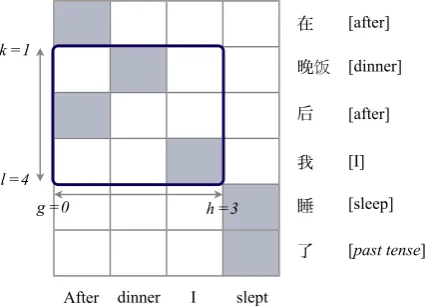
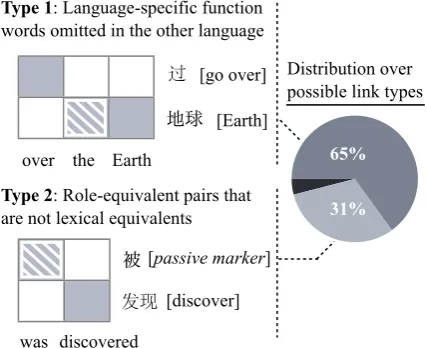
Figure 2: Examples of two types of possible align-ment links (striped). These types account for 96% of the possible alignment links in our data set.
alignment linksA ={(i, j)}to anextraction set of bispans Rn(A) = {[g, h) ⇔ [k, `)}, where each bispan links target span[g, h)to source span
[k, `).1 The maximum phrase lengthnensures that
max(h−g, `−k)≤n.
We can describe this mapping via word-to-phrase projections, as illustrated in Figure 1. Let wordeiproject to the phrasal spanσ(ei), where
σ(ei) =
min
j∈Jij , maxj∈Ji j+ 1
(1) Ji={j: (i, j)∈ A}
and likewise each wordfj projects to a span ofe. Then,Rn(A)includes a bispan[g, h)⇔[k, `)iff
σ(ei)⊆[k, `) ∀i∈[g, h)
σ(fj)⊆[g, h) ∀j∈[k, `)
of the NIST MT02 Chinese-to-English test set, which has been used in previous alignment experi-ments (Ayan et al., 2005; DeNero and Klein, 2007; Haghighi et al., 2009).
[image:3.595.311.525.66.186.2]Possible links account for 22% of all alignment links in these data, and we found that most of these links fall into two categories. First, possible links are used to align function words that have no equivalent in the other language, but colocate with aligned content words, such as English determin-ers. Second, they are used to mark pairs of words or short phrases that are not lexical equivalents, but which play equivalent roles in each sentence. Figure 2 shows examples of these two use cases, along with their corpus frequencies.2
On the other hand, null alignments are used sparingly in our annotated data. More than 90% of words participate in some alignment link. The unaligned words typically express content in one sentence that is absent in its translation.
Figure 3 illustrates how we interpret possible and null links in our projection. Possible links are typically not included in extraction procedures be-cause most aligners predict only sure links. How-ever, we see a natural interpretation for possible links in rule extraction: they license phrasal rules that both include and exclude them. We exclude null alignments from extracted phrases because they often indicate a mismatch in content.
We achieve these effects by redefining the pro-jection operator σ. Let A(s) be the subset of A that are surelinks, then let the index set Ji used for projectionσin Equation 1 be
Ji =
j: (i, j)∈ A(s) if∃j : (i, j)∈ A(s) {−1,|f|} if@j : (i, j)∈ A {j: (i, j)∈ A} otherwise
Here, Ji is a set of integers, and σ(ei) for null alignedeiwill be[−1,|f|+ 1)by Equation 1.
Of course, the characteristics of our aligned cor-pus may not hold for other annotated corpora or other language pairs. However, we hope that the overall effectiveness of our modeling approach will influence future annotation efforts to build corpora that are consistent with this interpretation. 2.3 A Linear Model of Extraction Sets We now define a linear model that scores extrac-tion sets. We restrict our model to score only co-2We collected corpus frequencies of possible alignment link types ourselves on a sample of the hand-aligned data set. k
l
g h
2月
15日 2010年
On February 15 2010
2月
15日 2010年
On February 15 2010 σ(ei)
σ(f2)
σ(e1)
Type 1: Language-specific function words omitted in the other language
Type 2: Role-equivalent word pairs that are not lexical equivalents
过
地球 [go over]
[Earth]
over the Earth 65%
31%
被
发现
[passive marker]
[discover]
was discovered
Distribution over possible link types σ(fj)
年
过去
中
In the past two years
[past]
[two]
[year]
[in]
PDT
After dinner I slept 在
饭
后
我
睡
了
[after]
[dinner]
[after]
[I]
[sleep]
(past) k =2
l =4
g =1 h =3
Figure 3: Possible links constrain the word-to-phrase projection of otherwise unaligned words, which in turn license overlapping phrases. In this example, σ(f2) = [1,2) does not include the possible link at (1,0)because of the sure link at
(1,1), but σ(e1) = [1,2) does use the possible link because it would otherwise be unaligned. The word “PDT” is null aligned, and so its projection σ(e4) = [−1,4)extends beyond the bounds of the sentence, excluding “PDT” from all phrase pairs.
herent extraction sets Rn(A), those that are li-censed by an underlying word alignment Awith sure alignments A(s) ⊆ A. Conditioned on a sentence pair (e,f) and maximum phrase length n, we score extraction sets via a feature vec-torφ(A(s), R
n(A))that includes features on sure links(i, j) ∈ A(s)and features on the bispans in Rn(A)that link[g, h)ineto[k, `)inf:
φ(A(s), Rn(A)) =
X (i,j)∈A(s)
φa(i, j) +
X [g,h)⇔[k,`)∈Rn(A)
φb(g, h, k, `)
Because the projection operator Rn(·) is a deterministic function, we can abbreviate φ(A(s), Rn(A)) as φ(A) without loss of infor-mation, although we emphasize that A is a set of sure and possible alignments, and φ(A) does not decompose as a sum of vectors on individual word-level alignment links. Our model is param-eterized by a weight vector θ, which scores an extraction setRn(A)asθ·φ(A).
k
l
g h
2月
15日 2010年
On February 15 2010
2月
15日
2010年
On February 15 2010
σ(ei)
σ(f2)
σ(e1)
Type 1: Language-specific function words omitted in the other language
Type 2: Role-equivalent pairs that are not lexical equivalents
过
[image:4.595.73.289.62.164.2]地球
[go over]
[Earth]
over the Earth 65%
31%
被
发现
[passive marker]
[discover]
was discovered
Distribution over possible link types σ(fj)
年
过去
中
In the past two years
[past]
[two]
[year]
[in]
PDT
After dinner I slept
在
饭
后
我
睡
了
[after]
[dinner]
[after]
[I]
[sleep]
[past tense]
k =2
l =4
g =1 h =3
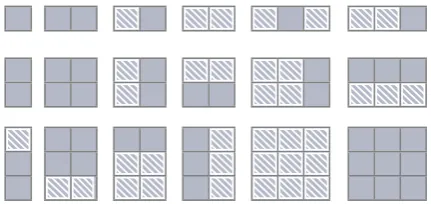
Figure 4: Above, we show a representative sub-set of the block alignment patterns that serve as terminal productions of the ITG that restricts the output space of our model. These terminal pro-ductions cover up ton= 3words in each sentence and include a mixture of sure (filled) and possible (striped) word-level alignment links.
is more computationally convenient than arbitrar-ily ordered phrase matchings (Wu, 1997; DeNero and Klein, 2008). However, the space of block ITG alignments is expressive enough to include the vast majority of patterns observed in hand-annotated parallel corpora (Haghighi et al., 2009). In summary, our model scores all Rn(A) for A ∈ ITG(e,f) where Acan include block termi-nals of size up ton. In our experiments,n = 3. Unlike previous work, we allow possible align-ment links to appear in the block terminals, as de-picted in Figure 4.
3 Model Estimation
We estimate the weights θ of our extraction set model discriminatively using the margin-infused relaxed algorithm (MIRA) of Crammer and Singer (2003)—a large-margin, perceptron-style, online learning algorithm. MIRA has been used suc-cessfully in MT to estimate both alignment mod-els (Haghighi et al., 2009) and translation modmod-els (Chiang et al., 2008).
For each training example, MIRA requires that we find the alignment Am corresponding to the highest scoring extraction set Rn(Am) under the current model,
Am =arg maxA∈ITG(e,f)θ·φ(A) (2)
Section 4 describes our approach to solving this search problem for model inference.
MIRA updates away from Rn(Am) and to-ward a gold extraction setRn(Ag). Some hand-annotated alignments are outside of the block ITG
model class. Hence, we update toward the ex-traction set for a pseudo-gold alignment Ag ∈ ITG(e,f)with minimal distance from the true ref-erence alignmentAt.
Ag =arg minA∈ITG(e,f)|A ∪ At− A ∩ At| (3) Inference details appear in Section 4.3.
GivenAgandAm, we update the model param-eters away fromAmand towardAg.
θ←θ+τ·(φ(Ag)−φ(Am))
whereτ is the minimal step size that will ensure we prefer Ag to Am by a margin greater than the loss L(Am;Ag), capped at some maximum update size C to provide regularization. We use C= 0.01in experiments. The step size is a closed form function of the loss and feature vectors:τ =
min
C,L(Am;Ag)−θ·(φ(Ag)−φ(Am)) ||φ(Ag)−φ(Am)||2
2
We train the model for 30 iterations over the training set, shuffling the order each time, and we average the weight vectors observed after each it-eration to estimate our final model.
3.1 Extraction Set Loss Function
In order to focus learning on predicting the right bispans, we use an extraction-level loss L(Am;Ag): an F-measure of the overlap between bispans in Rn(Am) andRn(Ag). This measure has been proposed previously to evaluate align-ment systems (Ayan and Dorr, 2006). Based on preliminary translation results during develop-ment, we chose bispan F5as our loss:
Pr(Am) =|Rn(Am)∩Rn(Ag)|/|Rn(Am)| Rc(Am) =|Rn(Am)∩Rn(Ag)|/|Rn(Ag)| F5(Am;Ag) =
(1 + 52)·Pr(A
m)·Rc(Am)
52·Pr(A
m) +Rc(Am) L(Am;Ag) = 1−F5(Am;Ag)
F5 favors recall over precision. Previous align-ment work has shown improvealign-ments from adjust-ing the F-measure parameter (Fraser and Marcu, 2006). In particular, Lacoste-Julien et al. (2006) also chose a recall-biased objective.
3.2 Features on Extraction Sets
The discriminative power of our model is driven by the features on sure word alignment links φa(i, j) and bispansφb(g, h, k, `). In both cases, the most important features come from the pre-dictions of unsupervised models trained on large parallel corpora, which provide frequency and co-occurrence information.
To score word-to-word links, we use the poste-rior predictions of a jointly trained HMM align-ment model (Liang et al., 2006). The remaining features include a dictionary feature, an identical word feature, an absolute position distortion fea-ture, and features for numbers and punctuation.
To score phrasal translation rules in an extrac-tion set, we use a mixture of feature types. Ex-traction set models allow us to incorporate the same phrasal relative frequency statistics that drive phrase-based translation performance (Koehn et al., 2003). To implement these frequency features, we extract a phrase table from the alignment pre-dictions of a jointly trained unsupervised HMM model using Moses (Koehn et al., 2007), and score bispans using the resulting features. We also in-clude indicator features on lexical templates for the 50 most common words in each language, as in Haghighi et al. (2009). We include indicators for the number of words and Chinese characters in rules. One useful indicator feature exploits the fact that capitalized terms in English tend to align to Chinese words with three or more characters. On 1-by-norn-by-1 phrasal rules, we include in-dicator features of fertility for common words.3
We also include monolingual phrase features that expose useful information to the model. For instance, English bigrams beginning with “the” are often extractable phrases. English trigrams with a hyphen as the second word are typically ex-tractable, meaning that the first and third words align to consecutive Chinese words. When any conjugation of the word “to be” is followed by a verb, indicating passive voice or progressive tense, the two words tend to align together.
Our feature set also includes bias features on phrasal rules and links, which control the num-ber of null-aligned words and numnum-ber of rules li-censed. In total, our final model includes 4,249 individual features, dominated by various instanti-ations of lexical templates.
3Limiting lexicalized features to common words helps prevent overfitting.
k
l
g h
2月
15日 2010年
On February 15 2010
2月
15日 2010年
On February 15 2010 σ(ei)
σ(f2)
σ(e1)
Type 1: Language-specific function words omitted in the other language
Type 2: Role-equivalent pairs that are not lexical equivalents
过
[image:5.595.311.524.62.217.2]地球 [go over]
[Earth]
over the Earth 65%
31%
被
发现
[passive marker]
[discover]
was discovered
Distribution over possible link types σ(fj)
年
过去
中
In the past two years
[past]
[two]
[year]
[in]
PDT
After dinner I slept 在
饭
后
我
睡
了
[after]
[dinner]
[after]
[I]
[sleep]
[past tense] k =2
l =4
g =1 h =3 or
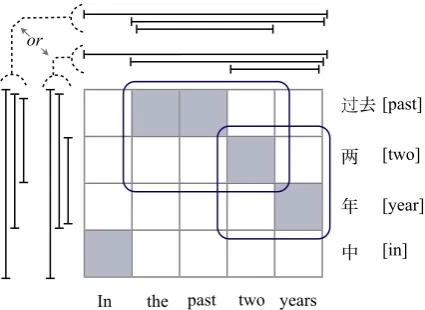
Figure 5: Both possible ITG decompositions of this example alignment will split one of the two highlighted bispans across constituents.
4 Model Inference
Equation 2 asks for the highest scoring extraction set under our model,Rn(Am), which we also re-quire at test time. Although we have restricted Am ∈ITG(e,f), our extraction set model does not factor over ITG productions, and so the dynamic program for a vanilla block ITG will not suffice to findRn(Am). To see this, consider the extraction set in Figure 5. An ITG decomposition of the un-derlying alignment imposes a hierarchical brack-eting on each sentence, and some bispan in the ex-traction set for this alignment will cross any such bracketing. Hence, the score of some licensed bis-pan will be non-local to the ITG decomposition. 4.1 A Dynamic Program for Extraction Sets If we treat the maximum phrase lengthnas a fixed constant, then we can define a dynamic program to search the space of extraction sets. An ITG deriva-tion for some alignmentA decomposes into two sub-derivations forALandAR.4 The model score ofA, which scores extraction setRn(A), decom-poses over AL and AR, along with any phrasal bispans licensed by adjoiningALandAR.
θ·φ(A) =θ·φ(AL) +θ·φ(AR) +I(AL,AR)
where I(AL,AR) is θ ·Pφ(g, h, k, l) summed over licensed bispans[g, h) ⇔ [k, `)that overlap the boundary betweenALandAR.5
4We abuse notation in conflating an alignmentAwith its derivation. All derivations of the same alignment receive the same score, and we only compute the max, not the sum.
k
l
g h
2月
15日
2010年
On February 15 2010
2月
15日 2010年
On February 15 2010
σ(ei)
σ(f2)
σ(e1)
Type 1: Language-specific function words omitted in the other language
Type 2: Role-equivalent word pairs that are not lexical equivalents
过
[image:6.595.75.290.66.164.2]地球
[go over]
[Earth]
over the Earth 65%
31%
被
发现
[passive marker]
[discover]
was discovered
Distribution over possible link types
σ(fj)
年 过去
中
In the past two years
[past]
[two]
[year]
[in]
PDT
After dinner I slept
在
饭
后
我
睡
了
[after]
[dinner]
[after]
[I]
[sleep]
(past)
k =2
l =4
g =1 h =3
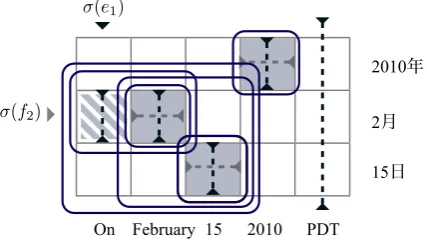
Figure 6: Augmenting the ITG grammar states with the alignment configuration in ann−1deep perimeter of the bispan allows us to score all over-lapping phrasal rules introduced by adjoining two bispans. The state must encode whether a sure link appears in each edge column or row, but the spe-cific location of edge links is not required.
In order to compute I(AL,AR), we need cer-tain information about the alignment configura-tions ofALandARwhere they adjoin at a corner. The state must represent (a) the specific alignment links in then−1deep corner of eachA, and (b) whether any sure alignments appear in the rows or columns extending from those corners.6 With this information, we can infer the bispans licensed by adjoiningALandAR, as in Figure 6.
Applying our score recurrence yields a polynomial-time dynamic program. This dynamic program is an instance of ITG bitext parsing, where the grammar uses symbols to encode the alignment contexts described above. This context-as-symbol augmentation of the grammar is similar in character to augmenting symbols with lexical items to score language models during hierarchical decoding (Chiang, 2007).
4.2 Coarse-to-Fine Inference and Pruning Exhaustive inference under an ITG requiresO(k6)
time in sentence lengthk, and is prohibitively slow when there is no sparsity in the grammar. Main-taining the context necessary to score non-local bispans further increases running time. That is, ITG inference is organized around search states associated with a grammar symbol and a bispan; augmenting grammar symbols also augments this state space.
To parse quickly, we prune away search states using predictions from the more efficient HMM 6The number of configuration states does not depend on the size ofAbecause corners have fixed size, and because the position of links within rows or columns is not needed.
alignment model (Ney and Vogel, 1996). We dis-card all states corresponding to bispans that are incompatible with 3 or more alignment links un-der an intersected HMM—a proven approach to pruning the space of ITG alignments (Zhang and Gildea, 2006; Haghighi et al., 2009). Pruning in this way reduces the search space dramatically, but only rarely prohibits correct alignments. The ora-cle alignment error rate for the block ITG model class is 1.4%; the oracle alignment error rate for this pruned subset of ITG is 2.0%.
To take advantage of the sparsity that results from pruning, we use an agenda-based parser that orders search states from small to large, where we define the size of a bispan as the total number of words contained within it. For each size, we main-tain a separate agenda. Only when the agenda for sizekis exhausted does the parser proceed to pro-cess the agenda for sizek+ 1.
We also employ coarse-to-fine search to speed up inference (Charniak and Caraballo, 1998). In the coarse pass, we search over the space of ITG alignments, but score only features on alignment links and bispans that are local to terminal blocks. This simplification eliminates the need to augment grammar symbols, and so we can exhaustively ex-plore the (pruned) space. We then compute out-side scores for bispans under a max-sum semir-ing (Goodman, 1996). In the fine pass with the full extraction set model, we impose a maximum size of 10,000 for each agenda. We order states on agendas by the sum of their inside score under the full model and the outside score computed in the coarse pass, pruning all states not within the fixed agenda beam size.
Search states that are popped off agendas are indexed by their corner locations for fast look-up when constructing new states. For each cor-ner and size combination, built states are main-tained in sorted order according to their inside score. This ordering allows us to stop combin-ing states early when the results are fallcombin-ing off the agenda beams. Similar search and beaming strate-gies appear in many decoders for machine trans-lation (Huang and Chiang, 2007; Koehn and Had-dow, 2009; Moore and Quirk, 2007).
k
l
g h
2月
15日
2010年
On February 15 2010
2月
15日
2010年
On February 15 2010
σ(ei)
σ(f2)
σ(e1)
Type 1: Language-specific function words omitted in the other language
Type 2: Role-equivalent pairs that are not lexical equivalents
过
[image:7.595.75.290.64.217.2]地球
[go over]
[Earth]
over the Earth 65%
31%
被
发现
[passive marker]
[discover]
was discovered
Distribution over possible link types
σ(fj)
年
过去
中
In the past two years
[past]
[two]
[year]
[in]
PDT
After dinner I slept
在
饭
后
我
睡
了
[after]
[dinner]
[after]
[I]
[sleep]
[past tense]
k =1
l =4
g =0 h =3
or
Figure 7: A* search for pseudo-gold ITG align-ments uses an admissible heuristic for bispans that counts the number of gold links outside of[k, `)
but within[g, h). Above, the heuristic is 1, which is also the minimal number of alignment errors that an ITG alignment will incur using this bispan.
Ag using A* bitext parsing (Klein and Manning, 2003). Search states, which correspond to bispans
[g, h)⇔[k, `), are scored by the number of errors within the bispan plus the number of(i, j) ∈ At such thatj ∈ [k, `) buti /∈ [g, h) (recall errors). As an admissible heuristic for the future cost of a bispan[g, h) ⇔ [k, `), we count the number of
(i, j) ∈ Atsuch thati ∈ [g, h)butj /∈ [k, `), as depicted in Figure 7. These links will become re-call errors eventually. A* search with this heuristic makes no errors, and the time required to compute pseudo-gold alignments is negligible.
5 Relationship to Previous Work
Our model is certainly not the first alignment ap-proach to include structures larger than words. Model-based phrase-to-phrase alignment was pro-posed early in the history of phrase-based trans-lation as a method for training transtrans-lation models (Marcu and Wong, 2002). A variety of unsuper-vised models refined this initial work with priors (DeNero et al., 2008; Blunsom et al., 2009) and inference constraints (DeNero et al., 2006; Birch et al., 2006; Cherry and Lin, 2007; Zhang et al., 2008). These models fundamentally differ from ours in that they stipulate a segmentation of the sentence pair into phrases, and only align the min-imal phrases in that segmentation. Our model scores the larger overlapping phrases that result from composing these minimal phrases.
Discriminative alignment is also a
well-explored area. Most work has focused on pre-dicting word alignments via partial matching in-ference algorithms (Melamed, 2000; Taskar et al., 2005; Moore, 2005; Lacoste-Julien et al., 2006). Work in semi-supervised estimation has also con-tributed evidence that hand-annotations are useful for training alignment models (Fraser and Marcu, 2006; Fraser and Marcu, 2007). The ITG gram-mar formalism, the corresponding word alignment class, and inference procedures for the class have also been explored extensively (Wu, 1997; Zhang and Gildea, 2005; Cherry and Lin, 2007; Zhang et al., 2008). At the intersection of these lines of work, discriminative ITG models have also been proposed, including one-to-one alignment mod-els (Cherry and Lin, 2006) and block modmod-els (Haghighi et al., 2009). Our model directly ex-tends this research agenda with first-class possi-ble links, overlapping phrasal rule features, and an extraction-level loss function.
K¨a¨ari¨ainen (2009) trains a translation model discriminatively using features on overlapping phrase pairs. That work differs from ours in that it uses fixed word alignments and focuses on translation model estimation, while we focus on alignment and translate using standard relative fre-quency estimators.
Deng and Zhou (2009) present an alignment combination technique that uses phrasal features. Our approach differs in two ways. First, their ap-proach is tightly coupled to the input alignments, while we perform a full search over the space of ITG alignments. Also, their approach uses greedy search, while our search is optimal aside from pruning and beaming. Despite these differences, their strong results reinforce our claim that phrase-level information is useful for alignment.
6 Experiments
thegrow-diagheuristic (Koehn et al., 2003). Unsupervised Baseline: Joint HMM. We trained and combined two HMM alignment mod-els (Ney and Vogel, 1996) using the Berkeley Aligner.7 We initialized the HMM model pa-rameters with jointly trained Model 1 param-eters (Liang et al., 2006), combined word-to-word posteriors by averaging (soft union), and de-coded with the competitive thresholding heuristic of DeNero and Klein (2007), yielding a state-of-the-art unsupervised baseline.
Supervised Baseline: Block ITG. We discrimi-natively trained a block ITG aligner with only sure links, using block terminal productions up to 3 words by 3 words in size. This supervised base-line is a reimplementation of the MIRA-trained model of Haghighi et al. (2009). We use the same features and parser implementation for this model as we do for our extraction set model to ensure a clean comparison. To remain within the alignment class, MIRA updates this model toward a pseudo-gold alignment with only sure links. This model does not score any overlapping bispans.
Extraction Set Coarse Pass. We add possible links to the output of the block ITG model by adding the mixed terminal block productions de-scribed in Section 2.3. This model scores over-lapping phrasal rules contained within terminal blocks that result from including or excluding pos-sible links. However, this model does not score bispans that cross bracketing of ITG derivations. Full Extraction Set Model. Our full model in-cludes possible links and features on extraction sets for phrasal bispans with a maximum size of 3. Model inference is performed using the coarse-to-fine scheme described in Section 4.2.
6.1 Data
In this paper, we focus exclusively on Chinese-to-English translation. We performed our discrimi-native training and alignment evaluations using a hand-aligned portion of the NIST MT02 test set, which consists of 150 training and 191 test sen-tences (Ayan and Dorr, 2006). We trained the baseline HMM on 11.3 million words of FBIS newswire data, a comparable dataset to those used in previous alignment evaluations on our test set (DeNero and Klein, 2007; Haghighi et al., 2009).
7http://code.google.com/p/berkeleyaligner
Our end-to-end translation experiments were tuned and evaluated on sentences up to length 40 from the NIST MT04 and MT05 test sets. For these experiments, we trained on a 22.1 million word parallel corpus consisting of sentences up to length 40 of newswire data from the GALE gram, subsampled from a larger data set to pro-mote overlap with the tune and test sets. This cor-pus also includes a bilingual dictionary. To im-prove performance, we retrained our aligner on a retokenized version of the hand-annotated data to match the tokenization of our corpus.8 We trained a language model with Kneser-Ney smoothing on 262 million words of newswire using SRILM (Stolcke, 2002).
6.2 Word and Phrase Alignment
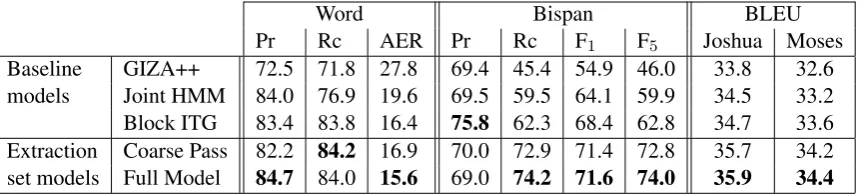
The first panel of Table 1 gives a word-level eval-uation of all five aligners. We use the alignment error rate (AER) measure: precision is the frac-tion of sure links in the system output that are sure or possible in the reference, and recall is the frac-tion of sure links in the reference that the system outputs as sure. For this evaluation, possible links produced by our extraction set models are ignored. The full extraction set model performs the best by a small margin, although it was not tuned for word alignment.
The second panel gives a phrasal rule-level evaluation, which measures the degree to which these aligners matched the extraction sets of hand-annotated alignments, R3(At).9 To compete fairly, all models were evaluated on the full ex-traction sets induced by the word alignments they predicted. Again, the extraction set model outper-formed the baselines, particularly on the F5 mea-sure for which these systems were trained.
Our coarse pass extraction set model performed nearly as well as the full model. We believe these models perform similarly for two reasons. First, most of the information needed to predict an extraction set can be inferred from word links and phrasal rules contained within ITG terminal productions. Second, the coarse-to-fine inference may be constraining the full phrasal model to pre-dict similar output to the coarse model. This simi-larity persists in translation experiments.
8All alignment results are reported under the annotated data set’s original tokenization.
Word Bispan BLEU
Pr Rc AER Pr Rc F1 F5 Joshua Moses
Baseline GIZA++ 72.5 71.8 27.8 69.4 45.4 54.9 46.0 33.8 32.6
models Joint HMM 84.0 76.9 19.6 69.5 59.5 64.1 59.9 34.5 33.2
Block ITG 83.4 83.8 16.4 75.8 62.3 68.4 62.8 34.7 33.6
Extraction Coarse Pass 82.2 84.2 16.9 70.0 72.9 71.4 72.8 35.7 34.2
[image:9.595.86.517.62.159.2]set models Full Model 84.7 84.0 15.6 69.0 74.2 71.6 74.0 35.9 34.4
Table 1: Experimental results demonstrate that the full extraction set model outperforms supervised and unsupervised baselines in evaluations of word alignment quality, extraction set quality, and translation. Inword andbispanevaluations, GIZA++ did not have access to a dictionary while all other methods did. In theBLEUevaluation, all systems used a bilingual dictionary included in the training corpus. The BLEU evaluation of supervised systems also included rule counts from the Joint HMM to compensate for parse failures.
6.3 Translation Experiments
We evaluate the alignments predicted by our model using two publicly available, open-source, state-of-the-art translation systems. Moses is a phrase-based system with lexicalized reordering (Koehn et al., 2007). Joshua (Li et al., 2009) is an implementation of Hiero (Chiang, 2007) using a suffix-array-based grammar extraction approach (Lopez, 2007).
Both of these systems take word alignments as input, and neither of these systems accepts possi-ble links in the alignments they consume. To inter-face with our extraction set models, we produced three sets of sure-only alignments from our model predictions: one that omitted possible links, one that converted all possible links to sure links, and one that includes each possible link with 0.5 prob-ability. These three sets were aggregated and rules were extracted from all three.
The training set we used for MT experiments is quite heterogenous and noisy compared to our alignment test sets, and the supervised aligners did not handle certain sentence pairs in our par-allel corpus well. In some cases, pruning based on consistency with the HMM caused parse fail-ures, which in turn caused training sentences to be skipped. To account for these issues, we added counts of phrasal rules extracted from the baseline HMM to the counts produced by supervised align-ers.
In Moses, our extraction set model predicts the set of phrases extracted by the system, and so the estimation techniques for the alignment model and translation model both share a common underly-ing representation: extraction sets. Empirically, we observe a BLEU score improvement of 1.2
over the best unsupervised baseline and 0.8 over the block ITG supervised baseline (Papineni et al., 2002).
In Joshua, hierarchical rule extraction is based upon phrasal rule extraction, but abstracts away sub-phrases to create a grammar. Hence, the ex-traction sets we predict are closely linked to the representation that this system uses to translate. The extraction model again outperformed both un-supervised and un-supervised baselines, by 1.4 BLEU and 1.2 BLEU respectively.
7 Conclusion
Our extraction set model serves to coordinate the alignment and translation model components of a statistical translation system by unifying their rep-resentations. Moreover, our model provides an ef-fective alternative to phrase alignment models that choose a particular phrase segmentation; instead, we predict many overlapping phrases, both large and small, that are mutually consistent. In future work, we look forward to developing extraction set models for richer formalisms, including hier-archical grammars.
Acknowledgments
This project is funded in part by BBN under DARPA contract HR0011-06-C-0022 and by the NSF under grant 0643742. We thank the anony-mous reviewers for their helpful comments.
References
the Annual Conference of the Association for Com-putational Linguistics.
Necip Fazil Ayan, Bonnie J. Dorr, and Christof Monz. 2005. Neuralign: combining word alignments us-ing neural networks. InProceedings of the Confer-ence on Human Language Technology and
Empiri-cal Methods in Natural Language Processing.
Alexandra Birch, Chris Callison-Burch, and Miles Os-borne. 2006. Constraining the phrase-based, joint probability statistical translation model. In Proceed-ings of the Conference for the Association for Ma-chine Translation in the Americas.
Phil Blunsom, Trevor Cohn, Chris Dyer, and Miles Os-borne. 2009. A Gibbs sampler for phrasal syn-chronous grammar induction. InProceedings of the Annual Conference of the Association for Computa-tional Linguistics.
Eugene Charniak and Sharon Caraballo. 1998. New figures of merit for best-first probabilistic chart pars-ing. InComputational Linguistics.
Colin Cherry and Dekang Lin. 2006. Soft syntactic constraints for word alignment through discrimina-tive training. InProceedings of the Annual Confer-ence of the Association for Computational Linguis-tics.
Colin Cherry and Dekang Lin. 2007. Inversion trans-duction grammar for joint phrasal translation mod-eling. InProceedings of the Annual Conference of the North American Chapter of the Association for Computational Linguistics Workshop on Syntax and Structure in Statistical Translation.
David Chiang, Yuval Marton, and Philip Resnik. 2008. Online large-margin training of syntactic and struc-tural translation features. InProceedings of the Con-ference on Empirical Methods in Natural Language Processing.
David Chiang. 2007. Hierarchical phrase-based trans-lation. Computational Linguistics.
Koby Crammer and Yoram Singer. 2003. Ultracon-servative online algorithms for multiclass problems.
Journal of Machine Learning Research, 3:951–991.
John DeNero and Dan Klein. 2007. Tailoring word alignments to syntactic machine translation. In Pro-ceedings of the Annual Conference of the Associa-tion for ComputaAssocia-tional Linguistics.
John DeNero and Dan Klein. 2008. The complexity of phrase alignment problems. In Proceedings of the Annual Conference of the Association for Computa-tional Linguistics: Short Paper Track.
John DeNero, Dan Gillick, James Zhang, and Dan Klein. 2006. Why generative phrase models un-derperform surface heuristics. InProceedings of the NAACL Workshop on Statistical Machine Transla-tion.
John DeNero, Alexandre Bouchard-Cote, and Dan Klein. 2008. Sampling alignment structure under a bayesian translation model. InProceedings of the Conference on Empirical Methods in Natural Lan-guage Processing.
Yonggang Deng and Bowen Zhou. 2009. Optimizing word alignment combination for phrase table train-ing. InProceedings of the Annual Conference of the Association for Computational Linguistics: Short Paper Track.
Alexander Fraser and Daniel Marcu. 2006. Semi-supervised training for statistical word alignment. In Proceedings of the Annual Conference of the Asso-ciation for Computational Linguistics.
Alexander Fraser and Daniel Marcu. 2007. Getting the structure right for word alignment: Leaf. In Pro-ceedings of the Joint Conference on Empirical Meth-ods in Natural Language Processing and Computa-tional Natural Language Learning.
Michel Galley, Jonathan Graehl, Kevin Knight, Daniel Marcu, Steve DeNeefe, Wei Wang, and Ignacio Thayer. 2006. Scalable inference and training of context-rich syntactic translation models. In Pro-ceedings of the Annual Conference of the Associa-tion for ComputaAssocia-tional Linguistics.
Joshua Goodman. 1996. Parsing algorithms and met-rics. In Proceedings of the Annual Meeting of the Association for Computational Linguistics.
Aria Haghighi, John Blitzer, John DeNero, and Dan Klein. 2009. Better word alignments with super-vised ITG models. In Proceedings of the Annual Conference of the Association for Computational Linguistics.
Liang Huang and David Chiang. 2007. Forest rescor-ing: Faster decoding with integrated language mod-els. InProceedings of the Annual Conference of the Association for Computational Linguistics.
Matti K¨a¨ari¨ainen. 2009. Sinuhe—statistical machine translation using a globally trained conditional ex-ponential family translation model. InProceedings of the Conference on Empirical Methods in Natural
Language Processing.
Dan Klein and Chris Manning. 2003. A* parsing: Fast exact Viterbi parse selection. InProceedings of the Conference of the North American Chapter of the Association for Computational Linguistics.
Philipp Koehn and Barry Haddow. 2009. Edinburghs submission to all tracks of the WMT2009 shared task with reordering and speed improvements to Moses. InProceedings of the Workshop on Statis-tical Machine Translation.
Philipp Koehn, Hieu Hoang, Alexandra Birch, Chris Callison-Burch, Marcello Federico, Nicola Bertoldi, Brooke Cowan, Wade Shen, Christine Moran, Richard Zens, Chris Dyer, Ondrej Bojar, Alexandra Constantin, and Evan Herbst. 2007. Moses: Open source toolkit for statistical machine translation. In Proceedings of the Annual Conference of the Associ-ation for ComputAssoci-ational Linguistics: DemonstrAssoci-ation track.
Simon Lacoste-Julien, Ben Taskar, Dan Klein, and Michael I. Jordan. 2006. Word alignment via quadratic assignment. InProceedings of the Annual Conference of the North American Chapter of the Association for Computational Linguistics.
Zhifei Li, Chris Callison-Burch, Chris Dyer, Juri Gan-itkevitch, Sanjeev Khudanpur, Lane Schwartz, Wren Thornton, Jonathan Weese, and Omar Zaidan. 2009. Joshua: An open source toolkit for parsing-based machine translation. In Proceedings of the Work-shop on Statistical Machine Translation.
Percy Liang, Ben Taskar, and Dan Klein. 2006. Align-ment by agreeAlign-ment. In Proceedings of the Annual Conference of the North American Chapter of the Association for Computational Linguistics.
Adam Lopez. 2007. Hierarchical phrase-based trans-lation with suffix arrays. InProceedings of the Con-ference on Empirical Methods in Natural Language Processing.
Daniel Marcu and Daniel Wong. 2002. A phrase-based, joint probability model for statistical machine translation. In Proceedings of the Conference on Empirical Methods in Natural Language Process-ing.
I. Dan Melamed. 2000. Models of translational equiv-alence among words. Computational Linguistics.
Robert Moore and Chris Quirk. 2007. Faster
beam-search decoding for phrasal statistical ma-chine translation. InProceedings of MT Summit XI.
Robert C. Moore. 2005. A discriminative framework for bilingual word alignment. InProceedings of the Conference on Empirical Methods in Natural Lan-guage Processing.
Hermann Ney and Stephan Vogel. 1996. HMM-based word alignment in statistical translation. In Pro-ceedings of the Conference on Computational lin-guistics.
Franz Josef Och and Hermann Ney. 2003. A sys-tematic comparison of various statistical alignment models. Computational Linguistics, 29:19–51.
Franz Josef Och, Christoph Tillmann, and Hermann Ney. 1999. Improved alignment models for statisti-cal machine translation. InProceedings of the Con-ference on Empirical Methods in Natural Language Processing.
Kishore Papineni, Salim Roukos, Todd Ward, and Wei-Jing Zhu. 2002. BLEU: A method for automatic evaluation of machine translation. InProceedings of the Annual Conference of the Association for Com-putational Linguistics.
Andreas Stolcke. 2002. Srilm an extensible language modeling toolkit. In Proceedings of the
Interna-tional Conference on Spoken Language Processing.
Ben Taskar, Simon Lacoste-Julien, and Dan Klein. 2005. A discriminative matching approach to word alignment. InProceedings of the Conference on
Em-pirical Methods in Natural Language Processing.
Dekai Wu. 1997. Stochastic inversion transduction grammars and bilingual parsing of parallel corpora. Computational Linguistics, 23:377–404.
Hao Zhang and Daniel Gildea. 2005. Stochastic lex-icalized inversion transduction grammar for align-ment. InProceedings of the Annual Conference of the Association for Computational Linguistics.
Hao Zhang and Daniel Gildea. 2006. Efficient search for inversion transduction grammar. InProceedings of the Conference on Empirical Methods in Natural
Language Processing.
![Figure 6: Augmenting the ITG grammar stateswith the alignment configuration in an在晚饭后我[after]k =2 n−1 deepperimeter of the bispan allows us to score all over-lapping phrasal rules introduced by adjoining two[dinner]bispans](https://thumb-us.123doks.com/thumbv2/123dok_us/230329.522444/6.595.75.290.66.164/augmenting-stateswith-alignment-conguration-an-deepperimeter-introduced-adjoining.webp)