Proceedings of ACL-08: HLT, pages 843–851,
An Entity-Mention Model for Coreference Resolution
with Inductive Logic Programming
Xiaofeng Yang1 Jian Su1 Jun Lang2 Chew Lim Tan3
Ting Liu2
Sheng Li2
1
Institute for Infocomm Research {xiaofengy,sujian}@i2r.a-star.edu.sg
2
Harbin Institute of Technology {bill lang,tliu}@ir.hit.edu.cn
3
National University of Singapore, [email protected]
Abstract
The traditional mention-pair model for coref-erence resolution cannot capture information beyond mention pairs for both learning and testing. To deal with this problem, we present an expressive entity-mention model that per-forms coreference resolution at an entity level. The model adopts the Inductive Logic Pro-gramming (ILP) algorithm, which provides a relational way to organize different knowledge of entities and mentions. The solution can explicitly express relations between an entity and the contained mentions, and automatically learn first-order rules important for corefer-ence decision. The evaluation on the ACE data set shows that the ILP based entity-mention model is effective for the coreference resolu-tion task.
1 Introduction
Coreference resolution is the process of linking mul-tiple mentions that refer to the same entity. Most of previous work adopts the mention-pair model, which recasts coreference resolution to a binary classification problem of determining whether or not two mentions in a document are co-referring (e.g. Aone and Bennett (1995); McCarthy and Lehnert (1995); Soon et al. (2001); Ng and Cardie (2002)). Although having achieved reasonable success, the mention-pair model has a limitation that informa-tion beyond meninforma-tion pairs is ignored for training and testing. As an individual mention usually lacks ad-equate descriptive information of the referred entity, it is often difficult to judge whether or not two
men-tions are talking about the same entity simply from the pair alone.
An alternative learning model that can overcome this problem performs coreference resolution based on entity-mention pairs (Luo et al., 2004; Yang et al., 2004b). Compared with the traditional mention-pair counterpart, the entity-mention model aims to make coreference decision at an entity level. Classi-fication is done to determine whether a mention is a referent of a partially found entity. A mention to be resolved (called active mention henceforth) is linked to an appropriate entity chain (if any), based on clas-sification results.
One problem that arises with the entity-mention model is how to represent the knowledge related to an entity. In a document, an entity may have more than one mention. It is impractical to enumerate all the mentions in an entity and record their informa-tion in a single feature vector, as it would make the feature space too large. Even worse, the number of mentions in an entity is not fixed, which would re-sult in variant-length feature vectors and make trou-ble for normal machine learning algorithms. A solu-tion seen in previous work (Luo et al., 2004; Culotta et al., 2007) is to design a set of first-order features summarizing the information of the mentions in an entity, for example, “whether the entity has any men-tion that is a name alias of the active menmen-tion?” or “whether most of the mentions in the entity have the same head word as the active mention?” These fea-tures, nevertheless, are designed in an ad-hoc man-ner and lack the capability of describing each indi-vidual mention in an entity.
In this paper, we present a more expressive
mention model for coreference resolution. The model employs Inductive Logic Programming (ILP) to represent the relational knowledge of an active mention, an entity, and the mentions in the entity. On top of this, a set of first-order rules is automatically learned, which can capture the information of each individual mention in an entity, as well as the global information of the entity, to make coreference deci-sion. Hence, our model has a more powerful repre-sentation capability than the traditional mention-pair or entity-mention model. And our experimental re-sults on the ACE data set shows the model is effec-tive for coreference resolution.
2 Related Work
There are plenty of learning-based coreference reso-lution systems that employ the mention-pair model. A typical one of them is presented by Soon et al. (2001). In the system, a training or testing instance is formed for two mentions in question, with a fea-ture vector describing their properties and relation-ships. At a testing time, an active mention is checked against all its preceding mentions, and is linked with the closest one that is classified as positive. The work is further enhanced by Ng and Cardie (2002) by expanding the feature set and adopting a “best-first” linking strategy.
Recent years have seen some work on the entity-mention model. Luo et al. (2004) propose a system that performs coreference resolution by doing search in a large space of entities. They train a classifier that can determine the likelihood that an active mention should belong to an entity. The entity-level features are calculated with an “Any-X” strategy: an entity-mention pair would be assigned a feature X, if any mention in the entity has the feature X with the ac-tive mention.
Culotta et al. (2007) present a system which uses an online learning approach to train a classifier to judge whether two entities are coreferential or not. The features describing the relationships between two entities are obtained based on the information of every possible pair of mentions from the two en-tities. Different from (Luo et al., 2004), the entity-level features are computed using a “Most-X” strat-egy, that is, two given entities would have a feature X, if most of the mention pairs from the two entities
have the feature X.
Yang et al. (2004b) suggest an entity-based coref-erence resolution system. The model adopted in the system is similar to the mention-pair model, except that the entity information (e.g., the global num-ber/gender agreement) is considered as additional features of a mention in the entity.
McCallum and Wellner (2003) propose several graphical models for coreference analysis. These models aim to overcome the limitation that pair-wise coreference decisions are made independently of each other. The simplest model conditions coref-erence on mention pairs, but enforces dependency by calculating the distance of a node to a partition (i.e., the probability that an active mention belongs to an entity) based on the sum of its distances to all the nodes in the partition (i.e., the sum of the prob-ability of the active mention co-referring with the mentions in the entity).
Inductive Logic Programming (ILP) has been ap-plied to some natural language processing tasks, in-cluding parsing (Mooney, 1997), POS disambigua-tion (Cussens, 1996), lexicon construcdisambigua-tion (Claveau et al., 2003), WSD (Specia et al., 2007), and so on. However, to our knowledge, our work is the first ef-fort to adopt this technique for the coreference reso-lution task.
3 Modelling Coreference Resolution
Suppose we have a document containingnmentions
{mj : 1 < j < n}, in whichmj is thejth mention occurring in the document. Leteibe theith entity in the document. We define
P(L|ei, mj), (1)
the probability that a mention belongs to an entity. Here the random variableLtakes a binary value and is 1 ifmjis a mention ofei.
By assuming that mentions occurring after mj have no influence on the decision of linking mj to an entity, we can approximate (1) as:
P(L|ei, mj)
∝ P(L|{mk ∈ei,1≤k≤j−1}, mj) (2)
∝ max
mk∈ei,1≤k≤j−1
P(L|mk, mj) (3)
mention-[ Microsoft Corp. ]1
1announced [ [ its ] 1
2new CEO ] 2 3
[ yesterday ]34. [ The company ] 1
5said [ he ] 2 6will . . .
Table 1: A sample text
pair score. Both (2) and (1) can be approximated with a machine learning method, leading to the tra-ditional mention-pair model and the entity-mention model for coreference resolution, respectively.
The two models will be described in the next sub-sections, with the sample text in Table 1 used for demonstration. In the table, a mention m is high-lighted as [m ]eidmid, wheremid andeidare the IDs for the mention and the entity to which it belongs, respectively. Three entity chains can be found in the text, that is,
e1 : Microsoft Corp. - its - The company e2 : its new CEO - he
e3 : yesterday
3.1 Mention-Pair Model
As a baseline, we first describe a learning framework with the mention-pair model as adopted in the work by Soon et al. (2001) and Ng and Cardie (2002).
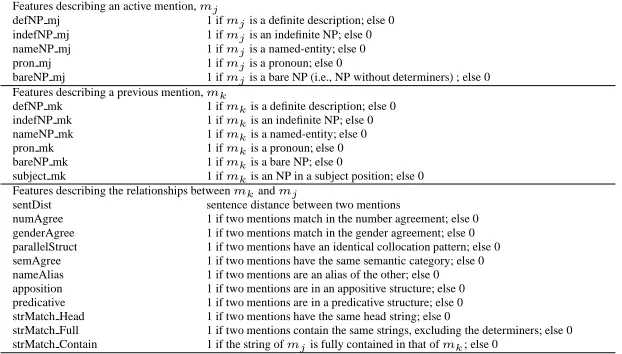
In the learning framework, a training or testing instance has the form of i{mk,mj}, in whichmj is an active mention and mk is a preceding mention. An instance is associated with a vector of features, which is used to describe the properties of the two mentions as well as their relationships. Table 2 sum-marizes the features used in our study.
For training, given each encountered anaphoric mentionmj in a document, one single positive train-ing instance is created for mj and its closest an-tecedent. And a group of negative training in-stances is created for every intervening mentions between mj and the antecedent. Consider the ex-ample text in Table 1, for the pronoun “he”, three instances are generated: i(“The company”,“he”), i(“yesterday”,“he”), and i(“its new CEO”,“he”).
Among them, the first two are labelled as negative while the last one is labelled as positive.
Based on the training instances, a binary classifier can be generated using any discriminative learning algorithm. During resolution, an input document is processed from the first mention to the last. For each
encountered mention mj, a test instance is formed for each preceding mention, mk. This instance is presented to the classifier to determine the corefer-ence relationship. mjis linked with the mention that is classified as positive (if any) with the highest con-fidence value.
3.2 Entity-Mention Model
The mention-based solution has a limitation that in-formation beyond a mention pair cannot be captured. As an individual mention usually lacks complete de-scription about the referred entity, the coreference relationship between two mentions may be not clear, which would affect classifier learning. Consider a document with three coreferential mentions “Mr.
Powell”, “he”, and “Powell”, appearing in that
or-der. The positive training instance i(“he”, “Powell”) is not informative, as the pronoun “he” itself dis-closes nothing but the gender. However, if the whole entity is considered instead of only one mention, we can know that “he” refers to a male person named “Powell”. And consequently, the coreference rela-tionships between the mentions would become more obvious.
The mention-pair model would also cause errors at a testing time. Suppose we have three mentions “Mr. Powell”, “Powell”, and “she” in a document. The model tends to link “she” with “Powell” be-cause of their proximity. This error can be avoided, if we know “Powell” belongs to the entity starting with “Mr. Powell”, and therefore refers to a male person and cannot co-refer with “she”.
The entity-mention model based on Eq. (2) per-forms coreference resolution at an entity-level. For simplicity, the framework considered for the entity-mention model adopts similar training and testing procedures as for the mention-pair model. Specif-ically, a training or testing instance has the form of
i{ei,mj}, in whichmj is an active mention andei is a partial entity found before mj. During train-ing, given each anaphoric mention mj, one single positive training instance is created for the entity to whichmj belongs. And a group of negative train-ing instances is created for every partial entity whose last mention occurs betweenmj and the closest an-tecedent ofmj.
Features describing an active mention,mj
defNP mj 1 ifmjis a definite description; else 0
indefNP mj 1 ifmjis an indefinite NP; else 0
nameNP mj 1 ifmjis a named-entity; else 0
pron mj 1 ifmjis a pronoun; else 0
bareNP mj 1 ifmjis a bare NP (i.e., NP without determiners) ; else 0
Features describing a previous mention,mk
defNP mk 1 ifmkis a definite description; else 0
indefNP mk 1 ifmkis an indefinite NP; else 0
nameNP mk 1 ifmkis a named-entity; else 0
pron mk 1 ifmkis a pronoun; else 0
bareNP mk 1 ifmkis a bare NP; else 0
subject mk 1 ifmkis an NP in a subject position; else 0
Features describing the relationships betweenmkandmj
sentDist sentence distance between two mentions
numAgree 1 if two mentions match in the number agreement; else 0 genderAgree 1 if two mentions match in the gender agreement; else 0 parallelStruct 1 if two mentions have an identical collocation pattern; else 0 semAgree 1 if two mentions have the same semantic category; else 0 nameAlias 1 if two mentions are an alias of the other; else 0 apposition 1 if two mentions are in an appositive structure; else 0 predicative 1 if two mentions are in a predicative structure; else 0 strMatch Head 1 if two mentions have the same head string; else 0
[image:4.612.152.463.65.242.2]strMatch Full 1 if two mentions contain the same strings, excluding the determiners; else 0 strMatch Contain 1 if the string ofmjis fully contained in that ofmk; else 0
Table 2: Feature set for coreference resolution
entity e1, e3 and e2:
i({“Microsoft Corp.”, “its”, “The company”},“he”),
i({“yesterday”},“he”),
i({“its new CEO”},“he”).
Among them, the first two are labelled as negative, while the last one is positive.
The resolution is done using a greedy clustering strategy. Given a test document, the mentions are processed one by one. For each encountered men-tionmj, a test instance is formed for each partial en-tity found so far,ei. This instance is presented to the classifier.mjis appended to the entity that is classi-fied as positive (if any) with the highest confidence value. If no positive entity exists, the active mention is deemed as non-anaphoric and forms a new entity. The process continues until the last mention of the document is reached.
One potential problem with the entity-mention model is how to represent the entity-level knowl-edge. As an entity may contain more than one candi-date and the number is not fixed, it is impractical to enumerate all the mentions in an entity and put their properties into a single feature vector. As a base-line, we follow the solution proposed in (Luo et al., 2004) to design a set of first-order features. The fea-tures are similar to those for the mention-pair model as shown in Table 2, but their values are calculated at an entity level. Specifically, the lexical and gram-matical features are computed by testing any men-tion1in the entity against the active mention, for
ex-1
Linguistically, pronouns usually have the most direct
coref-ample, the feature nameAlias is assigned value 1 if at least one mention in the entity is a name alias of the active mention. The distance feature (i.e.,
sent-Dist) is the minimum distance between the mentions
in the entity and the active mention.
The above entity-level features are designed in an ad-hoc way. They cannot capture the detailed infor-mation of each individual mention in an entity. In the next section, we will present a more expressive entity-mention model by using ILP.
4 Entity-mention Model with ILP
4.1 Motivation
The entity-mention model based on Eq. (2) re-quires relational knowledge that involves informa-tion of an active meninforma-tion (mj), an entity (ei), and the mentions in the entity ({mk ∈ ei}). How-ever, normal machine learning algorithms work on attribute-value vectors, which only allows the repre-sentation of atomic proposition. To learn from rela-tional knowledge, we need an algorithm that can ex-press first-order logic. This requirement motivates our use of Inductive Logic Programming (ILP), a learning algorithm capable of inferring logic pro-grams. The relational nature of ILP makes it pos-sible to explicitly represent relations between an en-tity and its mentions, and thus provides a powerful expressiveness for the coreference resolution task.
ILP uses logic programming as a uniform repre-sentation for examples, background knowledge and hypotheses. Given a set of positive and negative ex-ample E = E+ ∪ E−, and a set of background knowledge K of the domain, ILP tries to induce a set of hypotheseshthat covers most ofE+
with no
E−, i.e.,K∧h|=E+andK∧h6|=E−.
In our study, we choose ALEPH2, an ILP imple-mentation by Srinivasan (2000) that has been proven well suited to deal with a large amount of data in multiple domains. For its routine use, ALEPH fol-lows a simple procedure to induce rules. It first se-lects an example and builds the most specific clause that entertains the example. Next, it tries to search for a clause more general than the bottom one. The best clause is added to the current theory and all the examples made redundant are removed. The proce-dure repeats until all examples are processed.
4.2 Apply ILP to coreference resolution
Given a document, we encode a mention or a par-tial entity with a unique constant. Specifically, mj represents thejth mention (e.g.,m6for the pronoun “he”). ei j represents the partial entity ibefore the
jth mention. For example, e1 6 denotes the part of
e1 before m6, i.e., {“Microsoft Corp.”, “its”, “the
company”}, while e1 5 denotes the part of e1 be-forem5 (“The company”), i.e.,{“Microsoft Corp.”, “its”}.
Training instances are created as described in Sec-tion 3.2 for the entity-menSec-tion model. Each instance is recorded with a predicate link(ei j,mj), wheremj is an active mention andei j is a partial entity. For example, the three training instances formed by the pronoun “he” are represented as follows:
link(e1 6, m6).
link(e3 6, m6).
link(e2 6, m6).
The first two predicates are put intoE−, while the last one is put toE+.
The background knowledge for an instance
link(ei j, mj) is also represented with predicates, which are divided into the following types:
1. Predicates describing the information related to
ei j and mj. The properties of mj are
pre-2http://web.comlab.ox.ac.uk/oucl/
research/areas/machlearn/Aleph/aleph toc.html
sented with predicates like f(m, v), where f
corresponds to a feature in the first part of Ta-ble 2 (removing the suffix mj), and v is its value. For example, the pronoun “he” can be described by the following predicates:
defNP(m6,0). indefNP(m6,0).
nameNP(m6,0). pron(m6,1).
bareNP(m6,0).
The predicates for the relationships between
ei j and mj take a form off(e,m,v). In our study, we consider the number agreement
(ent-NumAgree) and the gender agreement (entGen-derAgree) between ei j and mj. v is 1 if all of the mentions in ei j have consistent num-ber/gender agreement withmj, e.g,
entNumAgree(e1 6, m6,1).
2. Predicates describing the belonging relations between ei j and its mentions. A predicate
has mention(e,m) is used for each mention in
e 3. For example, the partial entity e1 6 has three mentions,m1,m2 andm5, which can be described as follows:
has mention(e1 6, m1).
has mention(e1 6, m2).
has mention(e1 6, m5).
3. Predicates describing the information related to
mj and each mention mk in ei j. The predi-cates for the properties ofmkcorrespond to the features in the second part of Table 2 (removing the suffix mk), while the predicates for the re-lationships betweenmj andmk correspond to the features in the third part of Table 2. For ex-ample, given the two mentionsm1(“Microsoft
Corp.) andm6 (“he), the following predicates can be applied:
nameNP(m1,1).
pron(m1,0). . . .
nameAlias(m1, m6,0).
sentDist(m1, m6,1). . . .
the last two predicates represent that m1 and
3If an active mention
mj is a pronoun, only the previous
m6 are not name alias, and are one sentence apart.
By using the three types of predicates, the dif-ferent knowledge related to entities and mentions are integrated. The predicate has mention acts as a bridge connecting the entity-mention knowledge and the mention-pair knowledge. As a result, when evaluating the coreference relationship between an active mention and an entity, we can make use of the “global” information about the entity, as well as the “local” information of each individual mention in the entity.
From the training instances and the associated background knowledge, a set of hypotheses can be automatically learned by ILP. Each hypothesis is output as a rule that may look like:
link(A,B):-predi1, predi2, . . . , has mention(A,C), . . . , prediN.
which corresponds to first-order logic
∀A, B(predi1∧predi2∧. . .∧
∃C(has mention(A, C)∧. . .∧prediN)
→link(A, B))
Consider an example rule produced in our system:
link(A,B)
:-has mention(A,C), numAgree(B,C,1), strMatch Head(B,C,1), bareNP(C,1).
Here, variables Aand B stand for an entity and an active mention in question. The first-order logic is implemented by using non-instantiated argumentsC
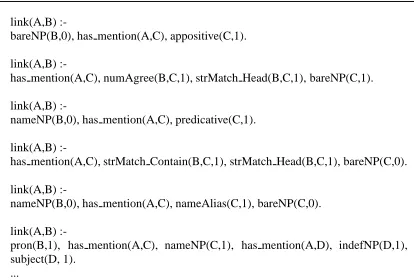
in the predicate has mention. This rule states that a mention B should belong to an entityA, if there ex-ists a mention C in A such that C is a bare noun phrase with the same head string asB, and matches in number withB. In this way, the detailed informa-tion of each individual meninforma-tion in an entity can be captured for resolution.
A rule is applicable to an instance link(e, m), if the background knowledge for the instance can be described by the predicates in the body of the rule. Each rule is associated with a score, which is the accuracy that the rule can produce for the training instances.
The learned rules are applied to resolution in a similar way as described in Section 3.2. Given an active mention m and a partial entity e, a test in-stance link(e,m) is formed and tested against every rule in the rule set. The confidence thatm should
Train Test
[image:6.612.356.496.63.100.2]#entity #mention #entity #mention NWire 1678 9861 411 2304 NPaper 1528 10277 365 2290 BNews 1695 8986 468 2493
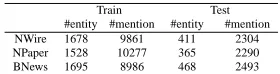
Table 3: statistics of entities (length>1) and contained mentions
belong to eis the maximal score of the applicable rules. An active mention is linked to the entity with the highest confidence value (above 0.5), if any.
5 Experiments and Results
5.1 Experimental Setup
In our study, we did evaluation on the ACE-2003 corpus, which contains two data sets, training and devtest, used for training and testing respectively. Each of these sets is further divided into three do-mains: newswire (NWire), newspaper (NPaper), and broadcast news (BNews). The number of entities with more than one mention, as well as the number of the contained mentions, is summarized in Table 3. For both training and resolution, an input raw document was processed by a pipeline of NLP modules including Tokenizer, Part-of-Speech tag-ger, NP Chunker and Named-Entity (NE) Recog-nizer. Trained and tested on Penn WSJ TreeBank, the POS tagger could obtain an accuracy of 97% and the NP chunker could produce an F-measure above 94% (Zhou and Su, 2000). Evaluated for the MUC-6 and MUC-7 Named-Entity task, the NER mod-ule (Zhou and Su, 2002) could provide an F-measure of 96.6% (MUC-6) and 94.1%(MUC-7). For evalu-ation, Vilain et al. (1995)’s scoring algorithm was adopted to compute recall and precision rates.
By default, the ALEPH algorithm only generates rules that have 100% accuracy for the training data. And each rule contains at most three predicates. To accommodate for coreference resolution, we loos-ened the restrictions to allow rules that have above 50% accuracy and contain up to ten predicates. De-fault parameters were applied for all the other set-tings in ALEPH as well as other learning algorithms used in the experiments.
5.2 Results and Discussions
NWire NPaper BNews
R P F R P F R P F
C4.5
- Mention-Pair 68.2 54.3 60.4 67.3 50.8 57.9 66.5 59.5 62.9
- Entity-Mention 66.8 55.0 60.3 64.2 53.4 58.3 64.6 60.6 62.5 - Mention-Pair (all mentions in entity) 66.7 49.3 56.7 65.8 48.9 56.1 66.5 47.6 55.4 ILP
- Mention-Pair 66.1 54.8 59.5 65.6 54.8 59.7 63.5 60.8 62.1
[image:7.612.101.512.62.165.2]- Entity-Mention 65.0 58.9 61.8 63.4 57.1 60.1 61.7 65.4 63.5
Table 4: Results of different systems for coreference resolution
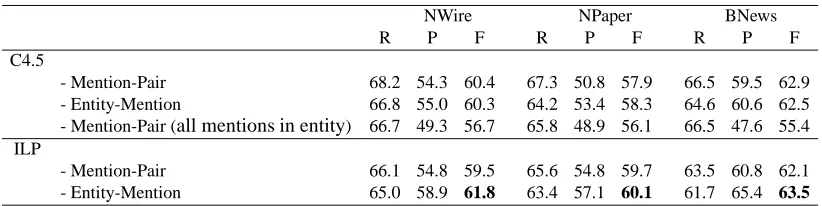
examined the C4.5 algorithm4which is widely used for the coreference resolution task. The first line of the table shows the baseline system that employs the traditional mention-pair model (MP) as described in Section 3.1. From the table, our baseline system achieves a recall of around 66%-68% and a preci-sion of around 50%-60%. The overall F-measure for NWire, NPaper and BNews is 60.4%, 57.9% and 62.9% respectively. The results are comparable to those reported in (Ng, 2005) which uses similar fea-tures and gets an F-measure ranging in 50-60% for the same data set. As our system relies only on sim-ple and knowledge-poor features, the achieved F-measure is around 2-4% lower than the state-of-the-art systems do, like (Ng, 2007) and (Yang and Su, 2007) which utilized sophisticated semantic or real-world knowledge. Since ILP has a strong capability in knowledge management, our system could be fur-ther improved if such helpful knowledge is incorpo-rated, which will be explored in our future work.
The second line of Table 4 is for the system that employs the entity-mention model (EM) with “Any-X” based entity features, as described in Sec-tion 3.2. We can find that the EM model does not show superiority over the baseline MP model. It achieves a higher precision (up to 2.6%), but a lower recall (2.9%), than MP. As a result, we only see
±0.4% difference between the F-measure. The re-sults are consistent with the reports by Luo et al. (2004) that the entity-mention model with the “Any-X” first-order features performs worse than the nor-mal mention-pair model. In our study, we also tested the “Most-X” strategy for the first-order features as in (Culotta et al., 2007), but got similar results with-out much difference (±0.5% F-measure) in
perfor-4
http://www.rulequest.com/see5-info.html
mance. Besides, as with our entity-mention predi-cates described in Section 4.2, we also tried the “All-X” strategy for the entity-level agreement features, that is, whether all mentions in a partial entity agree in number and gender with an active mention. How-ever, we found this bring no improvement against the “Any-X” strategy.
As described, given an active mentionmj, the MP model only considers the mentions betweenmjand its closest antecedent. By contrast, the EM model considers not only these mentions, but also their an-tecedents in the same entity link. We were interested in examining what if the MP model utilizes all the mentions in an entity as the EM model does. As shown in the third line of Table 4, such a solution damages the performance; while the recall is at the same level, the precision drops significantly (up to 12%) and as a result, the F-measure is even lower than the original MP model. This should be because a mention does not necessarily have direct corefer-ence relationships with all of its antecedents. As the MP model treats each mention-pair as an indepen-dent instance, including all the anteceindepen-dents would produce many less-confident positive instances, and thus adversely affect training.
link(A,B)
:-bareNP(B,0), has mention(A,C), appositive(C,1).
link(A,B)
:-has mention(A,C), numAgree(B,C,1), strMatch Head(B,C,1), bareNP(C,1).
link(A,B)
:-nameNP(B,0), has mention(A,C), predicative(C,1).
link(A,B)
:-has mention(A,C), strMatch Contain(B,C,1), strMatch Head(B,C,1), bareNP(C,0).
link(A,B)
:-nameNP(B,0), has mention(A,C), nameAlias(C,1), bareNP(C,0).
link(A,B)
:-pron(B,1), has mention(A,C), nameNP(C,1), has mention(A,D), indefNP(D,1), subject(D, 1).
[image:8.612.81.288.64.204.2]...
Figure 1: Examples of rules produced by ILP (entity-mention model)
a good classifier learner for the mention-pair model. The fifth line of Table 4 is for the ILP based entity-mention model (described in Section 4.2). We can observe that the model leads to a better performance than all the other models. Compared with the sys-tem with the MP model (under ILP), the EM version is able to achieve a higher precision (up to 4.6% for BNews). Although the recall drops slightly (up to 1.8% for BNews), the gain in the precision could compensate it well; it beats the MP model in the overall F-measure for all three domains (2.3% for Nwire, 0.4% for Npaper, 1.4% for BNews). Es-pecially, the improvement in NWire and BNews is statistically significant under a 2-tailed t test (p <
0.05). Compared with the EM model with the man-ually designed first-order feature (the second line), the ILP-based EM solution also yields better perfor-mance in precision (with a slightly lower recall) as well as the overall F-measure (1.0% - 1.8%).
The improvement in precision against the mention-pair model confirms that the global infor-mation beyond a single mention pair, when being considered for training, can make coreference rela-tions clearer and help classifier learning. The bet-ter performance against the EM model with heuristi-cally designed features also suggests that ILP is able to learn effective first-order rules for the coreference resolution task.
In Figure 1, we illustrate part of the rules pro-duced by ILP for the entity-mention model (NWire domain), which shows how the relational knowledge of entities and mentions is represented for decision making. An interesting finding, as shown in the last
rule of the table, is that multiple non-instantiated ar-guments (i.e. C and D) could possibly appear in the same rule. According to this rule, a pronominal mention should be linked with a partial entity which contains a named-entity and contains an indefinite NP in a subject position. This supports the claims in (Yang et al., 2004a) that coreferential informa-tion is an important factor to evaluate a candidate an-tecedent in pronoun resolution. Such complex logic makes it possible to capture information of multi-ple mentions in an entity at the same time, which is difficult to implemented in the mention-pair model and the ordinary entity-mention model with heuris-tic first-order features.
6 Conclusions
This paper presented an expressive entity-mention model for coreference resolution by using Inductive Logic Programming. In contrast to the traditional mention-pair model, our model can capture infor-mation beyond single mention pairs for both training and testing. The relational nature of ILP enables our model to explicitly express the relations between an entity and its mentions, and to automatically learn the first-order rules effective for the coreference res-olution task. The evaluation on ACE data set shows that the ILP based entity-model performs better than the mention-pair model (with up to 2.3% increase in F-measure), and also beats the entity-mention model with heuristically designed first-order features.
Our current work focuses on the learning model that calculates the probability of a mention be-longing to an entity. For simplicity, we just use a greedy clustering strategy for resolution, that is, a mention is linked to the current best partial entity. In our future work, we would like to investigate more sophisticated clustering methods that would lead to global optimization, e.g., by keeping a large search space (Luo et al., 2004) or using integer programming (Denis and Baldridge, 2007).
Acknowledgements This research is supported
References
C. Aone and S. W. Bennett. 1995. Evaluating automated and manual acquisition of anaphora resolution strate-gies. In Proceedings of the 33rd Annual Meeting of
the Association for Computational Linguistics (ACL),
pages 122–129.
V. Claveau, P. Sebillot, C. Fabre, and P. Bouillon. 2003. Learning semantic lexicons from a part-of-speech and semantically tagged corpus using inductive logic pro-gramming. Journal of Machine Learning Research, 4:493–525.
A. Culotta, M. Wick, and A. McCallum. 2007. First-order probabilistic models for coreference resolution. In Proceedings of the Annual Meeting of the North
America Chapter of the Association for Computational Linguistics (NAACL), pages 81–88.
J. Cussens. 1996. Part-of-speech disambiguation using ilp. Technical report, Oxford University Computing Laboratory.
P. Denis and J. Baldridge. 2007. Joint determination of anaphoricity and coreference resolution using integer programming. In Proceedings of the Annual Meeting
of the North America Chapter of the Association for Computational Linguistics (NAACL), pages 236–243.
X. Luo, A. Ittycheriah, H. Jing, N. Kambhatla, and S. Roukos. 2004. A mention-synchronous corefer-ence resolution algorithm based on the bell tree. In
Proceedings of the 42nd Annual Meeting of the As-sociation for Computational Linguistics (ACL), pages
135–142.
A. McCallum and B. Wellner. 2003. Toward condi-tional models of identity uncertainty with application to proper noun coreference. In Proceedings of
IJCAI-03 Workshop on Information Integration on the Web,
pages 79–86.
J. McCarthy and W. Lehnert. 1995. Using decision trees for coreference resolution. In Proceedings of
the 14th International Conference on Artificial Intel-ligences (IJCAI), pages 1050–1055.
R. Mooney. 1997. Inductive logic programming for nat-ural language processing. In Proceedings of the sixth
International Inductive Logic Programming Work-shop, pages 3–24.
V. Ng and C. Cardie. 2002. Improving machine learn-ing approaches to coreference resolution. In
Proceed-ings of the 40th Annual Meeting of the Association for Computational Linguistics (ACL), pages 104–111,
Philadelphia.
V. Ng. 2005. Machine learning for coreference resolu-tion: From local classification to global ranking. In
Proceedings of the 43rd Annual Meeting of the As-sociation for Computational Linguistics (ACL), pages
157–164.
V. Ng. 2007. Semantic class induction and coreference resolution. In Proceedings of the 45th Annual
Meet-ing of the Association for Computational LMeet-inguistics (ACL), pages 536–543.
W. Soon, H. Ng, and D. Lim. 2001. A machine learning approach to coreference resolution of noun phrases.
Computational Linguistics, 27(4):521–544.
L. Specia, M. Stevenson, and M. V. Nunes. 2007. Learn-ing expressive models for words sense disambiguation. In Proceedings of the 45th Annual Meeting of the
As-sociation for Computational Linguistics (ACL), pages
41–48.
A. Srinivasan. 2000. The aleph manual. Technical re-port, Oxford University Computing Laboratory. M. Vilain, J. Burger, J. Aberdeen, D. Connolly, and
L. Hirschman. 1995. A model-theoretic coreference scoring scheme. In Proceedings of the Sixth
Mes-sage understanding Conference (MUC-6), pages 45–
52, San Francisco, CA. Morgan Kaufmann Publishers. X. Yang and J. Su. 2007. Coreference resolution us-ing semantic relatedness information from automati-cally discovered patterns. In Proceedings of the 45th
Annual Meeting of the Association for Computational Linguistics (ACL), pages 528–535.
X. Yang, J. Su, G. Zhou, and C. Tan. 2004a. Improv-ing pronoun resolution by incorporatImprov-ing coreferential information of candidates. In Proceedings of the 42nd
Annual Meeting of the Association for Computational Linguistics (ACL), pages 127–134, Barcelona.
X. Yang, J. Su, G. Zhou, and C. Tan. 2004b. An NP-cluster approach to coreference resolution. In
Proceedings of the 20th International Conference on Computational Linguistics, pages 219–225, Geneva.
G. Zhou and J. Su. 2000. Error-driven HMM-based chunk tagger with context-dependent lexicon. In
Pro-ceedings of the Joint Conference on Empirical Meth-ods in Natural Language Processing and Very Large Corpora, pages 71–79, Hong Kong.
G. Zhou and J. Su. 2002. Named Entity recognition us-ing a HMM-based chunk tagger. In Proceedus-ings of the
40th Annual Meeting of the Association for Compu-tational Linguistics (ACL), pages 473–480,