Learning Entity Representation for Entity Disambiguation
Zhengyan He† Shujie Liu‡ Mu Li‡ Ming Zhou‡ Longkai Zhang† Houfeng Wang†∗ †Key Laboratory of Computational Linguistics (Peking University) Ministry of Education,China
‡Microsoft Research Asia
[email protected] {shujliu,muli,mingzhou}@microsoft.com [email protected] [email protected]
Abstract
We propose a novel entity disambigua-tion model, based on Deep Neural Net-work (DNN). Instead of utilizing simple similarity measures and their disjoint com-binations, our method directly optimizes document and entity representations for a given similarity measure. Stacked Denois-ing Auto-encoders are first employed to learn an initial document representation in an unsupervised pre-training stage. A su-pervised fine-tuning stage follows to opti-mize the representation towards the simi-larity measure. Experiment results show that our method achieves state-of-the-art performance on two public datasets with-out any manually designed features, even beating complex collective approaches.
1 Introduction
Entity linking or disambiguation has recently re-ceived much attention in natural language process-ing community (Bunescu and Pasca, 2006; Han et al., 2011; Kataria et al., 2011; Sen, 2012). It is an essential first step for succeeding sub-tasks in knowledge base construction (Ji and Grishman, 2011) like populating attribute to entities. Given a sentence with four mentions, “The [[Python]] of [[Delphi]] was a creature with the body of a snake. This creature dwelled on [[Mount Parnassus]], in central [[Greece]].” How can we determine that Python is an earth-dragon in Greece mythology and not the popular programming language, Del-phi is not the auto parts supplier, and Mount Par-nassus is in Greece, not in Colorado?
A most straightforward method is to compare the context of the mention and the definition of candidate entities. Previous work has explored many ways of measuring the relatedness of context
∗Corresponding author
dand entitye, such as dot product, cosine similar-ity, Kullback-Leibler divergence, Jaccard distance, or more complicated ones (Zheng et al., 2010; Kulkarni et al., 2009; Hoffart et al., 2011; Bunescu and Pasca, 2006; Cucerzan, 2007; Zhang et al., 2011). However, these measures are often dupli-cate or over-specified, because they are disjointly combined and their atomic nature determines that they have no internal structure.
Another line of work focuses on collective dis-ambiguation (Kulkarni et al., 2009; Han et al., 2011; Ratinov et al., 2011; Hoffart et al., 2011). Ambiguous mentions within the same context are resolved simultaneously based on the coherence among decisions. Collective approaches often un-dergo a non-trivial decision process. In fact, (Rati-nov et al., 2011) show that even though global ap-proaches can be improved, local methods based on only similaritysim(d, e)of contextdand entitye
are hard to beat. This somehow reveals the impor-tance of a good modeling ofsim(d, e).
Rather than learning context entity associa-tion at word level, topic model based approaches (Kataria et al., 2011; Sen, 2012) can learn it in the semantic space. However, the one-topic-per-entity assumption makes it impossible to scale to large knowledge base, as every entity has a sepa-rate word distributionP(w|e); besides, the train-ing objective does not directly correspond with disambiguation performances.
To overcome disadvantages of previous ap-proaches, we propose a novel method to learn con-text entity association enriched with deep architec-ture. Deep neural networks (Hinton et al., 2006; Bengio et al., 2007) are built in a hierarchical man-ner, and allow us to compare context and entity at some higher level abstraction; while at lower levels, general concepts are shared across entities, resulting in compact models. Moreover, to make our model highly correlated with disambiguation performance, our method directly optimizes
ument and entity representations for a fixed simi-larity measure. In fact, the underlying representa-tions for computing similarity measure add inter-nal structure to the given similarity measure. Fea-tures are learned leveraging large scale annotation of Wikipedia, without any manual design efforts. Furthermore, the learned model is compact com-pared with topic model based approaches, and can be trained discriminatively without relying on ex-pensive sampling strategy. Despite its simplicity, it beats all complex collective approaches in our experiments. The learned similarity measure can be readily incorporated into any existing collective approaches, which further boosts performance.
2 Learning Representation for Contextual Document
Given a mention stringm with its context
docu-mentd, a list of candidate entitiesC(m)are
gen-erated form, for each candidate entityei ∈C(m),
we compute a ranking scoresim(dm, ei)
indicat-ing how likelymrefers toei. The linking result is
e= arg maxeisim(dm, ei).
Our algorithm consists of two stages. In the pre-training stage, Stacked Denoising Auto-encoders are built in an unsupervised layer-wise fashion to discover general concepts encodingdande. In the
supervised fine-tuning stage, the entire network weights are fine-tuned to optimize the similarity scoresim(d, e).
2.1 Greedy Layer-wise Pre-training
Stacked Auto-encoders (Bengio et al., 2007) is one of the building blocks of deep learning. As-sume the input is a vectorx, an auto-encoder
con-sists of an encoding process h(x) and a decod-ing processg(h(x)). The goal is to minimize the
reconstruction errorL(x, g(h(x))), thus retaining
maximum information. By repeatedly stacking new auto-encoder on top of previously learned
h(x), stacked auto-encoders are obtained. This
way we learn multiple levels of representation of inputx.
One problem of auto-encoder is that it treats all words equally, no matter it is a function word or a content word. Denoising Auto-encoder (DA) (Vincent et al., 2008) seeks to reconstructxgiven
a random corruptionx˜ofx. DA can capture global
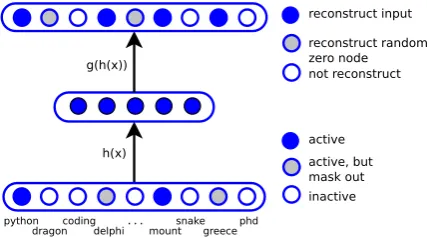
structure while ignoring noise as the author shows in image processing. In our case, we input each document as a binary bag-of-words vector (Fig.
1). DA will capture general concepts and ignore noise like function words. By applying masking noise (randomly mask 1 with 0), the model also exhibits a fill-in-the-blank property (Vincent et al., 2010): the missing components must be re-covered from partial input. Take “greece” for ex-ample, the model must learn to predict it with “python” “mount”, through some hidden unit. The hidden unit may somehow express the concept of Greece mythology.
h(x) g(h(x))
python
dragoncodingdelphi...mountsnakegreecephd
reconstruct input
reconstruct random zero node not reconstruct
[image:2.595.310.524.211.330.2]inactive active, but mask out active
Figure 1: DA and reconstruction sampling.
In order to distinguish between a large num-ber of entities, the vocabulary size must be large enough. This adds considerable computational overhead because the reconstruction process in-volves expensive dense matrix multiplication. Re-construction sampling keeps the sparse property of matrix multiplication by reconstructing a small subset of original input, with no loss of quality of the learned representation (Dauphin et al., 2011).
2.2 Supervised Fine-tuning
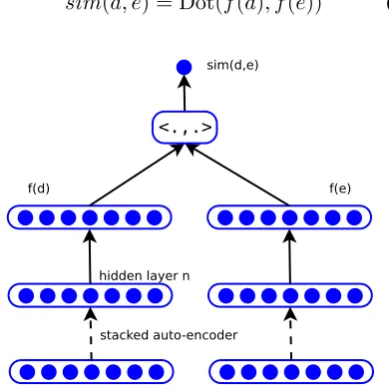
This stage we optimize the learned representation (“hidden layer n” in Fig. 2) towards the ranking score sim(d, e), with large scale Wikipedia an-notation as supervision. We collect hyperlinks in Wikipedia as our training set{(di, ei, mi)}, where
mi is the mention string for candidate generation.
The network weights below “hidden layer n” are initialized with the pre-training stage.
Next, we stack another layer on top of the learned representation. The whole network is tuned by the final supervised objective. The reason to stack another layer on top of the learned rep-resentation, is to capture problem specific struc-tures. Denote the encoding of dand eas dˆand ˆ
erespectively, after stacking the problem-specific
layer, the representation fordis given asf(d) = sigmoid(W ×dˆ+b), whereW andbare weight
encoding process.
The similarity score of (d, e) pair is defined as
the dot product off(d)andf(e)(Fig. 2):
sim(d, e) = Dot(f(d), f(e)) (1)
<.,.>
f(d) f(e)
hidden layer n
[image:3.595.84.279.120.316.2]stacked auto-encoder sim(d,e)
Figure 2: Network structure of fine-tuning stage.
Our goal is to rank the correct entity higher than the rest candidates relative to the context of the mention. For each training instance(d, e), we
contrast it with one of its negative candidate pair
(d, e0). This gives the pairwise ranking criterion:
L(d, e) = max{0,1−sim(d, e) +sim(d, e0)}
(2) Alternatively, we can contrast with all its candi-date pairs (d, ei). That is, we raise the similarity
score of true pair sim(d, e) and penalize all the
rest sim(d, ei). The loss function is defined as
negative log ofsof tmaxfunction:
L(d, e) =−logP expsim(d, e) ei∈C(m)expsim(d, ei)
(3)
Finally, we seek to minimize the following train-ing objective across all traintrain-ing instances:
L=X d,e
L(d, e) (4)
The loss function is closely related to con-trastive estimation (Smith and Eisner, 2005), which defines where the positive example takes probability mass from. We find that by penaliz-ing more negative examples, convergence speed can be greatly accelerated. In our experiments, the
sof tmax loss function consistently outperforms
pairwise ranking loss function, which is taken as our default setting.
However, the sof tmax training criterion adds additional computational overhead when per-forming mini-batch Stochastic Gradient Descent (SGD). Although we can use a plain SGD (i.e. mini-batch size is 1), mini-batch SGD is faster to converge and more stable. Assume the mini-batch size ismand the number of candidates isn, a total
ofm×nforward-backward passes over the
net-work are performed to compute a similarity ma-trix (Fig. 3), while pairwise ranking criterion only needs2×m. We address this problem by grouping
training pairs with same mentionminto one
mini-batch{(d, ei)|ei ∈C(m)}. Observe that if
candi-date entities overlap, they share the same forward-backward path. Only m +n forward-backward
passes are needed for each mini-batch now.
Python (programming language) Pythonidae
[image:3.595.314.520.294.403.2]Python (mythology)
... ...
... ... ... ...
d0
d1
...
dm
...
=sim(d,e)
e0 e1 e2 en
Figure 3: Sharing path within mini-batch.
The re-organization of mini-batch is similar in spirit to Backpropagation Through Structure (BTS) (Goller and Kuchler, 1996). BTS is a vari-ant of the general backpropagation algorithm for structured neural network. In BTS, parent node is computed with its child nodes at the forward pass stage; child node receives gradient as the sum of derivatives from all its parents. Here (Fig. 2), parent node is the score nodesim(d, e)and child
nodes are f(d) and f(e). In Figure 3, each row shares forward path of f(d) while each column
shares forward path off(e). At backpropagation
stage, gradient is summed over each row of score nodes forf(d)and over each column forf(e).
Till now, our input simply consists of bag-of-words binary vector. We can incorporate any handcrafted featuref(d, e)as:
sim(d, e) = Dot(f(d), f(e)) +~λ ~f(d, e) (5)
In fact, we find that with only Dot(f(d), f(e))
3 Experiments and Analysis
Training settings: In pre-training stage, input layer has 100,000 units, all hidden layers have 1,000 units with rectifier functionmax(0, x).
Fol-lowing (Glorot et al., 2011), for the first recon-struction layer, we use sigmoid activation func-tion and cross-entropy error funcfunc-tion. For higher reconstruction layers, we use sof tplus (log(1 + exp(x))) as activation function and squared loss
as error function. For corruption process, we use a masking noise probability in{0.1,0.4,0.7}for the
first layer, a Gaussian noise with standard devi-ation of 0.1 for higher layers. For reconstruction sampling, we set the reconstruction rate to 0.01. In fine-tuning stage, the final layer has 200 units with sigmoid activation function. The learning rate is set to 1e-3. The mini-batch size is set to 20.
We run all our experiments on a Linux ma-chine with 72GB memory 6 core Xeon CPU. The model is implemented in Python with C exten-sions, numpy configured with Openblas library. Thanks to reconstruction sampling and refined mini-batch arrangement, it takes about 1 day to converge for pre-training and 3 days for fine-tuning, which is fast given our training set size.
Datasets:We use half of Wikipedia1plain text (˜1.5M articles split into sections) for pre-training. We collect a total of 40M hyperlinks grouped by name stringm for fine-tuning stage. We holdout a subset of hyperlinks for model selection, and we find that 3 layers network with a higher masking noise rate (0.7) always gives best performance.
We select TAC-KBP 2010 (Ji and Grishman, 2011) dataset for non-collective approaches, and AIDA2dataset for collective approaches. For both datasets, we evaluate the non-NIL queries. The TAC-KBP and AIDA testb dataset contains 1020 and 4485 non-NIL queries respectively.
For candidate generation, mention-to-entity dic-tionary is built by mining Wikipedia structures, following (Cucerzan, 2007). We keep top 30 can-didates by prominenceP(e|m) for speed
consid-eration. The candidate generation recall are 94.0% and 98.5% for TAC and AIDA respectively.
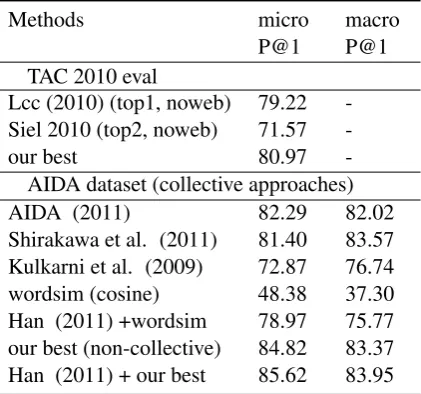
Analysis: Table 1 shows evaluation results across several best performing systems. (Han et al., 2011) is a collective approach, using Person-alized PageRank to propagate evidence between 1available at http://dumps.wikimedia.org/enwiki/, we use
the 20110405 xml dump.
2available at http://www.mpi-inf.mpg.de/yago-naga/aida/
different decisions. To our surprise, our method with only local evidence even beats several com-plex collective methods with simple word similar-ity. This reveals the importance of context model-ing in semantic space. Collective approaches can improve performance only when local evidence is not confident enough. When embedding our sim-ilarity measuresim(d, e)into (Han et al., 2011),
we achieve the best results on AIDA.
A close error analysis shows some typical er-rors due to the lack of prominence feature and name matching feature. Some queries accidtally link to rare candidates and some link to en-tities with completely different names. We will add these features as mentioned in Eq. 5 in future. We will also add NIL-detection module, which is required by more realistic application scenarios. A first thought is to construct pseudo-NIL with Wikipedia annotations and automatically learn the threshold and feature weight as in (Bunescu and Pasca, 2006; Kulkarni et al., 2009).
Methods micro
P@1 macroP@1 TAC 2010 eval
Lcc (2010) (top1, noweb) 79.22 -Siel 2010 (top2, noweb) 71.57
-our best 80.97
-AIDA dataset (collective approaches)
AIDA (2011) 82.29 82.02
[image:4.595.312.523.358.555.2]Shirakawa et al. (2011) 81.40 83.57 Kulkarni et al. (2009) 72.87 76.74 wordsim (cosine) 48.38 37.30 Han (2011) +wordsim 78.97 75.77 our best (non-collective) 84.82 83.37 Han (2011) + our best 85.62 83.95
Table 1: Evaluation on TAC and AIDA dataset.
4 Conclusion
Acknowledgments
We thank Nan Yang, Jie Liu and Fei Wang for helpful discus-sions. This research was partly supported by National High Technology Research and Development Program of China (863 Program) (No. 2012AA011101), National Natural Sci-ence Foundation of China (No.91024009) and Major Na-tional Social Science Fund of China(No. 12&ZD227).
References
Y. Bengio, P. Lamblin, D. Popovici, and H. Larochelle. 2007. Greedy layer-wise training of deep networks.
Advances in neural information processing systems, 19:153.
R. Bunescu and M. Pasca. 2006. Using encyclope-dic knowledge for named entity disambiguation. In
Proceedings of EACL, volume 6, pages 9–16. S. Cucerzan. 2007. Large-scale named entity
disam-biguation based on wikipedia data. InProceedings of EMNLP-CoNLL, volume 6, pages 708–716. Y. Dauphin, X. Glorot, and Y. Bengio. 2011.
Large-scale learning of embeddings with recon-struction sampling. In Proceedings of the Twenty-eighth International Conference on Machine Learn-ing (ICML11).
X. Glorot, A. Bordes, and Y. Bengio. 2011. Domain adaptation for large-scale sentiment classification: A deep learning approach. InProceedings of the 28th International Conference on Machine Learning. Christoph Goller and Andreas Kuchler. 1996.
Learn-ing task-dependent distributed representations by backpropagation through structure. InNeural Net-works, 1996., IEEE International Conference on, volume 1, pages 347–352. IEEE.
X. Han, L. Sun, and J. Zhao. 2011. Collective en-tity linking in web text: a graph-based method. In
Proceedings of the 34th international ACM SIGIR conference on Research and development in Infor-mation Retrieval, pages 765–774. ACM.
G.E. Hinton, S. Osindero, and Y.W. Teh. 2006. A fast learning algorithm for deep belief nets. Neural com-putation, 18(7):1527–1554.
J. Hoffart, M.A. Yosef, I. Bordino, H. F¨urstenau, M. Pinkal, M. Spaniol, B. Taneva, S. Thater, and G. Weikum. 2011. Robust disambiguation of named entities in text. In Proceedings of the Con-ference on Empirical Methods in Natural Language Processing, pages 782–792. Association for Com-putational Linguistics.
Heng Ji and Ralph Grishman. 2011. Knowledge base population: Successful approaches and chal-lenges. In Proceedings of the 49th Annual Meet-ing of the Association for Computational LMeet-inguis- Linguis-tics: Human Language Technologies, pages 1148– 1158, Portland, Oregon, USA, June. Association for Computational Linguistics.
S.S. Kataria, K.S. Kumar, R. Rastogi, P. Sen, and S.H. Sengamedu. 2011. Entity disambiguation with hier-archical topic models. InProceedings of KDD. S. Kulkarni, A. Singh, G. Ramakrishnan, and
S. Chakrabarti. 2009. Collective annotation of wikipedia entities in web text. In Proceedings of the 15th ACM SIGKDD international conference on Knowledge discovery and data mining, pages 457– 466. ACM.
J. Lehmann, S. Monahan, L. Nezda, A. Jung, and Y. Shi. 2010. Lcc approaches to knowledge base population at tac 2010. In Proc. TAC 2010 Work-shop.
L. Ratinov, D. Roth, D. Downey, and M. Anderson. 2011. Local and global algorithms for disambigua-tion to wikipedia. In Proceedings of the Annual Meeting of the Association of Computational Lin-guistics (ACL).
P. Sen. 2012. Collective context-aware topic mod-els for entity disambiguation. InProceedings of the 21st international conference on World Wide Web, pages 729–738. ACM.
M. Shirakawa, H. Wang, Y. Song, Z. Wang, K. Nakayama, T. Hara, and S. Nishio. 2011. Entity disambiguation based on a probabilistic taxonomy. Technical report, Technical Report MSR-TR-2011-125, Microsoft Research.
N.A. Smith and J. Eisner. 2005. Contrastive estima-tion: Training log-linear models on unlabeled data. InProceedings of the 43rd Annual Meeting on Asso-ciation for Computational Linguistics, pages 354– 362. Association for Computational Linguistics. P. Vincent, H. Larochelle, Y. Bengio, and P.A.
Man-zagol. 2008. Extracting and composing robust features with denoising autoencoders. In Proceed-ings of the 25th international conference on Ma-chine learning, pages 1096–1103. ACM.
Pascal Vincent, Hugo Larochelle, Isabelle Lajoie, Yoshua Bengio, and Pierre-Antoine Manzagol. 2010. Stacked denoising autoencoders: Learning useful representations in a deep network with a local denoising criterion. The Journal of Machine Learn-ing Research, 11:3371–3408.
W. Zhang, Y.C. Sim, J. Su, and C.L. Tan. 2011. Entity linking with effective acronym expansion, instance selection and topic modeling. In Proceedings of the Twenty-Second international joint conference on Artificial Intelligence-Volume Volume Three, pages 1909–1914. AAAI Press.