Plurality, Negation, and Quantification:
Towards Comprehensive Quantifier Scope Disambiguation
Mehdi Manshadi, Daniel Gildea, and James AllenUniversity of Rochester 734 Computer Studies Building
Rochester, NY 14627
mehdih,gildea,[email protected]
Abstract
Recent work on statistical quantifier scope disambiguation (QSD) has improved upon earlier work by scoping an arbitrary num-ber and type of noun phrases. No corpus-based method, however, has yet addressed QSD when incorporating the implicit uni-versal of plurals and/or operators such as negation. In this paper we report early, though promising, results for automatic QSD when handling both phenomena. We also present a general model for learning to build partial orders from a set of pair-wise preferences. We give annlogn
algo-rithm for finding a guaranteed approxima-tion of the optimal soluapproxima-tion, which works very well in practice. Finally, we signifi-cantly improve the performance of the pre-vious model using a rich set of automati-cally generated features.
1 Introduction
The sentence there is one faculty member in ev-ery graduate committeeis ambiguous with respect to quantifier scoping, since there are at least two possible readings: Ifonehaswide scope, there is a unique faculty member on every committee. If every has wide scope, there can be different fac-ulty members on each committee. Over the past decade there has been some work on statistical quantifier scope disambiguation (QSD) (Higgins and Sadock, 2003; Galen and MacCartney, 2004; Manshadi and Allen, 2011a). However, the extent of the work has been quite limited for several rea-sons. First, in the past two decades, the main focus of the NLP community has been on shallow text processing. As a deep processing task, QSD is not essential for many NLP applications that do not re-quire deep understanding. Second, there has been a lack of comprehensive scope-disambiguated cor-pora, resulting in the lack of work on extensive
statistical QSD. Third, QSD has often been con-sidered only in the context of explicit quantifica-tion such aseachandeveryversussomeanda/an. These co-occurrences do not happen very often in real-life data. For example, Higgins and Sadock (2003) find fewer than 1000 sentences with two or more explicit quantifiers in the Wall Street journal section of Penn Treebank. Furthermore, for more than 60% of those sentences, the order of the quan-tifiers does not matter, either as a result of the logi-cal equivalence (as in two existentials), or because they do not have any scope interaction.
Having said that, with deep language processing receiving more attention in recent years, QSD is becoming a real-life issue.1 At the same time, new
scope-disambiguated corpora have become avail-able (Manshadi et al., 2011b). In this paper, we aim at tackling the third issue mentioned above. We push statistical QSD beyond explicit quantifi-cation, and address an interesting, yet practically important, problem in QSD: plurality and quan-tification. In spite of an extensive literature in theoretical semantics (Hamm and Hinrichs, 2010; Landmann, 2000), this topic has not been well in-vestigated in computational linguistics. To illus-trate the phenomenon, consider (1):
1. Three words start with a capital letter. A deep understanding of this sentence, requires deciding whether each word in the set, referred to by Three words, starts with a potentially dis-tinctcapital letter(as inApple, Orange, Banana) or there is a uniquecapital letterwhich eachword starts with (as inApple, Adam, Athens). By treat-ing the NPThree wordsas a single atomic entity, earlier work on automatic QSD has overlooked this problem. In general, every plural NP poten-tially introduces an implicit universal, ranging
1For example, Liang et al. (2011) in their state-of-the-art statistical semantic parser within the domain of natural lan-guage queries to databases, explicitly devise quantifier scop-ing in the semantic model.
over the collection of entities introduced by the plural.2 Scoping this implicit universal is just as
important. While explicit universals may not oc-cur very often in natural language, the usage of plurals is very common. Plurals form 18% of the NPs in our corpus and 20% of the nouns in Penn Treebank. Explicit universals, on the other hand, form less than 1% of the determiners in Penn Tree-bank. Quantifiers are also affected by negation. Previous work (e.g., Morante and Blanco, 2012) has investigated automatically detecting the scope and focus of negation. However, the scope of negation with respect to quantifiers is a different phenomenon. Consider the following sentence.
2. The word does not start with a capital letter. Transforming this sentence into a meaning repre-sentation language, for almost any practical pur-poses, requires deciding whether the NPa capital letterlies in the scope of the negation or outside of it. The former describes the preferred reading where The word starts with a lowercase letter as inapple, orange, banana, but the latter gives the unlikely reading, according to which there exists a particularcapital letter, sayA, thatThe wordstarts with, as in apple, Orange, Banana. By not in-volving negation in quantifier scoping, a semantic parser may produce an unintended interpretation.
Previous work on statistical QSD has been quite restricted. Higgins and Sadock (2003), which we refer to as HS03, developed the first statisti-cal QSD system for English. Their system dis-ambiguates the scope of exactly two explicitly quantified NPs in a sentence, ignoring indefinite a/an, definites and bare NPs. Manshadi and Allen (2011a), hence MA11, go beyond those limita-tions and scope an arbitrary number of NPs in a sentence with no restriction on the type of quantifi-cation. However, although their corpus annotates the scope of negations and the implicit universal of plurals, their QSD system does not handle those.
As a step towards comprehensive automatic QSD, in this paper we present our work on auto-matic scoping of the implicit universal of plurals and negations. For data, we use a new revision of MA11’s corpus, first introduced in Manshadi et al. (2011b). The new revision, calledQuanText, carries a more detailed, fine-grained scope annota-tion (Manshadi et al., 2012). The performance of
2Although plurals carry different types of quantification (Herbelot and Copestake, 2010), almost always there exists an implicit universal. The importance of scoping this univer-sal, however, may vary based on the type of quantification.
our model defines a baseline for future efforts on (comprehensive) QSD over QuanText. In addition to addressing plurality and negation, this work im-proves upon MA11’s in two directions.
• We theoretically justify MA11’s
ternary-classification approach, formulating it as a general framework for learning to build par-tial orders. Annlognalgorithm is then given
to find a guaranteed approximation within a fixed ratio of the optimal solution from a set of pairwise preferences (Sect. 3.1).
• We replace MA11’s hand-annotated features with a set of automatically generated linguis-tic features. Our rich set of features signifi-cantly improves the performance of the QSD model, even though we give up the gold-standard dependency features (Sect. 3.3).
2 Task definition
In QuanText, scope-bearing elements (or, as we call them, scopal terms) of each sentence have been identified using labeledchunks, as in (3).
3. Replace[1/every line] in[2/the file]ending in[3/punctuation]with[4/a blank line]. NP chunks follow the definition of baseNP
(Ramshaw and Marcus, 1995) and hence are flat. Outscoping relations are used to specify the rel-ative scope of scopal terms. The relation i > j
means that chunkioutscopes(or haswide scope
over) chunk j. Equivalently, chunk j is said to
have narrow scope with respect toi. Each
sen-tence is annotated with its most preferred scoping (according to the annotators’ judgement), repre-sented as apartial order:
4. SI : (2>1>4; 1>3)
If neither i > j nor j > i is entailed from the
scoping,iandjareincomparable. This happens
if both orders are equivalent (as in two existentials) or when the two chunks have no scope interaction. Since a partial order can be represented by a
Di-rected Acyclic Graph (DAG), we use DAGs to
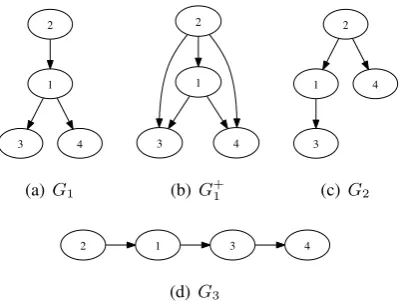
represent scopings. For example, G1 in Figure 1
represents the scoping in (4).
2.1 Evaluation metrics
Given the gold standard DAGGg = (V, Eg) and
the predicted DAG Gp = (V, Ep), a similarity
2
1
3 4
(a)G1
2
1
3 4
(b)G+ 1
2
1 4
3
(c)G2
2 1 3 4
[image:3.595.82.283.64.216.2](d)G3
Figure 1: Scoping as DAG
total number of pairs. In order to take the transi-tivity of outscoping relations into account, we use thetransitive closure(TC) of DAGs. LetG+ = (V, E+)represent the TC of a DAGG= (V, E).3 G1andG+1 in Figure 1 illustrate this concept. We
now define the similiarty metricS+as follows:
σ+= |E
+
p ∩Eg+| ∪ |E¯p+∩E¯g+|
|V|(|V| −1)/2 (1)
in which G¯ = (V,E)¯ is the complement of the
underlying undirected version of G.
HS03 and others have used such a similarity measure for evaluation purposes. A disadvantage of this metric is that it gives the same weight to outscoping and incomparability relations. In prac-tice, if two scopal terms with equivalent ordering (and hence, no outscoping relation) are incorrectly labeled with an outscoping, the logical form still remains valid. But if an outscoping relation is mis-labeled, it will change the interpretation of the sen-tence. Therefore, in MA11, we suggest defining a precision/recall based on the number of outscop-ing relations recovered correctly:4
P+= |E
+ p ∩Eg+|
|Ep+|
, R+= |E
+ p ∩Eg+|
|Eg+| (2)
3(u, v) ∈ G+
⇐⇒((u, v)∈G ∨
∃w1. . . wn∈V,(u, w1). . .(wn, v)∈E)
4MA11 argues that TC-based metrics tend to produce higher numbers. For example ifG3 in Figure 1 is a
gold-standard DAG andG1is a candidate DAG, TC-based metrics
count2>3as another match, even though it is entailed from 2>1and1>3. They give an alternative metric based on
transitive reduction(TR), obtained by removing all the re-dundant edges of a DAG. TR-based metrics, however, have their own disadvantage. For example, ifG2is another
candi-date forG3, TR-based metrics produce the same numbers for
bothG1andG2, even thoughG1is clearly closer toG3than
G2. Therefore, in this paper we stick to TC-based metrics.
3 Our framework
3.1 Learning to do QSD
Since we defined QSD as a partial ordering, auto-matic QSD would become the problem of learn-ing to build partial orders. The machine learnlearn-ing community has studied the problem of learning to-tal orders (ranking)in depth (Cohen et al., 1999; Furnkranz and Hullermeier, 2003; Hullermeier et al., 2008). Many ranking systems create partial orders as output when the confidence level for the relative order of two objects is below some thresh-old. However, the target being a partial order is a fundamentally different problem. While the lack of order between two elements is interpreted as the lack of confidence in the former, it should be inter-preted asincomparabilityin the latter. Learning to build partial orders has not attracted much atten-tion in the learning community, although as seen shortly, the techniques developed for ranking can be adopted for learning to build partial orders.
As mentioned before, a partial order P can be
represented by a DAGG, withaprecedingbinP
if and only ifareachesbinGby a directed path.
Although there could be many DAGs representing a partial orderP, only one of those is atransitive
DAG.5Therefore, in order to have a one-to-one
re-lationship between QSDs and DAGs, we only con-sider the class of transitive DAGs, orTDAG. Ev-ery non-transitive DAG will be converted into its transitive counterpart by taking its transitive clo-sure (as shown in Figure 1).
Consider V, a set of nodes and a TDAG G = (V, E). It would help to think of disconnected nodesu, vofG, as connected with a null edge.
We define the labeling functionδG :V ×V −→
{+,−, }assigning one of the three labels to each pair of nodes inG:
δG(u, v) =
+ (u, v)∈G − (v, u)∈G otherwise
(3)
Given the true TDAGGˆ = (V,E)ˆ , and a candidate
TDAG G, we define the Lossfunction to be the
total number of incorrect edges:
L(G,G) =ˆ X
u≺v∈V
I(δG(u, v)6=δGˆ(u, v)) (4)
in which ≺ is an arbitrary total order over the nodes inV6, andI(·)is the indicator function. We
5Gis transitive iff(u, v),(v, w)
adopt a minimum Bayes risk (MBR) approach, with the goal of finding the graph with the lowest expected loss against the (unknown) target graph:
G∗ = argmin
G∈TDAGEGˆ
h
L(G,G)ˆ i (5)
Substituting in the definition of the loss function and exchanging the order of the expectation and summation, we get:
G∗= argmin
G∈TDAG
X
u≺v∈V
EGˆI(δG(u, v)6=δGˆ(u, v)
= argmin
G∈TDAG
X
u≺v∈V
P(δG(u, v)6=δGˆ(u, v)) (6)
This means that in order to solve Eq. (5), we need only the probabilities of each of the three labels for each of theC(n,2) =n(n−1)/2pairs of nodes7
in the graph, rather than a probability for each of the superexponentially many possible graphs. We train a classifier to estimate these probabili-ties directly for a given pair. Therefore, we have reduced the problem of predicting a partial order topairwise comparison, analogous to ranking by pairwise comparison orRPC(Hullermeier et al., 2008; Furnkranz and Hullermeier, 2003), a popu-lar technique in learning total orders. The differ-ence though is that in RPC, the comparison is a (soft) binary classification, while for partial orders we have the case of incomparability (the label),
hence a (soft) ternary classification.
A soft ternary classifier generates three proba-bilities,pu,v(+),pu,v(−), andpu,v()for each pair
(u, v),8 corresponding to the three labels. Hence,
equation Eq. (6) can be rearranged as follows:
G∗= argmax
G∈TDAG
X
u≺v∈V
pu,v(δG(u, v)) (7)
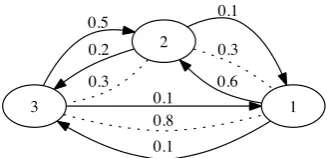
LetΓpbe a graph like the one in Figure 2,
contain-ing exactly three edges between every two nodes, weighted by the probabilities from then(n−1)/2
classifiers. We callΓp thepreference graph.
In-tuitively speaking, the solution to Eq. (7) is the transitive directed acyclic subgraph ofΓp that has
the maximum sum of weights. Unfortunately find-ing this subgraph is an NP-hard problem.9
7Throughout this subsection, unless otherwise specified, by a pair of nodes we mean a pair(u, v)withu≺v.
8pv,uforu
≺vis defined in the obvious way:pv,u(+) =
pu,v(−),pv,u(−) =pu,v(+), andpv,u() =pu,v(). 9The proof is beyond the scope of this paper, but the idea is similar to that of Cohen et al. (1999), on finding total or-ders. Although they don’t use an RPC technique, Cohen et
3
2 0.5
1 0.1
0.8 0.2
0.3
0.1
0.3
0.1 0.6
Figure 2: A preference graph over three nodes.
1. Let Γp be the preference graph and
set G to ∅.
2. ∀u∈V, let π(u) =Pvpu,v(+)−Pvpu,v(−).
3. Let u∗= argmaxuπ(u), S− = P
v∈Gpv,u∗(−) & S = P
v∈Gpv,u∗().
4. Remove u∗ and all its incident edges from Γp.
5. Add u∗ to G; also if S− > S, for
every v∈G−u∗, add (v, u∗) to G. 6. If Γp is empty, output G, otherwise
[image:4.595.333.497.68.147.2]repeat steps 2-5.
Figure 3: An approximation algorithm for Eq. (7)
Since it is very unlikely to find an efficient al-gorithm to solve Eq. (7), instead, we propose the algorithm in Figure 3 which finds an approximate solution. The idea of the algorithm is simple. By findingu∗with the highestπ(u)in step 3, we form
atopological orderfor the nodes inGin a greedy
way (see Footnote 9). We then addu∗ toG. A
directed edge is added either from every node in
G−u∗tou∗or from no node, depending on which
case makes the sum of the weights inGhigher.
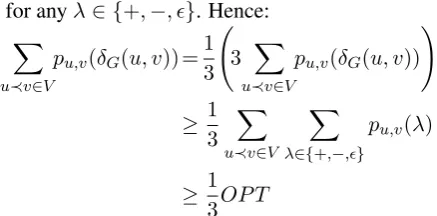
Theorem 1 The algorithm in Figure 3 is a 1/3-OPT approximation algorithm for Eq. (7).
Proof idea. First of all, note that G is a TDAG,
because edges are only added to the most recently created node in step 5. LetOP T be the optimum value of the right hand side of Eq. (7). The sum of all the weights inΓpis an upper bound forOP T:
X
u≺v∈V X
λ∈{+,−,}
pu,v(λ)≥OP T
Step 5 of the algorithm guarantees that the labels
δG(u, v)satisfy: X
u≺v∈V
pu,v(δG(u, v))≥ X
u≺v∈V
pu,v(λ) (8)
for anyλ∈ {+,−, }. Hence:
X
u≺v∈V
pu,v(δG(u, v)) =1
3 3
X
u≺v∈V
pu,v(δG(u, v)) !
≥ 1 3
X
u≺v∈V X
λ∈{+,−,}
pu,v(λ)
≥ 1 3OP T
In practice, we improve the algorithm in Figure 3, while maintaining the approximation guarantee, as follows. When adding a nodeu∗ to graphG, we
do not make a binary decision as to whether con-nect every node in G tou∗ or none, but we use
some heuristics to choose a subset of nodes (pos-sibly empty) in Gthat if connected to u∗ results
in a TDAG whose sum of weights is at least as big as the binary none-vs-all case. As described in Sec. 4, the algorithm works very well in our QSD system, finding the optimum solution in virtually all cases we examined.
3.2 Dealing with plurality and negation
Consider the following sentence with the plural NP chunkthe lines.
5. Merge[1p/the lines], ending in[2/a punctu-ation], with[3/the next non-blank line]. 6. SI : (1c >1d >2; 1d >3)10
In QuanText, plural chunks are indexed with a number followed by the lowercase letter “p”. As seen in (6), the scoping looks different from before in that the terms1dand1care not the label of any
chunk. These two terms refer to the two quantified terms introduced by the plural chunk1p: 1c (for
collection) represents the set (or in better words collection) of entities, defined by the plural, and1d
(fordistribution) refers to the implicit universal, introduced by the plural. In other words, for a plu-ral chunkip,idrepresents the universally
quanti-fied entity over the collectionic. The outscoping
relation1d >2 in (6) states that everylinein the
collection, denoted by1c, starts with its own
punc-tuationcharacter. Similarly,1d >3indicates that
every line has its own next non-blank line. Fig-ure 4(a) shows a DAG for the scoping in (6).
In (7) we have a sentence containing a negation. In QuanText, negation chunks are labeled with an uppercase “N” followed by a number.
10This scoping corresponds to the logical formula:
Dx1c, Collection(x1c)∧ ∀x1d, In(x1d, x1c)⇒
(Line(x1d)∧(∃x2, P unctuation(x2)∧EndIn(x1d, x2))∧
(Dx3,¬blank(x3)∧next(x1d, x3)∧merge(x1d, x3)))
It is straightforward to write a formula for, say,1c >2>1d.
(a)
1c 1d
2
3
(b)
2 1
3
[image:5.595.72.291.65.173.2]N1 4
Figure 4: DAGs for scopings in (6) and (8)
7. Extract [1/ every word] in [2/ file “1.txt”], which starts with [3/ a capital letter], but does[N1/not]end with[4/a capital letter]. 8. SI : (2>1>3; 1> N1>4)
As seen here, a negation simply introduces a chunk, which participates in outscoping relations like an NP chunk. Figure 4(b) represents the scop-ing in (8) as a DAG.
From these examples, as long as we create two nodes in the DAG corresponding to each plu-ral chunk, and one node corresponding to each negation, there is no need to modify the under-lying model (defined in the previous section). However, when u (or v) is a negation (N i) or
an implicit universal (id) node, the probabilities pλu,v (λ∈ {+,−, }) may come from a different
source, e.g. a different classification model or the same model with a different set of features, as de-scribed in the following section.
3.3 Feature selection
one of the scopal terms in the pair11is a negation,
although most of the features are quite similar.
3.3.1 NP chunks
We first describe the set of features we have adopted when both scopal terms in a pair are NP-chunks. We have organized the features into dif-ferent categories listed below.
Individual NP-chunk features
Following features are extracted for both NP chunks in a pair.
• The part-of-speech (POS) tag of the head of chunk • The lexical item of the head noun
• The lexical item of the determiner/quantifier • The lexical item of the pre-determiner
• Does the chunk contain a constant (e.g. “do”, ’x’)? • Is the NP-chunk a plural?
Implicit universal of a plural
Remember that every plural chunk i introduces
two nodes in the DAG, ic and id. Both nodes
are introduced by the same chunki, therefore they use the same set of features. The only exception is a single additional binary feature for plural NP chunks, which determines whether the given node refers to the implicit universal of the plural (i.e.id)
or to the collection itself (i.e.ic).
• Does this node refer to an implicit universal?
Syntactic features – phrase structure tree
As mentioned above, we have used two sets of syntactic features. The first is motivated by HS03’s work and is based on the constituency (i.e. phrase structure) tree T of the sentence. Since
our model is based on pairwise comparison, the following features are defined for each pair of chunks. In the following, by chunk we mean the deepest phrase-level node inT dominating all the
words in the chunk. If the constituency tree is cor-rect, this node is usually an NP node. Also, P
refers to the undirected path in T connecting the two chunks.
• Syntactic category of the deepest common ancestor • Does 1st/2nd chunkC-command2nd/1st one? • Length of the pathP
• Syntactic categories of nodes onP
• Is there a conjoined node onP?
• List of punctuation marks dominated by nodes onP
Syntactic features – dependency tree
Although regular “untyped” dependency relations do not seem to help our QSD system in the pres-ence of phrase-structure trees, we found the
col-11Since our model is based on pairwise comparison, every sample is in fact a pair of nodes(u, v)of the DAG.
lapsed typed dependencies(de Marneffe and Man-ning, 2008) very helpful, even when used on top of the phrase-structure features. Below is the list of features we extract from the collapsed typed de-pendency treeTdof each sentence. In the
follow-ing, by noun we mean the node inTdwhich
corre-sponds to the head of the chunk. The choice of the word noun, however, may be sloppy, as the head of an NP chunk may not be a noun.
• Does 1st/2nd noun dominate 2nd/1st noun? • Does 1st/2nd noun immediately dominate 2nd/1st? • Type of incoming dependency relation of each noun • Syntactic category of the deepest common ancestor • Lexical item of the deepest common ancestor • Length of the undirected path between the two
3.3.2 Negations
There are no sentences in our corpus with more than one negation. Therefore, for every pair of nodes with one negation, the other node must re-fer to an NP chunk. We use the following word-level, phrase-structure, and dependency features for these pairs.
• Lexical item of the determiner for the NP chunk • Does the NP chunk contain a constant? • Is the NP chunk a plural?
• If so, does this node refer to its implicit universal? • Does the negation C-command the NP chunk inT?
• Does the NP chunk C-command the negation inT?
• What is the POS of the parentpof negation inTd?
• Doespdominate the noun inTd?
• Does the noun dominatepinTd?
• Doespimmediately dominate the noun inTd? • If so, what is the type of the dependency? • Does the noun immediately dominatepinTd? • If so, what is the type of the dependency?
• Length of the undirected path between the two inTd 4 Experiments
QuanText contains 500 sentences with a total of 1750 chunks, that is 3.5 chunks/sentence on av-erage. Of those, 1700 chunks are NP chunks. The rest are scopal operators, mainly negation. Of all the NP chunks, 320 (more than 18%) are plu-ral, each introducing an implicit universal, that is, an additional node in the DAG. Since we feed each pair of elements to the classifiers indepen-dently, each (unordered) pair introduces one sam-ple. Therefore, a sentence withnscopal elements
createsC(n,2) =n(n−1)/2samples for
classi-fication. When all the elements are taken into ac-count,12the total number of samples in the corpus
will be:
X
i
C(ni,2)≈4500 (9)
Whereniis the number of scopal terms introduced
by sentencei. Out of the 4500 samples, around
1800 involve at least one implicit universal (i.e.,
id), but only 120 samples contain a negation. We
evaluate the performance of the system for implicit universals and negation both separately and in the context of full scope disambiguation. We split the corpus at random into three sets of 50, 100, and 350 sentences, as development, test, and train sets respectively.13
To extract part-of-speech tags, phrase structure trees, and typed dependencies, we use the Stan-ford parser (Klein and Manning, 2003; de Marn-effe et al., 2006) on both train and test sets. Since we are using SVM, we have passed the confidence levels through a softmax function to convert them into probabilities Pλ
u,v before applying the
algo-rithm of Section 3. We take MA11’s system as the baseline. However, in order to have a fair com-parison, we have used the output of the Stanford parser to automatically generate the same features that MA11 have hand-annotated.14 In order to run
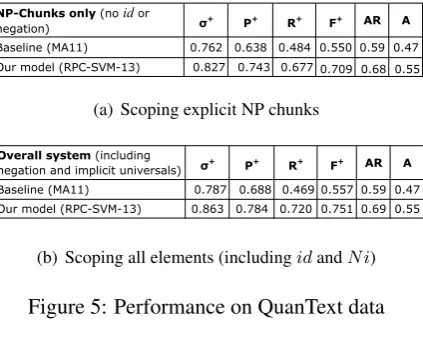
the baseline system on implicit universals, we take the feature vector of a plural NP and add a fea-ture to indicate that this feafea-ture vector represents the implicit universal of the corresponding chunk. Similarly, for negation we add a feature to show that the chunk represents a negation. As shown in Section 3.3.2, we have used a more compact set of features for negations. Once again, in order to have a fair comparison, we apply a similar modifi-cation to the baseline system. We also use the ex-act same classifier as used in MA11.15 Figure 5(a)
compares the performance of our model, which we refer to as RPC-SVM-13, with the baseline sys-tem, but only on explicit NP chunks.16 The goal
for running this experiment has been to compare the performance of our model to the baseline
sys-token, as described by Manshadi et al. (2012). In this work, we have only considered the token entity introduced by those nouns and have ignored the type entity.
13Since the percentage of sentences with negation is small, we made sure that those sentences are distributed uniformly between three sets.
14MA11’s features are similar to part-of-speech tags and untyped dependency relations.
15SV MM ulticlassfromSVM-light(Joachims, 1999).
16In all experiments, we ignore NP conjunctions. Previous work treats a conjunction of NPs as separate NPs. However, similar to plurals, NP conjunctions (disjunctions) introduce an extra scopal element: a universal (existential). We are working on an annotation scheme for NP conjunctions, so we have left this for after the annotations become available.
NP-Chunks only (no id or
negation) σ+ P+ R+ F+ AR A
Baseline (MA11) 0.762 0.638 0.484 0.550 0.59 0.47 Our model (RPC-SVM-13) 0.827 0.743 0.677 0.709 0.68 0.55
(a) Scoping explicit NP chunks
Overall system (including
negation and implicit universals) σ+ P+ R+ F+ AR A
Baseline (MA11) 0.787 0.688 0.469 0.557 0.59 0.47
Our model (RPC-SVM-13) 0.863 0.784 0.720 0.751 0.69 0.55
[image:7.595.313.525.66.242.2](b) Scoping all elements (includingidandN i)
Figure 5: Performance on QuanText data
tem on the task that it was actually defined to per-form (that is scoping only explicit NP chunks).
As seen in this table, by incorporating a richer set of features and a better learning algorithm, our model outperforms the baseline by almost 15%. The measure A in these figures shows
sentence-based accuracy. A sentence counts as correct iff every pair of scopal elements has been labeled correctly. Therefore A is a tough measure.
Fur-thermore, it is sensitive to the length of the sen-tence. Following MA11, we have computed an-other sentence-based accuracy measure, AR. In
computingAR, a sentence counts as correct iff all
the outscoping relations have been recovered cor-rectly – in other words, iffR = 100%, regardless
of the value of P. AR may be more practically
meaningful, because if in the correct scoping of the sentence there is no outscoping between two elements, inserting one does not affect the inter-pretation of the sentence. In other words, precision is less important for QSD in practice.
Implicit universals only (pairs
with at least one id) P+ R+ F+
Baseline (MA11) 0.776 0.458 0.576
Our model (RPC-SVM-13) 0.836 0.734 0.782
(a) Pairs with at least one implicit universal
Negation only (pairs with one
negation) P+ R+ F+
Baseline (MA11) 0.502 0.571 0.534 Our model (RPC-SVM-13) 0.733 0.55 0.629
(b) Pairs with at least one negation
Figure 6: Implicit universals and negations
are easier to scope, even for the human annota-tors.17 There are several reasons for poor
perfor-mance with negations as well. First, the number of negations in the corpus is small, therefore the data is very sparse. Second, the RPC model does not work well for negations. Scoping a negation relative to an NP chunk, with which it has a long distance dependency, often depends on the scope of the elements in between. Third, scoping nega-tion usually requires a deep semantic analysis.
In order to see how well our approximation al-gorithm is working, similar to the approach of Chambers and Jurafsky (2008), we tried an ILP solver18for DAGs with at most 8 nodes to find the
optimum solution, but we found the difference in-significant. In fact, the approximation algorithm finds the optimum solution in all but one case.19
5 Related work
Since automatic QSD is in general challenging, traditionally quantifier scoping is left underspec-ified in deep linguistic processing systems (Al-shawi and Crouch, 1992; Bos, 1996; Copestake et al., 2001). Some efforts have been made to move underspecification frameworks towards weighted constraint-based graphs in order to produce the most preferred reading (Koller et al., 2008), but the source of these types of constraint are often discourse, pragmatics, world knowledge, etc., and hence, they are hard to obtain automatically. In
or-17Trivially, we have taken the relation outscopingic > id for granted and not counted it towards higher performance.
18lpsolve: http://sourceforge.net/projects/lpsolve
19To find the gain that can be obtained with gold-standard parses, we used MA11’s system with their hand-annotated and the equivalent automatically generated features. The former boost the performance by 0.04. Incidentally, HS03 lose almost 0.04 when switching to automatically generated parses.
der to evade scope disambiguation, yet be able to perform entailment, Koller and Thater (2010) pro-pose an algorithm to calculate the weakest read-ings20from a scope-underspecified representation.
Early efforts on automatic QSD (Moran, 1988; Hurum, 1988) were based on heuristics, manually formed into rules with manually assigned weights for resolving conflicts. To the best of our knowl-edge, there have been four major efforts on statisti-cal QSD for English: Higgins and Sadock (2003), Galen and MacCartney (2004), Srinivasan and Yates (2009), and Manshadi and Allen (2011a). The first three only scope two scopal terms in a sentence, where the scopal term is an NP with an explicit quantification. MA11 is the first to scope any number of NPs in a sentence with no restric-tion on the type of quantificarestric-tion. Besides ignor-ing negation and implicit universals, their system has some other limitations too. First, the learning model is not theoretically justified. Second, hand-annotated features (e.g. dependency relations) are used on both the train and the test data.
6 Summary and future work
We develop the first statistical QSD model ad-dressing the interaction of quantifiers with nega-tion and the implicit universal of plurals, defining a baseline for this task on QuanText data (Man-shadi et al., 2012). In addition, our work improves upon Manshadi and Allen (2011a)’s work by (ap-proximately) optimizing a well justified criterion, by using automatically generated features instead of hand-annotated dependencies, and by boosting the performance by a large margin with the help of a rich feature vector.
This work can be improved in many directions, among which are scoping more elements such as other scopal operators and implicit entities, ploying more complex learning models, and de-veloping models which require less supervision.
Acknowledgement
We need to thank William de Beaumont and Jonathan Gordon for their comments on the pa-per and Omid Bakhshandeh for his assistance. This work was supported in part by NSF grant 1012205, and ONR grant N000141110417.
References
Hiyan Alshawi and Richard Crouch. 1992. Monotonic
semantic interpretation. InProceedings of
Associa-tion for ComputaAssocia-tional Linguistics, pages 32–39.
Johan Bos. 1996. Predicate logic unplugged. In
Pro-ceedings of the 10th Amsterdam Colloquium, pages 133–143.
Nathanael Chambers and Dan Jurafsky. 2008. Jointly combining implicit constraints improves temporal
ordering. InProceedings of the Conference on
Em-pirical Methods in Natural Language Processing, EMNLP ’08, pages 698–706, Stroudsburg, PA.
William W. Cohen, Robert E. Schapire, and Yoram
Singer. 1999. Learning to order things. Journal
of Artificial Intelligence Research, 10:243–270.
Ann Copestake, Alex Lascarides, and Dan Flickinger.
2001. An algebra for semantic construction in
constraint-based grammars. InProceedings of
As-sociation for Computational Linguistics ’01, pages 140–147.
Marie-Catherine de Marneffe and Christopher D. Man-ning. 2008. The Stanford typed dependencies
rep-resentation. In Coling 2008: Proceedings of the
workshop on Cross-Framework and Cross-Domain Parser Evaluation, CrossParser ’08, pages 1–8.
Marie-Catherine de Marneffe, Bill MacCartney, and Christopher D. Manning. 2006. Generating typed dependency parses from phrase structure trees. In Proceedings of International Conference on Lan-guage Resources and Evaluation ’12.
Johannes Furnkranz and Eyke Hullermeier. 2003.
Pairwise preference learning and ranking. In
Pro-ceedings of the 14th European Conference on Ma-chine Learning, volume 2837, pages 145–156.
Andrew Galen and Bill MacCartney. 2004. Statistical resolution of scope ambiguity in natural language. http://nlp.stanford.edu/nlkr/scoper.pdf.
Fritz Hamm and Edward W. Hinrichs. 2010. Plurality
and Quantification. Studies in Linguistics and Phi-losophy. Springer.
Aurelie Herbelot and Ann Copestake. 2010.
Anno-tating underquantification. In Proceedings of the
Fourth Linguistic Annotation Workshop, LAW IV ’10, pages 73–81.
Derrick Higgins and Jerrold M. Sadock. 2003. A ma-chine learning approach to modeling scope
prefer-ences. Computational Linguistics, 29(1):73–96.
Eyke Hullermeier, Johannes Furnkranz, Weiwei Cheng, and Klaus Brinker. 2008. Label ranking
by learning pairwise preferences. Artificial
Intelli-gence, 172(1617):1897 – 1916.
Sven Hurum. 1988. Handling scope ambiguities in
English. In Proceedings of the second conference
on Applied natural language processing, ANLC ’88, pages 58–65.
Thorsten Joachims. 1999. Making large-scale sup-port vector machine learning practical. In Bernhard Sch¨olkopf, Christopher J. C. Burges, and
Alexan-der J. Smola, editors,Advances in kernel methods,
pages 169–184. MIT Press, Cambridge, MA, USA. Dan Klein and Christopher D. Manning. 2003.
Ac-curate unlexicalized parsing. InProceedings of the
41st Annual Meeting on Association for Computa-tional Linguistics - Volume 1, ACL ’03, pages 423– 430.
Alexander Koller and Stefan Thater. 2010.
Comput-ing weakest readComput-ings. In Proceedings of the 48th
Annual Meeting on Association for Computational Linguistics, Uppsala, Sweden.
Alexander Koller, Michaela Regneri, and Stefan Thater. 2008. Regular tree grammars as a
formal-ism for scope underspecification. InProceedings of
Annual Meeting on Association for Computational Linguistics and Human Language Technologies ’08.
Fred Landmann. 2000. Events and plurality. Kluwer
Academic Publishers, Dordrecht.
Percy Liang, Michael I. Jordan, and Dan Klein. 2011. Learning dependency-based compositional
seman-tics. In Proceedings of Association for
Computa-tional Linguistics (ACL).
Mehdi Manshadi and James Allen. 2011a.
Unre-stricted quantifier scope disambiguation. In
Pro-ceedings of Association for Computational Linguis-tics ’11, Workshop on Graph-based Methods for NLP (TextGraph-6).
Mehdi Manshadi, James Allen, and Mary Swift. 2011b. A corpus of scope-disambiguated English
text. In Proceedings of Association for
Computa-tional Linguistics and Human Language Technolo-gies ’11: short papers, pages 141–146.
Mehdi Manshadi, James Allen, and Mary Swift. 2012. An annotation scheme for quantifier scope
disam-biguation. InProceedings of International
Confer-ence on Language Resources and Evaluation ’12. Douglas Moran. 1988. Quantifier scoping in the SRI
core language engine. In Proceedings of the 26th
Annual Meeting on Association for Computational Linguistics.
Lance Ramshaw and Mitch Marcus. 1995. Text Chunking Using Transformation-Based Learning. InProceedings of the Third Workshop on Very Large Corpora, pages 82–94, Somerset, New Jersey. Prakash Srinivasan and Alexander Yates. 2009.
Quan-tifier scope disambiguation using extracted
prag-matic knowledge: preliminary results. In