Question Answering Using Enhanced Lexical Semantic Models
Wen-tau Yih Ming-Wei Chang Christopher Meek Andrzej Pastusiak Microsoft Research
Redmond, WA 98052, USA
{scottyih,minchang,meek,andrzejp}@microsoft.com
Abstract
In this paper, we study the answer sentence selection problem for ques-tion answering. Unlike previous work, which primarily leverages syntactic analy-sis through dependency tree matching, we focus on improving the performance us-ing models of lexical semantic resources. Experiments show that our systems can be consistently and significantly improved with rich lexical semantic information, re-gardless of the choice of learning algo-rithms. When evaluated on a bench-mark dataset, the MAP and MRR scores are increased by 8 to 10 points, com-pared to one of our baseline systems using only surface-form matching. Moreover, our best system also outperforms pervious work that makes use of the dependency tree structure by a wide margin.
1 Introduction
Open-domain question answering (QA), which fulfills a user’s information need by outputting di-rect answers to natural language queries, is a chal-lenging but important problem (Etzioni, 2011). State-of-the-art QA systems often implement a complicated pipeline architecture, consisting of question analysis, document or passage retrieval, answer selection and verification (Ferrucci, 2012; Moldovan et al., 2003). In this paper, we focus on one of the key subtasks –answer sentence se-lection. Given a question and a set of candidate sentences, the task is to choose the correct sen-tence that contains the exact answer and can suf-ficiently support the answer choice. For instance, although both of the following sentences contain the answer “Jack Lemmon” to the question “Who won the best actor Oscar in 1973?” only the first sentence is correct.
A1: Jack Lemmon won the Academy Award for Best Actor for Save the Tiger (1973).
A2: Oscar winner Kevin Spacey said that Jack Lemmon is remembered as always making time for other people.
One of the benefits of answer sentence selec-tion is that the output can be provided directly to the user. Instead of outputting only the answer, re-turning the whole sentence often adds more value as the user can easily verify the correctness with-out reading a lengthy document.
Answer sentence selection can be naturally re-duced to a semantic text matching problem. Con-ceptually, we would like to measure how close the question and sentence can bematched seman-tically. Due to the variety of word choices and inherent ambiguities in natural languages, bag-of-words approaches with simple surface-form word matching tend to produce brittle results with poor prediction accuracy (Bilotti et al., 2007). As a result, researchers put more emphasis on exploit-ing both the syntactic and semantic structure in questions/sentences. Representative examples in-clude methods based on deeper semantic anal-ysis (Shen and Lapata, 2007; Moldovan et al., 2007) and on tree edit-distance (Punyakanok et al., 2004; Heilman and Smith, 2010) and quasi-synchronous grammar (Wang et al., 2007) that match the dependency parse trees of questions and sentences. However, such approaches often re-quire more computational resources. In addition to applying a syntactic or semantic parser during run-time, finding the best matching between struc-tured representations of sentences is not trivial. For example, the computational complexity of tree matching isO(V2L4), whereV is the number of
nodes andLis the maximum depth (Tai, 1979).
Instead of focusing on the high-level seman-tic representation, we turn our attention in this work to improving the shallow semantic
nent,lexical semantics. We formulate answer se-lection as a semantic matching problem with a la-tent word-alignment structure as in (Chang et al., 2010) and conduct a series of experimental stud-ies on leveraging recently proposed lexical seman-tic models. Our main contributions in this work are two key findings. First, by incorporating the abundant information from a variety of lexical se-mantic models, the answer selection system can be enhanced substantially, regardless of the choice of learning algorithms and settings. Compared to the previous work, our latent alignment model im-proves the result on a benchmark dataset by a wide margin – the mean average precision (MAP) and mean reciprocal rank (MRR) scores are increased by 25.6% and 18.8%, respectively. Second, while the latent alignment model performs better than unstructured models, the difference diminishes af-ter adding the enhanced lexical semantics infor-mation. This may suggest that compared to in-troducing complex structured constraints, incorpo-rating shallow semantic information is both more effective and computationally inexpensive in im-proving the performance, at least for the specific word alignment model tested in this work.
The rest of the paper is structured as follows. We first survey the related work in Sec. 2. Sec. 3 defines the problem of answer sentence selection, along with the high-level description of our solu-tion. The enhanced lexical semantic models and the learning frameworks we explore are presented in Sec. 4 and Sec. 5, respectively. Our experimen-tal results on a benchmark QA dataset is shown in Sec. 6. Finally, Sec. 7 concludes the paper.
2 Related Work
While the task of question answering has a long history dated back to the dawn of artificial in-telligence, early systems like STUDENT (Wino-grad, 1977) and LUNAR (Woods, 1973) are typ-ically designed to demonstrate natural language understanding for a small and specific domain. The Text REtrieval Conference (TREC) Question Answering Track was arguably the first large-scale evaluation of open-domain question answer-ing (Voorhees and Tice, 2000). The task is de-signed in an information retrieval oriented setting. Given a factoid question along with a collection of documents, a system is required to return the exact answer, along with the document that sup-ports the answer. In contrast, the Jeopardy! TV
quiz show provides another open-domain question answering setting, in which IBM’s Watson system famously beat the two highest ranked players (Fer-rucci, 2012). Questions in this game are presented in a statement form and the system needs to iden-tify the true question and to give the exact answer. A short sentence or paragraph to justify the answer is not required in either TREC-QA or Jeopardy!
As any QA system can virtually be decomposed into two major high-level components, retrieval andselection(Echihabi and Marcu, 2003), the an-swer selection problem is clearly critical. Limiting the scope of an answer to a sentence is first high-lighted by Wang et al. (2007), who argued that it was more informative to present the whole sen-tence instead of a short answer to users.
Observing the limitations of the bag-of-words models, Wang et al. (2007) proposed a syntax-driven approach, where each pair of question and sentence are matched by their dependency trees. The mapping is learned by a generative probabilis-tic model based on a Quasi-synchronous Gram-mar formulation (Smith and Eisner, 2006). This approach was later improved by Wang and Man-ning (2010) with a tree-edit CRF model that learns the latent alignment structure. In contrast, gen-eral tree matching methods based on tree-edit dis-tance have been first proposed by Punyakanok et al. (2004) for a similar answer selection task. Heil-man and Smith (2010) proposed a discriminative approach that first computes a tree kernel func-tion between the dependency trees of the quesfunc-tion and candidate sentence, and then learns a classifier based on the tree-edit features extracted.
Although lexical semantic information derived from WordNet has been used in some of these approaches, the research has mainly focused on modeling the mapping between the syntac-tic structures of questions and sentences, pro-duced from syntactic analysis. The potential im-provement from enhanced lexical semantic mod-els seems to have been deliberately overlooked.1
3 Problem Definition
We consider the answer selection problem in a supervised learning setting. For a set of ques-tions{q1,· · · , qm}, each questionqi is associated with a list of labeled candidate answer sentences
1For example, Heilman and Smith (2010) emphasized that
What is the fastest car in the world?
[image:3.595.145.470.78.141.2]The Jaguar XJ220 is the dearest, fastest and most sought after car on the planet.
Figure 1: An example pair of question and answer sentence, adapted from (Harabagiu and Moldovan, 2001). Words connected by solid lines are clear synonyms or hyponym/hypernym; words with weaker semantic association are linked by dashed lines.
{(yi1, si1),(yi1, si2),· · · ,(yin, sin)}, whereyij =
1indicates that sentencesijis a correct answer to
question qi, and 0 otherwise. Using this labeled data, our goal is to learn a probabilistic classifier to predict the label of a new, unseen pair of ques-tion and sentence.
Fundamentally, what the classifier predicts is whether the sentence “matches” the question se-mantically. In other words, does s have the an-swer that satisfies the semantic constraints pro-vided in the question? Without representing the question and sentence in logic or syntactic trees, we take a word-alignment view for solving this problem. We assume that there is an underly-ing structure h that describes how q and s can be associated through the relations of the words in them. Figure 1 illustrates this setting using a revised example from (Harabagiu and Moldovan, 2001). In this figure, words connected by solid lines are clear synonyms or hyponym/hypernym; words connected by dashed lines indicate that they are weakly related. With this alignment structure, features like the degree of mapping or whether all the content words in the question can be mapped to some words in the sentence can be extracted and help improve the classifier. Notice that the struc-ture representation in terms of word-alignment is fairly general. For instance, if we assume a naive complete bipartite matching, then effectively it re-duces to the simple bag-of-words model.
Typically, the “ideal” alignment structure is not available in the data, and previous work exploited mostly syntactic analysis (e.g., dependency trees) to reveal the latent mapping structure. In this work, we focus our study on leveraging the low-level semantic cues from recently proposed lexical semantic models. As will be shown in our experi-ments, such information not only improves a latent structure learning method, but also makes a simple
bipartite matching approach extremely strong.2
4 Lexical Semantic Models
In this section, we introduce the lexical seman-tic models we adopt for solving the semanseman-tic matching problem in answer selection. To go be-yond the simple, limited surface-form matching, we aim to pair words that are semantically re-lated, specifically measured by models of word relations including synonymy/antonymy, hyper-nymy/hyponymy(the Is-A relation) and general se-mantic word similarity.
4.1 Synonymy and Antonymy
Among all the word relations, synonymy is per-haps the most basic one and needs to be handled reliably. Although sets of synonyms can be eas-ily found in thesauri or WordNet synsets, such resources typically cover only strict synonyms. When comparing two words, it is more useful to estimate thedegreeof synonymy as well. For in-stance,ship andboatare not strict synonyms be-cause a ship is usually viewed as a large boat. Knowing that two words are somewhat synony-mous could be valuable in determining whether they should be mapped.
In order to estimate the degree of synonymy, we leverage a recently proposed polarity-inducing la-tent semantic analysis (PILSA) model (Yih et al., 2012). Given a thesaurus, the model first con-structs asigned d-by-nco-occurrence matrixW,
where d is the number of word groups and n is
the size of the vocabulary. Each row consists of a
2Proposed by an anonymous reviewer, one justification of
group of synonyms and antonyms of a particular sense and each column represents a unique word. Values of the elements in each row vector are the TFIDF values of the corresponding words in this group. The notion ofpolarityis then induced by making the values of words in the antonym groups negative, and the matrix is generalized by a low-rank approximation derived by singular-value de-composition (SVD) in the end. This design has an intriguing property – if the cosine score of two col-umn vectors are positive, then the two correspond-ing words tend to be synonymous; if it’s negative, then the two words are antonymous. The degree is measured by the absolute value.
Following the setting described in (Yih et al., 2012), we construct a PILSA model based on the Encarta thesaurus and enhance it with a discrimi-native projection matrix training method. The es-timated degrees of both synonymy and antonymy are used our experiments.3
4.2 Hypernymy and Hyponymy
TheClass-InclusionorIs-Arelation is commonly observed between words in questions and answer sentences. For example, to correctly answer the question “What color is Saturn?”, it is crucial that the selected sentence mentions a specific kind of color, as in “Saturn is a giant gas planet with brown and beige clouds.” Another example is “Who wrote Moonlight Sonata?”, wherecompose in “Ludwig van Beethoven composed the Moon-light Sonata in 1801.” is one kind ofwrite.
Traditionally, WordNet taxonomy is the linguis-tic resource for identifying hypernyms and hy-ponyms, applied broadly to many NLP problems. However, WordNet has a number of well-known limitations including its rather limited or skewed concept distribution and the lack of the coverage of the Is-A relation (Song et al., 2011). For in-stance, when a word refers to a named entity, the particular sense and meaning is often not encoded. As a result, relations such as “Apple” is-a “com-pany” and “Jaguar”is-a“car” cannot be found in WordNet. Similar to the case in synonymy, the Is-A relation defined in WordNet does not provide a native, real-valued degree of the relation, which can only be roughly approximated using the num-ber of links on the taxonomy path connecting two
3Mapping two antonyms may be desired if one of them is
in the scope of negation (Morante and Blanco, 2012; Blanco and Moldovan, 2011). However, we do not attempt to resolve the negation scope in this work.
concepts (Resnik, 1995).
In order to remedy these issues, we aug-ment WordNet with the Is-A relations found in Probase (Wu et al., 2012). Probase is a knowledge base that establishes connections between 2.7 mil-lion concepts, discovered automatically by apply-ing Hearst patterns (Hearst, 1992) to 1.68 billion Web pages. Its abundant concept coverage dis-tinguishes it from other knowledge bases, such as Freebase (Bollacker et al., 2008) and WikiTaxon-omy (Ponzetto and Strube, 2007). Based on the frequency of term co-occurrences, each Is-A rela-tion from Probase is associated with a probability value, indicating the degree of the relation.
We verified the quality of Probase Is-A relations using a recently proposed SemEval task of rela-tional similarity (Jurgens et al., 2012) in a com-panion paper (Zhila et al., 2013), where a subset of the data is to measure the degree of two words having a class-inclusion relation. Probase’s pre-diction correlates well with the human annotations and achieves a high Spearman’s rank correlation coefficient score,ρ = 0.619. In comparison, the
previous best system (Rink and Harabagiu, 2012) in the task only reachesρ = 0.233. These appeal-ing qualities make Probase a robust lexical seman-tic model for hypernymy/hyponymy.
4.3 Semantic Word Similarity
The third lexical semantic model we introduce tar-gets a general notion of word similarity. Unlike synonymy and hyponymy, word similarity is only loosely defined when two words can be associated by some implicit relation.4The general word sim-ilarity model can be viewed as a “back-off” so-lution when the exact lexical relation (e.g., part-wholeandattribute) is not available or cannot be accurately detected.
Among various word similarity models (Agirre et al., 2009; Reisinger and Mooney, 2010; Gabrilovich and Markovitch, 2007; Radinsky et al., 2011), the vector space models (VSMs) based on the idea of distributional similarity (Turney and Pantel, 2010) are often used as the core com-ponent. Inspired by (Yih and Qazvinian, 2012), which argues the importance of incorporating het-erogeneous vector space models for measuring word similarity, we leverage three different VSMs in this work: Wiki term-vectors, recurrent neural
4Instead of making the distinction, word similarityhere
network language model (RNNLM) and a concept vector space model learned from click-through data. Semantic word similarity is estimated using the cosine score of the corresponding word vectors in these VSMs.
Contextual term-vectors created using the Wikipedia corpus have shown to perform well on measuring word similarity (Reisinger and Mooney, 2010). Following the setting suggested by Yih and Qazvinian (2012), we create term-vectors representing about 1 million words by ag-gregating terms within a window of[−10,10] of
each occurrence of the target word. The vectors are further refined by applying the same vocabu-lary and feature pruning techniques.
A recurrent neural network language model (Mikolov et al., 2010) aims to esti-mate the probability of observing a word given its preceding context. However, one by-product of this model is the word embedding learned in its hidden-layer, which can be viewed as capturing the word meaning in some latent, conceptual space. As a result, vectors of related words tend to be close to each other. For this word similarity model, we take a 640-dimensional version of RNNLM vectors, which is trained using the Broadcast News corpus of 320M words.5
The final word relatedness model is a projec-tion model learned from the click-through data of a commercial search engine (Gao et al., 2011). Unlike the previous two models, which are cre-ated or trained using a text corpus, the input for this model is pairs of aggregated queries and ti-tles of pages users click. This parallel data is used to train a projection matrix for creating the mapping between words in queries and documents based on user feedback, using a Siamese neural network (Yih et al., 2011). Each row vector of this matrix is the dense vector representation of the corresponding word in the vocabulary. Perhaps due to its unique information source, we found this particular word embedding seems to complement the other two VSMs and tends to improve the word similarity measure in general.
5 Learning QA Matching Models
In this section, we investigate the effectiveness of various learning models for matching questions and sentences, including thebag-of-wordssetting
5http://www.fit.vutbr.cz/˜imikolov/
rnnlm/
and the framework of learning latent structures.
5.1 Bag-of-Words Model
The bag-of-words model treats each question and sentence as an unstructured bag of words. When comparing a question with a sentence, the model first matches each word in the question to each word in the sentence. It then aggregates features extracted from each of these word pairs to rep-resent the whole question/sentence pair. A bi-nary classifier can be trained easily using any ma-chine learning algorithm in this standard super-vised learning setting.
Formally, letx = (q, s)be a pair of questionq
and sentences. LetVq = {wq1, wq2,· · ·, wqm}
and Vs = {ws1, ws2,· · ·, wsn} be the sets of
words inqands, respectively. Given a word pair
(wq, ws), where wq ∈ Vq andws ∈ Vs, feature functions φ1,· · · , φd map it to a d-dimensional real-valued feature vector.
We consider two aggregate functions for defin-ing the feature vectors of the whole ques-tion/answer pair:averageandmax.
Φavgj(q, s) =
1
mn
X
wq∈Vq ws∈Vs
φj(wq, ws) (1)
Φmaxj(q, s) = maxwq∈Vq ws∈Vs
φj(wq, ws) (2)
Together, each question/sentence pair is repre-sented by a2d-dimensional feature vector.
We tested two learning algorithms in this set-ting: logistic regression and boosted decision trees (Friedman, 2001). The former is the log-linear model widely used in the NLP community and the latter is a robust non-linear learning algo-rithm that has shown great empirical performance. The bag-of-words model does not require an ad-ditional inference stage as in structured learning, which may be computationally expensive. Nev-ertheless, its lack of structure information could limit the expressiveness of the model and make it difficult to capture more sophisticated semantics in the sentences. To address this concern, we in-vestigate models of learning latent structures next.
5.2 Learning Latent Structures
This is observed in many question/sentence pairs, such as the one below.
Q: Which was the first movie that James Dean was in?
A: James Dean, who began as an actor on TV dramas, didn’t make his screen debut until 1951’s “Fixed Bayonet.”
While this sentence correctly answers the ques-tion, the fact that James Dean began as a TV actor is unrelated to the question. As a result, an “ideal” word alignment structure should not link words in this clause to those in the ques-tion. In order to leverage the latent structured in-formation, we adapt a recently proposed frame-work of learning constrained latent representa-tions(LCLR) (Chang et al., 2010). LCLR can be viewed as a variant of Latent-SVM (Felzenszwalb et al., 2009) with different learning formulations and a general inference framework. The idea of LCLR is to replace the decision function of a stan-dard linear modelθTφ(x)with
arg max h
θTφ(x, h), (3)
whereθrepresents the weight vector andh
repre-sents the latent variables.
In this answer selection task, x = (q, s) rep-resents a pair of question q and candidate
sen-tence s. As described in Sec. 3, h refers to the
latent alignment between q and s. The intuition
behinds Eq. (3) is: candidate sentencescorrectly
answers questionq if and only if the decision can
be supported by thebestalignmenth.
The objective function of LCLR is defined as:
minθ 1 2||θ||
2+CX
i
ξi2
s.t. ξi ≥1−yimax h θ
Tφ(x, h)
Note that the alignment is latent, so LCLR uses the binary labels in the training data as feedback to find the alignment for each example.
The computational difficulty of the inference problem (Eq. (3)) largely depends on the con-straints we enforce in the alignment. Complicated constraints may result in a difficult inference prob-lem, which can be solved by integer linear pro-gramming (Roth and Yih, 2007). In this work, we considered several sets of constraints for the alignment task, including a two-layer phrase/word
alignment structure, but found that they generally performed the same. Therefore, we chose the many-to-one alignment6, where inference can be solved exactly using a simple greedy algorithm. 6 Experiments
We present our experimental results in this sec-tion by first introducing the data and evaluasec-tion metrics, followed by the results of existing sys-tems and some baseline methods. We then show the positive impact of adding information of word relations from various lexical semantics models, with some discussion on the limitation of the word-matching approach.
6.1 Data & Evaluation Metrics
The answer selection dataset we used was orig-inally created by Wang et al. (2007) based on the QA track of past Text REtrieval Confer-ences (TREC-QA). Questions in this dataset are short factoid questions, such as “What is Crips’ gang color?” In average, each question is associ-ated with approximately 33 answer candidate sen-tences. A pair of question and sentence is judged positive if the sentence contains the exact answer keyandcan provide sufficient context as support-ing evidence.
The training set of the data contains manu-ally labeled 5,919 question/sentence pairs from TREC 8-12. The development and testing sets are both from TREC 13, which contain 1,374 and 1,866 pairs, respectively. The task is treated as a sentence ranking problem for each question and thus evaluated in Mean Average Precision (MAP) and Mean Reciprocal Rank (MRR), using the offi-cial TREC evaluation program. Following (Wang et al., 2007), candidate sentences with more than 40 words are removed from evaluation, as well as questions with only positive or negative candidate sentences.
6.2 Baseline Methods
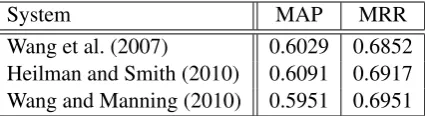
Several systems have been proposed and tested using this dataset. Wang et al. (2007) pre-sented a generative probabilistic model based on a Quasi-synchronous Grammar formulation and was later improved by Wang and Manning (2010) with a tree-edit CRF model that learns the la-tent alignment structure. In contrast, Heilman and
6Each word in the question needs to be linked to a word
System MAP MRR Wang et al. (2007) 0.6029 0.6852 Heilman and Smith (2010) 0.6091 0.6917 Wang and Manning (2010) 0.5951 0.6951
Table 1: Test set results of existing methods, taken from Table 3 of (Wang and Manning, 2010).
Dev Test
Baseline MAP MRR MAP MRR
[image:7.595.76.289.62.120.2]Random 0.5243 0.5816 0.4708 0.5286 Word Cnt 0.6516 0.7216 0.6263 0.6822 Wgt Word Cnt 0.7112 0.7880 0.6531 0.7071
Table 2: Results of three baseline methods.
Smith (2010) proposed a discriminative approach that first computes a tree kernel function between the dependency trees of the question and candidate sentence, and then learns a classifier based on the tree-edit features extracted. Table 1 summarizes their results on the test set. All these systems in-corporated lexical semantics features derived from WordNet and named entity features.
In order to further estimate the difficulty of this task and dataset, we tested three simple base-lines. The first is random scoring, which sim-ply assigns a random score to each candidate sen-tence. The second one, word count, is to count how many words in the question that also occur in the answer sentence, after removing stopwords7, and lowering the case. Finally, the last base-line method,weighted word count, is basically the same as identical word matching, but the count is re-weighted using the IDF value of the question word. This is similar to the BM25 ranking func-tion (Robertson et al., 1995). The results of these three methods are shown in Table 1.
Somewhat surprisingly, we find thatword count is fairly strong and performs comparably to previ-ous systems.8 In addition, weighting the question words with their IDF values further improves the results.
6.3 Incorporating Rich Lexical Semantics We test the effectiveness of adding rich lexical semantics information by creating examples of different feature sets. As described in Sec. 5,
7We used a list of 101 stopwords, including articles,
pro-nouns and punctuation.
8The finding has been confirmed by the lead author
of (Wang et al., 2007).
all the features are based on the properties of the pair of a word from the question and a word from the candidate sentence. Stopwords are first removed from both questions and sen-tences and all words are lower-cased. Features used in the experiments can be categorized into six types: identical word matching (I), lemma matching (L), WordNet (WN), enhanced Lexi-cal Semantics (LS), Named Entity matching (NE) and Answer type checking (Ans). Inspired by theweighted word countbaseline, all features ex-cept (Ans) are weighted by the IDF value of the question word. In other words, the IDF values help decide the importance of word pairs to the model. Staring from the our baseline model, weighted word count, the identical word matching (I) fea-ture checks whether the pair of words are the same. Instead of checking the surface form of the word, lemma matching (L) verifies whether the two words have the same lemma form. Ar-guably the most common source of word rela-tions, WordNet (WN) provides the primitive fea-tures of whether two words could belong to the same synset in WordNet, could be antonyms and whether one is a hypernym of the other. Alter-natively, the enhanced lexical semantics (LS) fea-tures apply the models described in Sec. 4 to the word pair and use their estimated degree of syn-onymy, antsyn-onymy, hyponymy and semantic relat-edness as features. Named entity matching (NE) checks whether two words are individually part of some named entities with the same type. Fi-nally, when the question word is the WH-word, we check if the paired word belongs to some phrase that has the correct answer type using simple rules, such as “Whoshould link to a word that is part of a named entity of typePerson.” We created exam-ples in each round of experiments by augmenting these features in the same order, and observed how adding different information helped improve the model performance.
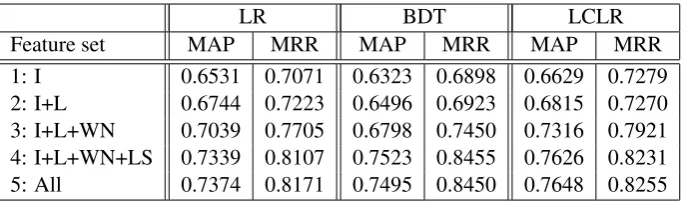
LR BDT LCLR
Feature set MAP MRR MAP MRR MAP MRR
1: I 0.6531 0.7071 0.6323 0.6898 0.6629 0.7279
2: I+L 0.6744 0.7223 0.6496 0.6923 0.6815 0.7270
3: I+L+WN 0.7039 0.7705 0.6798 0.7450 0.7316 0.7921 4: I+L+WN+LS 0.7339 0.8107 0.7523 0.8455 0.7626 0.8231
[image:8.595.129.471.61.162.2]5: All 0.7374 0.8171 0.7495 0.8450 0.7648 0.8255
Table 3: Test results of various models and feature groups. Logistic regression (LR) and boosted decision trees (BDT) are the two unstructured models. LCLR is the algorithm for learning latent structures. Feature groups are identical word matching (I), lemma matching (L), WordNet (WN) and enhanced Lexical Semantics (LS). All includes these four plus Named Entity matching (NE) and Answer type checking (Ans).
Hyper-parameters are selected using the ones that achieve the best MAP score on the development set. Results of these models and feature sets are presented in Table 3.
We make two observations from the results. First, while incorporating more information of the word pairs in general helps, it is clear that map-ping words beyond surface-form matching with the help of WordNet (Line #3 vs. #2) is impor-tant. Moreover, when richer information from other lexical semantic models is available, the per-formance can be further improved (Line #4 vs. #3). Overall, by simply incorporating more in-formation on word relations, we gain approxi-mately 10 points in both MAP and MRR com-pared to surface-form matching (Line #4 vs. #2), consistently across all three models. However, adding more information like named entity match-ing and answer type verification does not seem to help much (Line #5 vs. #4). Second, while the structured-output model usually performs better than both unstructured models (LCLR vs. LR & BDT), the performance gain diminishes after more information of word pairs is available (e.g., Lines #4 and #5).
6.4 Limitation of Word Matching Models Although we have demonstrated the benefits of leveraging various lexical semantic models to help find the association between words, the problem of question answering is nevertheless far from solved using the word-based approach. Examining the output of the LCLR model with all features on the development set, we found that there were three main sources of errors, including uncovered or in-accurate entity relations, the lack of robust ques-tion analysis and the need of high-level semantic
representation and inference. While the first two can be improved by, say, using a better named en-tity tagger, incorporating other knowledge bases and building a question classifier, how to solve the third problem is tricky. Below is an example:
Q: In what film is Gordon Gekko the main char-acter?
A: He received a best actor Oscar in 1987 for his role as Gordon Gekko in “Wall Street”.
This is a correct answer sentence because “win-ning a best actor Oscar” implies that the role Gor-don Gekko is the main character. It is hard to be-lieve that a pure word-matching model would be able to solve this type of “inferential question an-swering” problem.
7 Conclusions
In the future, we plan to explore several di-rections. First, although we focus on improv-ing TREC-style open-domain question answerimprov-ing in this work, we would like to apply the pro-posed technology to other QA scenarios, such as community-based QA (CQA). For instance, the sentence matching technique can help map a given question to some questions in an existing CQA database (e.g., Yahoo! Answers). More-over, the answer sentence selection scheme could also be useful in extracting the most related sen-tences from the answer text to form a summary answer. Second, because the task of answer sen-tence selection is very similar to paraphrase de-tection (Dolan et al., 2004) and recognizing tex-tual entailment (Dagan et al., 2006), we would like to investigate whether systems for these tasks can be improved by incorporating enhanced lexical se-mantic knowledge as well. Finally, we would like to improve our system for the answer sentence se-lection task and for question answering in general. In addition to following the directions suggested by the error analysis presented in Sec. 6.4, we plan to use logic-like semantic representations of ques-tions and sentences, and explore the role of lexical semantics for handling questions that require in-ference.
Acknowledgments
We are grateful to Mengqiu Wang for providing the dataset and helping clarify some issues in the experiments. We also thank Chris Burges and Hoi-fung Poon for valuable discussion and the anony-mous reviewers for their useful comments.
References
E. Agirre, E. Alfonseca, K. Hall, J. Kravalova, M. Pas¸ca and A. Soroa. 2009. A study on similarity and relatedness using distributional and WordNet-based approaches. InProceedings of NAACL, pages 19–27.
M. Bilotti, P. Ogilvie, J. Callan, and E. Nyberg. 2007. Structured retrieval for question answering. In Pro-ceedings of SIGIR, pages 351–358.
E. Blanco and D. Moldovan. 2011. Semantic repre-sentation of negation using focus detection. In Pro-ceedings of the 49th Annual Meeting of the Associ-ation for ComputAssoci-ational Linguistics: Human Lan-guage Technologies (ACL-HLT 2011).
K. Bollacker, C. Evans, P. Paritosh, T. Sturge, and J. Taylor. 2008. Freebase: a collaboratively
cre-ated graph database for structuring human knowl-edge. InACM Conference on Management of Data (SIGMOD), pages 1247–1250.
A. Budanitsky and G. Hirst. 2006. Evaluating WordNet-based measures of lexical semantic re-latedness. Computational Linguistics, 32:13–47, March.
M. Chang, D. Goldwasser, D. Roth, and V. Srikumar. 2010. Discriminative learning over constrained la-tent representations. InProceedings of NAACL.
I. Dagan, O. Glickman, and B. Magnini, editors. 2006.
The PASCAL Recognising Textual Entailment Chal-lenge, volume 3944. Springer-Verlag, Berlin.
W. Dolan, C. Quirk, and C. Brockett. 2004. Unsu-pervised construction of large paraphrase corpora: Exploiting massively parallel news sources. In Pro-ceedings of COLING.
A. Echihabi and D. Marcu. 2003. A noisy-channel approach to question answering. In Annual Meet-ing of the Association for Computational LMeet-inguistics (ACL), pages 16–23.
Oren Etzioni. 2011. Search needs a shake-up. Nature, 476(7358):25–26.
P. Felzenszwalb, R. Girshick, D. McAllester, and D. Ramanan. 2009. Object detection with discrim-inatively trained part based models. IEEE Transac-tions on Pattern Analysis and Machine Intelligence, 99(1).
D. Ferrucci. 2012. Introduction to “This is Wat-son”. IBM Journal of Research and Development, 56(3.4):1–1.
J. Friedman. 2001. Greedy function approximation: a gradient boosting machine. Annals of Statistics, 29(5):1189–1232.
E. Gabrilovich and S. Markovitch. 2007. Computing semantic relatedness using Wikipedia-based explicit semantic analysis. InAAAI Conference on Artificial Intelligence (AAAI).
J. Gao, K. Toutanova, and W. Yih. 2011. Clickthrough-based latent semantic models for web search. InProceedings of SIGIR, pages 675–684. S. Harabagiu and D. Moldovan. 2001. Open-domain
textual question answering. Tutorial of NAACL-2001.
M. Hearst. 1992. Automatic acquisition of hyponyms from large text corpora. InProceedings of COLING, pages 539–545.
D. Jurgens, S. Mohammad, P. Turney, and K. Holyoak. 2012. SemEval-2012 Task 2: Measuring degrees of relational similarity. InProceedings of the Sixth In-ternational Workshop on Semantic Evaluation (Se-mEval 2012), pages 356–364.
T. Mikolov, M. Karafi´at, L. Burget, J. Cernock´y, and S. Khudanpur. 2010. Recurrent neural network based language model. In Annual Conference of the International Speech Communication Associa-tion (INTERSPEECH), pages 1045–1048.
D. Moldovan, M. Pas¸ca, S. Harabagiu, and M. Sur-deanu. 2003. Performance issues and error analy-sis in an open-domain question answering system.
ACM Transactions on Information Systems (TOIS), 21(2):133–154.
D. Moldovan, C. Clark, S. Harabagiu, and D. Hodges. 2007. COGEX: A semantically and contextually en-riched logic prover for question answering. Journal of Applied Logic, 5(1):49–69.
R. Morante and E. Blanco. 2012. *SEM 2012 shared task: Resolving the scope and focus of negation. In
Proceedings of the First Joint Conference on Lexical and Computational Semantics, pages 265–274.
S. Ponzetto and M. Strube. 2007. Deriving a large scale taxonomy from wikipedia. In AAAI Confer-ence on Artificial IntelligConfer-ence (AAAI).
V. Punyakanok, D. Roth, and W. Yih. 2004. Mapping dependencies trees: An application to question an-swering. In International Symposium on Artificial Intelligence and Mathematics (AI & Math).
K. Radinsky, E. Agichtein, E. Gabrilovich, and S. Markovitch. 2011. A word at a time: computing word relatedness using temporal semantic analysis. InWWW ’11, pages 337–346.
J. Reisinger and R. Mooney. 2010. Multi-prototype vector-space models of word meaning. In Proceed-ings of NAACL.
P. Resnik. 1995. Using information content to evaluate semantic similarity in a taxonomy. InInternational Joint Conference on Artificial Intelligence (IJCAI).
B. Rink and S. Harabagiu. 2012. UTD: Determining relational similarity using lexical patterns. In Pro-ceedings of the Sixth International Workshop on Se-mantic Evaluation (SemEval 2012), pages 413–418.
S. Robertson, S. Walker, S. Jones, M. Hancock-Beaulieu, and M. Gatford. 1995. Okapi at TREC-3. In Text REtrieval Conference (TREC), pages 109– 109.
D. Roth and W. Yih. 2007. Global inference for entity and relation identification via a linear programming formulation. In Lise Getoor and Ben Taskar, editors,
Introduction to Statistical Relational Learning. MIT Press.
D. Shen and M. Lapata. 2007. Using semantic roles to improve question answering. InProceedings of EMNLP-CoNLL, pages 12–21.
D. Smith and J. Eisner. 2006. Quasi-synchronous grammars: Alignment by soft projection of syntactic dependencies. In Proceedings of the HLT-NAACL Workshop on Statistical Machine Translation, pages 23–30.
Y. Song, H. Wang, Z. Wang, H. Li, and W. Chen. 2011. Short text conceptualization using a probabilistic knowledgebase. In International Joint Conference on Artificial Intelligence (IJCAI), pages 2330–2336. K. Tai. 1979. The tree-to-tree correction problem. J.
ACM, 26(3):422–433, July.
P. Turney and P. Pantel. 2010. From frequency to meaning: Vector space models of semantics. Jour-nal of Artificial Intelligence Research, 37(1):141– 188.
E. Voorhees and D. Tice. 2000. Building a question answering test collection. InProceedings of SIGIR, pages 200–207.
M. Wang and C. Manning. 2010. Probabilistic tree-edit models with structured latent variables for tex-tual entailment and question answering. In Proceed-ings of COLING.
M. Wang, N. Smith, and T. Mitamura. 2007. What is the Jeopardy model? A quasi-synchronous grammar for QA. InProceedings of EMNLP-CoNLL. T. Winograd. 1977. Five lectures on artificial
intelli-gence. In A. Zampolli, editor,Linguistic Structures Processing, pages 399–520. North Holland. W. Woods. 1973. Progress in natural language
under-standing: An application to lunar geology. In Pro-ceedings of the National Computer Conference and Exposition (AFIPS), pages 441–450.
W. Wu, H. Li, H. Wang, and K. Zhu. 2012. Probase: a probabilistic taxonomy for text understanding. In
ACM Conference on Management of Data (SIG-MOD), pages 481–492.
W. Yih and V. Qazvinian. 2012. Measuring word relat-edness using heterogeneous vector space models. In
Proceedings of NAACL-HLT 2012, pages 616–620. W. Yih, K. Toutanova, J. Platt, and C. Meek. 2011.
Learning discriminative projections for text similar-ity measures. InACL Conference on Natural Lan-guage Learning (CoNLL), pages 247–256.
W. Yih, G. Zweig, and J. Platt. 2012. Polarity inducing latent semantic analysis. InProceedings of EMNLP-CoNLL, pages 1212–1222.