Proceedings of the COLING/ACL 2006 Main Conference Poster Sessions, pages 89–96,
Unsupervised Relation Disambiguation Using Spectral Clustering
Jinxiu Chen1 Donghong Ji1 Chew Lim Tan2 Zhengyu Niu1
1Institute for Infocomm Research 2Department of Computer Science
21 Heng Mui Keng Terrace National University of Singapore
119613 Singapore 117543 Singapore
{jinxiu,dhji,zniu}@i2r.a-star.edu.sg [email protected]
Abstract
This paper presents an unsupervised learn-ing approach to disambiguate various rela-tions between name entities by use of vari-ous lexical and syntactic features from the contexts. It works by calculating eigen-vectors of an adjacency graph’s Laplacian to recover a submanifold of data from a high dimensionality space and then per-forming cluster number estimation on the eigenvectors. Experiment results on ACE corpora show that this spectral cluster-ing based approach outperforms the other clustering methods.
1 Introduction
In this paper, we address the task of relation extrac-tion, which is to find relationships between name en-tities in a given context. Many methods have been proposed to deal with this task, including supervised learning algorithms (Miller et al., 2000; Zelenko et al., 2002; Culotta and Soresen, 2004; Kambhatla, 2004; Zhou et al., 2005), semi-supervised learn-ing algorithms (Brin, 1998; Agichtein and Gravano, 2000; Zhang, 2004), and unsupervised learning al-gorithm (Hasegawa et al., 2004).
Among these methods, supervised learning is usu-ally more preferred when a large amount of la-beled training data is available. However, it is time-consuming and labor-intensive to manually tag a large amount of training data. Semi-supervised learning methods have been put forward to mini-mize the corpus annotation requirement. Most of
semi-supervised methods employ the bootstrapping framework, which only need to pre-define some ini-tial seeds for any particular relation, and then boot-strap from the seeds to acquire the relation. How-ever, it is often quite difficult to enumerate all class labels in the initial seeds and decide an “optimal” number of them.
Compared with supervised and semi-supervised methods, Hasegawa et al. (2004)’s unsupervised ap-proach for relation extraction can overcome the dif-ficulties on requirement of a large amount of labeled data and enumeration of all class labels. Hasegawa et al. (2004)’s method is to use a hierarchical cluster-ing method to cluster pairs of named entities accord-ing to the similarity of context words intervenaccord-ing be-tween the named entities. However, the drawback of hierarchical clustering is that it required providing cluster number by users. Furthermore, clustering is performed in original high dimensional space, which may induce non-convex clusters hard to identified.
This paper presents a novel application of spec-tral clustering technique to unsupervised relation ex-traction problem. It works by calculating eigenvec-tors of an adjacency graph’s Laplacian to recover a submanifold of data from a high dimensional space, and then performing cluster number estimation on a transformed space defined by the first few eigen-vectors. This method may help us find non-convex clusters. It also does not need to pre-define the num-ber of the context clusters or pre-specify the simi-larity threshold for the clusters as Hasegawa et al. (2004)’s method.
The rest of this paper is organized as follows. Sec-tion 2 formulates unsupervised relaSec-tion extracSec-tion and presents how to apply the spectral clustering
technique to resolve the task. Then section 3 reports experiments and results. Finally we will give a con-clusion about our work in section 4.
2 Unsupervised Relation Extraction Problem
Assume that two occurrences of entity pairs with similar contexts, are tend to hold the same relation type. Thus unsupervised relation extraction prob-lem can be formulated as partitioning collections of entity pairs into clusters according to the similarity of contexts, with each cluster containing only entity pairs labeled by the same relation type. And then, in each cluster, the most representative words are iden-tified from the contexts of entity pairs to induce the label of relation type. Here, we only focus on the clustering subtask and do not address the relation type labeling subtask.
In the next subsections we will describe our pro-posed method for unsupervised relation extraction, which includes: 1) Collect the context vectors in which the entity mention pairs co-occur; 2) Cluster these Context vectors.
2.1 Context Vector and Feature Design
LetX={xi}ni=1be the set of context vectors of oc-currences of all entity mention pairs, wherexi
repre-sents the context vector of thei-th occurrence, andn
is the total number of occurrences of all entity men-tion pairs.
Each occurrence of entity mention pairs can be denoted as follows:
R→(Cpre, e1, Cmid, e2, Cpost) (1)
wheree1 ande2represents the entity mentions, and
Cpre,Cmid,and Cpost are the contexts before,
be-tween and after the entity mention pairs respectively. We extracted features from e1, e2, Cpre, Cmid, Cpost to construct context vectors, which are
com-puted from the parse trees derived from Charniak Parser (Charniak, 1999) and the Chunklink script 1 written by Sabine Buchholz from Tilburg University.
Words: Words in the two entities and three context
windows.
1
Software available at http://ilk.uvt.nl/ sabine/chunklink/
Entity Type: the entity type of both entities, which
can be PERSON, ORGANIZATION, FACIL-ITY, LOCATION and GPE.
POS features: Part-Of-Speech tags corresponding
to all words in the two entities and three con-text windows.
Chunking features: This category of features are
extracted from the chunklink representation, which includes:
• Chunk tag information of the two
enti-ties and three context windows. The “0” tag means that the word is outside of any chunk. The “I-XP” tag means that this word is inside an XP chunk. The “B-XP” by default means that the word is at the beginning of an XP chunk.
• Grammatical function of the two entities
and three context windows. The last word in each chunk is its head, and the function of the head is the function of the whole chunk. “NP-SBJ” means a NP chunk as the subject of the sentence. The other words in a chunk that are not the head have “NOFUNC” as their function.
• IOB-chains of the heads of the two
enti-ties. So-called IOB-chain, noting the syn-tactic categories of all the constituents on the path from the root node to this leaf node of tree.
We combine the above lexical and syntactic fea-tures with their position information in the context to form the context vector. Before that, we filter out low frequency features which appeared only once in the entire set.
2.2 Context Clustering
Once the context vectors of entity pairs are prepared, we come to the second stage of our method: cluster these context vectors automatically.
Table 1: Context Clustering with Spectral-based Clustering technique.
Input: A set of context vectors X = {x1, x2, ..., xn},
X ∈ <n×d
;
Output: Clustered data and number of clusters; 1. Construct an affinity matrix byAij= exp(−
s2ij σ2)ifi6=
j,0ifi=j. Here,sijis the similarity betweenxiand
xjcalculated by Cosine similarity measure. and the free
distance parameterσ2
is used to scale the weights; 2. Normalize the affinity matrixAto create the matrixL=
D−1/2AD−1/2
, whereDis a diagonal matrix whose (i,i) element is the sum ofA’sith row;
3. Setq= 2;
4. Computeqeigenvectors ofLwith greatest eigenvalues. Arrange them in a matrixY.
5. Perform elongated K-means withq+ 1centers onY, initializing the(q+ 1)-th mean in the origin;
6. If theq+ 1-th cluster contains any data points, then there must be at least an extra cluster; setq = q+ 1and go back to step 4. Otherwise, algorithm stops and outputs clustered data and number of clusters.
(Sanguinetti et al., 2005) of the algorithm by Ng et al. (2001) because it can provide us model order se-lection capability.
Since we do not know how many relation types in advance and do not have any labeled relation training examples at hand, the problem of model order selection arises, i.e. estimating the “opti-mal” number of clusters. Formally, let k be the model order, we need to find k in Equation: k =
argmaxk{criterion(k)}. Here, the criterion is de-fined on the result of spectral clustering.
Table 1 shows the details of the whole algorithm for context clustering, which contains two main stages: 1) Transformation of Clustering Space (Step 1-4); 2) Clustering in the transformed space using Elongated K-means algorithm (Step 5-6).
2.3 Transformation of Clustering Space
We represent each context vector of entity pair as a node in an undirected graph. Each edge (i,j) in the graph is assigned a weight that reflects the similarity between two context vectors i and j. Hence, the re-lation extraction task for entity pairs can be defined as a partition of the graph so that entity pairs that are more similar to each other, e.g. labeled by the same relation type, belong to the same cluster. As a relaxation of such NP-hard discrete graph partition-ing problem, spectral clusterpartition-ing technique computes eigenvalues and eigenvectors of a Laplacian matrix
related to the given graph, and construct data clus-ters based on such spectral information.
Thus the starting point of context clustering is to construct an affinity matrix A from the data, which is an n×nmatrix encoding the distances between the various points. The affinity matrix is then nor-malized to form a matrixLby conjugating with the the diagonal matrixD−1/2 which has as entries the square roots of the sum of the rows ofA. This is to take into account the different spread of the various clusters (points belonging to more rarified clusters will have lower sums of the corresponding row of
A). It is straightforward to prove that Lis positive definite and has eigenvalues smaller or equal to 1, with equality holding in at least one case.
Let K be the true number of clusters present in the dataset. If K is known beforehand, the firstK eigenvectors ofLwill be computed and arranged as columns in a matrixY. Each row ofY corresponds to a context vector of entity pair, and the above pro-cess can be considered as transforming the original context vectors in ad-dimensional space to new con-text vectors in theK-dimensional space. Therefore, the rows ofY will cluster upon mutually orthogonal points on theK dimensional sphere,rather than on the coordinate axes.
2.4 The Elongated K-means algorithm
As the step 5 of Table 1 shows, the result of elon-gatedK-means algorithm is used to detect whether the number of clusters selectedqis less than the true numberK, and allows one to iteratively obtain the number of clusters.
Consider the case when the number of clustersq
is less than the true cluster numberK present in the dataset. In such situation, taking the first q < K eigenvectors, we will be selecting a q-dimensional subspace in the clustering space. As the rows of the
K eigenvectors clustered along mutually orthogo-nal vectors, their projections in a lower dimensioorthogo-nal space will cluster along radial directions. Therefore, the general picture will be ofq clusters elongated in the radial direction, with possibly some clusters very near the origin (when the subspace is orthogonal to some of the discarded eigenvectors).
dis--4 -3 -2 -1 0 1 2 3 4 -4
-3 -2 -1 0 1 2 3 4
(a)
-4 -3 -2 -1 0 1 2 3 4 -4
-3 -2 -1 0 1 2 3 4
(b)
0 0.01 0.02 0.03 0.04 0.05 0.06 0.07 0.08 -0.08
-0.06 -0.04 -0.02 0 0.02 0.04 0.06 0.08 0.1
(c)
-4 -3 -2 -1 0 1 2 3 4 -4
-3 -2 -1 0 1 2 3 4
(d)
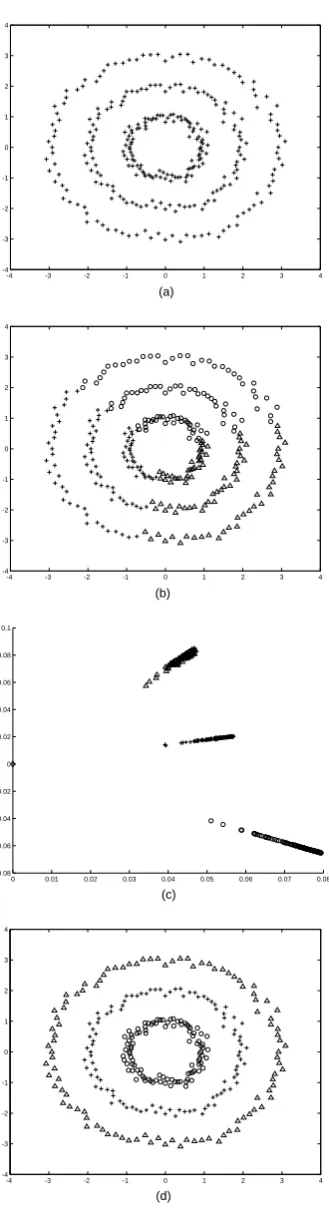
Figure 1: An Example:(a) The Three Circle Dataset. (b) The clustering result using K-means; (c) Three elongated clusters in the 2D clustering space using Spectral clustering: two dominant eigenvectors; (d)
tances along transversal directions. The elongated
K-means algorithm computes the distance of point x from the centerci as follows:
• If the center is not very near the origin,cT
ici > ²(²is a
parameter to be fixed by the user), the distances are cal-culated as:edist(x, ci) = (x−ci)TM(x−ci), where
M= 1
λ(Iq− cicTi cT
ici) +λ cicTi cT
ici,λis the sharpness
param-eter that controls the elongation (the smaller, the more elongated the clusters)2.
• If the center is very near the origin,cT
ici < ², the
dis-tances are measured using the Euclidean distance.
In each iteration of procedure in Table 1, elon-gated K-means is initialized withq centers corre-sponding to data points in different clusters and one center in the origin. The algorithm then will drag the center in the origin towards one of the clusters not accounted for. Compute another eigenvector (thus increasing the dimension of the clustering space to
q+ 1) and repeat the procedure. Eventually, when one reach as many eigenvectors as the number of clusters present in the data, no points will be as-signed to the center at the origin, leaving the cluster empty. This is the signal to terminate the algorithm.
[image:4.595.104.269.61.672.2]2.5 An example
Figure 1 visualized the clustering result of three cir-cle dataset using K-means and Spectral-based clus-tering. From Figure 1(b), we can see that K-means can not separate the non-convex clusters in three cir-cle dataset successfully since it is prone to local min-imal. For spectral-based clustering, as the algorithm described, initially, we took the two eigenvectors of
L with largest eigenvalues, which gave us a two-dimensional clustering space. Then to ensure that the two centers are initialized in different clusters, one center is set as the point that is the farthest from the origin, while the other is set as the point that simultaneously farthest the first center and the ori-gin. Figure 1(c) shows the three elongated clusters in the 2D clustering space and the corresponding clus-tering result of dataset is visualized in Figure 1(d), which exploits manifold structure (cluster structure) in data.
2
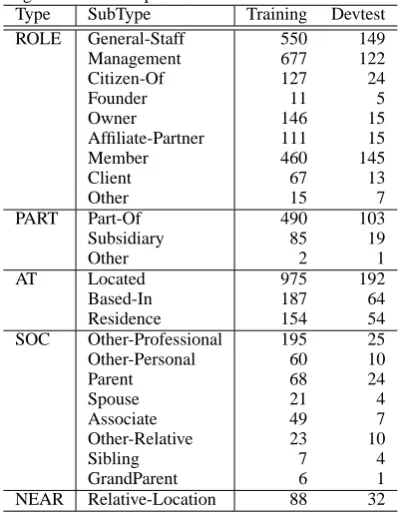
Table 2: Frequency of Major Relation SubTypes in the ACE training and devtest corpus.
Type SubType Training Devtest
ROLE General-Staff 550 149
Management 677 122
Citizen-Of 127 24
Founder 11 5
Owner 146 15
Affiliate-Partner 111 15
Member 460 145
Client 67 13
Other 15 7
PART Part-Of 490 103
Subsidiary 85 19
Other 2 1
AT Located 975 192
Based-In 187 64
Residence 154 54
SOC Other-Professional 195 25
Other-Personal 60 10
Parent 68 24
Spouse 21 4
Associate 49 7
Other-Relative 23 10
Sibling 7 4
GrandParent 6 1
NEAR Relative-Location 88 32
3 Experiments and Results
3.1 Data Setting
Our proposed unsupervised relation extraction is evaluated on ACE 2003 corpus, which contains 519 files from sources including broadcast, newswire, and newspaper. We only deal with intra-sentence explicit relations and assumed that all entities have been detected beforehand in the EDT sub-task of ACE. To verify our proposed method, we only col-lect those pairs of entity mentions which have been tagged relation types in the given corpus. Then the relation type tags were removed to test the unsuper-vised relation disambiguation. During the evalua-tion procedure, the relaevalua-tion type tags were used as ground truth classes. A break-down of the data by 24 relation subtypes is given in Table 2.
3.2 Evaluation method for clustering result
When assessing the agreement between clustering result and manually annotated relation types (ground truth classes), we would encounter the problem that there was no relation type tags for each cluster in our clustering results.
To resolve the problem, we construct a
contin-gency tableT, where each entryti,j gives the
num-ber of the instances that belong to both thei-th es-timated cluster andj-th ground truth class. More-over, to ensure that any two clusters do not share the same labels of relation types, we adopt a per-mutation procedure to find an one-to-one mapping function Ω from the ground truth classes (relation types) T C to the estimated clustering result EC. There are at most|T C|clusters which are assigned relation type tags. And if the number of the esti-mated clusters is less than the number of the ground truth clusters, empty clusters should be added so that
|EC| = |T C|and the one-to-one mapping can be performed, which can be formulated as the function:
ˆ
Ω = arg maxΩ P|T C|
j=1 tΩ(j),j, whereΩ(j)is the
in-dex of the estimated cluster associated with thej-th class.
Given the result of one-to-one mapping, we adopt
Precision, Recall and F-measure to evaluate the
clustering result.
3.3 Experimental Design
We perform our unsupervised relation extraction on the devtest set of ACE corpus and evaluate the al-gorithm on relation subtype level. Firstly, we ob-serve the influence of various variables, including Distance Parameterσ2, Different Features, Context Window Size. Secondly, to verify the effectiveness of our method, we further compare it with other two unsupervised methods.
3.3.1 Choice of Distance Parameterσ2
We simply search over σ2 and pick the value that finds the best aligned set of clusters on the transformed space. Here, the scattering criterion
trace(PW−1PB)is used to compare the cluster qual-ity for different value ofσ23, which measures the ra-tio of between-cluster to within-cluster scatter. The higher the trace(PW−1PB), the higher the cluster
quality.
In Table 3 and Table 4, with different settings of feature set and context window size, we find out the
3trace(P−1
W PB)istraceof a matrix which is the sum of
its diagonal elements. PW is the within-cluster scatter matrix
as: PW =
Pc j=1
P
Xi∈χj(Xi −mj)(Xi−mj) t
and PB
is the between-cluster scatter matrix as: PB =
Pc
j=1(mj− m)(mj−m)t, where m is the total mean vector andmj is
the mean vector forjth
cluster and(Xj−mj)tis the matrix
Table 3:Contribution of Different Features
Features σ2
cluster number tracevalue Precison Recall F-measure
Words 0.021 15 2.369 41.6% 30.2% 34.9%
+Entity Type 0.016 18 3.198 40.3% 42.5% 41.5%
+POS 0.017 18 3.206 37.8% 46.9% 41.8%
+Chunking Infomation 0.015 19 3.900 43.5% 49.4% 46.3%
Table 4:Different Context Window Size Setting Context Window Size σ2
cluster number tracevalue Precision Recall F-measure
0 0.016 18 3.576 37.6% 48.1% 42.2%
2 0.015 19 3.900 43.5% 49.4% 46.3%
5 0.020 21 2.225 29.3% 34.7% 31.7%
corresponding value ofσ2and cluster number which maximize thetracevalue in searching for a range of valueσ2.
3.3.2 Contribution of Different Features
As the previous section presented, we incorporate various lexical and syntactic features to extract rela-tion. To measure the contribution of different fea-tures, we report the performance by gradually in-creasing the feature set, as Table 3 shows.
Table 3 shows that all of the four categories of fea-tures contribute to the improvement of performance more or less. Firstly,the addition of entity type fea-ture is very useful, which improves F-measure by 6.6%. Secondly, adding POS features can increase
F-measure score but do not improve very much.
Thirdly, chunking features also show their great use-fulness with increasing Precision/Recall/F-measure by 5.7%/2.5%/4.5%.
We combine all these features to do all other eval-uations in our experiments.
3.3.3 Setting of Context Window Size
We have mentioned in Section 2 that the context vectors of entity pairs are derived from the contexts before, between and after the entity mention pairs. Hence, we have to specify the three context window size first. In this paper, we set the mid-context win-dow as everything between the two entity mentions. For the pre- and post- context windows, we could have different choices. For example, if we specify the outer context window size as 2, then it means that the pre-context (post-context)) includes two words before (after) the first (second) entity.
For comparison of the effect of the outer context of entity mention pairs, we conducted three different
Table 5: Performance of our proposed method (Spectral-based clustering) compared with other unsupervised methods: ((Hasegawa et al., 2004))’s clustering method and K-means clustering.
Precision Recall F-measure Hasegawa’s Method1 38.7% 29.8% 33.7% Hasegawa’s Method2 37.9% 36.0% 36.9%
Kmeans 34.3% 40.2% 36.8%
Our Proposed Method 43.5% 49.4% 46.3%
settings of context window size (0, 2, 5) as Table 4 shows. From this table we can find that with the con-text window size setting, 2, the algorithm achieves the best performance of 43.5%/49.4%/46.3% in
Precision/Recall/F-measure. With the context
win-dow size setting, 5, the performance becomes worse because extending the context too much may include more features, but at the same time, the noise also increases.
3.3.4 Comparison with other Unsupervised methods
In (Hasegawa et al., 2004), they preformed un-supervised relation extraction based on hierarchical clustering and they only used word features between entity mention pairs to construct context vectors. We reported the clustering results using the same clus-tering strategy as Hasegawa et al. (2004) proposed. In Table 5, Hasegawa’s Method1 means the test used the word feature as Hasegawa et al. (2004) while Hasegawa’s Method2 means the test used the same feature set as our method. In both tests, we specified the cluster number as the number of ground truth classes.
K-means, where we adopted the same feature set de-fined in our proposed method to cluster the con-text vectors of entity mention pairs and pre-specified the cluster number as the number of ground truth classes.
Table 5 reports the performance of our proposed method comparing with the other two unsupervised methods. Table 5 shows our proposed spectral based method clearly outperforms the other two unsuper-vised methods by 12.5% and 9.5% in F-measure re-spectively. Moreover, the incorporation of various lexical and syntactic features into Hasegawa et al. (2004)’s method2 makes it outperform Hasegawa et al. (2004)’s method1 which only uses word feature.
3.4 Discussion
In this paper, we have shown that the modified spec-tral clustering technique, with various lexical and syntactic features derived from the context of entity pairs, performed well on the unsupervised relation extraction problem. Our experiments show that by the choice of the distance parameterσ2, we can esti-mate the cluster number which provides the tightest clusters. We notice that the estimated cluster num-ber is less than the numnum-ber of ground truth classes in most cases. The reason for this phenomenon may be that some relation types can not be easily distin-guished using the context information only. For ex-ample, the relation subtypes “Located”, “Based-In” and “Residence” are difficult to disambiguate even for human experts to differentiate.
The results also show that various lexical and syntactic features contain useful information for the task. Especially, although we did not concern the dependency tree and full parse tree information as other supervised methods (Miller et al., 2000; Cu-lotta and Soresen, 2004; Kambhatla, 2004; Zhou et al., 2005), the incorporation of simple features, such as words and chunking information, still can provide complement information for capturing the character-istics of entity pairs. This perhaps dues to the fact that two entity mentions are close to each other in most of relations defined in ACE. Another observa-tion from the result is that extending the outer con-text window of entity mention pairs too much may not improve the performance since the process may incorporate more noise information and affect the clustering result.
As regards the clustering technique, the spectral-based clustering performs better than direct cluster-ing, K-means. Since the spectral-based algorithm works in a transformed space of low dimension-ality, data can be easily clustered so that the al-gorithm can be implemented with better efficiency and speed. And the performance using spectral-based clustering can be improved due to the reason that spectral-based clustering overcomes the draw-back of K-means (prone to local minima) and may find non-convex clusters consistent with human in-tuition.
Generally, from the point of view of unsu-pervised resolution for relation extraction, our approach already achieves best performance of 43.5%/49.4%/46.3% in Precision/Recall/F-measure compared with other clustering methods.
4 Conclusion and Future work
In this paper, we approach unsupervised relation ex-traction problem by using spectral-based clustering technique with diverse lexical and syntactic features derived from context. The advantage of our method is that it doesn’t need any manually labeled relation instances, and pre-definition the number of the con-text clusters. Experiment results on the ACE corpus show that our method achieves better performance than other unsupervised methods, i.e.Hasegawa et al. (2004)’s method and Kmeans-based method.
Currently we combine various lexical and syn-tactic features to construct context vectors for clus-tering. In the future we will further explore other semantic information to assist the relation extrac-tion problem. Moreover, instead of cosine similar-ity measure to calculate the distance between con-text vectors, we will try other distributional similar-ity measures to see whether the performance of re-lation extraction can be improved. In addition, if we can find an effective unsupervised way to filter out unrelated entity pairs in advance, it would make our proposed method more practical.
References
Brin Sergey. 1998. Extracting patterns and relations from world wide web. In Proc. of WebDB Workshop at 6th International Conference on Extending Database Technology (WebDB’98). pages 172-183.
Charniak E.. 1999. A Maximum-entropy-inspired parser. Technical Report CS-99-12.. Computer Science De-partment, Brown University.
Culotta A. and Soresen J. 2004. Dependency tree kernels for relation extraction, In proceedings of 42th Annual Meeting of the Association for Computational Linguis-tics. 21-26 July 2004. Barcelona, Spain.
Defense Advanced Research Projects Agency. 1995. Proceedings of the Sixth Message Understanding Con-ference (MUC-6) Morgan Kaufmann Publishers, Inc.
Hasegawa Takaaki, Sekine Satoshi and Grishman Ralph. 2004. Discovering Relations among Named Enti-ties from Large Corpora, Proceeding of Conference ACL2004. Barcelona, Spain.
Kambhatla N. 2004. Combining lexical, syntactic and semantic features with Maximum Entropy Models for extracting relations, In proceedings of 42th Annual Meeting of the Association for Computational Linguis-tics. 21-26 July 2004. Barcelona, Spain.
Kannan R., Vempala S., and Vetta A.. 2000. On cluster-ing: Good,bad and spectral. In Proceedings of the 41st Foundations of Computer Science. pages 367-380.
Miller S.,Fox H.,Ramshaw L. and Weischedel R. 2000. A novel use of statistical parsing to extract information from text. In proceedings of 6th Applied Natural Lan-guage Processing Conference. 29 April-4 may 2000, Seattle USA.
Ng Andrew.Y, Jordan M., and Weiss Y.. 2001. On spec-tral clustering: Analysis and an algorithm. In Pro-ceedings of Advances in Neural Information Process-ing Systems. pages 849-856.
Sanguinetti G., Laidler J. and Lawrence N.. 2005. Au-tomatic determination of the number of clusters us-ing spectral algorithms.In: IEEE Machine Learnus-ing for Signal Processing. 28-30 Sept 2005, Mystic, Con-necticut, USA.
Shi J. and Malik.J. 2000. Normalized cuts and image segmentation. IEEE Transactions on Pattern Analysis and Machine Intelligence. 22(8):888-905.
Weiss Yair. 1999. Segmentation using eigenvectors: A unifying view. ICCV(2). pp.975-982.
Zelenko D., Aone C. and Richardella A.. 2002. Ker-nel Methods for Relation Extraction, Proceedings of the Conference on Empirical Methods in Natural Lan-guage Processing (EMNLP). Philadelphia.
Zha H.,Ding C.,Gu.M,He X.,and Simon H.. 2001. Spec-tral Relaxation for k-means clustering. In Neural In-formation Processing Systems (NIPS2001). pages 1057-1064, 2001.
Zhang Zhu. 2004. Weakly-supervised relation classifi-cation for Information Extraction, In proceedings of ACM 13th conference on Information and Knowledge Management (CIKM’2004). 8-13 Nov 2004. Wash-ington D.C.,USA.