Development of the Short Version of the Scales of General Well-Being: The 14-item SGWB
Ylenio Longo
University of Nottingham, United Kingdom
Iain Coyne
Loughborough University, United Kingdom
Stephen Joseph
University of Nottingham, United Kingdom
Author note
Ylenio Longo, Division of Psychiatry and Applied Psychology, University of Nottingham; Iain Coyne, School of Business and Economics, Loughborough University; Stephen Joseph, School of Education, University of Nottingham.
This research was supported by the economic and Social Research Council grant ES/J500100/1 to Ylenio Longo.
Abstract
The Scales of General Well-Being (SGWB, Longo, Coyne & Joseph, 2017) is a 65-item tool assessing fourteen different constructs. The aim of this study was to develop a short 14-item version. One item was chosen from each of the fourteen scales following inspection of
previously-published factor loadings and content validity ratings. In total, 446 responses from U.S residents were collected from Amazon Mechanical Turk. Results supported a factor structure consistent with the long form, as well as good internal consistency. Additionally, general well-being scores of and long-form correlated at .96 and each item in the short-form was strongly related to its respective long-short-form scale. The 14-item SGWB offers a brief assessment of well-being based on a novel and comprehensive operational definition, and promises to be of practical use to researchers and clinicians.
Keywords. well-being; short form; SGWB; flourishing; measurement; scale; validation;
Introduction
The importance of well-being has been widely acknowledged over the past twenty years. Over that time, several new psychometric tools have been developed to assess well-being. Linton, Dieppe, and Medina-Lara (2016) carried out a systematic review to identify well-being assessments designed since 1993 for general use, with English-speaking adults. Their review of 99 instruments revealed the complexity of the field, how instruments reflect different theoretical backgrounds, and a lack of clarity surrounding the similarities and differences across the range of tools.
Subsequently, Longo, Coyne, and Joseph (2017) examined similarities and
differences in the six most widely used conceptions of well-being (i.e., Diener et al., 2010; Huppert & So, 2013; Keyes, 2002; Ryan, Huta & Deci, 2008; Seligman, 2011; Waterman et al., 2010), each of which offers a multidimensional architecture of well-being. They
identified fourteen distinct and recurring constructs in the literature – happiness, vitality, calmness, optimism, involvement, self-awareness, self-acceptance, self-worth, competence, development, purpose, significance, congruence, and connection. As no existing tools assessed all fourteen constructs, each offering only a partial assessment, these were used by Longo et al. (2017) as the framework for a new multidimensional tool: the Scales of General Well-Being (SGWB).
The SGWB is an advance in the well-being literature as it is comprehensive in scope, practical as it offers researchers the ability to assess any of the fourteen scales individually, or an overall score for general well-being. However, at 65 items, it is lengthy. Researchers who want to assess only general well-being will seek a shorter tool. The aim is to develop a short 14-item version of general well-being; by selecting the item from each of the fourteen scales with the best psychometric properties, then testing the one factor scoring structure, its internal consistency, and correlations with the long form. There are already various short measures of well-being available but, as shown by Linton et al. (2016), these tend to be limited to the assessment of only one construct, or are poorly defined theoretically, such that their content as general measures is restricted or it is not clear what constructs are being assessed. As such, there remains a need for a short, robust, and reliable measure for the rapid assessment of well-being that overcomes these limitations. Therefore, in the present paper, we present the development and initial validation of a short 14-item version of the SGWB.
Method
Participants and procedure
Preliminary analyses to select items from the long form of the SGWB were carried out using data from Studies 2 and 3 in Longo et al.’s (2017) paper. A brief summary of these studies is provided below.
Data from both studies 2 and 3 were collected from U.S. residents using Amazon Mechanical Turk. A small monetary incentive was given to encourage participation (approx. $0.50 to $0.77). In both studies, only individuals whose previous work had been rated as adequate 95% of the time were able to access the survey (Peer et al., 2014). Screening
showing no variation in their responses to the long form of the SGWB (i.e. row SD = 0) were excluded from further analyses.
In study 2, 560 completed survey responses were collected to the long form SGWB. Ages ranged from 19 to 77 years (M = 37.18, SD = 13.10), and 60.9% were female. After data screening 507 responses were retained.
In study 3, 1101 responses were collected from a new sample on a survey including well-being and personality measures. Ages ranged from 17 to 83 years (M=36.93,
SD=12.13), and 56.6% were female. In total, responses from 989 participants were adequate for the analyses.
Five weeks after Study 3, a follow-up sample was recruited to re-administer the long form and administer the newly developed short form on study 3 participants. In total, 446 responses from U.S. residents were recorded (61% female, 38% male). Ages ranged from 19 to 83, M=39.72, SD=12.65). Following the same screening procedure as above, responses from 431 participants were adequate for the analyses.
Measure
All participants completed the full 65 item version of the SGWB, followed by a battery of other measures not reported here (but see Longo, Coyne, & Joseph, 2017), and the follow-up sample completed a shorter 14-item version of the SGWB - the 14-item SGWB.
Analysis
Study 2 in Longo et al. 2017). The model was then re-tested in a new sample (using data from Study 3 in Longo et al. 2017). Third, the short form was administered on its own (follow-up study in Longo et al. 2017), and its factor structure, reliability and criterion validity were examined. Data from this sample has been previously reported in the development of the SGWB (see Longo et al., 2017). However, the present set of analyses using the short form data have not been previously published.
Results
As mentioned above, preliminary factor analyses were conducted by selecting items from the long form of the SGWB, using data from studies 2 and 3 in Longo et al.’s (2017) paper.
Item selection
The 14-item SGWB comprises one item from each of the fourteen scales of the SGWB. To select items, we consulted the previously published CFA data from Study 2 (n = 507) on each of the fourteen scales (Longo et al. 2017). Our aim was simply to select the highest loading item from each scale to compose the short version. However, we also
examined mean content validity ratings obtained from the six experts involved in the original scale's construction. Thus, we chose the item from the scale with the highest loading and content validity rating. In one case, the purpose in life item was chosen even though it did not have the highest content rating, because the others may be interpreted too literally (e.g. having an actual mission, or a vision) or too vaguely (e.g. having something to aspire to). Within the context of the scale, these other items are likely to be interpreted correctly, but if a single item is chosen, the chosen item, “in my life, I have a purpose,” seems to better
Preliminary factor structure analyses
The 14 items selected from the long form were first factor analyzed using data from the long form of the SGWB in study 2 (n = 507), and a new sample recruited in study 3 (n = 989). CFA of the fourteen items was run using the lavaan package (version 0.5-23.1097, Rosseel, 2012) using Robust Maximum Likelihood estimation (MLR). Several fit indices were used to evaluate the fit of a one factor model: the Yuan-Bentler chi-square (YB χ2), the
Comparative Fit Index (CFI), the Standardized Root Mean Square Residual (SRMR), and the Root Mean Square Error of Approximation (RMSEA). CFI values above 0.90, SRMR values below 0.08, and RMSEA values below 0.08 with an upper confidence limit no greater than 0.10, all indicate acceptable to good fit (Brown, 2015). By these indices the one factor model was an acceptable to good fit (see Table 1). While a non-significant YB χ2 indicates good fit,
in this case it was statistically significant, most likely due to the large sample size. However, as limitations of chi-square are well recognized (Hu & Bentler, 1999), we chose not to take YB χ2 into consideration. Overall, the selected items showed an adequate factor structure (see Table 1), thus justifying further tests of the validity and reliability of the short SGWB scores.
Confirmation of the single factor scoring procedure of the 14-item SGWB
Table 1. Fit indices for the 14 items selected from the long form (n = 507 and 989) and the short form on its own (n = 431)
YB χ2 df p CFI TLI SRMR RMSEA (90% CI) selected items (n = 507) 302.95 77 .000 .920 .905 .044 .085 (.075 - .096) selected items (n = 989) 410.13 77 .000 .940 .929 .037 .075 (.068 - .082) short form (n = 431) 261.76 77 .000 .934 .922 .039 .090 (.078 - .102)
Reliability analyses were run with the psych package (version 1.7.3.21, Revelle, 2017) in R version 3.4.2. Internal consistency reliability, tested using McDonald’s omega hierarchical (ωh) coefficient, was .86, confirming the high level of inter-relationship between the items. Actual scores on 14-item scale ranged from 1.29 to 5 (M = 3.64, SD = 0.84, skew = -0.54, kurtosis = -0.25) approximating a normal distribution with minimal skewness.
Construct validation
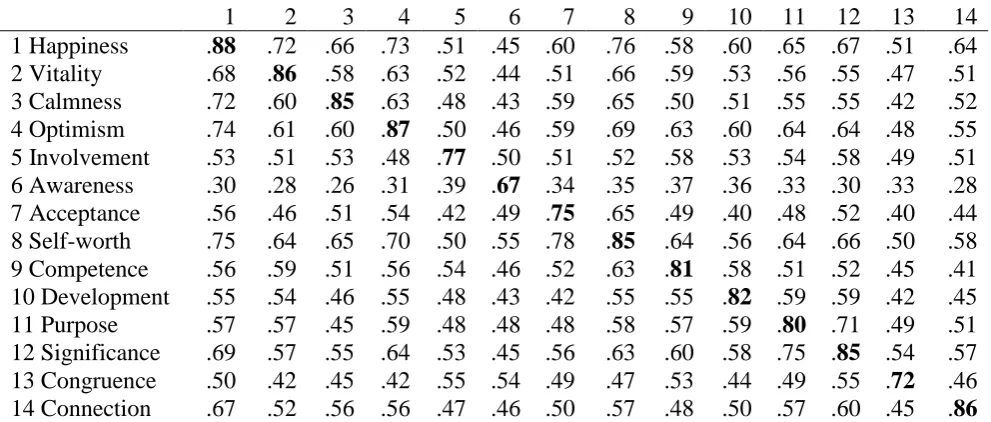
Second, construct validity was examined by testing the association of the individual items with the full scales from the long form. A single general well-being score from the 65-item SGWB was correlated with a general well-being score from the new 14-item SGWB at r = .96, p < .001. Additionally, each long form scale (e.g. calmness scale) correlated most highly with its respective short form item, ranging from r = .67 to r = .88 (see Table 2) 1.
Each short form item correlated most highly with its respective long form scale in all cases but one: item 7 measuring self-acceptance showed a slightly higher correlation at r = .78 with the self-worth scale than the self-acceptance scale at r = .75. According to Steiger's test, the two correlations were not significantly different (p > .05). In other words, item 7 showed equivalent correlations with the self-acceptance and self-worth scales (see Table 2). However, other research also shows that self-acceptance and self-worth are theoretically distinct but highly associated, in such a way that those with higher self-acceptance show
greater worth, but those with greater worth do not necessarily show higher self-acceptance (Patterson & Joseph, 2006).
Table 2. Correlations between long form scales (rows) and their respective short form single items (columns)
1 2 3 4 5 6 7 8 9 10 11 12 13 14
1 Happiness .88 .72 .66 .73 .51 .45 .60 .76 .58 .60 .65 .67 .51 .64 2 Vitality .68 .86 .58 .63 .52 .44 .51 .66 .59 .53 .56 .55 .47 .51 3 Calmness .72 .60 .85 .63 .48 .43 .59 .65 .50 .51 .55 .55 .42 .52 4 Optimism .74 .61 .60 .87 .50 .46 .59 .69 .63 .60 .64 .64 .48 .55 5 Involvement .53 .51 .53 .48 .77 .50 .51 .52 .58 .53 .54 .58 .49 .51 6 Awareness .30 .28 .26 .31 .39 .67 .34 .35 .37 .36 .33 .30 .33 .28 7 Acceptance .56 .46 .51 .54 .42 .49 .75 .65 .49 .40 .48 .52 .40 .44 8 Self-worth .75 .64 .65 .70 .50 .55 .78 .85 .64 .56 .64 .66 .50 .58 9 Competence .56 .59 .51 .56 .54 .46 .52 .63 .81 .58 .51 .52 .45 .41 10 Development .55 .54 .46 .55 .48 .43 .42 .55 .55 .82 .59 .59 .42 .45 11 Purpose .57 .57 .45 .59 .48 .48 .48 .58 .57 .59 .80 .71 .49 .51 12 Significance .69 .57 .55 .64 .53 .45 .56 .63 .60 .58 .75 .85 .54 .57 13 Congruence .50 .42 .45 .42 .55 .54 .49 .47 .53 .44 .49 .55 .72 .46 14 Connection .67 .52 .56 .56 .47 .46 .50 .57 .48 .50 .57 .60 .45 .86
Note. Correlations hypothesized to be the highest are in bold. All correlations were significant (p <.01) (n = 431)
Discussion
This study reported on the selection of fourteen items from the SGWB, and the initial
validation of a short 14-item tool with which to assess general well-being. Results support the one factor scoring procedure, internal consistency reliability, and the association with the longer version is strong, suggesting the new tool is a reliable and valid measure of well-being. For researchers and clinicians who wish to assess the individual scales of well-being the longer version is recommended but for researchers who need a short measure that provides a single index of well-being, the 14-item SGWB is recommended.
more comprehensive content than extant measures of well-being, the short form also offers the advantage of comprehensiveness compared to other shorter measures which tend to assess only a fraction of the constructs, such as happiness or optimism.
There is now a need for studies using the 14-item scale to replicate and extend these findings and provide further evidence of validity. Even though the 14-item SGWB exhibits good psychometric properties, the questionnaire was tested on its own only in the follow-up sample. It would be informative for future research to provide further evidence of
dimensionality, reliability and validity.
In conclusion, the 14-item SGWB offers a brief assessment of well-being based on a novel and comprehensive operational definition derived from the leading theoretical
perspectives in contemporary positive psychology. The tool promises to be useful to
References
Brown, T. A. (2015). Confirmatory factor analysis for applied research. New York: The Guilford Press.
Diener, E., Wirtz, D., Tov, W., Kim-Prieto, C., Choi, D. W., Oishi, S., & Biswas-Diener, R. (2010). New well-being measures: Short scales to assess flourishing and positive and negative feelings. Social Indicators Research, 97(2), 143-156.
Hair, J. F., Black, W. C., Babin, B. J., & Anderson, R. E. (2010). Multivariate data analysis:
A global perspective. New York: Pearson.
Hu, L. T., & Bentler, P. M. (1999). Cutoff criteria for fit indexes in covariance structure analysis: Conventional criteria versus new alternatives. Structural Equation
Modelling, 6(1), 1-55.
Huppert, F. A., & So, T. T. (2013). Flourishing across Europe: Application of a new conceptual framework for defining well-being. Social Indicators Research, 110(3), 837-861.
Keyes, C. L. M. (2002). The mental health continuum: From languishing to flourishing in life. Journal of Health and Social Behavior, 43(2), 207-222.
Linton, Dieppe, & Medina-Lara (2016). Review of 99 self-report measures for assessing
well-being in adults: exploring dimensions of well-well-being and developments over time.
BMJ Open, 2016; 6:e010641. doi:10.1136/bmjopen-2015-010641
Longo, Y., Coyne, I., & Joseph, S. (2017). The Scales of general well-being. Personality and
Individual Differences, 109, 148-159.
Patterson, T., & Joseph, S. (2006). Development of a self-report measure of
unconditional positive self-regard. Psychology and Psychotherapy: Theory,
Peer, E., Vosgerau, J., & Acquisti, A. (2014). Reputation as a sufficient condition for data quality on Amazon Mechanical Turk. Behavior Research Methods, 46(4), 1023-1031. Revelle, W. (2017) psych: Procedures for Personality and Psychological Research,
Northwestern University, Evanston, Illinois, USA, https://CRAN.R-project.org/package=psych.
Rosseel, Y. (2012). lavaan: An R Package for Structural Equation Modeling. Journal of Statistical Software, 48(2), 1-36. URL http://www.jstatsoft.org/v48/i02/.
Ryan, R. M., Huta, V., & Deci, E. L. (2008). Living well: A self-determination theory perspective on eudaimonia. Journal of Happiness studies, 9(1), 139-170.
Seligman, M. E. P. (2011). Flourish: a new understanding of happiness and well-being – and
how to achieve them. London. Nicholas Brealey.
Waterman, A. S., Schwartz, S. J., Zamboanga, B. L., Ravert, R. D., Williams, M. K.,…Donnellan, M. B. (2010). The Questionnaire for Eudaimonic Well-Being: Psychometric properties, demographic comparisons, and evidence of validity. The
Supplementary material
14-item Scales of General Well-Being (14-SGWB)
Instructions
Below you’ll find fourteen statements about your experiences. Please indicate how true each statement is regarding the EXPERIENCES IN YOUR LIFE OVERALL. There are no right or wrong answers. Please, choose the answer that best reflects your experience rather than what you think your experience should be.
Not at all
true
A bit
true
Somewhat
true
Mostly
true
Very true
1. I feel happy 2. I feel energetic 3. I feel calm 4. I’m optimistic
5. In my activities, I feel absorbed by what I’m doing 6. I’m in touch with how I really feel inside
7. I accept most aspects of myself 8. I feel great about myself
9. I am highly effective at what I do 10.I feel I am improving
11.I have a purpose
12.What I do in my life is worthwhile
13.What I do is consistent with what I believe I should do 14.I feel close and connected to the people around me