A Middleware Framework for Constraint-Based
Deployment and Autonomic Management of
Distributed Applications
Alan Dearle, Graham Kirby and Andrew McCarthy
School of Computer Science, University of St Andrews,
St Andrews, Fife KY16 9SS, Scotland
{al, graham, ajm}@dcs.st-and.ac.uk
Abstract
We propose a middleware framework for deployment and subsequent autonomic management of component-based applications. An initial deployment goal is specified using a declarative constraint language, expressing constraints over aspects such as component-host mappings and component interconnection topology. A constraint solver is used to find a configuration that satisfies the goal, and the configuration is deployed automatically. The deployed application is instrumented to allow subse-quent autonomic management. If, during execution, the manager detects that the original goal is no longer being met, the satisfy/deploy process can be repeated automatically in order to generate a revised deployment that does meet the goal.
Keywords: component, deployment, autonomic
1
Introduction
In [1], IBM identifies the growing problem of complexity in IT systems, predicting that demand for skilled workers will double in the next six years, and will soon be impossible to satisfy: “The increasing system complexity is reaching a level beyond human ability to manage and secure.”
The approach of autonomic computing is to automate the management of computing systems themselves, in the same way that existing business activities have been automated in the past. An autonomic system needs to be self-managing in the following aspects, among others: self-configuration, self-optimization, self-healing and self-protection [2]. The general concept of autonomic computing can be applied to any application domain; we propose to apply it to the specific problem of middle-ware to supportdeployment and evolution of distributed applications.
granularity, with clearly defined interfaces (termed ports). Deploying and maintaining a distributed application involves at least the following activities:
selecting or implementing appropriate components
defining an inter-connection topology specifying how components communicate with one another
defining a mapping of components to physical nodes deploying the individual components to the chosen nodes
repeating any or all of the above when evolution of the application becomes nec-essary due to failures or other changes in its environment
Our proposed middleware aims to largely automate all but the first of these, driven by programmer-specified high-level goals regarding connection topology and physi-cal placement. The motivation is to improve application reliability and performance, and to reduce the costs involved in human-managed system maintenance.
The general structure of an autonomic system is illustrated in Fig 1, which shows a
[image:2.595.199.398.398.550.2]managed element and its autonomic lifecycle. The element is associated with an auto-nomic manager that attempts to maintain some high-level objective for the element. The behaviour of the element is continually monitored and analysed. When this devi-ates sufficiently from the objective, the manager plans and executes a change to the element in order to restore the desired behaviour. In our middleware the managed elements are collections of components making up a distributed application.
Fig 1: A managed element (from [2])
The research issues involved in developing such a middleware framework include: how to express the high-level goals defining connection and placement policy how to automatically identify a configuration conforming to these goals how to automatically deploy such a configuration
how to automatically evolve the deployed configuration when necessary due to changing circumstances
o how to monitor the deployed application
In order to describe how an application is intended to be structured, we propose a domain-specific constraint-based language. This describes configuration goals in terms of resources including software components and physical hosts, relationships between hosts and components, and constraints over these. From such configuration goals it is possible to:
deploy components using the available physical resources
configure monitoring software to assess whether the executing application contin-ues to obey the constraints specified in the description
configure software for automatically evolving the application in response to con-straint violations arising from changes in the environment
Some mechanism is required for deploying and redeploying components in possi-bly remote locations. We advocate the use of bundles, which were developed by us in the Cingal project (Computation in Geographically Appropriate Locations) [3, 4]. Bundles permit XML-encoded closures of code and data to be pushed and executed in remote locations. Cingal-enabled hosts provide a lightweight runtime and security infrastructure, written in pure Java, necessary to support the execution of bundles.
There are several levels at which a deployed application may be evolved. The sim-plest, on which we concentrate here, involves evolution of the configuration in order to maintain a previously specified goal. Thus the configuration evolves whilst the high-level configuration goal remains the same. We term this autonomic evolution, and consider it to be fundamental to the autonomic management of distributed appli-cations. Our aim is for this style of evolution to take place automatically whenever required.
A second level of evolution is needed when the high-level goal itself changes, due to a change in application requirements. Our framework handles both levels of evolu-tion in the same way, treating the first as a special case of the second in which the goal remains fixed. In both cases an ongoing autonomic cycle, as shown in Fig 1, repeatedly attempts to solve the current constraint problem, deploys the resulting configuration, and monitors the deployment to determine when to repeat the se-quence.
2
Related Work
2.1
Architecture Description
A number of software architecture description languages (ADLs) have been devel-oped, including Acme [5]. Aesop [6], ArchWare [7], Darwin [8], Rapide [9], SADL [10], Unicon [11], and Wright [12]. Acme, for example, is intended to fulfil three roles: to provide an architectural interchange format for design tools, to provide a foundation for the design of new tools and to support architectural modelling. In common with many ADLs, Acme supports the description of components joined via connectors, which provide a variety of communication styles. Components and con-nectors may be annotated with properties that specify attributes such as source files, degrees of concurrency, etc.
As well as providing a basis for reasoning about software structure via explicit rep-resentations of that structure, a number of systems support the specification of in-tended properties, using architectural styles. A style defines certain structural or be-havioural properties that are desired for an application. It is possible to check auto-matically whether a given application instance conforms to a style, and in some cases to generate conforming instances automatically. ADLs supporting styles include Acme, ArchWare, Darwin, Rapide and Wright. A high-level configuration goal as outlined in the introduction may be thought of as a specialised architectural style, in that it corresponds to a set of possible configurations that meet the goal.
Styles are typically defined in a declarative manner in the form of constraints. Other work involving the use of constraints to describe software configuration and evolution includes [13-17]. Our work shares the motivation to use a simple declara-tive notation to define high-level goals regarding intended application structure, but differs from the systems mentioned here in several respects:
We wish to allow the human administrator to control the deployment of compo-nents onto physical nodes, in terms of the physical and logical properties of the re-sources available on those nodes. It may be appropriate for physical placement policy to be influenced by various considerations related to cost, performance, re-silience, political issues and so on.
We intend to manage autonomic evolution, necessary when a deployed application deviates from its original constraints, solely from those constraints. This contrasts with [14, 16, 17], in which repair strategies are expressed separately from the con-straints in an imperative style.
2.2
Constraint Programming
Constraint programming models problems by declaring a set of variables with finite domains and constraints between values of these variables. Instead of writing an im-perative program to provide a result, the user invokes a search algorithm to find a solution that satisfies the constraints specified by the user. A number of constraint programming and solving systems exist. We believe that the lack of domain-specific syntax in such systems makes them unsuitable for specifying the high-level configura-tion goal in an autonomic applicaconfigura-tion. However, they are applicable as constraint solvers when used in conjunction with a domain-specific language.
For example, ECLiPSe [19] is a constraint logic programming system with syntax similar to Prolog, supplied with a number of constraint solvers and libraries. JSolver [20] is a commercial Java library which provides constraint satisfaction functionality, while Cream [21] is a simpler open-source library. Any such systems could be em-ployed in our framework.
In Section 4 we describe a new domain-specific constraint language, Deladas (DE-clarative LAnguage for Describing Autonomic Systems), which is suitable for speci-fying autonomic systems and may be used to drive the deployment and evolution process. Currently we are developing a prototype implementation in which Deladas programs are compiled into low-level constraint satisfaction problems, which are then solved using Cream.
A similar approach is taken with Alloy [22], a declarative notation for describing structural architectural constraints. The language is derived from Z, and is compiled into lower level SAT constraint problems. However, it does not address the physical deployment of components.
2.3
Deployment Techniques
The OSGi Service Platform [23] addresses similar issues of remote installation and management of software components, and (independently) adopts similar terminology for bundles and wiring. The most significant difference is the lack of high-level de-clarative architectural descriptions. This arises from it being targeted primarily at software deployment onto smart and embedded devices, whereas Cingal is aimed more generally at deployment and evolution of distributed applications on the basis of explicit architectural descriptions. Another difference is in the wiring model: a given OSGi bundle can be a producer and/or a consumer, and all its associated wires are conceptually equivalent. Cingal allows any number of symbolically named ports to be associated with a bundle, and the programmer may treat these differently. However, the two schemes have equivalent modelling power. Finally, Cingal is more flexible with regards to initial provisioning: its ubiquitous fire service allows bundles to be pushed to a new node from a remote management agent without any intervention required locally on the node. Initial provisioning in OSGi involves pull from a new node, which must be initialised somehow with an address from which to pull the code. The address may be provided by various means such as direct user intervention, factory installation, reading from a smartcard, etc.
3
Our Approach
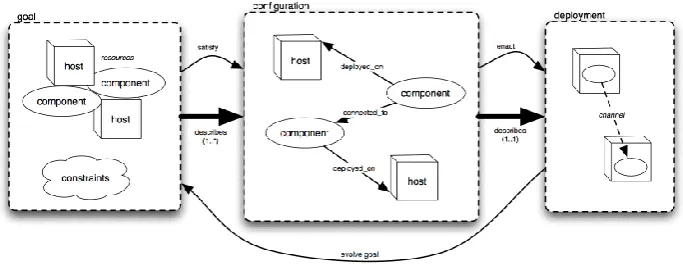
Our general approach is shown in Fig 2. The application administrator specifies a deployment goal in terms of resources available and constraints over their deploy-ment. The resources include software components and physical hosts on which these components may be installed and executed. Constraints operate over aspects such as the mapping of components to hosts and the interconnection topology between com-ponents.
We assume that the distributed application can be structured as encapsulated com-ponents, each with its own thread of control. The granularity of components is in-tended to be large, so that a relatively small number of components execute on each host. The components must be capable of recovering their own state if necessary, for example, in the event of a host crash. In our current prototype, components communi-cate with one another via asynchronous channels, but the approach could be extended in a straight-forward manner to support other styles such as RPC. We also assume that the application contains application-level protocols that cope with the disconnection and reconnection of channels to different platforms and servers. One such technology is the half session abstraction described by Strom and Yemeni [24].
The cycle shown in Fig 2 is controlled by the Autonomic Deployment and Man-agement Engine (ADME). In order to produce a concrete deployment of the applica-tion, the ADME attempts to satisfy the goal, specified by the administrator in the Deladas language. The engine includes a Deladas parser and constraint solver. The result of the attempted goal satisfaction is a set of zero or more solutions. Each solu-tion is in the form of a configuration, which describes a particular mapping of com-ponents to hosts and interconnection topology that satisfies the constraints. Configura-tions are encoded in XML documents known as Deployment Description Documents
Fig 2: Refined autonomic cycle
If a configuration can be found1, it is enacted by ADME to produce a running
de-ployment of the application. This is facilitated using Cingal, and the Cingal infrastruc-ture must already be installed on each of the hosts involved. From a configuration expressed as a DDD, ADME generates a collection of bundles that perform installa-tion, instantiation and wiring of the components. Once these bundles have been fired on the appropriate hosts, the application is fully deployed in its initial configuration. This process is described in detail in [25].
The autonomic aspect of this approach is that the deployed application is instru-mented with probes to monitor its execution. Events generated by the probes are sent to the ADME, which may decide that the deployment no longer satisfies the original goal, for example if a component or host fails. In this case the ADME evolves the goal to take account of changed resource availability—for example, removing failed hosts and perhaps adding new hosts that may now be available—and initiates the
satisfy/enact cycle again. This attempts to find a new solution of the constraints that combines existing and new components, and to enact this in an efficient manner. Assuming that such a new configuration can be found and deployed, the system has reacted automatically and appropriately to a change in the application’s environment. The cycle may continue indefinitely. This process is described in more detail in Sec-tion 5.
The nature of the probes required to monitor the application depends on the con-straints specified in the goal. At the simplest level the concon-straints operate over just the component/host topology, and for this, simple probes are sufficient. Where more complex probes are required, this can be deduced by ADME from the specified con-straints. For example, constraints can operate over the latency or bandwidth of a channel, the degree of replication of a component, or the mean availability of a host. Each of these dynamic aspects requires a specialised probe. We view Deladas as a core language that may be extended to incorporate new constraint types and associ-ated probes.
This style of autonomic application evolution can be achieved without human in-tervention. The framework described above also accommodates the need for more
wide-ranging evolution. For example, in addition to changes in the application’s envi-ronment, changes may occur in the enterprise that the application supports; examples include changes in legal or financial regulations, or mergers of organisations. These may require manual revision of the deployment goal, including changes to the con-straints.
4
Initial Deployment
In this section we explore, using an example, the use of Deladas to describe the re-sources and constraints described in the last section. The language belongs to the family of architectural description languages (ADLs). Unlike some ADLs, Deladas does not contain any computational constructs, and programs that perform computa-tion cannot be written in it; it is purely declarative and descriptive.
We believe that Deladas’ constraint style of deployment specification gives it a relative simplicity compared with more explicit styles, making it suitable for the specification of relatively large application deployments. This is especially important when the deployment is to be recomputed repeatedly in an autonomic cycle.
Deladas is used to define systems and constraints over them. The types supported are: component, host and constraintset. The type component is used to describe soft-ware components at a high level. Components, like many of the types in Acme, have associated attributes. The mandatory attributes for components are bundles and ports. Bundles are used to define the code and static data of the components. Ports are used to define communication channels between components. The type host is used to describe a resource on which components can be deployed. Attributes of hosts include IP-address, ownership, platform type, etc.
The type constraintset is a high level constraint-based specification of the invari-ants that pertain to a system. A constraintset constrains the way in which the system is realised, for example how processes are placed on machines and how the processes are wired up. These are used to yield an initial configuration that might be deployed, and also to constrain deployments in the face of change. In the future we envisage extending the constraintsets described here to include other aspects such as bandwidth and geopolitical constraints.
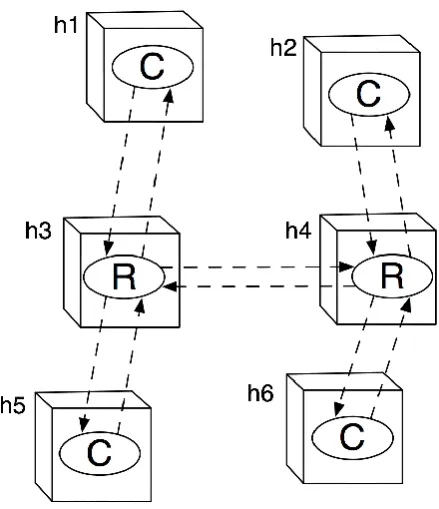
Fig 3: Example configuration
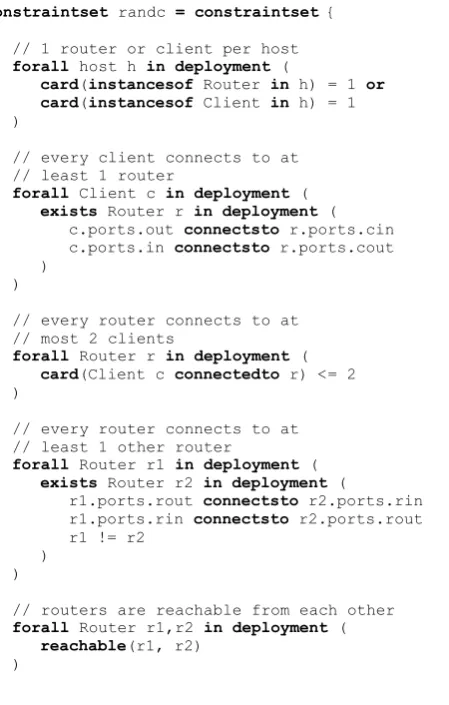
We now describe in more detail the Deladas constraintset shown in Fig 4. Given a set of resources specified in Deladas and comprising components and hosts, the con-straintset might describe none, one or many possible configurations. It is easily possi-ble to write Deladas constraintsets that are internally inconsistent and therefore spec-ify no valid configurations, irrespective of resources. The writing of appropriate con-straintset definitions is likely to remain difficult, and we envisage that constraintsets
for common architectural patterns might be available off the shelf, presenting the opportunity for high level architectural reuse and specialisation.
In this example, the constraintset contains five constraint clauses. These clauses operate over two types of component named Router and Client. It is not necessary to specify the concrete types of these components but it is possible to infer that, in order to satisfy the constraints, the component Router must have ports named rin, rout, cin
and cout. The constraints are written in first-order logic and specify (in sequence) that:
hosts run an instance of a router and/or a client
every client connects to at least one router via the out and in ports on the client and the cin and cout ports on the router
there are at most two clients for every router
Note that if two clients are connected to a router, routers require a separate cin and
cout port per client.
constraintset randc = constraintset {
// 1 router or client per host forall host h in deployment (
card(instancesof Router in h) = 1 or card(instancesof Client in h) = 1 )
// every client connects to at // least 1 router
forall Client c in deployment ( exists Router r in deployment (
c.ports.out connectsto r.ports.cin c.ports.in connectsto r.ports.cout )
)
// every router connects to at // most 2 clients
forall Router r in deployment ( card(Client c connectedto r) <= 2 )
// every router connects to at // least 1 other router
forall Router r1 in deployment ( exists Router r2 in deployment (
r1.ports.rout connectsto r2.ports.rin r1.ports.rin connectsto r2.ports.rout r1 != r2
) )
// routers are reachable from each other forall Router r1,r2 in deployment (
reachable(r1, r2) )
[image:10.595.133.358.180.533.2]}
Fig 4: Example Deladas constraintset
Fig 5 shows an example Deladas specification of resources that might be given to the solver in order to obtain a deployment. This specification defines the components
Client and Router. The specification of Client includes the bundle containing code and static data, and defines two ports named in and out. The port definition of Router
component Client(
code = "file:///D:ClientBundle.xml", ports = {in, out}
)
component Router(
code = "http://deladas.org/RBundle.xml", ports = {cin[], cout[], rin[], rout[]} )
host h1 = host(ipaddress = "192.168.0.1") ...
host h6 = host(ipaddress = "192.168.0.6")
Fig 5: Example Deladas resources
5
An Autonomic Cycle
Here we describe in more detail the autonomic cycle first described in Section 3. We assume that the clients and routers described in Figs4 and 5 have been deployed in the topology shown in Fig 3, which is compliant with the Deladas constraints. Fig 6
Fig 6: Components for autonomic management
It is now possible to see how the autonomic cycle shown in Fig 2 is implemented. An instance of the ADME solves the constraints and the resulting architecture is enacted by ADME to produce a running deployment. This deployment may include a new MADME process, or the ADME instance may become the MADME for the deploy-ment. When events are received by the MADME that indicate invalidation of the constraints, the MADME attempts to find a new solution to the constraints. We have glossed over two details—how the changes are detected and how stability of the sys-tem is maintained.
When a system is deployed, in addition to the resources and constraints specified in Deladas, the MADME has knowledge of the identity of the Cingal machines execut-ing the components, and of the AMP processes. Each Cexecut-ingal machine runnexecut-ing a com-ponent knows of its local AMP process, which is configured with knowledge of the MADME. To illustrate how the autonomic cycle is initiated we will consider two possible failures: the failure of the router process running on host h3, and the failure of the entire node h3.
In the event of the router process running on h3 failing (say due to a heap over-flow), various different entities can potentially observe the failure: the connected clients running on hosts h1 and h5, the connected router running on host h4, the MADME, or the collocated AMP. The failures can be detected either by the loss of a connection to other processes or by using heartbeats between the components. The entities observing the failure are commonly known as failure suspectors and the ap-proach to recovery advocated here is perhaps first due to Birman [26].
reliably determine which hosts and/or components have failed, and that the failures will be reported to the MADME.
If a failure has been reported by the collocated AMP, the MADME can trivially de-termine that it is the process hosting the router and not the host that has failed. In this case the MADME can instantiate a new router instance on node h3 using a subset of the functionality used to initially create it. If the entire h3 node fails, the MADME is required to find a new solution to the constraints. However, before examining how this is performed, the issue of stability of constraint solutions must be addressed.
The solution to the placement of clients and routers shown in Fig 3 is one of many possible solutions to the constraints given in the Deladas specification. Other solu-tions may be trivially found by hosting the routers on hosts h1 and h2 for example. When the MADME is required to find a new solution to the specified constraints, it is desirable to minimise the redeployment of processes between hosts. Before attempt-ing to find a new solution to the general problem, as it did when the initial deploy-ment was determined, the MADME therefore attempts to solve a more constrained problem. In this case, the problem is formed from the original constraints and re-sources, and the bindings surviving from the original deployment, comprising R to h4,
C to h1, C to h2, C to h5 and C to h6. If no solution can be found to this problem, the extant bindings are progressively removed from the description until a solution can be found.
Like the original attempt to find a solution, there is always the possibility that no solution may be found. If no solution can be found, a constraint error is issued by the MADME. This can be delivered via a variety of mechanisms.
[image:13.595.193.406.443.665.2]In the situation where the host h3 fails completely, the MADME might find the so-lution shown in Fig 7.
Thus far, the autonomic processes described have not included any human interven-tion. However, as discussed earlier, changes may occur in the enterprise that the ap-plication supports, requiring manual revision of the deployment goal, including changes to the constraints. In order to accommodate such changes, mechanisms are required whereby the resources and constraints may be changed by human agents. This may be achieved via direct interaction with the MADME.
The situations where resources are changed are similar to that where evolution is forced due to some failure. Changes initiated by a human are richer than those that are machine-initiated since resources can be added as well as removed. However, the changing of constraints cannot occur without human intervention. To accommodate these changes, the MADME presents five methods (as Web services) to the outside world, shown in Fig 8.
String getResources(); String getConstraints(); String getConfig();
String[] satisfy( String config, String resources, String constraints); void enact(String config);
Fig 8: MADME external interface
The first three methods are selectors enabling the Deladas resources and constraints and the DDD describing the deployment to be obtained. The satisfy method allows new constraints, resources and existing deployed components to be specified in order to accommodate some enterprise-level change. The config parameter may be null, corresponding to the initial deployment problem. The satisfy method returns a collec-tion of DDDs compliant with the specified constraints. The enact method performs enactment as described earlier. This may require extant processes to be terminated and redeployed elsewhere.
6
Status and Further Work
The main constituents of the framework described in this paper are: the Deladas language;
the constraint solver;
the component deployment mechanism; the monitoring infrastructure; and the ADME autonomic manager
topol-ogy problem is encoded using a binary variable for each possible connection between two components.
We are experimenting with the Cream constraint library [21] to find valid solutions to each of the sub-problems. We have implemented a translator that takes the output from Cream and generates an XML description of the required application configura-tion.
The component deployment mechanism is also fully implemented, based on the Cingal system [4]. It takes an XML description and deploys it on a set of Cingal-enabled hosts.
The monitoring infrastructure and autonomic manager will be developed once the initial satisfy/enact functionality is operational. We would hope to have a full pro-totoype implementation completed by the time of the conference.
We plan to evaluate the basic utility of the framework initially by deploying sev-eral distributed applications such as a load-balanced web server and a pub-lish/subscribe network onto a Beowulf cluster, and forcing various types of host and component failure. Longer term we will investigate the scalability of the framework, in particular the tractability of the constraint solving part, and experiment with exten-sibility in terms of the constraints and monitoring infrastructure that can be incorpo-rated.
7
Conclusions
We believe that autonomic management of distributed application deployment will become essential as the scale and complexity of applications grow. This paper has outlined a middleware framework to support the initial deployment and subsequent autonomic evolution of distributed applications in the face of perturbations such as host and link failure, temporary bandwidth problems, etc. The knowledge required for autonomic management is specified in the form of a set of available hardware and software resources and a set of constraints over their deployment. We postulate that it is feasible to implement an autonomic manager that will automatically evolve the deployed application to maintain the constraints while it is in operation. We are cur-rently working on an implementation to enable us to test this assertion.
8
Acknowledgements
This work is supported by EPSRC Grants GR/M78403 “Supporting Internet Compu-tation in Arbitrary Geographical Locations”, GR/R51872 “Reflective Application Framework for Distributed Architectures” and GR/S44501 “Secure Location-Independent Autonomic Storage Architectures”, and by EC Framework V IST-2001-32360 “ArchWare: Architecting Evolvable Software”.
This paper is a revised version of one originally submitted to ICAC’04, now avail-able as a technical report [29]. An extended abstract and poster will appear at ICAC’04 in May 2004 [30].
9
References
1. IBM. Autonomic Computing: IBM's Perspective on the State of Information Technology. IBM, 2002. http://www.research.ibm.com/autonomic/
2. Kephart J.O., Chess D.M. The Vision of Autonomic Computing. IEEE Computer 2003; 36,1:41-50
3. Diaz y Carballo J.C., Dearle A., Connor R.C.H. Thin Servers - An Architecture to Sup-port Arbitrary Placement of Computation in the Internet. In: Proc. 4th International Con-ference on Enterprise Information Systems (ICEIS 2002), Ciudad Real, Spain, 2002, pp 1080-1085
4. Dearle A., Connor R.C.H., Diaz y Carballo J.C., Neely S. Computation in Geographically Appropriate Locations (CINGAL). EPSRC, 2002.
http://www-systems.dcs.st-and.ac.uk/cingal/
5. Garlan D., Monroe R., Wile D. ACME: An Architecture Description Interchange Lan-guage. In: Proc. Conference of the Centre for Advanced Studies on Collaborative Re-search (CASCON'97), Toronto, Canada, 1997, pp 169-183
6. Garlan D., Allen R., Ockerbloom J. Exploiting Style in Architectural Design Environ-ments. In: Proc. 2nd ACM SIGSOFT Symposium on Foundations of Software Engineer-ing, New Orleans, Louisiana, USA, 1994, pp 175-188
7. Morrison R., Kirby G.N.C., Balasubramaniam D., Mickan K., Oquendo F., Cîmpan S., Warboys B.C., Snowdon B., Greenwood R.M. Constructing Active Architectures in the ArchWare ADL. University of St Andrews Report CS/03/3, 2003. http://www.dcs.st-and.ac.uk/research/publications/MKB+03.shtml
8. Magee J., Dulay N., Eisenbach S., Kramer J. Specifying Distributed Software Architec-tures. In: W. Schäfer and P. Botella (ed) Lecture Notes in Computer Science 989, Proc. 5th European Software Engineering Conference (ESEC), Sitges, Spain. Springer, 1995, pp 137-153
9. Luckham D.C., Kenney J.L., Augustin L.M., Vera J., Bryan D., Mann W. Specification and Analysis of System Architecture Using Rapide. IEEE Transactions on Software En-gineering 1995; 21,4:336-355
10. Moriconi M., Qian X., Riemenschneider R.A. Correct Architecture Refinement. IEEE Transactions on Software Engineering 1995; 21,4:356-372
11. Shaw M., DeLine R., Klein D.V., Ross T.L., Young D.M., Zelesnik G. Abstractions for Software Architecture and Tools to Support Them. IEEE Transactions on Software Engi-neering 1995; 21,4:314-335
12. Allen R., Garlan D. A Formal Basis for Architectural Connection. ACM Transactions on Software Engineering and Methodology 1997; 6,3:213-249
13. Minsky N.H., Rozenshtein D. Towards Controlling the Evolution of Large Software Systems or The DARWIN System. In: Proc. XP7.52 Workshop on Database Theory, Austin, TX, USA, 1986
14. Coatta T., Neufeld G. Distributed Configuration Management Using Composite Objects and Constraints. Distributed Systems Engineering 1994; 1,5:294-303
16. Schmerl B.R., Garlan D. Exploiting Architectural Design Knowledge to Support Self-Repairing Systems. In: Proc. 14th International Conference on Software Engineering and Knowledge Engineering (SEKE 2002), Ischia, Italy, 2002, pp 241-248
17. Georgiadis I., Magee J., Kramer J. Self-Organising Software Architectures for Distrib-uted Systems. In: Proc. 1st Workshop on Self-Healing Systems, Charleston, USA, 2002, pp 33-38
18. Keller R., Ramamirtham J., Wolf T., Plattner B. Active Pipes: Service Composition for Programmable Networks. In: Proc. IEEE MILCOM 2001, McLean, VA, USA, 2001 19. The ECLiPSe Constraint Logic Programming System. 2003.
http://www-icparc.doc.ic.ac.uk/eclipse/
20. ILOG. ILOG JSolver. 2004. http://www.ilog.com/products/jsolver/
21. Tamura N. Cream: Class Library for Constraint Programming in Java. 2003. http://bach.istc.kobe-u.ac.jp/cream/
22. Jackson D. Alloy: A Lightweight Object Modelling Notation. MIT, 2001. 23. OSGi Service Platform Release 3. Open Services Gateway Initiative, 2003.
http://www.osgi.org/
24. Strom R., Yemini S. Optimistic Recovery in Distributed Systems. ACM Transactions on Computer Systems 1985; 3,3:204-226
25. Dearle A., Kirby G.N.C., McCarthy A., Diaz y Carballo J.C. A Flexible and Secure De-ployment Framework for Distributed Applications. In: Proc. 2nd International Working Conference on Component Deployment (CD 2004), Edinburgh, Scotland, 2004. http://www.dcs.st-and.ac.uk/research/publications/DKM+04.php
26. Birman K.P., Cooper R. The ISIS Project: Real Experience with a Fault Tolerant Pro-gramming System. Operating Systems Review 1991; 25,2:103-107
27. Chandra T., Toueg S. Unreliable Failure Detectors for Reliable Distributed Systems. Journal of the ACM 1996; 43,1:225-267
28. Aguilera M.K., Chen W., Toueg S. Heartbeat: a Timeout-Free Failure Detector for Qui-escent Reliable Communication. In: M. Mavronicolas and P. Tsigas (ed) Lecture Notes in Computer Science 1320, Proc. 11th International Workshop on Distributed Algorithms (WDAG '97), Saarbrücken, Germany. Springer-Verlag, 1997, pp 126-140
29. Dearle A., Kirby G.N.C., McCarthy A. A Framework for Constraint-Based Deployment and Autonomic Management of Distributed Applications. University of St Andrews Re-port CS/04/1, 2004. http://www.dcs.st-and.ac.uk/research/publications/DKM04a.php 30. Dearle A., Kirby G.N.C., McCarthy A. A Framework for Constraint-Based Deployment
![Fig 1: A managed element (from [2])](https://thumb-us.123doks.com/thumbv2/123dok_us/8661527.375287/2.595.199.398.398.550/fig-a-managed-element-from.webp)