rsif.royalsocietypublishing.org
Research
Cite this article:
Trapman P, Ball F, Dhersin
J-S, Tran VC, Wallinga J, Britton T. 2016
Inferring
R
0in emerging epidemics—the
effect of common population structure is small.
J. R. Soc. Interface
13
: 20160288.
http://dx.doi.org/10.1098/rsif.2016.0288
Received: 12 April 2016
Accepted: 1 August 2016
Subject Category:
Life Sciences – Mathematics interface
Subject Areas:
biomathematics
Keywords:
infectious disease modelling, emerging
epidemics, population structure, real-time
spread,
R
0Author for correspondence:
Pieter Trapman
e-mail: [email protected]
Electronic supplementary material is available
at http://dx.doi.org/10.1098/rsif.2016.0288 or
via http://rsif.royalsocietypublishing.org.
Inferring
R
0
in emerging epidemics—the
effect of common population structure
is small
Pieter Trapman
1, Frank Ball
2, Jean-Ste´phane Dhersin
3, Viet Chi Tran
4,
Jacco Wallinga
5,6and Tom Britton
11Department of Mathematics, Stockholm University, Stockholm, Sweden
2School of Mathematical Sciences, University of Nottingham, Nottingham, UK
3LAGA, CNRS (UMR 7539), Universite´ Paris 13, Sorbonne Paris Cite´, France
4Laboratoire Paul Painleve´, Universite´ des Sciences et Technologies de Lille, Villeneuve-d’Ascq, France
5Rijksinstituut voor Volksgezondheid en Milieu (RIVM), Bilthoven, The Netherlands
6Department of Medical Statistics and Bioinformatics, Leiden University Medical Center, Leiden, The Netherlands
PT, 0000-0003-0569-1659
When controlling an emerging outbreak of an infectious disease, it is essential to know the key epidemiological parameters, such as the basic reproduction number R0 and the control effort required to prevent a large outbreak.
These parameters are estimated from the observed incidence of new cases and information about the infectious contact structures of the population in which the disease spreads. However, the relevant infectious contact structures for new, emerging infections are often unknown or hard to obtain. Here, we show that, for many common true underlying heterogeneous contact struc-tures, the simplification to neglect such structures and instead assume that all contacts are made homogeneously in the whole population results in con-servative estimates for R0 and the required control effort. This means that
robust control policies can be planned during the early stages of an outbreak, using such conservative estimates of the required control effort.
1. Introduction
An important area of infectious disease epidemiology is concerned with the planning for mitigation and control of new emerging epidemics. The impor-tance of such planning has been highlighted during epidemics over recent decades, such as human immunodeficiency virus (HIV) around 1980 [1], severe acute respiratory syndrome (SARS) in 2002/2003 [2], the influenza A H1N1 pandemic in 2009 [3] and the Ebola outbreak in West Africa, which started in 2014 [4]. A key priority is the early and rapid assessment of the transmission potential of the emerging infection. This transmission potential is often summarized by the expected number of new infections caused by a typical infected individual during the early phase of the outbreak, and is usually denoted by the basic reproduction number, R0. Another key priority
is estimation of the proportion of infected individuals we should isolate before they become infectious, and thus completely prevent them from spread-ing the disease to any other individuals in order to break the chain of transmission. This quantity is denoted as the required control effort,vc. From
a modelling perspective, vc is equivalent to the critical vaccination coverage:
if a vaccine is available, then the required control effort is equal to the pro-portion of the population that needs to be immunized in order to stop the outbreak, if the immunized people are chosen uniformly at random. These key quantities are inferred from available observations on symptom onset dates of cases and the generation times, i.e. the typical duration between time of infection of a case and infection of its infector [5,6]. The inference procedure
&
2016 The Authors. Published by the Royal Society under the terms of the Creative Commons Attributionfor R0 and vc requires information on the infectious
contact structure (‘who contacts whom’), information that is typically not available or hard to obtain quickly for emerging infections.
The novelty of this paper lies in that we assess the estima-tors for the basic reproduction number R0 and required
control effortvc, which are based on usually available
obser-vations, over a wide range of assumptions about the underlying infectious contact structure. We find that most plausible contact structures result in only slightly different estimates ofR0 and vc. Furthermore, we find that ignoring
the infectious contact pattern, thus effectively assuming that individuals mix homogeneously, will in many cases result in a slight overestimation of these key epidemiological quantities, even if the actual contact structure is far from homogeneous. This is important good news for planning for mitigation and control of emerging infections, because the relevant contact structure is typically unknown: ignoring the contact structures results in slightly conservative esti-mates for R0 and vc. This is a significant justification for
basing infection control policies on estimates ofR0 derived
for the Ebola outbreak in West Africa in [4], for which, although we know that transmission is mainly due to close and intimate contact with bodily fluids, it is hard to obtain data on who regularly has such contact with whom. There-fore, the data are stratified by region, without further assumptions on contact structure.
We focus on communicable diseases in a closed population (i.e. a population without births, migration and non-disease-related deaths) that follow an infection cycle where the end of the infectious period is followed by long-lasting immunity or death. In such an infection cycle, individuals are either susceptible, exposed (latently infected), infectious or removed, which means either recovered and permanently immune (or immune for the duration of the epidemic) or dead. Those dynamics can be described by the so-called stochastic SEIR epidemic model [7, ch. 3]. For ease of presentation, we use the Markov SIR epidemic as a leading example. In this special case, there is no latent period (so an individual is able to infect other individuals as soon as they are infected), the infectious period is exponentially distributed with expected length 1/g, and infected individuals make close contacts at a constant ratel. While infectious, an individual infects all susceptible individuals with whom he or she has close contact. The rate at which an infectious individual
makes contact with other individuals depends on the contact structure in the community but it does not change over time in the Markov SIR model. The more general results for the full SEIR epidemic model are given and derived in the electronic supplementary material.
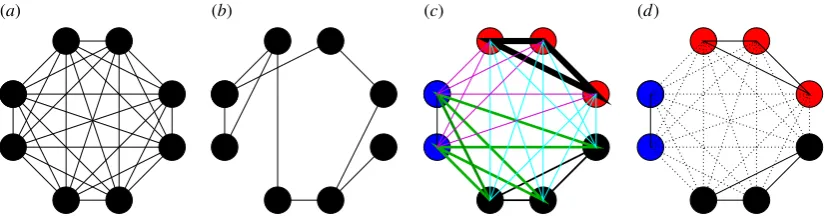
We cover a wide range of possible contact structures. For each of these, we derive estimators of the basic repro-duction number and the required control effort. We start with the absence of structure, when the individuals mix homogeneously [8, ch. 1] (figure 1a). We examine three differ-ent kinds of heterogeneities in contacts: the first kind, network structure [9–12] (figure 1b), emphasizes that indi-viduals have regular contacts with only a limited number of other individuals; the second kind, multi-type structure (figure 1c), emphasizes that individuals can be categorized into different types, such as age classes, where differences in contact behaviour with respect to disease transmission are pronounced among individuals of different type but negligible among individuals of the same type [7,13]; and the third kind, household structure [14,15] (figure 1d), emphasizes that individuals tend to make most contacts in small social circles, such as households, school classes or workplaces. Finally, we compare the performance of the esti-mators for R0 and vc against the simulated spread of an
epidemic on an empirical contact network.
2. Estimation of
R
0
and required control efforts
for various contact structures
2.1. Homogeneous mixing
Many results for epidemics in large homogeneously mixing populations can be obtained, because the initial phase of the epidemic is well approximated by a branching process [16 –18], for which an extensive body of theory is available. In particular, an outbreak can become large only ifR0.1.
Note that ifR0.1, then it is still possible that the epidemic
will go extinct quickly. The probability for this to happen can be computed [7, eqn 3.10] and is less than 1. Another result is that if R0.1 and the epidemic grows large
(which we assume from now on), then the number of infectious individuals grows roughly proportional to eat
during the initial phase of the epidemic. Here,tis the time since the start of the epidemic and the epidemic growth
[image:2.595.91.504.42.150.2](a) (b) (c) (d)
Figure 1.
The four contact structures considered: individuals are represented by circles and possible contacts are denoted by lines between them. (
a
) A
homo-geneously mixing population, in which all individuals have the same frequency of contacting each other. (
b
) A network-structured population, in which, if contact
between two individuals is possible, the contacts occur at the same frequency. (
c
) A multi-type structure with three types of individuals, in which individuals of the
same type have the same colour and lines of different colour and width represent different contact frequencies. (
d
) A population partitioned into three households,
in which members of the same households have the same colour and household contacts, represented by solid lines, have higher frequency than global contacts,
represented by dotted lines.
rsif.r
oy
alsocietypublishing.org
J.
R.
Soc.
Interfa
ce
13
:
20160288
rate a is a positive constant, which depends on the par-ameters of the model, through the equation
1¼
ð1
0
eatbðtÞdt: ð2:1Þ
Here,b(t) is the expected rate at which an infected individual infects other individualsttime units after they were infected. For the Markov SIR model, with expected duration of the infectious period 1/g, b(t) is given by legt. This can be
understood by observing that l is the rate at which an infected individual makes contacts if he or she is still infec-tious, whereas egt is the probability that the individual is
still infectioust time units after he or she became infected. The epidemic growth ratea corresponds to the Malthusian parameter for population growth. Note that the expected number of newly infected individuals caused by a given infected individual is
R0¼
ð1
0
bðtÞdt: ð2:2Þ
For the Markov SIR model, (2.1) and (2.2) translate to
1¼ l
gþa and R0¼ l
g: ð2:3Þ
Because we usually have observations on symptom-onset dates of cases for a new, emerging epidemic, as was the case for the Ebola epidemic in West Africa, it is often possible to estimateafrom observations. In addition, we often have observations (albeit often only for a subset of the infected cases) on the typical duration between time of infection of a case and infection of its infector, which allow us to estimate, assuming a Markov SIR model, the average duration of the infectious period, 1/g[5]. Using (2.3), this provides us with an estimator of R0 in a homogeneously mixing Markov
SIR model
R0¼1þ a
g, ð2:4Þ
which, as desired, does not depend on l. In the electronic supplementary material, we deduce expressions for a and
R0, in terms of the model parameters for the more general
SEIR epidemic, and relate these quantities.
The required control effort for the SEIR epidemic in a homogeneously mixing population is known to depend solely onR0through the relation [7, p. 69]
vc¼1
1
R0
: ð2:5Þ
Thus, we obtain an estimator of the required control effort in terms of observable growth rate and duration of the infec-tious period
vc¼ a
aþg: ð2:6Þ
We compare the estimators (2.4) and (2.6) with other estima-tors that we obtain for different infectious contact structures, using the same values for the epidemic growth rate and dur-ation of the infectious period. Throughout the comparison, we assume that the initial stage of an epidemic shows expo-nential growth, which is a reasonable assumption for many diseases, including the Ebola epidemic in West Africa.
2.2. Network structure
One kind of infectious contact structure is network structure. We consider the so-called configuration model ([19], [20, ch. 3]) in which each individual may contact only a limited number (which varies between individuals) of other acquain-tances, with meanmand variances2. In such a network, the mean number of different individuals (acquaintances) a typi-cal newly infected individual can contact (other than his or her infector) is referred to as the mean excess degree [19], which is given by
k¼s2 m þm1
(see the electronic supplementary material or [19] for the deri-vation of k). This quantity is hard to observe for a new emerging infection, but we know the value must be finite and strictly greater than 1 if the epidemic grows exponen-tially fast. For the Markov SIR model for which the constant rate at which close contacts per pair of acquaintances occur is denoted byl(net), we obtainb(t)¼kl(net)e(l(net)þg)t
. This can be seen by noting thatkis the expected number of susceptible acquaintances a typical newly infected individual has in the early stages of the epidemic, whereas el(net)t
is the probability that a given susceptible individual is not con-tacted by the infective over a period of t time units, and egt is the probability that the infectious individual is still
infectious t time units after he or she became infected. In the electronic supplementary material, we deduce an estima-tor ofR0in terms of the observable epidemic growth rate, the
average duration of the infectious period and the unobserva-ble mean excess degree:R0¼(gþa)=(gþa=k) (cf. [21]). We
find that the estimator obtained assuming homogeneous mixing (2.4) overestimatesR0by a factor 1þa=gk:
We know that this factor is strictly greater than 1, because the exponential growth rate a, the recovery rate g and the mean excess degree k (which is often hard to observe) are all strictly positive. Furthermore, the factor tends to 1 as k
tends to infinity.
In the electronic supplementary material, we also con-sider more general SEIR models. We conclude that estimates ofR0obtained by assuming homogeneous mixing
are always larger than the corresponding estimates if the contact structure follows the configuration network model. In the electronic supplementary material, we also show, by example, that if we allow for even more general random infection cycle profiles, then it is possible that assuming homogeneous mixing might lead to a non-conservative esti-mate of R0. However, for virtually all standard models
studied in the literature, assuming homogeneous mixing leads to conservative estimates.
As is the case for the homogeneously mixing contact structure, the required control effort for epidemics on the net-work structures under consideration is known to depend solely on R0 through equation (2.5) [22]. This provides us
with an estimator ofvcin terms of observableaand duration
of infectious period and the unobservable mean excess degreek:vc¼((k1)=k)a=aþg. We find that the estimator
obtained assuming homogeneous mixing overestimatesvcby
a factor 1þ(1=(k1)):This factor is always strictly greater than 1, because the mean excess degreek is strictly greater than 1, and again tends to 1 asktends to infinity. Thus,vc
obtained by assuming homogeneous mixing is always
rsif.r
oy
alsocietypublishing.org
J.
R.
Soc.
Interfa
ce
13
:
20160288
larger than that of the configuration network model. Consequently, we conclude that, if the actual infectious con-tact structure is made up of a configuration network and a perfect vaccine is available, we need to vaccinate a smaller proportion of the population than predicted assuming homogeneous mixing.
The overestimation ofR0is small wheneverR0is not much
larger than 1 or whenkis large. The same conclusion applies to the required control effortvc. The observation that theR0andvc
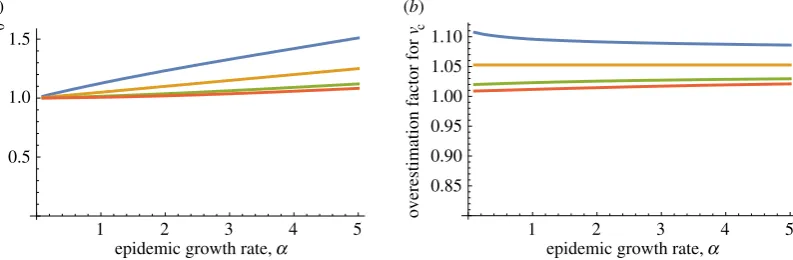
for the homogeneously mixing model exceed the correspond-ing values for the network model extends to the full epidemic model allowing for an arbitrarily distributed latent period followed by an arbitrarily distributed independent infectious period, during which the infectivity profile (the rate of close contacts) may vary over time but depends only on the time since the start of the infectious period (see the electronic supplementary material for the corresponding equations). Figure 2a shows that, for SIR epidemics with gamma-distributed infectious periods, the factor by which the homogeneous mixing estimator overestimates the actual
R0 increases with increasing epidemic growth rate a, and
suggests that this factor increases with increasing standard deviation of the infectious period. Figure 2b shows that the factor by which the homogeneous mixing estimator over-estimates the actual vc decreases with increasing a and
increases with increasing standard deviation of the infectious period. When the standard deviation of the infectious period is low, which is a realistic assumption for most emerging infec-tious diseases [23], and R0is not much larger than 1, then
ignoring the contact structure in the network model and using the simpler estimates based on homogeneous mixing results in a slight overestimation ofR0andvc.
2.3. Multi-type structure
A second kind of infectious contact structure reflects that often a community contains different types of individuals that display specific roles in contact behaviour. Types might be related to age groups, social behaviour or occu-pation. It may be hard to classify all individuals into types and sometimes data on the types of individuals are missing. Furthermore, the number of parameters required to describe the contact rates between the types is large. We assume that there areKtypes of individuals, labelled 1,2,. . .,K, and that for i¼1,. . .,K a fraction pi of the n individuals in the
population is of type i. For the Markov SIR epidemic, we assume that the rate of close contacts from a given typei indi-vidual to a given typej individual islij/n. Note that here close contacts are not necessarily symmetric, i.e. if individual
x makes a close contact with individual y, then it is not necessarily the case thatymakes a close contact withx. We assume again that individuals stay infected for an exponen-tially distributed time with expectation 1/g. The expected rate at which a given typeiindividual infects typej individ-uals at timetsince infection isaij(t)¼lijpjegt. Here,lij/nis
the rate at which the typeiindividual contacts a given typej
individual,npjis the number of typejindividuals and egt
[image:4.595.102.499.44.174.2]is the probability that the type i individual is still infec-tious t time units after being infected. It is well known [7,13,24,25] that the basic reproduction number R0¼rM is
the largest eigenvalue of the matrixM, which has elements
mij¼Ð
1
0 aij(t)dt, and the epidemic growth rateais such that
1¼Ð01eatr
A(t)dt, where rA(t) is the largest eigenvalue of
the matrixA(t) with elementsaij(t). Letrbe the largest
eigen-value of the matrix with elements lijpj and note that
rA(t)¼regt. Therefore,
1¼r
ð1
0
eðaþgÞtdt and R
0¼r
ð1
0
egtdt:
These equalities imply that
R0¼
Ð1 0 e
gtdt
Ð1
0 eðaþgÞtdt ¼1þa
g,
which shows that the relation betweenR0andafor this class
of multi-type Markov SIR epidemics is the same as for such an epidemic in a homogeneously mixing population (cf. equation (2.4)).
It is readily seen that if for every type of individual a frac-tion 12vc is immunized, then the expected number of
individuals infected by one infectious individual decreases by a factor 12vc, for all types of individuals. This implies
that, for epidemics in a multi-type population structure, the relationvc¼11=R0still holds. In the electronic
supplemen-tary material, we derive that estimators forR0and (if control
measures are independent of the types of individuals)vcare exactlythe same as for homogeneous mixing in a broad class of SEIR epidemic models. This class includes the full epidemic model allowing for arbitrarily distributed latent and infectious periods and models in which the rates of contacts between
1 2 3 4 5
0.5 1.0 1.5
epidemic growth rate,a
overestimation factor for
R0
1 2 3 4 5
0.85 0.90 0.95 1.00 1.05 1.10
epidemic growth rate,a
overestimation factor for
vc
(a) (b)
Figure 2.
The factor by which estimators based on homogeneous mixing will overestimate (
a
) the basic reproduction number
R
0and (
b
) the required control effort
v
cfor the network case. Here, the epidemic growth rate
a
is measured in multiples of the mean infectious period 1/
g
. The mean excess degree
k
¼
20. The
infectious periods are assumed to follow a gamma distribution with mean 1 and standard deviation
s
¼
1.5,
s
¼
1,
s
¼
1/2 and
s
¼
0, as displayed from top
to bottom. Note that the estimate of
R
0based on homogeneous mixing is 1
þ
a
. Furthermore, note that
s
¼
1 corresponds to the special case of an
exponentially distributed infectious period, whereas if
s
¼
0 the duration of the infectious period is not random. (Online version in colour.)
rsif.r
oy
alsocietypublishing.org
J.
R.
Soc.
Interfa
ce
13
:
20160288
different types keep the same proportion all of the time, although the rates themselves may vary over time (cf. [24]).
We illustrate our findings on multi-type structures through simulations of SEIR epidemics in §3.1.
2.4. Household structure
A third kind of infectious contact structure is household structure. This partitions a population into many relatively small social groups or households, which reflect actual households, school classes or workplaces. This contact struc-ture is different from the multi-type strucstruc-ture, because, in the latter, the population is partitioned into a limited number of large groups of individuals having the same type. The contact rate between pairs of individuals from different households is small and the contact rate between pairs of individuals in the same household is much larger. This model was first ana-lysed in detail in [15]. It is possible to define several different measures for the reproduction numbers for this model [14,26], but the best suited for our purpose is given in [27,28]. For this model, it is hard to find explicit expressions for R0 and required control effort in terms of
the observable epidemic growth rate. Numerical compu-tations described in [28] suggest that the difference between the estimatedR0based onaand the real R0might be
con-siderable, but it is theoretically shown that the estimate is conservative for the most commonly studied models. It is also argued that the required control effort vc11=R0
(with equality if and only if all households have size less than or equal to 3) for this model, which implies that, if we knowR0and we base our control effort on this knowledge,
we might fail to stop an outbreak. However, we usually do not have direct estimates forR0, and even though it is not
true in general that using R0 leads to conservative
estima-tes for vc [28] numerical computations suggest that the
approximation of vc usinga and the homogeneous mixing
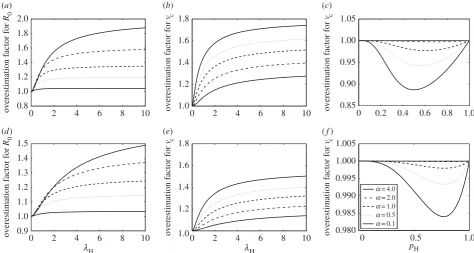
assumption is often conservative. This is illustrated in figure 3, which shows the factors by which the homogeneous mixing estimators overestimate the true R0s and vcs over a
range of values for the relative contribution of the within-household spread. We use two types of epidemics: in (a) and (b), the Markov SIR epidemic is used, whereas in (c), the so-called Reed –Frost model is used, which can be inter-preted as an epidemic in which infectious individuals have a long latent period of non-random length, after which they are infectious for a very short period of time. We note that for the Reed–Frost model the relationship between a and
R0 does not depend on the household structure (cf. [28])
and therefore, for this model, only the dependence ofvcon
the relative contribution of the within-household spread is shown in figure 3. The household size distributions are taken from a 2003 health survey in Nigeria [29] and from data on the Swedish household size distribution in [30]. For Markov SIR epidemics, as the within-household infection ratelHis varied, the global infection rate is varied in such
a way that the computed epidemic growth rate a is kept fixed. For this model, a is calculated using the matrix method described in §4.1 of [31]. In figure 3a,b,d,e,we observe that the overestimation factor for R0 increases with a,
whereas that forvcdecreases witha. For the Reed–Frost
epi-demic model, the probability that an infectious individual infects a given susceptible household member during its
0 2 4 6 8 10 0.8
1.0 1.2 1.4 1.6 1.8 2.0
lH
overestimation factor for
R0
0 2 4 6 8 10 1.0
1.2 1.4 1.6 1.8
lH
overestimation factor for
vc
0 0.2 0.4 0.6 0.8 1.0 0.85
0.90 0.95 1.00 1.05
pH
overestimation factor for
vc
0 2 4 6 8 10 0.9
1.0 1.1 1.2 1.3 1.4 1.5
overestimation factor for
R0
0 2 4 6 8 10 1.0
1.2 1.4 1.6 1.8
overestimation factor for
vc
0 0.5 1.0 0.980
0.985 0.990 0.995 1.000 1.005
overestimation factor for
vc
a= 4.0
a= 2.0
a= 1.0
a= 0.5
a= 0.1
(a) (b) (c)
[image:5.595.61.536.42.295.2](d) (e) (f)
Figure 3.
The factor by which estimators based on homogeneous mixing overestimate key epidemiological variables in a population structured by households. The
basic reproduction number
R
0for Markov SIR epidemics with expected infectious period equal to 1 (
a,d
), critical vaccination coverage
v
cfor Markov SIR epidemics
(
b,e
) and
v
cfor Reed – Frost epidemics (
c,f
), as a function of the relative influence of within-household transmission, in a population partitioned into households. For
(
a
–
c
), the household size distribution is taken from a 2003 health survey in Nigeria [29] and is given by
m
1¼
0
:
117,
m
2¼
0
:
120,
m
3¼
0
:
141,
m
4¼
0
:
132,
m
5¼
0
:
121,
m
6¼
0
:
108,
m
7¼
0
:
084,
m
8¼
0
:
051,
m
9¼
0
:
126; for
i
¼
1,2,
,9,
m
iis the fraction of the households with size
i
. For (
d
–
f
), the Swedish
household size distribution in 2013 taken from [30] is used and is given by
m
1¼
0
:
482,
m
2¼
0
:
2640,
m
3¼
0
:
102,
m
4¼
0
:
109,
m
5¼
0
:
01. The global
infectivity is chosen, so that the epidemic growth rate
a
is kept constant while the within-household transmission varies. Homogeneous mixing corresponds
to
l
H¼
p
H¼
0, in which case
R
0¼
1
þ
a
. Note that the order of the graphs is different in (
b
) and (
e
) from that in (
a
,
c
,
d
,
f
).
rsif.r
oy
alsocietypublishing.org
J.
R.
Soc.
Interfa
ce
13
:
20160288
infectious period, pH, is varied, whereas the corresponding
probability for individuals in the general population varies withpH, so thatais kept constant. For this model, assuming
that the unit of time is the length of the latent period, R0
coincides with the initial geometrical rate of growth of infec-tion, soa¼log(R0). From figure 3, we see that estimates ofvc
assuming homogeneous mixing are reliable for Reed–Frost-type epidemics, although, as opposed to all other analysed models and structures, the estimates are not conservative. We see also that, for the Markov SIR epidemic, estimating
R0 and vc based on the homogeneous mixing assumption
might lead to conservative estimates which are up to 80% higher than the realR0andvc.
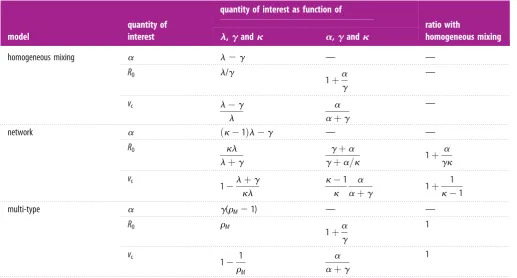
The results obtained for Markov SIR epidemics in the homogeneously mixing, network and multi-type popu-lation structures are summarized in table 1. The results from household models are not in the table, because deter-mining a, R0 and vc requires solutions of nonlinear
equations, which themselves are rather complex and defined only recursively.
3. Simulation studies
3.1. Simulation of an epidemic in a multi-type
population structure
We illustrate our findings on multi-type structures through simulations of SEIR epidemics in an age-stratified population with known contact structure. As a population, we took the Dutch population in 1987 (approx. 14.6 million people) as used in [32], for which extensive data on contact structure are available. The population is subdivided into six age groups, and contact intensities are based on questionnaire data. Further details on the population, their types and
contact intensities can be found in the electronic supplemen-tary material. We use values of the average infectious period 1/gand the average latent period 1/dclose to the estimates for the 2014 Ebola epidemic in West Africa [4]. The simu-lation and estimation methods are described in detail in the electronic supplementary material. We use two estimators forR0. The first of these estimators is based on the average
number of infections among the people who were infected early in the epidemic. This procedure leads to a good estimate ofR0if the spread of the disease is observed completely. The
second estimator forR0is based ona^, an estimate of the
epi-demic growth ratea, and known expected infectious period 1/g and expected latent period 1/d, and is given by (1þa^=d)(1þa^=g). We calculate estimates ofR0using these
two estimators for 250 simulation runs. As predicted by the theory, the simulation results show that for each run the esti-mates are close to the actual value without a systematic bias (figure 4 and electronic supplementary material, figure S1). Note that in figure 4 we compare two estimators of R0,
which are each based on a finite number of observations and hence not exact. We do not compare the estimates of
R0 with the computed value of R0 based on the model
parameters.
3.2. Estimation of
R
0and required control efforts for
empirical network structure
[image:6.595.42.560.77.355.2]The three kinds of infectious contact structure studied are car-icatures of actual social structures. Those actual structures may contain features of all three caricatures, and reflect small social groups such as school classes and households in which individuals interact frequently, as well as distinct social roles such as those based on age and gender, and fre-quently repeated contacts among those acquaintances. This leads us to expect that estimators based on ignoring contact
Table 1.
The epidemic growth rate
a
, the basic reproduction number
R
0and required control effort
v
cfor a Markov SIR epidemic model as functions of the
model parameters in the homogeneously mixing, network and multi-type models and their relationships to each other.
model
quantity of
interest
quantity of interest as function of
ratio with
homogeneous mixing
l,
g
and
k
a,
g
and
k
homogeneous mixing
a
l
2
g
—
—
R
0l
/
g
1
þ
a
g
—
v
cl
g
l
a
a
þ
g
—
network
a
ð
k
1
Þ
l
g
—
—
R
0kl
l
þ
g
g
þ
a
g
þ
a
=
k
1
þ
a
gk
v
c1
l
þ
g
kl
k
1
k
a
a
þ
g
1
þ
1
k
1
multi-type
a
g
(
r
M2
1)
—
—
R
0rM
1
þ
a
g
1
v
c1
1
r
Ma
a
þ
g
1
rsif.r
oy
alsocietypublishing.org
J.
R.
Soc.
Interfa
ce
13
:
20160288
structure will in general result in a slight overestimation ofR0
and required control effort.
We test this hypothesis further on some empirical net-works taken from the Stanford Large Network Dataset Collection [33]. In this report, we present a network of collab-orations in condensed matter physics, where the individuals are authors of papers and authors are ‘acquaintances’ if they were co-authors of a paper posted on the e-print service arXiv in the condensed matter physics section between January 1993 and April 2004. In the electronic supplementary material, we also analyse SEIR epidemics on two other net-works from [33]. The ‘condensed matter physics’ network is built up of many (overlapping) groups that represent papers. It was chosen since it is relatively large (23 133 indi-viduals and 93 497 links), with over 92% of the indiindi-viduals in the largest component. The mean excess degree, k, for this network is approximately 21 and small groups in
which everybody is acquainted with everybody else are also present. In figure 5, we show the densities of estimates of R0, based on 1000 simulations of an SEIR epidemic on
this network, using parameters close to estimates for the spread of Ebola virus in West Africa [4]. The estimates are based on who infected whom in the real infection process (black line), the estimated epidemic growth rate and the con-figuration network assumption with k21 (blue dashed line) and the estimated epidemic growth rate and the homo-geneous mixing assumption (red dotted line). In most of the cases (886 out of 1000), the estimate ofR0based on
homo-geneous mixing is larger than the estimate based on who infected whom. In only 21 out of 1000 cases, the estimate of
R0based on homogeneous mixing is less than 90% of the
esti-mate of R0 based on who infected whom. Half of the
estimates of R0based on the epidemic growth rate and the
homogeneous mixing assumption are between 12% and
R0
estimates based on
a
R0 estimates based on who infected whom
(a) (b)
1.5 2.0 2.5 3.0 3.5 1.5
2.0 2.5 3.0 3.5
0.90 0.92 0.94 0.96 0.98 1.00 1.02 1.04 1.06 1.08 1.10
1
ratio of estimates of
[image:7.595.147.476.44.216.2]R0
Figure 4.
The estimated basic reproduction number,
R
0, for a Markov SEIR model in a multi-type population as described in [32], based on the real infection process
(who infected whom) plotted against the computed
R
0, assuming homogeneous mixing, based on the estimated epidemic growth rate,
a
, and given expected
infec-tious period (5 days) and expected latent period (10 days). The infectivity is chosen at random, such that the theoretical
R
0is uniform between 1.5 and 3. The estimate of
a
is based on the times when individuals become infectious. In (
b
), a box plot of the ratios of the two
R
0estimates (the estimate based on the homogeneous mixing
assumption divided by the estimate based on the real infection process for each of the 250 simulation runs) is given. (Online version in colour.)
1.4 1.6 1.8 2.0 2.2 2.4 0
0.5 1.0 1.5 2.0 2.5
basic reproduction number R0
density
0.8 1.0 1.2 1.4 1.6 1.8
ratio of estimates of
R0
[image:7.595.141.459.308.452.2](a) (b)
Figure 5.
Estimates for the basic reproduction number
R
0of an SEIR epidemic on the collaboration network in condensed matter physics [33] based on 1000
simulated outbreaks. Each epidemic is started by 10 individuals chosen uniformly at random from the 23 133 individuals in the population. The infection rate
is chosen such that
R
02. In (
a
), the black solid line provides the density of estimates based on full observation of who infected whom, the blue dashed
line denotes the density of estimates based on the estimated epidemic growth rate
a
and the assumption that the network is a configuration model with
known
k
, whereas the red dotted line denotes the density of estimates based on
a
and the homogeneous mixing assumption. (The modes of these three densities
are in increasing order.) The orange vertical line segment denotes the estimate of
R
0based only on the infection parameters and
k
, assuming that the network is a
configuration model (see equation (2.12) in the electronic supplementary material). We excluded the 50 simulations with highest estimated
a
and the 50
simu-lations with lowest estimated
a
. In (
b
), a box plot of the ratios of the two
R
0estimates (the estimate based on the homogeneous mixing assumption divided by the
estimate based on the real infection process for each of the 250 simulation runs) is provided. (Online version in colour.)
rsif.r
oy
alsocietypublishing.org
J.
R.
Soc.
Interfa
ce
13
:
20160288
45% larger than the estimate based on who infected whom. The difference in estimates might be explained through the relatively small average number of acquaintances per individ-ual and the structure of small groups in which all individindivid-uals are acquaintances with all other individuals in the group. As in figure 4, we note that in figure 5 we compare two estima-tors ofR0. It is hard, if not impossible, to define, let alone
compute,R0for epidemics on empirical networks.
In order to check the sensitivity of our results to the par-ameter values, we also performed simulations on the ‘condensed matter physics’ network with two alternative infection rates (70% and 200% of the value used in the main simulation). The qualitative results are the same as for the orig-inal simulations. We note, however, that if the infection rate is increasing the overestimation factor also shows an increasing trend. This is consistent with our observations in §§2.2 and 2.4.
4. Discussion and conclusion
In calculating the required control effortvc, we have assumed
that vaccinations, or other interventions against the spread of the emerging infection, are distributed uniformly at random in the population. For new, emerging infections, this makes sense when we have little idea about the contact structure, and we do not know who is at high risk and who is at low risk of infection. When considering control measures that are targeted at specific subgroups, such as vaccination of the individuals at highest risk, closure of schools or travel restrictions, more information on infectious contact structure becomes essential to determine which intervention strategies are best. We note that for non-targeted control strategies the overestimation ofR0seems to be less for network-structured
and multi-type populations than for populations structured in households, especially for high values ofR0. Because, for
epidemics among households, better strategies than non-targeted control efforts are available [15,34,35], household (and workplace) structure is the first contact structure that should be taken into account.
Overestimation of the required control effort leads to additional costs, both monetary and societal. These costs can be viewed as the value of information on the detailed contact structure of the population, because they would have been avoided had the correct details on the contact structure been incorporated into the epidemic model. This implies that obtaining the detailed contact structure could become a relevant policy option when the additional costs for infection control are sufficiently high. However, an impor-tant concern for most policy-makers is the cost of getting the decision wrong. This would require good estimates on the probabilities of extreme values of R0 (given the observed
data). Even though this is clearly beyond the scope of this study, obtaining more information on such extreme values is a worthwhile objective for future work.
When the objective is to assess R0 and vc from the
observed epidemic growth rate of a new emerging infectious disease such as Ebola, ignoring contact structure leads to a positive bias in the estimated value. For both SIR epidemics and SEIR epidemics (see electronic supplementary material), this bias is small when the standard deviation of the infec-tious period is small enough compared with the mean, as is the case for the Markov SEIR epidemic and even more so for the Reed–Frost model. For Ebola in West Africa, we know that the standard deviation of the time between onset of symptoms (which is a good indication of the start of the infectious period) and the time until hospitalization or death is of the same order as the mean. The same holds for the time between infection and onset of symptoms [4]. These ratios of mean and standard deviation are well captured by the Markov SEIR epidemic.
Our findings are important for prioritizing data collection during an emerging epidemic, when assessing the control effort is a priority: it is most crucial to obtain accurate esti-mates for the epidemic growth rate from times of symptom onset of cases, and duration of the infectious and latent periods from data on who acquires infection from whom [36 –38]. This is consistent with current practice [4,39]. Data about the contact structure will be welcome to add precision, but will have little effect on the estimated non-targeted required control effort in an emerging epidemic.
Throughout the manuscript, we assume that we have enough data for reliable estimates ofa. Further research on evaluating the behaviour of the estimators themselves in finite structured populations is needed, but beyond the scope of the present research.
Data accessibility.No primary data are used in this article. Secondary data sources are taken from the Stanford Large Network Dataset Collection [33], from [29,30] and from [32].
Authors’ contributions. The main mathematical derivations were done jointly by P.T., F.B., T.B., J.S.D. and V.C.T. Numerical computations and analysis were done by P.T., F.B. and V.C.T. J.W. helped to put the results in a broader public health context. All authors were active in producing the final manuscript, which was drafted by P.T. Competing interests.We have no competing interests.
Funding. P.T. was supported by Vetenskapsra˚det (Swedish Research Council), project 20105873. V.C.T. has been supported by the Chair ‘Mode´lisation Mathe´matique et Biodiversite´’ of Veolia Environnement-Ecole Polytechnique-Museum National d’Histoire Naturelle-Fondation X, and by Labex CEMPI (ANR-11-LABX-0007-01).
Acknowledgements. The authors thank the Mathematical Biosciences Institute in Columbus, Ohio, where the research was initiated during the workshop ‘Evolution and spread of disease’ held in March 2012.
References
1. Fauci AS. 2008 25 years of HIV.Nature453,
289 – 290. (doi:10.1038/453289a)
2. Bauch CT, Lloyd-Smith JO, Coffee MP, Galvani AP.
2005 Dynamically modeling SARS and other newly emerging respiratory illnesses: past, present, and
future.Epidemiology16, 791 – 801. (doi:10.1097/01.
ede.0000181633.80269.4c)
3. Yang Y, Sugimoto JD, Halloran ME, Basta NE, Chao
DL, Matrajt L, Potter G, Kenah E, Longini IM. 2009 The transmissibility and control of pandemic
influenza A (H1N1) virus.Science326, 729 – 733.
(doi:10.1126/science.1177373)
4. WHO Ebola Response Team. 2014 Ebola virus
disease in West Africa—the first 9 months of the
epidemic and forward projections.N. Engl. J.
Med.371, 1481 – 1495. (doi:10.1056/
NEJMoa1411100)
5. Wallinga J, Lipsitch M. 2007 How generation
intervals shape the relationship between growth
rates and reproductive numbers.Proc. R. Soc. B274,
599 – 604. (doi:10.1098/rspb.2006.3754)
rsif.r
oy
alsocietypublishing.org
J.
R.
Soc.
Interfa
ce
13
:
20160288
6. Scalia Tomba G, Svensson A˚, Asikainen T, Giesecke J. 2010 Some model based considerations on observing generation times for communicable
diseases.Math. Biosci.223, 24 – 31. (doi:10.1016/j.
mbs.2009.10.004)
7. Diekmann O, Heesterbeek H, Britton T. 2013
Mathematical tools for understanding infectious disease dynamics. Princeton, NJ: Princeton University Press.
8. Anderson RM, May RM. 1992Infectious diseases of
humans: dynamics and control. Oxford, UK: Oxford Science Publications.
9. Andersson H. 1998 Limit theorems for a random
graph epidemic model.Ann. Appl. Probab.8,
1331 – 1349. (doi:10.1214/aoap/1028903384) 10. Barbour AD, Reinert G. 2013 Approximating the
epidemic curve.Electron J. Probab.18, 1 – 30.
(doi:10.1214/EJP.v18-2557)
11. Decreusefond L, Dhersin JS, Moyal P, Tran VC. 2012 Large graph limit for an SIR process in random
network with heterogeneous connectivity.Ann.
Appl. Probab.22, 541 – 575. (doi:10.1214/11-AAP773)
12. Newman MEJ. 2002 Spread of epidemic disease on
networks.Phys. Rev. E66, 016128. (doi:10.1103/
PhysRevE.66.016128)
13. Ball F, Clancy D. 1993 The final size and severity of a generalised stochastic multitype epidemic model.
Adv. Appl. Probab.25, 721 – 736. (doi:10.2307/ 1427788)
14. Becker NG, Dietz K. 1995 The effect of household distribution on transmission and
control of highly infectious diseases.Math.
Biosci.127, 207 – 219. (doi:10.1016/0025-5564(94)00055-5)
15. Ball F, Mollison D, Scalia-Tomba G. 1997 Epidemics
with two levels of mixing.Ann. Appl. Probab.7,
46 – 89. (doi:10.1214/aoap/1034625252) 16. Ball F, Donnelly P. 1995 Strong approximations
for epidemic models.Stochastic Process Appl.55,
1 – 21. (doi:10.1016/0304-4149(94)00034-Q)
17. Jagers P. 1975Branching processes with biological
applications. New York, NY: Wiley.
18. Haccou P, Jagers P, Vatutin VA. 2005Branching
processes: variation, growth, and extinction of
populations. Cambridge, UK: Cambridge University Press.
19. Newman MEJ. 2003 The structure and function of
complex networks.SIAM Rev.45, 167 – 256.
(doi:10.1137/S003614450342480)
20. Durrett R. 2006Random graph dynamics.
Cambridge, UK: Cambridge University Press. 21. Pellis L, Spencer SE, House T. 2015 Real-time
growth rate for general stochastic SIR epidemics on
unclustered networks.Math. Biosci.265, 65 – 81.
(doi:10.1016/j.mbs.2015.04.006)
22. Britton T, Janson S, Martin-Lo¨f A. 2007 Graphs with specified degree distributions, simple
epidemics, and local vaccination strategies.Adv.
Appl. Probab.39, 922 – 948. (doi:10.1017/ S0001867800002172)
23. Cori A, Valleron A, Carrat F, Scalia Tomba G, Thomas G, Boe¨lle P. 2012 Estimating influenza latency and infectious period durations using viral excretion
data.Epidemics4, 132 – 138. (doi:10.1016/j.epidem.
2012.06.001)
24. Diekmann O, Gyllenberg M, Metz JAJ, Thieme HR. 1998 On the formulation and analysis of general deterministic structured population models. I. Linear
theory.J. Math. Biol.36, 349 – 388. (doi:10.1007/
s002850050104)
25. Doney R. 1976 On single- and multi-type general
age-dependent branching processes.J. Appl.
Probab.13, 239 – 246. (doi:10.1017/ S0021900200094304)
26. Goldstein E, Paur K, Fraser C, Kenah E, Wallinga J, Lipsitch M. 2009 Reproductive numbers, epidemic spread and control in a community of households.
Math. Biosci.221, 11 – 25. (doi:10.1016/j.mbs.2009. 06.002)
27. Pellis L, Ball F, Trapman P. 2012 Reproduction numbers for epidemic models with households and other social structures. I. Definition and calculation ofR0.Math. Biosci.235, 85 – 97. (doi:10.1016/j.
mbs.2011.10.009)
28. Ball F, Pellis L, Trapman P. 2016 Reproduction numbers for epidemic models with households and other social structures II: comparisons and
implications for vaccination.Math. Biosci.274,
108 – 139. (doi:10.1016/j.mbs.2016.01.006)
29. National Population Commission (NPC) [Nigeria] and
ORC Macro. 2004Nigeria demographic and health
survey 2003. Calverton, MD: National Population Commission and ORC Macro. See http://www. dhsprogram.com/pubs/pdf/FR148/FR148.pdf.
30. Statistics Sweden. 2014Statistical yearbook of
Sweden 2014. Stockholm, Sweden: Statistics Sweden.
31. Pellis L, Ferguson NM, Fraser C. 2011 Epidemic growth rate and household reproduction number in communities of households, schools and
workplaces.J. Math. Biol.63, 691 – 734. (doi:10.
1007/s00285-010-0386-0)
32. Wallinga J, Teunis P, Kretzschmar M. 2006 Using data on social contacts to estimate age-specific transmission parameters for respiratory-spread
infectious agents.Am. J. Epidemiol.164, 936 – 944.
(doi:10.1093/aje/kwj317)
33. Leskovec J, Krevl A. 2014 SNAP datasets: Stanford Large Network Dataset Collection. See http://snap. stanford.edu/data.
34. Ball FG, Lyne OD. 2002 Optimal vaccination policies for stochastic epidemics among a population of
households.Math. Biosci.177, 333 – 354. (doi:10.
1016/S0025-5564(01)00095-5)
35. Becker NG, Starczak DN. 1997 Optimal vaccination
strategies for a community of households.Math.
Biosci.139, 117 – 132. (doi:10.1016/S0025-5564(96)00139-3)
36. Lloyd AL. 2001 The dependence of viral parameter estimates on the assumed viral life cycle: limitations
of studies of viral load data.Proc. R . Soc. Lond. B
268, 847 – 854. (doi:10.1098/rspb.2000.1572)
37. Nowak MAet al.1997 Viral dynamics of primary
viremia and antiretroviral therapy in simian
immunodeficiency virus infection.J. Virol.71,
7518 – 7525.
38. Roberts M, Heesterbeek J. 2007 Model-consistent estimation of the basic reproduction number from the incidence of an emerging infection.
J. Math. Biol.55, 803 – 816. (doi:10.1007/s00285-007-0112-8)
39. Mills CE, Robins JM, Lipsitch M. 2004
Transmissibility of 1918 pandemic influenza.Nature
432, 904 – 906. (doi:10.1038/nature03063)