
Riemann solution for a class of
1
morphodynamic shallow water dam-break
2
problems
3
Fangfang Zhu
1, Nicholas Dodd
2†
41
Department of Civil Engineering, Research Centre for Fluids and Thermal Engineering,
5
University of Nottingham Ningbo China, Ningbo, 315100, China
6
2
Faculty of Engineering, University of Nottingham, Nottingham NG7 2RD, UK
7
(Received ?; revised ?; accepted ?. - To be entered by editorial office)
8
This paper investigates a family of dam-break problems over an erodible bed. The hy-9
drodynamics are described by the shallow water equations, and the bed change by a 10
sediment conservation equation, coupled to the hydrodynamics by a sediment transport 11
(bed load) law. When the initial states U~l and U~r are sufficiently close to each other
12
the resulting solutions are consistent with the theory proposed by Lax (1973), that for 13
a Riemann problem ofn equations there are n waves associated with the n character-14
istic families. However, for wet-dry dam-break problems over a mobile bed, there are 3 15
governing equations, but only 2 waves. One wave vanishes because of the presence of the 16
dry bed. When initial left and right bed levels (Bl and Br) are far apart, it is shown
17
that a semi-characteristic shock may occur, which happens because, unlike in shallow 18
water flow on a fixed bed, the flux function is non-convex. In these circumstances it is 19
shown that it is necessary to reconsider the usual shock conditions. Instead, we propose 20
an implied internal shock structure the concept of which originates from the fact that 21
the stationary shock over fixed bed discontinuity can be regarded as a limiting case of 22
flow over a sloping fixed bed. The Needham & Hey (1991) approximation for the ambigu-23
ous integral termR
hdBin the shock condition is improved based on this internal shock 24
structure, such that mathematically valid solutions that incorporate a morphodynamic 25
semi-characteristic shock are arrived at. 26
Key words: Authors should not enter keywords on the manuscript, as these must 27
be chosen by the author during the online submission process and will then be added 28
during the typesetting process (see http://journals.cambridge.org/data/relatedlink/jfm-29
keywords.pdf for the full list) 30
1. Introduction
31A Riemann problem consists of an initial value problem composed of a set of conserva-32
tion equations together with initial piecewise constant data having a single discontinuity. 33
In nonlinear shallow water flows, piecewise continuous solutions frequently develop. 34
This is because the equations commonly used for describing them admit shocks (dis-35
continuities) as solutions. These are usually interpreted as breaking waves (or bores), 36
and therefore possess a straightforward physical significance, as well as a mathematical 37
structure. These shocks are weak solutions in the sense that they satisfy the integral form 38
of the flow equations. Smooth (differentiable) flow regions may be matched across these 39
shocks by shock conditions, which can be derived by considering mass and momentum 40
conservation across the shock. 41
Therefore, Riemann problems commonly occur in shallow water flows. Indeed, if one 42
interprets all data in a shallow water numerical model as being piecewise continuous, 43
then a whole series of such problems is solved at each time, and this interpretation forms 44
the basis of a class of numerical shallow water solvers (Toro 2001). 45
From a physical standpoint, Riemann solutions in shallow water flows are important 46
because they provide us with solutions to idealised problems that can be used as verifica-47
tion cases for numerical solvers. Additionally, these idealised problems serve to highlight 48
fundamental shallow water dynamics. In shallow water flows a variety of Riemann prob-49
lems are of interest. One of the simplest of these are dam-break problems, which comprise 50
a Riemann problem with zero initial velocities. 51
The simplest dam-break problem involves one wet and one dry side (wet-dry), and 52
with the point of discontinuity corresponding to the position of a notional dam wall that 53
at the initial time is instantaneously removed. Solution to this simplest shallow water 54
dam-break problem is given in Stoker (1957). Although one could insist that a dam-break 55
problem only be wet-dry, here we relax this description so as to include so-called wet-wet 56
dam-break problems. These more generalised dam-break problems have a richer structure 57
(see Toro 2001). We further consider dam-break problems in which the initial bed levels 58
also are different (see Bernetti et al. 2008). 59
The Riemann problems in Stoker (1957); Toro (2001); Bernetti et al. (2008) are those 60
with a fixed bed. If we allow the bed to become erodible, coupling flow velocity to move-61
ment of sediment via a bed-load sediment transport relation, then a more complex picture 62
emerges. The solution of the shallow water mobile bed wet-dry dam-break problem with 63
no bed discontinuity at the dam location dates back to Fraccarollo & Capart (2002), who 64
considered a system with separate layers for fluid and sediment. The equivalent problem 65
without separate layers was considered by Kelly & Dodd (2009), amongst others. These 66
problems are also important from a physical perspective because in real dam-break events 67
considerable scour may result due to the high flow velocities. 68
In this paper we go further and consider generalised mobile-bed dam-break problems, 69
in which initial bed levels are not, in general, equal across the initial data: see figure 70
1. Aside from being important in the context of true dam-break events, they also have 71
relevance in the dynamics of waves on a beach. This is because a so-called backwash bore 72
(i.e., a hydraulic jump) is frequently created when water runs back down the beach after 73
a single wave uprush (Hibberd & Peregrine 1979). As the water drains the conditions at 74
the hydraulic jump may be such that flow is minimal and thus subsequent development 75
is predictable as a solution to a mobile-bed dam-break problem (Zhu & Dodd 2015). 76
Furthermore, we reconsider the usual shock conditions. For non-constant bed-levels 77
the bed-slope term in the flux-conservative form of the momentum equation is not in-78
tegrable, necessitating approximation using conditions on each side of the shock. Here 79
we reinterpret this term based on a new approximation of the internal shock structure. 80
Although the motivation for this comes from the limiting case of flow over a sloping 81
bed (and against which we subsequently verify the method), we instead approximate the 82
internal morphodynamic shock structure as a series of sub-shock problems. 83
In the next section we present our governing equations, as well as some of the theory 84
governing the determination of the wave structure across the evolving Riemann solution. 85
We then use this theory to solve this class of Riemann problem in§3. Finally we present 86
Dam
ˆ
hl
ˆ
ul= 0
ˆ
hr
ˆ
Br
ˆ
ur= 0
ˆ
Bl
ˆ
[image:3.595.118.470.130.268.2]x= 0 xˆ
Figure 1.Schematic diagram for a dam-break problem.
2. Model development
882.1. Governing equations
89
A one dimensional (1D) idealised configuration for the initial set-up of a generalised dam-90
break problem is shown in figure 1. As mentioned, the nonlinear shallow water equations 91
(NSWEs) have often been used for describing one- or two-dimensional dam-break flows 92
(Ritter 1892; Stoker 1957; Toro 2001; Bernetti et al. 2008). For dam-break problems 93
over a mobile bed, and if only bed load is considered (see Soulsby 1997), the governing 94
equations are the NSWEs and a sediment conservation equation: 95
ˆ
htˆ+ ˆuhˆxˆ+ ˆhuˆxˆ= 0, (2.1)
ˆ
uˆt+ ˆuuˆxˆ+ghˆxˆ+gBˆxˆ= 0, (2.2)
ˆ
Bˆt+ξqˆxˆ= 0, (2.3)
where ˆxrepresents horizontal distance (m), ˆt is time (s), ˆhrepresents water depth (m), 96
ˆ
uis a depth-averaged horizontal velocity (ms−1), ˆB is the bed level (m), ˆq is sediment
97
flux due to bed load (m2s−1),ξ= 1
1−p with pbeing bed porosity, andg is acceleration
98
due to gravity (ms−2).
99
In order to reveal the shock dynamics by solving a strictly hyperbolic system, we do 100
not include the downslope diffusion effect in our model, although morphodynamic shocks 101
are considered where vertical bed steps occur. 102
In general, ˆqis strongly dependent on ˆuand a weak function of ˆh. Here, a simple but 103
commonly used formula ˆq=Auˆ3 (see Grass 1981) is employed for the bed load (see e.g.
104
Kelly & Dodd 2010; Zhu et al. 2012), withAbeing the bed mobility parameter (s2m−1).
105
Note that this formulation is an over-simplification of the complex process of bed-load 106
transport (see e.g. Pritchard & Hogg 2005) but that the purpose here is to construct the 107
mathematical solution so that the basic dynamics can be understood, and to provide a 108
mathematical test case for numerical models. 109
Therefore, (2.3) becomes 110
ˆ
Bˆt+ 3ξAˆu2uˆxˆ= 0. (2.4)
2.2. Non-dimensionalisation
111
The nondimensional variables are 112
x= xˆ ˆ
h0
, t= ˆt ˆ
h10/2g−1/2, h=
ˆ
h
ˆ
h0
, u= uˆ ˆ
u0
and B = Bˆ ˆ
h0
where ˆh0is a length scale, and ˆu0= (gˆh0)1/2.
113
Substituting (2.5) into the governing equations (2.1), (2.2) and (2.4) gives 114
ht+uhx+hux= 0, (2.6)
ut+uux+hx+Bx= 0, (2.7)
Bt+ 3σu2ux= 0, (2.8)
whereσ=ξAg. 115
The vector form of these three non-dimensional governing equations is 116
~
Ut+A(U~)U~x= 0 (2.9)
with 117
~ U =
h u B
,A(U~) =
u h 0
1 u 1
0 3σu2 0
.
The eigenvalues ofAare the roots of the polynomial equation 118
λ3−2uλ2+ (u2−3σu2−h)λ+ 3σu3= 0. (2.10)
Equation (2.10) has three roots, denotedλ1,λ2 andλ3 such thatλ16λ36λ2. For the
119
solution ofλ1,λ2andλ3 we refer to Kelly & Dodd (2009, 2010).
120
2.3. Generalised simple wave theory
121
When there are two equations or fewer in a Riemann problem, we can derive a Riemann 122
invariant along each characteristic (Stoker 1957). Jeffrey (1976) shows, however, that a 123
direct extension of the concept of a Riemann invariant is not possible when there are 124
more than two equations and dependent variables in a Riemann problem. Therefore, the 125
generalised simple wave theory and the generalised Riemann invariants are introduced 126
to solve such Riemann problems. 127
If we consider, for the moment, a general quasilinear hyperbolic system 128
~
Ut+A(U~)U~x= 0, (2.11)
whereU~ is a vector ofndependent variables, given by 129
~
U = [u1, u2, . . . , un]T, (2.12)
then the assumption that a simple wave region exists in a Riemann problem (or indeed 130
generally) is such thatU~ =U~(u1) holds across a wave, whereu1 is chosen without loss
131
of generality. This means that there is a functional dependence betweenui andu1of the
132
formui=fi(u1), and the wave is called a generalised simple wave (Jeffrey 1976). For a
133
simple wave, Eq. (2.11) can be written as, 134
∂u
1
∂t I+ ∂u1
∂x A
d~U
du1
= 0. (2.13)
This system can have a non-trivial solution ford~U /du1 only if
135
|A−λiI|= 0, (2.14)
where 136
λi=−
∂u
1
∂t
∂u
1
∂x
, i= 1,2, . . . , n⇒ dudt1 = 0 along dx
This implies thatu1, and thereforeui, are constant along characteristics dxdt =λi, which
137
are themselves straight lines. A simple wave can also be defined as the wave, across which 138
one family of characteristics are all straight lines. There arenfamilies of characteristics, 139
and the simple wave associated with theith characteristic family is called theλ
i simple
140
wave. 141
From Eq. (2.13), whenλ=λi the vector dud ~U
1 must be proportional to the right eigen-142
vectorR~(i)of A, which gives (Jeffrey 1976),
143
duj =
r(ji)
r(1i)
du1, j= 2, . . . , n, (2.16)
wherer(ji)is thejth component ofR~(i).
144
Integrating (2.16) yields thejth generalised Riemann invariantKjassociated with the
145
λi simple wave:
146
uj−
Z r(i)
j
r1(i)du1=Kj, j= 2, . . . , n. (2.17)
Further details of the simple wave theory can be found in Jeffrey (1976). 147
Returning to the present system we have: 148
~ R(i)=
1
λi−u h
(λi−u)2
h −1
, (2.18)
and
du=λi−u
h dh (2.19)
dB=
(λ
i−u)2
h −1
dh (2.20)
For a fixed t, where h varies continuously, Eqs. (2.19) and (2.20) may be integrated 149
across theλi simple wave, in the (h,u,B) phase space, to yield the structure. However,
150
variables do not always vary continuously across the Riemann structure. Therefore, we 151
must understand the structure before we can solve it. 152
2.4. Wave structure for a Riemann problem
153
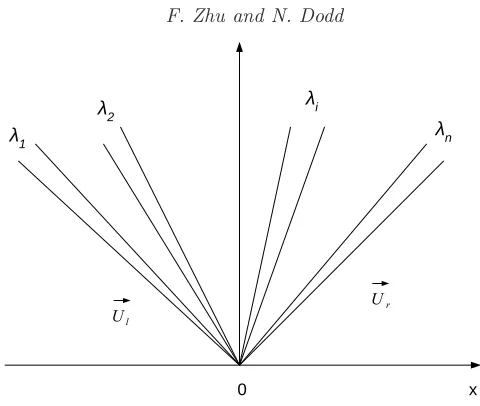
In general the Riemann problem associated with Eq. (2.11), is composed of n waves 154
associated with thencharacteristic families, which are separated byn−1 newly formed 155
constant regions provided that the values in the initial piecewise constant states are 156
sufficiently close (Toro 2009; Lax 1973; Fraccarollo & Capart 2002): see figure 2. Note 157
that a wave could be a rarefaction fan, a shock, or a contact wave. 158
As we integrate Eqs. (2.19) and (2.20) across a λi simple wave, λi varies such that
159
dλi =P∂uj∂λiduj, and in view of Eq. (2.16):
160
dλi
du1
=∇~U~λi·R~(i) (2.21)
where we have assumed, without loss of generality, that r1(i) = 1. Eq. (2.21) therefore
161
represents the rate of change of characteristic velocity across theλi wave. If
162
~
Figure 2.Wave structure for a Riemann problem withncharacteristic families.
then the characteristic velocity increases or decreases continuously across theλi wave,
163
thus implying the existence of either an expansion (rarefaction) wave, or a compressive 164
wave (which becomes a shock ultimately). Then theλi wave field is said to be genuinely
165
nonlinear (or convex) (Sharma 2010). Note that if 166
~
∇U~λi·R~(i)= 0, for allU ,~ (2.23)
the wave field is said to be genuinely linear. 167
If we return again to the present system we find that 168
~
∇U~λi·R~(i)=
λi+2λ2i −(2u−6σu)λi−9σu2 (u−λi)
h
G (2.24)
whereG= 3λ2−4uλ+ (u2−3σu2−h), and it is therefore not clear that (2.24) will be
169
strictly>or<0. In this case the problem is said to be non-convex (Sharma 2010). Note 170
that this is in contrast to the classical (fixed bed) shallow water system, wherein 171
~
∇U~λ−,+·R~(−,+)=∓
3 2
r
1
h. (2.25)
This implies that the solution to the dam-break problem resulting from the system (2.6)– 172
(2.8) may possess semi-characteristic shocks (Sharma 2010). 173
2.5. Semi-characteristic shock
174
In general, ∇~U~λi ·R~(i) = f(u1) across a simple wave. If, as seems possible for Eq.
175
(2.24),f(u1) passes through 0, this implies that at a rarefaction fan, across which
char-176
acteristics must diverge, a point is reached at which this can no longer happen because 177
dλi
du1 = f(u1) = 0. The only way then of accommodating this behaviour without the
178
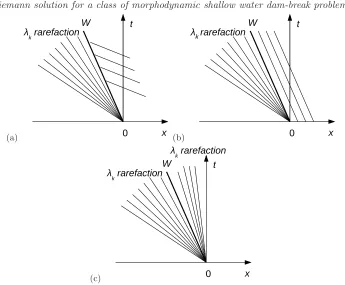
solution becoming multivalued is for a shock to be contiguous with the fan: the semi-179
characteristic shock, with the characteristic at one edge of the fan coinciding with this 180
semi-characteristic shock. The possible three wave structures are shown in figure 3. Note 181
that only (a) represents a physical structure in general. This is because for figure 3(b) and 182
(c) the structures will, in general, be overdetermined. For further details and exceptions 183
(a) (b)
[image:7.595.116.461.106.391.2](c)
Figure 3.Schematic diagrams depicting possible structures for the combination of a rarefaction wave and a semi-characteristic shock within a simple wave.
2.6. Shock conditions
185
We require shock conditions to be satisfied across shocks and semi-characteristic shocks. 186
For derivations of the shock conditions we refer to Kelly & Dodd (2010); Zhu et al. (2012); 187
the shock conditions are 188
hRuR−hLuL−(hR−hL)W = 0, (2.26)
W(hRuR−hLuL)−
hRu2R+
h2
R
2 −hLu
2
L−
h2
L
2
−
Z xR
xL
hBxdx= 0, (2.27)
(BR−BL)W−σ(u3R−u3L) = 0, (2.28)
whereLandR represent variables on the left and right side of a shock, andW is shock 189
velocity. 190
The term RxR
xL hBxdx =
RBR
BL hdB is not uniquely determined, because h(x, t) is not
191
well defined along the face of bed step (Kelly 2009). Needham & Hey (1991) performed 192
the integration by approximation: 193
Z BR
BL
hdB≈1
2(BR−BL)(hR+hL). (2.29)
This expression is adopted by Kelly & Dodd (2010); Zhu et al. (2012); Zhu & Dodd 194
(2013, 2015). 195
step by the water: 197
Z BR
BL
hdB=
1
2h
2
L ifBL+hL6BR
1
2(BR−BL)(2hL+BL−BR) ifBR >BL andBL+hL> BR
1
2(BR−BL)(2hR+BR−BL) ifBR < BL andBR+hR> BL 1
2h2R ifBR+hR6BL
(2.30)
There are four cases depending on from which side the water is exerting force on the 198
bed step, and whether the free surface on the side of lower bed level is above the top of 199
the bed step. Note that when free surface elevations on both sides are equal, Eqs. (2.29) 200
and (2.30) are identical. 201
Different interpretations are possible. This can be seen by assuming that in the vicinity 202
of a sudden change in bed level (a bed step)B =BL+ (BR−BL)H(x−x0), whereH(x)
203
is the Heaviside function, so that 204
Bx= (BR−BL)δ(x−x0) (2.31)
whereδ(x−x0) is the Dirac delta function, andx=x0 is the location of the bed step.
205
Using (2.31) 206
Z xR
xL
hBxdx= (BR−BL)h(x0). (2.32)
Therefore, the remaining ambiguity is in how to defineh(x0). From this perspective the
207
expression of Needham & Hey (1991) (hereinafter NH91) is a simple average depth across 208
the discontinuity; similarly, the middle two of the expressions of Bernetti et al. (2008) 209
also correspond to composite depths, although the first and last cannot obviously be 210
interpreted in this way. More generally, there is an implied variation of depth across the 211
shock, which, it turns out, is important for the shocks we consider here. 212
2.7. Investigation ofRxR
xL hBxdx
213
If we know the internal structure of a shock, i.e., h = h(B) across the shock, we can 214
calculate the ambiguous integral numerically or analytically straightforwardly: 215
Z BR
BL
hdB≈ n−1 X
i=0
¯
hi∆Bi= n−1 X
i=0
1
2(hi+hi+1) (Bi+1−Bi), (2.33)
wherehi =h(Bi),B0≡BL,Bn ≡BR, and here we take ∆Bi = BR−nBL. Whenn= 1,
216
it is Needham & Hey (1991) approximation, i.e., (2.29). We refer to this approach as the 217
n-step approach; it is based on an implied internal structure of a shock. To see how this 218
internal structure might be arrived at from a physical standpoint we now consider flow 219
over a fixed bed slope. 220
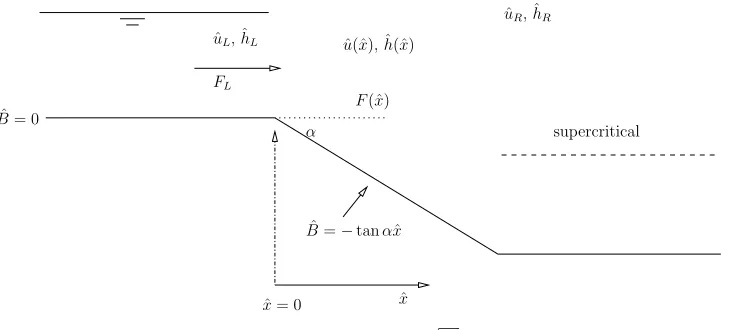
2.7.1. Interpretation of a stationary shock across a fixed bed discontinuity
221
We consider a steady state flow across a fixed, linear slope (see figure 4), and therefore 222
only the hydrodynamic behaviour. From shallow water theory, the flow over the slope 223
is either entirely sub- or supercritical (see Appendix D). We return here to dimensional 224
variables, and then use an alternative non-dimensionalisation. 225
From continuity we have 226
ˆ
subcritical
supercritical
α
ˆ
B= 0
FL
F(ˆx)
ˆ
uR, ˆhR
ˆ
u(ˆx), ˆh(ˆx)
ˆ
B=−tanαxˆ
ˆ
x= 0 xˆ
ˆ
[image:9.595.108.475.157.322.2]uL, ˆhL
Figure 4.Bed level geometry for this case.F = ˆu/
q
gˆhis the Froude number. In these scenarios the whole flow is either sub- or supercritical.
For a steady state, the flux-conservative form of (2.2) is 227
ˆ
huˆ2+1 2gˆh
2
ˆ
x
=−gˆhBˆˆx. (2.35)
Now we introduce a different set of nondimensional variables ˜h, ˜u, ˜xand ˜Bon the sloping 228
section with ˆh= ˆhL˜h, ˆu= ˆuLu˜, ˆx= ˆhLx/˜ tanα, and ˆB= ˆhLB˜. This gives:
229
˜
u= 1˜
h, (2.36)
230
˜
B=−x,˜ (2.37)
and 231
FL2
1 ˜
h+
1 2˜h
2
˜
x
=−˜hB˜x˜= ˜h. (2.38)
Note that the slope tanαis now absent, and the only free parameter is the inflow Froude 232
number,FL.
233
Straightforwardly, we then obtain 234
˜
h= 1 + ˜x+1 2F
2
L
(˜h2−1) ˜
h2 = 1−B˜+
1 2F
2
L
(˜h2−1) ˜
h2 (2.39)
for the variation of ˜hacross the slope. If we consider an abrupt change in bed level to 235
be the limiting case asα→π/2 of this linear slope variation, and, moreover, that this 236
variation is independent of slope (tanα), we may then assume that this variation may 237
be used across a fixed bed step as the implied internal shock structure. 238
It should be noted that (2.39) can also be directly derived from an energy conservation 239
law for the shallow water equations, because the flow down the slope is continuous. There 240
is some debate about whether energy conservation or the momentum balance equation, 241
in whichRBR˜ ˜
BL
˜
hdB˜ has to be approximated, should be used for the shock across a fixed 242
has been widely used to study the stationary shock across a fixed bed discontinuity 244
(Karelskii & Petrosyan 2006; Valiani & Caleffi 2017). Valiani & Caleffi (2017) uses both 245
energy conservation and momentum balance to derive a depth at the bed step, i.e.,h(x0)
246
in (2.32). However, the energy loss across a morphodynamic shock isa priori unknown. 247
Therefore in this work, we utilise the momentum equation to solve the stationary shock 248
across a fixed bed step and also for morphodynamic shocks. Accordingly, we now focus 249
on the approximations forRBR˜ ˜
BL ˜hdB˜.
250
(2.38) gives the exact solution of 251
Z BR˜
˜
BL
˜
hdB˜=−
FL2
1 ˜
h+
1 2˜h
2
R
L
, (2.40)
for a stationary shock across a fixed bed discontinuity, in which ˜h is calculated using 252
(2.39). 253
The exact solution (2.40) together with (2.39) allows us to see how well (2.29), (2.30) 254
or (2.33) describe this usually ambiguous integral. The performances of these approxi-255
mations are presented in Appendix A, from which we can see that (2.33) yields greater 256
accuracy than (2.29) or (2.30). 257
2.7.2. Application ofn-step approach to morphodynamic shocks
258
In this section we consider whether the n-step approach is valid for morphodynamic 259
shocks. Hereafter we return to the non-dimensionalisation introduced in§2.2. 260
In the shallow water morphodynamical system that we consider here, there is in general 261
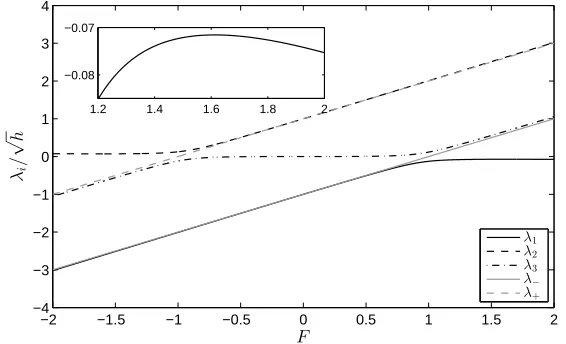
one characteristic speed much smaller than the other two. This can be seen in figure 5, in 262
which we plotλ′=λ/√hversus Froude numberF=u/√h. Note that the characteristic 263
polynomial forλ′ depends only on F andσ: 264
λ′3−2F λ′2+ ((1−3σ)F2
−1)λ′+ 3σF3= 0. (2.41)
The characteristic speed that is generally much smaller than the other two is associated 265
with bed wave movement. This property pertains everywhere except for transcritical 266
flows, as also indicated in figure 5. Here we define a morphodynamic shock as a shock 267
formed by the convergence of two characteristics of one family, at least one of which is a 268
bed characteristic, and for which the shock speed|W| ≪1. 269
Now, note thatσ=ξAg≪1 (see (2.8) and (2.28)). This is because ˆq=O(10−3)m3/s/m
270
or less, whereas ˆu0=O(1m/s) in our original non-dimensionalisation (2.5). This implies
271
that at the hydrodynamical timescale ˆt0 = q
ˆ
h0/g, (2.8) becomes Bt≈0, implying no
272
bed change at this timescale. However, at the morphodynamical timescale, ˆtm = ˆt0/σ,
273
⇒both sides of (2.28) are of comparable magnitude. This is consistent withW ≪1 for 274
a morphodynamic shock, so that in these circumstances (2.26)–(2.28) become 275
hRuR−hLuL≈0, (2.42)
−
hRu2R+
h2
R
2 −hLu
2
L−
h2
L
2
−
Z xR
xL
hBxdx≈0, (2.43)
(BR−BL)W−σ(u3R−u3L) = 0.
Note that (2.42) and (2.43) are the same shock conditions as those for flow over a fixed bed 276
step. This implies (2.39) can be derived from (2.42) and (2.43). This scaling is equivalent 277
to use of the quasi-steady approximation that is often used to study morphodynamics 278
(see e.g. Ribas et al. 2015). Therefore, we conclude that both (2.40) together with (2.39), 279
−2 −1.5 −1 −0.5 0 0.5 1 1.5 2 −4
−3 −2 −1 0 1 2 3 4
F
λi
/
√
h
λ1 λ2 λ3 λ
− λ+
1.2 1.4 1.6 1.8 2
[image:11.595.146.429.124.296.2]−0.08 −0.07
Figure 5. Dimensionless characteristic velocities for our system with σ = 0.01 (after Zhu & Dodd (2015), figure 2). λ+,− are the equivalent hydrodynamic (fixed bed) characteristic velocities.
can in principle be used as approximations for morphodynamic shocks with simplified 281
shock conditions (2.42), (2.43) and (2.28). Note that the conversion between different 282
non-dimensionalisations in §2.7.1 and § 2.2 should be done before applying (2.40) and 283
(2.39) for morphodynamic shocks. 284
By analogy, we can instead retain the W terms in (2.26) and (2.27) to obtain the 285
internal shock structures (hi,uiandBi) and apply then-step approach (2.33) for (2.26)–
286
(2.28). In the remainder of this paper we use this approach, which we refer to as the 287
n-step approach, to construct the Riemann solution. The performances of these other 288
approximations for morphodynamic shocks are examined in Appendix C. 289
2.7.3. Implementation ofn-step approach for morphodynamic shocks
290
To use (2.33) across a morphodynamic shock with (2.26)–(2.28), the procedure is as 291
follows: 292
(a) Obtain initial estimates forU~R =U~R(1) by solving (2.26)–(2.28), withRxLxRhBxdx
293
approximated using (2.29). 294
(b) Bi values are then chosen according to BL and BR. Then h(Bi) and u(Bi) are
295
calculated according to (2.26) and (2.27) for the knownBi, by replacing (h, u, B)iL and
296
(h, u, B)iR by (h, u, B)i−1 and (h, u, B)i. Note that (h, u, B)0= (h, u, B)L.
297
(c) Calculate theRxR
xL hBxdxusing then-step approach (2.33).
298
(d) We then solve (2.26)–(2.28) using the calculatedRxR
xL hBxdxto get U~R=U~
(2)
R .
299
(e) Repeat (b)-(d) untilU~R converges.
300
3. Solution of dam-break problems over an initially piecewise flat
301mobile bed
302The dam-break problem system consists of 3 equations, and according to Lax’s theorem 303
(Lax 1973) there are at most 4 constant states separated by 3 elementary waves associated 304
with the 3 characteristic families. Note that for wet-dry dam-break problems over mobile 305
bed there are two waves separated by one newly formed constant region (Kelly & Dodd 306
3.1. Initial conditions
308
The dimensional initial conditions for a generalised dam-break problem are shown in 309
figure 1. With ˆh0= ˆhl, the non-dimensional initial conditions of the left side areh(x6
310
0) =hl = 1,u(x60) =ul= 0, B(x60) =Bl = 0. For wet-dry dam-break problems,
311
h(x> 0) =hr = 0, and u(x> 0) = ur = 0. For wet-wet dam-break problems, we set
312
h(x>0) =hr = 0.1, and u(x>0) =ur = 0. In this paper, we consider conditions of
313
both Br = 0 and Br 6= 0 to investigate the wave structures in these more generalised
314
dam-break problems. 315
3.2. Wet-dry dam-break problem
316
We first assume that the wet-dry dam-break solution over an erodible bed for various 317
Br consists only of elementary waves, i.e., rarefaction waves or shocks. We introduce
318
the semi-characteristic shock when the assumption no longer applies. The obtained wave 319
structures att= 1 are shown in figure 6. 320
3.2.1. Br>Bl
321
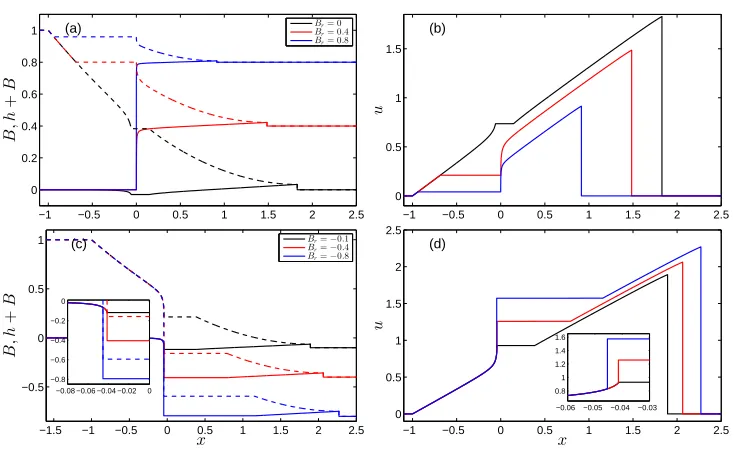
Figure 6(a) and (b) show, respectively, water surface elevation and bed level, and 322
velocity. The wave structure is that of aλ1 rarefaction wave, a constant region,U~∗, and 323
aλ3 rarefaction wave, which is consistent with that presented by Kelly & Dodd (2009),
324
who considered onlyBr=Bl= 0. AsBr→Bl+hl,B∗+h∗→Bl+hland the extents of
325
theλ1andλ3rarefaction waves decrease, and the solution (att= 1) resembles the initial
326
conditions more. Note that the volume of water set in motion at timetishl|λ1(hl)|t, and
327
is independent ofBrbecause the left edge of theλ1fan (λ1(hl)) is unaffected by changes
328
inBr. As the downstream elevationBrincreases, velocities across the Riemann solution
329
decrease, as, therefore, does the sediment movement. As Br increases, the flow in the
330
constant region changes from supercritical (e.g., whenBr = 0) to subcritical flow (e.g.,
331
when Br = 0.4 or 0.8), and the λ3 wave close to x = 0 changes from a hydrodynamic
332
into a bed wave. 333
In theλ3 rarefaction fan,
334
dB=
(λ3−u)2
h −1
dh=−3σu 2(λ
3−u)
λ3h
dh (3.1)
where (2.10) has been used. Thus, the large bed change that occurs near the dam location 335
forBr= 0.4 or 0.8 is connected by the λ3 simple wave withλ3→0 in (3.1). The lip of
336
the initial bed discontinuity is eroded by the flow, and the initial discontinuity in bed 337
level is transformed into a steep continuous variation. The small bed step (Kelly & Dodd 338
2010) at the flow tip (x=xs(t)) remains a feature of the solutions with decreasing height
339
as flow velocity there decreases as Br increases. For Br =hl+Bl no flow ensues, and
340
there is no erosion. 341
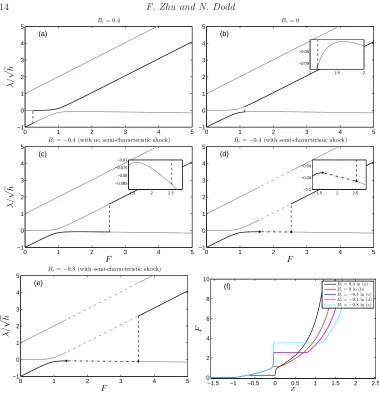
The wave development is closely related to Froude number (F), and Froude number 342
acts as a proxy for positionx. In figure 7(f), we show the relationship between F and 343
x. F increases across the Riemann solution as x increases. In figure 7 (a) and (b) the 344
three derived characteristic velocities λ′ = λ/√h are plotted as a function of Froude 345
number (F). Again, note that the λ′ curves are invariant for all dam-break solutions 346
with σ= 0.01 unless there is a discontinuity in F when a shock develops. In contrast, 347
the black line superimposed on parts of these curves indicates the variation ofλ′
1across
348
the λ1 fan, and the variation of λ′3 across the λ3 fan, with the jump from one to the
349
other also depicted, forBr= 0 and 0.4. If we follow the (black)λ′i values along the λ′i
350
curves in figure 7 (a) and (b) from F = 0 we see that λ′
1 increases as F increases for
351
Br = 0.4 and 0. For Br = 0 the jump from λ′1 to λ′3 for Br >0, which corresponds
−1 −0.5 0 0.5 1 1.5 2 2.5 0
0.2 0.4 0.6 0.8 1
B
,h
+
B
(a) Br= 0
Br= 0.4 Br= 0.8
−1 −0.5 0 0.5 1 1.5 2 2.5
0 0.5 1 1.5
u
(b)
−1.5 −1 −0.5 0 0.5 1 1.5 2 2.5
−0.5 0 0.5 1
x
B
,h
+
B
(c) Br=−0.1 Br=−0.4 Br=−0.8
−0.08 −0.06 −0.04 −0.02 0 −0.8
−0.6 −0.4 −0.2 0
−1 −0.5 0 0.5 1 1.5 2 2.5
0 0.5 1 1.5 2 2.5
x
u
(d)
−0.06 −0.05 −0.04 −0.03 0.8
[image:13.595.104.471.117.342.2]1 1.2 1.4 1.6
Figure 6.Structure of the wave solution for a wet-dry dam-break problem (hl = 1, ul = 0,
Bl= 0, hr = 0, ur = 0, andσ= 0.01) with varyingBr values (t= 1). All semi-characteristic shocks are solved by then-step approach for (2.26)–(2.28) with n= 2.
to the constant region, occurs for a largerF value than that forBr= 0.4. Both jumps
353
occur prior to the point at which dλ′1
dF = 0. Therefore,λ′ increases monotonically across
354
both fans. dλ′1
dF = 0, indicating a convergence inλ′1, occurs atF ≈1.6 for all dam-break
355
solutions withσ= 0.01. 356
3.2.2. Br6Bl
357
In figure 6(c) and (d) we can see the dam-break structure in this case, which is similar 358
to the preceding one in that two rarefaction fans (λ1 and λ3) form, separated by a
359
constant region. 360
Before commenting further on the structure of these solutions it is instructive first to 361
consider their representation in (λ′, F) space. In figure 7(c)-(e) we do this. Figure 7(c) 362
and (d) illustrate the behaviour for Br =−0.4. For figure 7(c) we see the elementary
363
wave solution. Note, however, that the jump via the constant region, from λ′
1 to λ′3
364
curve, occurs when dλ′1
dF <0. This implies that at some point within the λ1 fan the λ′1
365
derived characteristics start decreasing asF increases. In contrast figure 7(d) shows the 366
behaviour with a semi-characteristic shock included. 367
Representing the solution in (λ′, F) space is appealing because these curves are in-368
variant with the continuous Riemann solution (i.e. size of bed step). However, it is the 369
convergence of λ1 characteristics (not λ′1) in the (x, t)-plane that determines whether
370
or not a semi-characteristic shock must be fitted. So, to determine this point of change 371
in the Riemann solution it is appropriate to examine variation inλ1. The multivalued
372
solution ofλ1 starts atBr/−0.175, at the location at whichF ≈1.87 (andh≈0.301).
373
This point is illustrated in figure 8.λ1 increases asF increases, but atF ≈1.87 the the
374
characteristic velocity (λ1) starts to decrease at the leading edge of the λ1 rarefaction
375
fan. The constant region, corresponding to the jump from λ1 to λ3 curve, thus occurs
376
when dλ1
dF < 0. This indicates the convergence of λ1 characteristics within the λ1 fan.
377
The solution is multi-valued. The part of the λ1 curve for which F >1 behaves like a
0 1 2 3 4 5 −1
0 1 2 3 4 5
λ
/
√
h
Br= 0.4
(a)
0 1 2 3 4 5
−1 0 1 2 3 4 5
Br= 0
(b)
1 1.5 2 −0.09
−0.08
0 1 2 3 4 5
−1 0 1 2 3 4 5
F
λ
/
√
h
Br=−0.4 (with no semi-characteristic shock)
(c)
1.5 2 2.5 −0.085
−0.08 −0.075 −0.07
0 1 2 3 4 5
−1 0 1 2 3 4 5
F
Br=−0.4 (with semi-characteristic shock)
(d)
1.5 2 2.5 −0.1
−0.08 −0.06
0 1 2 3 4 5
−1 0 1 2 3 4 5
F
λ
/
√
h
Br=−0.8 (with semi-characteristic shock)
(e)
−1.5 −1 −0.5 0 0.5 1 1.5 2 2.5
0 2 4 6 8 10
x
F
(f) Br= 0.4 in (a)
Br= 0 in (b)
Br=−0.4 in (c)
Br=−0.4 in (d)
[image:14.595.97.476.104.497.2]Br=−0.8 in (e)
Figure 7.Illustrations of four of the Riemann solutions depicted in figure 6 in (λ/√h, F) space as the solution is traversed fromxlto xs. Dashed lines represent the jumps fromλ1 wave and
λ3wave. Dash-dotted lines represent the jump at the semi-characteristic shocks. (f) Illustration
of howF varies across these solutions.
characteristic associated with a bed wave. Becauseλ1<0 this behaviour results in a bed
379
wave propagating against the flow. Similar behaviour can be observed in the propagation 380
of anti-dunes in supercritical open channel flow on a mobile bed, which propagate against 381
the flow (see Kennedy 1963). 382
To obtain a valid mathematical structure here, theλ1fan must terminate prior to the
383
point at which dλ1
dh = 0 at a semi-characteristic shock withλ1L=W; downstream, in the
384
constant region we must haveλ1R < W, for a valid shock structure, which is possible
385
becauseF increases across the shock and thereforeλ1 decreases.
386
Physically, the main difference between this case and that for Br > Bl is the larger
387
velocities induced by the lower downstream elevation, which drives the early supercritical 388
flow development and therefore the formation of the semi-characteristic shock. Now, the 389
constant region is shifted mostly to x > 0, with a large decrease in h∗. The flow is 390
supercritical at the dam location, and the λ1 wave has become a bed wave close to
0 1 2 3 4 5 −1
−0.5 0 0.5 1 1.5 2
F
λ
Br=−0.175 (no semi-characteristic shock)
(a)
1.868 1.87 1.872 1.874 1.876 −0.0403
0 1 2 3 4 5
−1 −0.5 0 0.5 1 1.5 2
F
Br=−0.175 (with semi-characteristic shock)
(b)
1.87 1.875 1.88 −0.0403
0 0.2 0.4 0.6 0.8 1
−1 −0.5 0 0.5 1 1.5 2
h
λ
Br=−0.175 (no semi-characteristic shock)
(c)
0.3002 0.3004 0.3006 0.3008 0.301 −0.0403
0 0.2 0.4 0.6 0.8 1
−1 −0.5 0 0.5 1 1.5 2
h
Br=−0.175 (with semi-characteristic shock)
(d)
[image:15.595.109.468.109.367.2]0.3 0.3005 0.301 0.3015 −0.0403
Figure 8.Illustrations of Riemann solutions for dam-break problem withhl= 1,ul= 0,Bl= 0,
hr= 0,ur= 0,Br= 0.175, andσ= 0.01 in (λ, F) and (λ, h) space to indicate why a semi-char-acteristic shock must be fitted. Dashed lines represent the jumps from λ1 wave and λ3 wave.
Dash-dotted lines represent the jump at the semi-characteristic shocks. All semi-characteristic shocks are solved by then-step approach for (2.26)–(2.28) with n= 2.
x= 0, where we can also see the large bed change. The large bed decrease occurs at the 392
shock, which helps to connect widely separated values ofBl andBr.
393
We assume an implied internal shock structure for all the semi-characteristic shocks, 394
andn= 2 is adopted here. For the semi-characteristic shocks for all negativeBr values,
395
we have λ1L = W > λ1R. The convergence of characteristics implies that the shocks
396
are physical. Note that if we use the approximation (2.29) we do not arrive at physical 397
solutions forBr=−0.8, and if we use the approximation (2.30) we do not get solutions
398
for any semi-characteristic shocks with the examined Br values. It is therefore critical
399
that we introduce this more accurate approach. In Appendix C we show the equivalent 400
solutions and examine dependence onn. 401
3.2.3. Varying upstream bed level
402
We also examine the effect of varying the upstream bed level only, while keeping the 403
upstream surface elevation and downstream bed level fixed (hl+Bl = 1 and Br = 0).
404
The Riemann solutions (B and B+h only) are shown in figure 9. The structures are 405
similar to those already observed, but now with particularly large variations between 406
solutions forx <0, becausehl varies and so therefore does the driving force.
407
The wave solutions of these dam-break problems are similar to those of fixed hl and
408
Bl values (hl = 1, Bl = 0) but varying Br values. Actually, these two kinds of
dam-409
break problems can be converted to each other through scaling and transformation. It 410
is the water depth on the left and bed difference that determines the wave structure. 411
Two dam-break problems with the same ratios of water depths and bed differences, i.e., 412
hl1/hl2= (Bl1−Br1)/(Bl2−Br2) are similar. Therefore the wave structures after dam
413
−1.5 −1 −0.5 0 0.5 1 1.5 2 2.5 0
0.2 0.4 0.6 0.8 1
x
B
,h
+
B
(a) Bl= 0.4
Bl= 0.2
Bl= 0
−1.5 −1 −0.5 0 0.5 1 1.5 2 2.5
−0.8 −0.6 −0.4 −0.2 0 0.2 0.4 0.6 0.8 1 1.2
x
(b) Bl= 0
Bl=−0.4
[image:16.595.103.463.103.230.2]Bl=−0.8
Figure 9.Solutions for dam-break problems with fixed upstream surface elevation (hl+Bl= 1) and downstream bed level (Br = 0) but varyingBl values. All semi-characteristic shocks are solved by then-step approach for (2.26)–(2.28) withn= 2.
3.3. Wet-wet dam-break problem
415
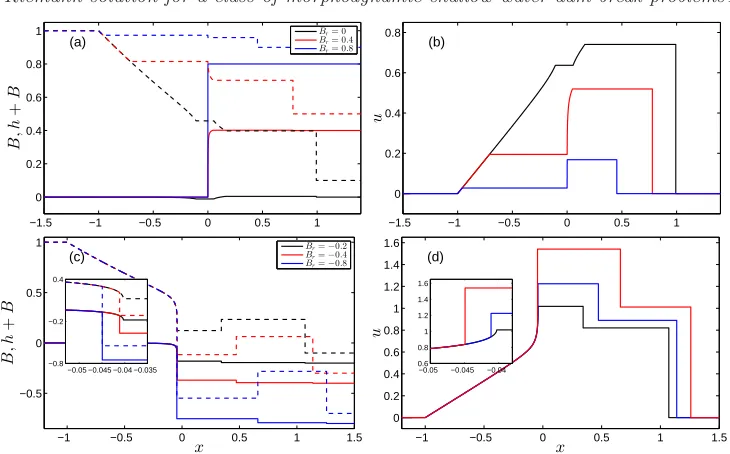
We now turn to the wet-wet dam-break solution over an initially piecewise flat erodible 416
bed for variousBrvalues, which consists of elementary waves. The solutions att= 1 are
417
shown in figure 10. 418
3.3.1. Br>Bl
419
Figure 10(a) and (b) show, respectively, water surface level and bed level, and velocity 420
for this case. The wave structure is of aλ1 rarefaction wave, a λ3 rarefaction wave and
421
a λ2 shock. There are two newly formed constant regions (U~l∗ and U~r∗) separating the 422
three waves. ForBr= 0, theλ2shock corresponds to theλ+shock in the equivalent fixed
423
bed wet-wet dam-break problem (e.g. Toro 2001), and theλ1 and λ3 rarefaction waves
424
correspond to the λ− rarefaction wave in the fixed bed case. When the bed mobility 425
σ→0, the λ1 andλ3rarefaction waves tend to combine into one wave.
426
AsBrincreases, theλ3 wave becomes more confined to the original bed step position,
427
and less water flows intox >0 region. Whenhr+Br→1 flow ceases.
428
3.3.2. Br6Bl
429
In figure 10(c) and (d), we can see the dam-break structure in this case. There is still 430
a λ1 rarefaction wave, and a λ2 shock, as for Br > Bl. However, for the investigated
431
negativeBrvalues, theλ3 wave changes from a rarefaction wave into a shock. There are
432
also two newly formed constant regions. ForBr <0 asBr decreases further (see figure
433
10(c)),hl∗ decreases very quickly, and whenhl∗< hr∗ theλ3fan observable for Br= 0
434
becomes a shock as the characteristics converge. 435
WhenBr/−0.207, we get multivalued solutions within theλ1 fan, (see figure 10(c)).
436
The Br value at which this occurs will depend on hr, which here is 0.1, recall. We
437
again assume the existence of aλ1semi-characteristic shock, and the corresponding wave
438
structure is shown in figure 10 (c) and (d). Once again, we assume an implied internal 439
shock structure, expressed through (2.33) in (2.26)–(2.28), in order to obtain a physical 440
shock (see Appendix C). 441
3.3.3. Varying downstream water depth
442
In figure 11 we look at the effect that varyinghrhas on the structure of these problems.
443
Ashrdecreases, we expect this wet-wet problem to start to resemble previously examined
444
wet-dry problems (see figure 6). Accordingly, theλ3 shock diminishes such that between
445
hr = 0.03 and 0.015 it becomes a rarefaction fan. As hr decreases further the λ3 fan
446
extends towards theλ2 shock such that in the limithr→0 the leading edge of thisλ3
−1.5 −1 −0.5 0 0.5 1 0
0.2 0.4 0.6 0.8 1
B
,h
+
B
(a) BBrr= 0= 0.4 Br= 0.8
−1.5 −1 −0.5 0 0.5 1
0 0.2 0.4 0.6 0.8
u
(b)
−1 −0.5 0 0.5 1 1.5
−0.5 0 0.5 1
x
B
,h
+
B
(c) BBrr==−−00..24 Br=−0.8
−0.05 −0.045 −0.04 −0.035 −0.8
−0.2 0.4
−1 −0.5 0 0.5 1 1.5
0 0.2 0.4 0.6 0.8 1 1.2 1.4 1.6
x
u
(d)
−0.05 −0.045 −0.04 0.6
[image:17.595.105.470.113.340.2]0.8 1 1.2 1.4 1.6
Figure 10.Structure of the wave solution for a wet-wet dam-break problem (hl = 1,ul= 0,
Bl= 0,hr= 0.1,ur= 0, andσ= 0.01) with varyingBrvalues att= 1. All semi-characteristic shocks are solved by then-step approach for (2.26)–(2.28) with n= 2.
−1.5 −1 −0.5 0 0.5 1 1.5 2
−0.5 0 0.5 1
x
B
,h
+
B
(a) hhrr= 0= 0..103
hr= 0.015
0.6 0.65 0.7 0.75 0.8 −0.16
−0.14 −0.12 −0.1 −0.08
−1.5 −1 −0.5 0 0.5 1 1.5 2
−0.5 0 0.5 1
x
(b) hhrr= 0= 0..01001
hr= 0.0001
1.4 1.6 1.8 2
−0.4 −0.3 −0.2
Figure 11.Structure of the wave solution for a wet-wet Riemann problem with (hl= 1,
ul= 0,Bl= 0,ur= 0,Br=−0.4 andσ= 0.01) varyinghr values.
fan becomes the wet-dry boundary (with zero depth) and a semi-characteristic shock, and 448
theλ2shock disappears. Theλ1 wave is a combination of a fan and a semi-characteristic
449
shock, which is consistent with the equivalent wet-dry dam-break solution. 450
4. Conclusion
451Generalised wet-dry and wet-wet dam-break problems over an erodible, initially piece-452
wise flat bed with water initially at rest and discontinuous bed levels are investigated and 453
solved based on the Riemann theory, and quasi-exact solutions are presented. The solu-454
tions are consistent with the theory proposed by Lax (1973) that for a Riemann problem 455
ofnequations there are at mostn+ 1 constant states separated bynelementary waves 456
associated with thencharacteristic families. However, for wet-dry dam-break problems, 457
one wave vanishes because of the presence of the dry bed. For the examined wet-dry 458
dam-break problems, there are 2 waves separated by 1 newly formed constant region, 459
[image:17.595.113.463.392.495.2]For some dam-break problems with negative bed steps, in which the initial states (Bl
461
and Br) are not sufficiently close, there are multivalued solutions when applying Lax’s
462
theorem. The semi-characteristic shock is introduced to describe the flow and physical 463
wave structures are obtained. This is consistent with the solution for a Riemann problem 464
of one single equation of non-convex flux function (Sharma 2010). 465
The ambiguous integralRxR
xL hBxdxin shock conditions, which is usually approximated
466
by the Needham & Hey (1991) approach, is reconsidered. An implied internal shock struc-467
ture is proposed initially by considering the limiting case of flow down a linear slope over 468
fixed bed. Based on the internal shock structure, the integralRxR
xL hBxdx is discretized
469
into many steps and each step is approximated by Needham & Hey (1991) approach. 470
This is to reduce the effects of curvature betweenhandB, which is source of inaccuracy 471
in Needham & Hey (1991) approximation. This strategy is then extended to morphody-472
namic shocks which are here by assumption slow moving. However, because of the more 473
general implied internal shock structure approach we ultimately adopt it would appear 474
that this approach is more generally applicable. The resulting semi-characteristic shocks 475
are physical, in that the characteristics converge across them. 476
477
FZ and ND would like to acknowledge the financial support from both National Natural 478
Science Foundation of China (Grant No. 51509135) and University of Nottingham Ningbo 479
China (Small Research Grant). The authors would also like to thank the anonymous 480
reviewers for their constructive comments. 481
Appendix A. Analysis of
R
B˜R ˜BL
˜
hd
B
˜
approximation methods
482
In this section, we analyse the performances of three approximation methods for the 483
ambiguous termRB˜R
˜
BL ˜hdB˜ (in the orginal nondimensional system
RBR
BL hdBin shock
con-484
dition (2.27)) on a linear (fixed) slope in§2.7: (2.29), (2.30) and (2.33) with (2.39) against 485
the exact solution (2.40) with (2.39). 486
Here, we take ˜BL= 0 and ˜BR=−x˜, with ˜x >0 being a variable. The approximation
487
(2.29) gives 488
Z −x˜
0
˜
hdB˜ =−12x˜(1 + ˜h), (A 1)
and it is exact if the relationship between ˜hand ˜B is linear. The approximation (2.30) is 489
Z −x˜
0
˜
h dB˜=
(
−12x˜(2˜h−x˜) if ˜BR<B˜Land ˜BR+ ˜hR>B˜L
−1
2h˜
2 if ˜B
R+ ˜hR<B˜L
(A 2)
We also use then-step approach (2.33) withn= 5 for the approximation 490
Z −x˜
0
˜
h dB˜ =−1
2
i=4 X
i=0
˜
hi+ ˜hi+1 B˜i+1−B˜i
(A 3)
with ˜Bi=−ix/˜ 5, in whichhi is calculated by (2.39).
491
The results of (A 1), (A 2), (A 3) and (2.40) are illustrated in figure 12. Comparison 492
shows that the approximation (A 1), i.e., (2.29), is generally quite accurate. Nearer to 493
critical conditions the free surface curvature introduces significant discrepancies. Also, as 494
˜
BR−B˜Lincreases, accuracy diminishes. Then-step approach (A 3), i.e., (2.33), greatly
495
increased the accuracy. The approximation (A 2), i.e., (2.30) (Bernetti et al. 2008), is 496
0 0.2 0.4 0.6 0.8 1 −2
−1.5 −1 −0.5 0
R˜BR ˜BL
˜hd ˜B
FL= 0.1
(a)
0 0.2 0.4 0.6 0.8 1 −2
−1.5 −1 −0.5 0
FL= 0.9
(b)
0 0.2 0.4 0.6 0.8 1 −0.8
−0.6 −0.4 −0.2 0
R˜BR ˜BL
˜hd ˜B
−( ˜BR−B˜L)
FL= 1.1
(c)
0 0.2 0.4 0.6 0.8 1 −1
−0.8 −0.6 −0.4 −0.2 0
−( ˜BR−B˜L)
FL= 2.1
[image:19.595.111.468.134.438.2](d)
Figure 12.RB˜R
˜
BL ˜
h dB˜plotted against size of bed step:RB˜R
˜
BL ˜
h dB˜=−hF2
L
1 ˜
h+
1 2˜h
2iR
Lcalculated using (2.39) (solid black line); that approximated by (A 1), i.e., (2.29) (dashed line), by (A 2), i.e., (2.30) (dotted line), and by (A 3), i.e., (2.33) withn= 5 (grey solid line) for various Froude numbers.
the exact value when it is closer to critical flow. However, when the flow is supercritical, 498
the discrepancies become significant. 499
Appendix B. Comparison between wet-dry dam-break Riemann
500solution of fixed and nearly fixed bed case
501In this section, we test the Riemann solver by comparing the nearly fixed bed wet-dry 502
dam-break solution (σ= 1×10⁻⁵) against the fixed bed solution.
503
The dam-break problem over a fixed bed with a bed step will lead to a stationary 504
shock at the bed step (Bernetti et al. 2008). For the positive Br values examined, the
505
wave structure over a fixed bed from the left to right is aλ−rarefaction wave, a constant 506
region, a stationary shock, and aλ− rarefaction wave. That for the negativeBr values
507
examined, is a λ− rarefaction wave, a stationary shock, a constant region, and a λ− 508
rarefaction wave (figure 13). This stationary shock corresponds to a semi-characteristic 509
shock if we interpret it in a morphodynamic context. It is aλ3 semi-characteristic shock
510
withλ3L =W =λ3R= 0 becauseσ= 0.
511
On a nearly fixed bed, the wave structure for the non-negativeBr values examined, is
512
aλ1rarefaction wave, a constant region and aλ3rarefaction wave. The stationary shock
513
in the fixed bed case disappears because of the bed mobility, and the left part of theλ3
−1 −0.5 0 0.5 1 1.5 2 2.5 3 0
0.2 0.4 0.6 0.8 1
x
B
,h
+
B
(a) Br= 0
Br= 0.2
Br= 0.4
Br= 0.6
Br= 0.8
−1 −0.5 0 0.5 1 1.5 2 2.5 3
−0.5 0 0.5 1
x
B
,h
+
B
(b) Br= 0
[image:20.595.106.454.103.223.2]Br=−0.2 Br=−0.4 Br=−0.6 Br=−0.8
Figure 13.Comparison between wet-dry dam-break fixed bed (hl= 1,ul= 0,Bl= 0,hr= 0,
ur= 0, andBr= 0) solution (σ= 0; solid lines) and nearly fixed bed solution (σ= 1×10⁻⁵; dashed lines). All semi-characteristic shocks are solved with NH91 approximation.
rarefaction wave becomes a steep but smooth part, which is to some extent similar to 515
the stationary shock in the fixed bed case. The nearly fixed bed solutions are in good 516
agreement with the fixed bed solutions (figure 13(a)). 517
The Riemann solutions with NH91 condition for the examined negativeBrvalues over
518
a nearly fixed bed are similar to those presented in§3.2.2. The wave structures are aλ1
519
rarefaction, aλ1 semi-characteristic shock, and aλ3 rarefaction. Theλ1 rarefaction fan
520
corresponds to the stationary shock on the fixed bed. The results compare favourably 521
with the corresponding fixed bed results (figure 13(b)). 522
Appendix C. Investigation of
R
BRBL
hdB
approximation methods in
523
dam-break problems
524In this section, we investigate the approximation ofRBR
BL hdBby comparing the
solu-525
tions of wet-dry and wet-wet dam-break problems using different approximation methods 526
(see Appendix A and§2.7.2). In summary, the approximation methods include (a): (2.40) 527
together with (2.39) and (2.28), i.e.,hRanduRare directly calculated for a knownBRas
528
for the stationary shock across fixed bed discontinuity; (b):n-step approach with (2.39) 529
applied in (2.42), (2.43) and (2.28) (c):n-step approach with (2.26)-(2.27) forhi,ui and
530
Bi for (2.26)-(2.28), (d): NH91 approximation (i.e.,n-step approach in method (c) with
531
n= 1; and (e): Bernetti et al. (2008) condition for (2.26)-(2.28) It should be noted that 532
with Bernetti et al. (2008) condition, we cannot find a solution if a semi-characteristic 533
shock is assumed, i.e., there is no alternative to the multi-valued solution. 534
The performances of the approximation methods forRBR
BL hdBare compared by
exam-535
ining wet-dry dam-break solutions for bothBr=−0.4 and−0.8. In general, the
approx-536
imations give similar results for water levels and bed elevations when the whole solution 537
is shown. Differences can be seen at the semi-characteristic shock. When Br = −0.4,
538
method (a) and (b) give very similar results, and the results of method (c) and (d) 539
are close. When the bed step height increases, the difference grows. However, the semi-540
characteristic shocks predicted by method (a) and (b) for Br =−0.4 (and Br =−0.2,
541
not shown) and that by method (d) for Br = −0.8 (and Br = −0.6, not shown) are
542
non-physical becauseλ1L>W >λ1R cannot be satisfied. In contrast, method (c), used
543
throughout this paper, results in a physical semi-characteristic shock for all these Br
544
values. It is therefore necessary to retain theW terms in (2.26)-(2.28). 545
The effects of how many steps the integralRBR
BL hdBis discretized into are also
investi-546
gated. The comparison for both wet-dry and wet-wet dam-break problems using method 547
−1.5 −1 −0.5 0 0.5 1 1.5 2 2.5 −0.5
0 0.5 1
x
B
,h
+
B
Br=−0.4
(a) Method (a)Method (b)
Method (c) Method (d)
−0.055−0.05−0.045−0.04 −0.5
0 0.5
−1.5 −1 −0.5 0 0.5 1 1.5 2 2.5
−0.5 0 0.5 1
x
B
,h
+
B
Br=−0.8
(b) Method (a)Method (b)
Method (c) Method (d)
−0.055−0.05−0.045−0.04 −0.5
[image:21.595.106.473.107.240.2]0 0.5
Figure 14. The comparison of wet-dry dam-break (hL = 1,uL= 0,BL= 0) solutions with different approximation methods forRBR
BL hdB. In then-step approach in method (b) and (c), n= 2.
that the results with the implied internal shock structure are initially very close to those 549
directly using the NH91 approximation. As the size of bed step increases, the difference 550
between solutions with NH91 approximation and the new approach also increases slightly. 551
In the wet-dry dam-break problems with Br = −0.2,−0.4, the semi-characteristic
552
shocks haveλ1L=W > λ1R when solved directly with NH91 approximation. However,
553
as previously mentioned that for Br = −0.6,−0.8, we have λ1L = W < λ1R, which
554
indicates a non-physical shock. It is further noted that in theBr=−0.4,−0.6,−0.8 cases,
555
the water on the left and right sides of the λ1 semi-characteristic shock are separated
556
by the high bed step (figure 16). Similarly, in the wet-wet dam-break problems with 557
Br=−0.6,−0.8, the semi-characteristic shocks are also non-physical. However, when we
558
use the implied internal shock structure, the shocks become physical. 559
In order to further investigate this, we take the wet-dry dam-break problem with 560
Br =−0.6 as an example to illustrate the characteristics across the semi-characteristic
561
shocks; see figure 17. We can see the characteristics diverging when using the NH91 ap-562
proximation, and characteristics converging when using implied internal shock structure. 563
This indicates that the NH91 approximation becomes less accurate when the bed step 564
becomes large in which the curvature ofh withB becomes enhanced. In this case, the 565
importance of considering the internal shock structure becomes obvious. 566
In figure 18 we see how the multivalued problem in a wet-dry dam-break problem is 567
rationalised by introducing a semi-characteristic shock. According to Whitham (1974), 568
the areas ∆A1= ∆A2. The results obtained here are consistent with this law, and when
569
n increases, |∆A1−∆A2| decreases. This also demonstrates that the n-step approach
570
applied for (2.26)-(2.28) gives more accuracy. Note that when the NH91 condition is used, 571
the jump at the semi-characteristic shock occurs outside the multi-valued region. As a 572
result, the shock becomes non-physical, becauseλ1∗> λ1L=W.
573
Appendix D. Impossibility of a smooth flow from sub- to
574supercriticality down a slope
575For smooth transition from sub- to supercriticality down a slope we need a situation 576
like that depicted in figure 19. 577
This flow is described by (2.38). Note that the RHS of (2.38)>0 for all ˜x; therefore 578
−1.5 −1 −0.5 0 0.5 1 1.5 2 2.5 −0.5 0 0.5 1 x B ,h + B
Br=−0.2
(a) NH91n= 2
n= 4
n= 6
−0.0404 −0.0402 −0.04 −0.2
−0.1 0 0.1 0.2
−1.5 −1 −0.5 0 0.5 1 1.5 2 2.5
−0.5 0 0.5 1 x B ,h + B
Br=−0.4
(b) NH91n= 2
n= 4
n= 6
−0.06 −0.05 −0.04 −0.03 −0.5
0 0.5
−1.5 −1 −0.5 0 0.5 1 1.5 2 2.5
−0.5 0 0.5 1 x B ,h + B
Br=−0.6
(c) NH91n= 2
n= 4
n= 6
−0.06 −0.05 −0.04 −0.03 −0.5
0 0.5
−1.5 −1 −0.5 0 0.5 1 1.5 2 2.5
−0.5 0 0.5 1 x B ,h + B
Br=−0.8
(d) NH91n= 2
n= 4
n= 6
−0.06 −0.05 −0.04 −0.03 −0.5
0 0.5
−1.5 −1 −0.5 0 0.5 1 1.5 2
−0.5 0 0.5 1 x B ,h + B
Br=−0.4
(e) NH91n= 2
n= 4
n= 6
−0.06 −0.05 −0.04 −0.03 −0.5
0 0.5
−1.5 −1 −0.5 0 0.5 1 1.5 2 2.5
−0.5 0 0.5 1 x B ,h + B
Br=−0.6
(f) NH91n= 2
n= 4
n= 6
−0.06 −0.05 −0.04 −0.03 −0.5
0 0.5
−1.5 −1 −0.5 0 0.5 1 1.5 2
−0.5 0 0.5 1 x B ,h + B
Br=−0.8
(g) NH91n= 2
n= 4
n= 6
−0.06 −0.05 −0.04 −0.03 −0.5
[image:22.595.103.472.103.598.2]0 0.5
Figure 15.The comparison of dam-break solutions with NH91 approximation and those with the implied internal shock structure (n-step approach, for various n values). (a)–(d): wet-dry dam-break solutions; (e)–(g): wet-wet dam-break solutions.
If we differentiate the LHS of (2.38) w.r.t.xwe get:
˜
h˜hx˜−FL2
˜
h˜x
˜
h2 =˜hx˜
˜
h−F 2
L
˜
h2
=˜h˜hx˜
−1.5 −1 −0.5 0 0.5 1 1.5 2 2.5 −0.5
0 0.5 1
x
B
,h
+
[image:23.595.198.377.122.229.2]B
Figure 16. Structure of the wave solution (NH91 approximation) for a wet-dry dam-break problem withBr=−0.6 which shows that the water on the two sides of the semi-characteristic shock is separated by the high bed step (t= 1).
−20 −1.5 −1 −0.5 0 0.5 1 1.5 2
0.2 0.4 0.6 0.8 1
λ1 fan Constant star region λ3 fan
x
t
(a)
−0.037 −0.0365 −0.036 0.77
0.775 0.78 0.785 0.79
−20 −1.5 −1 −0.5 0 0.5 1 1.5 2
0.2 0.4 0.6 0.8 1
λ1 fan Constant star region λ3 fan
x (b)
−0.015 −0.01 −0.0050 0 0.1
[image:23.595.113.465.289.397.2]0.2 0.3 0.4
Figure 17.The characteristics set up for the dam-break solutions withBr=−0.6 with NH91 approximation (a) and n-step approach applied for (2.26)-(2.28) (n= 2; b).
−1.5 −1 −0.5 0 0.5 1 1.5 2 2.5 0
0.2 0.4 0.6 0.8 1
x
h
Br=−0.6
No shock NH91
n= 2
n= 4
n= 6
−0.046 −0.044 −0.042 −0.04
0.25 0.3 0.35
∆A1
∆A2
Figure 18.Multivalued profile and semi-characteristic shock fitting with NH91 approximation andn-step approach (2.33) for (2.26)–(2.28) in a wet-dry dam-break solution withBr=−0.6.
However, for the flow in figure 19, ˜h˜x<0. Therefore, we must have
1−F 2
L
˜
[image:23.595.169.404.448.601.2]FL
F
˜
uL,˜hL
˜
u,h˜
˜
[image:24.595.193.364.100.268.2]h= ˜hc
Figure 19.Smooth flow on a constant slope from sub- to supercritical conditions.
Now,
F2=uˆ
2
ghˆ =
ˆ
u2
L
gˆhL
˜
u2
˜
h =F
2
L
1 ˜
h3 (D 3)
⇒
1−F 2
L
˜
h3
=
1−F2 (D 4)
Therefore, if flow is subcritical the flow cannot exist. Therefore, the flow in figure 19 580
cannot exist. The authors could not find an example in the literature of this analysis 581
being presented, hence its inclusion here. 582
REFERENCES
Bernetti, R., Titarev, V. A. & Toro, E. F.2008 Exact solution of the riemann problem for
583
the shallow water equations with discontinuous bottom geometry. J. Comput. Phys.227, 584
3212–3243.
585
Cozzolino, L., Morte, R. D., Covelli, C., Giudice, G. D. & Pianese, D.2011 Numerical
586
solution of the discontinuous-bottom shallow-water equations with hydrostatic pressure
587
distribution at the step. Advances in Water Resources34, 1413–1426. 588
Fraccarollo, L. & Capart, H.2002 Riemann wave descriptions of erosional dam break flows.
589
J. Fluid Mech.461, 183–228. 590
Grass, A.J.1981 Sediment transport by waves and currents. Technical Report FL29. University
591
College London, London Centre for Marine Technology.
592
Hibberd, S. & Peregrine, D. H.1979 Surf and run-up on a beach: A uniform bore. J. Fluid
593
Mech.95, 323–345. 594
Jeffrey, A.1976 Quasilinear hyperbolic systems and waves. Pitman.
595
Karelskii, K. V. & Petrosyan, A. S.2006 Problem of steady-state flow over a step in the
596
shallow-water approximation. Fluid Dynamics41(1), 12–20. 597
Kelly, D. M.2009 Bore-driven swash on a mobile beach. PhD thesis, School of Civil
Engineer-598
ing, University of Nottingham, Nottingham, UK.
599
Kelly, D. M. & Dodd, N.2009 Floating grid characteristics method for unsteady flow over a
600
mobile bed. Computers and Fluids38, 899–909. 601
Kelly, D. M. & Dodd, N.2010 Beach face evolution in the swash zone. J. Fluid Mech.661, 602
316–340.
603
Kennedy, J. F.1963 The mechanics of dunes and antidunes in erodible-bed channels. J. Fluid
604
Mech.16(4), 521–544. 605
Lax, P. D.1973 Hyperbolic systems of conservation laws and the mathematical theory of shock
606
waves. S.I.A.M.
Needham, D. J. & Hey, R. D.1991 On nonlinear simple waves in alluvial river flows: a theory
608
for sediment bores. Phil. Trans. Roy. Soc. Lond. A334, 25–53. 609
Pritchard, D. & Hogg, A. J.2005 On the transport of suspended sediment by a swash event
610
on a plane beach. Coastal Eng.52, 1–23. 611
Ribas, F., Falqu´es, A., de Swart, H. E., Dodd, N., Garnier, R. & Calvete, D.2015
Un-612
derstanding coastal morphodynamic patterns from depth-averaged sediment concentration.
613
Rev. Geophys.53, 362–410. 614
Ritter, A.1892 Die fortpflanzung der wasserwellen. Vereine Deutcher Ingenieure Zeitschrift
615
36, 947–954. 616
Sharma, V. D.2010 Quasilinear Hyperbolic Systems, Compressible Flows, and Waves. CRC
617
Press.
618
Soulsby, R. L.1997 Dynamics of marine sands. a manual for practical applications. SR 466.
619
Hydraulics Research Wallingford, Wallingford, England.
620
Stoker, J.J.1957 Water Waves. New York, N.Y.: Interscience.
621
Toro, E. F. 2001 Shock-capturing methods for free-surface shallow flows. New York, NY.:
622
Wiley.
623
Toro, E. F.2009 Riemann solvers and numerical methods for fluid dynamics, 3rd edn. Berlin:
624
Springer.
625
Valiani, A. & Caleffi, V.2017 Momentum balance in the shallow water equations on bottom
626
discontinuities. Advances in Water Resources100, 1–13. 627
Whitham, G. B.1974 Linear and Nonlinear Waves. New York: Wiley-Interscience.
628
Zhu, F. & Dodd, N.2013 Net beach change in the swash: A numerical investigation. Advances
629
in Water Resources53, 12–22. 630
Zhu, F. & Dodd, N. 2015 The morphodynamics of a swash event on an erodible beach. J.
631
Fluid Mech.762, 110–140. 632
Zhu, F., Dodd, N. & Briganti, R.2012 Impact of a uniform bore on an erodible beach.
633



![Diethyl 2,6 dimethyl 4 [5 (4 methylphenyl) 1H pyrazol 4 yl] 1,4 dihydropyridine 3,5 dicarboxylate](data:image/gif;base64,R0lGODlhAQABAIAAAP///wAAACH5BAEAAAAALAAAAAABAAEAAAICRAEAOw==)