DOI 10.4171/EMSS/x Mathematical Sciences c
European Mathematical Society
Between primitive and 2-transitive:
Synchronization and its friends
Jo˜
ao Ara´
ujo
∗Peter J. Cameron
∗∗Benjamin Steinberg
‡Contents
1 Introduction . . . 4
2 Transitivity and primitivity . . . 8
3 Synchronization . . . 16
4 Graph endomorphisms . . . 24
5 Related concepts . . . 30
6 Examples . . . 41
7 Representation theory . . . 52
8 Detecting properties with functions . . . 60
9 Applications to the ˇCern´y Conjecture . . . 63
10 Other properties . . . 70
11 The infinite . . . 74
∗The first author was supported by the Funda¸c˜ao para a Ciˆencia e Tecnologia (Portuguese
Foundation for Science and Technology) through the project CEMAT-CI ˆENCIAS UID/Multi/ 04621/2013, and through project Hilbert’s 24th problem PTDC/MHC-FIL/2583/2014.
∗∗The second author was supported by the Funda¸c˜ao para a Ciˆencia e Tecnologia (Portuguese
Foundation for Science and Technology) through the project CEMAT-CI ˆENCIAS UID/Multi/ 04621/2013.
‡The third author was supported in part by a grant from the Simons Foundation (#245268
to Benjamin Steinberg), the Binational Science Foundation of Israel and the US (#2012080), a CUNY Collaborative Research Incentive Grant #2123 and by a PSC-CUNY grant.
J. Ara´ujo, Universidade Aberta and CEMAT-CI ˆENCIAS, Universidade de Lisboa, Campo Grande, C6, 1749-016 Lisboa, Portugal
E-mail: [email protected]
P. J. Cameron, School of Mathematics and Statistics, University of St Andrews, St Andrews, Fife KY16 9SS, UK, and CEMAT-CI ˆENCIAS, Universidade de Lisboa, Portugal
E-mail: [email protected]
B. Steinberg, Department of Mathematics, City College of New York, New York, NY 10031, USA
An automaton (consisting of a finite set of states with given transitions) is said to be synchronizing if there is a word in the transitions which sends all states of the automa-ton to a single state. Research on this topic has been driven by theCern´ˇ y conjecture, one of the oldest and most famous problems in automata theory, according to which a synchronizing n-state automaton has a reset word of length at most (n−1)2. The
transitions of an automaton generate a transformation monoid on the set of states, and so an automaton can be regarded as a transformation monoid with a prescribed set of generators. In this setting, an automaton is synchronizing if the transitions generate a constant map.
A permutation groupGon a set Ω is said to synchronize a mapfif the monoidhG, fi generated byGandf is synchronizing in the above sense; we sayGis synchronizing if it synchronizes every non-permutation.
The classes of synchronizing groups and friends form an hierarchy of natural and elegant classes of groups lying strictly between the classes of primitive and 2-homogeneous groups. These classes have been floating around for some years and it is now time to provide a unified reference on them. The study of all these classes has been prompted by the ˇCern´y conjecture, but it is of independent interest since it involves a rich mix of group theory, combinatorics, graph endomorphisms, semigroup theory, finite geometry, and representation theory, and has interesting computational aspects as well. So as to make the paper self-contained, we have provided background material on these topics.
Our purpose here is to present recent work on synchronizing groups and related topics. In addition to the results that show the connections between the various areas of mathematics mentioned above, we include a new result on the ˇCern´y conjecture (a strengthening of a theorem of Rystsov), some challenges to finite geometers (which classi-cal polar spaces can be partitioned into ovoids?), some thoughts about infinite analogues, and a long list of open problems to stimulate further work.
Mathematics Subject Classification (2010). 20B15; 20M20
Keywords. Permutation groups, transformation semigroups, automata, synchronization, primitivity.
Acknowledgment. We are grateful to the referee, whose thoughtful and careful
1. Introduction
The study of primitive and multiply-transitive permutation groups is one of the oldest parts of group theory, going back to Jordan and Mathieu in the nineteenth century.
Recently, in the study of synchronization of automata, various other classes of permutation groups have been considered, most notably thesynchronizing groups, those permutation groups which, together with any transformation which is not a permutation, generate a constant map. The class of synchronizing groups contains the 2-transitive (or 2-homogeneous) groups, and is contained in the class of primi-tive groups (or indeed the class ofbasic groups in the O’Nan–Scott classification). The purpose of this paper is to introduce the theories of synchronizing groups, and of various related classes of groups. We stress the links to semigroup theory and automata theory and give numerous examples to show that for the most part all our classes of groups are distinct.
Since the paper covers a wide variety of subject matter, we have taken some trouble to include enough background material to make it self-contained.
After a brief introduction we give in Section 1 some theory of permutation groups, transformation monoids, graphs and digraphs. Section 2 further develops the theory of permutation groups, introducing the notions of transitive, primi-tive, 2-homogeneous and 2-transitive groups, the O’Nan–Scott theorem, and the Classification of Finite Simple Groups.
In Section 3 we introduce our main concern, the notion of synchronization for finite automata, which can be expressed as a property of transformation monoids. We introduce one of the main research problems in this area, the famous ˇCern´y conjecture. We define the class of synchronizing groups, and study its relation to the classes already defined.
Section 4 introduces graph homomorphisms and endomorphisms, and charac-terizes synchronizing monoids and groups in terms of these concepts. Section 5 defines several related classes of permutation groups. Section 6 gives some exam-ples, concentrating on the action of the symmetric group onk-sets and the action of a classical group on its polar space.
Section 7 links some of the properties of permutation groups we have considered with representation theory, and introduces some new classes. Section 8 gives alternative characterizations of some of our classes in terms of functions. Section 9 explains the connection between some of our results and instances of the ˇCern´y conjecture, including a new theorem which strengthens a result of Rystsov.
In Section 10, we look at other classes of permutation groups lying between primitive and 2-transitive, and in Section 11 we take a brief look at what happens in the infinite case. The final Section 12 lists a number of unsolved problems.
In the remainder of this section, we give a brief outline to permutation groups, transformation monoids, graphs and digraphs.
Apart from the present authors, many others have contributed to the theory presented here. We are particularly grateful to Peter Neumann, whose contribu-tions are discussed in many places. Csaba Schneider, Leonard Soicher and Pablo Spiga wrote GAP code for determining which primitive permutation groups of small degree are synchronizing, which guided many of our conjectures. Others to whom we are grateful include Wolfram Bentz, Michael Brough, Ian Gent, Nick Gravin, Ferdinand Ihringer, Cristy Kazanidis, Tom Kelsey, James Mitchell, Dima Pasechnik, Colva Roney-Dougal, Gordon Royle, Nik Ruˇsku´c, Jan Saxl and Artur Schaefer.
1.1. Permutation groups. For general references on permutation groups, we
recommend [35, 47, 113].
Thesymmetric group Sym(Ω) on a set Ω is the group whose elements are all the permutations of Ω and whose operation is composition. If Ω ={1,2, . . . , n}, we write the group asSn, the symmetric group of degreen. We write permutations
on the right of their argument, so thatagis the image ofaunder the permutation g: this has the advantage that the composition “g followed by h” is gh, rather thanhg.
Apermutation group Gon Ω is a subgroup of Sym(Ω). Thedegree ofGis the cardinality of Ω.
Almost always in this paper, Ω is a finite set.
It is more usual to define anaction of a groupGon a set Ω, this being defined as a homomorphism fromG to the symmetric group Sym(Ω). The advantage is that the same group may act on several different sets. Note that the image of an action is a permutation group. Most concepts defined below, starting with transitivity, can be extended to group actions by saying that (for example) an action is transitive if its image is a transitive permutation group.
It is well known from elementary discrete mathematics that a permutation on a finite set can be decomposed into disjoint cycles. A similar decomposition applies to a permutation group. Let Gbe a permutation group on Ω. Define an equivalence relation ≡ on Ω by the rule that a ≡ b if ag = b for some g ∈ G. (The reflexive, symmetric and transitive laws for ≡follow immediately from the identity, inverse and closure axioms forG.) The equivalence classes are theorbits ofGon Ω.
We say thatGistransitiveif it has just one orbit.
1.2. Transformation monoids. The set of all mappings from Ω to itself, with
the operation of composition, is amonoid: that is, it is closed and associative and has an identity element. It is called thefull transformation monoid on Ω, denoted byT(Ω), orTn if Ω ={1, . . . , n}. As for permutations, we write a transformation
on the right of its argument.
Note that Sym(Ω) is a subgroup ofT(Ω). The differenceT(Ω)\Sym(Ω) consists of all thesingular maps on Ω.
{af : a ∈ Ω} of Ω. The rank of f is the cardinality of its image. The kernel Ker(f) off is the equivalence relation≡on Ω defined bya≡bifaf =bf; we will not distinguish between the equivalence relation and the corresponding partition. Note that the number of equivalence classes of Ker(f) is equal to the rank off.
1.3. Graphs and digraphs. A graph on the vertex set Ω can be regarded in
several ways: as a symmetric binary relation called adjacency on Ω, or as a col-lection of subsets callededges, each of cardinality 1 or 2. Note that this definition forbids multiple edges. Usually we will also forbid loops: that is, we do not allow a vertex to be adjacent to itself (so edges cannot have cardinality 1).
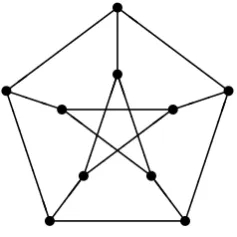
Let Γ be a graph on the vertex set Ω. An induced subgraph of Γ is obtained by choosing a subsetAof Ω as vertex set, and including all edges of Γ which join two vertices of A. A spanning subgraph is obtained by choosing the whole of Ω as vertex set, but taking a subset of the edge set of Γ. Thus, for example, the Petersen graph (Figure 1) does not contain a 4-cycle as induced subgraph, but does have the disjoint union of two 5-cycles as a spanning subgraph.
A graph isconnected if, given any two verticesvandw, there is a sequencev= x0, x1, . . . , xd=wof vertices such that xi−1 andxi are adjacent fori= 1, . . . , d.
The smallest suchd(for givenv andw) is thedistance fromv tow.
Thecomplete graph on a given vertex set has all possible edges; thenull graph has no edges. These graphs are denoted byKn andNnif there arenvertices. The
line graph of a graph Γ is the graph L(Γ) whose vertex set is the edge set of Γ, two vertices ofL(Γ) being adjacent if the corresponding edges of Γ have a common vertex. Thecomplement Γ of Γ is the graph with the same vertex set as Γ, two vertices being adjacent in the complement if and only if they are not adjacent in Γ.
Let P be a partition of a set Ω. The complete multipartite graph on Ω with multipartition P is the graph in which two vertices are adjacent if and only if they belong to different parts of P. If the number of parts is 2, we speak of a complete bipartite graph with bipartition P. A spanning subgraph of a complete multipartite graph is calledmultipartite, and similarly for bipartite.
An automorphism of a graph is a permutation of the vertex set which maps edges to edges. (If the graph is infinite, we must also require that it maps non-edges to non-edges.) The set of all automorphisms of a graph is a group, a permutation group on the vertex set, called theautomorphism group of the graph.
The best known graph is thePetersen graph, the graph with ten vertices and fifteen edges shown in Figure 1.
Z Z Z Z Z Z B B B B B B B S S S P PP Z Z Z Z Z B B B B B B t t t t t t t t t t
Figure 1. The Petersen graph
A directed graph, or digraph, is similarly defined, except that an edge is an ordered pair of vertices. So each edge has a direction, say from v to w, and can be represented by an arrow with tail atv and head atw. Such directed edges are calledarcs.
We say that a directed graph is connected, if, when we ignore the directions of the arcs (and keep only one of any pair of edges thus created), the undirected graph so obtained is connected. A directed graph isstrongly connected if, given any two vertices v and w, there is a sequence v =x0, x1, . . . , xd =w of vertices
such that there is an arc fromxi−1 toxi fori= 1, . . . , d.
Automorphisms of directed graphs are defined similarly to the undirected case. The following important result holds.
Theorem 1.1. Let D be a finite directed graph whose automorphism group is
transitive on the vertices. IfD is connected, then it is strongly connected. Proof. Let R(x) be the set of vertices which can be reached by directed paths starting atx. Clearly we have
(a) x∈R(x);
(b) ify∈R(x), thenR(y)⊆R(x);
(c) if an automorphismg carriesxtoy, then it mapsR(x) toR(y).
Now by the third property, if Aut(D) is vertex-transitive, then|R(x)|is constant for all verticesx; by the second property, if y∈R(x), thenR(y) =R(x), and so by the first propertyx∈R(y).
2. Transitivity and primitivity
In this section, we introduce some of the basic notions of permutation group theory, especially primitivity.
We begin this section with a convention that will prove useful later. We say that a structure on a set Ω is trivial if it is preserved by the whole symmetric group on Ω, and isnon-trivial otherwise.
So, for example,
(a) the trivial subsets of Ω are the empty set and the whole of Ω;
(b) the trivial partitions of Ω are the partition all of whose parts are singletons (corresponding to the equivalence relation of equality), and the partition with a single part;
(c) the trivial graphs on Ω are the complete and null graphs.
2.1. Transitivity. As we saw in the last section, a permutation group Gon Ω
istransitive if we can map any element of Ω to any other by an element ofG. In the convention introduced above,Gis transitive if the onlyG-invariant subsets of Ω are the trivial ones. The same definition applies to an action ofGon Ω.
Thestabilizer Ga of a pointa∈Ω is the set
{g∈G:ag=a}
of elements ofG(which is easily seen to be a subgroup ofG).
There is an internal description of the transitive actions of a group, as follows. LetH be a subgroup of G. Thecoset space H\Gconsists of all right cosets Hx ofH inG; there is an action ofGonH\G, where the permutation corresponding to the group elementg maps the coset Hxto the cosetHxg. The action ofGon H\Gis transitive, and the stabilizer of the cosetH is the subgroupH.
Two actions of G on sets Ω1 and Ω2 are isomorphic if there is a bijection φ: Ω1→Ω2commuting with the action ofG, that is, such that (ag)φ= (aφ)gfor alla∈Ω1 andg∈G.
Theorem 2.1. (a) Any transitive action ofGis isomorphic to the action ofG
on a coset space (specifically, onH\G, where H is the stabilizer of a point). (b) The actions ofGon coset spacesH\GandK\Gare isomorphic if and only
ifH andK are conjugate subgroups of G.
2.2. Primitivity. A transitive permutation groupGon Ω is said to beprimitive if the onlyG-invariant partitions of Ω are the trivial ones.
Primitivity is a very important concept in permutation group theory, and we will see several further characterizations of it.
A subset B of Ω is called a block, or block of imprimitivity, for G if, for all g∈G, eitherBg=B orBg∩B =∅.
Proposition 2.2. The transitive permutation group G on Ω is primitive if and
only if the only blocks forGare the empty set, singletons, and the whole ofΩ. Proof. A part of anyG-invariant partition is clearly a block. Conversely, ifB is a non-empty block, then for allg, h∈G, we haveBg=BhorBg∩Bh=∅; so the translates ofB underGform aG-invariant partition. The result follows.
We saw in the last subsection that any transitive group G can be identified withGacting on a coset space H\G.
Proposition 2.3. The action of G in H\G is primitive if and only if H is a
maximal subgroup ofG.
Proof. IfH ≤K ≤G, then the cosets of H contained inK form a block forG; every block containing the cosetH arises in this way.
2.2.1. Normal subgroups. As Cayley observed, every group is isomorphic to
a transitive permutation group. However, not every group is isomorphic to a primitive permutation group; primitive groups have strong restrictions on their normal subgroup structure. The basic observation is:
Proposition 2.4. A non-trivial normal subgroup of a primitive group is transitive.
Proof. This follows from the observation that the orbits of a normal subgroup of a transitive group are blocks for the group.
Theorem 2.5. A primitive permutation group has at most two minimal normal
subgroups; if there are two, then they are isomorphic, non-abelian, and regular, and each is the centralizer of the other in the symmetric group.
Proof. A permutation group (not necessarily transitive) is called semiregular if the stabilizer of any point is the identity. Thus a transitive semiregular group is regular. It is easy to show that the centralizer of a transitive group is semiregular. Suppose thatN1andN2are minimal normal subgroups of the primitive group G. Then each of N1 andN2 is transitive; but they centralize each other, and so each is semiregular, and so regular. Clearly it is not possible for there to be a third minimal normal subgroup.
Example 2.6. Here is an example of a primitive group with two minimal normal subgroups. LetSbe any finite group, and letG=S×S. Then there is an action ofGon S, where the first factor acts on the left and the second on the right, as follows:
(g, h) :x7→g−1xh.
It is easy to show that the action is faithful if and only if S has trivial centre. Moreover, the action is primitive if and only if S is a non-abelian simple group. For any congruence for the second factor is the relation “same coset ofT” for some subgroupT ofS; and this congruence is preserved by the first factor if and only if Tis a normal subgroup. So, ifSis simple, thenGhas only the trivial congruences; and conversely.
2.2.2. Other definitions. In this section, we give two further properties
equiv-alent to primitivity, one due to Higman, the other to Rystsov.
Let G be a transitive permutation group on Ω. Then the set Ω2 of ordered pairs of elements of Ω is partitioned into orbits under the componentwise action of G. These orbits are called orbitals ofG. One orbital consists of all the pairs (a, a) for a∈ Ω (by the assumption of transitivity); this is the diagonal orbital. Any non-diagonal orbital can be regarded as the set of edges of a digraph on the vertex set Ω, called anorbital digraph of G. If the orbital O is symmetric (that is, (a, b) ∈ O implies (b, a) ∈ O), then we can regard the orbital digraph as an undirected graph.
Theorem 2.7. The transitive permutation group G is primitive if and only if
every non-diagonal orbital digraph is connected.
Proof. If there is an orbital digraph which is not connected, then its connected components form blocks for G. Conversely, suppose that there is a non-trivial G-invariant partition P of Ω, and choose distinct points a, bin the same part of P. Then the orbital digraph corresponding to the orbital (a, b)Ghas the property that all its edges are contained within parts ofP, so it is not connected.
The next theorem was essentially proved, but not stated, by Rystsov [91]; the statement in this form appears in [12].
Theorem 2.8. Let G be a transitive permutation group on Ω, where |Ω| = n.
Then G is primitive if and only if, for any map f: Ω → Ω of rank n−1, the monoidhG, ficontains an element of rank 1.
This theorem is not difficult, but it will be much easier when we have developed a bit more technique.
2.3. Imprimitive groups and wreath products. A transitive but imprimitive
is the wreath product SkwrSm of symmetric groups of degrees k and m. This
means that it is the product of two subgroups:
(a) thebase group, the direct product ofmcopies ofSk, where theith copy acts
on theith part of the partitionP;
(b) thetop group, isomorphic toSm, which permutes the parts ofP.
The base group is a normal subgroup, and the top group acts on it by permuting the direct factors. Thus the group has order (k!)mm!.
It is possible to define the wreath product of two arbitrary permutation groups similarly, and to show that ifGis an imprimitive group,H is the group induced on a block by its setwise stabilizer, andLis the group of permutations of the blocks induced byG, thenGis embedded into the wreath productHwrL.
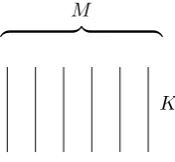
The set on which the wreath product acts can be identified with the Cartesian productK×M, whereK={1, . . . , k} andM ={1, . . . , m}: we think of this as a fibre space overM, where each fibre is isomorphic toK (Figure 2):
M
z }| {
[image:11.595.258.346.316.397.2]K
Figure 2. A fibration
This action of the wreath product is called theimprimitive action, as opposed to thepower action, which we will meet shortly.
2.4. The O’Nan–Scott theorem. The group-theoretic structure of primitive
groups was further elucidated independently by Michael O’Nan and Leonard Scott at a conference on finite groups in Santa Cruz in 1979. Both papers appeared in preliminary proceedings but only Scott’s paper is in the final volume. We do not require the full detail of the theorem (for which see [78]), so we can make some simplifications.
2.4.1. Non-basic groups. A Cartesian structure or power structure on Ω is a bijection between Ω and the setKM of functions fromMtoK, where|M|,|K|>1.
This gives Ω the structure of anm-dimensional hypercube (wherem=|M|) whose sides have size |K|. IfK ={1, . . . , k} and M ={1, . . . , m}, then Ω is identified with the set of m-tuples over the alphabet K = {1, . . . , k}. The automorphism group of a power structure is the wreath productSkwrSm, but in a different action
from the imprimitive action we saw earlier: the power action, or product action, of the wreath product.
LetGact on Ω. We say thatGisnon-basicif it preserves a Cartesian structure on Ω, andbasic otherwise.
A transitive non-basic group is embeddable in the wreath product of permu-tation groups on K and M in the power action. Elements of the base group of the wreath product permute the symbols in each coordinate independently, while elements of the top group permute the coordinates. If we take a set of size km partitioned intomsets of sizekon which the wreath product has its imprimitive action, then we can identify the elements of the Cartesian structure with sets of points which are sections for the partition (that is, contain one element from each part).
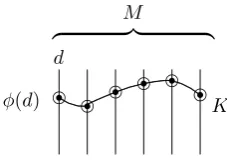
In other language, in terms of the fibre space K×M on which the wreath product has its imprimitive action, the elements of the product action (which are the functionsφ:M →K) are theglobal sections of the fibration (Figure 3):
M
z }| {
φ(d) d
[image:12.595.232.346.374.454.2]re re re re re re .......... . . . . . . . . . . . . . . . . .. ... ... ... . . . . . . . . . . . . . . . . . . . . . . . . ... . . . . . . . . . . . . .... ... . . . . . . . . . . . . . . . . . . . . . . . . . . . . . . . . . . . K
Figure 3. A global section
However, for primitive groups, we can make a stronger statement.
Theorem 2.9(O’Nan–Scott for non-basic groups). LetGbe a primitive but
non-basic permutation group with socleN. ThenGis embeddable in the wreath product G0wrK, where G0 is a basic primitive permutation group. Moreover, if K has degreen, thenN =Nn
0, whereN0is either the socle or a minimal normal subgroup ofG0.
2.4.2. Basic groups. In order to describe basic groups, we need to look at several special classes of groups.
Affine groups LetV be ad-dimensional vector space over the fieldFp, where
pis prime, and letH be a group of linear transformations ofV. Then there is a correspondingaffine group
G={x7→xh+v:h∈H, v∈V}
of permutations of V, generated by the translations (which form a normal sub-group) and elements ofH.
Theorem 2.10. With the above notation,
(a) Gis always transitive;
(b) Gis primitive if and only ifH actsirreduciblyonV (that is, leaves invariant no non-zero proper subspace ofV);
(c) G is basic if and only if H acts primitively on V (that is, preserves no non-trivial direct sum decomposition ofV).
A primitive group is affine if and only if its socle (which is its unique minimal normal subgroup) is an elementary abelianp-group.
Diagonal groups LetS be a non-abelian finite simple group. Adiagonal group
is one whose socle isSn, acting on the cosets of a diagonal subgroup
{(s, s, . . . , s) :s∈S} ofSn.
Forn= 2 we have the example ofS×S acting by left and right multiplication we saw earlier.
A diagonal group may also contain
(a) automorphisms ofS, acting in the same way on all factors; (b) permutations of the factors.
Ifn >2, we must have at least a transitive group of permutations of the factors in order for the diagonal group to be primitive.
Almost simple groups A groupGisalmost simpleif its socle is simple. Such a
group is an extension of a simple group by a subgroup of its automorphism group; in other words, there is a simple groupS such thatS≤G≤Aut(S).
For example, the symmetric group Sn is almost simple for n≥5. (It is affine
forn≤4.)
The almost simple primitive groups are the largest and least understood class. Note that, unlike the other two cases, the action of the group is not specified.
Theorem 2.11 (O’Nan–Scott for basic groups). Let G be a basic primitive
The O’Nan–Scott Theorem opened the way to the application of the Classifi-cation of Finite Simple Groups to permutation group theory, which has been done very successfully since the Classification was first announced in 1980. (These re-sults were conditional on the Classification until its proof was completed in 2005.)
2.5. The Classification of Finite Simple Groups. This major theorem has
a proof which is currently over 10000 pages long. We will not specify the groups too precisely, since there are good sources for this: we recommend [115].
Theorem 2.12. Any finite simple group is one of the following:
(a) a cyclic group of prime order; (b) an alternating groupAn,n≥5;
(c) a group of Lie type;
(d) one of the26 sporadic finite simple groups. We refer to this theorem as CFSG.
The groups of Lie type are quotients of matrix groups over finite fields. There are finitely many families; some (the classical groups, which we will discuss in more detail later) are parametrized by a dimension and a field order; the rest (the exceptional groups) just by a field order.
2.6. 2-transitive and 2-homogeneous groups. A permutation groupGon Ω
is said to be 2-transitiveif it acts transitively on the set of ordered pairs of distinct elements of Ω: in other words, given two ordered pairs (a1, a2) and (b1, b2), with a16=a2 andb16=b2, there existsg∈Gwithaig=bi fori= 1,2.
A permutation groupGon Ω is said to be 2-homogeneousif it acts transitively on the set of 2-element subsets of Ω. This is weaker than 2-transitivity, since we do not require that we can interchange two points. Indeed, a 2-homogeneous group is 2-transitive if and only if its order is even. For, ifGis 2-transitive, then an element which interchanges two points has even order. Conversely, a group of even order contains an involution, so some pair of points can be interchanged; if the group is 2-homogeneous, then any pair can be interchanged.
Using this, the classification of 2-homogeneous but not 2-transitive groups was achieved by Kantor and Berggren independently in the late 1960s, using the Feit– Thompson theorem on solvability of groups of odd order [69, 22].
Theorem 2.13. Let Gbe a permutation group onΩwhich is2-homogeneous but
not 2-transitive. Then we can identify Ω with the finite field Fq where q ≡ 3
(mod 4), so that Gis a subgroup of the semi-affine group {x7→a2xσ+b:a, b∈Fq, a6= 0, σ∈Aut(Fq}.
The classification of 2-transitive groups is a consequence of CFSG. We do not discuss the result here; the list of 2-transitive groups can be found in the books by Cameron [35] and by Dixon and Mortimer [47].
We conclude this section with a simple observation:
Proposition 2.14. A 2-homogeneous group is primitive.
Proof. This follows easily from Higman’s Theorem, since any two points are adja-cent in a non-trivial orbital graph forG, which is thus connected.
So we have the following properties of permutation groups: transitive⇐primitive⇐basic
⇐2-homogeneous⇐2-transitive.
Note that each of these properties is closed upwards: an overgroup of a per-mutation group with the property also has the property.
3. Synchronization
Our automata (illustrated by examples below) are very simple gadgets. An au-tomaton is a triple (Ω, A, F), where Ω is a finite set of states, A a finite input alphabet, and F a map from A to the set of all functions from Ω to itself. The machine is in one of the states s ∈ Ω; on reading an input, a symbol from the alphabetA, it undergoes a change of state to the image ofsunder F(a). Unlike the automata used in other areas, there is no prescribed initial or terminal state; these automata do not accept languages. Moreover, they are deterministic: there is a unique functionF(a) for eacha∈A.
An automaton can read a word in A, a finite sequence of letters; each letter causes a change of state, and the overall effect is then a function on Ω which is the composition of the functions corresponding to the letters. Our interest is whether an automaton has a reset word with the property that, if it is presented in an unknown state, then reading the reset word brings it to a known state.
3.1. Two examples. The first example was suggested by Olof Sisask.
Example 3.1. A certain calculator has an ‘On’ button but no ‘Off’ button. To
switch it off, you hold down the ‘Shift’ key and press the ‘On’ button. The ‘Shift’ key has no effect if the calculator is switched off. Assuming that you can’t see the screen, how can you ensure that the calculator is switched off?
Obviously, pressing the ‘On’ button leaves the calculator switched on, no mat-ter what its former state; and then ‘Shift-On’ will switch it off.
Note that if, instead, there is a single ‘On-Off’ button which toggles the states, then the problem would have no answer.
Example 3.2. You are in a dungeon consisting of a number of rooms. Passages
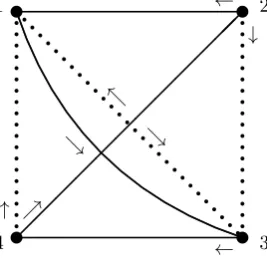
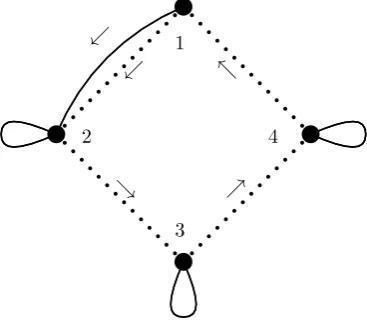
are marked with coloured arrows, where the colours aredotted and solid. Each room contains a special door; in one room (say 4), the door leads to freedom, but in all the others, to instant death. You have a schematic map of the dungeon (Figure 4), but you do not know where you are.
[image:16.595.234.368.485.619.2]← ← % . ... ... ... ... ... ... ...... ...... ...... ...... ...... ...... & qq qq qq qq qq qq qq qq qq qq q qq qq qq qq qq qq qq qq qq qq q ↓ ↑ q q q
q q q q q q
q q q q q q
q q q q q q
q q q q q qq q -& u u u u 1 2 3 4
You can check that the sequence (dotted, solid, dotted) takes you to room 1 from any starting point. Then you can use the map to navigate to the exit door in room 4.
3.2. Automata and synchronization. Combinatorially, an automaton can be
regarded as an edge-coloured digraph, where the vertices are the states, and edge colours correspond to letters of the alphabet; there should be one edge with each colour out of each vertex. On reading a letter in a given state, the automaton follows the edge whose colour corresponds to that letter, and moves to the state at the terminus of this edge. This is the representation used in Figure 4. An-coloured automaton is said to becomplete and deterministic if for each colour c and from each vertex (or state) there is one and only one out-arrow coloured c. In this paper we only consider deterministic and complete automata. Figure 4 provides the example of a 4-state 2-coloured automaton which is complete (in every state there are out-arrows of both colours) and deterministic (no state has two different out-arrows of the same colour). In a finite deterministic automaton, each colour induces a transformation of the states. For example, in Figure 4 the two colours, that is, the two transitions, induce the following transformations
dotted =
1 2 3 4 3 3 1 1
solid =
1 2 3 4 3 1 4 2
.
Algebraically, we will be interested in the composition of transitions of the automaton. The set of all transformations of the states which are produced by applying a (possibly empty) sequence of transitions is atransformation semigroup on Ω; that is, a set of transformations closed under composition. So we can regard an automaton as a transformation semigroup (acting on the set of states) with a prescribed set of generators (the transitions of the automaton, corresponding to the colours or the letters labelling the arrows).
Therank of a transformation of Ω is the cardinality of its image.
Areset wordis a sequence of transitions such that the composition of the tran-sitions in the sequence, applied to any starting vertex, brings you to the same state. An automaton which possesses a reset word is calledsynchronizing. Thus, from the algebraic point of view, an automaton is synchronizing if the corresponding transformation monoid contains a map of rank 1, that is, a constant map.
Not every finite automaton has a reset word. For example, if every transition is a permutation, then every word in the transitions is a permutation, and has rank equal to|Ω|.
3.3. The ˇCern´y conjecture. Here is a simplified example of the application of
transitions can be performed by simple machinery, and apply a reset word before the pieces arrive at the robot.
Example 3.3. Suppose that the component is square with a projecting tab on
one side.
It can sit in a tray on the conveyor belt in any one of four orientations. The following transitions are easy to implement:
A: rotate through 90◦ in the positive direction;
[image:18.595.254.342.164.259.2]B: rotate through 90◦ if the projection points up, otherwise do nothing. Figure 5 is a diagram of the automaton. Transition A is represented by a dotted line; transition B is represented by a solid line (fixing the states 2, 3 and 4). Each state represents the position of the component with the projection on that side. x x x x 1 2 3 4
q qq q q qq q
q qq q q qq q q qq q
q qq q q qq q
q qq q
qq qq qq qq qq qq qq
qq qq qq
[image:18.595.207.391.404.569.2]qq qq qq qq qq qq . & % -... ... ... ... ... ... ... ... ... ... ... ... . ... ... ... ... ... ... ... ... ... ... ... ... ... ... ... ... ... . . . ... ... ... ... ... ... ... ... ... ... ... ............... . ... ... ... ... ... ... ... ... . ...... ............ .... ... ... ... ... ... ... ... ... ... ...
B A A A B A A A B
1 2 3 4 1 2 3 4 1 2
2 2 3 4 1 2 3 4 1 2
3 3 4 1 2 2 3 4 1 2
4 4 1 2 3 3 4 1 2 2
So BAAABAAAB is a reset word.
It can be shown that there is no shorter reset word for this automaton. Moreover, the example extends to any numbernof states, replacing the square by a regularn-gon. The corresponding shortest reset word has length (n−1)2.
In 1969, ˇCern´y made the following conjecture (see [108]):
Conjecture 3.4. Suppose that an automaton with n states is synchronizing.
Then it has a reset word of length at most (n−1)2.
This conjecture is still open after close to fifty years! The example above shows that, if true, it would be best possible. The best current upper bound, despite years of intensive effort, is n36−n, due to the combined work of Frankl [54] and Pin [87] from 1983. The remainder of the literature consists of special cases (e.g. [4, 5, 6, 7, 9, 14, 21, 40, 41, 42, 50, 70, 71, 86, 88, 89, 90, 91, 92, 97, 99, 100, 104, 105]). The strongest result is Dubuc’s theorem [49], which proves the ˇCern´y conjecture under the assumption that some transition cyclically permutes the states, as is the case for the ˇCern´y examples [42]. See [68] for a recent approach involving linear programming.
One of the difficulties of the ˇCern´y problem is that there are few known families of slowly synchronizing automata (cf. [8] for the connection with exponents of primitive digraphs) and so we don’t have a very good understanding of what makes an automaton slow to synchronize. In fact, the ˇCern´y sequence is still the only infinite sequence of examples ofn-state automata that have minimal length reset word of length (n−1)2.
The other issue is that random automata are synchronizing and synchronize quickly. More precisely, Berlinkov [23] showed that a randomn-state automaton is synchronizing with high probability asnapproaches infinity. Nicaud [85] proved that ifε >0, then with high probability ann-state automaton has a reset word of length at mostn1+ε. Thus one is unlikely to find a counterexample by searching
at random; also the search space is too large for a brute force attempt to find a counterexample.
We will not prove the ˇCern´y conjecture in this paper, but it provided motivation for our approach, and we will return to it later.
For an accessible discussion of the ˇCern´y conjecture, we recommend the survey by Volkov [108].
3.4. The Road-Colouring Conjecture. The underlying digraph of an
Conversely, and trivially, given any digraph with this property, it is clear that it can be edge-coloured so as to represent an automaton.
The resulting automaton may or may not be synchronizing. What are nec-essary and sufficient conditions for there to be an edge-colouring representing a synchronizing automaton?
We will assume that the automaton can be synchronized in any given state by a suitable reset word. A necessary and sufficient condition for this is that it is strongly connected. (If so then, as in our dungeon, if we can synchronize at some state, we can move from there to any other state.)
It is also necessary that the greatest common divisor of the lengths of cycles in the digraph is 1. For suppose the g.c.d. of cycle lengths isd. Choose any vertexv, and let Ωi be the set of vertices reachable fromv in a number of steps congruent
to i mod d, for i = 0,1, . . . , d−1. The sets Ωi are pairwise disjoint, and so no
automaton based on the digraph can be synchronizing.
The conjecture that these two necessary conditions are also sufficient was made in 1970 by Weiss and Adler [1, 2] in connection with symbolic dynamics, and became known as the Road-Colouring Conjecture. It was proved by Avraham Trahtman in 2007 [106]:
Theorem 3.5. Let D be a digraph which is strongly connected and has constant
out-degree, and suppose that the greatest common divisor of the cycle lengths inD is1. Then D can be edge-coloured so as to produce a synchronizing automaton.
3.5. Synchronizing groups. Looking at the extreme examples above for the
ˇ
Cern´y conjecture, we see that, of the two transitions, the first is a cyclic permu-tation, which generates a transitive group on the set of states; the second is a non-permutation.
This observation is the basis of the next definition [10, 14]. A permutation group Gon Ω is said to besynchronizing if, whenever f is a map on Ω which is not a permutation, the monoidhG, fiis synchronizing (that is, there is a word in f and the elements ofGwhich has rank 1).
We have abused language here since G itself (regarded as a monoid) is not a synchronizing monoid; but a permutation group cannot be a synchronizing monoid, so hopefully the confusion will not be too great.
For example, the automorphism group of the Petersen graph is synchronizing. This fact can be proved by considering all possible non-permutations on the vertex set; but in the next section we will develop a technique to make it much easier to check assertions like this.
More generally, we say that a permutation groupGsynchronizesa non-permutation f ifhG, fi contains a map of rank 1. Thus,Gis synchronizing if it synchronizes every non-permutation.
The next theorem shows how synchronizing groups relate to the classical no-tions of primitive and 2-homogeneous groups.
Theorem 3.6. (a) A synchronizing group is primitive.
Proof. (a) The simplest argument here is to recall the characterization of primi-tivity based on Theorem 2.8: a permutation group Gof degree n is primitive if and only if the monoidhG, fiis synchronizing for any mapf of rankn−1.
Since we haven’t proved this yet, we give a different proof. Suppose that G is imprimitive. Let P be a non-trivial G-invariant partition of Ω, and let A be a subset of Ω containing one point from each part of P (so A is a section, or transversal, ofP.) Now the mapf that takes each point of Ω to the unique point ofAin the same part ofP is not synchronized by G. For any word inf and the elements ofGwhich containsf at least once has the property that its image is a section forP, so no such word can have rank 1.
(b) Suppose thatGis 2-homogeneous, and letf be any non-permutation. Let rbe the minimal rank of an element h∈ hG, fi, and suppose for a contradiction that r > 1. Choose two distinct points x, y in the image of h, and two points u, v which are mapped to the same place by f. Then choose g ∈ G mapping {x, y} to{u, v}. Thenhgf has smaller rank thanh, a contradiction. Sor= 1, as required.
The first part of this theorem can be improved:
Proposition 3.7. A synchronizing group is basic.
Proof. LetGbe non-basic, and suppose that Ω has been identified with the set of m-tuples over a setAof sizek, in such a way that Gpreserves the identification (and so is embedded inSkwrSm).
Let f be the map which takes the m-tuple (a1, a2, . . . , am) to the m-tuple
[image:21.595.252.345.469.565.2](a1, a1, . . . , a1) with all entries equal. LetBbe the image off. Then applying any element ofGtoBgives a set ofkelements whose projections onto any coordinate form the whole ofA; so following this by f gives us the setB again. So no word inf andGcan have rank smaller thank, andGfails to synchronizef.
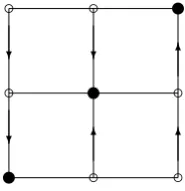
Figure 6 shows how the map works for S3wrS2, the automorphism group of the 3×3 grid.
c c
c c
c c
u
u
u
? ?
6 ?
6 6
Figure 6. Failure to synchronize a square grid
Our examples are given by the symmetric groupsSmform≥5, in their action
on the set of 2-element subsets of{1, . . . , m}.
(a) The group is primitive and basic for all m≥ 5. For it is easy to see that there are just two complementary orbital graphs: the vertex set is the set of 2-subsets of{1, . . . , m}: two vertices are joined in the first graph if they have non-empty intersection (so this is theline graph of the complete graph Km), and in the second if they have empty intersection. Now both of these
graphs are connected.
(b) The group is not 2-homogeneous. For the edges in the two orbital graphs are not equivalent.
(c) The group is synchronizing if and only ifmis odd. We will defer the proof of this assertion to the next section, when we will have another technique available.
3.6. Section-regular partitions. In the next section we will develop a very
convenient combinatorial characterization of synchronization. In the meantime we give another characterization which was introduced in [10] and developed by Peter Neumann [84].
Let P be a partition of Ω. A section, or transversal, for P is a subset A of Ω which meets every part of P in a single point. Recall that a partition P is non-trivial if it is not the partition into singletons and not the partition with a single part.
Now let G be a permutation group on Ω. We say that the partition P is section-regular forG, with sectionA, ifAg is a section forP for everyg∈G.
In Figure 6, the partition into vertical lines is section-regular for the group S3wrS2 of automorphisms, with the diagonal as a section.
Theorem 3.8. A permutation groupGonΩis synchronizing if and only if it has
no non-trivial section-regular partition.
Proof. Suppose first thatGis non-synchronizing. Letf be a map such thathG, fi contains no map of rank 1. We may suppose, without loss of generality, thatf is an element of minimal rank (sayr) inhG, fi. LetP be the kernel off, andAthe image off. IfAgis not a section forP, thenAgmeets fewer thanrkernel classes off, and sof gf has rank smaller thanr, a contradiction. SoP is section-regular with sectionA.
Conversely, suppose that P is a section-regular partition for G, with section A. Then for anyx∈Ω, there is a uniquey∈Awhich lies in the same class of P as doesx. Define a mapf by the rule that xf =y when the above holds. Now Ag is a section forP, soAgf =A, for anyg∈G. An easy induction shows that no element ofhG, fihas rank smaller than|A|.
Theorem 3.9. A section-regular partition for a transitive permutation group G onΩis uniform.
Proof. Letn=|Ω|be the degree of G. Suppose that P is section-regular forG, with sectionA. Suppose thatBis a part ofP. Count triples (a, b, g), wherea∈A, b∈B andg ∈G satisfiesag =b; there are|A| · |B| choices of aand b and then |G|/nchoices of g(since the set of elements ofGmappingatob is a coset of the stabilizer ofa). On the other hand, for everyg ∈G, |Ag∩B|= 1, so there is a unique pair (a, b) satisfying the condition. Thus|A| · |B|=n; in particular,|B|is independent of the partB ofP chosen.
Corollary 3.10. A map f of minimal rank subject to being not synchronized by
the transitive groupG has uniform kernel.
Proof. This follows from the two preceding theorems and the argument in the proof of Theoroem 3.8.
It follows that any transitive group of prime degree is synchronizing, a result due originally to Pin [86] that can be considered the first result in the theory of synchronizing groups.
Theorem 3.9 and the proof of Theorem 3.8 in fact yield the following corollary.
Corollary 3.11. Let M be a transformation monoid on a finite set Ω with a
transitive group of units. Then each element ofM of minimal rank has a uniform kernel.
3.7. The ˇCern´y conjecture revisited. Can we prove at least some instances
of the ˇCern´y bound for transformation monoids of the formhG, fi, whereGis a synchronizing permutation group?
Since the permutations in this monoid are precisely the elements in G, and these by themselves will not synchronize, it seems reasonable to build a word of the formf g1f g2· · ·f grf, where we usef to reduce the rank of the partial product
andgi to ensure that the next application off does so. Note that the rank of hf
is strictly less than the rank off if and only if two points of the image of hlie in the same kernel class off. So, if the rank of a product of the above form is at mostk, choosegr+1 to map two points in the image of the product into a kernel class off, and then the rank of the productf g1f· · ·gr+1f will be at mostk−1. If this strategy succeeds, we will have a reset word with at most n−1 occur-rences off. The task now is to bound the lengths of the expressions forg1, . . .in terms of the given generators ofG, for which hopefully group theory will help.
4. Graph endomorphisms
In this section, we define endomorphisms of graphs, and use them to give charac-terizations of synchronizing monoids and groups. This result gives us the simplest available test for the synchronizing property of permutation groups. We will il-lustrate by returning to the example of the symmetric groupSmacting on 2-sets,
and showing that it is synchronizing if and only ifmis odd.
4.1. Cliques, colourings and endomorphisms. A relational structure
con-sists of a set carrying a number of relations of specified arities. The most important example for us is a graph, a set with a single binary relation.
Ahomomorphism f :A→B between relational structures AandB is a map between the underlying sets which preserves all instances of the relation. Thus, a graph homomorphism maps edges to edges, but its action on non-edges is not specified; it could map a non-edge to an edge, or to a non-edge, or to a single vertex. (If the graph has no loops, then edges cannot be collapsed to single vertices.)
Some important graph parameters can be expressed in terms of homomor-phisms. The clique number ω(Γ) of a graph Γ is the number of vertices in the largest complete subgraph of Γ, that is, the largest number of vertices such that any two are adjacent. A(proper) colouringof Γ is an assignment of colours from a setCto the vertices in such a way that the ends of any edge have different colours. Thechromatic number χ(Γ) of Γ is the smallest number of colours required for a proper colouring of Γ.
It is clear thatχ(Γ)≥ω(Γ) for any graph Γ, since the vertices of a clique must all have different colours.
Recall that Kr is the complete graph withrvertices.
Theorem 4.1. (a) There is a homomorphism from Kr to Γ if and only if
ω(Γ)≥r.
(b) There is a homomorphism fromΓtoKr if and only if χ(Γ)≤r.
Proof. (a) The images of the vertices ofKr under a homomorphism must all be
distinct.
(b) LetC be the vertex set of Kr. We think ofC as a set of colours, and the
homomorphismf assigns tov the colourf(v). Now the definition of a homomor-phism shows that this is a proper colouring.
Corollary 4.2. For a graphΓ, the following are equivalent:
(a) ω(Γ) =χ(Γ);
(b) there are homomorphisms in both directions betweenΓand a complete graph. For a detailed study of graph homomorphisms, we recommend [59].
Anendomorphism of Γ is a homomorphism from Γ to itself. The composition of endomorphisms is an endomorphism, and the identity map is an endomorphism; so the set of endomorphisms of Γ is a transformation monoid on the vertex set of Γ, denoted by End(Γ).
4.2. Graphs and endomorphism monoids. The map Γ→End(Γ) is a map-ping from graphs to transformation monoids. Unfortunately, it is not a functor in any reasonable sense; this is also the case for the next map we define, which goes in the other direction.
LetM be a transformation monoid on a set Ω. We define a graph Γ = Gr(M) on the vertex set Ω by the following rule for adjacencies:
v and w are adjacent in Gr(M) if and only if there does not exist f ∈M withvf =wf.
This correspondence has various nice properties:
Theorem 4.3. (a) For any transformation monoidM onΩ, the graphGr(M)
has the properties (i) M ≤End(Gr(M)); (ii) ω(Gr(M)) =χ(Gr(M)).
(b) IfM1≤M2, thenGr(M2) is a spanning subgraph ofGr(M1).
Proof. (a) (i) Letf ∈M; we have to show that f is an endomorphism of Gr(M), so suppose not. Then there exists an edge{v, w}of Gr(M) which is not preserved byM. By definition,vf 6=wf; so this can only happen if{vf, wf}is a non-edge of Gr(M). But then, by definition, there exists h∈M such that (vf)h= (wf)h. Thenf h∈M andv(f h) =w(f h), contradicting the fact that{v, w}is an edge of Gr(M).
(a) (ii) Now letf be an element ofM of smallest possible rank. LetA= Im(f). No element of M can map two points of A to the same place, since if h did so thenf hwould have smaller rank thanf. So by definition,Ais a clique in Gr(M). Sincef ∈End(Gr(M)), we see thatf induces a proper colouring of Gr(M) with |A|colours.
(b) Clearly adding extra endomorphisms cannot produce new edges which were not there before.
4.3. Characterization of synchronizing monoids. Now we can give our
char-acterization of synchronizing monoids.
Theorem 4.4. Let M be a transformation monoid on Ω. Then M is
non-synchronizing if and only if there exists a non-null graphΓon the vertex setΩwith M ≤End(Γ). If such a graphΓexists, then we may choose it so thatω(Γ) =χ(Γ), and this number is equal to the minimum rank of an element ofM.
Proof. If M ≤ End(Γ) for any non-null graph Γ, then M is not synchronizing, since edges of Γ cannot be collapsed by elements ofM.
smaller rank than f. Sof has rank 1, and M is synchronizing, a contradiction. So Γ is non-null.
Now the remaining assertions of the theorem come from the properties of Gr(M) from the preceding subsection.
Corollary 4.5. Let G be a transitive permutation group on Ω. Then G is
syn-chronizing if and only if every non-trivialG-invariant graph Γ has ω(Γ)6=χ(Γ). Proof. If Γ is a non-trivialG-invariant graph withω(Γ) = χ(Γ) = r, then there are graph homomorphisms f: Γ → Kr and g: Kr → Γ. Composition of these
homomorphisms provides a singular endomorphism h: Γ → Γ and sohG∪hi is not synchronizing by the previous theorem.
The converse follows immediately from Theorem 4.4.
For example, the automorphism group of the Petersen graph is edge-transitive and nonedge-transitive; so we only have to check the Petersen graph and its com-plement. It is not hard to show that the Petersen graph has clique number 2 and chromatic number 3, while its complement has clique number 4 and chromatic number 5. So the automorphism group is synchronizing.
This corollary is the basis for the best computational test for synchronization. The test runs as follows. Given a transitive permutation groupGon Ω, run the following algorithm:
Algorithm 4.6. (a) Find all the non-trivialG-invariant graphs. There are 2r−
2 such graphs, whereris the number of orbits ofGon 2-element subsets of Ω, since the edge set of aG-invariant graph is a union of orbits ofG. (b) Test each graph Γ to see whetherω(Γ) =χ(Γ). If one does, then Gis not
synchronizing; otherwise it is synchronizing.
This algorithm looks extremely inefficient. The first stage generates exponen-tially many graphs to be checked; and computing the clique number and chromatic number of a graph are bothNP-complete problems.
However, in practice, “interesting” permutation groups often have compara-tively few orbits on 2-sets, sor is small; and the graphs which have to be tested have large automorphism groups, which can be exploited to reduce the computa-tional burden in the second step.
In the next section, we will see how the algorithm can be slightly improved.
Example 4.7. Here is an example promised earlier. Let G be the symmetric
group of degreem≥5, in its action on 2-element subsets of{1, . . . , m}. There are only two orbits on pairs of 2-element subsets: the subsets may intersect in a point, or they may be disjoint. So we have twoG-invariant graphs to consider: the line graph ofKmand its complement.
Let Γ be the line graph ofKm. The clique number of Γ ism−1; a typical
max-imal clique is{{1, i}:i= 2, . . . , m}. When can the chromatic number bem−1? Pairs with the same colour must be disjoint, so there are at mostbm/2cpairs in a colour class. Ifmis odd, this number is (m−1)/2, so at least m2
colours are required. Ifm is even, we can have m/2 edges in a colour class, and m−1 colours. This can be realized as follows. Take a regular (m−1)-gon in the plane. The edges and diagonals fall intom−1 parallel classes, with (m/2)−1 pairs in each class, and one point omitted from each class. Assign one colour to all the edges in each class. Now add an extra point∞, and give the colour of a classCto the pair consisting of∞and the point omitted byC. For example, ifm= 6 and we label the vertices of the regular pentagon by 1,2,3,4,5 in counterclockwise order-ing, then the five colour classes are{{1,2},{3,5},{4,∞}},{{2,3},{1,4},{5,∞}}, {{3,4},{5,2},{1,∞}},{{4,5},{1,3},{2,∞}}, and {{1,5},{2,4},{3,∞}. So this graph Γ hasω(Γ) =χ(Γ) if and only ifmis even.
Now let Γ be the complement of the line graph ofKm. Now a clique consists
of disjoint pairs, so the largest clique has size bm/2c. But Γ cannot be coloured with this many colours. For the colour classes must be cliques inL(Km); we saw
that such cliques have size at most m−1 and so we would need at leastm/2 in a partition. So we could only achieve the bound ifm were even and the cliques were pairwise disjoint. But the cliques of sizem−1 consist of all pairs containing a given point; and the cliques defined by points a and b have the pair {a, b} in common. So this graph never has clique number and chromatic number equal.
We conclude that, form≥5,Smacting on 2-sets is synchronizing if and only
ifm is odd.
We remark that, in fact, the chromatic number of the complement ofL(Km)
is known to bem−2; this is a special case of a theorem of Lov´asz [80].
Theorem 4.4 and Corollary 4.5 have been used in a number of places, for example, [11, 12, 37, 93], for investigating synchronizing groups.
4.4. Rystsov’s Theorem. We illustrate these concepts by proving Theorem 2.8.
With the terminology we have introduced, the theorem states:
Theorem 4.8. A transitive permutation group of degreenis primitive if and only
if it synchronizes every map of rankn−1.
Proof. Suppose first thatGfails to synchronize the mapfof rankn−1. Then there exist aand b such thataf =bf, but f is injective on any subset not containing bothaandb. Suppose that Γ is a non-trivial graph withhG, fi ≤End(Γ). SinceG is transitive, Γ is regular; suppose that every vertex has degreed. Sinceaf =bf, we see that{a, b} is a non-edge of Γ; so f maps the neighbours of a bijectively to the neighbours of af. Similarly, f maps the neighbours of b bijectively to the neighbours of bf =af. Hence a and b have the same neighbours. Now the relation≡, defined byx≡y if and only ifxandy have the same neighbours, is a G-invariant equivalence relation; soGis imprimitive.
Conversely, suppose that Gis imprimitive; let P be a non-trivial G-invariant partition. Letaand bbe two points in the same part ofP. Define a mapf by
xf= (
It is easy to see that f has rank n−1 and is not synchronized by G (it is an endomorphism of the complete multipartite graph with multipartitionP).
In the paper [11], the authors extend this result to show that a primitive group of degreensynchronizes any map of rankn−4 or greater. The non-basic group S3wrS2, the automorphism group of the 3×3 square grid, has degree 9 and fails to synchronize a map of rank 3 (the grid graph has clique number and chromatic number 3); so this result is within one of best possible.
4.5. Cores and hulls. Thecore of a graph Γ is the smallest graph ∆ with the
property that there are homomorphisms from Γ to ∆ and from ∆ to Γ. It is known that every graph has a core, which is unique up to isomorphism; moreover, the core is an induced subgraph of Γ, and there is aretraction from Γ to its core (an endomorphism which acts as the identity on its image).
Cores play an important role in the theory of graph homomorphisms, see [59]. We remark that the graphs which we used in our characterization of synchronizing monoids can be defined as the graphs whose cores are complete. The following well-known result in graph theory [58, Theorem 3.9], can be viewed as part of the theory of synchronizing groups.
Theorem 4.9. Let Γ be a vertex-transitive graph. Then the retraction fromΓ to
its core is uniform; in particular, the number of vertices in Core(Γ) divides the number of vertices ofΓ.
Proof. The retraction from Γ to its core is a minimal rank element of End(Γ) and so the theorem follows from Corollary 3.11.
A “dual” concept is that of thehull of a graph, introduced in [38]. It is defined by
Hull(Γ) = Gr(End(Γ));
in other words, two vertices are adjacent in the hull of Γ if and only if no endo-morphism of Γ collapses them to the same point.
Some of its properties are given by the following result:
Theorem 4.10. (a) Γis a spanning subgraph ofHull(Γ).
(b) The core ofHull(Γ)is a complete graph on the vertices of the core ofΓ. (c) End(Γ)≤End(Hull(Γ)) andAut(Γ)≤Aut(Hull(Γ)).
Proof. (a) This just says that every edge of Γ is an edge of its hull, which is clear since endomorphisms do not collapse edges.
(b) The core of Γ is the image of an endomorphism of Γ of minimal rank. Thus endomorphisms of Γ cannot identify two vertices of the core, so it induces a clique in Hull(Γ). This clique is the image of an endomorphism of Hull(Γ), and it is clear that no endomorphism can have smaller image; so it is the core of Hull(Γ).
Thus, passing from a graph to its hull cannot decrease the symmetry, but might increase it in some cases.
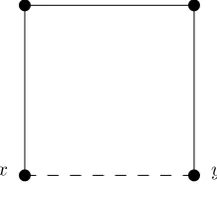
Example 4.11. Let Γ be the path of length 3, shown in Figure 7.
u u
u u
[image:29.595.244.353.147.250.2]x y
Figure 7. A graph and its hull
5. Related concepts
The definition of synchronization can be varied in several ways, giving rise to several closely-related concepts. We consider some of these in this section of the paper. Perhaps the most interesting is the property of being almost synchronizing. The first examples showing that this is not equivalent to primitivity were found very recently.
We also define some measures of how far a given group is from being synchro-nizing.
5.1. Almost synchronizing groups. We saw in the preceding section that the
symmetric group Sm acting on 2-sets is primitive but not synchronizing if m is
even andm≥6.
However, the only maps that it fails to synchronize are the proper endomor-phisms ofL(Km), which all have rankm−1.
To take another example, consider the (non-basic primitive) group SkwrSm
fork≥3,m≥2. This group fails to be synchronizing, but the situation is more complicated than the preceding one. Consider theHamming graphH(m, k), whose vertices are allm-tuples over an alphabet of sizek, and twom-tuples are adjacent if they agree in all but one position. The automorphism group of this graph is the wreath productSkwrSm.
Now, for anyd with 1≤d≤m, we can construct an endomorphismfd with
rankkd, as follows. Choose the alphabet to be a group of order k, for example, the additive group of the integers modk. Now set
(a1, . . . , am)fd= (a1, . . . , ad−1, ad+ad+1+· · ·+am,0, . . . ,0).
It is easily verified that changing one coordinate in anm-tuple changes one coor-dinate in its image, sofd is an endomorphism; its image is the Hamming graph
H(d, k) withkd vertices, as required.
So for this group, there are maps which are not synchronized but have a variety of ranks, not just the minimum possible rank. However, all these maps have uniform kernels. Can there exist a map with non-uniform kernel synchronized by G?
These considerations suggested the following definition. Let us call a transitive permutation groupG on Ωalmost synchronizing if every map on Ω which is not uniform (i.e. not all its kernel classes have the same size) is synchronized byG. We note that an almost synchronizing group is primitive. For suppose thatGis im-primitive, and preserves the non-trivial partitionP. Form the multipartite graph in which two vertices are adjacent if they lie in different parts ofP. This graph is preserved byG, but we can collapse vertices within each part ofP arbitrarily by endomorphisms.
On the strength of this observation and examples like those above, it was conjectured for some time that every primitive group is almost synchronizing.
Consider the following two graph products. Let Γ and ∆ be graphs with vertex setsAandB respectively.
(a) The cartesian product Γ∆ has vertex set A×B; there is an edge from (a1, b1) to (a2, b2) if eithera1 = a2 and b1 is adjacent to b2 in ∆, or a1 is adjacent toa2in ∆ andb1=b2.
(b) The categorical product Γ×∆ also has vertex set A×B; but there is an edge from (a1, b1) to (a2, b2) if there are edges froma1to a2 in Γ and from b1 tob2 in ∆.
The notation for these products is chosen so that the product symbol represents the corresponding product of two edges.
For example, the Cartesian product of two copies ofKris the Hamming graph
H(2, r), while the categorical product is the complement ofH(2, r).
Now here is a flexible construction of primitive graphs with non-uniform endo-morphisms.
Example 5.1. Let Γ be a graph whose automorphism group acts primitively
on its vertices. Then the Cartesian product ΓΓ is also vertex-primitive, with automorphism group Aut(Γ)wrS2. In addition, if the chromatic and clique number of Γ are both equal tok, thenV(Γ) can be partitioned intokcolour classes, sayV1, V2,. . .,Vk; these classes have equal size, by Theorem 3.9. So there is a surjective
homomorphism ΓΓ→ Kk Kk with kernel classes Vi×Vj for 1≤i, j ≤k}.
Moreover, there is a homomorphism from Γ to ΓΓ; simply take the second coordinate to be fixed.
If in addition there is a homomorphismf :KkKk →Γ, then by composing
homomorphisms
ΓΓ→KkKk f
→Γ→ΓΓ,
there is an endomorphism of ΓΓ. Moreover, if the homomorphism f is non-uniform, then the endomorphism is also non-uniform; and its rank is equal to the rank off.
We can obtain examples by taking Γ to be the complement of KkKk, that
is, Γ =Kk×Kk. Now a homomorphismf from KkKk toKk×Kk is given by
(u, v)7→(g(u, v), h(u, v)), where the two coordinate functions g(u, v) and h(u, v) satisfy the homomorphism requirement that if (u, v) and (u0, v0) agree in one po-sition but not the other, theng(u, v)6=g(u0, v0) andh(u, v)6=h(u0, v0).
In other words,gandhareLatin squares of orderk: that is, they definek×k arrays with entries from a set of sizeksuch that no entry is repeated in a row or a column. But note that there is no connection between the two Latin squares!
The rank of the homomorphism is the number of ordered pairs of symbols which arise when the two Latin squares are superimposed. The possibilities have been determined by Colbourn, Zhu and Zhang [43, 116]:
Theorem 5.2. There are two Latin squares of orderk whose superposition gives
(a) k= 2 andr= 4; (b) k= 3 andr∈ {5,6,7};
(c) k= 4 andr∈ {7,10,11,13,14}; (d) k= 5 andr∈ {8,9,20,22,23};
(e) k= 6 andr∈ {33,36}.
Note that the case r =k corresponds to using the same Latin square twice, whiler=k2corresponds to a pair of orthogonal Latin squares. In these cases, the endomorphism constructed is uniform; but in general it is not.
We conclude that, for each value ofrwithr=k, orr=k2, ork+2≤r≤k2−2, with the exceptions given in Theorem 5.2, there is a map of rankknot synchronized by the primitive groupG= (SkwrC2) wrC2 (of degreek4); in most cases, these maps are not uniform, so the groupGis not almost synchronizing.
Here is another example from [11]. Though this construction is not as flexible as the previous one, it was the first one found, produces a primitive group of smallest possible degree (namely 45) which is not almost synchronizing, and also produces a non-uniform map of smallest possible rank (namely 5) which fails to be synchronized by a primitive group.
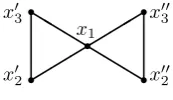
We start with three particular graphs. Two of these examples are two of the three “remarkable graphs” discussed by Biggs [25], namely the Petersen graph (see Figure 1) and the Biggs–Smith graph; the third is theTutte–Coxeter graph on 30 vertices [107, 44]. All are trivalent graphs without triangles, and have proper 3-edge colourings; and their automorphism groups act primitively on the edges. We consider their line graphs. These are 4-valent vertex-primitive graphs with chromatic number 3; the closed neighbourhood of a vertex is the butterfly graph shown in Figure 8.
r r
r r
r
" "
" "
""
b b b b b b x
1 x02
x03
[image:32.595.255.342.434.484.2]x002 x003
Figure 8. The butterfly
Take a 3-colouring of one of these line graphs, with colour classesC1,C2, C3. A colour class contains no edges; so ifvis a vertex in C3, then two neighbours of v lie in each of the other two classes. So the induced subgraph on C2∪C3 has valency 2, and is a union of cycles. (The cycles have even length since the colours alternate.) If this induced subgraph is disconnected, letC0 andC00 be unions of connected components; and let C20 = C0 ∩C2, C200 =C00∩C2, and similarly for C30 and C300. This gives partitions C2 =C20 ∪C200 and C3 =C30 ∪C300, with edges only between C20 and C30 and between C200 and C300. In other words, we have a homomorphism from L(Γ) onto the butterfly, where C1 maps to the “body” x, andC0
The line graph of the Petersen graph has a unique 3-colouring up to isomor-phism, andC2∪C3 turns out to be connected. But in each of the other cases, the required homomorphism exists. For the line graph of the Tutte–Coxeter graph (with 45 vertices), the induced subgraph onC2∪C3 falls into components of sizes 10 and 20, and so we obtain a homomorphism with kernel classes of sizes 5, 5, 10, 10, and 15. Since the butterfly is a subgraph, we can realise this map as an endomorphism ofL(Γ); so the automorphism group ofL(Γ) is primitive but not almost synchronizing.
Further analysis shows that this graph has an endomorphism onto the “double butterfly” (a triangle with triangles attached at two of its vertices) with rank 7. (We performed the computation using the software systems GAP [56] and
Minion[55].)
The line graph of the Biggs–Smith graph is even more prolific. It has non-uniform endomorphisms of ranks 5, 7 and 9 (the last onto the “triple butterfly”, a triangle with triangles attached at each vertex).
An almost synchronizing group is primitive (since an imprimitive group pre-serves a complete multipartite graph, which has non-uniform endomorphisms). However, it need not be basic: the automorphism group of the square grid (Fig-ure 6) fails to synchronize only uniform maps of rank 3, but is clearly not basic. In the other direction, the butterfly examples in this section show that primitive groups which fail to be almost synchronizing may or may not be basic. So there is no implication between these concepts.
5.2. Separating groups. The next variant is based on the following theorem.
A set of vertices of a graph Γ isindependentif it contains no edge (so the induced subgraph on the set is a null graph). Letα(Γ) be theindependence number of Γ, the size of the largest independent set. Note thatα(Γ) =ω(Γ).
Theorem 5.3. LetΓbe a graph onnvertices, whose automorphism groupGacts
transitively on vertices. Thenα(Γ)·ω(Γ) ≤n. Equality holds if and only if any clique and any independent set of maximum size have non-empty intersection. Proof. Let A be a clique and B an independent set. Count triples a, b, g with a ∈ A, b ∈ B, and ag = b. There are |A| choices for a, |B| choices for B, and |G|/|Ω|choices forg (since the set of suchg is a coset of the stabilizer of a point, and all such cosets have the same cardinality). On the other hand, there are|G| choices forg, and for each choice there is at most one element inAg∩B, since a clique and an independent set cannot have more than one point in common. So
|A| · |B| · |G|/n≤ |G|,
giving |A| · |B| ≤ n. If equality holds, then Ag∩B 6= ∅ for all g ∈ G, and in particularA∩B6=∅; this holds for any clique and independent set.