Using isotopic dilution to assess chemical extraction of labile Ni, Cu, Zn, Cd and Pb in soils
J. M. GARFORTHa,b,E.H.BAILEYb,*,A.M.TYEc,S.D.YOUNGb&S.LOFTSa
a
Centre for Ecology & Hydrology, Lancaster Environment Centre, Library Avenue, Bailrigg,
Lancaster, LA1 4AP, England,bThe University of Nottingham, School of Biosciences, Sutton
Bonington Campus, LE12 5RD, England, cBritish Geological Survey, Environmental Science
Centre, Keyworth, Nottingham, NG12 5GG, England
*Corresponding Author: [email protected]
Highlights:
Stable isotope dilution can inform underlying mechanisms during chemical extraction Agreement between extracted metal and E values is sometimes fortuitous
Powerful extractants (0.05 M EDTA and 0.43 M Nitric acid) solubilize non-labile metal
Weaker extractants (0.43 M CH3COOH and 1 M CaCl2) fail to solubilize all labile metal
E values measured within on the soil extraction reveal non-labile metal mobilization
Abstract
Chemical extractants used to measure labile soil metal must ideally select for and solubilise
the labile fraction, with minimal solubilisation of non-labile metal. We assessed four
extractants (0.43 M HNO3, 0.43 M CH3COOH, 0.05 M Na2H2EDTA and 1 M CaCl2) against
these requirements. For soils contaminated by contrasting sources, we compared isotopically
exchangeable Ni, Cu, Zn, Cd and Pb (EValue, mg kg-1), with the concentrations of metal
solubilised by the chemical extractants (MExt, mg kg-1). Crucially, we also determined
isotopically exchangeable metal in the soil–extractant systems (EExt, mg kg-1). Thus ‘EExt -
EValue’ quantifies the concentration of mobilised non-labile metal, while ‘EExt - MExt’
represents adsorbed labile metal in the presence of the extractant. Extraction with CaCl2
consistently underestimated EValue for Ni, Cu, Zn and Pb, while providing a reasonable
estimate of EValue for Cd. In contrast, extraction with HNO3 both consistently mobilised
non-labile metal and overestimated the EValue. Extraction with CH3COOH appeared to provide a
good estimate of EValue for Cd; however, this was the net outcome of incomplete
solubilisation of labile metal, and concurrent mobilisation of non-labile metal by the
extractant (MExt < EExt > EValue). The Na2H2EDTA extractant mobilised some non-labile metal
in three of the four soils, but consistently solubilised the entire labile fraction for all
soil-metal combinations (MExt ≈ EExt). Comparison of EValue, MExt and EExt provides a rigorous
means of assessing the underlying action of soil chemical extraction methods and could be
Introduction
The solubility and reactivity of metal added to soil may decrease with prolonged contact as it
becomes ‘fixed’ in mineral phases due to aging processes (Bruemmer et al., 1988; Buekers et
al., 2007; Young, 2013).In this respect, contaminant metal in soils is often found to be more
labile than the metal originating from the soil parent material (Gleyzes et al., 2002). The
reverse situation may also occur if recalcitrant waste material is added to soil. To improve the
assessment of risks associated with soil-borne metals, it may be useful to determine soil metal
solubility and lability alongside total soil metal content. This is particularly relevant if metal
uptake from soil pore water, by soil organisms, is being considered (Plette et al., 1999; Nolan
et al., 2003). There is a clear dependence of soil metal solubility on the labile fraction, as
illustrated by Buekers et al. (2008) and Marzouk (2012), who showed that isotopically
exchangeable metal, as an estimate of labile metal, is superior to total metal as an input
parameter for geochemical models to predict soil metal solubility.
Measuring the isotopically exchangeable soil metal pool, the ‘E value’, by isotopic dilution
(Hamon et al., 2008), may be the most conceptually sound approach to determining the labile
metal pool in soils, because of the mechanistic basis of the method (Buekers et al., 2008;
Groenenberg et al., 2010). However, chemical extraction methods are far more widely used
to estimate the labile metal fraction in soils, despite being substantially dependent on
operational parameters such as the nature and concentration of chemical extractant,
soil-to-solution ratio and extraction time (Young et al., 2006). The preference for simple chemical
extractions persists, partly because the methods are more familiar, faster, less analytically
demanding and considered cheaper than isotopic dilution. In marked contrast to the dilute
suspending matrices used for E value assays, e.g. deionised water, 0.1 M CaCl2, 0.01 M
Ca(NO3)2, and 0.0005 M EDTA (Young et al., 2000; Atkinson et al., 2011; Huang et al.,
while not solubilising any non-labile metal through, for example, chemical attack on the soil
solid phase. This dual requirement may present an operational contradiction which remains
unresolved; see for example Gleyzes et al. (2002), Young et al. (2006) and Peijnenburg et al.
(2007) who have reviewed the extensive range of published chemical extraction methods. In
order to introduce some standardisation, the Measurements and Testing Programme of the
European Commission published collaboratively tested and harmonised extraction methods
for 0.05 M EDTA and 0.43 M CH3COOH (Quevauviller, 1998a; b; 2002). Standardisation
alone, however, does not validate their use for the measurement of labile metal in soils.
To assess the reliability of estimates of labile metal determined by chemical extraction,
several studies have compared chemically extracted metal with E values. For example, it has
been found that Cd E value correlates well with Cd extracted with 1 M CaCl2 over a wide
range of soil types, total metal concentrations and Cd contamination sources (Young et al.,
2000; Gray et al., 2003; Gray et al., 2004; Sterckeman et al., 2009) but that Zn extracted by
the same method underestimates E value (Young et al., 2000). Extraction of Cd with both
0.05 M and 0.04 M EDTA has been shown to overestimate E value (Nakhone & Young, 1993;
Stanhope et al., 2000; Gray et al., 2003) whereas a lower concentration of EDTA (0.025 M)
has been reported to provide a good estimate (Gäbler & Bahr, 2001). Gabler et al. (1999)
determined extractable Ni, Cu, Zn, Cd and Pb in water, NH4NO3 and buffered 0.025 M
EDTA extractants and compared this with E value measured in the extractant. They observed
E value to be nearly independent of extractant. A comparison of 0.025 M EDTA extracts
with E value for 115 soils with a wide range of properties resulted in good correlations for Ni,
Cu, Zn, Cd and Pb. No significant differences were observed for Zn and Cd indicating that
both approaches were accessing the same metal pool whereas EDTA extracted more Ni, Cu
and Pb than the E value approach. Conversely, Ayoub et al. (2003) reported that, for both Cd
observed for Pb by Tongtavee et al. (2005). There is therefore a need for a more systematic
analysis of how well different chemical extractants satisfy the two requirements outlined
above.
In this study, we compared the concentrations of Ni, Cu, Zn, Cd and Pb solubilised by four
commonly used chemical extraction methods (MExt, mg kg-1), with labile metal
concentrations determined by multi-element stable-isotope dilution (EValue, mg kg-1) in a
dilute electrolyte suspension (0.01 M Ca(NO3)2). In addition, to understand the interaction
between the chemical extractants and the soil, we combined the isotopic dilution and
chemical extraction methodologies by isotopically labelling soil suspended in each extractant.
This enabled determination of isotopically exchangeable metal in the presence of the
extractant (EExt, mg kg-1). Comparison of the three variables, EValue, EExt and MExt, allowed us
to assess the selectivity of each extraction method for the isotopically labile pool and thus the
usefulness of each method as a surrogate for isotope dilution.
Materials and methods Soils
Four UK soils, selected for their contrasting metal contamination histories and metal
concentrations, were sampled (0-20 cm) from the following locations: Kegworth (52o 49’
35’’ N, 1o
16’ 19” W), Chat Moss (53o 28’ 34” N, 2o 24’ 11” W), Clough Wood (53o 09’ 07”
N, 1o 36’ 52” W) and a sewage processing farm (52o 57’ 33” N, 1o 02’ 49” W) (Atkinson et
al., 2011). The metal contamination history of each site has been described in detail by
Atkinson et al. (2011) but, briefly, the Kegworth, Chat Moss, Clough Wood and Sewage
Farm soils were contaminated by road traffic, 19th century urban waste from Manchester,
Pb/Zn calcareous mine spoil and digested sewage sludge respectively.Soils were air dried
and sieved to < 2 mm. Soil pH was determined in soil-water suspensions (5 g : 12.5 ml), and
Available P was determined using the Olsen method (Rowell, 1994). Soil texture was
measured by laser diffraction particle size analysis (Beckman Coulter LS13320) following
organic matter removal by oxidation with H2O2 (30% w/v) (Sheldrick and Wang, 1993).
Chemical extractions
Three replicate soil samples were suspended in the extractants 0.43 M HNO3, 0.43 M
CH3COOH, 0.05 M Na2H2EDTA and 1.0 M CaCl2. The operational details for each extraction
method, and the publications from which each method was adapted, are outlined in Table 1.
Extraction suspensions were centrifuged at 2200 g for 15 minutes, and supernatant solutions
filtered to < 0.22 µm (Filtropur S without prefilter, Sarstedt). The filtered CaCl2 extractions
were acidified to 2 % HNO3; samples were stored at 4°C prior to multi-element analysis by
ICP-MS.
For the determination of total soil metal concentration (MTotal), soil (< 2 mm) was agate
ball-milled (Retsch, PM400) and two replicates (c. 0.2 g) digested with 2 ml HNO3, 1 ml HClO4
and 2.5 ml HF. All chemicals were either Trace Analysis Grade (TAG) or Analytical Reagent
(AR) grade (Fisher Scientific UK Ltd, Loughborough, UK). Total P was determined by
ICP-AES on the soil digests.
Isotopic dilution assay
Enriched stable isotopes with certified isotopic abundances (IA), were obtained as metal foils
from Isoflex, San Fransisco, USA: 62Ni (IA = 97.0 %), 65Cu (IA = 99.2 %), 70Zn (IA =
99.9 %), 108Cd (IA = 70.3 %) and 204Pb (IA = 99.4 %) and dissolved in 5 % TAG HNO3.
Dilute isotope stock solutions of 62Ni, 65Cu, 70Zn, 108Cd and 204Pb were combined to create
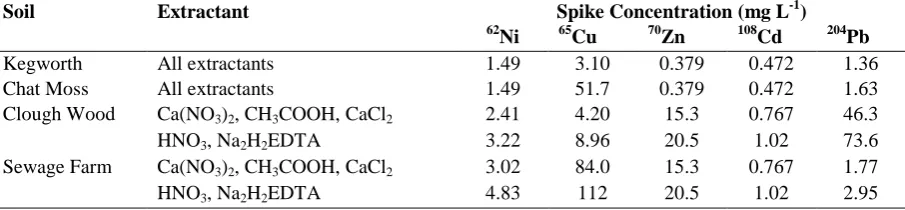
bespoke mixed-isotope spikes for each soil-extractant combination (Table 2). The
concentrations used were intended to cause an increase of at least 20 % in the natural
an increase in MTotal of Ni: 0.252-1.2 %, Cu: 1.29-7.58 %, Zn 0.036-0.22 %, Cd: 0.476 –
20.5 %, Pb: 0.083-0.201 %. Spike additions were increased for some soil-extractant
combinations to ensure that the measurement of metal concentrations were analytically robust
(Table 2). Six replicate soil samples (c. 1 g) were suspended in 30 ml 0.01 M Ca(NO3)2 and
shaken for 72 hours at room temperature. Three replicate suspensions were then spiked with
the mixed-isotope solution (0.4 ml; Table 2), before all replicates were shaken for a further
72 hours. Similarly, six replicate soil samples were suspended in HNO3, CaCl2, CH3COOH
and Na2H2EDTA, at the same concentration and soil-to-solution ratio as the corresponding
chemical extraction method (Table 1). Immediately after suspension, three replicates were
spiked with a mixed-isotope solution (0.4 ml; Table 2) before being shaken for the time
periods outline in Table 1. All suspensions were centrifuged at 2200 g for 15 minutes and
supernatant solutions filtered to < 0.22 µm. Neutral salt solutions (0.01 M Ca(NO3)2 and 1 M
CaCl2) were acidified to 2 % HNO3 prior to determination of isotopic abundances by ICP-MS
in all soil extracts.
Multi-element analysis and determination of isotopic abundances by ICP-MS
Metal concentrations in the soil extracts were measured by quadrupole ICP-MS (X-SeriesII;
Thermo Fisher Scientific, Bremen, Germany). The ICP-MS was operated in collision cell
technology with kinetic energy discrimination (CCT-KED) mode, to minimise polyatomic
interferences. Internal standards Sc, Ge, Rh and Ir were used to correct for changes in analyte
sensitivity throughout the sample run. External multi-element standards were used for
instrument calibration.
The isotope ratios 62Ni/60Ni, 65Cu/63Cu, 70Zn/66Zn, 108Cd/111Cd, 204Pb/208Pb, 206Pb/208Pb and
207
Pb/208Pb, were measured by quadrupole ICP-MS, again operating in CCT-KED mode,
particularly to minimise interference from the chlorine dimer (35Cl-35Cl) in some extractions,
corrected by assay of 202Hg, although this was a very small adjustment. The isobaric
interference of 208Pd on 108Cd was found to be negligible from the mass ratio 108/111
(108Cd/111Cd) in the supernatant solution of all unspiked soil suspensions (expected value =
0.06953). Where necessary, samples were diluted to ensure measurement by the electron
multiplier detector in pulse-counting, rather than analogue, mode. Corrections for mass
discrimination (MD) were calculated from measured count rate (CPS) ratios of ICP-MS
calibration standards for Ni, Cu, Zn and Cd, and the certified reference standard NIST
SRM-981 for Pb; these were run every 20 samples and MD factors implemented as a drift
correction.
Calculation of Evalue and EExt
The isotopically exchangeable metal concentrations (mg kg-1) in soil suspended in 0.01 M
Ca(NO3)2 (EValue) or in the extractants listed in Table 1 (EExt), were determined from the
isotopic abundance (IA) of the spike isotope (sIA), and a reference isotope (rIA), measured in
three solutions: the spike solution (spike), the spiked soil-solution (sp-soil) and the un-spiked
soil-solution (control). For a given metal this was calculated from Equation 1 (Nolan et al.,
2004; Degryse et al., 2007; Atkinson et al., 2011) where AMcontrol and AMspike are the average
atomic masses of the metal in the unspiked soil and the spike respectively, Cspike and Vspike
are the concentration (mg L-1) and volume (L) of the spike respectively, and W is the mass of
the soil (kg).
Experimental theory
If a chemical extraction method is to provide a good estimate of labile soil metal, the
extractant must solubilise all the labile soil metal during the specified extraction time, but
without mobilising significant non-labile soil metal. These requirements can be rigorously
tested by comparison of the three assays of soil metal described below.
EValue and EExt
For the purpose of this study, we regard isotopically exchangeable metal, measured in a 0.01
M Ca(NO3)2 suspending matrix, (EValue), as representing the labile metal concentration under
natural soil conditions, and therefore as the reference concentration against which we will
assess chemical extractant performance. We will use the term ‘mobilisation’ specifically to
refer to the process(es) by which soil metal that is non–labile (i.e. not isotopically
exchangeable in 0.01 M Ca(NO3)2) becomes isotopically exchangeable under the conditions
of the extraction. We assume that, if the extraction conditions have not caused quantifiable
mobilisation of non-labile metal, EExt should be equal to EValue. If EExt > EValue, the suspending
extractant has mobilised non-labile metal, either into solution or into adsorbed isotopically
exchangeable forms. Conversely, it is also possible that EExt < EValue, in which case either (i)
the suspending extractant has caused fixation of naturally labile metal into non-labile forms
within the soil solid phase or (ii) the isotope equilibration time permitted by the extraction
protocol (Table 1) has been insufficient to match the level of isotopic dilution achieved in
measuring the EValue with three days isotope equilibration.
MExt and EExt
Ideally, the metal solubilised by the extractant (MExt, mg kg-1) should be equal to the EValue.
Furthermore, if MExt = EExt, any non-labile metal mobilised by the extractant must also have
been solubilised. However, if MExt < EExt a proportion of the isotopically exchangeable metal
adsorbed isotopically exchangeable forms. There is no mechanistic basis for the outcome
MExt > EExt because all metal in solution (MExt) must also be isotopically exchangeable and
so this outcome must represent analytical or procedural error.
MExt and EValue
If MExt < EValue, the extraction method has underestimated labile soil metal. This is either
solely because the extractant is too weak to solubilise all the naturally labile metal, or
represents a situation where the extractant has actually mobilised non-labile metal, and a
proportion of the resulting isotopically exchangeable pool (EExt) remains adsorbed to the solid
phase (MExt < EValue but MExt < EExt > EValue). Conversely, if MExt > EValue the extraction
method overestimates labile soil metal because non-labile metal has been both mobilised and
solubilised by the extractant. There are two possible explanations for the outcome MExt =
EValue. It is possible that the extractant has solubilised all the naturally labile metal without
mobilising any non-labile metal, i.e. it has efficiently extracted the naturally labile pool.
Alternatively, this may be the co-incidental outcome of a situation where the extractant has
mobilised non-labile metal, but a proportion of the isotopically exchangeable metal pool
(which now includes the mobilised metal) is not solubilised (MExt ≈ EValue but MExt < EExt >
EValue). Measurement of EValue, MExt and EExt allows us to distinguish between these two
possibilities.
Results and discussion General soil characteristics
The general characteristics of the four soils are shown in Table 3. The Chat Moss soil
contaminated with urban waste was sampled from an arable fenland and had the highest
organic matter content (58.5 %) and the lowest pH (4.8), in relation to the other soils. The
at the soil sampling sites. The Kegworth roadside soil contained the lowest concentration of
all five metals, but was comparable in organic matter content to the Clough Wood mine spoil
soil which had the greatest concentrations of Zn (6080 mg kg-1), Cd (64.4 mg kg-1) and Pb
(17 400 mg kg-1). The largest concentrations of Ni (478 mg kg-1) and Cu (1030 mg kg-1) were
in the Sewage Farm soil that was previously found to have extremely high available (453 mg
kg-1) and total ( 9540 mg kg-1) phosphate contents (Atkinson et al., 2011).
Labile soil metal
The values of EValue (mg kg-1) for the four soils, shown in Table 3, cover a range spanning
several orders of magnitude. EValue expressed as a percentage of MTotal, in the soils
contaminated by road traffic, urban waste and mine spoil, was found to increase in the order
Ni < Zn ≈ Cu < Pb < Cd (Figures 1a, b and c); when averaged across these three soils %EValue
was 8 %, 19 %, 21 %, 34 % and 51 %, respectively. In contrast, in the soil contaminated by
sewage sludge (Figure 1d), Ni was the most labile metal (%EValue = 42), possibly because of
the large humus content derived from sewage sludge addition; available Ni exists mainly in
organically-bound forms (Gonnelli & Renella, 2013). Lead was the least labile metal in this
soil (%EValue = 18), probably resulting from the high phosphate content of the soil and the
consequent presence of Pb in the form of insoluble Pb-phosphates (Atkinson et al., 2011).
Test for mobilisation of non-labile soil metal (EExt vs. EValue)
The concentration of non-labile soil metal mobilised by each chemical extractant was
quantified by comparison of EExt and EValue (Figure 1). The concentration of non-labile metal
mobilised by each extractant (EExt – EValue) almost invariably decreased in the order HNO3 >
CH3COOH > Na2H2EDTA > CaCl2 for each of the five metals and for all four soils,
according to the relative ability of each extractant to dissolve mineral assemblages in the soils.
On average, HNO3 mobilised 17 %, 43 %, 33 %, 40 % and 63 % of the non-labile Ni, Cu, Zn,
Cd and Pb, respectively. The percentage of non-labile metal mobilised by HNO3 was
particularly large (>50 %) for Cu, Zn, Cd and Pb in the sewage sludge soil (Figure 1d), for Zn
and Pb in the minespoil soil (Figure 1c) and for Pb in the roadside soil (Figure 1a). In contrast,
mobilisation of non-labile Ni and Zn in the reclaimed fen peat soil contaminated with urban
waste (Figure 1b) was relatively small (< 5 %) as was mobilisation of non-labile Ni in the
roadside soil (Figure 1a). The CH3COOH extractant mobilised a smaller percentage of
labile metal than the HNO3 extractant for every soil-metal combination. Mobilisation of
non-labile metal by Na2H2EDTA was reasonably consistent across all soil-metal combinations;
with the exception of Cu in the mine spoil soil (Figure 1c), and Pb in the roadside soil (Figure
1a), EExt was never more than twice the EValue. The Na2H2EDTAextractant did not mobilise
any non-labile metal in the reclaimed fen peat soil contaminated with urban waste (Figure 1b).
For 1 M CaCl2, EExt and EValue were very close for Ni, Cu, Zn and Cd across all soils but, on
average, CaCl2 mobilised 15 % of the non-labile Pb. However, for seven (out of 20)
soil-metal combinations, values of EExt in CaCl2 and Na2H2EDTA were significantly (p < 0.01)
smaller than the corresponding EValue (percentage difference ranged from 4-30 %). Although
theoretically this may represent a situation where the extractant has caused fixation of
naturally labile metal into non-labile forms within the soil solid phase, there is no obvious
mechanism for this process. It is known that that EValue increases significantly over several
days with increasing isotope equilibration time (e.g. Tongtavee et al., 2005; Oliver et al.,
2006). It is therefore likely that the longer isotope equilibration time allowed for the
measurement of EValue (72 hours), compared to measurements of EExt in 1 M CaCl2 (24 hours)
and 0.05 M Na2H2EDTA (1 hour), is the main cause of these differences.
The proportion of the isotopically exchangeable metal (which includes any non-labile metal
mobilised by the extractant; EExt) that is solubilised (MExt) in the presence of the extractant is
given by RMExt/EExt. For HNO3 as the extractant, MExt was, on average, 97 %, 75 %, 102 %,
99 %, 80 % of EExt for Ni, Cu, Zn, Cd and Pb, respectively (Figure 2a). In comparison, in
CH3COOH a larger proportion of the isotopically exchangeable metal remained adsorbed
with 71 %, 14 %, 77 %, 64 % and 12 % of EExt dissolved for Ni, Cu, Zn, Cd and Pb,
respectively (Figure 2b). Both extractants solubilise soil metal by competition with H+ ions
and loss of negative charge on adsorption sites (Alloway, 1990). In addition, CH3COOH may
cause metal solubilisation due to the formation of weak acetate-metal complexes (Meers et al.,
2007). However, overall, these results show that the stronger acid (HNO3) was more
effective in solubilising all five metals. Nitric acid (0.43 M) was able to completely solubilise
all isotopically exchangeable Ni, Zn and Cd. Solubilisation of Ni, Zn and Cd by CH3COOH
was more variable across the range of soils, and particularly poor in the Chat Moss soil
contaminated with urban waste. Solubilisation of isotopically exchangeable Cu and Pb by
both acid extractants was noticeably lower than for Ni, Zn and Cd. This is likely to be
because of their relatively high binding strength to the soil solids, resulting in retention of a
proportion of the isotopically exchangeable metal by the soil, even under extracting
conditions.
The Na2H2EDTA extraction was the only method to result in complete solubilisation of
isotopically exchangeable metal (EExt). For all five metals, in all soils, MExt was close to EExt
(Figure 2c); thus Na2H2EDTA met one of the requirements of the ideal extractant. For some
soil-metal combinations, values of RMExt/EExt in Na2H2EDTA exceeded 100 %, for which
there is no mechanistic basis. This is most likely the result of compounded errors across the
For 1 M CaCl2 as the extractant, on average 84 % of the Cd EExt concentration was solubilised,
but only 4 % and 14 % of the Cu and Pb EExt concentrations respectively (Figure 2d).
Solubilisation of isotopically exchangeable Ni and Zn by this extractant was particularly
variable ranging from 8 % and 6 % in the soil contaminated by road traffic, to 57 % and 64 %
in the soil contaminated by urban waste for Ni, and Zn, respectively. Extraction with CaCl2
solubilises metals from soil by competition with Ca2+ ions and formation of chloride
complexes (McLaughlin et al., 2000; Young et al., 2000). The efficiency of CaCl2 as an
extractant for Cd results from the relatively high binding strength of Cd to chloride ions,
relative to the binding strength of the Cd to the soil solid-phase. However, the metal-chloride
stability constants for Ni, Cu, Zn and Pb are considerably lower than that of Cd, and the
higher binding strength of Cu and Pb to the soil solid-phase (Bruemmer et al., 1986; Alloway,
1990) limits the efficiency of CaCl2 at solubilising these metals.
Use of the chemical extraction methods to estimate labile soil metal (MExt vs. EValue)
The overall performance of each extraction method was assessed by directly comparing
extracted metal concentration (MExt) with EValue (MExt/EValue). The HNO3 extraction method
(recently standardized as BSI ISO 17402) overestimated EValue for all soil-metal combinations
(Figure 3a) and on average solubilised 196 %, 182 %, 236 %, 157 % and 208 % of the EValue
concentrations for Ni, Cu, Zn, Cd and Pb respectively, due to mobilisation of non-labile metal
by the extractant (Figure 1). This was despite the fact that, for Cu and Pb, a proportion of the
isotopically exchangeable metal in the soil suspension remained adsorbed during the
extraction process with HNO3 (EExt > MExt; Figure 2a). The degree to which EValue was
overestimated was variable: in the soil contaminated with urban waste, MExt overestimated
EValue by up to a factor of two, whereas in the soil contaminated with mine spoil, MExt
The behaviour of the metals in the CH3COOH extractions, and the consequent relationship
between MExt and EValue was variable (Figure 3b). Values of Cu and Pb EValue were
underestimated in the soils contaminated by road traffic, mine spoil and sewage sludge,
because although the extractant mobilised non-labile Cu and Pb (Figure 1), a proportion of
the isotopically exchangeable metal (EExt) remained adsorbed to the soil (Figure 2b). Values
of EValue for Ni, Cu, Zn, Cd and Pb were underestimated in the Chat Moss soil contaminated
with urban waste (Figure 3b). In this instance, little non-labile Ni, Cu, Zn, Cd or Pb was
mobilised by the extractant (Figure 1b), but solubilisation of isotopically exchangeable metal
(EExt) was poor (Figure 2b). When only comparing MExt and EValue (Figure 3b), it appeared
that extraction with CH3COOH provided a reasonably good estimate of Cd EValue in the
mineral soils contaminated by road traffic, mine spoil and sewage sludge. However,
comparison of EValue and MExt with EExt revealed that this was actually a fortuitous result in
which there was compensation for mobilisation of non-labile Cd (Figure 1; EExt > EValue) with
incomplete solubilisation of the isotopically exchangeable Cd in the extractant (Figure 2b;
MExt < EExt).
The Na2H2EDTA extraction method (MExt) provided a good estimate of EValue for the Chat
Moss fenland soil (Figure 3c). In this soil, the extractant solubilised all labile metal (Figure
2c), without mobilising any non-labile metal (Figure 1b), possibly due to the low soil pH (4.8)
and high organic matter content (59 %) which ensured the predominance of organically
bound metal. These findings are in agreement with Marzouk (2012), who reported that
extraction with 0.05 M Na2H2EDTA was an appropriate method for the estimation of labile
Zn, Cd and Pb in organic soils with pH < 6.4. However, in the three more mineral soils, the
Na2H2EDTA extractant mobilised (Figure 1) and solubilised (Figure 2c) non-labile metal, so
that MExt overestimated EValue by up to a factor of approximately two (Figure 3). This
extraction method using a lower concentration of Na2H2EDTA e.g. 0.025 M as used by
Gabler et al. (2007) might therefore provide better estimates of EValue in mineral soils, if, by
reducing the Na2H2EDTA concentration, a smaller proportion of non-labile metal is
mobilised, and at the same time, all labile metal can still be solubilised (as in Figure 2c).
The CaCl2 extraction method on average solubilised 32 %, 3 %, 29 %, 88 % and 19 % of the
EValue concentrations for Ni, Cu, Zn, Cd and Pb, respectively. This comparatively weak
extraction method therefore substantially underestimated EValue for Ni, Cu, Zn and Pb (Figure
3d) but, as reported previously by many authors, (Hutchinson et al., 2000; Stanhope et al.,
2000; Young et al., 2000; Gray et al., 2003; Gray et al., 2004; Sterckeman et al., 2009),
provided a reasonable estimate of Cd EValue. The extractant was strong enough to solubilise,
on average, 84 % of the isotopically exchangeable Cd (EExt, Figure 2d) and yet did not
mobilise non-labile Cd (Figure 1); EExt was just 105 % of the EValue.
Conclusions
The combined isotopic-dilution-chemical-extraction assay (EExt), when compared to MExt and
EValue, reveals whether extractants (i) mobilise any non-labile soil metal and (ii) solubilise all
labile soil metal, including isotopically exchangeable metal generated during the extraction. It
therefore provides a rigorous means of assessing the underlying action of soil chemical
extraction methods and could be used to refine long-standing soil extraction methodologies.
The method can distinguish between circumstances where an extraction method appears to
provide a good estimate of labile metal (MExt ≈ EValue) because mobilisation of non-labile
metal is being compensated for by incomplete solubilisation of labile metal (MExt < EExt >
EValue), from circumstances where an extraction method is good at selectively extracting the
labile metal only, providing a genuine surrogate for isotope dilution (MExt = EValue). Of the
0.43 M CH3COOH provided the clearest evidence of this. In such circumstances, and for
weaker extractants such as CaCl2, the extraction method would demonstrate an enhanced
operational dependence on soil-to-solution ratio. The presence of an adsorbed labile pool of
metal ions would presumably desorb in response to any decrease in soil-solution ratio and so
change the calculated value of MExt.
None of the extraction methods tested in this study provided consistently good estimates of
labile metal for all 20 soil-metal combinations. However, the Na2H2EDTA extraction method
did consistently solubilise all isotopically exchangeable soil metal thereby meeting one of the
requirements of the ideal extractant. The second requirement (no mobilisation of non-labile
metal) was only met by this extractant for the most organic soil, with substantial mobilisation
of non-labile metal occurring in the three mineral soils. Given that in this study the number of
soil was limited, for the Na2H2EDTA extraction in particular, the methods presented could
usefully be applied to a wider range of soils to investigate how well extractants perform in
different soil types. In addition, by testing a range of Na2H2EDTA extractant concentrations,
below that used in this study (0.05 M), it may be possible to establish an optimum
Na2H2EDTA extractant concentration, at which complete solubilisation of labile metal is still
achieved, and yet mobilisation of non-labile metal is minimised.
Acknowledgements
We thank the Natural Environment Research Council for providing research funding through
a PhD algorithm studentship. The data generated in this study can be downloaded from the
References
Alloway, B.J. 1990. Soil processes and the behaviour of metals. In: Heavy metals in soils (ed. B.J.
Alloway), pp. 7-28. Blackie and Son Ltd, London.
Atkinson, N.R., Bailey, E.H., Tye, A.M., Breward, N. & Young, S.D. 2011. Fractionation of lead in
soil by isotopic dilution and sequential extraction. Environmental Chemistry, 8, 493-500.
Ayoub, A.S., McGaw, B.A., Shand, C.A. & Midwood, A.J. 2003. Phytoavailability of Cd and Zn in
soil estimated by stable isotope exchange and chemical extraction. Plant and Soil, 252, 291-300.
Bruemmer, G.W., Gerth, J. & Herms, U. 1986. Heavy metal species, mobility and availability in soils.
Zeitschrift für Pflanzenernährung und Bodenkunde, 149, 382-398.
Bruemmer, G.W., Gerth, J. & Tiller, G. 1988. Reaction kinetics of the adsorption and desorption of
nickel, zinc and cadmium by goethite. I. Adsorption and diffusion of metals. Journal of Soil
Science, 39, 37-52.
Buekers, J., Degryse, F., Maes, A. & Smolders, E. 2008. Modelling the effects of ageing on Cd, Zn,
Ni and Cu solubility in soils using an assemblage model. European Journal of Soil Science, 59,
1160-1170.
Buekers, J., Van Laer, L., Amery, F., Van Buggenhout, S., Maes, A. & Smolders, E. 2007. Role of
soil constituents in fixation of soluble Zn, Cu, Ni and Cd added to soils. European Journal of
Soil Science, 58, 1514-1524.
Cancès, B., Ponthieu, M., Castrec-Rouelle, M., Aubry, E. & Benedetti, M.F. 2003. Metal ions
speciation in a soil and its solution: experimental data and model results. Geoderma, 113,
341-355.
Degryse, F., Waegeneers, N. & Smolders, E. 2007. Labile lead in polluted soils measured by stable
isotope dilution. European Journal of Soil Science, 58, 1-7.
Gäbler, H.E. & Bahr, A. 2001. Enriched stable isotopes for determining the sorbed element fraction in
soils in order to calculate sorption isotherms. In: Water-rock interaction. Proceedings of the
10th international symposium on water-rock interaction (ed. R. Cidu), pp. 267-270. Swets & Zeitlinger, Lisse.
Gäbler, H.E., Bahr, A. & Mieke, B. 1999. Determination of the interchangeable heavy-metal fraction
in soils by isotope dilution mass spectrometry. Fresnius Journal of Analytical Chemistry, 365,
409-414.
Gäbler, H.E., Bahr, A. Heidkamp, A. & Utermann, J. 2007. Enriched stable isotopes for determining
the isotopically exchangeable element content in soils. European Journal of Soil Science, 58,
746-757.
Gleyzes, C., Tellier, S. & Astruc, M. 2002. Fractionation studies of trace elements in contaminated
soils and sediments: a review of sequential extraction procedures. Trends in Analytical
Chemistry, 21, 451-467.
Gonnelli, C. & Renella, G. 2013. Chromium and nickel. In: Heavy metals in soils. Trace metals and
metalloids in soils and their bioavailability (ed. B.J. Alloway), pp. 313-334. Springer, Dordrecht.
Goody, D.C., Shand, P., Kinniburgh, D.G. & Van Riemsdijk, W.H. 1995. Field-based partition
coefficients for trace elements in soil solutions. European Journal of Soil Science, 46, 265-285.
Gray, C.W., McLaren, R.G., Günther, D. & Sinaj, S. 2004. An assessment of cadmium availability in
cadmium-contaminated soils using isotope exchange kinetics. Soil Science Society of America
Journal, 68, 1210-1217.
Gray, C.W., McLaren, R.G. & Shiowatana, J. 2003. The determination of labile cadmium in some
biosolids-amended soils by isotope dilution plasma mass spectrometry. Australian Journal of
Groenenberg, J.E., Römkens, P.F.A.M., Comans, R.N.J., Luster, J., Pampura, T., Shotbolt, L., et al.
2010. Transfer functions for solid-solution partitioning of cadmium, copper, nickel, lead and zinc in soils: derivation of relationships for free metal ion activities and validation with
independent data. European Journal of Soil Science, 61, 58-73.
Hamon, R.E., Parker, D.R. & Lombi, E. 2008. Advances in isotopic dilution techniques in trace
element research: a review of methodologies, benefits, and limitations. In: Advances in
Agronomy (ed. L.S. Donald), pp. 289-343. Academic Press.
Huang, Z.-Y., Chen, T., Yu, J., Zeng, X.-C. & Huang, Y.-F. 2011. Labile Cd and Pb in
vegetable-growing soils estimated with isotope dilution and chemical extractants. Geoderma, 160,
400-407.
Hutchinson, J.J., Young, S.D., McGrath, S.P., West, H.M., Black, C.R. & Baker, A.J.M. 2000.
Determining uptake of 'non-labile' soil cadmium by Thlaspi caerulescens using isotopic dilution
techniques. New Phytologist, 146, 453-460.
Marzouk, E.R. 2012. Using multi-element stable isotope dilution to quantify metal reactivity in soil.
PhD thesis, University of Nottingham.
McLaughlin, M.J., Zarcinas, B.A., Stevens, D.P. & Cook, N. 2000. Soil testing for heavy metals.
Communications in Soil Science and Plant Analysis, 31, 1661-1700.
Meers, E., Du Laing, G., Unamuno, V., Ruttens, A., Vangronsveld, J., Tack, F.M.G., et al. 2007.
Comparison of cadmium extractability from soils by commonly used single extraction protocols.
Geoderma, 141, 247-259.
Nakhone, L.N. & Young, S.D. 1993. The significance of (radio-) labile cadmium pools in soil.
Environmental Pollution, 82, 73-77.
Nolan, A.L., Lombi, E. & McLaughlin, M.J. 2003. Metal bioaccumulation and toxicity in soils - why
bother with speciation? Australian Journal of Chemistry, 56, 77-91.
Nolan, A.L., Ma, Y., Lombi, E. & McLaughlin, M.J. 2004. Measurement of labile Cu in soil using
stable isotope dilution and isotope ratio analysis by ICP-MS. Analytical and Bioanalytical
Chemistry, 380, 789-797.
Oliver, I.W., Ma, Y.B., Lombi, E., Nolan, A.L. & McLaughlin, M.J. 2006. Stable isotope techniques for assessing labile Cu in soils: Development of an L-value procedure, its application, and
reconciliation with E values. Environmental Science & Technology, 40, 3342-3348.
Peijnenburg, W.J.G.M., Zablotskaja, M. & Vijver, M.G. 2007. Monitoring metals in terrestrial
environments within a bioavailability framework and a focus on soil extraction. Ecotoxicology
and Environmental Safety, 67, 163-179.
Plette, A.C.C., Nederlof, M.M., Temminghoff, E.J.M. & van Riemsdijk, W.H. 1999. Bioavailability
of heavy metals in terrestrial and aquatic systems: a quantitative approach. Environmental
Toxicology and Chemistry, 18, 1882-1890.
Pueyo, M., Rauret, G., Bacon, J.R., Gomez, A., Muntau, H., Quevauviller, P., et al. 2001. A new
organic-rich soil reference material certified for its EDTA- and acetic acid- extractable contents of Cd, Cr, Cu, Ni, Pb and Zn, following collaboratively tested and harmonised procedures.
Journal of Environmental Monitoring, 3, 238-242.
Quevauviller, P. 1998a. Operationally defined extraction procedures for soil and sediment analysis - I.
standardization. Trends in Analytical Chemistry, 17, 289-298.
Quevauviller, P. 1998b. Operationally defined extraction procedures for soil and sediment analysis -
II. certified reference materials. Trends in Analytical Chemistry, 17, 632-642.
Quevauviller, P. 2002. Operationally-defined extraction procedures for soil and sediment analysis.
Part 3: new CRMs for trace-element extractable contents. Trends in Analytical Chemistry, 21,
Rowell, D. L. 1994 Soil Science: Methods and Applications (Longman Scientific and Technical: Harlow, UK).
Sheldrick B.H. and Wang C. 1993. Particle size distribution. In Soil Sampling and Methods of Analysis (ed. Carter M.R.). Lewis Publishers, USA. pp 499-511.
Stanhope, K.G., Young, S.D., Hutchinson, J.J. & Kamath, R. 2000. Use of isotopic dilution
techniques to assess the mobilization of nonlabile Cd by chelating agents in phytoremediation.
Environmental Science & Technology, 34, 4123-4127.
Sterckeman, T., Carignan, J., Srayeddin, I., Baize, D. & Cloquet, C. 2009. Availability of soil
cadmium using stable and radioactive isotope dilution. Geoderma, 153, 372-378.
Temminghoff, E.J.M., Van der Zee, S.E.A.T.M. & de Haan, F.A.M. 1997. Copper mobility in a copper-contaminated sandy soil as affected by pH and solid and dissolved organic matter.
Environmental Science & Technology, 31, 1109-1115.
Tipping, E., Rieuwerts, J., Pan, G., Ashmore, M.R., Lofts, S., Hill, M.T.R., et al. 2003. The
solid-solution partitioning of heavy metals (Cu, Zn, Cd, Pb) in upland soils of England and Wales.
Environmental Pollution, 125, 213-225.
Tongtavee, N., Shiowatana, J., McLaren, R.G. & Gray, C.W. 2005. Assessment of lead availability in
contaminated soil using isotope dilution techniques. Science of the Total Environment, 348,
244-256.
Young, S.D. 2013. Chemistry of heavy metals and metalloids in soils. In: Heavy metals in soils. Trace
metals and metalloids in soils and their bioavailability (ed. B.J. Alloway), pp. 51-96. Springer, Dordrecht.
Young, S.D., Tye, A., Carstensen, A., Resende, L. & Crout, N. 2000. Methods for determining labile
cadmium and zinc in soil. European Journal of Soil Science, 51, 129-136.
Young, S.D., Zhang, H., Tye, A.M., Maxted, A., Thums, C. & Thornton, I. 2006. Characterizing the availability of metals in contaminated soils. I. The solid phase: sequential extraction and
Table 1: Operational details for the chemical extraction methods.
Extractant Concentration
(M)
Soil to solution ratio (g : ml)
Shaking time (hr)
Associated publications
HNO3 0.43 1: 10 2 Goody et al. (1995), Temminghoff et
al. (1997), Cancès et al. (2003), Tipping et al. (2003) and Groenenberg et al. (2010).
CH3COOH 0.43 0.75: 30 16 Pueyo et al. (2001) - collaboratively
tested and harmonised extraction procedure.
Na2H2EDTA 0.05 1: 10 1 Quevauviller (1998a) -
collaboratively tested and harmonised extraction procedure.
CaCl2 1 1: 10 24 Young et al. (2000), Gray et al.
(2004) and Sterckeman et al. (2009).
Table 2: Mixed-isotope solution concentrations.
Soil Extractant Spike Concentration (mg L-1)
62Ni 65Cu 70Zn 108Cd 204Pb
Kegworth All extractants 1.49 3.10 0.379 0.472 1.36
Chat Moss All extractants 1.49 51.7 0.379 0.472 1.63
Clough Wood Ca(NO3)2, CH3COOH, CaCl2 2.41 4.20 15.3 0.767 46.3
HNO3, Na2H2EDTA 3.22 8.96 20.5 1.02 73.6
Sewage Farm Ca(NO3)2, CH3COOH, CaCl2 3.02 84.0 15.3 0.767 1.77
[image:21.595.76.529.344.449.2]22 Table 3: Soil properties, total metal concentrations (MTotal) and E values measured in 0.01 M Ca(NO3)2 (EValue). Values in brackets are standard errors (n=2) [n=3].
Soil and contaminant source
pH LOI
(%)
Olsen P (mg kg-1)
Total P (mg kg-1)
Texture MTotal
(mg kg-1)
EValue (mg kg-1) Sand
(%)
Clay (%)
Silt (%) Ni Cu Zn Cd Pb Ni Cu Zn Cd Pb
Chat Moss, Urban waste
4.8 58.5 [0.8]
44.3 1920 26.00 31.18 42.82 63.6 [1.6] 273 [7] 422 [1] 2.16 [0.09] 624 (16) 6.74 [0.01] 53.0 [1.5] 119 [1] 1.03 [0.01] 196 [12] Kegworth, Road traffic
7.4 10.2 [0.0]
2.37 213 82.04 7.81 10.16 49.3 [11.7] 45.4 [0.1] 186 [6] 0.923 [0.003] 271 [2] 1.10 (0.00) 11.4 (0.1) 21.4 (0.8) 0.426 (0.001) 77.9 (1.0) Clough Wood, Pb/Zn mine spoil
6.8 13.9 [0.7]
9.70 832 49.93 20.46 29.61 116 [15] 130 [1] 6080 [139] 64.4 [1.6] 17400 (211) 12.2 (0.1) 25.9 (0.9) 1090 (9) 38.5 (0.3) 7190 (79) Sewage Farm, Sewage sludge
6.3 26.6 [0.8]
23 0 10 20 30 40 50 60 70 80 90 100
Ni Cu Zn Cd Pb
%
E
E x tand
%
E
V al u e(a ) Kegworth
0 10 20 30 40 50 60 70 80 90 100
Ni Cu Zn Cd Pb
%
E
E x tand
%
E
V al u e(b) Cha t Moss
0 10 20 30 40 50 60 70 80 90 100
Ni Cu Zn Cd Pb
%
E
E x tand
%
E
V al u e(c) Clough Wood
0 10 20 30 40 50 60 70 80 90 100
Ni Cu Zn Cd Pb
%
E
E x tand
%
E
V al u e(d) Sewa ge Fa rm
[image:23.842.59.610.47.403.2]24 0 20 40 60 80 100 120 140
Ni Cu Zn Cd Pb
R
M E xt /E E xt/%
(a ) HNO3
0 20 40 60 80 100 120 140
Ni Cu Zn Cd Pb
R
M E xt /E E xt/
%
(b) CH3COOH
0 20 40 60 80 100 120 140
Ni Cu Zn Cd Pb
R
M E xt /E E xt/%
(c) Na2H2EDTA
0 20 40 60 80 100 120 140
Ni Cu Zn Cd Pb
R
M E xt /E E xt/
%
[image:24.842.53.606.43.420.2](d) Ca Cl2
25 0 50 100 150 200 250 300 350 400
Ni Cu Zn Cd Pb
R
M E xt /E V al ue/
%
(a ) HNO3
0 50 100 150 200 250 300 350 400
Ni Cu Zn Cd Pb
R
M E xt /E V al ue/
%
(b) CH3COOH
0 50 100 150 200 250 300 350 400
Ni Cu Zn Cd Pb
R
M E xt /E V al ue/
%
(c) Na2H2EDTA
0 50 100 150 200 250 300 350 400
Ni Cu Zn Cd Pb
R
M E xt /E V al ue/
%
[image:25.842.47.545.68.406.2](d) Ca Cl2
Figure 3: Values of RMExt/EValue (MExt as a percentage of EValue) for soils contaminated by road traffic (Kegworth, □), urban waste (Chat Moss, ○), Pb/Zn mine spoil (Clough Wood, △) and sewage sludge (Sewage Farm, ◇). Extractants used were (a) 0.43 M HNO3, (b) 0.43 M CH3COOH, (c) 0.05 M