MASTER THESIS
Example based instructions in e-science:
Using principles and sub-goals to improve
effectiveness and efficiency
Jiaying Xu
Faculty of Behavioural, Management, and Social Sciences
Master: Communication Studies
Specialization: Technology and Communication
Student number: s2171341
First Supervisor: Dr. J. Karreman
Second Supervisor: R. S. Jacobs PhD
Acknowledgement
I would like to thank my supervisors, Dr. Joyce Karreman and Dr. Ruud Jacobs, for their
guidance, support and patience. I would also like to show my gratitude to all 102 participants.
Without their help, I could not have finished the experiment within limited time. Finally, I want to
1
Abstract
Purpose: Examples are widely used in procedural instructions, especially in complex domains such as e-science in which scientific knowledge and technical information are intertwined. Example-based instructions are effective because users tend to follow the instantiated and specific procedures. Prior studies have pointed out that adding sub-goals to examples can benefit users’ task performance and efficiency because it makes sub-tasks easy to understand and memorize. Principles also have positive influences on users’ learning and transfer of knowledge as they enable users to generalize their learning outcomes. This study is designed to determine whether the general principles and specific sub-goals are effective in examples of e-science as proven by previous research in the examples of other contexts.
Method: A 2*2 between-subjects experiment was conducted with presence of sub-goals and principles as independent variables, and the effect on task efficiency and effectiveness as dependent variables. Novice users of sky survey databases were selected as the target group, and 93 participants were assigned to four conditions with different versions of instructions. Each participant was asked to complete ten learning tasks and five transfer tasks. Their task performance and task efficiency were measured.
Results: Users showed better performance in learning tasks and higher efficiency in transfer tasks when assisted by examples with sub-goals. No significant difference was found in transfer performance and learning efficiency between groups with and without sub-goals, nor between groups with and without principles.
Conclusion: The effectiveness of sub-goal information was proven in the context of e-science databases. There is no significant effect regarding general principles when added to examples. Therefore, in documentation practices, descriptions of sub-tasks are suggested for use in examples in order to reduce complexity. More research is needed to study principles and sub-goals by improved approach and to focus on cognitive and emotional effects.
2
Table of Contents
1. Introduction ... 3
2. Theoretical framework ... 5
2.1. Theoretical basis of supporting e-science users in SQL data query ... 5
2.1.1. Supporting users of e-science applications ... 5
2.1.2. Facilitating SQL usage in e-science databases ... 6
2.2. Theoretical basis of example-oriented instructions ... 8
2.2.1. Types of information in user instructions ... 8
2.2.2. Use and effect of examples ... 9
2.3. Use and effect of principles ... 10
2.4. Use and effect of sub-goals ... 12
2.5. Hypotheses ... 12
3. Methods ... 14
3.1. Experimental design ... 14
3.2. Participants ... 14
3.3. Materials... 15
3.3.1. Learning materials ... 15
3.3.2. Survey ... 18
3.3.3. Pre-test ... 20
3.4. Measurements ... 20
3.5. Procedures ... 20
4. Results ... 21
4.1. Differences in learning performance ... 21
4.2. Differences in transfer performance ... 22
4.3. Differences in time efficiency ... 22
5. Discussion and conclusion ... 24
5.1. Main findings ... 24
5.2. Implications for practice and suggestions for future research ... 26
5.3. Limitations ... 28
5.4. Conclusion ... 28
References ... 30
Appendix ... 34
Appendix 1 Current practices of SQL instructions in e-science databases ... 34
Appendix 2 Learning materials ... 36
Appendix 3 Knowledge test ... 46
3
1.
Introduction
The internet became an important tool for education, business and science in the 1990s. Then, after
several years of development, the scientific world started to explore the potential of linking
computers and integrating computing resources so as to access data and experimental equipment
from remote sites. This created the concept of e-science, which is considered a special infrastructure
of various forms such as search engines, specialized databases, and data-mining tools. E-science
applications enable data-intensive research, projects across distributed data repositories and
collaborations between scientific communities and institutes (Hey & Trefethen, 2005). One typical
example of e-science is the Large Hadron Collider (LHC) Computing Grid in Geneva, which aims
to find experimental evidence of the Higgs particle. At LHC, large-scale experiments are conducted
and a huge amount of data generated every year, so analysis and simulation can only be done through
collaborations between scientists from different countries. Nowadays a number of similar projects
have been implemented in various disciplines such as geoscience, environmental science and
astronomy.
As have been widely deployed, e-science infrastructures also created needs for management and
user support. Users of e-science infrastructure may include experts, novice scientists and students
with various technical skill levels. Among these skills, writing data queries according to structured
query language (SQL) is one of the most common ways to retrieve scientific data and manipulate
databases. Hence, providing web-based technical content to support complex SQL usage becomes
increasingly important. From users’ perspectives, efficiently composing the right queries is an
indispensable procedure in doing science. However, from e-science developers’ perspectives, SQL
query logs, in other words the log files containing what users submit, have been employed as a
method to investigate user behavior and improve user experience (Makiyama, Raddick & Santos,
2015). If users have access to sufficient and effective user instructions, SQL formatting errors can
be avoided so that query-log analysis will become easier.
4
connecting disciplinary concepts with database parameters and specified functions that represent
them, which results in the wide use of query samples. These samples are mostly structured as worked
examples, so users can copy the given examples and test or modify them to fulfill their own goals.
This self-learning behavior can be explained by theoretical works of example-based learning and
the four-stage skill acquisition model (Anderson, Fincham & Douglass, 1997). Though some
e-science applications have developed web search forms for novices, many of their advanced
functions can only be used when searching by SQL query code. Therefore, SQL query samples often
serve as instructive agents in learning. Similarly, in the software industry, working examples of code
or data to use with the product is one of the major genres of software documentation used by over
50% of users on a weekly or monthly basis (Earle, Rosso & Alexander, 2015).
Given this need to learn complex queries through examples, their design and structure play a crucial
role in learning performance and learners’ experience (Atkinson, Derry, Renkl & Wortham 2000;
Chen, Mitrovic & Matthews, 2019). Novice users of e-science databases especially rely on query
examples both offered in documentations and embedded in query interfaces. Through these
examples they become familiar with the tables and fields defined in each specific database, and
prepare to perform complex tasks in which multiple databases may be involved. The effectiveness
and efficiency of example-based learning contribute to the overall image and quality of e-science
SQL documentation.
Given that most research have studied example-based learning in classroom settings, this method
also has its effectiveness in informal learning such as training and skill acquisition (Atkinson, Derry,
Renkl & Wortham, 2000). To further test their effect, examples of various forms have been explored
in past three decades, such as worked examples, erroneous examples, and sub-goal example. The
usefulness of examples assisted by information in different levels of specificity were compared by
Catrambone (1995) and Morrison, Margulieux and Guzdial (2015), who attempted to study
intra-example features such as sub-goals and principles.
5
examples in the theoretical framework. Then, a 2*2, between-subject experiment is described to
investigate the effectiveness and learning efficiency of examples structured differently by using
principles and sub-goals. Through quantitative analysis, it attempts to discover the best practice of
designing examples for novice users of e-science databases. This may give insight into the distinct
challenges faced by e-science user support.
Research question:
How do SQL query examples, as specific instructions in e-science databases, combined with general
principles and sub-goal labels to improve users’ performance and efficiency?
2.
Theoretical framework
This chapter consists of two parts. The first part focuses on user support in e-science, especially for
SQL usage. Then effects of example-oriented instructions and two types of information, principles
and sub-goals, are explained in the second part.
2.1.
Theoretical basis of supporting e-science users in SQL data query
2.1.1.
Supporting users of e-science applications
E-science infrastructures have covered many data-intensive areas of science such as astronomy,
geoscience and physics. Supporting users, namely researchers, to complete their scientific tasks and
activities is a vital part of facilitating research based on e-science infrastructure. In the projects that
have been studied in recent years, user support of e-science is offered mainly in two forms:
self-help (e.g. websites, online tutorials and wikis), and traditional self-help desks (e.g. mailing lists, human
support agents) (Chunpir, Ludwig & Curri, 2014). Besides, user communities, face-to-face training
and workshops organized by research institutes can additionally be listed as user support procedures.
The differences between user support in e-science and user support in industry have been recognized
6
user needs often relate to both scientific and technical problems; (2) these problems are to be solved
by the staffs of geographically distributed institutions; (3) representation of disciplinary knowledge
can be a challenge to user support designers. Most prior studies focused on the interaction between
support staffs and users as well as organizational strategies (Chunpir, Ludwig & Curri, 2014;
Chunpir & Ludwig, 2014). The user experience and user interface design in e-science came as a
new focus (Chunpir, 2018).
However, how the documentation practices recommended by literature and IT industries can be
applied to improve the quality of web-based help content for e-science tools is a question to be
answered and the gap is to be filled by empirical studies. In e-science applications, the acquisition
of technical skills and recall of scientific knowledge both seem important in user cognition. Whether
or not current approaches, for example, minimal user instructions, design features supporting
usability or selecting information types on a user-centered basis remain effective has not yet been
tested in this context.
2.1.2.
Facilitating SQL usage in e-science databases
Structured query language is a programming language used to manage data in relational databases
in which data are structured and relations are built between entities or variables. It has become an
effective method to work with large datasets and contributed to several successful e-science projects
including Sloan Digital Sky Survey (SDSS) and Gaia in the field of astronomy, ArcGIS in the field
of geography and SQLShare as a general data platform. An increasing number of queries and a
growing user community have been observed according to SQL logs analysis of SDSS, and they
indicate the effective usage of SQL query and changing user manner. Although users may start with
web-form-based searches, these scientists switch gradually to composing query code and using
predefined functions rather than filling in search forms when they gain a proficiency in SQL (Li &
Thakar, 2008).
7
composition phase, in which users compose and submit a query; and a query answer analysis phase,
in which users view and analyze the results produced by database system (Zolaktaf, 2017).
Composing useful queries and selecting relevant data from database systems is still a challenge
faced by scientists at the first stage. In the worst case, researchers spend almost nine times as much
time on technical problems such as managing data as they spend on scientific problems (Howe, Cole,
Khoussainova & Battle, 2011). Although scientists and other e-science users are less likely to
acquire significant SQL expertise through formal curriculum, offering a rich set of query examples
empowers them to use SQL for data retrieval (Howe, Cole, Khoussainova & Battle, 2011). The
successful practices of SDSS and many other scientific databases have demonstrated this strategy
by including examples in their documentation.
Furthermore, providing technical support for scientific SQL users by various approaches is
necessary because inexperienced usage and mistaken queries can be a danger to a scientific database.
If users fail to plan their queries carefully, it may cause a large amount of network traffic and
interfere with other users’ activities. In the case of Skyserver, the primary catalog data portal of
SDSS, a significant number of queries are prematurely terminated by the server because of wrong
conditions or parameters chosen by inexperienced users (Ivanova, Nes, Goncalves & Kersten, 2007).
Limits on time of running a search and the number of records can be retrieved by one query should
also be noted by users. The server may not return anything if the amount of data they try to search
is too large even if they submit the right code.
In current practices of e-science databases, types of SQL documentation include tutorials, how-to
guides, reference manuals and searching advice,e while all databases provide sample queries,
namely examples. These examples generally contain goal descriptions, tables used and a query code
block. Special information types used in particular databases include utilization information,
sub-goal description, system information, syntax explanations and query results (see Appendix 1). This
raises a practical question: which types of information in written instructions are more effective in
8
2.2.
Theoretical basis of example-oriented instructions
2.2.1.
Types of information in user instructions
As people often encounter procedural tasks in their daily life, they may have to use new tools,
technologies and systems that they are not familiar with. Being instructed by written materials is a
common method in various situations. These instructions contain different types of information,
such as procedural action steps, general rules and specific examples. The definition given to
procedural information, which is information that describes user actions, conditions for actions and
results from actions, by Ummelen (1997) has been widely accepted and used in present studies.
However, the classification of other information types varies according to different researchers.
Ummelen (1997) only made the distinction between procedural information and all types of
explanatory information other than procedural information, namely declarative information.
Declarative information was further categorized by Karreman (2004) as system information about
the internal working mechanism of the product and utilization information about the conditions in
which a particular function can be used. Another way of classification was proposed by Eiriksdottir
and Catrambone (2011) who excluded utilization information about the current state of a system or
environment where the task is to be carried out from instructions. Besides the most important type,
procedural instructions, they distinguished two major types of instructions: principles which are
general rules governing the task domain, and examples demonstrating how the task is actually
performed.
Although researchers have different ways of categorizing instructions, all these information types
are respectively studied and widely used in real instruction practices. Besides other explanatory
information added to procedural information, the specificity of procedural instructions also has an
effect. A tradeoff between general and specific instructions was recognized by Catrambone (1990),
as he found detailed instructions restricted to certain cases help users apply the learning gains
immediately but could be problematic in further transfer. On the contrary, general instructions that
are able to support a wider range of tasks are more helpful for generalizing the procedure learned
9
improving general instructions by adding principles or examples and the results showed that initial
performance was improved in both conditions so that the drawback of general instructions is
compensated. In addition, although reading longer text requires more time when principles or
examples are added, users become more efficient at comprehending the action steps, so the overall
time spent is balanced. As for specific instructions, adding general instructions or principles has an
obvious effect on generalization when users get to novel situations even if specific instructions have
been rewritten to support this goal (Catrambone, 1990). Catrambone also pointed out that it is worth
investigating the effect of combining the features of general and specific instructions, but using
examples as specific instructions has not yet been explored from this perspective.
H1. Users of e-science databases will spend more time reading learning materials when using query examples with sub-goal or principle labels than users using examples without these labels.
2.2.2.
Use and effect of examples
Examples illustrate how abstract and complex instructions can be instantiated and allow users to
gain a better understanding of general instructions or principles (Eiriksdottir & Catrambone, 2011).
It is still considered a special information type because whether examples are classified as
procedural information or declarative information largely depend on the particular content. In
previous studies, examples generally referred to descriptions of how the task is performed under
certain conditions. Thus, they are regarded as procedural information by Karreman (2004) while
Eiriksdottir and Catrambone (2011) later pointed out that the difference between procedural
instructions and examples lies in whether the task is described or demonstrated. In this research,
considering the real SQL examples used in e-science context, examples are classified as a type of
specific procedural instruction, as blocks or lines of SQL statement are essential components in any
SQL manual.
Prior studies have proven the usefulness and effectiveness of using examples in instructions. The
example effect was found by LeFevre and Dixon (1986): examples were more compelling than
10
to be robust and pervasive in various conditions where examples and written instructions were
presented in different orders or with descriptions of incorrect usage. Students and novice scientists
presented with worked examples showed better problem-solving performance and strategies
compared to using a traditional, practice-based method (Sweller & Cooper, 1985). This may be
because the similarity of content and surface features between examples and novel tasks contributes
to extracting action steps and generating good initial task performance. Trying to relate known
examples to the problem is a typical analogy process in the initial stage of skills acquisition, as in
the theoretical model proposed by Anderson, Fincham, and Douglass (1997).
Using examples in web-based instructions also has its potentials and helps researchers gain insights
into user behavior. An example-based approach for online documentation design, especially for
non-linear tasks in solving complex problems, was proposed by Tomasi and Mehlenbacher (1999).
Examples were designed for the learning process of specific concepts needed for using a software,
and users who were experienced software developers with relevant skills were aided by these
examples to become productive in a brief time. As in the software setting examples are presented in
the form of complete code files, modes of user interaction with examples included (1) modifying
the provided examples to meet specific needs, (2) directly copying features from examples into their
own projects and (3) operating the original and unmodified examples. Theses ways of interaction
indicated the usefulness and effectiveness of example-based technical support and revealed the
potential for how structured examples can be integrated in user documentation and benefit
information products such as custom data entry and office automation tools.
2.3.
Use and effect of principles
Principles, or in other words system information, are general rules governing the entire system that
users work with. It is commonly assumed that principles contribute to the understanding of the
system and the construction of a mental representation. However, it has been controversial whether
principles should be included in instructions. The minimalism approach highlights the task-oriented
11
interest and needs in reading conceptual knowledge (Karreman, Ummelen & Steehouder, 2005).
Experiments did show that users read both system information and utilization information while no
significant effect on cognitive load, confidence, knowledge, or even negative influence was shown
in the aspect of appreciation toward the device and the instructions (Ummelen,1997; Karreman,
2004). A number of studies also aimed to investigate the influences of system information on
learning and transfer, but the results have been inconclusive so far. Smith and Goodman (1984)
found that learners were able to perform tasks more efficiently when fundamental principles about
steps were provided. Catrambone (1995) found that adding principles could aid transfer
performance, because users were able to reason more effectively about new tasks. However, it was
not clear whether or not principles were able to eliminate the difficulty of generalizing examples.
While these studies showed positive outcomes, others showed no obvious effect (Karreman &
Steehouder, 2004; Kieras & Bovair, 1984; Reder, Charney & Morgan, 1986). This might result from
a diversity of instructions provided together with principles. In general, users are able to benefit
from principles and gain better performance in learning and transfer, but how much they rely on and
make use of principles is influenced by how detailed other instructions are (Duff & Barnard, 1990;
Eiriksdottir, 2011). The fewer detailed instructions provided, the more they follow the principles. It
was suggested by Duff and Barnard (1990) that people are forced to learn from principles and
practice with them when no specific instructions are accessible so as to develop mental
representation and gain better performance in transfer tasks. From this perspective, the lack of
obvious advantage found in prior studies may result from presenting highly detailed procedural
information along with principles.
H2a. Users of e-science databases will be more efficient in transfer of learning when using query examples with principles than users using examples without this information.
12
2.4.
Use and effect of sub-goals
As examples have been recognized as effective instructional devices, how examples are structured
becomes important to encourage users to employ better strategies in enhancing transfer and learning
performance. The design features, relationships between multiple examples and practices, and ways
of self-explaining are suggested by Atkinson, Derry, Renkl and Wortham (2000) as factors
determining the effectiveness of examples. Emphasizing sub-goals is one of the mainly studied
structuring approaches in enhancing example-based learning. Sub-goal labels are given to a set of
actions or steps in order to highlight shared features within the task and enhance transfer of learning.
Sub-goals eliminate the difficulty of memorizing the whole procedure with little meaning explained
and completing new tasks with changed action steps. With better understanding and memory of
examples that have been learned, learners are capable of applying sub-steps to performing similar
learning tasks. The sub-goal model assumes that labeling sub-goals enables learners to engage in
self-explanation and promote their understanding of task structure and procedures (Catrambone &
Holyoak 1990; Catrambone, 1998). Empirical studies have shown that adding structural cues, such
as affixing a label to sub-goals within a solution or visually isolating them, improved transfer of
learning, as more effective self-explanations were observed through think-aloud approach. In
addition, Morrison, Margulieux and Guzdial (2015) proved that adding sub-goal labels results in
more efficient problem solving in learning tasks.
H2b. Users of e-science databases will be more efficient in transfer of learning when using query examples with sub-goals than users using examples without this information.
H4. Users of e-science databases will have better initial learning performance when using query examples with sub-goal labels compared to users using examples without this type of information.
2.5.
Hypotheses
Since research about structuring SQL query examples in e-science databases is limited, this study
explores the structuring strategy of presenting examples with sub-goal and principle labels to
13
question is how SQL query examples, as specific instructions in e-science databases, work with
general principles and sub-goal labels to improve users’ performance and efficiency? Five
hypotheses based on prior research are listed as below. Besides, interaction effects of two
independent variables, principles and sub-goals, may exist in users’ learning performance and
transfer performance (see H5 and H6). Though these two effects are not expected based on prior studies, examination of the interaction effect is included in this research. It is not only because some
possible simultaneous effects of principles and sub-goals have never been found, but also because
the absence of interaction effect provides evidence for generalization of a single variable’s effect.
Time efficiency
H1. Users of e-science databases will spend more time reading learning materials when using query examples with sub-goal or principle labels than users using examples without these labels.
H2a. Users of e-science databases will be more efficient in transfer of learning when using query examples with principles than users using examples without this information.
H2b. Users of e-science databases will be more efficient in transfer of learning when using query examples with sub-goals than users using examples without this information.
Effectiveness
H3. Users of e-science databases will have better transfer performance when using SQL query examples with principle labels compared to users using examples without this type of information.
H4. Users of e-science databases will have better initial learning performance when using SQL query examples with sub-goal labels compared to users using examples without this type of
information.
Possible interaction effects:
H5. Because of the interaction effect, users of e-science databases will have better initial learning performance when using SQL query examples with sub-goal labels and principles compared to
users using examples without two types of information.
14
performance when using SQL query examples with sub-goal labels and principles compared to
users using examples without two types of information.
3.
Methods
3.1.
Experimental design
Based on prior studies about the effect of examples, a quantitative method was employed to
investigate how principles and sub-goals influence the effectiveness of examples among e-science
users. Astronomy and large sky survey database were chosen as the specific context and e-science
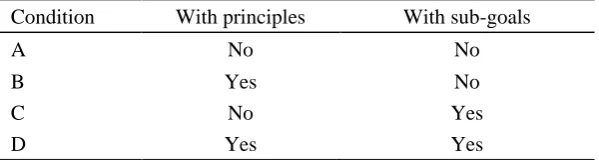
application in this study. A 2*2 between-subject experiment was conducted with two independent variables (sub-goals and principles) and two subclasses of each variable (absence and presence).
[image:16.595.90.390.407.487.2]Differences between examples in four conditions are listed in Table 3-1.
Table 3-1 Four conditions in the experiment
Condition With principles With sub-goals
A No No
B Yes No
C No Yes
D Yes Yes
3.2.
Participants
To test the effect on novice users of e-science database, participants were required to have limited
experience or no experience with SQL. 93 participants met this requirement and completed the
experiment successfully. They are all astronomy majors in China while 56 of them are males and
37 are females. They were randomly assigned into four groups, with 24 students in group D and 23
in each of other three groups, to perform the task under four different conditions respectively. There
was no significant difference between four groups regarding the correctness of 10 answers in
knowledge test (see Appendix 3): F (3,99) =.78, p=.508. Therefore, the levels of prior SQL
15 shown as below:
Table 3-2 Four groups’ performance in the knowledge test
Group Mean score of correctness
A (no principle, no sub-goal) 0.68
B (principles, no sub-goal) 0.54
C (sub-goals, no principle) 0.84
D (principles, sub-goals) 0.96
Total 0.75
There is no significant difference of average age among four groups: F (3,89) =1.410, p=.245.
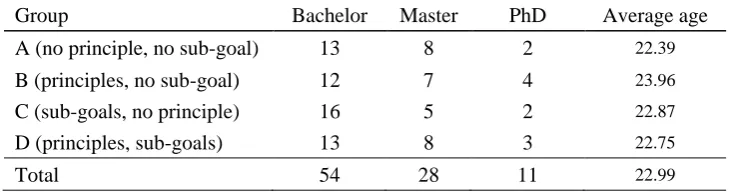
Education level and average age of participants are shown below:
Table 3-3 Education level and average age of participants
Group Bachelor Master PhD Average age
A (no principle, no sub-goal) 13 8 2 22.39
B (principles, no sub-goal) 12 7 4 23.96
C (sub-goals, no principle) 16 5 2 22.87
D (principles, sub-goals) 13 8 3 22.75
Total 54 28 11 22.99
3.3.
Materials
3.3.1.
Learning materials
The examples in this study were selected from Sloan digital sky survey (SDSS). In large sky survey
databases operated by different institutes, SQL query examples are presented with various types of
declarative information such as goal description, use case, explanations of SQL syntax and each
command line while different types of information are not categorized or labeled. In this study, four
different SQL example books were designed in which selected examples were structured into four
conditions by the researcher. A general introduction to SQL statement and tables involved in the
material was added. The content covered basic syntax and queries regarding tables that are often
used, which was sufficient to instruct novice users to comprehend functions and start composing
some code. Besides the original instructions in English, the general introduction and statement of
[image:17.595.88.455.343.441.2]16
in recalling astronomical terms they have learned in Chinese. (See Appendix 2)
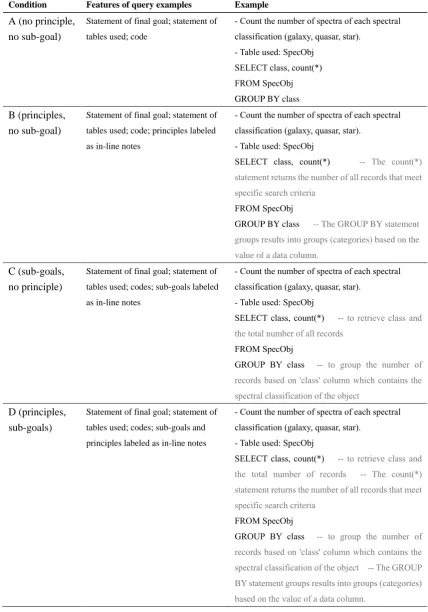
To be more detailed, each of the four conditions had different types of information to support users
of these query examples. In condition A, queries were not aided by additional information just like
most existing documentations. Examples in condition B and C were combined with principle labels
or sub-goal labels respectively, and condition D had both two types of label. The comparison of four
17 Table 3-4 An example in four conditions
Condition Features of query examples Example A (no principle,
no sub-goal)
[image:19.595.87.516.116.729.2]Statement of final goal; statement of
tables used; code
- Count the number of spectra of each spectral classification (galaxy, quasar, star).
- Table used: SpecObj SELECT class, count(*) FROM SpecObj
GROUP BY class
B (principles, no sub-goal)
Statement of final goal; statement of
tables used; code; principles labeled
as in-line notes
- Count the number of spectra of each spectral classification (galaxy, quasar, star).
- Table used: SpecObj
SELECT class, count(*) -- The count(*) statement returns the number of all records that meet specific search criteria
FROM SpecObj
GROUP BY class -- The GROUP BY statement groups results into groups (categories) based on the value of a data column.
C (sub-goals, no principle)
Statement of final goal; statement of
tables used; codes; sub-goals labeled
as in-line notes
- Count the number of spectra of each spectral classification (galaxy, quasar, star).
- Table used: SpecObj
SELECT class, count(*) -- to retrieve class and the total number of all records
FROM SpecObj
GROUP BY class -- to group the number of records based on 'class' column which contains the spectral classification of the object
D (principles, sub-goals)
Statement of final goal; statement of
tables used; codes; sub-goals and
principles labeled as in-line notes
- Count the number of spectra of each spectral classification (galaxy, quasar, star).
- Table used: SpecObj
SELECT class, count(*) -- to retrieve class and the total number of records -- The count(*) statement returns the number of all records that meet specific search criteria
FROM SpecObj
18
3.3.2.
Survey
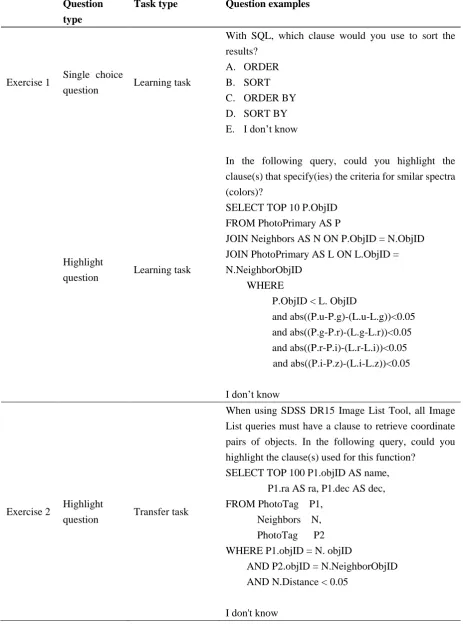
After learning the examples, participants started to do Exercise 1 and Exercise 2 in a survey form
to practice what they just learnt (see Appendix 4). Exercise 1 consisted of 10 learning tasks with
which participants answered five single choice questions about general principles and performed
five labeling tasks by highlighting the given query line. Then Exercise 2 presented transfer tasks,
which are new queries selected from SDSS and using the same SQL statements as in the learning
materials while the goals were slightly different. Participants were asked to perform five labeling
tasks by highlighting query lines that serves the goal stated by the question stem. In both Exercise
1 and Exercise 2, participants could choose ‘I don’t know’ if they did not know which answer was
19 Table 3-5 Survey questions
Question
type
Task type Question examples
Exercise 1 Single choice
question Learning task
With SQL, which clause would you use to sort the results?
A. ORDER
B. SORT
C. ORDER BY
D. SORT BY
E. I don’t know
Highlight
question Learning task
In the following query, could you highlight the clause(s) that specify(ies) the criteria for smilar spectra (colors)?
SELECT TOP 10 P.ObjID FROM PhotoPrimary AS P JOIN Neighbors AS N ON P.ObjID = N.ObjID JOIN PhotoPrimary AS L ON L.ObjID =
N.NeighborObjID WHERE
P.ObjID < L. ObjID and abs((P.u-P.g)-(L.u-L.g))<0.05
and abs((P.g-P.r)-(L.g-L.r))<0.05 and abs((P.r-P.i)-(L.r-L.i))<0.05 and abs((P.i-P.z)-(L.i-L.z))<0.05
I don’t know
Exercise 2 Highlight
question Transfer task
When using SDSS DR15 Image List Tool, all Image List queries must have a clause to retrieve coordinate pairs of objects. In the following query, could you highlight the clause(s) used for this function?
SELECT TOP 100 P1.objID AS name, P1.ra AS ra, P1.dec AS dec, FROM PhotoTag P1,
Neighbors N, PhotoTag P2 WHERE P1.objID = N. objID
AND P2.objID = N.NeighborObjID AND N.Distance < 0.05
20
3.3.3.
Pre-test
Nine students from the target group were asked to pretest the learning materials to help estimate the
difficulty of SQL syntax involved and time spent on using learning materials. They did not
participate in the main experiment afterwards. Besides, all instructions and four versions of the
survey were checked and tested with a real database user, another student who are experienced with
this database, to avoid misunderstanding and ambiguous wording. As SDSS is restricted to optical
sky survey, Chinese translations of specific astronomical terms were added according to the needs
of students from different subdomains of astronomy. This avoided misunderstanding of scientific
goals and allowed participants to concentrate on acquiring technical skills.
3.4.
Measurements
Two components of performance in learning from four different materials were measured by the
survey: effectiveness and efficiency. In evaluating effectiveness, participants’ learning outcome and
transfer of knowledge were measured by the number of questions they answered correctly in
Exercise 1 and Exercise 2. In single choice tasks, giving a wrong answer or choosing ‘I don’t know’
were both regarded as not performing the task correctly. And in highlight tasks, participants were
required to choose the exact clauses that are relevant to sub-goals or principles. Choosing wrong
clauses or more than the right clause(s) is regarded as giving incorrect answers. Besides, users’
efficiency in four conditions were compared based on time spent during learning and filling in the
two exercises, which was counted by the timer embedded in the survey platform.
3.5.
Procedures
The experiment was computerized and based on online instructions and online survey. It consisted
of three sessions: a preparation session during which participants signed the consent form, and test
their prior knowledge of SQL, a learning session where examples were presented to participants
along with a basic introduction to the database, and a testing session. In the learning session, four
21
performed two groups of tasks in the testing session. An overview of three sessions is given by the
[image:23.595.165.425.158.273.2]figure.
Figure 1. Overview of experimental procedures
4.
Results
This section presents results and findings of the experiment. Differences of effectiveness and time
efficiency between four versions of instructions are described.
4.1.
Differences in learning performance
Among 93 participants, two participants failed to complete more than one learning task so that
their data is detected as outliers by descriptive statistics. The mean scores of 91 valid data records
[image:23.595.90.361.582.744.2]are shown in Table 4-1.
Table 4-1 Difference in learning performance
Principles Sub-goals M SD N
No No 6.22 2.11 23
Yes 7.82 1.87 22
Total 7.00 2.13 45
Yes No 6.57 2.52 23
Yes 7.74 1.84 23
Total 7.15 2.26 46
Total No 6.39 2.30 46
Yes 7.78 1.83 45
22
By two-way ANOVA tests, there is no effect of adding principles on learning performance: F (3,
87) = .09, p =.761. The difference of learning performance between groups with and without
sub-goal labels is significant: F (3, 87) =9.88, p=.002. Sub-sub-goals have a positive effect with medium
effect size (𝜂̂𝑃2= 0.102). No interaction effect between principles and sub-goals was found: F (3,
87) =.23, p =.630.
4.2.
Differences in transfer performance
Transfer performance is measured by five highlight tasks. Also, only highlighting the same
clause(s) as mentioned by principles or sub-goals is counted as a correct answer. The mean scores
[image:24.595.89.365.348.509.2]of 93 participants’ transfer performance are shown in Table 4-2.
Table 4-2 Difference in transfer performance
Principles Sub-goals M SD N
No No 2.13 1.42 23
Yes 2.35 1.30 23
Total 2.24 1.35 46
Yes No 1.87 1.36 23
Yes 2.08 1.18 24
Total 1.98 1.26 47
Total No 2.00 1.38 46
Yes 2.21 1.23 47
Total 2.11 1.31 93
Although examples with sub-goals score a little higher than examples without this information, there
is no significant effect on transfer performance between them: F (3, 89) = .62, p= .432. It also shows
no effect of principles on transfer tasks performance: F (3, 89) = .93, p= .339. There is no interaction
effect between principle labels and sub-goal labels in assisting participants to complete transfer tasks:
F (3, 89) =.00, p= .995.
4.3.
Differences in time efficiency
Time spent in reading materials in the first phase of this experiment was recorded, and 19 of 93
records are excluded from the data set as outliers. 16 outliers of extremely low values, ranging from
23
webpage by mistake when reading the example webpage. Besides, other three outliers that are over
6,000 seconds are excluded based on descriptive statistics. The mean scores of 74 valid values are
[image:25.595.90.363.181.342.2]shown in Table 4-3.
Table 4-3 Difference in learning time
Principles Sub-goals M SD N
No No 1011.09 843.59 19
Yes 811.68 632.26 15
Total 923.11 753.57 34
Yes No 767.86 811.81 21
Yes 703.45 694.38 19
Total 737.26 749.38 40
Total No 883.39 825.56 40
Yes 751.20 659.97 34
Total 822.65 751.94 74
No significant effect on learning efficiency is found between materials with and without principles:
F (3, 70) = .98, p= .326. And no significant effect is found between materials with and without
sub-goals: F (3, 70) = .55, p= .460. Besides, there is no interaction effect between sub-goals and
principles: F (3, 70) = .14, p= .705. Though adding different types of information to examples seems
helpful to lessen participants’ efforts invested in reading and learning, it does not obviously
influence the time duration.
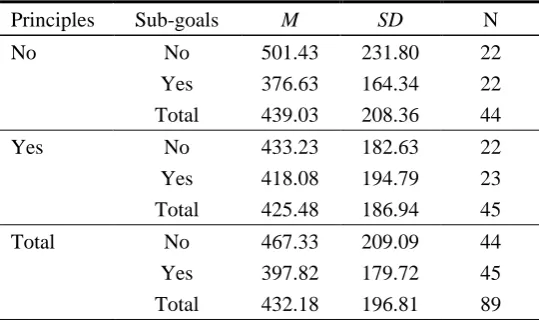
Time spent in performing learning tasks was recorded. Four outliers that are higher than 1,200
seconds are excluded based on descriptive statistics. Mean scores of 89 valid values are shown in
[image:25.595.90.360.606.770.2]Table 4-4.
Table 4-4 Difference in efficiency of learning tasks
Principles Sub-goals M SD N
No No 501.43 231.80 22
Yes 376.63 164.34 22
Total 439.03 208.36 44
Yes No 433.23 182.63 22
Yes 418.08 194.79 23
Total 425.48 186.94 45
Total No 467.33 209.09 44
Yes 397.82 179.72 45
24
The impact of adding principles on learning task efficiency is not significant: F (3, 85) = .11, p= .747.
The effect of sub-goals on how much time participants used in learning tasks is not significant: F
(3, 85) =2.87, p= .094. Besides, there is no interaction effect found between two types of labels
[image:26.595.91.364.221.380.2]added to the four conditions: F (3, 85) =1.759, p= .188.
Table 4-5 Difference in efficiency of transfer tasks
Principles Sub-goals M SD N
No No 528.30 237.18 22
Yes 433.05 249.21 22
Total 480.67 245.21 44
Yes No 551.33 323.25 23
Yes 372.48 219.42 24
Total 460.00 286.73 47
Total No 540.07 281.48 45
Yes 401.45 233.51 46
Total 467.00 266.19 91
In time spent in performing transfer tasks, two outliers are excluded by descriptive statistics. Among
91 valid results of transfer task duration, impact of principles is not significant: F (3, 87) = .12,
p= .732. Use of sub-goals is effective for improving efficiency in transfer tasks: F (3, 87) =6.30,
p=.014. There is no interaction between two independent variables: F (3, 87) =.59, p=.446.
5.
Discussion and conclusion
5.1.
Main findings
There are two major findings in this study. First, adding sub-goals to examples improved initial
learning performance among novice users of e-science databases. Second, on the question of
efficiency, using examples aided by sub-goals resulted in shorter time spent in performing transfer
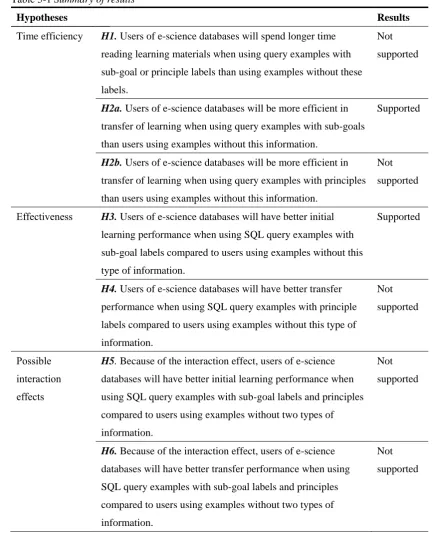
tasks. To determine the impact of using different examples on effectiveness and efficiency, seven
hypotheses were put forward based on prior studies and possible interaction effects. The results of
25 Table 5-1 Summary of results
Hypotheses Results
Time efficiency H1. Users of e-science databases will spend longer time reading learning materials when using query examples with sub-goal or principle labels than using examples without these labels.
Not supported
H2a. Users of e-science databases will be more efficient in transfer of learning when using query examples with sub-goals than users using examples without this information.
Supported
H2b. Users of e-science databases will be more efficient in transfer of learning when using query examples with principles than users using examples without this information.
Not supported
Effectiveness H3. Users of e-science databases will have better initial learning performance when using SQL query examples with sub-goal labels compared to users using examples without this type of information.
Supported
H4. Users of e-science databases will have better transfer performance when using SQL query examples with principle labels compared to users using examples without this type of information. Not supported Possible interaction effects
H5. Because of the interaction effect, users of e-science databases will have better initial learning performance when using SQL query examples with sub-goal labels and principles compared to users using examples without two types of information.
Not supported
H6. Because of the interaction effect, users of e-science databases will have better transfer performance when using SQL query examples with sub-goal labels and principles compared to users using examples without two types of information.
Not supported
The findings of this study are in consistent with some of the prior studies and two hypotheses, H2a
and H3, are supported. The analysis regarding sub-goals proves that giving users examples with specific sub-goals can assist them in applying their learning gains to isomorphic tasks (Catrambone
& Holyoak, 1990) and in solving novel problems more efficiently (Morrison, Margulieux & Guzdial,
2015). Sub-goal users did not improve their performance but only increased efficiency in transfer
26
explicitly described. For example, participants learnt about ‘sort the results based on program’ in
the instructions, but they encountered ‘ensure distinct source’s measurements appear sequentially’
later in their task. By only applying surface similarity between examples learned and novel tasks,
participants were not likely to outperform other groups without the process of generalization. This
is largely similar to the analogy process of example-based learning as proposed by Anderson,
Fincham and Douglass (1997), so that the effectiveness of sub-goals on performance is limited to
the initial stage. However, receiving sub-goal information might have increase their confidence so
that they completed the transfer tasks faster than non-sub-goal groups.
As for the effect of principles, this study also supports some previous findings (Ummelen,1997;
Karreman, 2004) that general instructions, or in other words system information, are less likely to
contribute to user performance even combined with certain examples or applied in the context of
e-science, in which principles are perceived as useful. One reason behind this finding can be that
participants still tend to follow more detailed instructions, both examples and sub-goals, provided
at the same time rather than general principles, as proposed by Duff and Barnard (1990). It can be
concluded that the usefulness of principles is determined by the certain context they are applied in
and their combination with other information. When designing brief and general instructions,
principles are likely to improve user’s understanding of procedures and the entire system. On the
other hand, when presented together with specific examples, users tend to use information that
shares superficial similarity with the task and not to invest much effort in processing the principles.
Regarding time efficiency, H1 is not supported. Participants in each condition invested almost the same amount of time in learning about the examples. Though in most cases additional information
will require longer time for reading, this experimental result may be due to easier comprehension
when participants were provided with explanations of query code, so that time spent in
comprehending and reading compensate for each other as described by Catrambone (1990).
5.2.
Implications for practice and suggestions for future research
27
effectiveness and efficiency. The findings further support previous research about the usefulness of
principles and sub-goals in the area of procedural instructions. From the perspective of general
practice, an implication is that examples are more effective when aided by additional information
or in-line notes. Using sub-goal or sub-task descriptions is suggested to break up high-complexity
tasks and keep information specificity consistent between examples and other labels, especially in
the context of e-science.
In instructional materials, the principle or system information is seldom proven effective for initial
task performance. However, according to participants feedback through e-mail after the experiment,
group A that received no additional information within examples seemed to have a higher level of
information needs. Users of condition A perceived the learning materials as more difficult and less
helpful, and a few of them asked the researcher about the correct answer of the tasks. This can be
an evidence that users feel uncertainty when facing examples without any further explanation, which
is quite common in real practices. Differently, other groups (with additional labels) only reported an
eagerness to learn about more examples and even more detailed notes. Although this was not a
formal and scientific comparison, we can notice a possibility that when offering instructions for this
specific user group, abundant information will result in a higher level of satisfaction and
appreciation for the materials. In other words, principles and system information still have a role in
e-science applications despite their limited effect in helping users learn and fulfill tasks.
For future research, there is some potential to improve relevant studies. There remains a disparity
in empirical findings about principles’ effectiveness, while the diversity in research methods and
context may have an impact. Eiriksdottir (2011) has pointed that having no effect could result from
principles being either ineffectiveness or ignored. Though it is worth considering how researchers
interpret their results, in real life instructions there is hardly a way to guarantee that system
information is actively processed.Ummelen (1997) and Karreman (2004) have used the
click-and-read method to measure how much time users invest in click-and-reading declarative information. Eiriksdottir
(2011) additionally applied an active study method and asked participants to summarize the
28
usefulness of principles, it is far from the actual fact that users of technical instructions mostly only
engage in passive activities such as reading when learning with document-based materials. In further
research, the research method should be carefully chosen so that it can not only measure how much
users are engaged in processing principles but also whether the procedures of performing tasks are
the same as in real use. Besides, other effects such as cognitive load or attitudes are still to be
explored, as the particular information needs of e-science users should be considered.
5.3.
Limitations
The experiment process may have some limitations that could influence the results. The experiment
was conducted completely online, so if the participant was having problem with how to operate the
survey, the communication between participants and the researcher was not as efficient as
face-to-face. And there was one among 93 students reported difficulty in highlighting the SQL clause in
knowledge test. He was given more detailed instructions through email and finished the survey
afterwards. The impact of operational issues was minimized by asking participants to complete the
knowledge test which contained similar single-choice questions and highlight tasks as in the survey.
But there are still some outliers in results caused by technical failures, such as closing the survey
window then stop the timer embedded in the survey by mistake. This kind of problem was not
detected in time by the researcher when participants were doing the tasks independently.
5.4.
Conclusion
As an important instruction type, examples provide users with specific instantiation and allow them
to reach pedagogical goals such as learning and transfer of learning. Different from prior research,
this study was designed to investigate examples’ effect on documentation users rather than on
students in classroom settings. An experiment was designed to examine how general principles, and
specific sub-goals assisted e-science users in performing SQL tasks. Though it was suggested by
other researchers that general principles are effective in generalizing learning gains and specific
29
differences between examples with and without sub-goal labels. Sub-goal users showed better
performance in learning tasks and higher efficiency in transfer tasks, which confirm previous
findings in the e-science context. Besides, principles did not show significant impact on task
performance but still seemed to increase users’ interest and appreciation. It can be concluded that
only specific instructions are proven effective in using examples and should receive a higher priority
than general principles when combining additional information with examples in e-science
30
References
Anderson, J. R., & Fincham, J. M. (1994). Acquisition of procedural skills from examples. Journal
of Experimental Psychology: Learning, Memory, and Cognition, 20(6), 1322.
Anderson, J. R., Fincham, J. M., & Douglass, S. (1997). The role of examples and rules in the
acquisition of a cognitive skill. Journal of Experimental Psychology: Learning, Memory, and
Cognition, 23(4), 932.
Atkinson, R. K., Derry, S. J., Renkl, A., & Wortham, D. (2000). Learning from examples:
Instructional principles from the worked examples research. Review of Educational
Research, 70(2), 181-214.
Catrambone, R. (1990). Specific versus general procedures in instructions. Human-Computer
Interaction, 5, 49–93.
Catrambone, R., & Holyoak, K. J. (1990). Learning subgoals and methods for solving probability
problems. Memory & Cognition, 18(6), 593-603.
Catrambone, R. (1995). Following instructions: Effects of principles and examples. Journal of
Experimental Psychology: Applied, 1(3), 227.
Catrambone, R. (1998). The subgoal learning model: Creating better examples so that students can
solve novel problems. Journal of Experimental Psychology: General, 127(4), 355.
Chen, X., Mitrovic, A. T., & Matthews, M. (2019). Learning from Worked Examples, Erroneous
Examples and Problem Solving: Towards Adaptive Selection of Learning Activities. IEEE
Transactions on Learning Technologies.
Chi, M., Feltovich, P., & Glaser, R. (1981). Categorization and representation of physics problems
by experts and novices. Cognitive Science, 5, 121-152.
Chi, M., Glaser, R., & Rees, E. (1982). Expertise in problem solving. In R. Sternberg (Ed.),
Advances in the Psychology of Human Intelligence (pp. 7-75). Hillsdale, NJ: Lawrence Erlbaum
Associates.
Chunpir, H., Ludwig, T., & Curri, E. (2014, October). Improving processes for user support in
e-Science. In 2014 IEEE 10th International Conference on e-Science (Vol. 2, pp. 87-90). IEEE.
31
cyberinfrastructures?. In International Conference of Design, User Experience, and
Usability (pp. 658-672). Springer, Cham.
Chunpir, H. I., & Ludwig, T. (2014). Reviewing the governance structure of end-user support in
e-Science infrastructures. Informatik 2014.
Duff, S. C., & Barnard, P. J. (1990, August). Influencing behaviour via device representation; decreasing
performance by increasing instruction. In Proceedings of the IFIP TC13 Third Interational
Conference on Human-Computer Interaction (pp. 61-72). North-Holland Publishing Co..
Earle, R. H., Rosso, M. A., & Alexander, K. E. (2015, July). User preferences of software
documentation genres. In Proceedings of the 33rd Annual International Conference on the
Design of Communication (p. 46). ACM.
Eiriksdottir, E., & Catrambone, R. (2011). Procedural instructions, principles, and examples: How
to structure instructions for procedural tasks to enhance performance, learning, and
transfer. Human Factors, 53(6), 749-770.
Eiriksdottir, E. (2011). The role of principles in instructions for procedural tasks: timing of use, method
of study, and procedural instruction specificity (Doctoral dissertation, Georgia Institute of
Technology).
Hey, T., & Trefethen, A. E. (2005). Cyberinfrastructure for e-Science. Science, 308(5723), 817-821.
Howe, B., Cole, G., Khoussainova, N., & Battle, L. (2011, June). Automatic example queries for ad
hoc databases. In Proceedings of the 2011 ACM SIGMOD International Conference on
Management of Data (pp. 1319-1322). ACM.
Huang, Y. H., Lin, K. C., Yu, X., & Hung, J. C. (2015). Comparison of different approaches on
example-based learning for novice and proficient learners. Human-centric Computing and
Information Sciences, 5(1), 29.
Huang, X. (2017). Example-based learning: Effects of different types of examples on student
performance, cognitive load and self-efficacy in a statistical learning task. Interactive Learning
Environments, 25(3), 283-294.
Ivanova, M., Nes, N., Goncalves, R., & Kersten, M. (2007, July). Monetdb/sql meets skyserver: the
challenges of a scientific database. In 19th International Conference on Scientific and Statistical
32
Karreman, J. (2004). Use and effect of declarative information in user instructions (Vol. 18). Rodopi.
Karreman, J., & Steehouder, M. (2004). Some effects of system information in instructions for
use. IEEE transactions on Professional Communication, 47(1), 34-43.
Karreman, J., Ummelen, N., & Steehouder, M. (2005, July). Procedural and declarative information
in user instructions: What we do and don't know about these information types. In IPCC 2005.
Proceedings. International Professional Communication Conference, 2005. (pp. 328-333).
IEEE.
Keller, J., & Suzuki, K. (2004). Learner motivation and e-learning design: A multinationally
validated process. Journal of Educational Media, 29(3), 229-239.
Kieras, D. E., & Bovair, S. (1984). The role of a mental model in learning to operate a device. Cognitive
Science, 8(3), 255-273.
LeFevre, J. A., & Dixon, P. (1986). Do written instructions need examples? Cognition and
Instruction, 3(1), 1-30.
Li, N., & Thakar, A. R. (2008). CasJobs and MyDB: A batch query workbench. Computing in
Science & Engineering, 10(1), 18-29.
Logan, G. D. (1988). Toward and instance theory of automatization. Psychological Review, 95, 492–
527.
Makiyama, V. H., Raddick, J., & Santos, R. D. (2015, September). Text Mining Applied to SQL
Queries: A Case Study for the SDSS SkyServer. In SIMBig (pp. 66-72).
Mora, A., González-Núñez, J., Baines, D., Durán, J., Gutiérrez-Sanchéz, R., Racero, E., ... & Segovia, J.
C. (2017). The Gaia Archive. Proceedings of the International Astronomical Union, 12(S330),
35-38.
Morrison, B. B., Margulieux, L. E., & Guzdial, M. (2015, July). Subgoals, context, and worked
examples in learning computing problem solving. In Proceedings of the Eleventh Annual
International Conference on International Computing Education Research (pp. 21-29). ACM.
Paas, F. G., & Van Merriënboer, J. J. (1994). Variability of worked examples and transfer of
geometrical problem-solving skills: A cognitive-load approach. Journal of Educational
Psychology, 86(1), 122-133.
33
from an instructional text. Memory & Cognition, 14(1), 64-78.
Renkl, A. and Atkinson, R.K. (2002). Learning from examples: Fostering self-explanations in
computer-based learning environments. Interactive Learning Environments. 10, 2 (2002), 105–
119.
Renkl, A., Atkinson, R. K., Maier, U. H., & Staley, R. (2002). From example study to problem
solving: Smooth transitions help learning. The Journal of Experimental Education, 70(4),
293-315.
Smith, E. E., & Goodman, L. (1984). Understanding written instructions: The role of an explanatory
schema. Cognition and Instruction, 1(4), 359-396.
Swarts, J. (2019). Open-source software in the sciences: The challenge of user support. Journal of
Business and Technical Communication, 33(1), 60-90.
Sweller, J., & Cooper, G. A. (1985). The use of worked examples as a substitute for problem solving
in learning algebra. Cognition and Instruction, 2, 59-89.
Tomasi, M. D., & Mehlenbacher, B. (1999). Re-engineering online documentation: Designing
examples-based online support systems. Technical communication, 46(1), 55-56.
Tsovaltzi, D., McLaren, B. M., Melis, E., & Meyer, A. K. (2013). Erroneous examples: effects on
learning fractions in a web-based setting. International Journal of Technology Enhanced
Learning, 4(3-4), 191-230.
Ummelen, N. (1997). Procedural and declarative information in software manuals: Effects on
information use, task performance and knowledge (Vol. 7). Rodopi.
Vallerand, R. J., Pelletier, L. G., Blais, M. R., Briere, N. M., Senecal, C., & Vallieres, E. F. (1992).
The Academic Motivation Scale: A measure of intrinsic, extrinsic, and amotivation in
education. Educational and Psychological Measurement, 52(4), 1003-1017.
Van der Meij, H. (1995). Principles and heuristics for designing minimalist instruction. Technical
Communication, 42(2), 243-261.
Van Der Meij, H. (2003). Minimalism revisited. Document Design, 4, 212–233.
Ward, M., & Sweller, J. (1990). Structuring effective worked examples. Cognition and Instruction,
7, 1-39.
34
Appendix
Appendix 1 Current practices of SQL instructions in e-science
databases
As a basic skill in data science, structural query language (SQL) is learnt by students and scientists through books, videos or tutorials. In the case of e-science databases, a scientific query can be complex and difficult to start with a number of unknown table structure and data fields to memorize. As these large databases develop, a focus on user experience prompts engineers and database administrator to provide them with various support for learning and using SQL. Six large e-science database from the disciplinary of astronomy and geo science are selected to give an overview of the current practices of web-based SQL instructions. Types of documentation are observed and sample queries, the examples written in SQL, were particularly focused and information included in each database is listed in the table below. Each information type is explained with selected examples from 6 databases.
Database SQL Documentation type Information type in examples
SkyServer (Sloan digital sky survey)
tutorial; sample query; query limits; searching advice
final goal description; table description; syntax explanation; utilization information; sub-goal description; system information; query code
PanSTARRS how-to guide; FAQ; sample
query;
goal description; table used; query code; results
Gaia tutorials; sample query;
timeout notes;
goal; use case; query code; notes; contributions in published articles;
GRASS GIS notes; sample query;
reference manual
goal; notes; query code; sub-goal; utilization information;
PostGIS tutorial (theory, conceptual
knowledge, query templates and query samples)
goal; definition of table used; query code; results/ description of results; system information
LAMOST query samples in SQL seach
interface
goal; query code
Goal description: the aim of using the query
Query the redshift of galaxies during given time. (LAMOST)
We want to get all objects with R degrees of a given position that are high fidelity stellar-like objects.
[image:36.595.91.509.388.646.2](PanSTARRS)