THE APPLICATION OF THE CSDP FRAMEWORK ON THE CURRENT
EU REFUGEE CRISIS
2
Author
Carmen de Oude | [email protected]
Double Degree programme
Master of Science European Studies – s1217828
University of Twente, Faculty of Behavioural, Management and Social Sciences
Master of Arts European Studies - 425703
University of Münster, Department of Political Science
Supervisors
Prof. dr. Ramses Wessel
Faculty of Behaviourial, Management & Social Sciences
University of Twente
Dr. Matthias Freise
3
we will be forever chasing one crisis after the next. We cannot let
sensationalism dictate our agenda. We need a framework that allows us to
combine swift action with patient negotiation; we need conflict prevention and
post-crisis management. At the same time, in a world (and a Union) of finite
resources, we need to prioritise those areas where we can, where we must,
and where we want to make a difference. All this requires a
consistent EU
global strategy
.”
- Federica Mogherini
High Representative of the EU for Foreign Affairs and Security Policy and
Vice-President of the European Commission
5
1. Introduction ... 8
1.1 The current situation: The EU refugee crisis in the Mediterranean... 8
1.2 State of the Art: literature on the CSDP ... 9
1.3 Research question: The CSDP as an instrument for the EU refugee crisis ... 11
1.4 Structure: answering the main research question ... 11
1.5 Methodology ... 13
2. The EU Refugee Crisis in Relation to Security Issues ... 14
2.1 The EU Refugee Crisis in the Mediterranean ... 14
2.2 Human Smuggling Networks ... 17
2.3 Conclusions ... 20
3. The CSDP: An Analysis of its Objectives and Potential ... 21
3.1 General Provisions on the Union’s External Action ... 21
3.2 An Introduction to the CSDP ... 23
3.3 The Tasks of the CSDP ... 26
3.4 The Capacities of the CSDP ... 27
3.5 Conclusions on the application of the CSDP ... 29
4. Case Study: The Application of EU NAVFORMED Operation Sophia ... 31
4.1 Approach 1: The Comprehensive Approach in the Operation ... 31
4.2 Approach 2: The Impact of the Operation ... 39
4.3 Conclusions on CSDP missions as a means for the EU refugee crisis ... 48
5. Conclusion ... 51
5.1 The Application of the CSDP framework ... 51
5.2 Consequences of the findings ... 52
5.3 Limitations of the thesis and suggestions for future research ... 54
5.4 Important final remarks ... 54
6
ESDP European Security and Defence Policy
ESS European Security Strategy
EU European Union
EUMC European Union Military Committee
EU NAVFORMED European Union Naval Force Mediterranean (Operation Sophia)
HR/VP High Representative of the European Union for Foreign Affairs and Security Policy/Vice-President of the European Commission
IOM International Organization for Migration ISIL Islamic State of Iraq and the Levant MENA Middle East and North Africa (region) NATO North Atlantic Treaty Organization PSC Political and Security Committee
TEU Treaty on the European Union
UN United Nations
UNHCR United Nations High Commissioner for Refugees UNODC United Nations Office on Drugs and Crime UNSC United Nations Security Council
7
deadly route for migrants in the world. In addition, the year 2015 highlighted massive numbers of casualties during these migratory flows.
Many scholars have written about the EU Common Security and Defence Policy (CSDP), a number of research concludes that the CSDP is mainly aimed at problems with a low risk and small mandate (Koutrakos, 2013). The CSDP has been established as a crisis management actor (Forsberg, 2006; Howorth, 2007) aimed at the European neighbourhood. This thesis elaborates on the CSDP and its application and potential with regards to the massive number of lives lost in the Southern Mediterranean since its massive increase in the beginning of 2015. Although the launch of a CSDP operation in this area seems logical, following the legal treaty provisions such as Article 21 TEU on the ‘General Provisions on the Union’s External Action’ and Article 42 and 43 on ‘Provisions on the Common Security and Defence Policy’, some major outcomes and results in Operation Sophia have been disappointing. The main aim of the operation following its mandate has been to focus on the human smuggling networks operating in the Southern Mediterranean, specifically in Libya. However, due to the crisis circumstances in the Mediterranean which require direct action, the main mandate has been neglected to a certain degree.
The conclusion on the application of the CSDP framework on the refugee crisis is therefore twofold. On the one hand the legal treaty provisions on the CSDP and the EU’s external action clearly provide a basis for action during the refugee crisis which is a humanitarian crisis in the European neighbourhood, consisting of a man-made disaster and involving security threats in both the internal and external dimensions of the EU. The need for action by the CSDP seems justified, if not necessary. However, the specific operation launched following the refugee crisis seems to have minimal impact. Although its goals and aims are clearly formulated and the mandate includes ambitious action in domestic territories, there are a number of issues that hold back the operation. The operation is aimed at the domestic territories of Libya, and so for only action is possible in the international waters due to the lack of a stable Libyan government or UNSC consent for the phases in territorial waters and land.
8
1.
I
NTRODUCTION
This first chapter will serve as an introductory chapter mainly announcing the motivation behind this thesis and the relevance of the research. It introduces the events that have led to EU refugee crisis in the Mediterranean and the potential use of specific EU instruments in the area of the Union’s CSDP to tackle this problem. After the problem and background situation of the crisis have been sketched, the state of art of existing literature can elaborate on what is already known on the capabilities of the CSDP. Following this short elaboration on this EU crisis and the EU instruments in place to tackle crises, the main research question will be formulated on the basis of these two variables. Finally, the last section will elaborate on the structure of the thesis by introducing and explaining the relevance of the sub-questions as well as the chosen chapter division and the methodology.
1.1 The current situation: The EU refugee crisis in the Mediterranean
In April 2015 a record number of 1 308 refugees and migrants lost their lives at sea while trying to cross the Mediterranean during their journey to Europe (compared to 42 in April 2014) (UNHCR, 2015b). The year 2015 has been a record year in general for lives lost at sea for migrants and refugees while travelling to Europe. In 2015 over 300 000 migrants have crossed the Mediterranean on their way to Europe. About 200 000 reached Europe in Greece, and about 110 000 arrived on the coasts of Italy (UNHCR, 2015a). Europe has been named the most dangerous and deadliest destination for migrants. In a report published by the International Organization for Migration in September 2015, a total number of 3 072 deaths have been reported in 2015 so far (International Organization for Migration, 2015). Since the year 2000 a total number of at least 22 000 deaths have occurred on the migrant routes towards Europe. Specifically the Mediterranean route near Italy has generated the most casualties. Both Italy and Greece have experienced migrant flows of around 90 000 through the sea. However, the number of casualties in the group trying to reach Italy was nearly 2 000, whereas in Greece the death rate is about 60.
9
1.2 State of the Art: literature on the CSDP
This section will explore existing literature on the perceived powers and strengths of the CSDP in order to see how current literature portrays the CSDP and its intentions.
The CSDP is the Common Security and Defence Policy of the EU. The CSDP, initially established in 1999 as the ‘European Security and Defence Policy’ (ESDP) has two main objectives (Iso-Markku, 2014):
1. To respond to crises in the European neighbourhood and beyond, based on the extended Petersberg Tasks, which cover joint disarmament, military advice and assistance, conflict prevention and peace-keeping, as well as tasks of combat forces in crisis management.
2. To ensure that member state are equipped with the necessary civilian and military capabilities to execute the Petersberg tasks in the context of an operation.
Articles by Forsberg (2006) and Howorth (2007) argue that the emergence of the CSDP is based on crisis management needs. Some scholars (Art, 2004; Jones, 2007; Posen, 2004, 2006) state that the main motivation behind the CSDP has been to increase the EU’s relative power position compared to the US, creating independence from the US in terms of security. The evolution of the CSDP can be explained by three major elements: (1) the natural expansion of the (EU) integration process, (2) the EU’s rivalry with the US, and (3) the practical needs of crisis management in a changed security environment (Strömvik, 2005). European defence integration has an intergovernmentalist nature and since its inception as the ESDP it has not had supranationalist institutions. Some say the EU should enhance its defence capabilities to show its independence from the US and to undermine NATO.
10
Forsberg (Forsberg, 2006) has stated that (Western) European nations will prefer working through NATO as opposed to the EU, since previous defence cooperation through the CSDP has caused some difficulties. EU foreign policy is fragmented and works in an intergovernmental way. There are major ‘capabilities – expectations gaps’ in the field of European foreign and security policy (Forsberg, 2006). Some scholars (Galtung, 1973) have argued in the past that the European Community would turn into a superpower and would have powers equal to that of the US. However, due to the (at that time) unforeseen accession of Eastern European states to the European Community things did not progress as fast. The US Clinton and Bush administrations have requested transferring military responsibility to the EU. Washington has played a critical role in order to engage the EU to become active in international security governance. Both NATO and the CSDP draw on the same pool of national forces. It depends on the mission under which institutional framework operations are carried out. Where the NATO primary objective is collective defence, the CSDP focusses more on “collective diplomacy with an institutional framework for crisis management” (Pohl, 2012). Pohl (2012) argues that he finds it unlikely that the EU will develop an overarching strategy of ideological logic soon. It has been argued that most operations or missions launched under the CSDP framework have been modest missions without tackling any major crises.
11
1.3 Research question: The CSDP as an instrument for the EU refugee crisis
The first section of this chapter has depicted the current situation in the Mediterranean regarding the lives of migrants and refugees lost at sea. The link to the EU can be made swiftly since the migrants and refugees who have lost their lives at sea died seeking prosperity in Europe, right on the borders of Europe. The previous section has already stated that the EU has an instrument that is aimed at crisis management. Despite the ‘security’ dimension of the refugee crisis, the link between this crisis and the potential application of the CSDP instruments has not been given much attention in academic research. Therefore the research question of this thesis will be:
To what extent is the CSDP framework capable of dealing with the current EU refugee crisis?
The main aim of this thesis will be to look at the current crisis regarding lives lost at sea and seeing how CSDP instruments can be applied to tackle this crisis. When looking at operations of the CSDP, one operation in specific can be identified that is aimed at this crisis: EU NAVFORMED Operation Sophia. This Operation will therefore form an important case study and will serve as a reality check of the theoretical findings.
1.4 Structure: answering the main research question
Elements of the above-mentioned research question will be answered separately on the basis of the following sub-questions. The first sub-question is formulated as follows:
1. What is the current problem for the EU with regards to the refugee crisis in relation to security issues?
This sub-question aims to establish background information regarding both the context of the refugee crisis for the EU and the security issues involved. This sub-question will be answered in
12 The second sub-question is:
2. What are the current tasks and capacities of the CSDP?
It will be appropriate to look into the EU’s CSDP in further detail. The answer to this sub-question will generate a theoretical basis in order to see to what extent the treaty provisions allow the CSDP to be used in the refugee crisis. This sub-question is relevant in the structure of this thesis since it examines the treaty provisions and their applicability to the current refugee crisis. Where the previous sub-question focuses on creating a contextual background, this sub-sub-question aims to investigate how the CSDP could be used to react to this crisis. The second sub-question will be answered in Chapter 3: The CSDP: An Analysis of its Objectives and Potential.
The third sub-question is:
3. How can the practical application of the CSDP be assessed with regards to the EU refugee crisis?
The relevance of this sub-question is that the answer aims to provide empirical evidence to answer the main research question. This section will also serve as a reality check of the theoretical findings. CSDP Operation Sophia will be used as a case study to see how the practical application of the CSDP can be assessed during the EU refugee crisis. This sub-question will be answered in Chapter 4: Case Study: The Application of EU NAVFORMED Operation Sophia. This chapter will go into more detail on the specific EU operation launched under the framework of the CSDP. Certain approaches
assessing the application of EU military operations will be used in order to analyse Operation Sophia, more specifically its application as CSDP operation during the EU refugee crisis in the Mediterranean.
The main research question of this thesis is:
To what extent is the CSDP framework capable of dealing with the current EU refugee crisis?
13
1.5 Methodology
The first part of this thesis will contribute to providing background information regarding the thesis topic. This content analysis will be necessary in order to bring perspective to Chapter 4. Chapter 3 will include an analysis of legal treaty provisions of the CSDP; this chapter will investigate whether the provisions set out by the EU allow intervention in the refugee crisis using CSDP.
Chapter 3 will include an analysis of the CSDP; this will be done by using official government documents, legal treaty articles and expert opinions on the CSDP. The capabilities of the CSDP will be analysed on the characteristics: tasks and capacities. This chapter will investigate to what extent the legal provisions on the CSDP could suggest the guidelines for intervention in the EU refugee crisis. After a theoretical basis has been established with Chapter 2 and Chapter 3, Chapter 4 including the case study on Operation Sophia will continue with a case study of empirical evidence that will be used to support the answer to the main research question. Chapter 4 will include an analysis of the current EU NAVFORMED Operation Sophia on the basis of its fact sheet, policy documents, expert opinions and assessments of the preliminary outcomes of the operation. This section will include an analysis based on two approaches for the operationalization of CSDP operations, a method introduced by Thierry Tardy. Tardy (2014) suggests that EU CSDP operations can be operationalized in two ways namely: the reality of ‘the comprehensive approach’ and ‘the measurement of impact and the related methodological and political challenges’. These two approaches suggested by Tardy will be used to assess the application of Operation Sophia on the refugee crisis. It is useful to use both approaches in this thesis since is allows for empirical evidence from two methods, contributing to the question of appropriateness of the operation. Operation Sophia will be analysed based on both methods followed by a comparative conclusion on both approaches with regards to the application of the EU military operation on the crisis. At the end of Chapter 4, there will be sufficient empirical evidence from two approaches to generate a conclusion on the application of the operation which will create more insight for the conclusion in Chapter 5.
14
2.
T
HE
EU
R
EFUGEE
C
RISIS IN
R
ELATION TO
S
ECURITY
I
SSUES
The following chapter will elaborate on the background of the EU refugee crisis influx and the human smuggling networks in the Mediterranean. Both concepts will be explained in order to gain a comprehensive understanding of the situation which the EU is currently facing as well as of the nature of the problem. This is important both to put the research question into perspective, and also to highlight the importance of the research question. The sub-question to be answered in this chapter is: what is the current problem for the EU with regards to the refugee crisis in relation to security issues?
2.1 The EU Refugee Crisis in the Mediterranean
This section of the chapter will focus on the background issues explaining the current influx of refugees fleeing to Europe resulting in high numbers of deaths in the Mediterranean Sea. The refugee crisis has two main dimensions, namely the push factor for refugees to flee from for example the Middle East, and the more specific pull factor for those refugees to choose to go to Europe. This section will focus on the pull factor for those refugees from the Middle East to come to Europe. In order to address the major problem analysis in the paper, it will be advantageous to focus on the background issue of the problem.
The refugee crisis in the EU is caused by the lack of a strategy.
- Elizabeth Ferris (2015), senior fellow in the Foreign Policy Studies Program at the Brookings Institution
Push factors
15
Many disagree on the question whether there is a strategy for the Middle East, but if there is one; its goal should be to solve (the root causes of) the refugee crisis.
- General David Patraeus (2015), former Director of the CIA; Commander ISAF; Commander US Forces Afghanistan; Commander, US Central Command
Table 2.1: Origin countries of refugees (UNHCR, 2014)
Rank Country Percentage Reason
1. Syria 34% Civil war and IS
2. Afghanistan 12% Taliban rebels
Eritrea 12% Forced labor
Since most refugees are currently from Syria, it will be useful to highlight a short history of the previous few years. In 2011 pro-democracy protests took place in Deraa, located in the south of Syria. A number of teenagers were arrested and torture after painting slogans on a school wall. Syrian security forces later also opened fire on demonstrators killing many (Rodgers, Gritten, Offer, & Asare, 2015). These events triggered protest all through Syria against President Assad and an opposition against President Assad grew. Soon the amount of violence in Syria escalated and a civil war was emerging. Rebel brigades were gaining power and fought with the Syrian government in order take over control of towns and cities. By June 2013, 90 000 people had been killed, increasing to 220 000 by March 2015 (Rodgers, et al., 2015). The conflict is no longer just between President Assad and the opposition parties, there has been a large rise in jihadist groups within Syria, including the Islamic State. The Assad regime has enabled terrorist groups such as ISIL to exist (Hof, 2015). Nearly 4 million people have fled from Syria, one of the largest refugee influxes in history. Most reside in directly bordering countries such as Lebanon, Jordan and Turkey.
The current refugee crisis influx to Europe is a “spill over challenge” from instability in Syria and the Middle East.
16
Pull factor
As mentioned before, most refugees fleeing to Europe are of Syrian and Afghan decent. Although the EU has always faced economic migrants seeking jobs in Europe, this current migrant influx is different. Most current refugees are fleeing wars and violence in their home countries, making the main reasons for migration forced. According to the International Organization for Migration (IOM), Europe is “the most dangerous destination for irregular migration in the world” (Park, 2015). This due to the fact that many cross outer European borders illegally, for example, using smugglers to cross the Mediterranean Sea in unsafe boats.
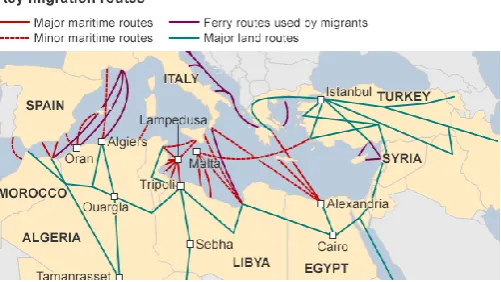
[image:16.595.82.354.370.618.2]Because of their geographical position, a number of countries are affected more directly by the migrant influx. Greece and Italy are located on the border of the EU on the Mediterranean Sea, by which refugees flee from North Africa and/or Turkey. Another upcoming place for refugees to flee to is Hungary; it is not dangerously bordered by sea, and can be reached by entering Eastern Europe through land. Although a shift is taking place where refugees are choosing to travel to Europe through its Eastern borders, it is still significant to look at the routes in the Mediterranean since these are the most deadly. Also, since Eastern European countries have started to close their borders since the end of 2015, and the route from Turkey has lost popularity due to the EU – Turkey action plan; the ‘old’, dangerous route in the Southern Mediterranean (from Libya to Italy) has regained popularity ("'Honderden vluchtelingen verdronken in Middellandse Zee'," 2016). Figure 1 shows the most popular migrant arrival sites. Many are centred on Italian islands in the Mediterranean Sea and on Greek islands near Turkey. The first EU destination of the refugees is usually not these islands located in the Mediterranean; however, due to the open borders of the EU system, the main goal is usually to get to Western and/or Northern Europe.
Figure 2.1: Migrant arrival sites and camps (UNHCR, 2014)
17
refugees. Although many refugees stay in these countries in refugee camps, a number of people seek for better circumstances, peace and wealth in Europe. However it should be recognized that most refugees stay in the immediate neighbouring countries; the Turkish Ambassador to the US stated that Turkey has received over 2 million refugees this year (Turkish Ambassador to the US, 2015). “Fleeing is an act of despair.”
- Philipp Ackermann (2015), Deputy Chief of Mission of the Embassy of the Federal Republic of Germany to the US
[image:17.595.308.559.297.438.2]Many people travel to Italy from Libya by boat, which is a long and dangerous crossing. Refugees often pay thousands of dollars to smugglers in Libya in order to get them to Europe. They are often transported in unsafe boats and are abused during the journey. The unstable situation has allowed major trafficking networks to emerge, persuading and exploiting refugees to make the dangerous journey to Europe.
Figure 2.2: Key migration routes ("Why is EU struggling with migrants and asylum?," 2015)
2.2 Human Smuggling Networks
This next section of the chapter will focus on the human smuggling business following the increased numbers of refugees fleeing to Europe. The human smuggling business includes major cross-border networks that are professionally set up in order to make profits from refugees wanting to enter Europe. This section will focus on the workings of the human smuggling business to Europe, this in order to lay a foundation for the next chapters on the application and potential of the CSDP and
Operation Sophia.
The human smuggling business
18
people to leave these areas. It has been estimated that smugglers running their business from Africa to Europe about $150 million dollars a year. Getting to Hungary will cost Afghans about €10 000, whereas a place on a boat from Turkey to Greece will cost about €1 000 (Chonghaile, 2015).
The main destinations for refugees from Syria are Jordan, Lebanon and Turkey. However, these countries are struggling with providing the basic needs for these refugees. The number of refugees in Jordan is expected to surpass 1 million this year. For a country with only 6 million inhabitants the facilities that can be offered to refugees is only limited. As explained in the previous section, the lack of food and healthcare in frontline countries can motivate refugees to continue their journey and try to reach Europe, desiring a better life and more possibilities. Some scholars have argued that the limited facilities and the limited capabilities to support refugees in these countries are the major cause for the pull factor towards Europe and therefore also the high demand for the journey to Europe, causing the expansion of the smuggling networks (King's College London, 2015). Many refugees are willing to risk their lives in order to try to find a better life in Europe. Due to the EU’s strict border controls, using smugglers and their networks is one of the only ways to cross the borders (De Haas, 2016).
Within Europe’s migration crisis there should be focus on law enforcement and human smuggling.
- Catherine Wiesner (2015b), Deputy Assistant Secretary of State, Bureau of Population, Refugees, and Migration
The human smuggling networks operating between Africa and Europe are professional, well organized criminal networks. These networks of smugglers can be defined as transnational criminal networks operating across borders. Because of the fact that smuggling is illegal and smugglers are profit orientated, the position of the migrant is vulnerable (UNODC). The smugglers on the other hand, enjoy a high degree of power and are often reported to have mistreated refugees. The journeys operated by these smugglers are often dangerous and unsafe; refugees refusing dangerous situations have been forced to complete the journey.
“The migrant smuggling business remains a very profitable industry for Libya, and is assessed to generate an annual revenue of € 250 to 300 million and in some cases this may be over 50% of the revenue for some of the towns in Tripolitania. An analysis has shown that the smuggling business mode in Libya is dependent on three vital conditions:
19
(2) the possibility to operate unmolested by militias, rivalling groups and authorities; and
(3) the capability to provide the transport to Europe or to merchant or military rescue vessels.” (Credendino, 2016, p. 6)
Border crossing casualties
In 2015 over 300 000 migrants have crossed the Mediterranean on their way to Europe. About 200 000 reached Europe in Greece, and about 110 000 arrived on the coasts of Italy (UNHCR, 2015a). Europe has named the most dangerous and deadliest destination for migrants. In a report published by the International Organization for Migration in September 2015, a total number of 3 072 deaths have been reported in 2015 so far (International Organization for Migration, 2015). Since the year 2000 a total number of at least 22 000 deaths have occurred on the migrant routes towards Europe.
The International Organization for Migration has reported that a number of survivors reaching Europe have stated that the engine of their boat got overheated and the smugglers used the drinking water onboard to cool it down. During that trip 14 migrants died to the direct effects of dehydration and heat exhaustion (International Organization for Migration, 2015). This story is not unique, this year there have been many accounts of similar events taking place in the Mediterranean, where smugglers have mistreated migrants, and in a number of cases resulting in massive deaths. Specifically the Mediterranean route near Italy has generated the most casualties. Both Italy and Greece have experienced migrant flows of around 90 000 through the sea. However, the number of casualties in the group trying to reach Italy was nearly 2 000, whereas in Greece the death rate is about 60.
In the Council Decision of the 18th of May 2015, the Council referred to a statement made on the 20th of April 2015, addressing the security issues regarding the refugee crisis: “(...) the Council confirmed a strong commitment to act in order to prevent human tragedies resulting from the smuggling of people across the Mediterranean”1. Here the Council specifically refers to the security issue regarding
the loss of lives at sea which result from the human smuggling networks. According to the Council the immediate priority is “to prevent more people from dying at sea”1.
1 Council Decision (CFSP) 2015/778 of 18 May 2015 on a European Union military operation in the Southern
20
2.3 Conclusions
In conclusion, this chapter aims to elaborate on the current refugee influx from the Middle East to the EU. Overall, two main elements can be distinguished, namely the push factor for refugees to come from the Middle East to the EU, and the pull factor to come to the EU from the Middle East. The former element suggests that the main focus is on looking into the unstable situations in the Middle East. The latter indicates that refugees are fleeing their country, and make the explicit choice to come to Europe. The research paper will focus on this last element, the pull factor, since it is in line with the overall objective to look at the EU CSDP and its abilities in the field of security issues related to the refugee crisis in the Mediterranean. Also, from this perspective there are multiple dimensions to focus on in the light of the refugee crisis. For the purpose of this paper there will only be focus on the CSDP strategy and operations in the field of this crisis.
Overall the conclusion can be made that the Mediterranean smuggler route is a very dangerous one. Migrants are sometimes forced to travel in dangerous boats by the smugglers who receive thousands of dollars for the crossing. There has been much media coverage on capsized ships or boats that are being abandoned by the smugglers after engine fails, resulting in major casualties. One of the main problems that arose alongside instability in the North Africa and Middle East region is the emergence of human smuggling networks. Although these have been present for much longer, they have undergone massive growths due to the massive increase in demand to go to Europe. Due to the large number of deaths in the Mediterranean on smuggler routes, the human smuggling networks have become a major element in the current EU refugee crisis influx.
21
3.
T
HE
CSDP:
A
N
A
NALYSIS OF ITS
O
BJECTIVES AND
P
OTENTIAL
This chapter will include an analysis of the objectives and potential of the CSDP. This will include a theoretical basis on the CSDP. The purpose of the chapter will be analyse the CSDP on the basis of legal provisions in the Treaty on European Union (TEU), scientific research and expert opinions, and to see to what extent certain legal provisions can be identified in the current refugee crisis. The main aim in this chapter will be to answer sub-question 2: What are the current tasks and capacities of the CSDP? The approach to answering the sub-question will be based on the analysis of relevant TEU legal provisions. The first section of this chapter will go into detail on the ‘General Provisions on the Union’s External Action’, more specifically Article 21 TEU. Once the legal wording has been specified the goal will be to link its applicability to the current EU refugee crisis. The latter sections will go into more detail on the relevant treaty provisions of the CSDP. The same will be done in as in the former section, linking the applicability of Article 42, 43 and 44 to the current EU refugee crisis. Specifically, this chapter will analyse the objectives and potential of the legal treaty provisions on the CSDP in reacting to the refugee crisis.
3.1 General Provisions on the Union’s External Action
Before looking at the different treaty provisions on the CSDP in more detail it is important to take a closer look at the general legal provisions on the EU’s external action. Chapter 1 of Title V starts with Article 21 (TEU)2 which refers to the Union’s action on the international scene.
Article 21 (1) TEU
The Union’s action on the international scene shall be guided by the principles which have inspired its own creation, development and enlargement, and which it seeks to advance in the wider world: democracy, the rule of law, the universality of human rights and fundamental freedoms, respect for human dignity, the principles of equality and solidarity, and respect for the principles of the United nations Charter and international law.
Main elements that can be highlighted in this article in relation to the refugee crisis in the Southern Mediterranean are the universality of human rights and fundamental freedoms and the respect for human dignity. Both the aspect of human rights and the respect for human dignity are points that can be identified when looking at the loss of lives at sea following migratory flows to Europe through the use of criminal human smuggling networks. Article 21 (1) TEU specifically refers to the Union’s action outside the EU and the conditions for this, Article 21 (2) goes into more detail on the goals of external action.
22 Article 21 (2) TEU
The Union shall define and pursue common policies and actions, and shall work for a high degree of cooperation in all fields of international relations, in order to:
(a) safeguard its values, fundamental interests, security, independence and integrity;
(b) consolidate and support democracy, the rule of law, human rights and the principles of international law;
(c) preserve peace, prevent conflicts and strengthen international security, in accordance with the purposes and principles of the United Nations Charter, with the principles of the Helsinki Final Act and with the aims of the Charter of Paris, including those relating to external borders;
(d) foster the sustainable economic, social and environmental development of developing countries, with the primary aim of eradicating poverty;
(e) encourage the integration of all countries into the world economy, including through the progressive abolition of restrictions on international trade;
(f) help develop international measures to preserve and improve the quality of the environment and the sustainable management of global natural resources, in order to ensure sustainable development;
(g) assist populations, countries and regions confronting natural or man-made disasters; and (h) promote an international system based on stronger multilateral cooperation and good global governance.
In relation to the refugee crisis a number of principles can be highlighted in Article 21 (2) TEU, such as to consolidate and support (…) human rights and the principles of international law. Again there is an emphasis on human rights with regards to the external action of the EU. Looking at this section of the article the human rights which are violated by the human smuggling networks in Libya (as mentioned in Chapter 2) are eligible for external action by the EU. Also, section (c) states that the EU aims to
23
3.2 An Introduction to the CSDP
Since its establishment the EU has developed as an international crisis management actor (Koutrakos, 2013). Since 2003 the EU has conducted more than 25 civilian and military crisis management missions in the world (dated to 2013). Looking back on the EU’s historical evolution, starting as a peace project based on economic integration in the 1950s (Koutrakos, 2013), the development of the EU being an international crisis management and military actor is quite exceptional. However, as a part of the Common Foreign and Security Policy (CFSP) the CSDP has advanced into a stand-alone policy field with its own rules, procedures and bodies (Wessel & Van Vooren, 2014).
Article 42 (1) TEU3 introduces the CSDP as part of the EU’s CFSP, focusing on peace-keeping, conflict prevention and strengthening international security. The reformed CSDP, previously known as the ESDP has been further developed on the basis of the European Security Strategy. The motivation behind the European Security Strategy (ESS) was the division between EU member states on the US-led invasion of Iraq in 2003. The ESS identifies strategic objectives to defend the EU’s security and to promote its values. “In an era of globalisation, distant threats may be as much a concern as those that are near at hand... The first line of defence will be often be abroad. The new threats are dynamic... Conflict prevention and threat prevention cannot start too early.” (European Security Strategy: A Secure Europe in a Better World 2003, p. 6). The event that triggered the ESS showed the urgency for a common strategic vision to enhance internal cohesion at EU level (European Union External Action).
The CSDP, established in 1999 as the ESDP has two main objectives (Iso-Markku, 2014):
Common Security and Defence Policy: Main objectives
1. To respond to crises in the European neighbourhood and beyond, based on the extended Petersberg Tasks, which cover joint disarmament, military advice and assistance, conflict prevention and peace-keeping, as well as tasks of combat forces in crisis management.
2. To ensure that member state are equipped with the necessary civilian and military capabilities to execute the Petersberg tasks in the context of an operation.
When looking to the main objectives of the CSDP in more detail its relevance in responding to the refugee crisis can be established. The first objective of the CSDP refers to the EU responding to crises in the European neighbourhood and beyond. The refugee crisis in this context, more specifically, the
24
loss of lives at sea is taking place near the EU’s borders. In fact, reaching the EU is the motive behind the migratory and refugee flows. Therefore the Petersberg Tasks which include military advice and assistance seems relevant in responding to crises in the European neighbourhood and beyond.
Article 42(1) TEU
The common security and defence policy shall be an integral part of the common foreign and security policy. It shall provide the Union with an operational capacity drawing on civilian and military assets. The Union may use them on missions outside the Union for peace-keeping, conflict prevention and strengthening international security in accordance with the principles of the United Nations Charter. The performance of these tasks shall be undertaken using capabilities provided by the Member States.
Looking at Article 42 (1) and its possible relevance to the refugee crisis a number of relevant parts can be identified. The treaty provision highlights the conditions for using the CSDP in situations for
peace-keeping, conflict prevention and strengthening international security. The main point that can be identified here with regards to the refugee crisis is strengthening international security. Chapter 2 has concluded that the refugee crisis includes a security dimension relating to the loss of lives at sea. Following Article 42 (1), the EU can relate this security dimension to use the CSDP for strengthening international security.
Structure and institutions
The two main structures of the CSDP are the Political and Security Committee (PSC) and the European Union Military Committee (EUMC). The PSC is a preparatory body for the Council of the EU, made up of ambassadors from the EU member states. It keeps track of the international situation and helps to define policies within the CSDP; the committee also prepares EU responses to crises. The EUMC is a body which is composed of the Chiefs of Defence of the Member States, the so-called permanent military representatives. This military body provides the PSC with recommendations and advice on military matters within the EU (European Union External Action). These specific organs of the CSDP are not explicitly mentioned in the treaty; instead they are established by Council Decisions4.
4 COUNCIL DECISION of 22 January 2001 setting up the Political and Security Committee [2001] OJ L27/1 and
25
With the implementation of the Lisbon Treaty in 2009, a new mechanism was introduced: the Permanent Structured Cooperation. This mechanism can be used for capability development between member states within the framework of the EU. At the same time, the position of the High Representative has been strengthened, making it the chair of the Council of Ministers on foreign and security policy (Biscop, 2010). This strengthened position will give new incentive to decision-making.
Decision-making: when will there be common defence?
Article 42 (2) TEU
The common security and defence policy shall include the progressive framing of a common Union defence policy. This will lead to a common defence, when the European Council, acting unanimously, so decides.
Due to the fact that the CSDP has no guidelines that illustrate whether the EU should react to a certain situation, the decision-making of whether to intervene will be reactive. The lack of a clear strategic framework keeps the CSDP from having preventive elements. Also, due to the reactive nature of operations, certain interests of member states can play a role in whether a CSDP operation is initiated. Article 42 (2) suggests that member states shall include the progressive framing of a common Union defence policy. In the case of the refugee crisis this will suggest that a response is possible if the European Council decides this. However, due to many historically strong ties that some European countries might have with third countries, the reason to intervene can be based on a number of different reasons. Also, countries holding the Presidency could possibly have more influence in deciding when to initiate an operation. Whether there are clear guidelines for response or not, the European Council can decide to respond to situations.
26
The main drivers behind EU integration have economic, monetary and fiscal natures. Integration among EU member states took place in a rapid pace, though the security realm seems to be evolved on a different level. The emergence of the CSDP can be ascribed to EU integration in other areas. When integration takes place in one area, this is likely to spill-over to other areas as well. The CSDP consists of a bottom-up approach (Biscop & Coelmont, 2010), meaning a common defence strategy has been built up by undertaking operations following the capabilities and development in the last decade without relying on a so-called ‘grand strategy’. Missions and operations are gradually developing instead of relying fully on an existing strategy. Engaging in different missions and operations will guide the EU towards a common CSDP strategy. In contrast, a top-down approach would suggest a clear defined common strategy, to which all operations are guided with an overarching aim.
3.3 The Tasks of the CSDP
Main tasks
Article 43 (1) TEU
The tasks referred to in Article 42 (1), in the course of which the Union may use civilian and military means, shall include disarmament operations, humanitarian and rescue tasks, military advice and assistance tasks, conflict prevention and peace-keeping tasks, tasks of combat forces in crisis management, including peace-making and post-conflict stabilisation. All these tasks may contribute to the fight against terrorism, including by supporting third countries in combating terrorism in their territories.
27
Regulation of CSDP Decisions
Article 42 (4) TEU
Decisions relating to the common security and defence policy, including those initiating a mission as referred to in this Article, shall be adopted by the Council acting unanimously on a proposal from the High Representative of the Union for Foreign Affairs and Security Policy or an initiative from a Member State. The High Representative may propose the use of both national resources and Union instruments, together with the Commission where appropriate.
Article 42 (4) TEU which refers to the decision-making within the CSDP states that mission or operation which can either be proposed by the HR/VP or a (group of) member state(s), can be adopted by the Council. Explicitly this means that a mission could be initiated by a group of member states during a crisis. In the case of the refugee crisis a group of member states or the HR/VP could propose action which can result in the launch of a CSDP mission after Council adoption.
Article 43 (2) TEU
The Council shall adopt decisions …, defining their objectives and scope and the general conditions for their implementation. The High Representative of the Union for Foreign Affairs and Security Policy, acting under the authority of the Council and in close and constant contact with the Political and Security Committee, shall ensure coordination of the civilian and military aspects of such tasks.
The CSDP is part of the CFSP meaning that other EU legal instruments such as Regulations and Directives cannot be issued (Wessel & Van Vooren, 2014). The CSDP provides the EU with certain civil and military assets given by the Member States. The CSDP allows the EU to “play a distinct role as a regional and global security actor, separate from that of the Member States” (Wessel & Van Vooren, 2014, p. 402).
3.4 The Capacities of the CSDP
28
involved. Not all countries are involved in all EU missions and operations5. The common strategy can show signs of fragmentation due to the fact that not all member states are involved. In every CSDP mission the composition of countries can differ. All in all the execution of a strategy relies on the member states themselves following a largely intergovernmentalist form of cooperation.
Article 44 (1) TEU
The Council may entrust the implementation of a task to a group of Member States which are willing and have the necessary capability for such a task. Those Member States, in association with the High Representative of the Union for Foreign Affairs and Security Policy, shall agree among themselves on the management of the task.
The EU has no fixed army; instead it depends on the CSDP forces contributed by EU member states (European Union, 2015). The willingness to participate in CSDP missions is on a case-by-case basis and is assessed by every member for every new mission. Launching new operations rely on unanimous decision-making in the Council. In the case of the refugee crisis launching an operation would be in the interest of a number of countries that are directly confronted with the crisis. Following the Council decision to launch an operation the member states with necessary capabilities and willingness with agree on the management of the set out task.
Under the Treaty of Lisbon, Article 42 (2) states that the European Council will act unanimously to progressively develop a ‘common EU defence policy’. This means that the European Council, thus the heads of state/government may decide on the further development of defence issues. However, actual CSDP decisions are taken by the Council (of Ministers) and since the entry into force of the Lisbon Treaty in 2009 the HR/VP heads the CFSP thus also the CSDP (“The common foreign and security policy shall be put into effect by the High Representative of the Union for Foreign Affairs and Security Policy and by Member States, in accordance with the Treaties”6).
As mentioned earlier, each operation is undertaken individually; therefore Member State engagement is assessed on a case-by-case basis. The question could then be raised, why choose one specific operation over another? One example; in 2008 the EU had an operation in Chad and the
5
EUTM Somalia: 11 contributing member states; EUCAP Sahel Niger: 11 contributing member states; EU NAVFOR ATALANTA Somalia: frequent rotation, and EUCAP Nestor: 17 contributing member states, retrieved from European Union External Action (2016a).
29
Central African Republic for the protection of displaced person from Darfur. However, during this time the EU was also asked by the UN to intervene in Eastern Congo in order to safeguard human security, but they decided not to. Again, without a clear overall strategy, justifying when to intervene, and when not to intervene seems to be difficult. The CSDP strategy does not entail guidelines when to or when not to intervene; this suggests more fragmentation due to the fact that it would be difficult to predict whether the EU would intervene in a crisis when it is happening.
When looking at the numbers, the aim of the CSDP is to have the possibility to be able to deploy 50 000 to 60 000 troops, together with air and maritime forces, command and control, strategic transport and additional support services within the period of 60 days, for the total period of at least one year (Biscop & Coelmont, 2010). In general this means that there should be 180 000 deployable troops without including logistic support. Besides the deployable troops the EU also has two Battlegroups of 1 500 troops on stand-by for rapid response operations. Each Battlegroup should be able to deploy within 10 days, for the period of at least four months. EU member states can adopt deployment missions in multiple frameworks such as the CSDP, NATO and OSCE.
Financing
Athena is a mechanism which handles the financing of common costs relating to EU military operations under the CSDP (European Council, 2015a). It was established by the Council Decision of 27 March 2015 establishing a mechanism to administer the financing of the common costs of European Union operations having military or defence implications (Athena)7. Article 6 of the Council Decision establishes a special committee. Athena is under the authority of this special committee with representatives of the member states that contribute to the funding of operations. In total, 27 of the 28 member states contribute to Athena with the exception of Denmark, which has an opt-out of the entire CSDP. Currently six active missions are being financed through Athena, including EUANVFOR MED: Operation Sophia. In addition, military assets and personnel are provided by the states involved in the operation, including running costs and personnel.
3.5 Conclusions on the application of the CSDP
European security and defence is unique within European integration. Unlike economic integration, CSDP integration within the EU is based on voluntary cooperation with all possibilities to keep national sovereignty when states decide this. The CSDP is therefore a cooperation framework with
7 Council Decision (CFSP) 2015/528 of 27 March 2015 establishing a mechanism to administer the financing of
30
some issues worth mentioning. One of the main objectives of the CSDP is to respond to crises in the European neighbourhood and beyond. However, it seems that there are no clear guidelines which the EU can follow to assess whether it should launch an operation under the framework of the CSDP. There is also a level of voluntariness in the CSDP since each operation demands the commitment of individual member states. Data shows that so far the CSDP has been seen as a means for low-intensity operations; which is reflected in the financing construction. Due to European integration in other areas, it seems unavoidable to not have an EU framework on defence cooperation; however, legal treaties seem to limit this to crisis management. Also, it seems that CSDP missions are launched in regions where some EU countries have interests or historic and cultural ties.
In conclusion, there is no clear direction in which the EU tries to steer the CSDP towards, apparent from the EU treaties. Firstly, Article 21 TEU refers to the Union’s external action in relation to human rights and the goals of EU external action. The legal treaty provisions on the CSDP8 can be interpreted in the way that action under the CSDP can be justified in the case of the refugee crisis. In conclusion, when looking at the application and the potential of the CSDP and the sub-question what are the current tasks and capacities of the CSDP?, treaty provisions (Article 42 (1) TEU and 43 (1) TEU) refer to the EU using civilian and military means including humanitarian and rescue tasks and responding to crises in the European neighbourhood. Together with the possible initiative coming from either the HR/VP or member states, responding to the refugee crisis through the CSDP seems relevant. However, as this chapter has illustrated, situations that can be perceived as a crisis will have to be assessed on a case-by-case basis. The objectives of the CSDP and the legal treaty provisions lack clear guidelines as to whether a situation demands response by the EU, however, the legal provisions can be interpreted to react to situation with the CSDP when the HR/VP or member states find this relevant.
31
4.
C
ASE
S
TUDY
:
T
HE
A
PPLICATION OF
EU
NAVFORMED
O
PERATION
S
OPHIA
This chapter will include empirical evidence for the main research question. This chapter further examines CSDP Operation Sophia in order to assess the application of the CSDP on the EU refugee crisis in the Mediterranean. The main aim of this chapter is to assess how the EU uses the CSDP for the EU refugee crisis in the Mediterranean in practice and how this relates to the goals set out in the objectives of the CSDP. The sub-question that will be answered in this chapter is: How can the practical application of the CSDP be assessed with regards to the EU refugee crisis?
This chapter will consist of multiple sections in order to come to a valid answer to the sub-question. Thierry Tardy (2014) suggests EU CSDP operations can be operationalized in two ways namely: the reality of ‘the comprehensive approach’ and ‘the measurement of impact and the related methodological and political challenges’. Tardy states that applying these two approaches on CSDP should be widely acknowledged and that this could become an overall approach to objectively see how CSDP operations work out. Operation Sophia will be analysed based both methods followed by a comparative conclusion on both approaches with regards to the application of the EU military operation on the crisis. Section 4.1 and 4.2 might have some overlap or repetition, however, since they aim to independently analyse Operation Sophia similarities and/or differences can contribute to the conclusions made in section 4.3.
4.1 Approach 1: The Comprehensive Approach in the Operation
32
concept set out by Woollard, Operation Sophia will be analysed with regards to dimensions falling under this comprehensive approach as stated by Helly and Galeazzi (2015): (1) develop a shared analysis, (2) define a common strategic vision, (3) focus on prevention, (4) mobilise the different strengths and capacities of the EU, (5) commit to the long term, (6) linking policies and internal and external action, (7) make better use of EU Delegations, and (8) work in partnership.
4.1.1 Develop a shared analysis
The launch of Operation Sophia is part of the EU Comprehensive Approach towards Migration (see Annex A). Operation Sophia is the military aspects of this approach aimed at lowering the migration influx and creating stability in Europe’s neighbours. However, the specific operation, not looking at its part in the overall approach is aimed at the loss of lives at sea in the Mediterranean following migrants and refugees’ efforts to come to Europe. It was Italy that had already launched ‘Operation Mare Nostrum’ in October 2013, also aimed at tackling the increasing migratory flow numbers and ship wreckages off the coast of the Italian island Lampedusa (Ministrero della Difesa, 2014). Operation Mare Nostrum soon became too costly for Italy to fund alone, costing over € 9 million per month. After Operation Mare Nostrum ended one year later, the EU’s border security agency Frontex launched ‘Operation Triton’, which was aimed at securing Europe’s borders and saving lives. In contrast, Operation Sophia is a military operation which has the aim to disrupt the human smuggling networks in the Mediterranean (European Union External Action, 2015a).
The development of a shared analysis has emerged from Italian initiative in launching an operation
in order to decrease the loss of lives off and migratory flows off the coast of Italy. This soon shifted
to an EU operation, due to financial reasons and EU interests under Italian leadership. This
operation was seen as an EU responsibility to reduce to loss of lives at sea near Europe’s borders.
4.1.2 Define a common strategic vision
On the 23rd of April 2015, the EU Prime Ministers and the EU Ministers of Defence agreed to strengthen defence cooperation in the EU refugee crisis directly following the deaths of a large number of refugees in their attempt to cross the Mediterranean Sea.
33
During the last few months a number of member states have joined the operation after previously stating that their capacities would limit participation, such as Austria (Manz, 2016). Currently, 24 of the 28 member states are officially participating in the operation (European Union External Action, 2015b), see figure 4.1.
According to the European Union External Action Services the main aim of Operation Sophia is to “tackle the root causes of the human emergency in the Mediterranean - in cooperation with the countries of origin and transit - and fight human smugglers and traffickers” (European Union External Action, 2015a). Specifically, the common strategic vision focuses on the Southern Mediterranean and the smuggling networks off the coast of Libya.
The first phase focuses on surveillance and assessment of human smuggling and trafficking networks in the Southern Central Mediterranean;
The second phase of the operation provides for the search and, if necessary, diversion of suspicious vessels;
The third phase would allow the disposal of vessels and related assets, preferably before use, and to apprehend traffickers and smugglers. (European Union External Action, 2015b)
The European Union External Action Service emphasizes that “the Council shall assess whether the conditions for transition beyond the first phase have been met, taking into account any applicable UN Security Council Resolution and consent by the Coastal States concerned” (European Union External Action, 2015b). This means that the Council will either need UNSC consent or individual states’ consent to execute parts of this operation in domestic waters and/or territories.
In reality much of the human smuggling is taking place on land, therefore some say that the
capabilities are not sufficient looking at the scope of the current crisis (Coffey, 2015). There are also
a number of different perspectives between EU member states. Italy, for example is highly
motivated to engage in EU (military) operations working towards safety (Alberini, 2015), while
others are more sceptic towards EU integration (Szemerkenyi, 2015). Overall, most EU member
states participate in the operation and hereby support the need for action. However, the exact
34
Figure 4.1: EU NAVFORMED Operation Sophia (European Union External Action, 2015b)
4.1.3 Focus on prevention
The focus of Operation Sophia seems to be on prevention, due to the wording “contribute to prevent loss of life at sea” (European Union External Action, 2015b) in its mandate. However, to “contribute to disrupt the business of human smuggling and trafficking in the Mediterranean” (European Union External Action, 2015b) suggests that there is an underlying issue that is not being tackled. As mentioned in chapter 2, there are a number of push and pull factors why refugees choose to travel to Europe. These factors possibly enable the emergence of human smuggling networks, making the instability in the Middle East and North Africa the main purpose behind the migratory flows, and thus possibly also emergence of human smuggling networks in the Southern Mediterranean.
In practice, Operation Sophia is not primarily aimed at creating stability in MENA areas such as
Syria, Afghanistan etc. or preventing the overall migratory flows from this area, instead it reacts to
the crisis in the Southern Mediterranean concerning direct migratory flows to Europe, including the
35
4.1.4 Mobilise the different strengths and capacities of the EU
The force strength of Operation Sophia varies since it is dependent on the rotation and composition of various warships and other assets that are assigned to the operation. All assets are contributed by individual member states. The Italian aircraft carrier ‘Cavour’ is the flagship of the operation; a total of 5 naval units and 6 air assets are also currently deployed (European Union External Action, 2015b). All military and personnel are provided by the contributing states including the running costs and personnel costs. There is also a common budget of € 11.8 million for the entire duration of the operation which is monitored by CSDP financing mechanism Athena9 which all CSDP members finance.
Athena is a mechanism which handles the financing of common costs relating to EU military operations under the CSDP. Athena is under the authority of a special committee with representatives of the member states that contribute to the funding of operations. In total, 27 of the 28 member states contribute to Athena with the exception of Denmark, which has an opt-out of the entire CSDP. Currently six active missions are being financed through Athena, including EUANVFOR MED: Operation Sophia. In addition, military assets and personnel are provided by the states involved in the operation, including running costs and personnel. (European Council, 2015a)
The different strengths and capacities are mobilised in this CSDP operation, mainly states with
comprehensive naval assets contribute to the operation; Italy as a geographical naval country with
the necessary experience is leading the operation, other countries with naval assets contribute, and
other member states contribute financially.
4.1.5 Commit to the long term
Operation Sophia is a phased military operation which is aimed to last a period of one year. All three phases of the operation are planned to be completed within this year. However, currently the operation is still in phase 2A, since there is no mandate to operate in territorial waters and/or soil. The UN has issued a resolution for the support of the first part of the operation including the search and diversion of suspicious vessels in the high seas (United Nations Security Council meetings coverage, 2015). Though this is not necessary for the EU in order to act, this does increase the international and political support, improving the legitimacy of the operation. However, as
9 Council Decision (CFSP) 2015/528 of 27 March 2015 establishing a mechanism to administer the financing of
36
mentioned before, the next stages of the operation include aspects that have not received support in the international community. In this case the lack of international support severely influences the execution of the operation since this is legally necessary in the form of a UNSC mandate.
In accordance with the Article 13 on the Entry into force and termination of the Council Decision10 dated 18 May 2015 the operation shall end no later than 12 months after having reached Full Operational Capability (FOC).
In practice, there is no commitment for the long term to keep Operation Sophia running. The
operation has been launched as a measure for crisis management for the EU refugee crisis among a
number of other measures. It can be expected that the EU will re-evaluate the need for this military
operation since it has been launched alongside a number of other (non-military) measures.
4.1.6 Linking policies and internal and external action
Initially, the CSDP was designed as a tool for crisis management outside the EU. Therefore it has always been distinct from other policy responses that were aimed at tackling internal security issues, which are traditionally terrorism, organised crime and illegal migration. However, Operation Sophia
clearly combines both internal and external domains. The operation has established a connection between both internal and external security issues. Operation Sophia’s mandate includes both the reducing the loss of lives at sea and disrupting the human smuggling networks (crisis management outside the EU) as part of the EU Comprehensive Approach to Migration (internal issues).
“Operation Sophia is the first operation that explicitly brings together the internal and external security agendas, in the sense that an internal security and societal challenge is partly handled – in terms of prevention and mitigation – through an action that takes place outside of the EU.” (Tardy, 2015, p. 2)
Some experts (Blaurock, 2015) agree that a military operation is not the way to handle the EU
refugee crisis since the operation is merely treating the symptoms and not the root causes; overall
the refugee influx crisis seems to be more of an issue for justice and home affairs and humanitarian
aid, however, it does seem logical that the EU launched this mission in the first place since crisis
management was necessary due to high number of lives lost at sea.
10 Council Decision (CFSP) 2015/778 of 18 May 2015 on a European Union military operation in the Southern